


Introduction
Cognitive theories of depression state that people have characteristic ways of understanding negative life events, and that those who exhibit negative cognitive styles are at greater risk of depression (Abramson, Metalsky and Alloy, Reference Abramson, Metalsky and Alloy1989; Beck, Reference Beck1987). There is now wide agreement about the relevance of negative cognitive styles referred to self-related information as latent vulnerability factors for emotional and affective disorders (Mathews and MacLeod, Reference Mathews and MacLeod1994).
To date, the literature has focused principally on maladaptive attentional (e.g. threat monitoring) and cognitive (e.g. rumination, worry, thought suppression) responses to negative stimuli, defined as negative past experiences or unpleasant cues, that enhance negative sensations and feelings (Roelofs et al., Reference Roelofs, Papageorgiou, Gerber, Huibers, Peeters and Arntz2007; Wells, Reference Wells2008). Nevertheless, several studies have shown a well-established difference between depressed and non-depressed individuals in emotional response even to positive and pleasant stimuli, as first described by clinical theories that focused on the concept of anhedonia (Klein, Reference Klein1974; Meehl, Reference Meehl1975). Research that has focused on emotion context insensitivity in depression has shown that depressed people have a smaller electromyographic response to positive experiences than healthy controls (Schwartz, Fair, Salt, Mandel and Klerman, Reference Schwartz, Fair, Salt, Mandel and Klerman1976), and that they rate images with hedonic content as less pleasant and less arousing than non-depressed individuals (Dunn, Dalgleish, Lawrence, Cusack and Ogilvie, Reference Dunn, Dalgleish, Lawrence, Cusack and Ogilvie2004; Sloan, Strauss, Quirk and Sajatovic, Reference Sloan, Strauss, Quirk and Sajatovic1997; Sloan, Strauss and Wisner, Reference Sloan, Strauss and Wisner2001). Moreover, analysing three major emotion response systems (self-reported experience, expressive behaviour, and peripheral physiology), depressed people show reduced emotional reactivity to both positively and negatively valenced stimuli, with the reduction larger for positive stimuli than for negative ones (Bylsma, Morris and Rottenberg, Reference Blysma, Morris and Rottenberg2008). These findings suggest that diminished subjective emotional response in depression refers not only to negative stimuli but also to positive ones.
Following self-discrepancy theory (Higgins, Reference Higgins1987), different kinds of discomfort have their origin in different types of self-discrepancies: while discrepancies between the actual state and ideal states are associated with dejection-related emotions, discrepancies between the actual state and ought states give rise to agitation-related emotions (Hardin and Lakin, in press). Literature confirms this hypothesis, showing how patients with depressive symptoms report a larger gap between ideal and actual selves when compared to nonclinical subjects (e.g. Fairbrother and Moretti, Reference Fairbrother and Moretti1998; Scott and O'Hara, Reference Scott and O'Hara1993); on the other hand, anxious subjects report larger discrepancies between ought and actual selves than non-anxious subjects (Scott and O'Hara, Reference Scott and O'Hara1993).
Everybody perceives some kind of self-discrepancy in his or her own everyday life (Ogilvie and Clark, Reference Ogilvie, Clark, Lipka and Brinthaupt1992), but not everybody pays much attention to detecting signals of discrepancies. The degree to which one person tends to experience self-discrepancy appears to be a relatively stable trait (Higgins, Reference Higgins1987) and whereas people's specific self-descriptions can vary over time, magnitude of self-discrepancy and regulatory focus (the individual's dominant self-guide domain) have shown to be stable (Strauman, Reference Strauman1996). Nevertheless, it is still unknown whether individual differences in self-discrepancy are representative of differential detection of signals of discrepancy, of differential maintenance of self-discrepancy monitoring, or both.
The present study explored how the conscious monitoring of self-discrepancy influences depressive mood and symptoms. This strategy is characterized by a strategic allocation of attentional resources towards the monitoring of all the possible discrepancies between actual self (e.g. the individual's perception of his or her actual attributes and characteristics) and ideal self (e.g. the attributes that an individual hopes to possess or aspires to have), even in positive experiences (Higgins, Reference Higgins1987). This self-discrepancy monitoring (SDM) may represent a relevant process in discriminating between usual and transient self-discrepancy experiences and the sustained negative evaluation of the self, others and the future that is typical of depressed patients.
We still do not know the motivations or beliefs that could sustain a SDM strategy, but some hypothetical consequences of the use of self-discrepancy monitoring are: (1) the hindering of positive emotional experiences; (2) a re-orientation of attention towards the negative and even the less important aspects of a situation; (3) influences upon conscious interpretations (discounting positive ones); and (4) the enhancement of the frequency of negative triggers by focusing attention on negative content and, in turn, increasing the number of negative thoughts.
Following our hypotheses, monitoring the discrepancy between actual and ideal selves in a positive situation where this discrepancy is minimal can hinder the possibility of being satisfied and facilitate the likelihood to be sad or unsatisfied, focusing on what is still missing in order to reach the ideal goal. Following this line of reasoning, SDM has been conceptualized as an attentional strategy rather than a form of positive rumination (Larsen and Prizmic, Reference Larsen, Prizmic, Eid and Larsen2008), and it could represent the starting point or an intermediate step for subsequent focus on what is missing in a ruminative way.
SDM appears to be similar to but conceptually different from other cognitive constructs involved in the genesis and maintenance of depression, such as negative intrusive thoughts and memories, cognitive biases, ruminative brooding, and pessimism. First, even if SDM is theoretically associated with negative content, it differs from negative intrusive thoughts or memories because of its voluntary and non-intrusive nature (Wells, Reference Wells2008). Second, SDM is not necessarily associated with instrumental behaviour employed to control or eliminate the outcomes that can result from it, whereas distressing intrusions tend to activate thought suppression responses (Wegner, Eich and Bjork, Reference Wegner, Eich, Bjork, Druckman and Bjork1994). In fact, we can hypothesize that SDM is more likely to activate rumination on what is missing, instead of attempts to suppress the perception of discrepancy. Following the same line of reasoning, cognitive biases take the form of automatic interpretations (e.g. arbitrary inferences, discounting the positive, or over-generalizations) that may emerge as outcomes of a voluntary attentional strategy such as SDM. Third, SDM is hypothesized to worsen one's mood, but it differs from ruminative brooding because it does not have the repetitiveness that characterizes rumination. Moreover, the use of SDM means focusing on “what” a cue is, and what its definition is, instead of focusing on “why” it has started or “why” it can produce negative consequences. Finally, although SDM implies focusing attention on the negative side of experiences, it differs from pessimism because the latter is trait-like, and thus relatively stable over time (Carver, Scheier and Segerstrom, Reference Carver, Scheier and Segerstrom2010). As a result of this, pessimism has been conceptualized as a more global vision of life that implies negative expectancies about the future of uncertain events, while SDM implies an intentional focus and the search for elements of distance between the current and the ideal state.
To our knowledge, no research has explored the direct effect of SDM in response to positive stimuli. We have hypothesized that: (1) inducing SDM when faced with positive situations would enhance negative mood in a more significant way in depressed people than in healthy control subjects because of the major easiness in engaging in SDM by depressed people that are hypothesized to be used to doing it on their own; (2) to a certain degree, a change in ruminative brooding would mediate the relationship between SDM and negative mood because, while SDM could re-orientate attention towards the missing part of an experience enhancing negative mood, rumination could make the negative mood persist.
Method
Participants
The structure of this study provided for two clinical and two non-clinical samples of different nationality (Italian and Romanian). For the purpose of inclusion in the clinical samples, participants were required: 1) to speak Italian or Romanian (depending on their nationality); 2) to be at least 18 years old; 3) to consent to the study; and 4) to meet the criteria for Current Major Depressive Disorder on the Structured Clinical Interview for DSM-IV (First, Spitzer, Gibbon and Williams, Reference First, Spitzer, Gibbon and Williams1997) and score 13 or above on the Beck Depression Inventory (BDI; Beck, Ward, Mendelson, Mock and Erbaugh, Reference Beck, Ward, Mendelson, Mock and Erbaugh1961). Participants were excluded if they had severe cognitive deficiency or mental retardation.
The Italian clinical sample consisted of 28 depressed outpatients (19 female) recruited at the Servizio di Psicologia Clinica, AUSL Modena, Italy. Their mean age was 38.8 (SD = 12.9, Range = 18–64) and their BDI mean was 23.1 (SD = 6.4, Range = 13–33). The Romanian clinical sample consisted of 30 inpatients (15 of them female) with depression who were recruited at the Hospital of Clinical Neurology and Psychiatry, Oradea, Romania. Their mean age was 39.6 (SD = 10.9, Range = 23–57) and their BDI mean was 35.3 (SD = 11.2, Range = 15–58).
Non-depressed participants with no current or past diagnosis of major depressive episode or dysthymia (as evaluated using SCID-I interview) were recruited through leaflets and advertisements in work environments, universities and public places in both Italy and Romania, and matched on age and gender with the respective clinical samples.
The Italian control group consisted of 28 individuals (19 females) with a mean age of 39.3 (SD = 13.9, Range = 21–67) and BDI mean of 2.7 (SD = 2.1, Range = 0–7). The Romanian control group consisted of 30 individuals (14 females) with a mean age of 34.0 (SD = 8.7, Range = 21–55) and a BDI mean of 3.1 (SD = 1.9, Range = 0–7).
No significant differences in age and gender distribution were observed between the four subgroups (age: F = 1.95, p = .13; gender: x2 = 4.5, p = .20). No significant differences in BDI scores were observed between the two non-clinical samples (t = −.84, p = .40), whereas a significant difference was found between the Italian and Romanian clinical samples (t = −5.01, p < .01) because of the nature of the place of recruitment (outpatients versus inpatients), which probably led to a different degree of depressive symptom severity.
Design
A 2 (Group: depressed vs. non-depressed) × 2 (Condition: self-discrepancy monitoring vs. neutral self-observation) x 2 (Nationality: Italian vs. Romanian) mixed variables, repeated measures (Time 1, Time 2) design was used. Participants from the clinical subgroups were randomly allocated to two “cognitive response to positive stimuli” induction tasks: a self-discrepancy monitoring (SDM) and a neutral self-observation (NSO) induction task, and the non-clinical subgroups matched the clinical ones, so that eight experimental groups were constituted. The dependent variable was a self-reported measure of negative mood and thoughts.
Materials and measures
The Structured Clinical Interview for DSM-IV Personality Disorders
(SCID-II; First, Spitzer, Gibbon and Williams, Reference First, Spitzer, Gibbon and Williams1995a; Italian version by Mazzi, Morosini, De Girolamo and Guaraldi, Reference Mazzi, Morosini, De Girolamo and Guaraldi2003; Romanian version by David, Reference David2007) is a 2-stage diagnostic system that includes a screening questionnaire and a semi-structured clinical interview, whose reliability and validity have been supported in literature (Ekselius, Lindstrom, Von Knorring, Bodlund and Kullgren, Reference Ekselius, Lindstrom, Von Knorring, Bodlund and Kullgren1994; First et al., Reference First, Spitzer, Gibbon, Williams, Davies and Borus1995b). Ouimette and Klein (Reference Ouimette and Klein1995) reported that scores on the SCID-II screening questionnaire were stable over a 10-week period in a nonclinical sample, and Jacobsberg, Perry and Frances (Reference Jacobsberg, Perry and Frances1995) reported that the median false negative rate for the SCID-II questionnaire was only 1%.
The Beck Depression Inventory
(BDI; Beck et al., Reference Beck, Ward, Mendelson, Mock and Erbaugh1961; Italian version by Ghisi, Flebus, Montano, Sanavio and Sica, Reference Ghisi, Flebus, Montano, Sanavio and Sica2006; Romanian version by David and Dobrean, Reference David and Dobrean2010) is a 21-item self-reported measure of symptoms of depression. Total scores range from 0 to 63, with higher scores indicating higher levels of depression. This measure has been used extensively and has been shown to possess good psychometric properties (Beck, Steer and Garbin, Reference Beck, Steer and Garbin1988).
The Ruminative Responses Scale (RRS) of the Response Style Questionnaire
(RSQ; Nolen-Hoeksema and Morrow, Reference Nolen-Hoeksema and Morrow1991; Italian version by Palmieri, Gasparre and Lanciano, Reference Palmieri, Gasparre and Lanciano2007) is a 22-item sub-scale of the 71-item RSQ, which measures the propensity to ruminate in response to depression. Respondents are required to indicate the degree to which they engage in a ruminative thinking style when they feel depressed. Each item is rated on a 4-point scale ranging from 1 (almost never) to 4 (always). Total scores range from 22 to 88, with higher scores corresponding to higher levels of rumination. The sub-scale possesses good psychometric properties and has been used extensively (Just and Alloy, Reference Just and Alloy1997; Nolan, Roberts and Gotlib, Reference Nolan, Roberts and Gotlib1998; Nolen-Hoeksema and Davis, Reference Nolen-Hoeksema and Davis1999). Recent research has suggested the further division of the RRS into two sub-scales, ruminative brooding (RRS-B) and reflections (RRS-R) (Treynor, Gonzalez and Nolen-Hoeksema, Reference Treynor, Gonzalez and Nolen-Hoeksema2003). In the present study only the RRS-B subscale was administered, as it has been shown to capture the dysfunctional aspect of ruminative thinking style (Treynor et al., Reference Treynor, Gonzalez and Nolen-Hoeksema2003).
The Life Orientation Test-Revised
(LOT-R; Scheier, Carver and Bridges, Reference Scheier, Carver and Bridges1994) is a 10-item measure of generalized dispositional optimism (versus pessimism) that was developed to focus on respondents’ expectations for the future. The scores range from 0 to 24, with higher scores indicating greater optimism. The LOT-R appears to possess adequate predictive and discriminant validities (Scheier et al., Reference Scheier, Carver and Bridges1994). For the purpose of this study, we have used Italian and Romanian versions of the questionnaire after having translated them and having obtained authors’ authorization.
Negative Mood and Thoughts measure
(NMT). Participants rated their mood and cognitive content on four items. The first two items referred to how they felt at the present moment, on a range from 0 “I do not feel at all X” to 100 “I feel extremely X”, where X was either “happy” or “depressed” (Watkins, Teasdale and Williams, Reference Watkins, Teasdale and Williams2000). The two remaining items referred to cognitive content valence at the present moment on a range from 0 “I do not have any X thoughts” to 100 “I have only X thoughts”, where X was either “positive” or “negative”. Scores from the two positive items were reversed.
Current brooding measure
This is a modified self-reporting version of the brooding sub-scale of the Ruminative Response Scale (Treynor et al., Reference Treynor, Gonzalez and Nolen-Hoeksema2003) composed of 5 items. Each item is rated on a 4-point scale ranging from 1 (almost never) to 4 (always). In the version adopted in this study, the instructions had been changed, asking participants to focus their attention on the present moment instead of getting a general evaluation of experiences of sadness.
Attentional manipulation
The structure of the tasks was based on Nolen-Hoeksema and Morrow's (Reference Nolen-Hoeksema and Morrow1993) distraction and rumination task, and the content was adapted to the attentional response to positive stimuli. First, participants were asked to retrieve images of a recent positive life event for 3 minutes, focusing on it while keeping their eyes closed (“think about a positive life event that happened in your life and that made you feel satisfied for having reached a positive outcome”). Participants were then given 8 minutes to concentrate on one of two lists of audio-recorded items that were presented with an interval of 20 seconds between each item. In the SDM condition, participants were asked to focus their attention on what they felt was, at that actual moment, preventing their lives from being completely happy or satisfied (e.g. “focus on what is missing to fully reach your ideal goals”; “focus on what you think you should do to feel near your ideal”; “focus on how you think you could be better than you are right now”; “focus on what you are missing to feel completely satisfied”). In the NSO condition, the items suggested that participants focused their attention on emotions, sensations and thoughts they perceived in the contingent moment (e.g. “focus on what you are feeling right now”; “focus on your bodily sensations”; “focus on what is passing through your mind right now”).
Procedure
The research project was approved by the ethics committee of the Cognitive Psychotherapy School and Research Institute “Studi Cognitivi”. After participants had given written informed consent, they were screened using the SCID-II, administered by experienced mental health professionals, in order to provide data about the possibility of excluding the presence of a personality disorder. After the first screening phase, SCID-I, BDI, RRS-B and LOT-R were administered. All participants were informed that the data provided in the study were confidential, and that their personal information was linked to their name only through an ID number that was associated with the data and inserted in a Participant Debrief form. Participants were also informed that participation in the research project was entirely voluntary and unpaid, and they were assured that withdrawal was possible at any time. In a second session, one week after having completed the previous questionnaires, the participants completed the current brooding and NMT (Time 1), and then spent 8 minutes working through their assigned attentional task before completing the same self-report measures (Time 2). Four self-reported items that were not directly related to the subject of the research (fillers) were included at both Time 1 and Time 2, in order to prevent a tendency towards acquiescence and demand effects on the part of the participants (e.g. questions about physical pains and bodily sensations). An open-ended question investigated what the participants thought the study was testing. All participants were debriefed at the end of the experimental session.
Data analyses
We analysed the data using SPSS-16 package for Windows, testing firstly possible differences in baseline measures between groups, conditions, and nationalities with ANOVAs. Subsequently, we ran an ANCOVA and a Bonferroni pairwise comparison in order to test the induction effects in both samples. Finally, we tested the possible mediating role of changing in brooding between Time 1 and Time 2 using INDIRECT script version 4.1 for SPSS version 16.0 for Windows (Preacher and Hayes, Reference Preacher and Hayes2008).
Results
Analysis of effect of self-discrepancy induction
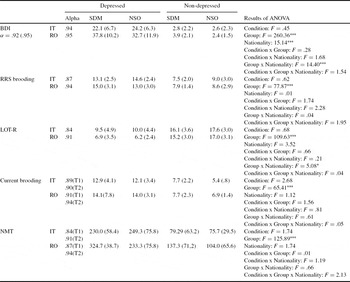
Separated 2 (Group: moderately depressed vs. non-depressed) x 2 (Condition: SDM vs. NSO) x 2 (Nationality: Italian vs. Romanian) Analyses of Variance (ANOVAs) were run to test whether there were differences in baseline psychological measures between groups, conditions and nationalities. Table 1 reports means and results of these ANOVAs. As expected, depressed participants reported significantly higher BDI and RRS-B and current brooding scores, lower LOT-R scores and a more depressed baseline mood, than non-depressed people. Romanian depressed participants reported significantly higher BDI scores than Italian depressed participants, indicating different severities of depressive symptoms that may be due to different recruitment settings (inpatients vs. outpatients). There were no significant differences in BDI, RRS-B, LOT-R, current brooding or baseline mood between the conditions in both depressed and non-depressed groups (See Table 1).
F values, means and standard deviations (in parentheses) for ANOVA baseline differences in BDI, RRS brooding, current brooding, LOT-R and NMT between Italian and Romanian non-depressed and depressed patients

Notes: IT = Italian, RO = Romanian; *p < .05, **p <.01, ***p < .001
In order to establish if there was an overall significant effect of attentional manipulation on change in NMT, a 2 Condition x 2 Group x 2 Nationality x 2 (Time: pre, post) repeated measures ANCOVA was conducted with RRS-B and LOT-R as covariates and NMT as the dependent variable.
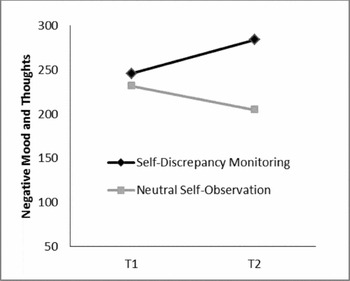
Contrary to our hypothesis, there was neither a significant Condition × Group × Nationality × Time interaction [F(1,79) = 1.62, p = .20], nor a significant effect from either RRS-B [F(1,79) = 1.74, p = .19] or LOT-R [F(1,79) = .23, p = .63]. Otherwise, the results showed that Condition x Time was the only significant interaction [F(1, 79) = 25.69, p < .001], suggesting an impact of the attentional manipulation task on mood that was independent of group and nationality memberships (See Figure 1). To further examine this interaction and to verify this suggestion, a Bonferroni pairwise comparison was conducted and indicated that SDM significantly increased negative mood (Mean Difference = 52.11, p < .001) while NSO slightly decreased negative mood (Mean Difference = 19.26, p = .06).
Ratings of Negative Mood and Thoughts (NMT) before (T1) and after (T2) attentional manipulation

Analysis of mediating role of change in current brooding
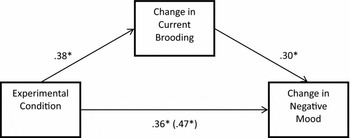
To investigate whether the effect of SDM could be accounted for by a change in levels of current brooding, we used a mediational approach to test the extent to which a proposed mediator carries the influence of an independent variable to a dependent variable. Statistical analyses were carried out using INDIRECT script version 4.1 for SPSS version 16.0 for Windows (Preacher and Hayes, Reference Preacher and Hayes2008). In our model, experimental condition was entered as independent variable, change in NMT was entered as dependent variable and change in current brooding was entered as mediator. The bootstrap test of indirect effects confirmed that change in current brooding mediated the effect of experimental condition on NMT change (see Figure 2). Sobel test was statistically significant (z = 2.45, p = .01) with indirect effect estimate (IE) = 16.91, 95% CI [16.67, 35.65]. The mediation was significant although the path from experimental condition to change in NMT remained significant when controlling for change in current brooding, suggesting a partial mediation relationship.
Change in current brooding partially mediates the effect of experimental condition on change in negative mood and thoughts. Notes: Parameter estimates are standardized coefficients. Value in parentheses is standardized coefficient of the direct effect of experimental condition with change in current brooding being entered in the model.*p<.001

Discussion
The aim of this study was to explore the impact of SDM on negative mood and thoughts in both depressed and non-depressed samples. Our findings showed that, after recalling a positive life event, SDM leads to a significant increase in depressed mood and negative thoughts over a short period. This increase is independent from clinical condition and nationality and is not purely dependent on (although it was partially mediated by) the concurrent change in levels of brooding. More specifically, these findings showed that, regardless of the pre-induction mood, forcing subjects into monitoring self-discrepancies worsens their mood. The fact that the level of participants’ depressive symptoms has no impact on the amount of change in negative mood following SDM induction suggests that focusing on what is missing can be a global trigger for negative mood, regardless of the mood state prior to the induction. Since the literature indicates the degree of severity of depressed symptoms is relevant for defining different degrees of self-discrepancy perception (Fairbrother and Moretti, Reference Fairbrother and Moretti1998), it is possible that our results reflect the importance of the time spent in monitoring self-discrepancy - which was the same in both clinical and control groups – rather than the importance of the degree of discrepancy perceived by the person.
Regarding the role of brooding in the relationship between SDM induction and mood worsening, our findings confirm the existing literature showing the partial mediation role of ruminative processes in the relationship between self-discrepancy and depressive symptoms (Roelofs et al., Reference Roelofs, Papageorgiou, Gerber, Huibers, Peeters and Arntz2007). It is possible that rumination plays an important role between an activation of SDM that leads to a small increase in negative mood and a tendency to go on thinking about the discrepancy that enhances this increase, leading the person to a sustained worsening of mood that lasts over time.
With regard to the consequences and clinical outcomes of SDM, we may only draw hypothetical impacts of this mode of processing on subjective emotional well-being and psychological impairment. First, discrepancy monitoring may have a direct effect so that starting from a positive stimulus SDM leads to a negative mood, independent of the influence of other dispositional attitudes. A frequent engagement in SDM may lead to a reduction of positive reinforcements in everyday life, and to an impairment in self-reinforcement skills. As a consequence, even positive stimuli (in the form of external events or internal positive bodily sensations or thoughts) could, more and more, become perceived as triggers for a lowering of mood. Second, discrepancy monitoring could have an indirect effect on mood, by representing a link between positive stimuli to the activation of negative cognitive styles such as negative biased interpretations, pessimistic forecasts and ruminative brooding (where present). Third, discrepancy monitoring may have an impact on the modification of dysfunctional beliefs, by hindering the degree of acceptance of alternative beliefs emerging from cognitive restructuring techniques, even when well-supported by realistic evidence or pragmatic arguments.
Limitations
The results of this study are clearly preliminary, and the study has several limitations that will have to be addressed in future research. First, the study relies solely on self-reported data that are subject to errors in measurement; moreover, the use of NMT in assessing the dependent variable has limitations because of its psychometric properties and its brevity. A further limitation is the lack of an independent check for the reliability of the SCID diagnosis. Moreover, the sampling strategy may have led to different levels of motivation and engagement in the research process. In particular, clinical samples may have been more willing to engage because of the perception of the usefulness of the process for their recovery. Once again, we have not inserted a mood check between the recall of a past experience and the induction task: it is possible that the mood lowering we have assessed after the SDM condition is partly due to the recall of a past memory, which could have impacted differently on clinical and control subjects, and biases in explicit memory favouring negative self-related information characteristic of depressed individuals (Mathews and MacLeod, Reference Mathews and MacLeod2005). Nevertheless, we have to some extent limited this possibility by randomizing depressed and non-depressed individuals between the two conditions. Finally, as regards the control condition, asking participants to focus on their bodily sensations and their concurrent feelings could have had an impact on their mood, encouraging introspection and possibly triggering rumination in people already disposed to ruminate. This is a limitation of the present study that should be addressed and avoided in future research, possibly by asking participants to focus on completely different topics, with the aim of provoking distraction and so avoiding self-reflection.
Future research should thoroughly investigate both the frequency of use of SDM among depressed and non-depressed individuals, and the reasons why people tend to engage in this kind of monitoring. Moreover, future research could extend the results to real-world situations (i.e. measuring self-discrepancy monitoring following actual positive events, including positive events that did not make participants feel satisfied). Finally, it is still unknown whether individual differences in self-discrepancy are representative of differential detection of signals of discrepancy, of differential maintenance of self-discrepancy monitoring, or both. Future research should further investigate which of these aspects can most influence mood worsening following SDM.
From a therapeutic perspective, the findings of the present study suggest that assessing self-discrepancy monitoring may be useful in identifying and socializing a potential maladaptive cognitive strategy that could impact on mood, even independently from the diagnosis of depression. With respect to interventions, strategies to address SDM may be beneficial for a reduction in negative emotion but also for enhancing the degree of acceptance of alternative beliefs emerging from cognitive restructuring techniques. More specifically, the first step could be to recognize the patient's tendency to monitor self-discrepancy, even of positive events, identifying it as a possible risk factor for mood worsening. In a second step, the therapist could investigate the reasons why the patient directs his/her attention this way, and call them into question with disputing techniques. Finally, the patient could learn how to develop flexible control over attentional monitoring and to interrupt SDM once it becomes activated, trying to re-focus attention on other aspects of the experience and the self.
We cannot state that self-discrepancy monitoring is typical of depression, nor that it is most frequently adopted by depressed individuals, even if it may be plausible to assume that. In this context, future research should investigate both the frequency of use of SDM in depressed and non-depressed individuals, and the motivations or beliefs that lead people to undertake it. If we are able to clarify the aim of engaging in SDM, as it is perceived by the patients, we will be able to call it into question and try to bring evidence of the maladaptive nature of discrepancy monitoring. As a consequence, patients would be able to learn how to manage the orientation of attention in a different way, and learn flexible control over it.
The findings of this study show the relevant impact of self-discrepancy monitoring in processing positive stimuli on both negative mood and thoughts. This impact appeared independent of the initial level of depressive symptoms trait ruminative brooding and pessimism. This suggests that self-discrepancy monitoring may be considered as a general trigger of emotional distress, and a possible risk factor for psychological suffering.
Acknowledgements
The research was completely self-funded.



Comments
No Comments have been published for this article.