Introduction
Depression and anxiety following myocardial infarction (MI) are related to poor cardiac prognosis (Strik et al. Reference Strik, Denollet, Lousberg and Honig2003; van Melle et al. Reference van Melle, de Jonge, Spijkerman, Tijssen, Ormel, van Veldhuisen, van den Brink and van den Berg2004). However, trials on the treatment of emotional distress in coronary patients have yielded mixed findings (Denollet & Brutsaert, Reference Denollet and Brutsaert2001; Glassman et al. Reference Glassman, O'Connor, Califf, Swedberg, Schwartz, Bigger, Krishnan, van Zyl, Swenson, Finkel, Landau, Shapiro, Pepine, Mardekian, Harrison, Barton and McIvor2002; Berkman et al. Reference Berkman, Blumenthal, Burg, Carney, Catellier, Cowan, Czajkowski, DeBusk, Hosking, Jaffe, Kaufmann, Mitchell, Norman, Powell, Raczynski and Schneiderman2003; Appels et al. Reference Appels, Bar, van der Pol, Erdman, Assman, Trijsburg, van Diest, van Dixhoorn and Mendes de Leon2005; van Melle et al. Reference van Melle, de Jonge, Honig, Schene, Kuyper, Crijns, Schins, Tulner, van den Berg and Ormel2007) and suggest the need for a more individually tailored approach to the treatment of various subtypes of post-MI depression (von Känel & Begré, Reference von Känel and Begré2006). According to Zerhouni (Reference Zerhouni2006), Director of the National Institutes of Health (NIH), an ‘individual difference’ approach to medicine is needed to precisely target treatment on a personalized basis. Hence, such an approach implies the identification of subtypes, and personality traits may play an important role in this context.
Type D or ‘Distressed’ personality refers to individuals with elevated levels of both negative affectivity (tendency to experience negative emotions) and social inhibition (tendency to inhibit self-expression in social interactions) (Denollet, Reference Denollet2005), and is associated with increased risk of cardiac events and poor quality of life (Denollet et al. Reference Denollet, Sys, Stroobant, Rombouts, Gillebert and Brutsaert1996, Reference Denollet, Vaes and Brutsaert2000, Reference Denollet, Pedersen, Vrints and Conraads2006a, Reference Denollet, Holmes, Vrints and Conraads2007; Pedersen et al. Reference Pedersen, Lemos, van Vooren, Liu, Daemen, Erdman, Smits, Serruys and van Domburg2004; Al-Ruzzeh et al. Reference Al-Ruzzeh, Athanasiou, Mangoush, Wray, Modine, George and Amrani2005). Some have speculated that depression and Type D have substantial phenomenological overlap (Lespérance & Frasure-Smith, Reference Lespérance and Frasure-Smith1996), but no study to date has examined the overlap of clinical depressive disorder and Type D personality in post-MI patients.
The present research is a predefined substudy of the Myocardial INfarction and Depression – Intervention Trial (MIND-IT) (van Melle et al. Reference van Melle, de Jonge, Kuyper, Honig, Schene, Crijns, van den Berg, van Veldhuisen and Ormel2006, Reference van Melle, de Jonge, Honig, Schene, Kuyper, Crijns, Schins, Tulner, van den Berg and Ormel2007). This trial allowed the investigation of depression and Type D personality in a large sample of Dutch post-MI patients using well-established methods to assess both constructs. Previous substudies from the MIND-IT trial showed that left ventricular dysfunction, a major clinical marker of disease severity, was associated with increased risk of depression (van Melle et al. Reference van Melle, de Jonge, Ormel, Crijns, van Veldhuisen, Honig, Schene and van den Berg2005, Reference van Melle, de Jonge, Kuyper, Honig, Schene, Crijns, van den Berg, van Veldhuisen and Ormel2006) but not with the diagnosis of Type D personality (de Jonge et al. Reference de Jonge, Denollet, van Melle, Kuyper, Honig, Schene and Ormel2007). However, these reports did not look at the overlap between post-MI depression and Type D personality, and the present substudy takes this issue further by investigating the clinical correlates of distinctly different depression/Type D subgroups. Given the possible bias of reverse causality (i.e. severe cardiac disorder may lead to depression and thereby may explain the relationship between depression and clinical events; see Nicholson et al. Reference Nicholson, Kuper and Hemingway2006), it is important to investigate whether depression/Type D subgroups are differently related to clinical cardiac correlates (Lane et al. Reference Lane, Carroll and Lip2003; Carney et al. Reference Carney, Freedland, Jaffe, Frasure-Smith, Lesperance, Sheps, Glassman, O'Connor, Blumenthal, Kaufmann and Czajkowski2004; van Melle et al. Reference van Melle, de Jonge, Ormel, Crijns, van Veldhuisen, Honig, Schene and van den Berg2005).
Therefore, this MIND-IT substudy focused on the relationship between depression and Type D personality. The purpose was (a) to examine whether depression and Type D personality refer to different forms of emotional distress, and (b) to explore the relationship between different subtypes of depression/Type D personality and clinical cardiac correlates.
Method
Subjects
The MIND-IT study has been described previously (van Melle et al. Reference van Melle, de Jonge, Honig, Schene, Kuyper, Crijns, Schins, Tulner, van den Berg and Ormel2007). Between September 1999 and November 2002, 2177 patients hospitalized for MI in 10 hospitals in The Netherlands were consecutively recruited for inclusion. This sample included first MI as well as recurrent MI patients. Limitations in funding meant that only patients who were enrolled before 1 February 2002 in nine of the 10 hospitals were included in the present substudy. Of these 1656 patients who were asked to complete the Type D assessment, 1267 returned the questionnaire; 62 of them had incomplete data on depression or Type D. Hence, this study included 1205 patients (78% men, aged 60.9±11.4 years) with complete depression and Type D assessment. The review boards of all participating hospitals approved the study protocol, and all patients gave written informed consent.
Depression and Type D
Patients were screened with the Beck Depression Inventory (BDI; Beck & Steer, Reference Beck and Steer1993) at 3, 6, 9 and 12 months post-MI; those with depressive symptoms as indicated by a score ⩾10 underwent the World Health Organization (WHO) Composite International Diagnostic Interview (CIDI) (WHO, 1990). Patients who met the ICD-10 criteria for major or minor depressive disorder on this psychiatric evaluation were diagnosed with depression. To allow natural recovery of depressive symptoms, the first interviews were performed at 3 months post-MI. The selection from high BDI score to CIDI interview also operated at each of the following assessment points (i.e. 6, 9 and 12 months post-MI). The depressed group included participants who were depressed at any one occasion during the first year post-MI. All patients completed the DS14 at 12 months post-MI to assess Type D personality (Denollet, Reference Denollet2005) in both (i) patients who were free of depression in the first year post-MI and (ii) depressed patients. The DS14 consists of seven negative affectivity items (e.g. ‘I often find myself worrying about something’) and seven social inhibition items (e.g. ‘I am a closed kind of person’) and is reliable (α=0.88/0.86) and stable over time. According to previously published cut-off scores (Denollet, Reference Denollet2005), MI patients were diagnosed as Type D if they scored ⩾10 on both the negative affectivity and social inhibition scales.
Clinical correlates
Echocardiographic or radionuclide measurements were used to categorize patients into four groups with left ventricular ejection fraction (LVEF) <30%, 30–45%, 45–60%, and >60%. Other indices of disease severity included heart failure, Killip class, Charlson index (Watkins et al. Reference Watkins, Schneiderman, Blumenthal, Sheps, Catellier, Taylor and Freedland2003) of co-morbid medical disorders (e.g. renal or pulmonary disease), and previous MI. These clinical correlates were assessed during hospitalization for the index MI. Baseline data also included treatment with coronary artery bypass surgery (CABG) or percutaneous coronary intervention (PCI) and the following cardiac risk factors: dyslipidaemia (taking lipid-lowering medication), hypertension (taking anti-hypertensive medication), diabetes, smoking, and body mass index (BMI) >30.
Statistical analyses
All patients were stratified by depressive disorder and Type D personality. Cross-tabulation was used to examine their overlap as well as differences in clinical correlates across depression/Type D subgroups; one-way analysis of variance (ANOVA) was used for continuous variables. A multivariable logistic regression analysis (enter model) was used to estimate the independent clinical correlates of Type D without depression versus depression without Type D.
Results
As the first purpose of this study was to examine the overlap of depressive disorder and Type D, we examined the convergence of these prognostic factors. During the 3- to 12-month follow-up period post-MI, 206 (17%) patients met the ICD-10 criteria for depressive disorder, and 224 (19%) had a Type D personality. Four out of five depressions (i.e. 168/206=82%) were early-onset depressions that were diagnosed at 3 months post-MI.
Different forms of distress
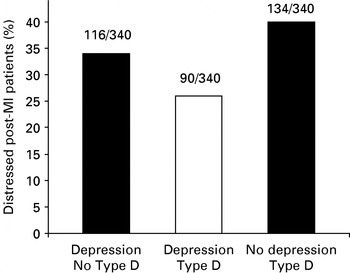
Based on the diagnosis of either depression or Type D, 340 (28%) MI patients displayed some form of psychological distress, but only 90 (7%) patients had both forms of distress (68 of them were diagnosed with depression at 3 months post-MI). Hence, one out of four distressed patients displayed both depression and Type D; 74% displayed one form of distress (clinical depression or Type D personality) but not the other (Fig. 1). This finding indicated that diagnosis of Type D was not a function of co-morbid depression, and that conceptualization of depressive disorder and Type D personality as two distinctly different categories of psychological distress in further analyses was warranted.
Percentage of distressed post-myocardial infarction (MI) patients (n=340), stratified by depressive disorder and Type D personality. Depression: patients who met ICD-10 criteria for major or minor depressive disorder as assessed by the Composite International Diagnostic Interview (CIDI). Type D: patients with a Type D personality as assessed by the DS14 scale.

Clinical correlates across distress subgroups
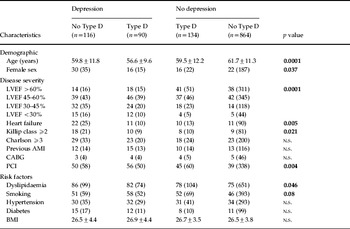
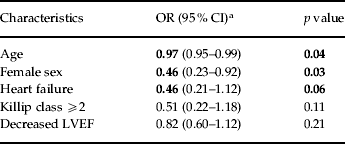
All MI patients were stratified by depression and Type D to one of four subgroups: depressed non-Type D (n=116), depressed Type D (n=90), non-depressed Type D (n=134), and non-distressed (n=864) patients (Table 1). Depression was related differently to disease severity as a function of Type D personality. Depressed non-Type D patients were more likely to have left ventricular dysfunction, heart failure, and a Killip class ⩾2 as compared to other patients. Bivariate comparisons of Type D and non-Type D patients within the group diagnosed with post-MI depression (n=206) showed that depressed patients with Type D were younger (56.6 v. 59.8 years, p=0.04), less likely to be female (16% v. 30%, p=0.03), and had a lower rate of heart failure (11% v. 22%, p=0.06) than depressed patients without Type D (Table 2). They also tended to have lower rates of Killip class ⩾2 [odds ratio (OR) 0.51] and left ventricular dysfunction (OR 0.82), but these differences were not statistically significant. Both subgroups did not differ on any of the other clinical correlates (p>0.30; data not shown). Importantly, depressed Type D patients had similar rates of heart failure (11%) and Killip class ⩾2 (10%) as compared to non-distressed patients (11% and 9% respectively), indicating that depression was not related to disease severity in Type D patients (Table 1). Depressed Type Ds were also younger and more likely to be treated with PCI and to be smokers than non-distressed patients.
Baseline characteristics stratified by depression/Type D groups (n=1204)

LVEF, Left ventricular ejection fraction; AMI, acute myocardial infarction; CABG, coronary artery bypass grafting; PCI, percutaneous coronary intervention; dyslipidaemia, taking lipid-lowering medication; hypertension, taking anti-hypertensive medication; BMI, body mass index; n.s., not significant (p>0.25).
Values are given as mean±standard deviation or % (n). p values ⩽0.09 are presented in bold.
Type D personality within the depressed post-MI group (n=206)

MI, Myocardial infarction; OR, odds ratio; CI, confidence interval; LVEF, left ventricular ejection fraction.
a Type D personality coded as 1. Age was entered as a continuous variable, all other characteristics as categorical variables.
p values ⩽0.09 are presented in bold.
Contrasting depression and Type D
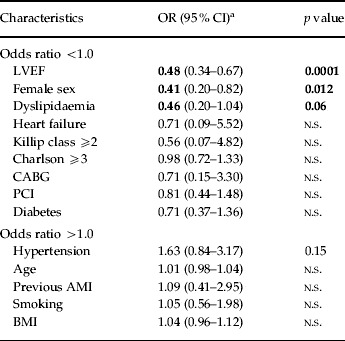
Contrasting subgroups with one form of distress but not the other indicated that Type D patients without depression were less likely to have an LVEF <45 (22% v. 47%), heart failure (10% v. 22%), Killip class ⩾2 (8% v. 18%), and to be female (16% v. 30%) than depressed patients without Type D. When contrasting these two subgroups in a multivariable logistic regression model, factors independently associated with depression were LVEF and sex; Type D patients without depression had significantly lower prevalence rates of left ventricular dysfunction (OR 0.48) and female sex (OR 0.41) as compared to depressed patients without Type D (Table 3). After adjustment for age and sex, Type D patients without depression were still significantly less likely to have left ventricular dysfunction [OR 0.47, 95% confidence interval (CI) 0.35–0.65, p<0.0001] than depressed patients without Type D. There was also a trend for less dyslipidaemia in Type D patients without depression (OR 0.53, 95% CI 0.27–1.06, p=0.07). Finally, LVEF was not significantly associated with continuous scores for the Type D personality traits negative affectivity (p=0.69) and social inhibition (p=0.97) (data not included in Table 3).
Correlates of ‘Type D without depression’ versus ‘depression without Type D’ groups (multivariable analysis)

OR, Odds ratio; CI, confidence interval; LVEF, left ventricular ejection fraction; CABG, coronary artery bypass grafting; PCI, percutaneous coronary intervention; AMI, acute myocardial infarction; dyslipidaemia, taking lipid-lowering medication; hypertension, taking anti-hypertensive medication; BMI, body mass index; n.s., not significant (p>0.25).
a Type D but no depression coded as 1. Age and BMI were entered as a continuous variables, all other characteristics as categorical variables.
p values⩽0.09 are presented in bold.
Discussion
Type D and depression as different forms of distress
This study is the first to focus on the relationship between depressive disorder and Type D personality and on the clinical correlates of distinctly different depression/Type D subgroups in post-MI patients. The present findings show that depressive disorder and Type D personality refer to two different forms of distress in these patients. During the 1-year follow-up period, 340 post-MI patients were diagnosed with depression or with Type D personality, but only one out of four of these patients had both diagnoses. The majority of distressed patients displayed one form of distress only, indicating that Type D cannot be inferred from the diagnosis of depression but rather should be assessed in its own right. Less than half of the depressed MI patients had a Type D personality, and 60% of Type D patients were free of depression in the first year post-MI. These findings confirm previous observations that depression and Type D personality are separate constructs within distressed post-MI patients (Schiffer et al. Reference Schiffer, Denollet, Widdershoven, Hendriks and Smith2007; Spindler et al. Reference Spindler, Pedersen, Serruys, Erdman and van Domburg2007; Whitehead et al. Reference Whitehead, Perkins-Porras, Strike, Magid and Steptoe2007; Denollet & Pedersen, Reference Denollet and Pedersen2008).
Some authors have speculated that depression and Type D personality have substantial phenomenological overlap, and that a well-known construct such as depression is more meaningful (Lespérance & Frasure-Smith, Reference Lespérance and Frasure-Smith1996). Although some overlap may exist between both constructs in terms of negative affect, they clearly differ in the inclusion of social inhibition (core characteristic of Type D but not of depression) and in their conceptualization as either a disorder (depression) or a personality trait. Previous research has already indicated that Type D personality predicts major cardiac events above and beyond concurrent symptoms of depression (Denollet et al. Reference Denollet, Sys, Stroobant, Rombouts, Gillebert and Brutsaert1996, Reference Denollet, Vaes and Brutsaert2000; Denollet & Pedersen, Reference Denollet and Pedersen2008).
Different clinical correlates
The present study provides new findings by showing that the subgroup of post-MI patients with the worst clinical baseline characteristics are those with depression but without Type D personality; that is, these patients were more likely to have left ventricular dysfunction, heart failure, and a Killip class ⩾2 as compared to other patients. Others have suggested that severe cardiac disorder may lead to depression and thereby may explain the relationship between depression and clinical events (Lane et al. Reference Lane, Carroll and Lip2003; Nicholson et al. Reference Nicholson, Kuper and Hemingway2006). Previous MIND-IT substudies also showed that left ventricular dysfunction was associated with increased risk of depression (van Melle et al. Reference van Melle, de Jonge, Ormel, Crijns, van Veldhuisen, Honig, Schene and van den Berg2005, Reference van Melle, de Jonge, Kuyper, Honig, Schene, Crijns, van den Berg, van Veldhuisen and Ormel2006) but this study is the first to look at the clinical correlates of depression/Type D subgroups. Type D personality seemed to moderate the relationship between depression and clinical cardiac correlates; that is, depression was associated with higher rates of heart failure and Killip class ⩾2 in non-Type D patients only, and was not related to disease severity in Type D patients.
Comparing ‘pure Type D’ and ‘pure depression’ subgroups indicates that Type D patients without depression had lower rates of left ventricular dysfunction than depressed patients without Type D, also when age and sex were controlled for. Type D patients without depression also tended to have lower rates of heart failure and Killip class ⩾2, which further emphasizes the differences between these two patient subgroups. In addition, patients with both depression and Type D were younger and more likely to be smokers than other patients. Hence, assessment of Type D provided important new information.
These findings indicate that investigation of different forms of psychological distress merits further study. Type D personality may play an important role in this context, including the identification of relevant subtypes of post-MI depression as a function of personality (de Jonge et al. Reference de Jonge, van den Brink, Spijkerman and Ormel2006). Among other things, delineation of discrete depression/Type D subgroups may be useful for developing more effective behavioural or pharmacological treatments tailored to these specific subtypes (von Känel & Begré, Reference von Känel and Begré2006; Zerhouni, Reference Zerhouni2006).
Different pathways
Recent evidence confirms that Type D personality may have distinct emotional, behavioural and prognostic correlates as compared to depression (Schiffer et al. Reference Schiffer, Denollet, Widdershoven, Hendriks and Smith2007, Reference Schiffer, Pedersen, Broers, Widdershoven and Denollet2008; Denollet & Pedersen, Reference Denollet and Pedersen2008). After adjustment for depression, Type D still predicted anxiety (Spindler et al. Reference Spindler, Pedersen, Serruys, Erdman and van Domburg2007; Schiffer et al. Reference Schiffer, Pedersen, Broers, Widdershoven and Denollet2008) and clinical events (Denollet & Pedersen, Reference Denollet and Pedersen2008) in cardiac patients, as well as cortisol dysregulation (Whitehead et al. Reference Whitehead, Perkins-Porras, Strike, Magid and Steptoe2007), which contributes to the increased immune activity in Type D patients (Conraads et al. Reference Conraads, Denollet, De Clerck, Stevens, Bridts and Vrints2006). These and other findings suggest that Type D personality may operate through distinctly different biological pathways as compared to established psychological factors such as hostility (Habra et al. Reference Habra, Linden, Anderson and Weinberg2003) and depression (Whitehead et al. Reference Whitehead, Perkins-Porras, Strike, Magid and Steptoe2007).
In terms of behavioural pathways, the Type D construct not only refers to negative emotions such as depression or anxiety but also emphasizes the potentially detrimental effect of social inhibition. Research shows that the addition of social inhibition to negative affectivity in the conceptualization of Type D significantly enhances the predictive value of emotional distress in cardiac patients (Denollet et al. Reference Denollet, Pedersen, Ong, Erdman, Serruys and van Domburg2006b). Another recent study found that Type D patients with heart failure were less likely to seek medical assistance in the case of elevated cardiac symptoms (Schiffer et al. Reference Schiffer, Denollet, Widdershoven, Hendriks and Smith2007). Paradoxically, these Type D patients did experience cardiac symptoms and were more worried about these symptoms as compared to non-Type D patients. This failure to consult for cardiac symptoms is a behavioural factor that may adversely affects cardiac prognosis in Type D patients.
Limitations and strengths
The limitations of this study are the small number of female patients and the fact that psychiatric assessment was limited to patients with significant self-reported depressive symptoms. Diagnoses of depression and Type D personality were made at different times, with Type D personality being diagnosed at 12 months and depression being diagnosed at 3, 6, 9 and 12 months post-MI. However, it is not likely that this had an effect on the lack of overlap between Type D and depression because Type D personality has been shown to be a stable taxonomy in post-MI patients over an 18-month period (Martens et al. Reference Martens, Kupper, Pedersen, Aquarius and Denollet2007) and 82% of depressions were early-onset depressions. Finally, it is possible that the relationship between depression and disease severity reflects an actual effect of depression on cardiac aetiology in patients with a history of recurrent depression throughout the lifespan. The strengths of this study were repeated measurement of self-reported depressive symptoms in the first year following MI, the use of the CIDI to diagnose depressive disorder, and the standard assessment of Type D personality in a large sample of post-MI patients.
Conclusions
This study highlights the importance of examining both depression and Type D personality in the psychological evaluation of post-MI patients. Previous research has shown that Type D personality predicts major cardiac events above and beyond concurrent symptoms of depression. The present findings indicate that depression and Type D personality are only partly overlapping, and also provide new information suggesting that these constructs have distinct cardiac correlates. Antidepressant treatment did not alter long-term post-MI depression status or improve cardiac prognosis (van Melle et al. Reference van Melle, de Jonge, Honig, Schene, Kuyper, Crijns, Schins, Tulner, van den Berg and Ormel2007).
Different subgroups may be involved in the relationship between depression and prognosis. It still is unclear whether this relationship is a reflection of cardiac disease severity, but our findings suggest that this is the case in non-Type D patients only, and not in Type D patients. We also observed that some Type D patients will cross the threshold for depressive disorder whereas many others display subclinical levels of distress. Type D personality is not part of today's standard research, but these findings suggest that a more accurate risk stratification may come from a model using both psychiatric and personality data. Therefore, we propose to include standard assessment of Type D personality in future clinical research and practice.
Acknowledgements
The present research was supported by a VICI grant (no. 453-04-004) from the Netherlands Organization for Scientific Research (The Hague, The Netherlands) to J. D., and by a grant from The Netherlands Heart Foundation (no. 97.016) to J. O. The MIND-IT received educational grants from Organon (Oss, The Netherlands) and Lundbeck (Amsterdam, The Netherlands).
Declaration of Interest
None.