



Introduction
Multisystem inflammatory syndrome in children is a newly defined syndrome associated with severe acute respiratory syndrome coronavirus 2. Reference Santos, Gonçalves and Silva1 Cardiac involvement has been reported in 67–80% of children with multisystem inflammatory syndrome. Reference Santos, Gonçalves and Silva1 Echocardiographic evaluations have demonstrated decreased cardiac function and localised contraction defects in more than a third of these children and mild to moderate valve insufficiencies in approximately 29%. Reference Karimi, Ghafouri, Alilou, Rezaei, Ashraf Talesh and Ashraf2 These findings are followed by coronary artery involvement and pericardial involvement at rates of up to 25 and 20%, respectively. Reference Karimi, Ghafouri, Alilou, Rezaei, Ashraf Talesh and Ashraf2 Cardiac involvement is the main reason for intensive care unit admissions in multisystem inflammatory syndrome. In case series, a 1–2% mortality rate and cardiovascular sequelae including aneurysms or decreased cardiac function at rates of up to 15% have been described. Reference Karimi, Ghafouri, Alilou, Rezaei, Ashraf Talesh and Ashraf2,Reference Yasuhara, Masuda and Watanabe3
Pentraxin-3 is an acute phase protein released from vascular endothelial cells in response to inflammatory signals. High plasma Pentraxin-3 concentrations have been associated with disease severity and mortality in conditions such as sepsis and infections. Reference Mantovani, Garlanda, Doni and Bottazzi4,Reference Lee, Gong and Chau5 Pentraxin-3 plays a role in vascular inflammation and endothelial dysfunction via different mechanisms. It may be indirectly involved in tissue repair and remodelling by regulating inflammation. Reference Mantovani, Garlanda, Doni and Bottazzi4,Reference Zlibut, Bocsan and Agoston-Coldea6 Increased Pentraxin-3 plasma levels have been observed in different cardiovascular diseases. Reference Fornai, Carrizzo and Forte7–Reference Ristagno, Fumagalli and Bottazzi9
In patients with severe acute respiratory syndrome coronavirus 2 infection, Pentraxin-3 was reported to be reliable in predicting short-term mortality and a better prognostic indicator than other markers such as C-reactive protein and interleukin 6. Reference Laing, Lorenc and Del Molino Del Barrio10,Reference Brunetta, Folci and Bottazzi11 High Pentraxin-3 levels in people with severe acute respiratory syndrome coronavirus 2 infection are believed to indicate uncontrolled inflammation. Reference Risitano, Mastellos and Huber-Lang12 However, only one small study has investigated Pentraxin-3 levels in multisystem inflammatory syndrome, a hyperinflammatory syndrome associated with severe acute respiratory syndrome coronavirus 2. Reference Syrimi, Fennell and Richter13 In this study, Pentraxin-3 levels were found to be higher in multisystem inflammatory syndrome patients, but no relationship was reported between Pentraxin-3 levels and disease severity. Reference Syrimi, Fennell and Richter13
The clinical and laboratory findings of multisystem inflammatory syndrome overlap with those of other febrile diseases, and the underlying cause of its cardiac involvement is not fully understood. In inflammatory diseases such as multisystem inflammatory syndrome, predicting cardiac involvement and disease severity at the time of diagnosis is important in disease management. In this study, we aimed to investigate the role of Pentraxin-3 in identifying cardiac involvement and evaluating disease severity in patients with multisystem inflammatory syndrome.
Materials and methods
This prospective study included children with multisystem inflammatory syndrome who were hospitalised and treated in the paediatric cardiology ward of Pamukkale University Faculty of Medicine Hospital. Multisystem inflammatory syndrome was diagnosed according to the criteria defined by the United States Centers for Disease Control and Prevention and the World Health Organization in 2020 14,15 . The control group consisted of children of similar age and sex distribution who presented to the paediatric cardiology outpatient clinic due to chest pain, palpitations, or murmur and had normal echocardiography results. Patients who were referred to our hospital after diagnosis and initiation of treatment in other centres were excluded from the study. In the control group, subjects with a history of infectious disease or drug use in the last 15 days or with chronic systemic disease were excluded. This study was performed in line with the principles of the Declaration of Helsinki. Approval was granted by the Ethics Committee of Pamukkale University (02.22.2022/04).
Blood samples for measurement of Pentraxin-3 levels were obtained from the multisystem inflammatory syndrome patients before treatment and from the healthy controls. A 10-cc sample of venous blood was collected in a biochemistry tube and left at room temperature for approximately 15 minutes, then centrifuged at 3500 r.p.m. for 10 minutes. The resulting serum was stored at −80°C until analysis. Pentraxin-3 was quantified using commercial human Pentraxin-3 kits from BioAssay Technology Laboratory (Shanghai, China). The absorbance values of the wells were read at 450 nm using a BioTek Elx800 Microplate reader (BioTek Instruments Inc., USA). The kit is based on the sandwich immunoassay method and has a sensitivity of 0.05 ng/mL and range of 0.1–30 ng/mL.
The patients’ demographic characteristics, physical examination and laboratory findings, treatment received, and length of hospital stay were recorded. All patients underwent electrocardiography and echocardiographic evaluation using 2.5–3.5 MHz and 2.7–8 MHz probes with a GE Vivid S5 echocardiography device. Left ventricular systolic dysfunction was defined as an ejection fraction being below 55% Reference Santos, Gonçalves and Silva1–Reference Yasuhara, Masuda and Watanabe3 . On echocardiographic evaluation, the presence of left ventricular dysfunction, valve insufficiency, coronary artery lesion, or pericardial effusion was accepted as cardiac involvement. The patients were divided into those with and without cardiac involvement and the two groups were compared.
Multisystem inflammatory syndrome severity was classified depending on the extent of respiratory or hemodynamic support and organ damage. Patients with no or very little respiratory or cardiovascular support and minimal organ damage [Pediatric Logistic Organ Dysfunction-2 score ≤ 2] were classified as having mild multisystem inflammatory syndrome. Those with no or very little respiratory or cardiovascular support and mild organ damage (Pediatric Logistic Organ Dysfunction-2 score 3 ≤ ) were classified as having moderate multisystem inflammatory syndrome. Reference Leteurtre, Duhamel, Salleron, Grandbastien, Lacroix and Leclerc16 Patients who needed any respiratory, vasoactive, or inotropic support and those who had severe organ damage and required intensive care were classified as having severe multisystem inflammatory syndrome. Reference Akkoyun, Most and Katragadda17 For comparison according to disease severity, the patients were grouped as mild-moderate multisystem inflammatory syndrome and severe multisystem inflammatory syndrome.
Statistical analysis of the data was performed using the Statistical Package for the Social Sciences (version 18 for Windows, SPSS Inc., Chicago, IL, USA). Continuous data were tested for normal distribution using the Kolmogorov–Smirnov test. Student’s t-test was used for comparisons of normally distributed data and the Mann–Whitney U-test for nonnormally distributed data. Categorical data were compared using chi-square and Fisher’s exact test. Receiver operating characteristic curve analysis was used to determine the threshold value for Pentraxin-3. The results were presented as number and percentage for categorical variables; mean, standard deviation, minimum, and maximum for continuous variables showing a normal distribution; and median and interquartile range for continuous variables showing a non-normal distribution. Logistic regression model was used to compare the effect of disease severity and cardiac involvement on Pentraxin-3 level. Statistical significance was accepted at p < 0.05.
Results
The study included 56 multisystem inflammatory syndrome patients (68%) and 26 healthy children (32%). There was no difference between the study and control groups in terms of age, sex, weight, or height (p > 0.05) (Table 1). The multisystem inflammatory syndrome patients had significantly lower mean haemoglobin level and platelet count (p = 0.001) and higher mean leukocyte count (p = 0.02). Mean C-reactive protein, erythrocyte sedimentation rate, and troponin levels were also significantly higher in the multisystem inflammatory syndrome group than the control group (p = 0.0001). The mean Pentraxin-3 level was 7.1 ± 5 (2.8–24.9) ng/mL in the multisystem inflammatory syndrome group, compared to 2.9 ± 2.1 (0.1–6.6) ng/mL in the control group (p = 0.001) (Table 1).
Demographic and laboratory findings of the patient and control groups

Data presented as n, mean ± standard deviation (minimum-maximum), or median (interquartile range). M = Male, F = female, ESR = erythrocyte sedimentation rate, NLR = neutrophil-to-lymphocyte ratio, AST = aspartame transaminase, ALT = alanine transaminase, LDH = lactate dehydrogenase, IL-6 = interleukin 6, BNP = B-type natriuretic peptide.
Multisystem inflammatory syndrome patients most commonly had gastrointestinal involvement (n = 51, 91.1%), followed by haematological (n = 47, 83.9%) and dermatological involvement (n = 42, 75%). Cardiac involvement was detected in 34 patients (60.7%), neurological involvement in 20 patients (35.7%), pulmonary involvement in 10 patients (17.9%), and renal involvement in 6 patients (10.7%).
When the multisystem inflammatory syndrome patients were grouped into those with and without cardiac involvement, no differences in age, sex, weight, or height were observed (p > 0.05). Of the hemogram parameters, leukocyte count, and haemoglobin levels were similar in both groups (p > 0.05), while patients with cardiac involvement had significant higher neutrophil-to-lymphocyte ratio (p = 0.032) and lower lymphocyte and platelet counts (p = 0.003 and p = 0.042, respectively). In terms of acute phase reactants, there was no significant difference between the groups in terms of C-reactive protein, erythrocyte sedimentation rate, IL-6, and ferritin levels (p > 0.05), whereas procalcitonin levels were significantly higher in the group with cardiac involvement (p = 0.006). Troponin and B-type natriuretic peptide (BNP) levels were also significantly higher in patients with cardiac involvement (p = 0.0001 and p = 0.003, respectively) (Table 2). The median Pentraxin-3 level was 5.8 (4.5–11.3) ng/mL in multisystem inflammatory syndrome patients with cardiac involvement and 4.1 (3.6–5.6) ng/mL in those without (p = 0.004). The area under the receiver operating characteristic curve for Pentraxin-3 level in the prediction of cardiac involvement was calculated as 0.668 (p = 0.039; 95% CI: 0.516–0.820). At a cut-off of 4.9 ng/mL, Pentraxin-3 had 63.6% sensitivity and 61.9% specificity for cardiac involvement in multisystem inflammatory syndrome. The demographic and laboratory findings of multisystem inflammatory syndrome patients with and without cardiac involvement are presented in Table 2.
Demographic and laboratory findings of MISC patients with and without cardiac involvement and severe and mild-moderate
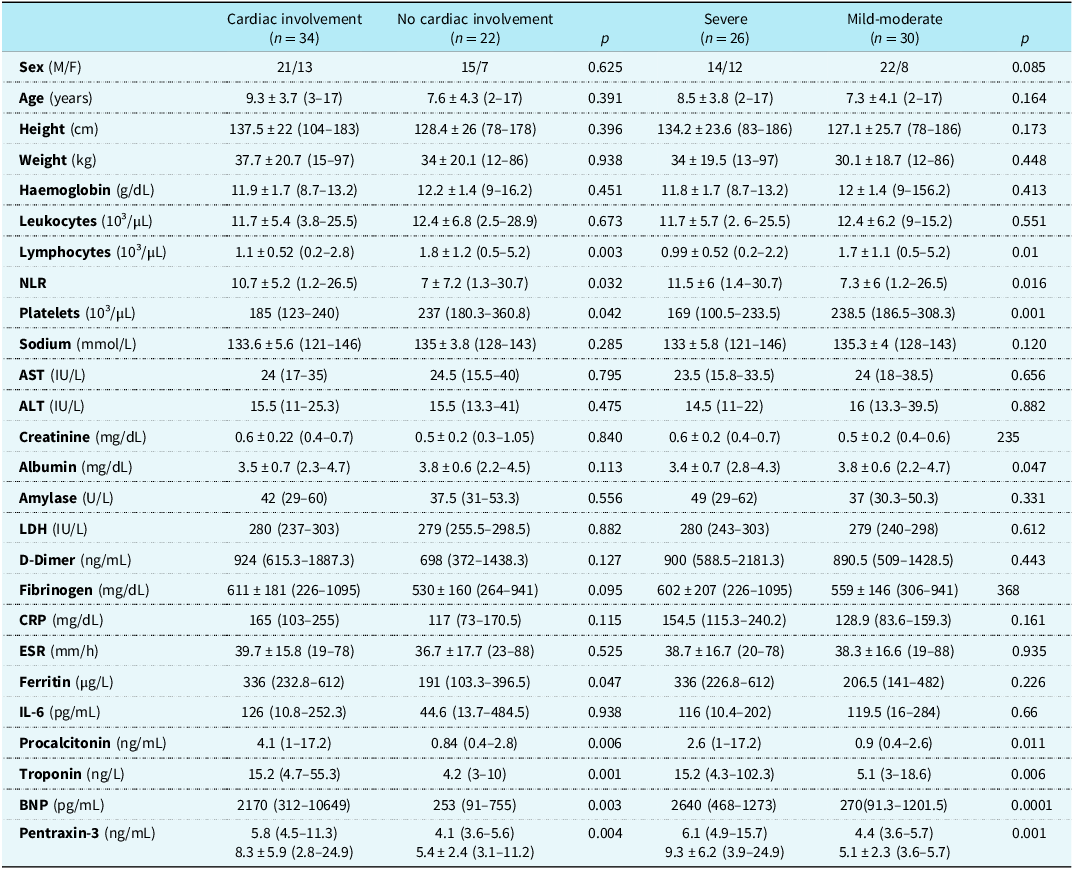
Data presented as n, mean ± standard deviation (minimum-maximum), or median (interquartile range). M = Male, F = female, ESR = erythrocyte sedimentation rate, NLR = neutrophil-to-lymphocyte ratio, AST = aspartame transaminase, ALT = alanine transaminase, LDH = lactate dehydrogenase, IL-6 = interleukin 6, BNP = B-type natriuretic peptide.
The mean left ventricular ejection fraction of the 34 patients with cardiac involvement was 57.8 ± 6.6% (40–69%). Eighteen patients (53%) had left ventricular systolic dysfunction, 15 (44%) had mitral valve regurgitation, 15 (44%) had pericardial effusion, and 3 patients (8.8%) had coronary artery aneurysm (Z-score: 2.7–4.3). Median Pentraxin-3 levels were 6.1 (4.9–17) ng/mL among patients with left ventricular systolic dysfunction and 4.6 (3.8–6.2) ng/mL in those without (p = 0.003). Patients with mitral valve insufficiency also had a significantly higher median Pentraxin-3 level than those without (6.2 [4.8–17.5] ng/ml vs. 4.6 [3.9–6.2] ng/mL, p = 0.011). Median Pentraxin-3 levels in patients with and without pericardial effusion were 4.8 (4.3–17.5) ng/mL and 5 (4.1–7) ng/mL, respectively, while those in patients with and without coronary artery aneurysm were 5.4 (4.3–7.3) ng/mL and 4.9 (4.0–7) ng/mL, respectively. There was no significant difference in Pentraxin-3 level between these groups (p = 0.643 and p = 0.748, respectively).
The multisystem inflammatory syndrome patients’ mean length of hospital stay was 10.8 days (range: 5–30 days). The 26 patients (46.4%) who had severe clinical findings and required inotropic support were followed up in the intensive care unit for an average of 4.1 days (range, 2–10 days). None of the patients needed extracorporeal membrane oxygenation and there was no mortality.
When patients with severe multisystem inflammatory syndrome were compared according to disease severity, there were 26 patients (46.4%) in the severe group and 30 patients (53.4%) in the mild-moderate group. There was no difference between these groups in terms of age, sex, weight, or height (p > 0.05) (Table 2). Patients in the severe multisystem inflammatory syndrome group had a significantly higher NLR and significantly lower lymphocyte and platelet counts (p = 0.01, p = 0.016, and p = 0.001, respectively). There was no significant difference between the groups in terms of leukocyte or haemoglobin levels (p > 0.05). Procalcitonin levels were significantly higher in the severe multisystem inflammatory syndrome group (p = 0.011) but there were no differences in C-reactive protein, erythrocyte sedimentation rate, interleukin-6, or ferritin levels between the groups (p > 0.05). Both troponin and BNP levels were significantly higher in the severe multisystem inflammatory syndrome group compared to the mild-moderate group (p = 0.006 and p = 0.0001, respectively). The median Pentraxin-3 level was 6.1 (4.9–15.7) ng/mL in the severe group and 4.4 (3.6–5.7) ng/mL in the mild-moderate group (p = 0.001). The receiver operating characteristic area under the curve for Pentraxin-3 level in the prediction of multisystem inflammatory syndrome severity was calculated as 0.786 (p < 0.001; 95% CI: 0.666–0.907). At a cutoff value of 5.1 ng/mL, Pentraxin-3 had 73.1% sensitivity and 71.4% specificity for clinically severe multisystem inflammatory syndrome. The demographic and laboratory findings of the groups according to multisystem inflammatory syndrome severity are given in Table 2.
Logistic regression model was used to compare the effect of disease severity and cardiac involvement on Pentraxin-3 level. The Pentraxin-3 value above 4.95 had a 12.0-fold effect on patients in the severe group (OR:12.033) (p < 0.001) and a 7.6-fold effect on patients with cardiac involvement (OR:7.600) (p < 0.001).
Pentraxin-3 was negatively correlated with left ventricular ejection fraction (r = −0.430, p = 0.0001), platelet count (r = −0.331, p = 0.003), and lymphocyte count (r = −0.271, p = 0.048) and positively correlated with BNP (r = 0.515, p = 0.0001), troponin (r = 0.274, p = 0.027), C-reactive protein (r = 0.491, p = 0.0001), and procalcitonin (r = 0.477, p = 0.0001) (Figures 1 – 2).
Negative correlation between serum PTX-3 level and left ventricular ejection and positive correlation between serum PTX-3 level and BNP and troponin.

Negative correlation between serum PTX-3 level and platelet count and lymphocyte count and positive correlation between serum PTX-3 level and CRP and procalcitonin.

Discussion
Multisystem inflammatory syndrome is a relatively new but serious clinical entity, and cardiac involvement is a major cause of intensive care admissions in these patients. Reference Santos, Gonçalves and Silva1–Reference Yasuhara, Masuda and Watanabe3 However, there is still no specific biomarker that can predict cardiac involvement or prognosis in multisystem inflammatory syndrome.
Pentraxin-3 is a new acute phase reactant that is still being investigated in terms of its role in the inflammatory process. Reference Mantovani, Garlanda, Doni and Bottazzi4 It has been reported to be a strong prognostic indicator of mortality in adult COVID-19 patients. Previously found to be a prognostic marker in intensive care patients with sepsis, Pentraxin-3 was also reported to be positively associated with adult COVID-19 mortality. Reference Brunetta, Folci and Bottazzi11,Reference Gutmann, Takov and Burnap18 The strong prognostic significance of Pentraxin-3 in COVID-19 may reflect its position at the intersection between macrophage-induced inflammation and vascular involvement. Reference Laing, Lorenc and Del Molino Del Barrio10,Reference Brunetta, Folci and Bottazzi11,Reference Gutmann, Takov and Burnap18 A significant correlation has been demonstrated between Pentraxin-3 and troponin, a marker of myocardial disease, in COVID-19 patients. Reference Brunetta, Folci and Bottazzi11 The literature includes only one small study evaluating Pentraxin-3 levels in multisystem inflammatory syndrome patients. Reference Syrimi, Fennell and Richter13 Syrimi et al. compared eight multisystem inflammatory syndrome patients and seven healthy controls and found that Pentraxin-3 levels were higher in the multisystem inflammatory syndrome patients, but no relationship was reported between Pentraxin-3 and disease severity. Reference Syrimi, Fennell and Richter13 In our study, we found that serum Pentraxin-3 levels were significantly higher in patients who had cardiac involvement and those who had severe multisystem inflammatory syndrome requiring intensive care. We found that, Pentraxin-3 had a sensitivity of 63.6% and specificity of 61.9% at a cut-off of 4.95 ng/mL for cardiac involvement, Pentraxin-3 for severe multisystem inflammatory syndrome had sensitivity 73.1% and specificity 71.4% at a cut-off of 5.15 ng/mL. In addition, we determined that Pentraxin-3 was positively correlated with troponin and proBNP levels. Pentraxin-3 has a regulatory role in inflammation by altering selectin-dependent neutrophil uptake and regulating the complement cascade. Reference Brunetta, Folci and Bottazzi11,Reference Risitano, Mastellos and Huber-Lang12,Reference Deban, Russo and Sironi19,Reference Deban, Jarva and Lehtinen20 The high Pentraxin-3 levels found in our study may reflect uncontrolled inflammation.
Elevated Pentraxin-3 levels have been reported in cardiovascular diseases. Reference Fornai, Carrizzo and Forte7–Reference Ristagno, Fumagalli and Bottazzi9,Reference Latini, Maggioni and Peri21–Reference Naito, Tsujino and Akahori23 Pentraxin-3 is produced by phagocytes, neutrophils, fibroblasts, and endothelial cells in the first stage of the inflammatory process. It coordinates the functions of macrophages and dendritic cells and promotes apoptosis/necrosis. It also plays a role in vascular repair and remodelling. In addition to the regulation of inflammation, Pentraxin-3 contributes to the formation of extracellular matrix, which promotes fibrocyte differentiation. It is through these effects that Pentraxin-3 is believed to participate in the regulation of cardiovascular damage and the inflammatory response. Reference Fornai, Carrizzo and Forte7,Reference Ristagno, Fumagalli and Bottazzi9,Reference Polat, Yildiz, Alan and Toprak22,Reference Naito, Tsujino and Akahori23 Pentraxin-3 expression by both macrophages and endothelial cells was shown to increase in acute myocardial infarction and myocarditis. Reference Nebuloni, Pasqualini and Zerbi24 Gürses et al. showed that serum Pentraxin-3 levels increased significantly in patients with acute rheumatic fever and carditis compared to the control group. Reference Gürses, Oğuz, Yilmaz, Aybek and Akpinar8 In our study, Pentraxin-3 levels were significantly increased in patients with cardiac involvement compared to those without cardiac involvement. This supports the association between Pentraxin-3 and cardiovascular disease.
Left ventricular dysfunction and mitral valve involvement are frequently echocardiographic findings in multisystem inflammatory syndrome patients. Reference Karimi, Ghafouri, Alilou, Rezaei, Ashraf Talesh and Ashraf2,Reference Yasuhara, Masuda and Watanabe3 Similarly, our patients most commonly had left ventricular systolic dysfunction, followed by mitral valve regurgitation. In our study, we found that Pentraxin-3 levels were higher both in patients with left ventricular dysfunction and those with any degree of mitral valve insufficiency compared to those without. There are no studies in the literature evaluating echocardiographic data together with serum Pentraxin-3 level in multisystem inflammatory syndrome patients. In an animal study, Pentraxin-3 overexpression was shown to increase left ventricular dysfunction and myocardial fibrosis. Reference Suzuki, Shishido and Funayama25 Studies in adults have indicated that Pentraxin-3 is independently and significantly associated with the severity of heart failure. In addition, Pentraxin-3 levels were found to be higher in individuals with ventricular dysfunction. Reference Matsubara, Sugiyama and Nozaki26,Reference Latini, Gullestad and Masson27
Multisystem inflammatory syndrome and Kawasaki disease have overlapping clinical and laboratory findings. In both diseases, immune system activation plays a role in the pathogenesis and anti-inflammatory drugs are used in treatment. Reference Santos, Gonçalves and Silva1,Reference Yasuhara, Masuda and Watanabe3,Reference Ching, Nerurkar, Lim, Shohet, Melish and Bratincsak28,Reference Kitoh, Ohara and Muto29 Pentraxin-3 has been associated with vascular dysfunction in Kawasaki disease . In two different studies evaluating Pentraxin-3 levels in Kawasaki disease patients, Pentraxin-3 was found to be significantly elevated in Kawasaki disease patients with coronary artery lesions compared to those with normal coronary arteries. In addition, Pentraxin-3 levels were found to be significantly higher in patients with resistant to intravenous immunoglobulin therapy. Reference Ching, Nerurkar, Lim, Shohet, Melish and Bratincsak28,Reference Kitoh, Ohara and Muto29 In the present study, we observed no relationship between coronary involvement and Pentraxin-3. This may be due to the small number of patients with coronary aneurysms and differences in the pathogenesis of Kawasaki disease and multisystem inflammatory syndrome. While the immune response in Kawasaki disease mostly causes mild or moderate vascular damage, the immune response in multisystem inflammatory syndrome more often causes multisystem organ damage to the heart, lungs, gastrointestinal tract, and other critical tissues. Endothelial dysfunction has been reported to occur in multisystem inflammatory syndrome patients, but the extent of this dysfunction is limited. Reference Wang and Li30 To gain a better understanding of this situation, there is a need for further studies that include larger patient series and evaluate echocardiographic data together with serum Pentraxin-3 levels.
This study has limitations that should be acknowledged. Firstl, our study included a small sample size. Secondly, other ventricular function measurements have not examined in the absence of global systolic dysfunction in multisystem inflammatory syndrome patients.
In conclusion, elevated Pentraxin-3 levels in multisystem inflammatory syndrome patients may help predict multisystem inflammatory syndrome in children disease severity and cardiac involvement.
Financial support
This work was supported by Pamukkale University Research Fund (Grant number: 2022HZDP015)
The authors have no relevant financial or non-financial interests to disclose.
Declaration
This study was performed in line with the principles of the Declaration of Helsinki.
Ethical standard
Approval was granted by the Ethics Committee of Pamukkale University (02.22.2022/04).



