

Recent studies of pawnship, panyarring, and other institutions related to slavery and the slave trade and the functioning of the societies of Atlantic Africa from the seventeenth to the early nineteenth century prompt a review of debt bondage and the connection of indebtedness to slavery. Pawnship was clearly important in the interface between coastal ports and other embarkation points on the Atlantic coast of Africa with the ships from Europe and the Americas that brought different economies and legal perceptions into contact. The possibilities of violation of accepted practices relating to pawnship resulted in continuous negotiations and problems of compliance. By the late seventeenth century, at least, a coastal system of exchange involving European, trans-Atlantic, and local interaction had developed that was based on personal relationships and travel within the Atlantic world. Many merchants on the African coast sent their children to Europe, and for various reasons, including redemption of kin, some merchants from the African coast had also been to one or more places in the Americas. The operation of commercial relations was Atlantic wide, and pawnship was an integral part of the ongoing process of interaction and negotiation.
While it is widely recognized that slavery was ubiquitous in many African societies at the height of the trans-Atlantic slave trade, it is not as well known that pawnship was, too. Pawning was common in the Bight of Benin from at least the beginning of the seventeenth century and was also found on the Gold Coast in the seventeenth and eighteenth centuries.Footnote 1 It was known along the Gambia River and elsewhere on the upper Guinea coast, as well as at Calabar and among the Duala, and at Bimbia in the Bight of Biafra in the eighteenth century.Footnote 2 In none of these cases were pawns an important source of slaves, although Joseph C. Miller has argued that pawnship, that is, ‘commercial hostage taking’, was closely associated with the operation of the slave trade.
Europeans advanced goods on explicit credit terms to big African brokers who kept no slaves near the beach but who borrowed the imports and took them to the interior to acquire captives from other owners left to hold them in readiness there. Foreign loans of this sort often required the African borrower to put up formal collateral in the person of a hostage, usually a kinsperson, left with his European creditor.Footnote 3
Miller suggests that a system of ‘trust’ developed on the coast of west Central Africa, from Loango in the north to Luanda and areas further south, in which European merchants advanced goods on credit, provided ‘gifts’, paid various fees, and otherwise underwrote the trade. For Miller, pawning amounted to ‘European financing of the Africans’ engagements with the Atlantic’, although there is some question as to whether or not pawning was found in Portuguese Angola, despite Miller's claims.Footnote 4 Pawning certainly facilitated the transfer of goods from European ships to African suppliers, at least at many places in Atlantic Africa, if not Angola.
In reassessing the history of pawnship, this article addresses the following questions: (1) What was the relationship of pawnship to the functioning of local economies in Atlantic Africa? (2) Although the status of pawn could not normally be altered to that of slave, in what circumstances might pawnship and slavery have been blurred? (3) Where pawnship was practiced at ports of embarkation for slaves and trade with the trans-Atlantic world, what mechanisms protected pawns and thereby limited their sale into slavery in the Americas? A reconsideration of pawnship in the context of the trans-Atlantic slave trade extends J. L. Guyer's discussion of money, values, and social payments in Africa.Footnote 5 Although Guyer does not discuss pawnship, the holding of pawns seems always to have been linked to financial liquidity involving money and required social payments that had value and were carefully calculated. As many studies have demonstrated, pawnship lasted well into the colonial era, during which period the institution came under increasing criticism and was often considered another form of slavery.Footnote 6 The focus here is on the period from late seventeenth century to the early nineteenth century when the distinction between slavery and pawnship was usually very clear.
CREDIT VERSUS LIQUIDITY: PAWNING AS SECURITY ON LOANS
Pawnship can be considered, according to Toyin Falola and Lovejoy, ‘a legal category of social and economic dependency in which a person was held as collateral for a loan’.Footnote 7 Pawnship was different from an indenture and other forms of debt bondage. An indenture involved paying off a debt in a specified period of time, labor constituting the form of payment. E. Adeniyi Oroge had earlier referred to pawning as ‘indenture’, but this is a questionable equivalence.Footnote 8 Pawnship arrangements could very easily blur into patron/client forms of relationships. Debt certainly underpinned pawning, and when people were physically removed from their homes and transferred to the location of the creditor they were being held as pawns. Pawnship differed from indenture in that the labor performed by the pawn did not contribute to the payment of the debt, which had to be paid in its entirety before the pawn was released. Indenture was a form of debt bondage but it was not pawnship.
Pawnship arises from the concept in which something, or in this case, someone, is held as collateral for a debt. The pawnshop is a place where an individual can receive a loan against valuable objects, such as jewelry, but with the possibility that the pawned object can be sold after a specified period of time if the loan is not repaid. The use of human beings for this purpose has been contested and subsequently declared illegal, following the League of Nations enquiries in the 1920s.Footnote 9 Yet historically, at least in some parts of Africa, pawnship provided an institutional means of securing credit and thereby supporting economic relationships that assured the marshalling of scarce resources. Pawnship was a mechanism to prevent the arbitrary seizure of assets, and particularly people who were perceived to be under obligation for financial and political debts and who might otherwise be sold or otherwise exploited as slaves in lieu of failure to settle real or even falsely claimed debts. Arbitrary retribution, often directed at those associated with individuals held responsible for the debt, as well as the parties who were held responsible, could be violent and indeed result in death, injury, destruction of property, and most importantly here, enslavement. Pawnship was intended to prevent such violence.
How pawnship functioned and where it was important have been elusive to historical analysis, however. The term for pawn is similar in some languages along the Western African coast: in Akan, awowa,Footnote 10 in Yoruba, iwofa, and in Edo (Benin), iyoha, but in Fon, gbanu. Footnote 11 The linguistic similarity suggests that the concept of pawning was common along the western African coast, at least for the area from modern Ghana through south-Western Nigeria, in the context of commercial expansion, perhaps in association with the rise of the trans-Atlantic trade, but more likely the practice had developed as an institution of credit and exchange earlier.
In the terminology of Western Africa, at least, arbitrary action to enforce debt repayment or impose retribution was sometimes referred to as panyarring, a term that is considered to have been Portuguese in origin to describe practices on the African coast that involved collective action, seizure of people and property, and usually were violent.Footnote 12 Jan Vansina has suggested that the term possibly derived from Portuguese penhora, that is, ‘pawning’, but more likely comes from apanhar, ‘to grab’.Footnote 13 Panyarring was the extreme form of retribution and method of enforcing debt repayment. Panyarring tested the limits of tolerance in situations of indebtedness. Hence being in debt and prolonging repayment had the danger of enslavement through panyarring, which was not only the arbitrary enforcement of a claim but the collective enforcement and the deliberate use of excessive violence. Whereas pawnship identified a specific individual as the representative of the debt, panyarring was a coordinated action that was directed at a family, kin group, or community, which was held collectively responsible for the debt, crime, or violation. Panyarring has sometimes been confused with kidnapping, which can be defined as arbitrary seizure of individuals for purpose of ransom or sale into slavery for profit, but for which there is neither justification for seizure nor economic debt. However, it is clear that pawning precluded panyarring. Moreover, Europeans could be in pawn as well, as is clear on the Gold Coast where ship captains at the end of the seventeenth century, at least, sometimes provided pawns to local merchants as collateral. With reference to trade at ‘Alamp’, that is Adangme, the coast east of Accra, Charles Towgood noted on 19 March 1682, ‘This morning I sent one whiteman ashoare to stay till I sailed, for they sent off word they would not bring off one slave before I sent one, for fear of being panyard.’Footnote 14 Hugh Shears, who was at Adangme on 30 September 1682, reported that he was ‘forced’ to pay an additional three slaves ‘upon Capt Ware's account, for the Negroes [on shore] kept Capt Nurs's man and mine which wee gave for pawnes, and would not permit them to come aboard, for Capt Ware did panyar 3 freemen and slaves, and wee had much adoe to gett them to trade with us’.Footnote 15 That is, Capt. Ware had seized three people, whom he had ‘panyared’ and hence the two sailors who were being held as pawns would not be released.
Hence, the alternative to pawnship was arbitrary seizure. The distinction here is between illegal seizure of people without cause, which is kidnapping, and the seizure of people or goods that is based on a collective action that at least has some measure of customary justification, both in its implementation and in its impact, which is panyarring. Panyarring and pawning were inevitably linked; panyarring enforced foreclosure, while pawning limited the need for panyarring. Pawning provided collateral to insure that debts would be paid without resort to violence, while panyarring enforced payment when debts were not secured. Because panyarring was collective, it was often conducted through male associations and secret societies, such as the asafo houses on the Gold Coast, the Ekpe (leopard) society in the interior of the Bight of Biafra, and Poro in the interior of Sierra Leone. In practice, arrangements for pawning were the antidote to panyarring, and it is possible that pawning came into use in some places as a means of countering the destruction that was inevitably associated with panyarring.
Pawnship, panyarring, and slavery were interrelated, therefore. The problem arises because of the various types of dependency that were to be found in Africa. The description ‘slave’ has sometimes been used more or less interchangeably with servant, and depending upon context may suggest other descriptions, such as serf, pawn, client, or even subject. The term ‘pawn’ has had a more ambiguous meaning that requires analysis. Many places in Africa remained embedded in status-driven cultures that supported notions of reciprocal obligations in which dependency was more to the point than any notion of class. The extent of dependency, once again, was determined in direct relation to the level of obligation, which sometimes had a clear financial focus. In fact there was seldom any confusion with respect to slavery, at least in many places where pawnship was to be found. Anyone who could be sold or who had been purchased was by definition a slave, not a pawn. A pawn, by contrast with the theoretical kinlessness of slaves, was part of a kinship network whose proximity might well prevent the enslavement of individuals. Pawns had kin, while slaves had been removed from kinship networks and the protection that such networks might provide. Relationships of dependency have not always been clearly defined. Pawns were not slaves, although as was sometimes the case, pawns could be enslaved if there were no mechanisms to confirm clientage to the creditor and if creditors were not subject to political authority that protected pawns from enslavement. The inherent contradiction between slavery and pawnship is one of the reasons there has been confusion in understanding pawnship in historical context.
Pawning did not simply involve people. On the Gold Coast, gold was pawned in the seventeenth century and later, as well as people.Footnote 16 As Ray Kea has demonstrated for the late seventeenth and early eighteenth century, the Dutch factor on the Gold Coast advanced loans to local merchants ‘against the current accounts and against deposited securities (pawns), which took the form of gold dust, gold ornaments, brass basins, textiles, people, and so on’.Footnote 17 The ruler of Afutu pawned gold valued at 27,168 dambas at Fredricksborg in February 1674, while in 1713, the ruler of Twifo provided securities for a loan that consisted of gold jewelry, aggrey beads, and ‘his friends and wives’.Footnote 18 These situations provide context for understanding the pawning of individuals, which was also practiced in the same areas. In South Africa, Susan Newton-King provides documentation of pawning at the Dutch colony of Cape Town, but not the pawning of people. In her study of credit and debt for freed slaves at the Cape, she notes that in 1734 one man, Koevoet, ‘pawned 10 silver spoons and six silver forks, as surety for a loan of 50 rix dollars from Maria Schriek, widow of Hendrik Willem Schriek of Amsterdam’.Footnote 19 While the Dutch practice is akin to European practice at the time, the extension of accepting collateral in kind can be extended to people. In Western Africa trees could be pawned in some places, the harvest adhering to the creditor until the debt was repaid, while gold was also pawned on the Gold Coast as early as the seventeenth century. Similar to European practice, there is no reason to think that the practice was not indigenous. As practiced in Western Africa, at least, pawnship prevented the arbitrary seizure of goods or people in relation to debts. The pawn served as the guarantee that the debt would be repaid.
Similarly, on 29 January 1790, James Fraser, commander of several ships from Bristol that were involved in the African slave trade beginning in 1772 and who subsequently spent twenty years ‘in that Trade’ testified before the Parliamentary Committee that he had originally sailed to Africa as second mate, and afterwards had the charge of chief mate, and so continued till he became master and went on four voyages to Angola, by which he probably meant the area north of the Congo River.Footnote 20 Asked by the committee if it was the practice for European ships to take in pawns, he replied
It is a practice, and a very bad one. It is the custom at Angola for the traders and inhabitants to pawn their Slaves, their children or relations, to procure goods for different purposes – it is sometimes, I believe, the custom with some great men in the country to order some of their friends, their relations, of families, to be sold: and, I suppose, that this being done in passion or resentment, the people who receive this commission chuse to deliver them as pawns, taking the value of a Slave in return, leaving the master at liberty to avail himself of that circumstance, if he chose to redeem the person so pledged.Footnote 21
The connection between pawnship and access to financial resources was clearly understood at the time.
As one supercargo of a Sierra Leone Company ship observed, pawnship had to do with securing advanced payments for commercial purposes and thereby with the control of trade. E. L. Parfitt, who was on the Calypso at Grand Cess in what is now Liberia, thought that the question of ‘debts’ was a problem in the conduct of trade in 1796.
It is getting very much into fashion to trust Natives (tho’ I think a bad one) with Goods for a certain quantity of their produce to be paid on your return to that place. I must leave it to every person to act as they see proper, a stranger should inform himself which he may do in general by the Natives Books. I can only say that I trusted Duke Willy & Robin Wilson of Grand Sessters for the space of 5 months with Goods for 50 Crews of Pepper each which they paid without hesitation & I believe reserved it for me, it is necessary you be particular in making them understand to whom you wish in to be paid – (in case of your decease) this was to have been paid to Capt Macaulay if he had reach'd so far down the Coast & they would have taken care to have got a receipt from him – it is usual to take a son with you, which certainly is a pawn tho’ it does not appear so to them.Footnote 22
Parfitt was of the opinion that it was necessary to accept ‘Pawns in case of being obliged to entrust your goods to Natives.’ Otherwise, he explained, ‘it appears to me many unforeseen accidents or circumstances may arise in which case Masters &c of ships in the [Sierra Leone] Companys employ may be at a loss how to act for instance’.Footnote 23
Pawnship was fundamental to trade and some pawns became slaves. As James Arnold, surgeon on board the Ruby of Bristol, observed when he was at Bimbia in Cameroon in the 1780s:
we intrust the Traders with Goods, with which they go to the Fairs, yet we expect that they should leave us something as a Pledge for their Return. To satisfy us in this Particular, they leave their Children and Relations in our Custody, whom we distinguish by the Name of Pawns. As the Traders bring us Slaves, or, in other Words, as they pay their Debts, so these are released. But if they are unable to discharge them at an appointed Day (which Day is fixed for the sailing of the Ship), they are taken to the West Indies and sold.Footnote 24
The case was similar at Gabon. Captain Samuel Swan from New England confronted the use of pawns in about 1810, when he was there purchasing ebony and redwood:
Slave ships, and sometimes produce ships, take pawns when they trust money out: these are generally the children of the head men who are trusted. When there are several ships in the river it is best to get these pawns for Ivory, & Ivory pawns for wood, which keep till paid. This method will save time & loss.Footnote 25
Seldom, however, does it appear that pawns were female; when gender is mentioned the reference is virtually always to males. Robert Hume, who was involved in slave trade for ‘near eleven’ years before his testimony before the House of Commons in 1789, including seven voyages, one as captain, reported the use of pawns at Cape Mount, including one woman who served as a pledge for 80 slaves.Footnote 26 F. B. Spilsbury of the Favourite reported in 1805 that any merchant who ‘procures articles which he is not at that time able to pay for… sends his wife, sister or child, as a pawn’ on the upper Guinea coast.Footnote 27 Vice Admiral Richard Edwards, who commanded the annual ship from Cape Verde to the Bight of Benin in 1752, 1754, and 1755, noted that at Anomabu on the Gold Coast, ‘Fathers pawn their Children, for they rely on the Descendants of the Female Branches of the Family for Heirs, as in that Case they are sure of the Blood; and they have much less Consideration for their own Children.’Footnote 28 When Edwards was asked whether he considered that the merchants to whom children were pawned were ‘guilty of Fraud and Abuses in this Respect, and sell them before the Time for which they are pawned is expired’, he replied that he had ‘never knew an Instance of their being so [because] They are usually pawned for a certain Number of Months, and were formerly kept during that Time in what was called the Floating Factory, but now they are kept in the Forts’.Footnote 29 The reference was to the ship that was moored off Anamobu before the British fort was rebuilt in the 1750s.
Ship captains accepted pawns as collateral, but even if debts were not settled before they wished to sail, they were reluctant to remove the pawns from the coast because of the potential negative consequences for future trade. As Spilsbury noted in 1805, ‘it is an invariable custom never to take these pawns away’, because as he was told, ‘if a vessel takes off any slaves without paying for them, they will detain the captain of the next vessel which arrives, until the full debt is paid’.Footnote 30 Instead, pawns were exchanged with other ships before leaving the coast, thereby passing on the debt and the collateral. Technically, the pawns might have been sold into slavery in order to recover the amount that had been advanced on credit, but protocol dictated that it was far better not to do so. In one case at Calabar, a ship sailed with pawns on board, and efforts were subsequently made to retrieve them from São Tomé, although in this case unsuccessfully.Footnote 31
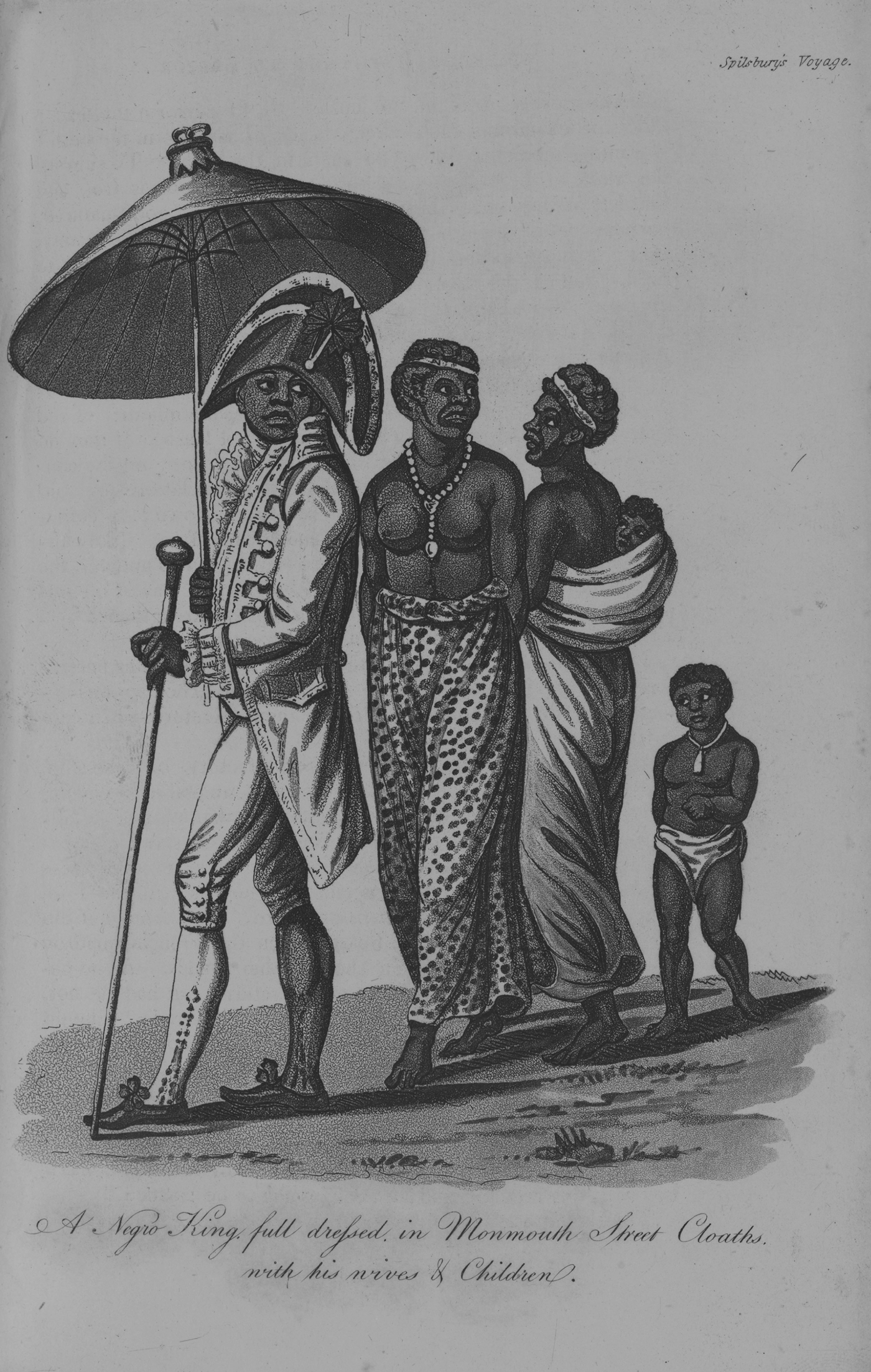
Based on his enquiries at Bristol and Liverpool, Thomas Clarkson was of the opinion that the removal of pawns from the coast was a frequent occurrence, nonetheless. A letter from William Earle of Liverpool to Duke Abashy of Calabar, 10 February 1761, refers to the efforts of a Bristol ship to secure the return of pawns who had been taken to the Caribbean.Footnote 32 Ship captains sometimes entered into written agreements to prevent disputes over whether or not a pawn could be legally taken from the coast, as in a case at Calabar dated 22 August 1776.Footnote 33 Ambrose Lace of Liverpool received a letter from Calabar on 13 January 1773 that attempted to protect pawns from the threat of being taken to the Americas.Footnote 34 The efforts to secure the return of two men who had been taken off the coast while in pawn are also reflected in a letter from Ambrose Lace to Thomas Jones of Bristol, 11 November 1773.Footnote 35 In the letter, Duke Ephraim, Duke Town's leading merchant in 1790, complained to James Rogers and Sir James Laroche of Bristol that two men had been seized illegally and were in danger of being removed.Footnote 36 Ephraim complained that he had been a ‘very good friend’ to the ship Jupiter; even so, its master had sailed away with two of his canoemen, both of whom were ‘free men’. Outraged by this, Duke Ephraim threatened to ‘make Bristol Ship pay for them two’ unless they were returned by ‘Any other Ship or himSelf’. Whether the two canoemen were returned or Duke Ephraim carried out his threat is unknown, but the fact that those illegally taken worked for Duke Ephraim is significant. Even when British merchants dealt regularly with Calabar merchants, as Rogers and Laroche did, the behavior of their agents in the field could undermine trust. Written correspondence did not guarantee that the parties would keep their promises. Keeping promises was perhaps especially problematical for local merchants who were dependent on other parties or events outside their control to meet their obligations. On the upper Guinea coast, pawns were identified on board ship by ‘putting a tally round their necks; the child then runs among the slaves until exchanged’. At Tasso Island, which was under the control of the fort at Bunce Island in the Sierra Leone River, Spilsbury ‘saw a great number of pawns with their tallies’. He included a plate (see Fig. 1) showing a local notable (‘king’) ‘in full court dress, followed by his wives, [who] has a boy with this article round his neck, going to be pawned’.Footnote 37 The use of tallies has not been noted for other parts of the coast.
‘Boy Pawn with Tally, Sierra Leone River, 1805’, from F. B. Spilsbury, Account of a Voyage to the Western Coast of Africa; Performed by His Majesty's Sloop Favourite in the Year 1805 (London, 1807). Courtesy of the National Maritime Museum, Greenwich, London.

The merchants and their extended families that facilitated the deportation of the enslaved were not immune to enslavement, as revealed in a letter from Duke Ephraim to Rogers and Laroche demanding the return of two of Ephraim's men in 1789.Footnote 38 There were various ways that members of the literate elite might end up in slavery. People could be seized or forced to repay debts through the arbitrary sale of relatives of the debtor, as Antera Duke's diary records.Footnote 39 Such actions in effect constituted panyarring as sanctioned by the Ekpe council, discussed below. The fact that pawns were occasionally exported resulted in appeals for their return. Indeed Clarkson learned that it was ‘not unusual for the English Captains to sail away with them’, and provided examples of pawns who had been removed.Footnote 40 He claimed that a certain Captain Forbes
carried off from Old Calabar two or three pledges or pawns. These had not been redeemed. There are instances, however, where they have been redeemed, and yet detained and carried off for the debts of others. Were the Captains of Guineamen to be asked if they had been guilty of any unjust practices in the course of their voyages, very few of them could justify themselves upon that question.Footnote 41
The tensions associated with pawning plagued other parts of the coast as well. When ships sailed with pawns on board, future commercial dealings were placed in jeopardy, and indeed other ships faced retaliation.
The most serious crisis involving disputes over the fate of pawns, individuals seized for alleged debts, and tensions among local merchants at Calabar occurred in 1767, when the British ship captains in the river conspired with the traders of Duke Town to eliminate their rivals at Old Town. Often referred to as the ‘Massacre of 1767’, the conspirators attacked and killed many of the residents of Old Town, sending the survivors into foreign slavery on board British ships.Footnote 42 Although it is not clear what happened to all of those sold abroad, there is evidence that several who were taken in 1767 were subsequently released and returned to Calabar, where they helped to reestablish the trade of the Old Town ward.Footnote 43 As is clear from surviving correspondence, the reliance on personal contact supplemented the pawning system, guaranteeing a method of recourse through written appeal to known business partners in two of the key ports of the British trade.
Pawning of individuals therefore constituted the transfer of a person and his or her productive assets as security until the debt was fully repaid.Footnote 44 Pawnship stands in contrast to a mortgage, where assets are only transferred in case of default. The labor of the pawn constituted interest on the debt and was intended to cover the cost of subsistence and accommodation but did not contribute to the principal. The pawn lived with the creditor, who was responsible for sustenance. In cases described as ‘self pawning’, the pawned individual did not live with the creditor but lived on his/her own as the only way of earning money to pay off the debt.Footnote 45 Self-pawning may actually refer to an indenture that was conceived in the context of pawnship, which is a subject that requires further examination.
Commercial hostage taking, as was the case with British ships at Calabar and elsewhere, was an adaptation of pawning, in which individuals were held as security for a debt and the expected payment.Footnote 46 Hence pawnship did not necessarily relate to poverty and did not necessarily lead to slavery. People were held as pawns to secure credit because guaranteeing the recovery of debts was fundamental to economic relationships and often affected social interaction and the structure of society. Individuals being held as pawns were almost always related to the person who contracted the debt, and as such were ‘free’ in that their previous status and relationships were respected and were expected to be restored. Without the tie of kinship, the usefulness of a person as security for debt was undermined. Relatively few Africans entered the trans-Atlantic trade originally as pawns, at least not from Western Africa. A sample of slaves who were liberated by British anti-slave trade patrols in the early nineteenth century included a number of individuals who had originally been pawns, but relatively few.Footnote 47
REGULATING PAWNING: THE EKPE SOCIETY
Pawnship was embedded in social and political structures that enforced compliance and facilitated the flow of credit and thereby reduced the risk of violence. Its institutional embeddedness can be understood as a rational application of transactional economics. In discussing the relationship of pawnship to slavery, therefore, it is important to understand that pawnship and indebtedness were not the same. Pawnship normally and legally was based on customary laws that prohibited the reduction of pawns to the status of slave. Pawns did become slaves, but whether in a legal and acceptable manner according to local ethical standards is another matter. The challenge is to address issues of chronology, development, and change over time in how pawnship operated in Western Africa.
The institutional mechanism to contain the rivalry that existed among the various wards of the Cross River was vested in the Ekpe association, which was a graded society of adult males that interlocked with similar associations at all the commercial centers of the Biafran interior. Probably founded by the mid-seventeenth century, Ekpe has sometimes been referred to as a ‘secret society’ because of its esoteric language, its communal decisions, and their implementation as governed by collective responsibility and taken in closed session.Footnote 48 This was an indigenous institution that played a major part in policing and enforcing contracts.Footnote 49 Indeed, Ekpe sometimes ordered Efik traders to settle disputes with exporters or to replace pawns who had absconded from European ships.Footnote 50
At Calabar, Ekpe regulated commercial relations, including the settlement of debts, and otherwise intervened in the treatment of individuals being held as pawns. Ekpe was found in many communities in the region of the Cross River, extending into Igbo country, where Ekpe was sometimes called Okonko. The society was common in the Cross River basin when Calabar emerged as an Atlantic port in the middle of the seventeenth century, and was certainly well established by the middle of the eighteenth century, not only at Calabar but also along the Aro commercial network into the interior. On the whole, the wealthiest and most powerful merchants dominated the highest grades of Ekpe and competed for its principal offices. These men were responsible, among other things, for debt enforcement, having the power to ‘blow’ ekpe, that is, punish offenders through summary justice. Membership in Ekpe extended to Aro traders, who formed similar closed associations of their own in the interior and also controlled the Ibinukpabi oracle at Arochukwu, their capital.Footnote 51 The oracle was recognized as the supreme court of appeal for a range of legal issues that pertained to credit and trade, including the protection of merchants and markets, the settlement of sectarian disputes, and the accumulation of slaves through fines and fees levied on litigants. Hence the leading ward houses at Calabar participated in a network of overlapping agencies that served to enforce payment of debts and to protect the commercial interests of the export trade in slaves. Similar institutions, apparently related to Ekpe, governed other parts of Cameroon and Gabon. While the connection among these societies is not known, their role in trade and protecting insiders related by kinship from enslavement is clear.
The terms of this private ordering also included the possibility that, if slaves were not delivered on time, masters of ships would sail away with the pawns that traders had lodged with them. In short, there were other sanctions used against traders who reneged on promises in addition to the judgments of Ekpe. According to one report, pawns were often ‘the sons and daughters of traders’ and the latter were ‘always particularly anxious’ about their fate and ‘seemed much distressed whenever they took up an idea that the ship would sail away with the pawns’.Footnote 52 Concern over the fate of their kin was perhaps compounded for slave dealers by the possibility that, as we have seen, pawns might be passed between ships. We do not know if masters needed approval from local traders for such transfers, although in local practice, as far as is known, such alterations in pawn-creditor arrangements required the approval of close kin. There were instances when traders sought to protect pawns from enslavement by ‘blowing ekpe’ on ship masters who might be tempted to abscond with them; the crew of ships were sometimes seized or panyarred to force the return of pawns.Footnote 53 This potential for arbitrary action was always just below the surface. Until they were redeemed, British merchants normally regarded pawns as enslavable by sale in the Americas ‘if their friends refuse, or are not able to redeem them’.Footnote 54 Ship captains were ready to sail with pawns on board, should conditions warrant the risk. Commercial pawning, therefore, was apparently governed by a precise time schedule, unlike domestic pawnship, which could continue indefinitely, even into a subsequent generation, unless other arrangements were made. Often such domestic arrangements, when they involved women, resulted in marriage contracts that recognized the continuation of the debt. Sometimes, although the justification of such actions is seldom clear, pawns became slaves. The reduction of commercial hostages being held as pawns to slavery was, therefore, not the only situation in which the status between slave and pawn became blurred.
The Ekpe society was theoretically ‘secret’ in that the decisions of the Ekpe council were enforced collectively, thereby absolving individuals of responsibility for its policies and decrees. The secrecy was reinforced through masquerades and the use of elaborate costumes to represent leopards, as well as the use of coded gestures and an elaborate pictograph system, of unknown antiquity, that effectively reduced Efik, Ibibio, Igbo, and other languages to writing. The secrecy in meaning that underlay the hundreds of pictographs in use allowed communication across language frontiers, but only to those who had been initiated, and therefore was adopted along the trade routes into the interior. Moreover, initiation into each of the several grades of the society involved mastering specific rituals, dances, and signs that allowed initiates to communicate with each other in secret.Footnote 55
Because of initiation fees for the various grades of the society, the leading merchants of the different wards dominated Ekpe and thereby regulated trade, settled disputes, protected pawns, and enforced debt repayment. Through the collective decisions of the senior Ekpe council, whose members were the leading merchants themselves, individuals could be forced to comply or suffer the consequences. As Antera Duke recorded in his diary on 18 January 1785, ‘all the Ekpe men went to the Ekpe Bush to make bob [that is, reach a settlement] about the Egbo Young [Ofiong] and Little Otto palaver’.Footnote 56 Although the cause of the dispute between the two men is not mentioned, a settlement was reached and the two men forced to pay a fine: ‘Egbo Young paid 1 goat and 4 rods and Little Otto paid 4 rods.’Footnote 57 Virtually all men in Calabar had to belong to one of the grades of the society and pay its fees, which in turn were shared among the members of the highest grade of the society, that is, the principal merchants. Antera Duke refers to these payments in his diary.
Ekpe also regulated European shipping, serving as a collective means of imposing sanctions, boycotting specific ships, and protecting pawns held on board from being taken to the Americas and sold as slaves. As noted by Antera Duke, Ekpe would isolate a ship, even if this adversely affected the interests of other merchants. According to the entry in his diary for 26 October 1786:
… so I hear Egbo [ekpe, the leopard masquerade] Run and I com to know I walk up to Egbo Young so wee see Egbo [the masquerade] com Down & the Egbo men he say Sam Ambo and Georg Cobham brow [blow, ‘blow ekpe’] for Captain Fairwether so all us family Dam [damned] angary about brow [blowing ekpe] that and wee send to call Captin Fairwether to com ashor and after 3 clock noon wee see Eyo & Ebetim com Down and Eshen Ambo so the[y] want [went] to Sam & Georg Cobham for mak the settle with Captin Fairwether.Footnote 58
The reference is to the public ‘running’ of the leopard masquerade through the community, which indicated summary justice was to be executed, based on the decisions of the Ekpe council. As the diary makes clear, Antera Duke was upset that other merchants (Sam Ambo and George Cobham) had imposed ekpe on Captain Fairweather's ship, thereby stopping trade, which could only resume once a settlement had been reached. Apparently Fairweather went ashore and the dispute was resolved so that the ship could sail.Footnote 59
PAWNSHIP, INDEBTEDNESS, AND SLIPPAGE INTO SLAVERY
The relationship between indebtedness in Africa and the institutions of pawnship and slavery during the period of trans-Atlantic slavery and its aftermath was complex. In fact, pawnship was also imposed in situations of indebtedness that had to be incurred to ward off poverty. Individuals could find themselves in situations in which the costs of funerals and other ceremonies could push credit to the limit. Sickness, the inability to produce a harvest, or other hardship could reduce individuals to poverty in which pawnship was the only way to survive, and even then seizure for debt and sale into slavery was often sanctioned. As Walter Rodney has observed for the upper Guinea coast, ‘to borrow and fail to repay the most trifling item in the seventeenth century was sufficient warrant for arrest, conviction, and execution by sale. … people [were] sold for debts’.Footnote 60 Similarly, Richard Miles, who was in the service of the Royal Africa Company for 18 years on the Gold Coast, 1765–84, spoke ‘the language of the Gold Coast perfectly’, that is, Twi, and he reported in response to the question, ‘in the case of Debt, is the person sold as a Slave for the benefit of the creditor?’, ‘Beyond all doubt: I have known thousands of instances of it.’Footnote 61 And as to the process whereby ‘Natives of the Gold Coast [were] condemned to sale for debt’,
We have in most of the towns on the Gold Coast a Palaver House, which strictly speaking, is a court of justice – in these places the Judges or Elders of the town (few of which are under the age of sixty or seventy) assemble to hear the parties. These trials are in open day, and free for any person to hear that pleases.Footnote 62
Miller has suggested a strong correlation between famine, indebtedness, and enslavement in the interior of Angola, which does not seem to have been related to pawnship.Footnote 63
How many people were in debt in this period is hard to say; there were certainly people who lived in poverty. Isolated communities could face extreme deprivation after a drought, especially if they were cut off politically from access to food. The fact that almsgiving was a tenet of Islam reflects differentials in income in which the better off were expected to give freely to those who were less well off, and indeed often did so. Despite the apparent prevalence of indebtedness, it is argued here, debt did not usually result in enslavement or even normally present the danger of enslavement, at least in Western Africa. Many poor people were enslaved, especially if they lived in rural retreats and mountain sanctuaries, because they were captured in raids, not because of their poverty and possible indebtedness. Being in debt was not inherently related to the risk of enslavement. Indeed being in debt could be protection from enslavement, depending on the situation.
It is difficult to estimate the intensity of relationships that underlay the personal connections of individuals, which clearly varied but at least functioned under the myth that creditors and debtors were close associates, well known to each other, and involved in transactions that in no way undermined the standing of either party in the community but rather consolidated friendships and citizenship. Despite expectations of fair treatment for pawns, it is impossible to determine the conditions of servitude, although sometimes, at least, pawns ran away, complained to kin, or otherwise became noticeable, perhaps because they married into the creditor's family. Inevitably there was abuse, sexual exploitation, and even sale into slavery, but unlikely on a substantial basis because of local mechanisms that upheld the strength of kinship. In general, pawnship was not expected to result in problems relating to the safety of and respect for individuals. The various references in the documentation to the ‘free’ status of pawns highlight the sharp distinction between slavery, which lacked ties of kinship, and pawnship, which was based on kinship. Freedom, and as Clarkson described it, ‘the loss of liberty’, seems to have been perceived in such terms.Footnote 64
Pawnship was a factor in relations between Muslims and non-Muslims in the interior of the Bights of Benin and Biafra. Non-Muslims exchanged their children for food during times of famine and scarcity, which was done out of necessity and often with the myth that the children could be redeemed. Muslim traders, nonetheless, considered the transaction differently, assuming that they had bought the children and therefore could sell them as slaves, which they did. Under Islamic law, freeborn Muslims could neither be enslaved nor pawned. Indeed these guarantees, although not always enforceable, were among the reasons why people became Muslims. Indebtedness under the law also could not lead to enslavement. One of the tenets of Islam, that was widely practiced, was alms for the poor, not enslavement.Footnote 65
It seems clear that indebtedness was a means by which individuals could be reduced to slavery and even sold into the trans-Atlantic trade. The institution of pawnship, however, was not usually related to seizure for debt, although it may have sometimes happened. In Western Africa, at least in the eighteenth and nineteenth centuries, pawnship served to protect people from enslavement, but in some cases, pawnship seems to have been a fiction to disguise seizure for debt and subsequent enslavement. Hence the concept of pawning has been applied in conflicting ways that warrant consideration. This review has intended to explore the distinction between pawnship in which people were protected against arbitrary seizure or panyarring, and the use of the concept of pawnship to justify the seizure of relatives of individuals who were in debt and might therefore be better represented as a form of foreclosure.
PAWNSHIP IN WEST CENTRAL AFRICA
The question of pawnship during the era of the slave trade in west Central Africa is unclear. Although Vansina and Miller argue that pawnship was essential to the operation of trade and the origins of slaves, other historians have found little or no evidence of the importance of pawnship in Angola and the ports of Luanda and Benguela, from whence most slaves left. Commercial hostage taking was found north of the Congo River, however. Phyllis Martin has described commercial pawnship at Gabon in the nineteenth century, which Lovejoy and Richardson have confirmed with respect to British trade at Gabon and Loango in the eighteenth century.Footnote 66 However, José C. Curto, Mariana Candido, and Vanessa Oliveira have found no evidence of pawnship of individuals in the relations between coastal and foreign merchants, on the one hand, or with African suppliers in the interior, on the other, for the eighteenth and nineteenth centuries.Footnote 67
According to Vansina, a decree issued by the governor-general of Angola in 1771 that prohibited the pawning of free people was ignored and apparently never reissued, but the decree apparently demonstrates that merchants had been accepting pawns (penhor) in return for the loan of goods equivalent to the value of a slave in the 1760s, if not earlier.Footnote 68 Despite Vansina's reservations, the prohibition apparently did have an impact because the pawning of free people seems to have disappeared. Anyone who was known in the community and who had ties of kinship would be difficult to disguise in a pawnship relationship; appeal to the governor was sufficient to secure release or at least investigation. The possibility of pawning a slave was low because creditors could insist on buying the slave, rather than accepting the slave as a pawn.
In the interior of Angola, according to Vansina, commercial transactions involving pawnship were common, which he considers to have been an innovation of the eighteenth century. By the 1770s, pawnship was ‘customary’ in the interior. In pawnship transactions, junior matrilineal relatives, preferably female, were targeted. They were pawned to pay off debts or fines incurred by older matrilineal relatives, usually the brothers of the mothers of the pawns, but occasionally by an older woman in the family. Transactions were conducted by a brother of the mother and sometimes by a sister. The brothers and sisters of the senior living generation in effect made the decisions that resulted in pawnship. Vansina's analysis of Kimbundu terminology suggests that pawnship was a relatively recent introduction. The usual term was ngunji, but the older Kimbundu documents refer to pawns as penhor or pinhor.Footnote 69 As De Castro Francina noted in his ‘Itinerario’, a pawn was called Gunge in the 1760s, that is, ngunji. Footnote 70 In the 1880s, ngunji referred to a ‘prop’, that is, something that provided ‘support’ for a loan. Vansina argues that pawnship became a feature of the slave trade after the consolidation of what he calls ‘matrilineal corporations’, which emerged in the second half of the eighteenth century.Footnote 71
Many communities had a preponderance of women, children, and slaves, controlled by a few older men whose polygynous relationships were essential to the organization of credit and dependency. The younger, free, adult men who were present at any given time had little say in the community and therefore usually left on migration and trade. From the 1790s onwards the corporate lineage secured exclusive rights to the alienation of people that overrode all other claims based on kinship relations. Earlier, any kin in positions of authority could pawn members of the extended family, but increasingly, it seems, pawns were provided to save a senior lineage member from enslavement for debt, and pawns were accepted precisely as insurance against the risk. When the creditor had to raise capital to pay a fine or debt, he could then exchange a pawn rather than pawn one of his own relatives or sell one of his slaves. And since debts (due to funerals) and accusations of crimes (especially adultery and responsibility for deaths) were commonplace, the risk of suddenly being fined a slave was high and required insurance. The court of local officials (soba) and the induua ordeal were the major mechanisms by which local people were enslaved, along with the sale of pawns that could not be redeemed by their lineages. The induua ordeal often was invoked because death was viewed with suspicion; divination determined who was responsible. Those accused could only dispute accusations through subjection to an ordeal that resulted in enslavement. If the accused died, relatives were enslaved and sold; and if the accused survived as a demonstration of innocence, the same number of the ‘family’ of the accuser underwent this fate. Based on Vansina's evidence, pawning only became common towards the end of the eighteenth century.
While commercial hostage taking was certainly found north of the Congo River, Candido's work on Benguela and Roquinaldo Ferreira's study of Luanda and Benguela refer neither to pawning in relation to domestic transactions and the conduct of the slave trade to Brazil, nor in relation to the origins of the enslaved.Footnote 72 Nor do John Thornton, Linda Heywood, or Curto describe a form of pawnship that involved holding people as collateral for debt in their studies of west Central Africa. When pawnship is described, it is more like panyarring, that is, the seizure of people for debt, than the practice of holding individuals as collateral for a debt.Footnote 73 Oliveira has found no examples of elite women traders, donas, holding or giving pawns as security, but the practice of hipoteca, in which wealthy traders held mortgages on property in exchange for credit, was common, such as the case of Manoel José Rebello de Macedo, who provided a female slave named Maria as security for a debt in February 1865. The slave was held in the public jail as a ‘deposit’ by order of a magistrate (juiz de direito) in Luanda.Footnote 74 The principal merchants lent money in which hipotecavam property, whether land or slaves, was used as the guarantee. Lack of references to pawning in the documentation raises questions about Vansina's and Miller's claims that pawnship was widespread and requires further research.
CONCLUSION
The study of pawnship addresses credit and indebtedness in the economies of Atlantic Africa and the vulnerability of people to slavery and possible transport to the Americas. As demonstrated, merchants at the coastal towns and embarkation places for the Atlantic slave trade often relied on the use of pawns in commercial transactions. The condition of ‘freedom’ as mentioned in documents seems to have related to the fact that those held as pawns should not have been sold into slavery but were instead human hostages of trade. There seems to have been a divide in the use of pawns between Islamic and non-Muslim societies, on the one hand, and between the Atlantic world and specific parts of Atlantic Africa, on the other. Muslim merchants appear to have recruited slaves through manipulations of pawnship almost seamlessly, while pawnship seems to have greased the credit mechanisms of trans-Atlantic slavery in many places, but not always and not everywhere. We need to know a lot more about the slippage from pawnship into slavery, which in hindsight reveals local confusion, documentary contradiction, or projection of theory onto vague description. In the past, there were clear distinctions between what was considered legal activity and illegal activity, and slavery and pawnship were clearly different. There appear to be no legal cases in which these distinctions were contested that can help us understand how the institutions were distinguished, and when and how transitions were achieved or obstructed, let alone justified.
If we define pawnship as a system in which collateral is provided to guarantee the repayment of a debt, there is an important difference between practice in Western Africa, the legal meaning in Islamic law, and the way the term has been applied in East and Central Africa. We would be more accurate to talk about enslavement for debt in East Africa and pawning of individuals in Western Africa, recognizing that they were not the same. We would recognize that pawns in non-Muslim areas of Western Africa provided the interest on the debt through their labor, which was prohibited in Islamic law. These conditions and situations have little similarity to what Mary Douglas described as ‘blood-debts’. Douglas described dependency practices in matrilineal societies that involved the transfer of rights in persons between kin groups in compensation for debts. She labeled the practice of settling what she terms ‘blood debts’ as ‘pawning’, which has proved confusing.Footnote 75 As Douglas explains, a ‘pawned’ individual only had value as compensation because of kinship and affine relationships that linked people to lineages. For Douglas, pawns were not slaves, and her concern was the way in which this type of dependency affected matrilineal societies, not individuals. Douglas does not refer to pawns as collateral for debts, but rather as the means through which debts were settled. In short, she described a system of debt-based clientage that existed alongside internal slavery and the export of slaves that resulted from debt bondage.Footnote 76
As Edward Alpers has shown, actual practice in the nineteenth century approximated seizure for debt and subsequent sale into slavery, which is more like panyarring than pawnship.Footnote 77 Because individuals and even whole families were subjected to ties of dependency that derived from ‘blood’ debts, that is obligatory acceptance of the fact that something was owed because of a perceived crime or failure to repay a loan that could result in slavery. As Alpers suggests, the power of determination shifted in favor of the person to whom something was owed, so that the creditor could insist on immediate foreclosure and failure to comply could result in seizure and sale of someone associated with the party who was in debt, whether the debt was financial or punitive. Individuals were seized or held as compensation and might be considered to be ‘pawns’, but it would be more accurate to see their condition as one of compensation and reparation resulting in slavery. The similarity related to indebtedness, but unlike pawnship where someone was held as collateral, compensation was seized and thereby resulted in the sale of individuals into slavery as a means of settling debts, no matter how incurred or how perceived.
In examining the historical development of pawnship as an institution, we need to identify its use in the Atlantic trade, noting when and where it occurred, and how this related to the practice of pawning trees, land, gold, and other commodities. We also need to consider whether pawnship could reinforce other relationships, including patron/client arrangements, marital arrangements, and kinship connections. We need a better understanding of its resurgence during the colonial period, especially during the Great Depression of the 1930s. The methods of enforcement and protection involved secret societies, the legal institutions of centralized states, reliance on panyarring, and the use of intimidation, threat, and force. A closer look suggests that there was little connection between pawnship and the process of enslavement, in which pawned individuals became slaves. Finally, we need to examine the interface between Muslim trade and marketing and the friction arising between ‘protected’ non-Muslims and Muslims that arose from an institutionalized cultural misunderstanding. The idea of dependency can be tied to debt, and pawnship perhaps shows this in a way that is unique in terms of its abstraction of accountability.
Pawnship demonstrates an extreme form of dependency, one in which an individual was expected to represent the debt of another person in a relationship that involved subordination but in a context that involved levels of reciprocity. The practice of pawnship in Atlantic Africa seems to have differed from what is referred to as pawnship in the Bantu-speaking regions of Central, Southern and Eastern Africa. If this analysis is correct, then the question arises as to why the term has been used for two quite different situations, if not different institutions, and what if any consequences arise from the possible confusion. The distinction between slavery and pawnship is compounded because of the necessity of raising capital to free pawns, on the one hand, and redeem family members from slavery, on the other. The similarity appears in the need to raise funds to restore a pawn to freedom and the financial obligations of redeeming a slave. Pawnship was a means of assuring the eventual freedom of a person, perhaps through marriage, and was comparable to slave redemption, but it did not usually lead to enslavement. Pawnship explicitly allowed for redemption and thereby is situated in Atlantic Africa as a mechanism tied to slavery as a means of securing credit. By contrast, in west Central and Central Africa the term pawnship has been used to describe an institution that related to enslavement for debt, not the surety of the debt through human bondage. The use of the term in some contexts justified enslavement rather than describing a context in which individuals were protected from enslavement.
It was possible to regain freedom. Individuals who were being held as pawns on European ships were often referred to as ‘free’, and records make reference to ‘free’ passage. Hence the concept of freedom, that is, that a person should not be enslaved, crossed cultural and racial boundaries. It was possible to take safe passage to the Americas and to Britain, with reasonable expectation of returning to Africa. It is hard to imagine that such pawns can be compared to the individuals whose indebtedness was tied to poverty rather than to the allocation of resources that might or might not lead to unfortunate circumstances. Pawnship status was gender specific; girls could hope to be married within the creditor's polygamous family, while boys could learn a craft or perform services that possibly could earn their freedom, if the loan was repaid or cancelled. The distinction between pawnship and seizure for debt is clear. Moreover, available records suggest that only a small minority of those whose sale at the coast can be documented entered slavery through pawnship. Admittedly, this conclusion considers that some descriptions on the Gold Coast and parts of the upper Guinea coast of wholesale enslavement of debtors might be exaggerated or based on misunderstanding. It is unlikely that large numbers of people were enslaved for debt in Atlantic Africa, although there are reports of its occurrence.
We seem to know what debt and slavery are, and hence the nature of credit, but I am not convinced that the term ‘pawnship’ is always used with any confidence in its meaning. Hence I am asking for clarification of the connection between the process of enslavement and factors of debt. This is clearly a very complex issue, especially because on the surface there should be very little connection. The process of enslavement in the great majority of cases was instituted through violence that had nothing to do with credit arrangements or market transactions but rather was identical with theft. Even the birth of children into slavery was a form of theft, a denial of rights of the freeborn, without cause or recourse. Could individuals be enslaved through foreclosure on debt? Could people place themselves in a form of indenture that was governed by debt and its administration? Could people be held for ransom, forced to find payment or seek help from friends and relatives who were willing to pay? Even if they could, ransom was not usually related to debt but an exchange arising from violence and threat of enslavement. Patron/client relations could be premised on debt, but this did not usually result in a process of enslavement, nor did many forms of debt bondage, including share-cropping or serfdom, which tied people to land, loosening their bondage for purposes of trade to distant places.
There is considerable confusion over relationships of dependency, particularly with respect to slave, pawn, debtor, captive, and even victim. Is a royal slave a victim? Are pawns returning from the Americas to their former ‘free’ status to be considered victimized? A discussion of the connection between debt and slavery is sometimes misdirected in assuming that there was a link. The intention here is to reconsider what has been meant by these terms, as well the related and sometimes equally ambiguous terms – ransom, redemption, commercial hostage, kidnapping, and specifically the practice of panyarring.Footnote 78 These cases all reflect a connection with slavery, but each is also an attempt to delimit the range of possibilities for enslavement, and thereby actually protects individuals from exposure to situations that could lead to slavery. Thereby they all indicate the danger of the loss of freedom, that is, the loss of free status. The review here has as its particular focus the institution of pawnship and how pawnship fitted into economic structures and political contexts in various parts of Atlantic Africa.Footnote 79 The conclusion argued here is that pawnship as practiced in Atlantic Africa was not part of the process of enslavement but entailed protection against enslavement. Moreover, pawnship was a factor in commercial exchange with slave-trading ships, but not everywhere. While pawnship was fundamental to trade at Calabar, it was not a factor at neighboring Bonny. Pawnship was common on the Gold Coast, but apparently not at the major ports of the Bight of Benin, at least in the eighteenth and nineteenth centuries, but was common throughout the interior. In Muslim areas, pawnship involving people was illegal, although pawnship seems to have been practiced in Muslim areas along the Gambia River.
Correspondingly, the use of the term ‘pawnship’ in some parts of Central and Eastern Africa seems to apply to other historical situations, which often resulted in enslavement. The term pawnship, like ransoming and redemption, has been used in different ways, particularly in relationship to the historical context in Atlantic Africa more generally. The discussion reveals confusion in how the term pawnship has been used in African history, there being a sharp distinction between Western Africa and indeed parts of west Central Africa from what has often been meant by pawnship in Central and East Africa. This article calls for sharper distinctions to be made in historical analysis, with implications that are yet to be explored. It is suggested that the use of the same term for different practices is confusing. In my opinion, the term should be reserved for situations in which individuals were being held as collateral for debts, and as often used in the scholarly literature, the ‘pawnship’ of Central and Eastern Africa should more aptly be described as enslavement for debt, or debt slavery.