A bilingual refers to a person who speaks two languages in a community (Romaine, Reference Romaine2008). While bilingualism has been associated with cognitive advantages (Bialystok, Reference Bialystok1999, Reference Bialystok2001; but see Hilchey & Klein, Reference Hilchey and Klein2011), many studies have found less efficient performance of bilinguals in spoken language in both their languages, which we refer to as the bilingual effect (e.g., Gollan, Montoya, Cera & Sandoval, Reference Gollan, Montoya, Cera and Sandoval2008; Ivanova & Costa, Reference Ivanova and Costa2008). For example, bilinguals show more TOT effects than monolinguals (Gollan & Silverberg, Reference Gollan and Silverberg2001; Gollan & Acenas, Reference Gollan and Acenas2004; Gollan, Montoya, Fennema-Notestine & Morris, Reference Gollan, Montoya, Fennema-Notestine and Morris2005), produce fewer exemplars than monolinguals in a verbal fluency task (Gollan, Montoya & Werner, Reference Gollan, Montoya and Werner2002; Rosselli, Ardila, Araujo, Weekes, Caracciolo, Padilla & Ostrosky-Solí, Reference Rosselli, Ardila, Araujo, Weekes, Caracciolo, Padilla and Ostrosky-Solí2000), and retrieve lexical items slower and less accurately than monolinguals in picture naming and spontaneous productions (Gollan et al., Reference Gollan, Montoya, Fennema-Notestine and Morris2005; Ivanova & Costa, Reference Ivanova and Costa2008; Roberts, Garcia, Desrochers & Hernandez, Reference Roberts, Garcia, Desrochers and Hernandez2002).
The reason why bilinguals, even highly proficient bilinguals in their native language, are slower and less accurate in spoken language compared to monolinguals is unclear. There are two possible explanations: that bilinguals have 1) weaker lexical links; and 2) cross-language interference from translation equivalents. The ‘weaker links’ hypothesis is based on the logic that, since bilinguals’ language use is divided between two (or more) languages, hence they typically use each of their languages less than monolinguals do (Gollan et al., Reference Gollan, Montoya, Cera and Sandoval2008). The consequence of this lower use is weaker linkage between semantic and phonological representations of words, resulting in less efficient word retrieval. Thus, retrieval difficulties are related to how frequently a word is used. While this frequency effect (slower retrieval of lower relative to higher frequency words) is also found in monolinguals (Oldfield & Wingfield, Reference Oldfield and Wingfield1965), support for the weaker links account is drawn from the finding that bilinguals show more pronounced frequency effect than monolinguals, especially in their less proficient language (typically L2) (Duyck, Vanderelst, Desmet & Hartsuiker, Reference Duyck, Vanderelst, Desmet and Hartsuiker2008; Gollan et al., Reference Gollan, Montoya, Cera and Sandoval2008; Gollan, Sandoval & Salmon, Reference Gollan, Sandoval and Salmon2011; Van Wijnendaele & Brysbaert, Reference Van Wijnendaele and Brysbaert2002). This account of less efficient performance in bilinguals has also been referred to as the frequency lag hypothesis (Emmorey, Petrich & Gollan, Reference Emmorey, Petrich and Gollan2013). The concept of less efficient word retrieval due to weak lexical links is not unique to bilinguals, and has been used to account for word retrieval decline with age, which is more pronounced for infrequently used words due to less accumulated practice overall (Burke, MacKay, Worthley & Wade, Reference Burke, MacKay, Worthley and Wade1991). The frequency lag between monolinguals and bilinguals was found to disappear with multiple word repetitions, reinforcing the argument that the main difference between bilinguals and monolinguals is the reduced language use (Gollan et al., Reference Gollan, Montoya, Fennema-Notestine and Morris2005). However, multiple repetitions do not always eliminate the frequency lag (Ivanova & Costa, Reference Ivanova and Costa2008). Previous research has mostly focused on nouns in testing the weaker links account, or the information on grammatical category about the stimuli has not been explicitly described. Therefore, verbs may present an important test case of the frequency lag effect, which should be independent of grammatical category. As discussed later, there are fundamental cognitive differences between nouns and verbs that may lead to a significant effect of grammatical category on bilinguals’ performance.
Another account of the bilingual effect in language production is that bilinguals experience cross-language interference from translation equivalents while monolinguals do not (Gollan & Silverberg, Reference Gollan and Silverberg2001; Hermans, Reference Hermans2004; Hermans, Bongaerts, de Bot & Schreuder, Reference Hermans, Bongaerts, De Bot and Schreuder1998; Lee & Williams, Reference Lee and Williams2001; Sandoval, Gollan, Ferreira & Salmon, Reference Sandoval, Gollan, Ferreira and Salmon2010; Van Hell & de Groot, Reference Van Hell and de Groot1998). Hence, bilinguals need to resolve this competition to select a single lexical representation for subsequent articulation, which is over and above the within-language lexical competition that all speakers (monolingual and bilingual) encounter. A key assumption of the cross-language interference hypothesis is that words that are more translatable across languages should cause greater interference because the non-target language translation is more likely to be activated. However, empirical support has been mixed. In support of cross-language interference, bilinguals produce intrusions from cross-language translations during verbal fluency tasks in the non-dominant language (English–Spanish bilinguals: Sandoval et al., Reference Sandoval, Gollan, Ferreira and Salmon2010), and a larger interference effect has been observed in a picture-word interference paradigm for semantic distractors that are highly translatable (Dutch–English bilinguals: Hermans et al., Reference Hermans, Bongaerts, De Bot and Schreuder1998). In contrast, facilitation of picture naming was found when the distractor in a picture-word interference was the translation (e.g., Mesa in Spanish) of the target picture name (e.g., name picture of a Table in Catalan) (Costa, Miozzo & Caramazza, Reference Costa, Miozzo and Caramazza1999). Similarly, Gollan et al. (Reference Gollan, Montoya, Fennema-Notestine and Morris2005) found translation facilitation – that is, faster naming speed with high-translatability than low-translatability words – for Spanish–English bilinguals.
Even though the cross-language interference hypothesis was supported by a few studies (Sandoval et al., Reference Sandoval, Gollan, Ferreira and Salmon2010; Macizo, Bajo & Martín, Reference Macizo, Bajo and Martín2010; Hermans et al., Reference Hermans, Bongaerts, De Bot and Schreuder1998), none of them have studied the effect of grammatical category on the magnitude of the interference. Based on the claim that there is lower cross-linguistic overlap in verb meanings compared to nouns (Prior, MacWhinney & Kroll, Reference Prior, MacWhinney and Kroll2007; Van Hell & de Groot, Reference Van Hell and de Groot1998), the cross-language interference account predicts that the bilingual effect for verbs would be smaller than for nouns. For instance, Faroqi-Shah and Milman (Reference Faroqi-Shah and Milman2015) found a bilingual effect in animal fluency but not in action fluency. Similarly, Faroqi-Shah and Li (in prep) found a smaller bilingual effect for verbs than for nouns in a picture-naming task. However, the empirical evidence for the cross-language interference account is inconsistent (e.g., Gollan et al., Reference Gollan, Montoya, Fennema-Notestine and Morris2005), and the role of grammatical category on cross-language interference has not been systematically studied. Further research is needed to test whether cross-language interference can account for bilingual differences in word production.
Most prior bilingual studies have examined the production and processing of nouns (i.e., Kohnert, Bates & Hernandez, Reference Kohnert, Bates and Hernandez1999; Kohnert, Reference Kohnert2002), while very little is known about how bilinguals process and produce other grammatical categories. Verbs are considered to be more complex in their semantic, syntactic, and morphological representation, which leads to greater processing demands compared to nouns, even when verbs are retrieved in isolation (Vigliocco, Vinson, Druks, Barber & Cappa, Reference Vigliocco, Vinson, Druks, Barber and Cappa2011). Verbs are often more semantically abstract, and could refer to events and actions that are temporally transient, but nouns are typically more concrete (Gentner, Reference Gentner1981; Vigliocco et al., Reference Vigliocco, Vinson, Druks, Barber and Cappa2011; Warrington & Shallice, Reference Warrington and Shallice1984). Also, verbs impose greater syntactic processing demands than nouns. For instance, verbs require a subject and they can assign thematic roles of agent and theme, but nouns do not assign thematic roles (Vigliocco et al., Reference Vigliocco, Vinson, Druks, Barber and Cappa2011). Further, verbs in certain languages are morphologically more complex than nouns as verbs have more inflected forms (Vigliocco et al., Reference Vigliocco, Vinson, Druks, Barber and Cappa2011). Additionally, in picture naming tasks, action pictures tend to be more conceptually complex than object pictures because they represent an actor, an action, and often a theme of the action (Szekely, D'Amico, Devescovi, Federmeier, Herron, Iyer, Jacobsen & Bates, Reference Szekely, D'Amico, Devescovi, Federmeier, Herron, Iyer, Jacobsen and Bates2005). Not surprisingly, then, verbs are found to be more challenging than nouns for monolingual speakers, when measuring language acquisition (Haman, Łuniewska, Hansen, Simonsen, Chiat, Bjekić, Blaziene, Chyl, Dabasinskiene, Engel de Abreu, Gagarina, Gavarro, Hakansson, Harel, Holm, Kapalkova, Kunnari, Levorato, Lindgren, Mieszkowska, Montes Salarich, Potgieter, Ribu, Ringblom, Rinker, Roch, Slancova, Southwood, Tedeschi, Tuncer, Unal-Logacev, Vuksanović & Armon-Lotem, Reference Haman, Łuniewska, Hansen, Simonsen, Chiat, Bjekić, Blaziene, Chyl, Dabasinskiene, Engel de Abreu, Gagarina, Gavarro, Hakansson, Harel, Holm, Kapalkova, Kunnari, Levorato, Lindgren, Mieszkowska, Montes Salarich, Potgieter, Ribu, Ringblom, Rinker, Roch, Slancova, Southwood, Tedeschi, Tuncer, Unal-Logacev, Vuksanović and Armon-Lotem2017; Kauschke & Frankenberg, 2008), verb naming in healthy adults (Shao, Roelofs & Meyer, Reference Shao, Roelofs and Meyer2012; Szekely et al., Reference Szekely, D'Amico, Devescovi, Federmeier, Herron, Iyer, Jacobsen and Bates2005), and word retrieval after brain injury (Mätzig, Druks, Masterson & Vigliocco, Reference Mätzig, Druks, Masterson and Vigliocco2009). A similar verb disadvantage has also been found in some bilingual studies (Jia, Kohnert & Collado, Reference Jia, Kohnert and Collado2006; Van Hell & de Groot, Reference Van Hell and de Groot1998; Hernández, Cano, Costa, Sebastián-Gallés, Juncadella & Gascón-Bayarri, Reference Hernández, Cano, Costa, Sebastián-Gallés, Juncadella and Gascón-Bayarri2008; Faroqi-Shah, Reference Faroqi-Shah2012). Van Hell and de Groot (Reference Van Hell and de Groot1998) tested word association in eighty unbalanced Dutch–English bilingual adults. Participants produced fewer associates for verbs compared to nouns. The authors argued that even though networks for both languages in bilinguals are strengthened when a word is processed, verb representations are less likely to be strengthened from cross-language spreading of activation because verbs have a less dense conceptual representation and less conceptual overlap across languages (Gentner, Reference Gentner1981).
Bilingualism and verbs therefore pose two separate challenges to lexical retrieval, but it is not clear if these effects are additive. Among the handful of studies comparing grammatical category differences in bilinguals, verb performance was lower than noun performance in a word association task (Van Hell & de Groot, Reference Van Hell and de Groot1998), and in picture naming by children (Jia et al., Reference Jia, Kohnert and Collado2006) and persons with aphasia (Faroqi-Shah, Reference Faroqi-Shah2012; Faroqi-Shah & Waked, 2010; Hernández et al., Reference Hernández, Cano, Costa, Sebastián-Gallés, Juncadella and Gascón-Bayarri2008). In contrast, the bilingual effect for verb retrieval was found to be smaller than for noun retrieval in children (Sheng, McGregor & Marian, Reference Sheng, McGregor and Marian2006; Klassert, Gagarina & Kauschke, Reference Klassert, Gagarina and Kauschke2014), and adults (Faroqi-Shah & Li, in prep; Faroqi-Shah & Milman, Reference Faroqi-Shah and Milman2015). Faroqi-Shah and Li (in prep) administered a verb and noun picture-naming task to eighteen highly proficient Spanish–English bilingual adults, who were tested in both English and Spanish on separate days. They compared bilinguals’ English picture naming latencies with those of monolinguals obtained from the International Picture Naming Project (Bates, Federmeier, Herron, Iyer, Jacobsen, Pechmann, D'Amico, Devescovi, Wicha, Orozco-Figueroa, Kohnert, Gutierrez, Lu, Hung, Hsu, Tzeng, Andonova, Szekely & Pléh, Reference Bates, Federmeier, Herron, Iyer, Jacobsen, Pechmann, D'Amico, Devescovi, Wicha, Orozco-Figueroa, Kohnert, Gutierrez, Lu, Hung, Hsu, Tzeng, Andonova, Szekely and Pléh2000). Not surprisingly, bilinguals named both verbs and nouns significantly more slowly than monolinguals (mean difference = 106.5 milliseconds/ms), and naming latencies for verbs were significantly longer than for nouns (mean difference = 239.7 ms) for both groups. Interestingly, there was a significant interaction between bilingualism and word category: that is, the bilingual effect for nouns was larger compared to verbs (mean difference = 127.1 ms vs. 86 ms). Similarly, Faroqi-Shah and Milman (Reference Faroqi-Shah and Milman2015) investigated whether the bilingual challenge was influenced by grammatical category in verbal fluency. They tested animal and action fluency in 33 high-proficiency Spanish–English and Asian Indian–English healthy adult bilinguals, and compared them with 40 age and education matched monolingual English speakers. While bilinguals performed worse than monolinguals on animal fluency (mean difference = 4.1 items), there was no difference in action fluency. The comparable performance of verb naming between bilinguals and monolinguals contradicts previous finding of a larger bilingual challenge for verbs (Jia et al., Reference Jia, Kohnert and Collado2006; Van Hell & de Groot, Reference Van Hell and de Groot1998; Hernández et al., Reference Hernández, Cano, Costa, Sebastián-Gallés, Juncadella and Gascón-Bayarri2008; Faroqi-Shah, Reference Faroqi-Shah2012). Hence, even though bilingual speakers are slower and less accurate in spoken word retrieval, the magnitude of this challenge appears to differ by grammatical class. Therefore, further replication is needed as the findings are scant and the exact mechanism for the bilingual effect is still unclear.
One limitation of the previous research is that many studies investigated language production in L2, which may or may not have been the dominant language of the bilinguals (but see Ivanova & Costa, Reference Ivanova and Costa2008; and Kohnert, Hernandez & Bates, Reference Kohnert, Hernandez and Bates1998). Further, prior research has not examined verb and noun naming in both L1 and L2, thus the interaction between bilingual effect, language status, and grammatical category is unknown. Hence, a more systematic investigation is needed to enhance our understanding of bilingual language representation.
The current study
The main motivation of the current study was to expand the noun-centric theories of bilingual lexical representation by incorporating findings on verb retrieval. The current study examined grammatical class differences in Mandarin–English bilinguals. In contrast to English and many other Indo-European languages, Mandarin, a Sino-Tibetan language, is a verb-friendly language, as Mandarin verbs are not morphologically inflected by case markings, tense suffixes, agreement markings, or plural markings. Additionally, Mandarin Chinese is a pro-drop language, in which both subjects and objects may drop from finite sentences. Thus, verbs typically occur in sentence final position and are more salient compared to nouns (Huang, Reference Huang1989). Additionally, sentences in Chinese can start with a verb. Verbs are also acquired early by Mandarin-speaking children compared to other languages (Tardif, Reference Tardif1996). The few prior studies of lexical representation in Chinese–English bilingual speakers have focused on noun retrieval in the context of semantic facilitation, neural signatures and code-switching (Chen, Bobb, Hoshino & Marian, Reference Chen, Bobb, Hoshino and Marian2017; Chen & Ng, Reference Chen and Ng1989; Li, Reference Li1996; Li, Jin & Tan, Reference Li, Jin and Tan2004). The current study adds to this body of knowledge by examining theories of bilingual naming effects and the role of grammatical category among Mandarin–English bilinguals given the verb friendliness of Mandarin and the relatively limited prior research of lexical retrieval in Mandarin–English bilinguals.
The first goal of the current study was to determine how well Mandarin–English bilingual adults perform verb and noun retrieval compared to monolingual English-speaking adults, and whether the previously observed pattern of verb-noun production (smaller bilingual effect for verbs compared to nouns) in other bilingual groups (e.g., Spanish–English bilinguals of Faroqi-Shah & Li, in prep) can be replicated for Mandarin–English bilinguals in L1 versus L2 (Research Question 1). Based on the verb friendliness of Mandarin (L1) and the extra morphosyntactic load of verbs in English (L2), we predicted that Mandarin–English bilinguals would experience a smaller bilingual effect for verbs compared to nouns in L2. The second goal of the study was to empirically test which theory (or theories) accounts for the less efficient word retrieval in bilinguals across both grammatical categories. To test the weaker links hypothesis (Research Question 2a), we examined if there was a larger frequency effect in bilinguals (especially in L2) compared to monolinguals for both nouns and verbs. The cross-language interference hypothesis (Research Question 2b) was tested, by examining if there was a translatability effect in naming latencies and accuracy for both nouns and verbs. Of course, the two accounts are not mutually exclusive and it is possible that both accounts play a role in bilingual language production.
Methods
Participants
Thirty-nine Mandarin–English bilinguals were contacted via e-mail and screened for language proficiency. Among these thirty-nine bilinguals, twenty-one of them met the criteria for proficiency (see the next section) and were included in the study. Therefore, twenty-one highly-proficient bilinguals (15 females, 6 males; mean age = 23, SD = 2.9; mean years of education = 16, SD = 2.9) and twenty-one monolingual English-speaking participants (16 females, 5 males; mean age = 22, SD = 4.7; mean years of education = 15, SD = 4.7) were recruited and matched for age (t (40) = −.83, p > .05) and years of education (t (40) = −1.33, p > .05). Three monolinguals were left-handed and all other participants were right handed. In order to help define bilingual vs. monolingual, we used the same criteria as Szekely et al. (Reference Szekely, D'Amico, Devescovi, Federmeier, Herron, Iyer, Jacobsen and Bates2005), in which the monolingual participants had no other language exposure before 12 years of age. The native language of bilingual participants was Mandarin, and they all acquired English as L2 before the age of 12 years (mean years of acquisition = 7, SD = 2.8). At the time of the study, all bilingual participants were residing in the United States and were college students (mean duration of US residence = 3.5, SD = 1.9) and they used English 34% of the time on average (SD = 12%). Eight of these participants had knowledge of other languages (Spanish, Japanese, French, Danish, Cantonese, and Korean) exposed after 12 years of age, and they all self-rated the proficiency of these languages as basic level. Based on self-report, participants were excluded if they had a positive history of neurodevelopmental conditions.
Language proficiency screening and testing
This study focused on highly proficient bilingual speakers, because balanced or nearly balanced proficiency of both languages is likely to consistently co-activate both languages during word production (Blumenfeld & Marian, Reference Blumenfeld and Marian2007). Language proficiency was determined by oral interviews and an online lexical test. The oral interviews were conducted via phone in Mandarin and in English, and were audio recorded for scoring. The interview question for English was: “What is the most unforgettable experience in your life” and the interview question for Mandarin was: “请用中文说明做泡面的步骤” (Please describe the steps for making ramen noodles).
Each response was scored according to the American Council on the Teaching of Foreign Languages (ACTFL) proficiency guidelines for spoken language (Swender, Conrad & Vicars, Reference Swender, Conrad and Vicars2012), which outline five major levels of proficiency described in speaking tasks: Distinguished, Superior, Advanced, Intermediate, and Novice. These criteria are based on the content, context, accuracy, and discourse types that were associated with tasks at each level. For example, according to the ACTFL 2012 guidelines (Swender et al., Reference Swender, Conrad and Vicars2012), advanced-level speakers showed abundant language skills, and could produce narratives in a clear manner. They also had sufficient control of basic structures and generic vocabulary to be understood. Eligibility criterion for bilingual participants was a rating of Advanced, Superior, or Distinguished level. Among the qualified participants, 15 were at Advanced level, 5 were at Superior level, and 1 was at Distinguished level.
An objective vocabulary test, Lexical Test for Advanced Learners of English (www.lextale.com) was given to assess bilinguals’ English proficiency (Lemhöfer & Broersma, Reference Lemhöfer and Broersma2012). LexTale uses a lexical decision task that tests vocabulary knowledge for medium to highly proficient speakers of English as a second language, and it takes less than 4 minutes to complete. The qualified participants all scored above 70% (mean = 83.6%, SD = 8.4), which is a higher score than another recent Chinese–English bilingual study (Wen & van Heuven, Reference Wen and van Heuven2017).
In addition, language dominance rating was obtained on the testing day from Bilingual Language Profile, which is a self-report instrument for assessing language dominance (Birdsong, Gertken & Amengual, Reference Birdsong, Gertken and Amengual2012). The range of possible scores for the language dominance index was −218 to 218, with the more extreme scores indicating higher dominance in any one language. A score of zero indicates equal language balance. The mean language dominance index for the bilingual participants was −66.39 (SD = 29.6), which was in the middle quartile (25% – 75%); that is, Mandarin was reported to be more frequently used than English, and it was the more dominant language, although both languages were rated quite highly proficient.
Stimuli
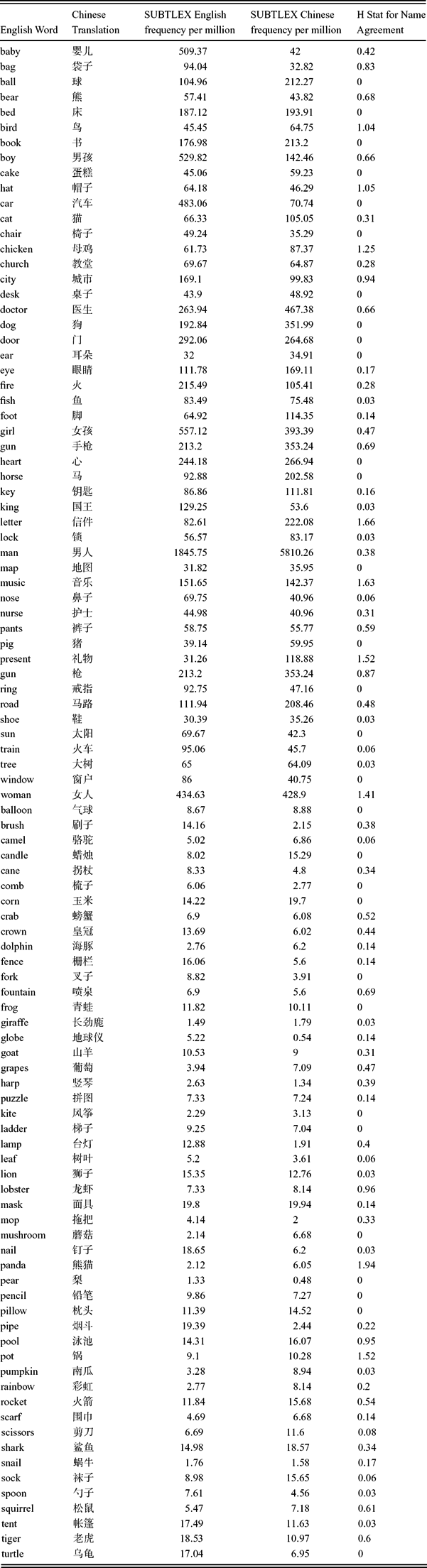
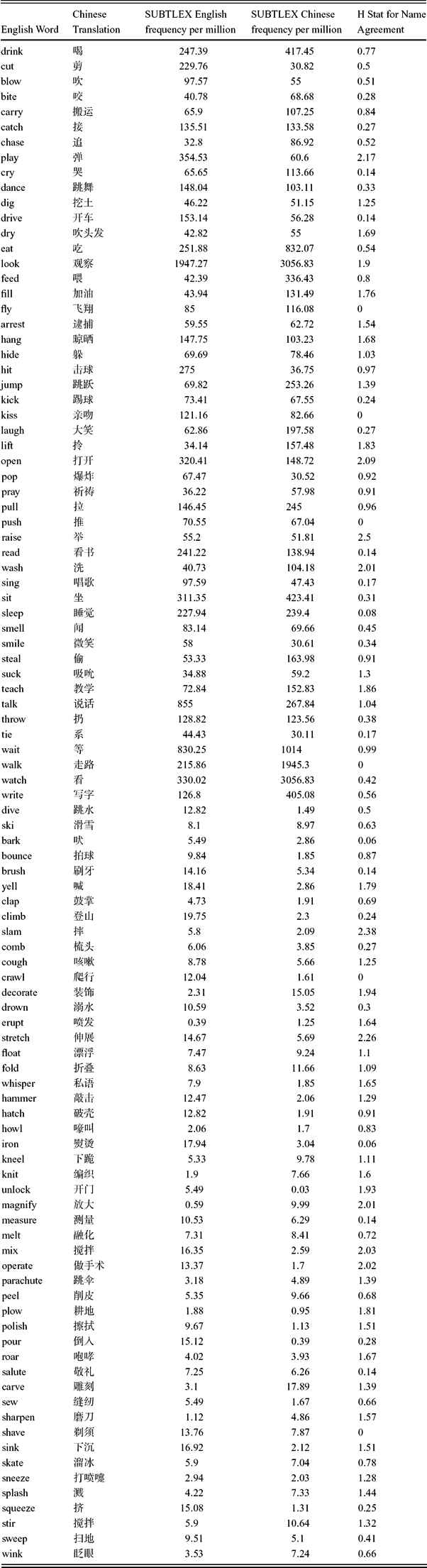
In order to determine the accuracy for Mandarin word items, a naming consistency check for Mandarin nouns and verbs was conducted on six native Mandarin speaking volunteers, who were not included in the formal study. The six raters were recruited from both Mainland China and the United States. The native Mandarin participants from the U.S. were the ones who had been exposed to rich English for less than 6 months. During the naming consistency check, participants were given black-and-white line drawings of 150 common object and 150 transitive and intransitive action pictures that were selected from the full stimulus set of the CRL International Picture Naming Project (IPNP, http://www.crl.ucsd.edu/~aszekely/ipnp/actobj.html; Bates et al., Reference Bates, Federmeier, Herron, Iyer, Jacobsen, Pechmann, D'Amico, Devescovi, Wicha, Orozco-Figueroa, Kohnert, Gutierrez, Lu, Hung, Hsu, Tzeng, Andonova, Szekely and Pléh2000), and they were asked to provide the first three names that came to their mind to name the picture (Li, Wang & Idsardi, Reference Li, Wang and Idsardi2015). In order to be selected as final stimuli, all raters had to have the target word in their list, and at least three of them used the target name as their first choice. Ultimately, 100 objects and 100 actions were used as stimuli for both English and Mandarin. The final noun and verb stimuli are given in Appendix I. For each English picture name, the lexical frequency was retrieved from SUBTLEXus word-frequency corpus (corpus size: 51 million words; Brysbaert & New, Reference Brysbaert and New2009). For each Mandarin picture name, the lexical frequency was obtained from Wmillion (frequency of the word per million words) in the SUBTLEX-CH word frequency corpus (corpus size: 33.5 million words; Cai & Brysbaert, Reference Cai and Brysbaert2010). Verb and noun stimuli were also matched for H statistic (taken from Szekely et al., Reference Szekely, D'Amico, Devescovi, Federmeier, Herron, Iyer, Jacobsen and Bates2005) of name agreement (nouns: t (98) = −1.25, p > .05; verbs: t (98) = 1.50, p > .05) based on English norms (Bates et al., Reference Bates, Federmeier, Herron, Iyer, Jacobsen, Pechmann, D'Amico, Devescovi, Wicha, Orozco-Figueroa, Kohnert, Gutierrez, Lu, Hung, Hsu, Tzeng, Andonova, Szekely and Pléh2000). H statistic is a measure of name agreement that takes into consideration the proportion of participants producing each alternative name. Higher H statistic value indicates lower name agreement (Snodgrass & Vanderwart, Reference Snodgrass and Vanderwart1980).
Procedures
Bilingual participants were tested individually in a quiet room for an approximately 2-hour long session, with rest breaks. Tasks for bilingual participants were administered in the following sequence: language proficiency (ACTFL and LexTale), picture naming task in one language, language dominance (BLP questionnaire), questionnaire on background information, including handedness, picture naming task in the other language, and translation task. The sequence of testing language (Mandarin vs. English) and word category (verb vs. noun) was counterbalanced across participants. Monolingual participants were tested for approximately one hour, and the tasks included English picture naming for verbs and nouns in a counterbalanced sequence.
Picture-naming task
The procedures followed the norming studies of IPNP in Szekely et al. (Reference Szekely, D'Amico, Devescovi, Federmeier, Herron, Iyer, Jacobsen and Bates2005). Participants were instructed to use a single word to name each picture as quickly as they could, and to avoid invalid responses, such as coughs, false starts, and hesitations, uses of “um”, etc. For the English verb-naming task, participants were asked to produce the uninflected form only. For the Mandarin verb-naming task, they were instructed to use the best Mandarin name for the depicted. Instructions were in English because potentially some participants might not be able to read Mandarin well due to their early age of arrival. Participants were given eight practice items for each testing block of word class. Each testing trial was presented for 3000ms, following a 200ms centered fixation cross “+” on the center of the screen. The next trial began 1000ms after the voice key detected a response or after 3000ms if the voice key did not detect a response. There was a short break after every 25 pictures of stimuli. The stimuli were digitally presented via DMDX – a Windows experiment presentation program (Forster & Forster, Reference Forster and Forster2003). Participants wore a headset microphone and their response times to each trial were logged, by a voice trigger key that was part of DMDX. An experimenter sat next to the participant in the testing room in order to provide instructions and helped record responses. The experimenter also typed up notes during the session to indicate any incorrect responses (i.e., inaccurate name, I don't know, and code-switches) or invalid responses, such as noises, or no responses. Participants’ responses were audio recorded for later verification and analysis purposes.
Translation task
Given that there are no existing norms for English-Mandarin translation, each bilingual participant completed a translation task for the 200 picture names used in the study. Words were presented in English one at a time on the screen, as the high-proficiency bilingual participants might not have been familiar with reading in Mandarin Chinese. The translation stimuli were presented in two blocks (verbs and nouns) in the same trial and stimulus durations as in the picture-naming task, and items were randomized within each individual block. Participants were asked to translate the 200 words from English to Mandarin as quickly as possible (see Appendix II for specific instructions), and their response times were recorded by a voice key triggered in DMDX. The experimenter stayed with the participant in the testing room to provide instructions and record responses. Comments were also typed up during the session to indicate any incorrect responses or invalid responses, such as noises or no responses.
Data analysis
The responses were recorded in accuracy (1 for accurate, 0 for inaccurate) based on dominant names, which came from the IPNP database (Bates et al., Reference Bates, Federmeier, Herron, Iyer, Jacobsen, Pechmann, D'Amico, Devescovi, Wicha, Orozco-Figueroa, Kohnert, Gutierrez, Lu, Hung, Hsu, Tzeng, Andonova, Szekely and Pléh2000) for English, and from the six raters for Mandarin Chinese. Statistical analyses of reaction times of accurate responses were computed on logarithmically transformed naming speed (Baayen & Milin, Reference Baayen and Milin2010). According to the procedures in Szekely et al. (Reference Szekely, D'Amico, Devescovi, Federmeier, Herron, Iyer, Jacobsen and Bates2005), valid responses included those with a codeable name and usable response times (when the voice key was triggered and there were no coughs, hesitations, false starts, etc.). Therefore, invalid responses were eliminated from the data. Based on the range of reaction times reported by Szekely et al. (Reference Szekely, D'Amico, Devescovi, Federmeier, Herron, Iyer, Jacobsen and Bates2005), responses faster than 500ms and slower than 3000ms were excluded as outliers: very fast reaction times might occur because the voice key might have been triggered prior to voice onset (e.g., heavy breathing), and very slow responses might not accurately reflect automatic word access.
We used R-studio (R Core Team, 2015) and lmerTest package (Kuznetsova, Brockhoff & Christensen, Reference Kuznetsova, Brockhoff and Christensen2015) to perform the statistical analysis for reaction times as dependent variable using linear mixed effects models (Baayen, Davidson & Bates, Reference Baayen, Davidson and Bates2008), and accuracy (0 or 1) as dependent variable using generalized linear mixed effects models (McCulloch & Neuhaus, Reference McCulloch and Neuhaus2001) with maximal random effect structure (Barr, Levy, Scheepers & Tily, Reference Barr, Levy, Scheepers and Tily2013). For the first research question, we entered language group (monolingual vs. bilingual L1 vs. bilingual L2), grammatical category (verb vs. noun), and the interaction term as fixed factors into the linear mixed effects model for RTs. As random factors, we had intercepts for subjects and items, by-subjects random slope for the effect of word category, and by-item random slope for the effect of language group. For the generalized linear mixed effects model for accuracy, which is treated as a dichotomous dependent variable, we entered the same fixed factors and the same random effects as in the model for RTs. For the second research question (2a), to compare the frequency effect between groups for both nouns and verbs, English frequency values and Mandarin frequency values were analyzed separately, which were highly correlated (r = 0.79, p < .01). We entered fixed factors including language group (monolingual vs. bilingual L1 vs. bilingual L2), word category (verb vs. noun), log form of word frequency value (W/million), a word category by frequency interaction term, a group by frequency interaction term, and a group by word category interaction term into two separate linear mixed effects models, one for English frequency and the other for Chinese frequency. Random structures include intercepts for subjects and items, a by-subject random slope for the interaction term of word category and frequency, and a by-item random slope for the effect of group. For the accuracy data, we ran two separate generalized linear mixed effects models. The model for English frequency values contains the same fixed factors and random structure as in the linear mixed effects model. The fixed factors and random structure entered in the model for Mandarin frequency values remained the same, except that the by-subject random slope was for the effect of word category only. In order to examine the translatability effect for the second research question (2b), translatability was represented as the log form of translation speed (in milliseconds from the translation task) for each individual participant. To normalize the translation speed into a linear distribution, we used the log transformation. Thus, the translation speed for each individual participant varies from each other. As the translation speed increases (shorter translation times), the translatability for the target word is higher, and as the translation speed decreases (longer translation times), the translatability for the target word is lower. The translation times had 6.3% of invalid (ms < 500 or ms > 3000) and incorrect nouns, and 14.6% of invalid and incorrect verbs, which were excluded from the RT analysis. For the RT data, we ran a linear mixed effects model with fixed factors including word category (verb vs. nouns), group (bilingual L1 vs. bilingual L2), log translation speed, a group by word category interaction term, a group by translation interaction term, and a word category by translation interaction term. As random factors, we had intercepts for subjects and items, a by-subject random slope for the interaction effect of word category and translation speed, and a by-item random slope for the group effect. For the accuracy data, we entered the same fixed factors and random structure into a generalized linear mixed effects model.
Results
Comparison of word retrieval for nouns and verbs
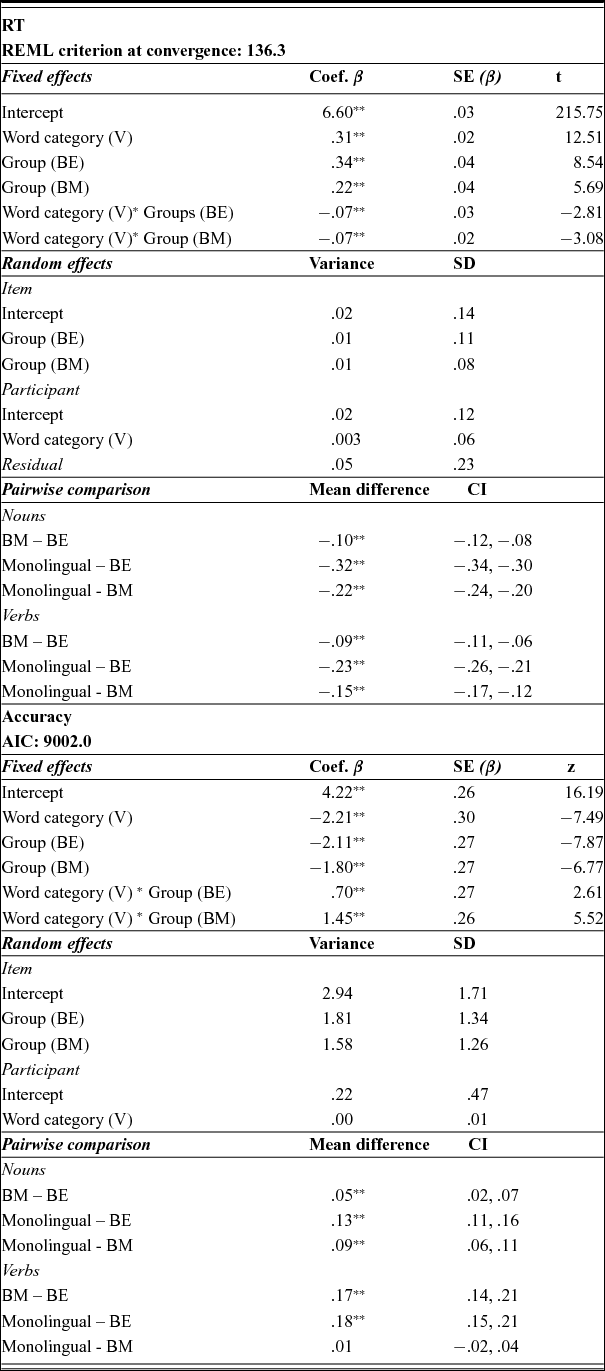
Reaction times (RTs) and accuracy rates for each group and language are depicted in Figure 1, and the results of the statistical comparisons are summarized in Table 1. There was a main effect of word category, verbs were produced significantly more slowly and less accurately than nouns. There was also a main effect of group for both L1 and L2 for both RT and accuracy. That is, naming in bilinguals’ L1 and L2 was slower and less accurate than that by monolinguals. For RTs, post-hoc pairwise t-test with Tukey HSD adjustment showed bilinguals in both L1 and L2 were slower than monolinguals (L1 vs. monolinguals: 1064.37 ± 388.55ms vs. 867.80 ± 280.70ms, t = −24.21, p < .01; L2 vs. monolinguals: 1164.57 ± 441.23ms vs. 867.80 ± 280.70ms, t = −32.84, p < .01), and bilingual L2 was slower than bilingual L1 (1164.57 ± 441.23ms vs. 1064.37 ± 388.55ms, t = −9.64, p < .01). Additionally, a Chi-squared test between verbs and nouns showed nouns were more accurate than verbs (44.90% vs. 35.55%, χ2 (1) = 485.55, p < .01). Another Chi-squared test between groups indicated bilingual L2 was less accurate than monolinguals (24.30% vs. 29.89%, χ2 (2) = 331.51, p < .01) and bilingual L1 (24.30% vs. 26.25%, χ2 (2) = 331.51, p = .01).
Monolinguals and bilinguals picture-naming reaction times in milliseconds (a) and proportion of accuracy (b) for nouns and verbs. Error bars show the standard error (SE) of the mean. ** = p < .01.

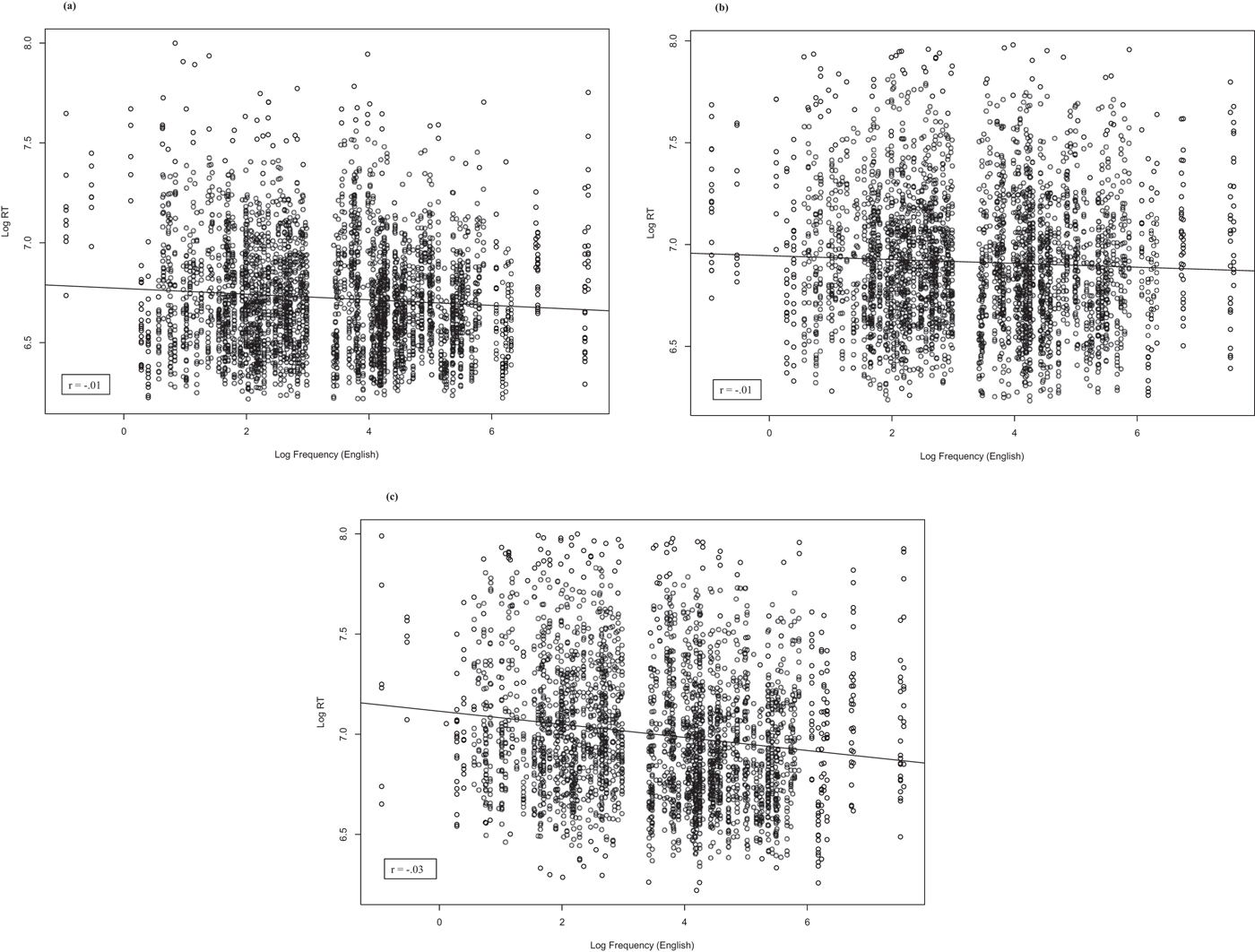
Scatterplot of the relationship between word frequency in log (x-axis) and picture-naming reaction times in log (y-axis) for monolinguals (a), bilingual Mandarin (b), and bilingual English (c).

Statistical comparisons between language group and word category for reaction times (RT) and accuracy. BE = Bilingual English (L2), BM = Bilingual Mandarin (L1), CI = Confidence Interval, Coef = Coefficient, SD = Standard Deviation, SE = Standard Error, V = Verb, ** = p < .01.

Pairwise comparison: t-test with the Tukey HSD adjustment
There was also a significant interaction effect between word category and group for RT and accuracy. These significant interactions indicated that the bilingual effect was smaller for verbs (L1 vs. monolinguals: 177.24ms; L2 vs. monolinguals: 295.61ms) than it was for nouns (L1 vs. monolinguals: 206.93ms; L2 vs. monolinguals: 311.71ms).
Effect of frequency
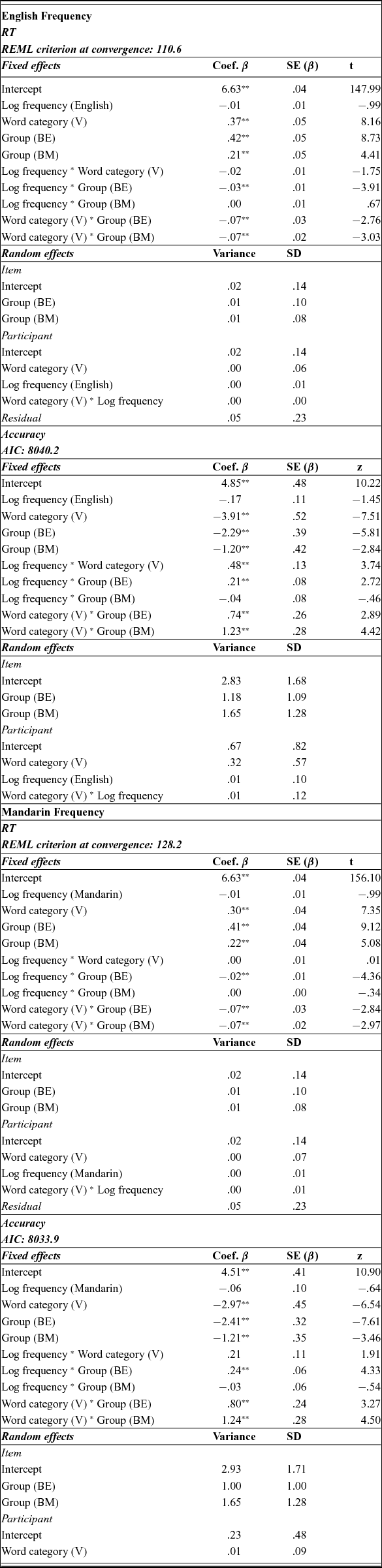
Table 2 shows the statistical comparison between each group for the frequency effect. Accuracy and RT data showed the same pattern of results. Models for both English and Mandarin frequency values generated the same pattern of findings, and the results for English frequency values are reported below. As we found in the first research question, RTs and accuracy data showed significant effects of word category, group, and group by word category interaction. A significant frequency by group (L2) interaction indicated faster RTs and higher accuracy rates for high versus low frequency words (larger frequency effect) for bilingual L2 only. In English, the accuracy data in addition showed a larger frequency effect for verbs compared to nouns (β = 0.48, |z| = 3.74, SE = 0.13, p < .01).
Statistical comparisons of RT and accuracy between language and frequency (English and Mandarin) for nouns and verbs. BE = Bilingual English (L2), BM = Bilingual Mandarin (L1), Coef = Coefficient, SD = Standard Deviation, SE = Standard Error, V = Verb, ** = p < .01.

Effect of translatability
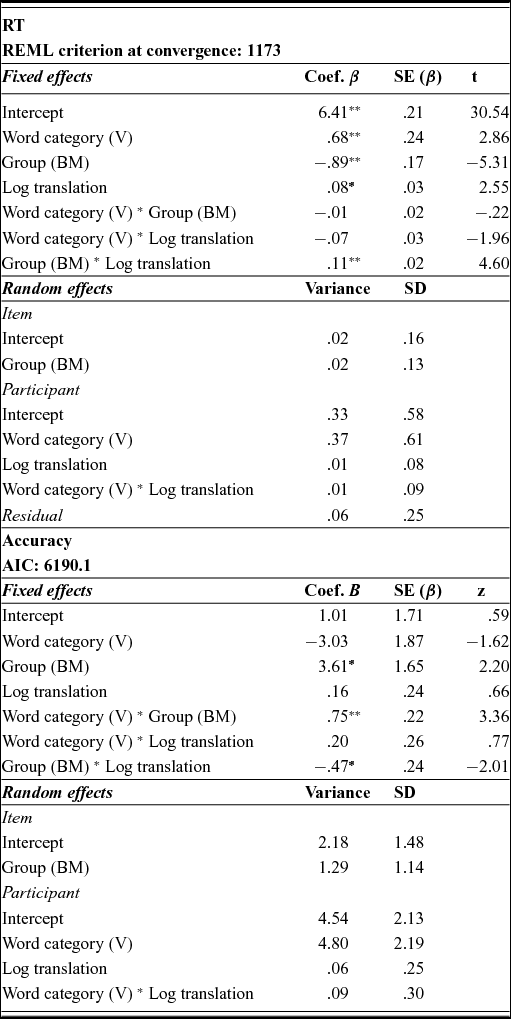
Results of the statistical comparison for the translatability effect are given in Table 3. As with previous analyses, both RT and accuracy data of picture naming captured a main effect of group, a main effect of word category (for RT only), and interaction between group and word category (for accuracy only). In addition, RT data of picture naming showed a main effect of translatability when the group reference level was L2 (p < .05) – that is, faster response times in picture naming for items that were translated faster compared to items that were translated slower, suggesting translation facilitation. We also tested the main effect of translatability when the group reference level was L1, and the result revealed a larger significant effect of translation facilitation (p < .01). An additional significant group (L1) by translation interaction in RT indicated that the translatability effect was significant in both L1 and L2, and was particularly larger in L1 than in L2, as shown in Figure 3. The accuracy data did not capture a main effect of translatability when the group reference level was L2, but a significant group (L1) by translation interaction suggests the translatability effect was significant in bilingual L1.
Statistical comparisons of RT and accuracy between language and translatability for nouns and verbs. BE = Bilingual English (L2), BM = Bilingual Mandarin (L1), Coef = Coefficient, SD = Standard Deviation, SE = Standard Error, V = Verb, ** = p < .01, * = p < .05.

Scatterplot of the relationship between translatability in log (x-axis) and picture-naming reaction times in log (y-axis) for bilingual Mandarin (a) and bilingual English (b).

Discussion
This study compared picture naming in highly proficient Mandarin–English and monolingual English speakers. To our knowledge, this is the first study to report bilingual picture naming data for Mandarin–English bilinguals. Mandarin is typologically different from Indo-European languages, and, of particular relevance to this study is the verb-friendly nature of Mandarin. Additionally, the ‘weaker-links’ and cross-language interference hypotheses were tested for their ability to explain bilingual's slow and less accurate performance in lexical retrieval for both nouns and verbs. This was done by analyzing the influence of lexical frequency and translatability on picture naming performance. In the following sections, we discuss the effects of bilingualism, translatability, word frequency and word category, followed by implications for our understanding of bilingual language representation.
The bilingual effect
When compared to monolinguals, Mandarin–English bilinguals had slower response speed and lower verb naming accuracy, both in L1 and L2. This magnitude of bilingual effect was larger in L2 than in L1. This finding is consistent with previous studies of bilingual speakers of Indo-European languages, such as Spanish–English, Catalan–English and French–English (e.g., Roberts et al., Reference Roberts, Garcia, Desrochers and Hernandez2002; Gollan et al., Reference Gollan, Montoya and Werner2002; Gollan et al., Reference Gollan, Montoya, Fennema-Notestine and Morris2005). A majority of previous studies have investigated bilinguals’ L2, and a few studies have examined bilinguals’ L1 (e.g., Ivanova & Costa, Reference Ivanova and Costa2008). The current study replicates Ivanova and Costa's (Reference Ivanova and Costa2008) finding that learning a second language has an impact on lexical retrieval in the native and dominant language. Comparing with monolinguals, performance in bilingual L1 by itself does not adjudicate between weaker links and cross-language interference accounts since it can be accommodated by both accounts. Ever since becoming bilingual, the Mandarin–English speakers use each of their languages less frequently compared to monolinguals, and this can lead to a weakening of L1 representations. L2 words can also compete with L1 and hence interfere with L1 production. Although our participants had not been residing in an L2 environment for very long and were using both languages on a daily basis, the weakening of performance in L1 could also be an early sign of L1 attrition (Schmid & Köpke, Reference Schmid and Köpke2009).
One limitation of our study is the absence of a monolingual Mandarin group that would have allowed us to have had a direct comparison between the same bilingual L1 and monolingual L1. Given that Mandarin and English differ in phonology and lexical morphology, it is possible that cross-linguistic differences have impact on the significant findings in this study. Therefore, future studies could include a group of monolingual Mandarin speakers to better control for cross-linguistic differences across monolingual and bilingual groups.
Effect of translatability
We found faster and more accurate picture naming responses for words that could be translated more quickly. This translation facilitation effect was found in both L1 and L2, with larger magnitude for L1 compared to L2. It should be pointed out that we measured translation speed from L2 to L1, and so it is likely that the larger effect of translation speed in L1 is because our translation measure more closely resembles word production in L1. The finding of translation facilitation is consistent with previous studies showing that translations facilitate word retrieval (Costa et al., Reference Costa, Miozzo and Caramazza1999; Gollan & Acenas, Reference Gollan and Acenas2004). For instance, in a picture word interference paradigm, Costa et al. (Reference Costa, Miozzo and Caramazza1999) showed that picture-naming speed was facilitated when translations were used as distractors. Gollan and Acenas (Reference Gollan and Acenas2004) used a picture-naming task and showed that bilinguals had fewer TOTs for words that could be more successfully translated. In this case, the translation facilitation occurred implicitly, even when no cross-language distractor was presented. The present study extends Gollan and Acenas’ work via analysis of response speed in addition to accuracy data. Finally, the current study also extends prior research by demonstrating a translation facilitation effect for verbs.
Given that there is unambiguous evidence that both languages of a bilingual are active during speaking (even in a monolingual mode, e.g., Colomé, Reference Colomé2001), the question is how the two active translation equivalents expedite naming of the target word in the target language. Word retrieval for highly translatable words could be facilitated by two possible mechanisms, which are not mutually exclusive (Gollan & Acenas, Reference Gollan and Acenas2004). One possibility is that there are direct facilitatory connections between translation equivalents, as proposed in Kroll and Stewart's (Reference Kroll and Stewart1994) hierarchical model of bilingual lexical representation. Another possibility is that the activated translation provides a boost to the target lexical representation by means of interactive activation between semantic and lexical connections (Dijsktra & van Heuven, 2002). Additionally, one may hypothesize that, over the course of time, the co-activation of the two translations for high translatability words makes the two cue each other and strengthens the lexical representations in each language. Such retrieval-induced consolidation is less likely to occur for low translatability words, which might just activate the lexical representation in the target language (Wolff & Ventura, Reference Wolff and Ventura2009). Crucially, these accounts, and any other accounts of translation facilitation, need to assume that translations do not compete for lexical selection, at least for phonological encoding.
The findings of the current study are incompatible with a bilingual lexical selection mechanism in which translation equivalents compete for selection, resulting in cross-language interference. It is noteworthy that the experimental manipulations that found cross-language interference typically used open-ended tasks such as verbal fluency (Sandoval et al., Reference Sandoval, Gollan, Ferreira and Salmon2010), or used semantic distractors in picture word interference (Costa et al., Reference Costa, Miozzo and Caramazza1999; Hermans et al., Reference Hermans, Bongaerts, De Bot and Schreuder1998), and interlexical homographs for semantic decision (Macizo et al., Reference Macizo, Bajo and Martín2010). In these situations, the words that are competing with the target word are typically semantically related words, which induce semantic interference. Semantic interference effects are well documented, even for monolingual speakers (e.g., Bloem & La Heij, Reference Bloem and La Heij2003).
Effect of word frequency
The finding of faster response and higher accuracy for high frequency compared to low frequency words has been reported for over half a century for monolingual speakers (e.g., Bartram, Reference Bartram1974; Balota, Cortese, Sergent-Marshall, Speiler & Yap, 2004; Oldfield & Wingfield, Reference Oldfield and Wingfield1965). The logic is that each time a word is activated, its lexical representation is strengthened, lowering its threshold for future activation. Infrequent words get less of this activation-related strengthening because speakers do not use these words as often (e.g., Monaghan, Chang, Wellbourne & Brysbaert, Reference Monaghan, Chang, Welbourne and Brysbaert2017). Applying the same logic, the magnitude of the frequency effect is inversely related to language proficiency, both in monolinguals and bilinguals (Diependale, Lemhöfer & Brysbaert, Reference Diependaele, Lemhöfer and Brysbaert2013; Gollan et al., Reference Gollan, Montoya, Fennema-Notestine and Morris2005, Reference Gollan, Montoya, Cera and Sandoval2008; Monaghan et al., Reference Monaghan, Chang, Welbourne and Brysbaert2017). In the present study, bilinguals showed a larger frequency effect in L2 compared to L1 and monolinguals. This replicated previous findings of a more marked frequency effect in L2 than in L1 across a variety of experimental tasks with nouns (Duyck et al., Reference Duyck, Vanderelst, Desmet and Hartsuiker2008; Gollan et al., Reference Gollan, Montoya, Cera and Sandoval2008, Reference Gollan, Sandoval and Salmon2011; Van Wijnendaele & Brysbaert, Reference Van Wijnendaele and Brysbaert2002). The present study (to our knowledge for the first time) showed that the exaggerated L2 frequency effect is present with verb naming as well.
It is noteworthy that, even though bilinguals were slower and less accurate in both L1 and L2 compared to monolinguals, they showed the exaggerated frequency effect only in L2. This finding supports Gollan et al. (Reference Gollan, Montoya, Cera and Sandoval2008), in which they found the exaggerated frequency effect depends on how often a bilingual speaker uses the language, so less use indicates greater frequency effect. The weaker links/frequency lag hypothesis is supported by the larger L2 frequency effect, but not the overall weaker bilingual performance in both L1 and L2. For weaker links hypothesis to explain both L1 and L2 performance, we should have observed a larger frequency effect in both L1 and L2. In other words, the L2-only exaggerated frequency effect shown in the present study and in prior studies, only partly supports the weaker links account. Thus, it is important to consider other possible explanations of the L2-only frequency effect.
Based on a meta-analysis of visual lexical decision latencies, Monaghan et al. (Reference Monaghan, Chang, Welbourne and Brysbaert2017) suggested that the size of the frequency effect is a key predictor of the overall lexical processing speed. Thus, slower participants (or conditions) show a larger frequency effect. In the present study, L2 naming had the slowest speed and the larger frequency effect. The overall response speed explanation falls short when we consider that verbs had slower response times than nouns, but had the same magnitude of frequency effect as nouns. This can be reconciled if we assume that the delay in verb naming stems from pre-lexical sources such as visual analysis of the picture and activation of morphosyntactic features prior to lexical access (Szekely et al., Reference Szekely, D'Amico, Devescovi, Federmeier, Herron, Iyer, Jacobsen and Bates2005). Verb accuracies showed a larger frequency effect than nouns for L2 (interaction between word category and group, Table 2), bilingual participants showed larger accuracy decrement for low frequency L2 verbs. As mentioned before, this could be due to the extra time required for naming verbs arising from pre-lexical sources, and is thus not reflected in the frequency effect. Frequency effects are typically assumed to arise from lexical-phonological encoding (Roelofs, 1997; Strijkers, Baus, Runnqvist, FitzPatrick & Costa, 2013). These possible explanations could be evaluated in future work.
The interpretation of frequency effects warrants consideration of a few factors. Frequency effect needs to be interpreted with the caveat that word frequency is confounded with numerous conceptual and lexical variables such as age of acquisition, conceptual complexity, word length, and name agreement (Barry, Hirsh, Johnston & Williams, Reference Barry, Hirsh, Johnston and Williams2001; Dent, Johnston & Humphreys, Reference Dent, Johnston and Humphreys2008; Ivanova & Costa, Reference Ivanova and Costa2008; Kittredge, Dell, Verkuilen & Schwartz, Reference Kittredge, Dell, Verkuilen and Schwartz2008; Kuperman, Stadthagen-Gonzalez & Brysbaert, Reference Kuperman, Stadthagen-Gonzalez and Brysbaert2012; Morrison, Ellis & Quinlan, 1992). Less reported, but of particular relevance to the current study, is the interaction between word frequency and translatability (de Groot, Reference de Groot1992; Gollan & Acenas, Reference Gollan and Acenas2004). The confound between frequency and translatability is relevant because we separately analyzed frequency and translatability effects to evaluate two different accounts of word retrieval in bilinguals. In our study, both English and Mandarin frequency values and translation times were correlated, showing faster translation for more frequent words (English: r = −.20, p < .01; Mandarin: r = −.12, p < .01). Future work could help us better understand how each of these factors impacts bilingual lexical retrieval if they were added into a single model. At this time, we can attest that words that are used more frequently have a production advantage in bilingual L2, and this pattern holds for both nouns and verbs. In bilingual L1, easily translated nouns and verbs have a production advantage, while frequency effects are insignificant.
The word category effect
The current study had three noteworthy findings regarding grammatical categories: 1) Verbs were slower and less accurate compared to nouns in both monolinguals and bilinguals; 2) the magnitude of the bilingual effect was smaller for verbs compared to nouns; 3) the effects of lexical frequency and translatability were similar for both nouns and verbs. We discuss each of these results in the following paragraphs.
The overall verb production challenge is consistent with prior findings comparing verb and noun retrieval in monolinguals (e.g., Haman et al., Reference Haman, Łuniewska, Hansen, Simonsen, Chiat, Bjekić, Blaziene, Chyl, Dabasinskiene, Engel de Abreu, Gagarina, Gavarro, Hakansson, Harel, Holm, Kapalkova, Kunnari, Levorato, Lindgren, Mieszkowska, Montes Salarich, Potgieter, Ribu, Ringblom, Rinker, Roch, Slancova, Southwood, Tedeschi, Tuncer, Unal-Logacev, Vuksanović and Armon-Lotem2017; Kauschke & Frankenberg, Reference Kauschke and von Frankenberg2008; Shao et al., Reference Shao, Roelofs and Meyer2012; Szekely et al., Reference Szekely, D'Amico, Devescovi, Federmeier, Herron, Iyer, Jacobsen and Bates2005), bilinguals (Jia et al., Reference Jia, Kohnert and Collado2006; Van Hell & de Groot, Reference Van Hell and de Groot1998; Hernández et al., Reference Hernández, Cano, Costa, Sebastián-Gallés, Juncadella and Gascón-Bayarri2008), and individuals with brain damage (e.g., Faroqi-Shah, Reference Faroqi-Shah2012; Mätzig et al., Reference Mätzig, Druks, Masterson and Vigliocco2009). The present study adds to this literature by directly comparing verbs and nouns in a picture-naming task in which both reaction times and percent accuracy were reported. Several explanations are available for the verb performance. Vigliocco et al. (Reference Vigliocco, Vinson, Druks, Barber and Cappa2011) suggested that verbs are more complex in their semantic, syntactic, and morphological representations, which leads to greater demands of processing compared to nouns, even when verbs are retrieved in isolation. Additionally, pictures used to elicit verb names often depict actions as relations between entities and require participants to mentally infer the action event, whereas individual entities are pictured for noun naming. Thus, action naming engages more complex visual processing and inferencing. Consistent with this, regression analyses by Szekely et al. (Reference Szekely, D'Amico, Devescovi, Federmeier, Herron, Iyer, Jacobsen and Bates2005) for monolinguals and Faroqi-Shah and Li (in prep) for bilinguals found that visual complexity of the picture was a strong predictor for both action and object naming speed. In fact, Szekely et al. (Reference Szekely, D'Amico, Devescovi, Federmeier, Herron, Iyer, Jacobsen and Bates2005) found that picture-naming speed was correlated with picture complexity. In the present study, the mean picture complexity values of verbs were significantly higher than that of nouns (t = 4.8, df = 198, p < .01). Thus the slower naming speed and lower accuracy for verbs than for nouns could be attributed to both their linguistic (semantic and morphosyntactic complexity) and stimulus (picture complexity) properties.
We found an interaction between participant group and grammatical category, such that the effect of bilingualism was larger for nouns (206.93ms in Mandarin and 311.71ms in English) than for verbs (177.24ms in Mandarin and 295.61ms in English). This finding is consistent with a few prior studies of bilingual adults (Faroqi-Shah & Li, in prep for Spanish–English picture naming; Faroqi-Shah and Milman, Reference Faroqi-Shah and Milman2015 for verbal fluency in Spanish–English and Hindi–English; Klassert et al., Reference Klassert, Gagarina and Kauschke2014 for picture naming study by Russian–German bilingual children; and Sheng et al., Reference Sheng, McGregor and Marian2006 for word associations by Mandarin–English bilingual children). Here we evaluate the most intuitive explanations of this finding.
First, the smaller bilingual effect for verbs could be due to the verb-friendly properties of Mandarin, such as morphological simplicity, sentence final position (Huang, Reference Huang1989), and early age of acquisition (Tardif, Reference Tardif1996). Therefore, verbs might require relatively less effort to retrieve by Mandarin–English bilinguals compared to nouns, yielding a smaller bilingual effect. However, this explanation does not account for the smaller bilingual effect for verbs reported in other bilingual groups such as Spanish–English (e.g., Faroqi-Shah & Li, in prep; Faroqi-Shah & Milman, Reference Faroqi-Shah and Milman2015) and Russian–German (Klassert et al., Reference Klassert, Gagarina and Kauschke2014).
Second, it has been argued that nouns are semantically more similar across languages compared to verbs (Gentner, Reference Gentner1981) and have lower translation ambiguity (Prior et al., Reference Prior, MacWhinney and Kroll2007). This implies stronger cross-language activation of translation equivalents for nouns compared to verbs, exposing nouns to greater cross-language interference from the non-target language (Van Hell & de Groot, Reference Van Hell and de Groot1998). It might take longer to resolve a stronger cross-language competition. However, we found that nouns were translated faster than verbs (mean translation time of nouns = 1076.76ms, SD = 362.05ms; mean translation time of verbs = 1184.24ms, SD = 422.49ms). Hence, cross language interference does not account for the larger bilingual effect for nouns either.
A third explanation is that the cumulative detrimental effects of verb retrieval and bilingualism are not directly additive. Given that verb naming is overall slower than noun naming (due to linguistic and stimulus complexity discussed earlier), the longer time taken to retrieve a verb somewhat masks the bilingual effect. This view is tenable if one were to assume an interactive view of word production, in which there is temporal overlap in conceptual-semantic access and phonological planning (rather than strictly serial view of word production).
The final finding regarding word categories was that the effects of frequency and translatability were generally comparable for verbs and nouns. This means that, beyond the overall slower retrieval speed of verbs, the mechanisms underlying lexical access are similar across word categories. The only exception to this pattern was a larger effect of frequency for verb naming accuracy compared to nouns. This is likely due to lower name agreement for low frequency verbs, resulting in lower overall accuracy.
Conclusions
The present study provided converging evidence that word retrieval in bilinguals is slower and less accurate compared to monolinguals in both L1 and L2, and extended the findings to verbs and to Mandarin–English speakers. This study elucidated the characteristics of this bilingual effect. The bilingual effect is graded, with a larger effect in L2 compared to L1. The bilingual effect is smaller in magnitude for verbs compared to nouns. The bilingual effect is modulated by translatability in both L1 and L2, particularly in L1, which means that it is less pronounced for words that can be more easily translated between L1 and L2. In L2, the bilingual effect is also modulated by frequency, such that low frequency words are retrieved more slowly and less accurately than high frequency words. The smaller magnitude of bilingual effect for verbs could be attributed to the overall longer latency of verbs, or a stronger cross-language translation facilitation. Translatability and frequency effects are conflated as evidenced by the strong correlation between word frequency and translation speed.
This study evaluated two explanations of the bilingual effect. The key test of the weaker links account was an exaggerated frequency effect, which was found only in L2 (compared to L1 and monolinguals) even though the bilingual effect was found in both L1 and L2. The weaker links account, in its traditional form, can explain the L2 findings, but not the findings in L1. The cross-language interference was tested by examining if low translatability words had a smaller bilingual effect. The translation facilitation found in the present study does not support cross-language interference as a source of the bilingual effect (Van Hell & de Groot, Reference Van Hell and de Groot1998; Green, Reference Green1998; Hermans, Reference Hermans2004; Hermans et al., Reference Hermans, Bongaerts, De Bot and Schreuder1998; Lee & Williams, Reference Lee and Williams2001; Sandoval et al., Reference Sandoval, Gollan, Ferreira and Salmon2010). The present study's findings can be reconciled by suggesting that word retrieval in highly proficient bilinguals is governed by a complex interplay between word frequency (frequency effect), connection strength between translation equivalents (translation facilitation), and overall efficiency of retrieval (verbs are slower than nouns). Further research can examine the relative contribution of each of these factors, as well as other factors unexplored in this study, such as the effects of words’ sublexical patterns (Li et al., Reference Li, Wang and Idsardi2015), age of acquisition (Dent et al., Reference Dent, Johnston and Humphreys2008), and the degree of conceptual overlap across languages. In order to better understand how bilinguals perform word retrieval compared to monolinguals, an additional monolingual Mandarin (L1) group can be included in future studies.
– Noun Stimuli

– Verb Stimuli

Appendix II – Task Instructions
1. Picture-Naming Task:
A. English Noun-Naming: “In this experiment you will be naming objects, which are illustrated in the pictures. Before each picture appears, you will see a fixation point +. Your task is to give the English name for the object. Try to do so as quickly and accurately as you can. Please try to avoid coughing, repeating words, and using uh or umm before you name the word.”
B. English Verb-Naming: “In this experiment you will be naming actions, which are illustrated in the pictures. Before each picture appears, you will see a fixation point +. Your task is to give the English name (present tense) for the action as quickly and accurately as you can. Try not to use tense markers (e.g., -ing, -ed). Please try to avoid coughing, repeating words, and using uh or umm before you name the word.”
C. Mandarin Noun-Naming: “In this experiment you will be naming objects, which are illustrated in the pictures. Before each picture appears, you will see a fixation point +. Your task is to give the Chinese name for the object. Try to do so as quickly and accurately as you can. Please try to avoid coughing, repeating words, and using uh or umm before you name the word.”
D. Mandarin Verb-Naming: “In this experiment you will be naming actions, which are illustrated in the pictures. Before each picture appears, you will see a fixation point +. Your task is to give the Chinese name for the action as quickly and accurately as you can. Please try to avoid coughing, repeating words, and using uh or umm before you name the word.”
2. Translation task:
A. Noun translation: “You will see an English word of an object on the next screen. Please translate it into Mandarin as quickly as you can.”
B. Verb translation: “You will see an English word of an action on the next screen. Please translate it into Mandarin as quickly as you can.”