Introduction
Childhood obesity is a global public health concern, and there is growing interest in the relationship with short sleep duration. Short sleep and obesity are consistently and clearly associated across diverse populations, independent of potential confounding factors including age, socioeconomic status and parental and household factors (Cappuccio et al., Reference Cappuccio, Taggart, Kandala, Currie, Peile, Stranges and Miller2008; Chen et al., Reference Chen, Beydoun and Wang2008; Patel & Hu, Reference Patel and Hu2008). The association is strongest in the youngest ages (Patel & Hu, Reference Patel and Hu2008), with sleep duration in pre-school children being independently associated with weight gain, particularly fat mass gain, later in childhood (Reilly et al., Reference Reilly, Armstrong, Dorosty, Emmett, Ness, Rogers, Steer and Sherriff2005; Carter et al., Reference Carter, Taylor, Williams and Taylor2011; Diethelm et al., Reference Diethelm, Bolzenius, Cheng, Remer and Buyken2011).
There is some evidence that in adults, hormonal mechanisms, appetite regulation and food intake link short sleep with weight gain (Taheri et al., Reference Taheri, Lin, Austin, Young and Mignot2004; Van Cauter et al., Reference Van Cauter, Holmback, Knuston, Leproult, Miller and Nedeltcheva2007; Schmid et al., Reference Schmid, Hallschmid, Jauchchara, Born and Schultes2008; Knutson, Reference Knutson2012). Studies have not been replicated in young children – although short sleep has been linked with child insulin resistance and metabolic marker levels (Flint et al., Reference Flint, Kothare, Zihlif, Suarez, Adams, Legido and De Luca2007; Spruyt et al., Reference Spruyt, Moflese and Gozal2011). An intervention that improved sleep in infants did not reduce overweight/obesity at age 6 years, indicating that (changes in) sleep may not directly impact obesity in young children (Wake et al., Reference Wake, Price, Clifford, Ukoumunne and Hiscock2011).
The role of social and cultural factors in the association between short sleep and obesity has been neglected, including the role of parenting (Hart & Jelalian, Reference Hart and Jelalian2008). Parental rules are associated with young children's sleep duration and obesity risk and may influence the link between them. For example, American children without a regular bedtime each night were found to be over twice as likely to fail to achieve US sleep duration recommendations for their age compared with those with one (Owens et al., Reference Owens, Jones and Nash2011). Parental rules regarding school children's sleep have been associated with time spent in bed (Meijer et al., Reference Meijer, Habekothé and van den Wittenboer2001); and household rules (including amount of television-viewing, eating sweets, bedtimes) were associated with longer weekday sleep (Adam et al., Reference Adam, Snell and Pendry2007). Children whose parents set limits on various activities and food habits are less likely to engage in obesity-promoting behaviours; for example rules restricting television-viewing are associated with less screen time (Carlson et al., Reference Carlson, Fulton, Lee, Foley, Heitzler and Huhman2010), a known risk factor for obesity in pre-schoolers (te Velde et al., Reference te Velde, van Nassau, Uijtdewilligen, van Stralen, Cardon and De Craemer2012). Consumption of ‘fat foods’ (including chips, biscuits, cakes, pies, chocolate and crisps) predicted weight gain in 1379 American pre-schoolers (Newby et al., Reference Newby, Peterson, Berkey, Leppert, Willett and Colditz2003); parental rules limiting consumption of such foods are likely to be protective against obesity. Family rules regarding what/when children eat, and time spent on television-viewing and video games, were less frequent in overweight parents with overweight adolescent children, compared with healthy weight parents with healthy weight children (Hearst et al., Reference Hearst, Sevcik, Fulterson, Pasch, Harnack and Lytle2012).
Parents who use rules to regulate one aspect of their child's behaviour (sleep, television-viewing, diet) may be more likely to do so in others (Thompson & Christakis, Reference Thompson and Christakis2005). This could lead to parental rules confounding the relationship between children's short sleep and obesity (because parental rules promote longer child sleep, healthier eating and less sedentary behaviour). Clustering of parental rules may also be important if they have a cumulative effect on children's sleep and body composition. In a US study examining three ‘household routines’ (regularly eating the evening meal as a family, adequate night-time sleep and limited screen-viewing time), the number of routines that pre-school children were exposed to was inversely associated with the prevalence of obesity (Anderson & Whitaker, Reference Anderson and Whitaker2010).
The present study aimed to examine relationships between different parental rules, and between parental rules and children's sleep duration and body composition, in a socioeconomically diverse population of families. This is a novel area of research, and the objective was to undertake exploratory research into these relationships, to inform the development of a hypothesis involving parental rules in the relationship between children's short sleep and obesity. The parental rules examined were: (1) setting a regular bedtime; (2) limiting television-viewing time; and (3) limiting intake of obesity-promoting foods. The following were examined: (1) associations of parental sleep, television-viewing and dietary rules with each other; (2) associations of parental rules with children's sleep duration and body composition; and (3) associations of parental rules, children's sleep duration and children's body composition with socioeconomic status. Socioeconomic status was examined because parental routines/rules are less prevalent in families of lower socioeconomic status (Hale et al., Reference Hale, Berger, LeBourgeois and Brooks-Gunn2009; Anderson & Whitaker, Reference Anderson and Whitaker2010); and deprivation is associated with greater prevalence of obesity in British children (Kinra et al., Reference Kinra, Nelder and Lewendon2000; Jebb et al., Reference Jebb, Rennie and Cole2004; Rennie & Jebb, Reference Rennie and Jebb2005); and with problematic sleep according to some (Rona et al., Reference Rona, Li, Gulliford and Chinn1998; Crabtree et al., Reference Crabtree, Korhonen, Montgomery-Downs, Jones, O'Brien and Gozal2005), but not all, studies (Smaldone et al., Reference Smaldone, Honig and Byrne2007; Mindell et al., Reference Mindell, Meltzer, Carskadon and Chervin2009). Since many pre-school children nap for substantial periods throughout the day (Iglowstein et al., Reference Iglowstein, Jenni, Molinari and Largo2003), both night-time sleep duration and total daily sleep duration (combined night-time sleep plus naps) were included in analyses.
Methods
This was a cross-sectional study of 3-year-old children and their parents, recruited at government-funded nursery schools in a socioeconomically diverse town in North-East England (Stockton-on-Tees). Nursery schools were identified in particularly deprived and non-deprived areas (based on the Index of Multiple Deprivation score for each area), and head-teachers were informed of the study by letter and a follow-up telephone call. Representatives in each participating nursery gave written informed consent. All parents of attending 3-year-old children who were able to complete interviews and diaries in English were eligible to participate (a small number were excluded at nursery staff discretion due to social services/police involvement or mental illness). Parents were informed about the study verbally and with an information sheet when they brought/collected their children from nursery. Those who gave written informed consent were interviewed at a private room in the nursery, after which they completed structured diaries. Ethical approval was granted by the Durham University Anthropology Departmental ethics committee, and data were collected from May 2008 to June 2009.
Semi-structured interviews (conducted by CJ) required parents to describe their children's typical sleep, food intake and television-viewing habits, including the use of parental rules. According to an anthropological interviewing style, interviews were conversational; parents were prompted to talk about the above topics with open questions (for example ‘Tell me about his/her typical bedtime, How do you feel about the amount of television that he/she watches?’), but were not required to answer discrete questions, so that responses were framed in parents' own terms and not imposed by the researchers. CJ ensured that the use/non-use of parental rules for sleep, diet and television-viewing were discussed by all parents either spontaneously, or as a result of specific prompting.
After listening to the interviews multiple times, CJ categorized parents as either implementing a parental rule or not for sleep/television-viewing/diet (verified by HB). The authors clearly defined the criteria needed to assign a family to the ‘parental rule’ or ‘no parental rule’ categories. This was discussed with an independent researcher prior to categorization, who then blind-coded a sample of five interviews. There was 100% agreement on the coding of parental rules between CJ and the independent researcher without necessitating discussion, hence it was considered that the coding method was reliable and CJ coded the remainder. Parents who described putting their children to bed/ensuring that they were in bed by the same time on all or most nights (e.g. with some flexibility on weekends/holidays) were assigned to the ‘parental sleep rule’ category. Those who described their children going to bed at different times each night, or who did not aim to set a regular bedtime, were assigned to the ‘no parental sleep rule’ category. Parents who restricted their children's television-viewing to what they felt to be an appropriate amount (or would restrict it if their child wanted to watch more) were assigned to the ‘parental television-viewing rule’ category. Those who allowed their children to watch as much television that they wanted were assigned to the ‘no parental television-viewing rule’ category. Parents who restricted the amount of ‘fat foods’ (including crisps, chips, sweets, chocolate, biscuits, cakes) that their children ate were assigned to the ‘parental dietary rule’ category. Those who did not limit the amount of ‘fat food’ that their children ate were assigned to the ‘no parental dietary rule’ category. Parents provided demographic information (child's birth order, household composition, mother's age at child's birth, mother's employment status) so that differences between socioeconomic groups could be examined.
Following interviews, parents were given diaries to document their children's sleep for 5 consecutive nights and the 4 intervening days (2 weekdays/2 weekend days). Parents reported the times at which their children went to bed, went to sleep, woke up and the duration of any daytime naps. Night-time sleep duration was calculated from sleep onset and wake up times, and naps were totalled for each day. Weighted means for night-time sleep and daily nap duration were calculated as [(mean week night/day sleep duration×5)+(mean weekend night/day sleep duration×2)÷7]. These were summed to obtain weighted mean total daily sleep duration for each child (night-time plus naps). Weighted means were used in all analyses to account for the different number of week and weekend days/nights, and because sleep duration has been shown to vary between week and weekends in young children (Snell et al., Reference Snell, Adam and Duncan2007). Diaries were validated by actigraphy in a convenience subgroup of eighteen children (twelve from non-deprived-area nurseries and six from deprived-area nurseries), who wore actiwatches to coincide with the entire diary period. Close correlation was found between diary and actigraphy measures of sleep start time, wake time and daily nap duration (no greater than 8 minutes difference between diary and actigraphy results for each; Pearson's correlation all r>0.80, paired samples t-test all p>0.05) (for more information see Jones, Reference Jones2011).
In light clothing with no shoes, at their nursery school, children were measured for height, weight, waist circumference and triceps and subscapular skinfold thicknesses by CJ, in accordance with Lohman et al. (Reference Lohman, Roche and Martorell1988). Weight was measured twice and all other measurements three times, so that means could be calculated. Body mass index (BMI) was calculated as kg/m2. Standard deviation (SD) scores were obtained for BMI and waist circumference using British 1990 reference data (Cole et al., Reference Cole, Freeman and Preece1990), and for triceps and subscapular skinfold thicknesses using WHO 2006 reference data (WHO, 2006).
Associations amongst categorical variables were assessed using chi-squared tests, and associations between categorical and continuous variables (all normally distributed) were assessed using independent t-tests.
Results
Participant characteristics
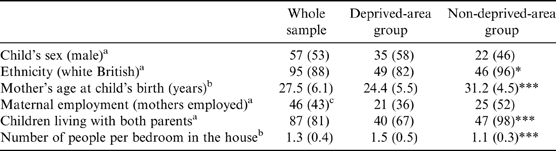
Five nursery schools participated. Based on the Index of Multiple Deprivation, three were in the 20% most deprived wards in England (the ‘deprived-area’ group), and two were in the 20% least deprived wards in England (the ‘non-deprived-area’ group). Accordingly, there were significant differences in weekly household earnings, proportion of residents claiming income benefits, low literacy and numeracy, and employment rate between the deprived and non-deprived areas in which participants were recruited, in the directions expected (Jones, Reference Jones2011). Parents of 133 children were invited, and 108 participated (response rate in the deprived-area group 81%, in the non-deprived-area group 83%). Around half the families (n=60, 56%) were in the deprived-area group, and half the children (n=57, 53%) were male. Characteristics of families are shown in Table 1. In the deprived-area compared with the non-deprived-area group there were significantly more non-white British families, fewer children living with both parents, younger maternal age and more people per bedroom living in the house.
Characteristics of participating families

a n (%); comparison between socioeconomic groups by χ 2 test.
b Mean (SD); comparison between socioeconomic groups by independent t-test.
c Maternal employment unknown for one participating family (in the deprived-area group).
Comparisons between socioeconomic groups: *p≤0.05; **p≤0.01; ***p≤0.001.
All 108 parents were interviewed. Data on the parental television-viewing rule were missing for six due to ambiguous parental responses that could not be confidently categorized; data on the sleep and dietary rules were complete for all 108. Sleep diary data were complete for 84 participants (other diaries partially completed or not returned); and body composition data were complete for 96 children (other children absent from nursery when measurements took place, or did not assent). Analyses involving sleep duration include only the children with complete sleep diary data (43 in the deprived-area and 41 in the non-deprived-area groups); and analyses involving body composition include only the children with complete body composition data (55 in the deprived-area and 41 in the non-deprived-area groups).
Mean night-time sleep duration (hh:mm) was 11:12±0:38, and mean total daily sleep duration (night-time plus naps) was 11:24±0:35. According to age- and sex-specific BMI cut-offs (Cole et al., Reference Cole, Bellizzi, Flegal and Dietz2000), 14% of children were overweight (n=12) or obese (n=1).
Parental rules
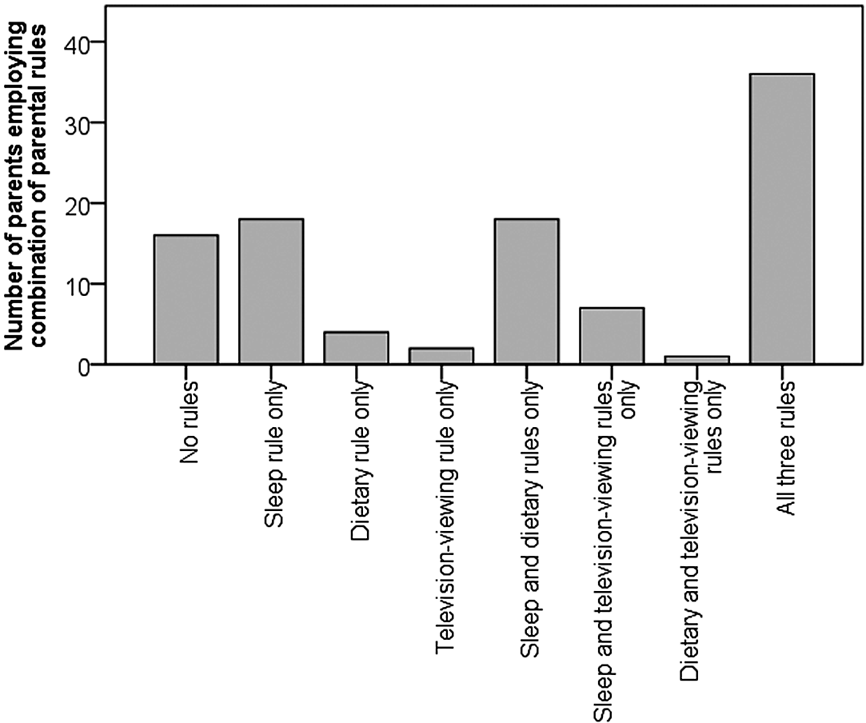
Eighty-three parents (77%) implemented the sleep rule, 46 (45%) implemented the television-viewing rule and 63 (58%) implemented the dietary rule. Parents who used the sleep rule were significantly more likely to employ the television-viewing and dietary rules compared with those who did not (χ 2=12.34, p<0.001 and χ 2=19.67, p<0.001 respectively). Parents who employed the television-viewing rule were significantly more likely to employ the dietary rule (χ 2=17.54, p<0.001). Sixteen parents employed no rules (16%), 24 employed one rule (24%), 26 employed two rules (26%) and 36 used all three rules (35%). Figure 1 shows the number of parents employing each combination of parental rules.
Number of parents employing each combination of parental rules. Total of 102 parents (use of the television-viewing rule was unknown for six of the 108 participants included in the study).
Associations of parental rules with sleep duration and body composition
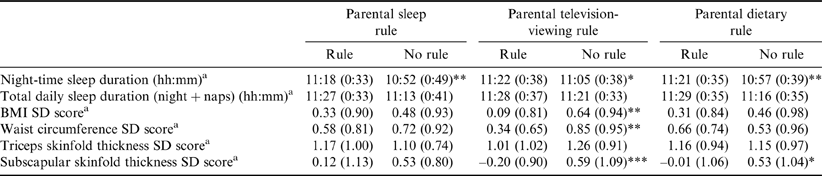
Associations of parental rules with children's sleep duration and body composition are shown in Table 2. For each rule, children whose parents implemented it had significantly longer night-time sleep duration compared with those whose parents did not; there were no significant differences in total daily sleep duration (night-time plus naps). Body composition did not vary significantly between children whose parents did versus did not implement the sleep rule. BMI, waist circumference and subscapular skinfold thickness SD scores were significantly greater in children whose parents did not implement the television-viewing rule; and subscapular skinfold SD score was significantly greater in children whose parents did not use the dietary rule.
Associations of parental rules with children's sleep duration and body composition
a Mean (SD).
Independent samples t-test: *p≤0.05; **p≤0.01; ***p≤0.001.
Socioeconomic differences
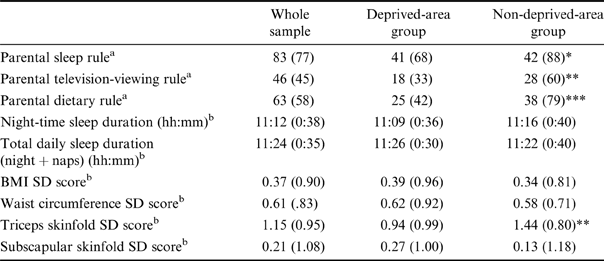
Comparisons in parental rules, children's sleep duration and children's body composition between the deprived-area and non-deprived-area groups are shown in Table 3. Significantly more parents in the non-deprived-area group implemented each parental rule. Sleep duration did not vary significantly between groups. Children in the non-deprived-area group had significantly greater mean triceps skinfold SD score; there were no other significant differences in body composition.
Comparisons of parental rules, children's sleep duration and body composition between the deprived-area and non-deprived-area groups
a Parents employing the parental rule, n (%); comparison between socioeconomic groups by χ 2 test.
b Mean (SD); comparison between socioeconomic groups by independent samples t-test.
Comparisons between socioeconomic groups: *p≤0.05; **p≤0.01; ***p≤0.001.
Discussion
Taken together, these exploratory results indicate that parental rules were clustered together, and were associated both with children's longer night-time sleep duration and some aspects of leaner body composition. This leads to the hypothesis that parental rules confound the observed association between young children's night-time sleep duration and body composition/obesity (but not combined night-time/daytime sleep duration and obesity – see below).
It is likely that multiple pathways link short sleep with obesity (Knutson, Reference Knutson2012); a novel anthropological approach has been taken in this study to expand the evidence-base beyond biological mechanisms. This is the first study, to the authors' knowledge, to demonstrate that parental rules for different aspects of pre-school children's lifestyles are correlated together, and that television-viewing and dietary rules are associated with children's sleep duration as well as obesity risk. Future research should test the hypothesis that parental rules play a role in the association between short sleep and obesity, estimate how much so, and examine these associations longitudinally to determine causality, i.e. whether parental rules lead to longer sleep duration and leaner body composition.
Parental rules may directly impact sleep duration and body composition; for example regular, early bedtimes provide children with adequate sleep opportunity, and shorter television-viewing (sedentary) time and reduced intake of ‘fat foods’ help to prevent excess energy intake. Restricting television-viewing may limit sedentary activity time and snacking (thereby protecting against obesity), in addition to preventing disturbed sleep, which is more likely in children who watch more television (Owens et al., Reference Owens, Maxim, McGuinn, Nobile, Msall and Alario1999; Taheri, Reference Taheri2006). Alternatively, the presence of parental rules may reflect household structure and regularity, which in turn are associated with improved child health. Previous research has found the presence of family routines to be associated with improved health (Denham, Reference Denham2003), with pre-school children being healthier, and their behaviour better regulated, when there are predictable routines in the family (Fiese et al., Reference Fiese, Tomcho, Douglas, Josephs, Poltrock and Baker2002). Furthermore, exposure to three household routines was associated with a lower prevalence of obesity in pre-school children (Anderson & Whitaker, Reference Anderson and Whitaker2010). There was variability in parental rules in the present study, with some parents employing them more strictly than others (for example in the parental sleep rule category some parents maintained the same bedtime with no variation at all, whilst others allowed the regular bedtime to vary by 30 minutes on weekends). It may not be the exact nature of the rule that determines the relationship with sleep duration/body composition, but the presence of some form of structure and regulation that positively impacts health.
Each parental rule was significantly associated with longer night-time sleep, but not sleep duration over the entire day. There are conflicting results regarding the role of napping in the sleep–obesity association (Agras et al., Reference Agras, Hammer, McNicholas and Kraemer2004; Ohayon & Vecchierini, Reference Ohayon and Vecchierini2005; Bell & Zimmerman, Reference Bell and Zimmerman2010). This study's results and proposed hypothesis are consistent with those of the majority of studies that demonstrate an association between childhood obesity and night-time sleep duration but do not measure total sleep duration over the entire day (Kagamori et al., Reference Kagamori, Yamagami, Sokejima, Numata, Handa and Nanri1999; von Kries et al., Reference von Kries, Toschke, Wurmser, Sauerwald and Koletzko2002; Reilly et al., Reference Reilly, Armstrong, Dorosty, Emmett, Ness, Rogers, Steer and Sherriff2005; Jiang et al., Reference Jiang, Zhum, Yan, Jin, Bandla and Shen2009).
Interestingly, nap duration in this sample was relatively short (the difference between mean night-time sleep and combined night-time/daytime sleep was 12 minutes). Half the children had at least one nap over the 4-day diary period, and median (interquartile range) daily nap duration in those children who napped was 21 (34) minutes (Jones & Ball, Reference Jones and Ball2013). Shorter night-time sleep amongst children in the deprived-area group was compensated for by longer daytime sleep, resulting in similar sleep amounts over the entire day in both socioeconomic groups. It has been previously reported that children in this sample whose parents allowed or encouraged naps had longer daily nap duration than those whose parents prevented naps (see Jones & Ball, Reference Jones and Ball2013, which also includes a discussion of the issue of nap prevention). Perhaps preventing naps (whether appropriate or not at this age) is another parental sleep rule that may be associated with the rules examined in this study. Children whose parents employed the regular bedtime sleep rule had longer night-time sleep, but if they also experienced the nap prevention rule they would be likely to have shorter nap duration, which may explain the similar sleep amounts over the entire day compared with those whose parents did not enforce parental sleep rules (who would have shorter night-time sleep but longer daytime napping).
The television-viewing and dietary rules were associated with leaner child body composition compared with lack of those rules, in support of previous research (te Velde et al., Reference te Velde, van Nassau, Uijtdewilligen, van Stralen, Cardon and De Craemer2012); the trend did not exist for the sleep rule. The parental dietary rule was associated with subscapular skinfold thickness only (a measure of central adiposity), which is important because central adiposity is strongly correlated with adverse health consequences in children (Lobstein et al., Reference Lobstein, Baur and Uauy2004; Katzmarmyk et al., Reference Katzmarmyk, Srinivasan, Chen, Malina, Bouchard and Berenson2004).
Parental rules were more prevalent in the non-deprived-area group, as found previously (Hale et al., Reference Hale, Berger, LeBourgeois and Brooks-Gunn2009; Hale et al., Reference Hale, Berger, LeBourgeois and Brooks-Gunn2011). Deprived households may be less likely to maintain parental rules due to increased stress and lack of household structure, organization and predictability (Bornstein et al., Reference Bornstein, Hahn, Suwalsky, Haynes, Bornstein and Bradley2003; Evans et al., Reference Evans, Gonnella, Marcynyszyn, Gentile and Salpekar2005). The present data did not support a positive association between obesity and low social class/deprivation in young UK children (Kinra et al., Reference Kinra, Nelder and Lewendon2000; Jebb et al., Reference Jebb, Rennie and Cole2004). In fact, triceps skinfold thickness was greater in children in the non-deprived-area compared with deprived-area group, a finding we were not able to explain, but which may be due to the relatively small sample size compared with nationally representative studies of obesity. No difference in sleep duration was found between socioeconomic groups. Hence socioeconomic differences in parental rules do not appear to be reflected in differences in body composition and sleep duration; however, this study was only designed to evaluate bivariate relationships.
The novel hypothesis that parental rules confound the sleep–obesity association has implications for the use of sleep interventions to reduce or prevent obesity. Taheri (Reference Taheri2006, p. 881) made a call to ‘recommend more sleep to prevent obesity’. Yet an infant sleep intervention did not reduce overweight/obesity at age 6 years (Wake et al., Reference Wake, Price, Clifford, Ukoumunne and Hiscock2011). The present results suggest that rather than targeting sleep duration as a single health behaviour with the potential to prevent obesity, the larger upstream issues of lack of structure and regulation of certain behaviours, such as sleep, particularly in deprived households, should be addressed. Little is known about successful components of behavioural interventions to prevent obesity in young children (Waters et al., Reference Waters, de Silva-Sanigorski, Hall, Brown, Campbell and Gao2011). Motivating and empowering households to become more organized and structured, which would be reflected in the use of parental rules, could be beneficial for a number of child health outcomes including preventing/treating obesity, and improving sleep duration, thereby reducing discordance between current sleeping patterns and human sleep physiology (Jones & Ball, Reference Jones, Ball, Green and Westcombe2012).
Limitations of this study include lack of an objective measure of sleep duration and lack of accountability for night wakings when calculating sleep duration. The sleep duration estimate was made more robust by calculating weighted means over 5 nights/4 days, and validating diaries against actigraphy. The assigning of parents to parental rule/no parental rule categories according to interview responses was open to bias. In order to minimize this risk the criteria needed to categorize parents were clearly described and this was discussed with an independent researcher who agreed with the categorization of five parents after blind-coding. The sample size was limited by incomplete sleep diary and body composition data. Due to the exploratory nature of the study there was a lack of power calculations; and analyses did not control for other potential confounding variables such as parental obesity. This reflects the study's aim, which was to generate and explore, rather than test, hypotheses.
This is the first study to the authors' knowledge to demonstrate the clustering of parental rules in different aspects of children's lifestyles, and the association of parental rules with both sleep duration and body composition. Future studies should rigorously test the hypothesis that parental rules confound the sleep–obesity link in large representative samples of young children. Determining whether parental rules play a role in the association, and how much so, is important given the growing need for interventions to prevent obesity in young children. Until now the emphasis has been on elucidating biological mechanisms causing short sleep to directly impact obesity (Taheri et al., Reference Taheri, Lin, Austin, Young and Mignot2004; Flint et al., Reference Flint, Kothare, Zihlif, Suarez, Adams, Legido and De Luca2007; Van Cauter et al., Reference Van Cauter, Holmback, Knuston, Leproult, Miller and Nedeltcheva2007; Schmid et al., Reference Schmid, Hallschmid, Jauchchara, Born and Schultes2008; Spruyt et al., Reference Spruyt, Moflese and Gozal2011). This exploratory study has highlighted the power of an anthropological perspective to challenge and further our understanding. Rather than recommending sleep to prevent obesity, perhaps we should recommend parental rules to both prevent obesity and improve sleep.
Acknowledgments
The authors thank the parents, children and nursery staff who participated in this study. The research was funded by the Economic and Social Research Council and Medical Research Council through CJ's studentship. The Biosocial Society provided additional fieldwork funding. Thanks also go to Megan Newark who served as an independent researcher and blind-coded interviews.