Contamination of the skin and clothing of healthcare personnel during removal of personal protective equipment (PPE) contributes to dissemination of pathogens and places personnel at risk for infection.Reference Tomas, Kundrapu and Thota 1 , Reference Kwon, Burnham and Reske 2 Educational interventions can improve the donning and doffing technique to reduce contamination.Reference Tomas, Kundrapu and Thota 1 , Reference Lai, Guo, Or and Li 3 However, recent surveys suggest that PPE training is often suboptimal with no requirement for demonstration of proficiency.Reference John, Tomas and Cadnum 4 , Reference John, Tomas, Hari, Wilson and Donskey 5 Disinfection of PPE prior to removal has shown promise in reducing contamination of personnel,Reference Tomas, Sunkesula, Kundrapu, Wilson and Donskey 6 , Reference Koganti, Alhmidi and Tomas 7 but this approach may only be practical during care of patients with suspected or documented infection due to pathogens such as Ebola virus.Reference Koganti, Alhmidi and Tomas 7
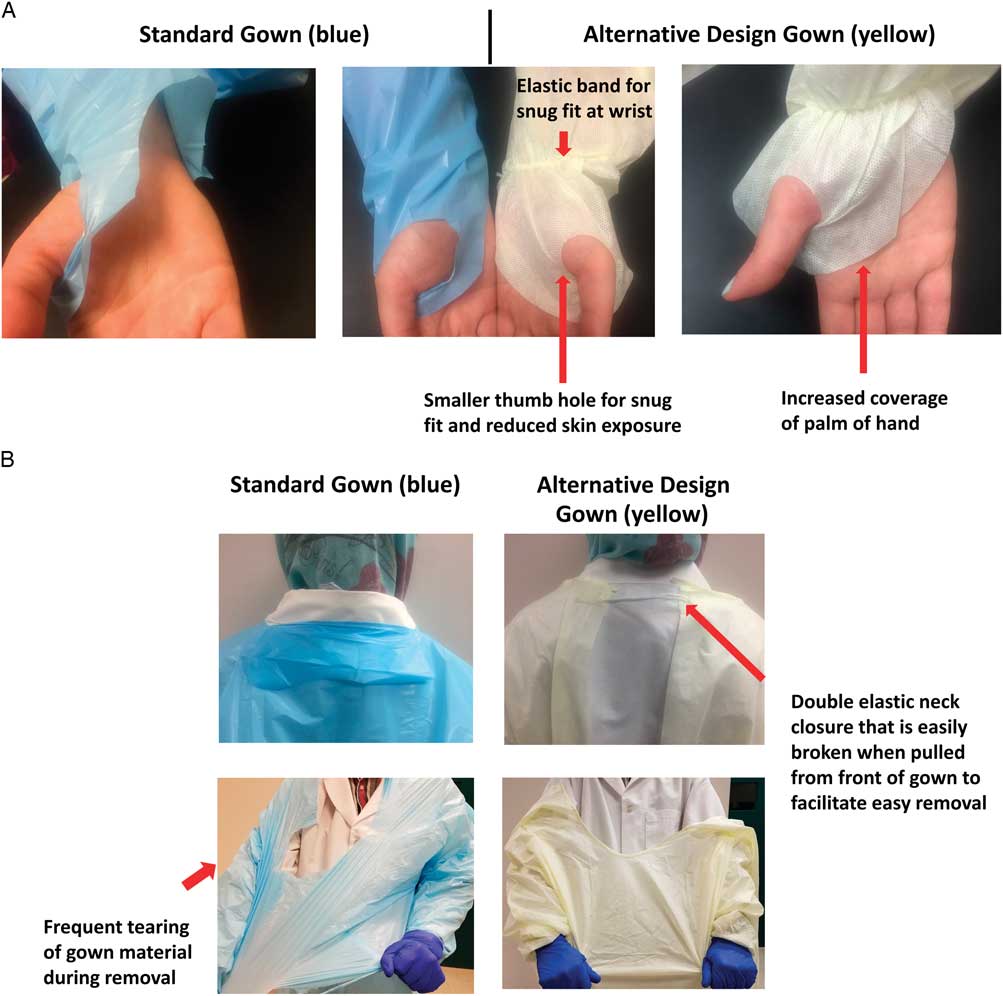
Another potential strategy to reduce the risk for contamination during PPE removal is to improve PPE design.Reference Tomas, Kundrapu and Thota 1 In previous studies, we identified several features in the design of cover gowns that might contribute to contamination during removal.Reference Tomas, Kundrapu and Thota 1 , Reference John, Tomas and Cadnum 4 , Reference John, Tomas, Hari, Wilson and Donskey 5 Hand and wrist contamination often occurred due to skin exposure at the gown–glove interface despite the presence of a thumb loop intended to keep the gown in proximity to the gloves. A loose fit at the wrist and minimal coverage of the upper palm contributed to the potential for contamination. Contamination of the neck region often occurred when gowns did not easily come apart at the posterior neck, resulting in tearing of gown material as personnel struggled to remove the gown. For gowns with ties at the neck, contamination of the posterior neck occurred frequently during loosening of the ties. Here, we conducted a randomized trial of 2 cover gowns to compare contamination of personnel during simulations of removal of contaminated PPE. We hypothesized that a gown designed to allow easy removal at the neck and with increased skin coverage and snugness of fit at the wrist would reduce contamination during PPE removal.
METHODS
Setting
The Louis Stokes Cleveland Veterans Affairs Medical Center is a 215-bed hospital with an adjacent 250-bed long-term-care facility. In 2015, a facility-wide intervention was conducted to train personnel on proper technique for donning and doffing gloves and gowns based on the Centers for Disease Control and Prevention (CDC) protocols. 8 The training sessions included education and practice in removal of fluorescent-lotion–contaminated gloves and gowns with immediate visual feedback on skin and clothing contamination. No additional training sessions were conducted. The facility’s institutional review board approved the study protocol.
Cover Gowns
We compared the Safety Plus polyethylene gown (TIDI Products, Neenah, WI) and the Assure Wear VersaGown with Flexneck technology (AMD Ritmed, Tonawanda, NY). For the purposes of the study, the Safety Plus gown was termed the standard gown because it is used in our facility and the Assure Wear gown was termed the alternative design gown. The Assure Wear gown with Flexneck technology was first marketed in 2013; it has a double elastic neck closure that facilitates easy removal when pulled from the front of the gown, a thumb loop that provides more coverage of the palm of the hand and a smaller thumb hole for snug fit, and an elastic band at the wrist that also improves snugness of fit. Figure 1 provides illustrations of the differences in the design of the 2 gowns at the neck and wrist/hand.
Comparison of the hand and wrist (A) and neck (B) design of the safety plus polyethylene gown (standard gown) and Assure Wear VersaGown with Flexneck Technology (alternative design gown).

Study Design
Healthcare personnel were randomized to perform simulations of contaminated glove and gown removal using either the standard or alternative design gown; on the following day, an identical simulation was conducted using the alternate gown. For each simulation, participants donned the gowns and nitrile gloves (Denville Scientific, Holliston, MA) in their usual manner. The gloved hands were inoculated with 0.5 mL of phosphate-buffered saline containing 108 plaque-forming units (PFU) of the enveloped virus bacteriophage Phi X174 (American Type Culture Collection [ATCC] 13706-B1), and 0.5 mL of fluorescent lotion and the solutions were rubbed over the gloved hands for 10 seconds. The participants then used the contaminated gloves to contaminate the front of the gown from the upper chest to the abdomen. Participants removed their PPE in their usual manner.
Contamination of the hands and wrists and the neck and chest (ie, anterior and posterior neck and upper chest) with the fluorescent lotion was assessed using a black light (Ultra Light UV1 by Grizzly Gear, SCS Direct, Trumball, CT). Participants then wiped both hands and wrists with a sterile, premoistened 4×4 gauze pad. After hand hygiene with alcohol gel, participants put on sterile gloves and used a second gauze pad to sample the same area of the neck and chest, including the clothing covering these areas. The gauze pads were processed as previously described to quantify virus particles.Reference Tomas, Kundrapu and Thota 1 , Reference Tomas, Cadnum, Mana, Jencson and Donskey 9 Prior to each participant’s second simulation, sets of cultures were obtained to ensure that residual virus was not detectable from the initial simulation.
Statistical Analysis
The primary outcome was the frequency of contamination at a composite of both the hands and wrists and/or the neck and chest; separate analyses were performed for fluorescent lotion and bacteriophage Phi X174. Based on preliminary data showing that ~50% of personnel contaminated their hands and wrists and/or their neck and chest during simulations, a 2-sample, 1-sided power calculation indicated that 29 participants per group would provide 80% power to detect a reduction from 50% to 20% contamination for the standard versus alternative gown. Subgroup analyses were performed for the hands and wrists and for the neck and chest. The Fisher exact test was used to compare the percentages of contamination and the Student t test was used to compare the concentrations of Phi X174 recovered from sites with positive cultures. Data were analyzed using SPSS statistical software version 10.0 (SPSS, Chicago, IL).
RESULTS
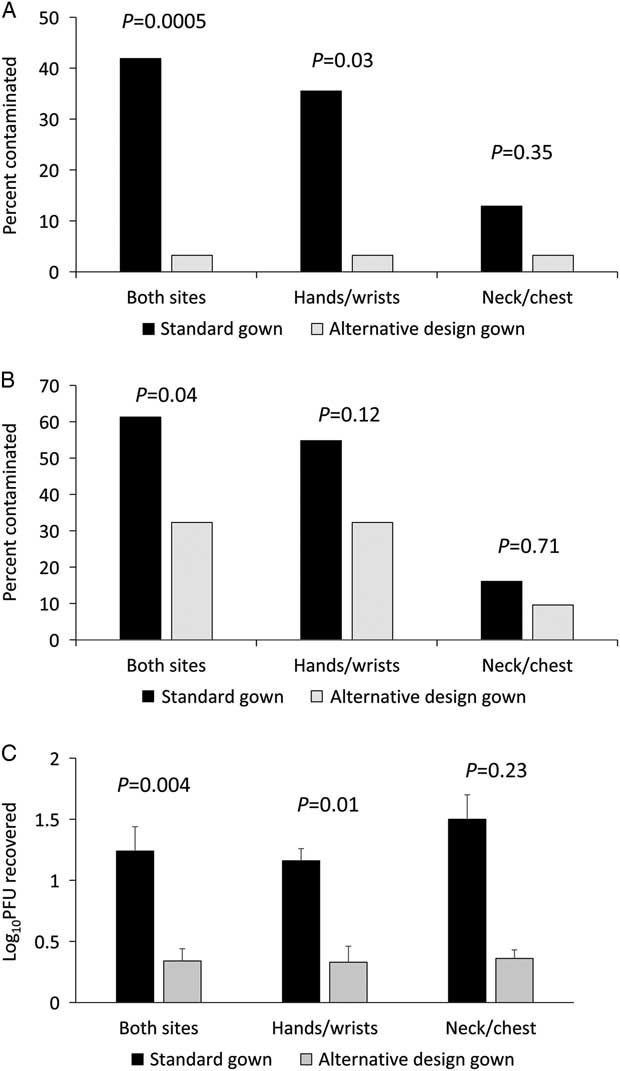
A total of 31 paired simulations were performed. Participants included 11 (36%) physicians, 6 (19%) nurses, and 14 (45%) allied health personnel. As shown in Figure 2, contamination of the hands and wrists and/or the neck and chest was significantly lower for the alternative gown in comparison to the standard gown (P≤.04). For both fluorescent lotion and bacteriophage Phi X174, there was a significant reduction in contamination of the skin of the hands and wrists, whereas there was a nonsignificant trend toward a reduction in contamination of the neck and chest. However, for the sites with positive cultures, the concentration of virus recovered was significantly lower for the improved versus the standard gown (P=.0005).
Frequency of fluorescent lotion (A) and frequency (B) and mean concentration (C) of bacteriophage Phi X174 contamination of the hands and wrists and the neck and chest during removal of contaminated gloves and gowns. For hands and wrists, bare skin was assessed for contamination. For bacteriophage Phi X174, the anterior and posterior neck and upper chest was evaluated, including the clothing covering these areas. Error bars indicate standard error.
DISCUSSION
Personal protective equipment that minimizes the risk for contamination is essential to protect healthcare personnel and patients. We found that a gown designed to allow easy removal at the neck and to increase skin coverage and snugness of fit at the wrist significantly reduced contamination of personnel during contaminated glove and gown removal. These results suggest that simple modifications of current PPE may be effective in reducing contamination of personnel.
It is possible that additional modifications of PPE may result in further reductions in contamination. We previously demonstrated that a prototype “seamless suit” PPE design that ensures wrist coverage and requires the wearer to remove gloves and gown simultaneously was effective in reducing self-contamination.Reference Tomas, Cadnum, Mana, Jencson and Donskey 9 For gowns used in care of patients infected with potentially fatal viral pathogens, including fingerless cloth gloves attached to the gown sleeve under the gloves has been used to minimize hand and wrist skin exposure during doffing.Reference Plut and Ormond 10
Our study has some limitations. We only studied 2 gown designs. We are currently conducting additional trials of other gown designs. Our comparison involved simulations and a high concentration of the virus was used. Future studies are needed in healthcare settings. Finally, many of the participants had received 1 session of education on PPE donning and doffing technique. It is not known whether the alternative gown would provide a similar benefit in reducing contamination for personnel with no prior training.
ACKNOWLEDGMENTS
Financial support: This work was supported by a Merit Review grant (no. 1 I01 BX002944-01A1) from the Department of Veterans Affairs to C.J.D. AMD Ritmed provided the Assure Wear VersaGowns with Flexneck technology for testing, but they had no role in study design, analysis or interpretation of the data, or writing of the manuscript.
Potential conflicts of interest: C.J.D. has received research grants from Clorox, Merck, AvidBiotics, and GOJO, and has served on scientific advisory boards for 3M and Seres Health. All other authors report no conflicts of interest relevant to this article.