Significant outcomes
-
• Patients with depression were associated with lower levels of circulating CD34+CD133+KDR+ EPCs and endothelial colony-forming units than that of healthy subjects.
-
• Depression was associated with increased inflammatory marker including tumour necrosis factor-α and interleukin-6.
-
• CD34+CD133+KDR+ EPCs had a negative correlation with tumour necrosis factor-α and interleukin-6.
Limitation
-
• Further studies are needed to investigate whether EPCs promote the development of depression or the depressive state results in low levels of EPCs.
Introduction
Depression is a common comorbid condition in patients with cardiovascular diseases (CVD) and also a well-known risk factor for the development of CVD and CV mortality too. Affective disorders with depressive episode are frequent illness with enormous personal and society burdens worldwide. The life-time prevalence of depression is 5–25% (Reference Rihmer, Angst, Sadock and Sadock1). It is widely known that depression is an independent risk factor for CVD, but the mechanisms underlying the relationship between depression and CVD are not well defined.
There is evidence that depression is associated with dysregulation of autonomic nervous system and hypothalamic–pituitary–adrenal axis, blood hyper-coagulability, systemic immune activation, increased inflammation and endothelial dysfunction (2–6), which may independently or coordinately contribute to the development of CVD such as atherosclerosis and hypertension, etc.
It is well known that vascular endothelial dysfunction is the initial and critical step to develop atherosclerosis (Reference Ladwig, Birgitt, Hannelore, Angela and Wolfgang7). Endothelial dysfunction features prominently in the onset, development, progression and clinical manifestations of atherosclerosis (Reference Sanjay, Robert, Melvyn, Elaine, Elizabeth and Bertram8). Hence, using peripheral blood (PB) samples obtained from patients with depression, we assessed the number of circulating endothelial progenitor cells (EPCs) by flow cytometry and functions of these cells by cell culture and also investigated whether these numbers are related to the severity of depression. Furthermore, we measured the concentration of pro-inflammatory cytokines such as hs-CRP, tumour necrosis factor (TNF)-α and interleukin (IL)-6.
Methodology
Participants
Patients were newly diagnosed with depressive episode by the Diagnostic and Statistical Manual of Mental Disorders, Fourth Edition (DSM-IV) criteria by two doctors who participated in the study.
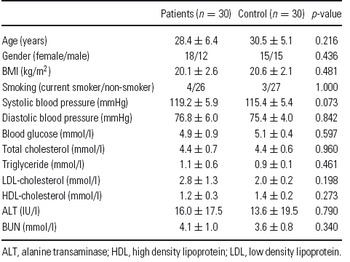
During participant enrollment, complete clinical (physical examination including blood pressure monitoring, height and body weight) and laboratory evaluations were carried out (Table 1). Patients' comorbid psychiatric diagnoses, obesity as body mass index (BMI) higher than 30 kg/m2, total cholesterol higher than 6.2 mmol/l, triglyceride higher than 2.25 mmol/l and signs of infection were excluded from the study. Moreover, classical CV risk factors (hypertension, diabetes mellitus and family history of CVD) and coronary artery diseases (angina pectoris and acute myocardial infarction) in the medical history of the patients were also criteria for exclusion. Hence, no patients received medications with known effects on EPCs within 1 month. Some patients with depression were treated with known antidepressants without effects on EPCs yet. Data about the smoking habit of patients and healthy controls were collected as well. The control group included 30 individuals matched for age, gender and smoking status. Healthy controls had no previous or current depression episode. The study was approved by the ethical committees. All subjects gave their informed consent.
Baseline clinical characteristics levels of patients and control groups

ALT, alanine transaminase; HDL, high density lipoprotein; LDL, low density lipoprotein.
Study design and administration
Assessment of depressive symptoms. Depression was evaluated at baseline using Hamilton Rating Scale of Depression (HAM-D), a 24-item measure of depressive symptomatology. Scores ranged from 0 to 96: a score >20 is considered a valid indication of clinically significant depression. Patients with missing data on some items were excluded in the study.
Flow cytometry. Flow cytometry of PB samples were carried out in the morning, after an overnight fast of at least 12 h. For fluorescence-activated cell-sorting (FACS) analysis, whole blood was first Fc-blocked by treatment with bovine albumin for 15 min at room temperature prior to staining. Immunofluorescent cell staining was performed with the use of the monoclonal mouse antihuman fluorescent conjugated antibody CD34-R-phycoerythrin covalent (ECD), CD133-phycoerythrin (PE) and kinase insert domain receptor (KDR)-fluorescein isothiocyanate (FITC). Following incubation for 45 min at 4 °C, whole blood lysing reagent was used for red blood cell lysis. Finally, the remaining cells were re-suspended in 500 µl phosphate-buffered saline for flow cytometric analysis with CellQuest Software (FACSCalibur; Becton Dickinson, San Jose, CA, USA). As a control analysis, each participant needed a corresponding negative control with IgG12a-FITC-PE antibody.
Cell culture. Mononuclear cells (MNCs) were isolated from whole blood with the use of a Ficoll density gradient according to standard protocols. After purification with two washing steps, 1 × 10⁷/ml MNCs were seeded on human fibronectin-coated 24-well plates, respectively. Cells were cultured in endothelial cell basal medium-2 (Clonetics, Shanghai, China) supplemented with EGM-2 MV single aliquots consisting of 5% fetal bovine serum, vascular endothelial growth factor, fibroblast growth factor, epidermal growth factor, insulin-like growth factor-1 and ascorbic acid. After 72 h, non-adherent cells were transferred to avoid contamination with mature endothelial cells and non-progenitor cells. After 7 days in vitro, endothelial colony-forming units (CFU) in three wells were counted by two independent investigators blindly. CFU of EPCs are expressed as average numbers of colonies per well.
EPCs identification. After 7 days in culture, attached cells were stained for the uptake of dioctadecyl-tetramethylindo-carbocyanine perchlo-rate (DiI)-labeled acetylated low density lipoprotein (acLDL) and the binding of FITC-labeled Ulex europaeus agglutinin (UEA-I). Dural-positive cells were deemed to be EPCs.
EPC adhesion to matrix molecules. Human fibronectin (100 µg/ml) was coated onto 24-well plates for 2 h at 37 °C. EPCs (1 × 10⁵/ml) were added to each well to attach for 1 h at 37 °C. Adherent cells were fixed with 4% paraformaldehyde and quantified by counting in five random microscopic fields (×200).
Measuring the levels of hs-CRP, TNF-α and IL-6 in the PB. For hs-CRP, TNF-α and IL-6, plasma samples from all patients and controls were collected and stored at −80 °C until the time of analysis. Levels of TNF-α and IL-6 were quantified using enzyme-labeled chemiluminescent sequential immunometric assay kits (both from SIEMENS Systems, Shanghai, China) according to the manufacturer's instructions. Concentration of hs-CRP was determined by turbidimetric immunoassay.
Statistical analysis
Statistical analysis was performed with Student's t-test and continuous variables are expressed as mean ± SD. Correlations of EPCs and cytokine levels were determined using Spearman's rank correlation test. To identify independent determinants of EPC number, a multivariate linear regression analysis was performed. Probability value of p < 0.05 was considered significant. All statistical analysis was carried out using SPSS software, version 12.0 for Windows.
Results
Numbers and characterisation of EPCs in PB samples of patients with depression and controls
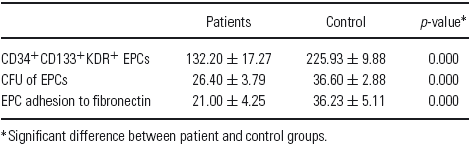
The lack of a special and exclusive marker truly specific for EPCs dictates that combinations of the surface markers must be used to best identify this cell population. Therefore, we identified EPCs for CD34/CD133/KDR triple-positive cells in PB by flow cytometry. In the patient population, CD34+CD133+KDR+ EPCs per milliliter of PB were significantly lower than those in the control group (p < 0.05, Table 2).
EPC numbers in healthy controls and patients with depression
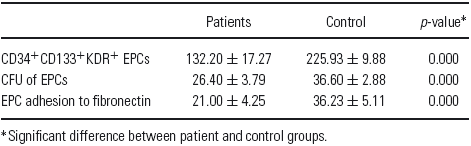
* Significant difference between patient and control groups.
PB level of the proinflammatory cytokines hs-CRP, TNF-α and IL-6
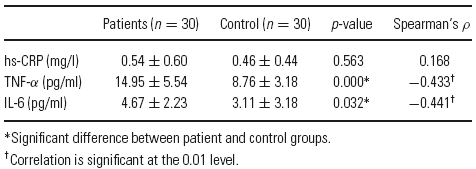
Although patients with depression tended to have higher hs-CRP level than healthy controls, the difference between the two groups remained insignificant (p = 0.563, Table 2). Furthermore, we also did not detect a significant relationship between hs-CRP concentrations and circulating CD34+CD133+KDR+ EPC counts (p = 0.200, r = 0.168). However, TNF-α and IL-6 levels of patients with depression were significantly elevated as compared with those of healthy controls (p = 0.000 and 0.0031, respectively) and moreover, a statistically significant inverse correlation was observed between TNF-α or IL-6 concentrations and EPC numbers (Table 3).
Cytokine levels of patient and control groups and the correlation with circulating CD34+CD133+KDR+ EPCs
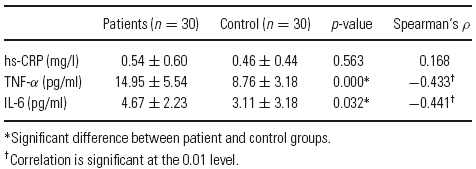
* Significant difference between patient and control groups.
† Correlation is significant at the 0.01 level.
Discussion
Several studies with prospective design have concluded that depression predicts the development of CVD after controlling for possible confounding factors such as hypertension, diabetes mellitus, smoking and age. Therefore, depression confers a relative risk between 1.5 and 2.0 for the onset of coronary artery disease in physically healthy individual (Reference Lett, Blumenthal, Babyak, Sherwood, Strauman and Robins9). However, although numerous theories have been proposed to explain the amplified risk of CVD in patients with depression, the exact biological mechanism has not been completely elucidated so far.
Experimental and clinical studies suggest that there is an evolving role for EPCs in neoangiogenesis and rejuvenation of the endothelial monolayer. In contrast to the measurement of a single serum/plasma marker for the prediction of CV risk, the use of a cellular marker such as EPC unifies the complex interactions of multiple negative factors and yields a better picture. Circulating EPCs, a sort of immature cell-derived bone marrow, may contribute to ongoing vascular repair by providing a circulating cell population that can home to the blood vessel walls, incorporate into the injured endothelial layer and replace dysfunctional endothelial cells (Reference Sanjay, Robert, Melvyn, Elaine, Elizabeth and Bertram8,Reference Aaron, Frank and Timothy10). Consequently, impairment of this EPC pool is considered to have negative effects on the CV system (Reference Gian, Anna and Ilenia11,Reference Jonathan, Gloria and Julian12) and patients with reduced number and impaired function of EPCs are at increased risk for endothelial injury and for arteriosclerotic plaque development.
In our study, we investigated the number and function of EPCs by flow cytometry and cell culture. There is a significant decrease in circulating CD34+CD133+KDR+ EPCs and endothelial CFU and EPCs were also found to be significantly impaired in their ability to adhere to fibronectin. Several studies show reduced number of circulating EPCs in hypertension (Reference Imanishi, Moriwaki, Hano and Nishio13), coronary artery diseases (Reference Nikos, Sonja and Tobias14), diabetes mellitus (Reference Loomans, De Koning and Staal15), hypercholesterolemia (Reference Chen, Zhang, Tao, Wang, Zhu and Zhu16), chronic renal failure (Reference Kay, Frank, Sarah and Peter17), rheumatoid arthritis (Reference Johannes, Daniel and Carl18) and cigarette smoking (Reference Michaud, Dussault, Haddad, Groleau and Rivard19) after vascular endothelium injury. Moreover, studies in animals suggest that enhancement of the number of circulating EPCs through statin therapy (Reference Dirk and Walter Kilian20), exercise training (Reference Jalees, Jingling and Lakshmi21) or estrogen therapy (Reference Kerstin, Nikos and Jan22) improves the replenishment of the endothelial monolayer. According to these findings, we infer that circulating EPCs enhance restoration of the endothelial monolayer after vascular injury, which may be the most important mechanism that EPCs diminish neointima formation. A variety of other mechanism may be secondary: depletion of the pool of EPCs in the bone marrow, reduced mobilisation of the EPC population or reduced survival and differentiation in the circulation.
Recent experimental and clinical data also suggest that a variety of inflammatory mediators could be involved in the pathogenesis of low level of circulating EPCs in depression. Elevated plasma levels of hs-CRP, TNF-α and IL-6 have been most frequently described. hs-CRP is a ubiquitous protein among vertebrate and invertebrate animals that phylogenetically spans 400 million years of evolution. This acute phase reactant is produced in large quantities by the liver (Reference Kilpatrick and Volanakis23) and its concentration rises as much as 2000-fold during the first 24–48 h after the onset of tissue injury or inflammation. The precise physiological functions of hs-CRP remain uncertain, although currently available evidence suggests that it plays a key role in the recognition of foreign pathogens and of damaged cells of the host and contributes to triggering the humoral and cellular responses that ultimately lead to their clearance. Depression has been associated with chronic changes in the serum concentration of hs-CRP in observational studies, but it is unclear if this association is causal or is due to confounding and bias. hs-CRP can promote apoptosis and attenuate differentiation and function of EPCs (Reference Subodh, Wang and Li24). TNF-α and IL-6 can reduce the number of EPCs (Reference Joseph, John and Martin25,Reference Florian, Judith and Dirk26). These findings suggested that hs-CRP, TNF-α and IL-6 might promote EPC-reduced number and impaired function in depressed patients. Thus, we assayed the plasma level of these cytokines and found that although hs-CRP concentrations were, on average, higher in patients than in the control subjects, there was no statistical significance. This suggests that hs-CRP may be a compensatory response to external insults that predispose to depression. Nevertheless, the levels of TNF-α and IL-6 were significantly higher in the patients compared with the healthy controls. Moreover, hs-CRP, TNF-α and IL-6 concentrations inversely correlated with EPC counts. However, the dynamic balance of other inflammatory cytokines and acute phase proteins are also likely to determine the number of EPCs. Therefore, additional studies are necessary to confirm the role of inflammation and immune system in modulating EPC levels in depression. Interestingly, it was also found that in depression cases, inflammation could suppress the proliferation of other stem cells, such as adult neural stem cells in the brain, especially the hippocampus. There could be some shared mechanisms underlying these stem cell niche dysregulation in depression patients or animals.
Limitations
However, it is definitely impossible to clarify whether EPCs has a direct relationship with depressive episode or simply represents a cell marker of CV risk factor related to endothelial dysfunction. In fact, by nature of its case–control design, this study does not establish causality between depression and CVD. However, some aspects of this relationship have already been shown in healthy European men and the current studies were intended to investigate further biological mechanism (as autonomic nervous system, immune system and endothelial function simultaneously in depressed patient free of CVD). Other relevant limitations of the study are the relatively low number of participants, coming from a single hospital. As a critical point, other mechanisms and patho-physiological contexts other than those we investigated might modulate EPCs, such as platelet aggregation, abnormal cardiac autonomic tone and unhealthy lifestyle. Moreover, it remains to be determined whether the EPC abnormalities are state- or trait-dependent phenomena in depression.
Conclusions and future directions
Circulating EPCs are obviously involved in the regeneration of injured endothelium and their number is thought to be a surrogate marker of vascular function. Depression as one of the CVD risk factor increases the risk of CV events in humans. The current study shows that EPCs are assessed in reduced numbers and impaired function in the PB of patients and it opens a new perspective in the pathogenesis of CV disorders in depression. However, further studies are needed to investigate whether EPCs promote the development of depression or the depressive state results in low levels of EPCs. We should focus on the relationship between EPCs and depression and explore the pathomolecular background of the connection between depression and EPCs. Finally, it is especially crucial that depressive patient population free from antidepressants should be screened and investigated for EPC numbers and function until definitive CVD.
Acknowledgements
We wish to thank the participants for their time and patience. Special thanks go to Mr Mu for his excellent technical assistance. We also thank Dr H. C. for his essential help in proof reading our manuscript. The study was funded by the Ningbo Natural Science Foundation, China. The project no. is 200901A6010001.