It is generally recognized that frequent occurrence of various disasters directly threatens human beings’ survival and development. There are 3 main categories of disasters: natural disasters (such as floods, earthquakes, or hurricanes), human system failures (such as Chernobyl nuclear reactor meltdown in Russia and nuclear power plant destruction in Japan during the tsunami of 2011), and war and conflict. Disasters often happen suddenly and cannot be predicted. Disasters usually cause huge losses of life and property. According to the Centre of Research on the Epidemiology of Disasters (CRED), disasters have become more frequent over the past decades.Reference Sorani, Tourani and Khankeh 1 , 2 During the first semester of 2017, EM-DAT preliminary data show that 149 disasters occurred in 73 countries. The impact of these disasters resulted in 3162 deaths, affected more than 80 million people, and caused more than US$32.4 billion in damages.Reference Wallemacq 3 In 2018, there were 281 climate-related and geophysical events recorded in the EM-DAT (International Disaster Database), with 10,733 deaths and over 60 million people affected across the world. 4
According to statics of CRED, between 1998 and 2017, climate-related and geophysical disasters killed 1.3 million people and left a further 4.4 billion injured, homeless, displaced, or in need of emergency assistance. In 1998-2017, disaster-hit countries also reported direct economic losses valued at US$2908 billion, 1 country’s climate-related disasters caused US$2245 billion in damages.Reference Wallemacq, Below and McLean 5 Once disaster occurs, all casualties need medical response immediately. It requires medical responders always be ready for rescue operations and medical facilities have surge capacity. Therefore, it is important to train all medical responders to improve the team’s response capability.
How to effectively deal with large-scale disasters has attracted the attention of scholars all over the world. Education and training is an indispensable part of disaster preparedness and planning. The quality of education and training is very important. The willingness of students to participate also determines the effectiveness of education and training. Reference Coico, Kachur and Lima6, Reference Parrish, Oliver and Jenkins 7 Now the research and practice about disaster medicine is deepening day by day all over the world. Many institutions have made many practical explorations on medical students’ disaster medical education and training. Reference Melnikov, Itzhaki and Kagan8-Reference Scott, Carson and Greenwell10
Recent natural disasters and mass casualty incidents indicate the importance of daily disaster response training for disaster emergency responders, especially for medical staff. Reference Dennis, Brandt and Steinberg11-Reference Schenk, Wijetunge and Mann13 Usually, the number of deaths and injuries associated with disasters increases significantly in the first hours and days after the disaster strikes. The potential for tremendous numbers of casualties from disasters and public health emergencies demand that we have a health and medical workforce that is well prepared, ready to serve, and willing to engage when needed. It has been shown that timely emergency medical care, especially in time-sensitive patients, improves outcomes.Reference Djalali, Hosseinijenab and Hasani 14 - Reference Swienton 16
Japan, Britain, France, and many other countries have special disaster medicine research projects or established disaster medicine organizations. The United States has a sound disaster response system, and places great emphasis on disaster response training. Under the current government, training bases have been built in various states, cities, and counties, and intensive training has been carried out year by year for medical workers participating in disaster response; emergency response ability has been improved. Research shows that effective disaster response training can quickly improve the response ability and confidence of responders. Reference Shultz, Marcelin and Madanes17-Reference Wiesner, Kappler and Shuster19 The framework of the NDLS course was established in 1999. The main contents of the courses are All-Hazards Disaster Casualty Management, public health response to disasters, Workforce Readiness and Disaster Deployment, Mass Casualty and Fatality Management, Triage for Disasters and Public Health Emergencies, surge capacity, etc. NDLS courses were initiated in China in 2015. To make the course suitable to Chinese audiences, this research established the NDLS course system with closed-loop feedback capability.
DEFINITIONS
Disasters often happen suddenly and cannot be predicted. An adequate disaster response requires whole societal participation and practical engineering. Disaster medicine involves many disciplines, including nursing, preventive medicine, clinical medicine, psychology, etc.
NDLS courses include BDLS (Basic Disaster Life Support) course and ADLS (Advanced Disaster Life Support) courses. The Objectives of BDLS course is to give learners “basic” concepts and “all-hazards” principles, help them to manage disaster-related injuries and illnesses, as well as mass casualty and population-based care, across a broad range of disasters. The overarching theme that captures the essence of the BDLS course is disaster casualty management.Reference Swienton 16 The ADLS course allows participants to demonstrate competencies in mass casualty management.Reference Schwartz and Armstrong 20 Learner participation is expected in all course components. Learner assessment across the 3 educational domains (cognitive, psychomotor, and affective) occurs through individual and group skills assessment and group participation.
The PRE-DISASTER ParadigmTM was developed by the NDLSTM Program to reinforce key elements for enhancing personal, organizational, and community preparedness. The “PRE” mnemonic stands for Planning and practice, Resilience, and Education and training. As the prefix suggests, the PRE portion is geared toward planning and preparation needed before an event occurs. The DISASTER ParadigmTM is a practical learning and organizational tool. The Disaster ParadigmTM is a useful reminder of key operational elements: Detection, Incident management, Safety and security, Assess hazards, Support, Triage and treatment, Evacuation, Recovery. According to DISASTER ParadigmTM, much of the work is completed at the scene. Disaster response is different from the daily paramedic work, with the biggest difference being organization and management. As most disasters are complex, often occur suddenly, and cause many casualties, disaster response is an emergency process with uncertainty. Planning and practice are very important in disaster response; an imperfect plan is better than no plan.
Gray prediction distinguishes the developing trend between system factors, performs correlation analysis, and finds the law of system change by accumulated generation operation (AGO) on original sequence. Ultimately, it establishes a corresponding differential equation model to predict the state of the future development of things.Reference Chen and Huang 21 Gray prediction forecast behaviors of systems in the future by reducing the randomness of data with AGO.Reference Hsu and Chen 22
METHODS
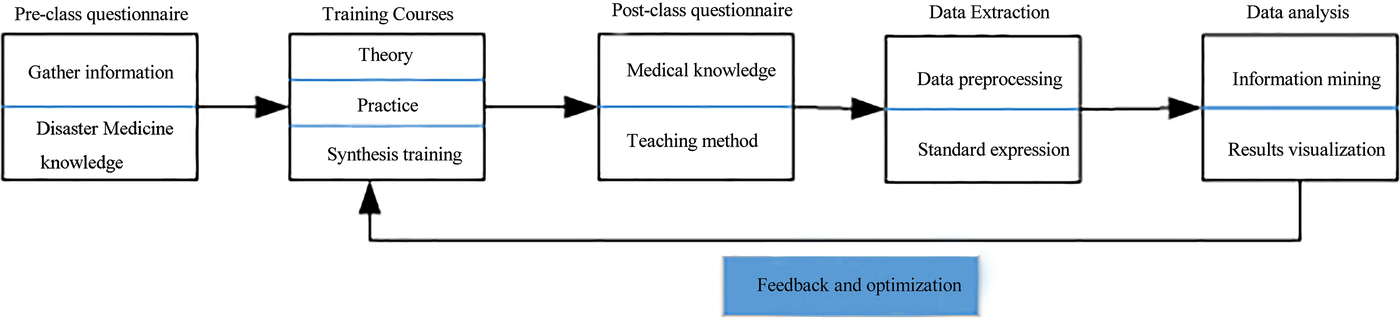
Hospitals are the core strength of disaster medical response in our country. Therefore, the training of disaster response for staffs in medical institutions is critical. The suggested audiences of the NDLS course in China are disaster response providers with medical background, such as physicians, nurses, paramedics. Figure 1 shows the curriculum training system.
NDLS Course System with Feedback Optimization Ability.

This system is a closed-loop feedback system constructed by using the gray predictive analysis method. For example, in the pre- and posttest questions, there will be questions about the respiratory diseases of the injured people. By comparing the answers of the students’ questionnaires and analyzing mid- and long-term training student scores with gray GM model, the training effect is evaluated.
To extract and analyze the follow-up information, the questionnaire is divided into preclass questionnaire and postclass questionnaire. When we designed the questionnaire, we classified the knowledge points of the course to make comparative analysis of the same knowledge points before and after class.
The preclass questionnaire includes some basic information of the audience (sex, age, education background, disaster response experience, etc.) and a pretest. The postclass questionnaire includes the evaluation and suggestions for the NDLS course and a posttest. To ensure the reliability and validity of subsequent information extraction, audiences are required to complete all questionnaires independently, and the preclass questionnaire answering system will be closed before the course.
The aim of NDLS course is to improve the existing problem in China’s disaster response. Although China has made some achievements in disaster response, there are still some problems. For example, the capability of dealing with disasters caused by new technologies or emerging things (such as biochemical nuclear magnetic radiation, hazardous material) is still inadequate. Before NDLS courses in China, there were few disaster courses for medical audiences (most existing courses were for first responders), and there were no “All Hazards” courses or “Hands On” skills training for medical audience. Most disaster courses lack “standards” and “interoperability.” Due to different national conditions, NDLS China courses made some changes based on the course in the United States. All changes have were approved by the National Disaster Life Support Foundation. NDLS China courses are comprehensive, all-hazards, competency-based, and multi-disciplinary courses, offer venue for standardized training, address awareness and operational level (hazardous materials [HAZMAT] training).
The audiences of NDLS China are medical staff, and most of them have a medical background and clinical work experience. NDLS China course is divided into a theoretical part and practical part. Audiences were required to integrate the course theories into practice.
RESULTS
General Information
We extracted and analyzed the information of 597 audience of 16 NDLS courses (including BDLS course and ADLS course in 2018). Table 1 shows the average score of the pretest and posttest.
Average Score of Pretest and Posttest

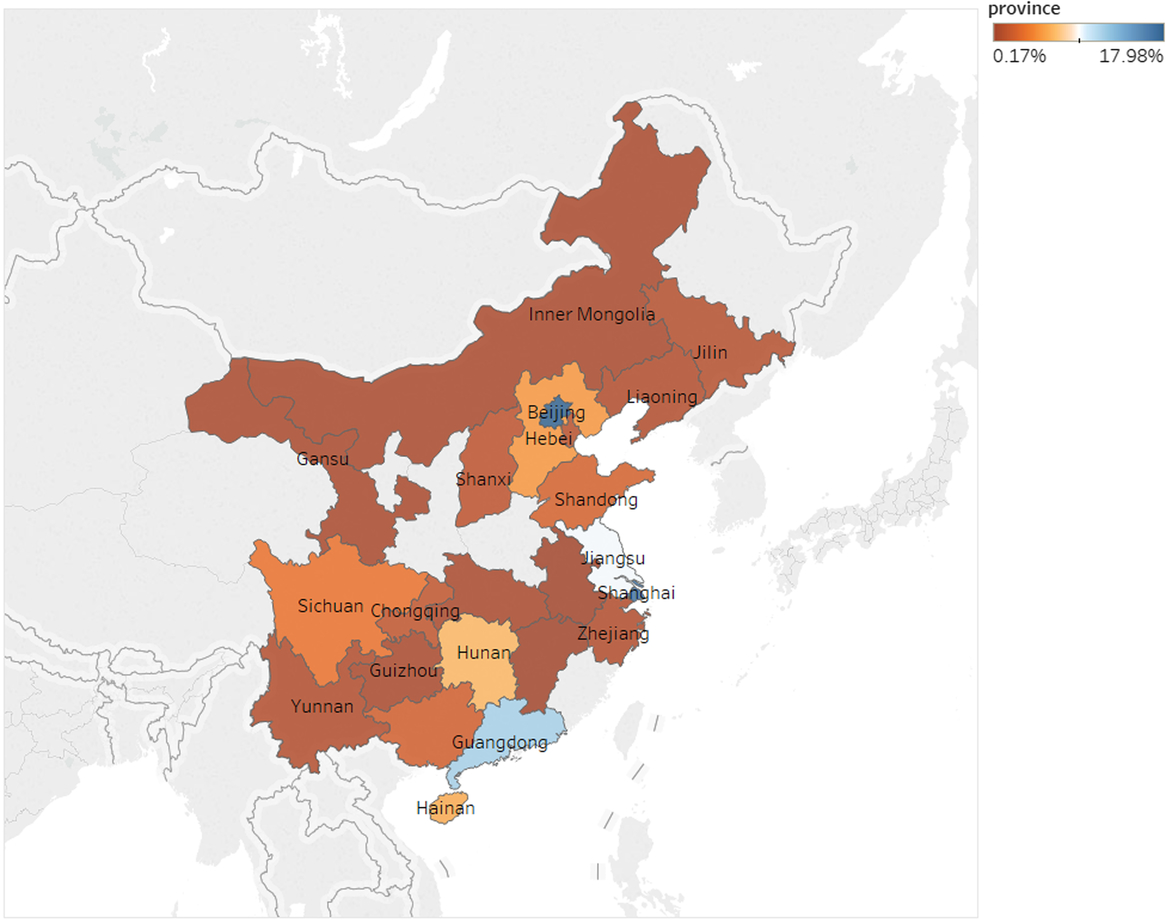
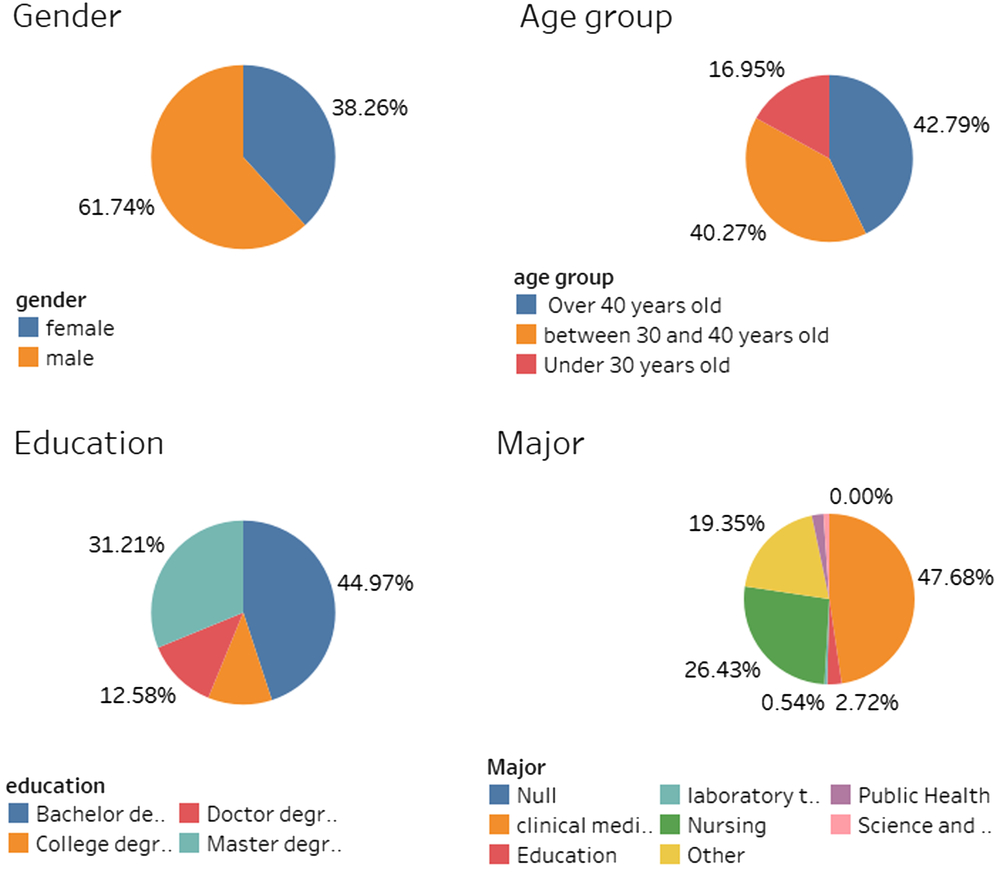
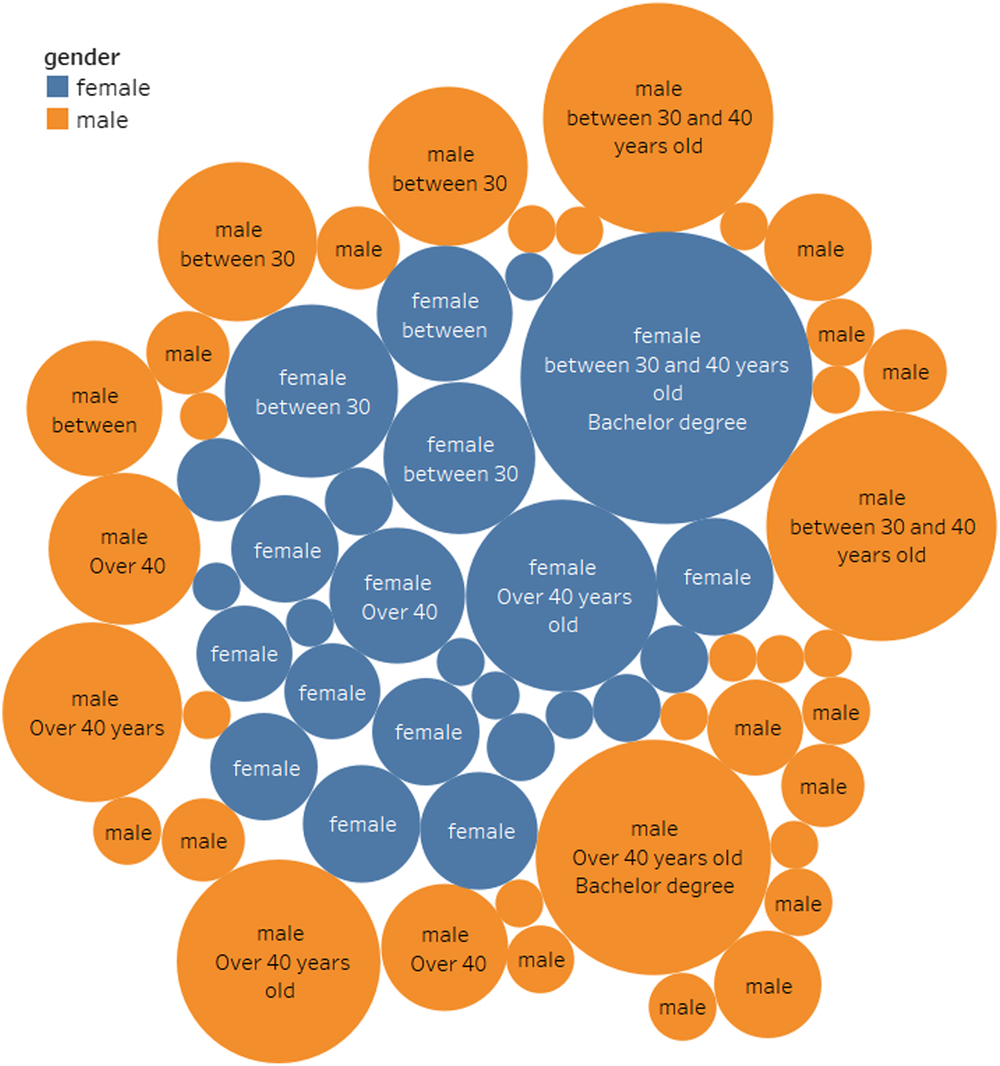
After we analyzed the information received from audiences, we established the following results (Figures 2-4): Most audiences are from Shanghai and Beijing, as big cities seem to place more importance in disaster response training. Most participants are males aged from 30 to 40 with a medical background; this demographic is the main force in the disaster response in China. Most participants have a master’s degree or doctoral degree. In the student overall distribution, the participants with a master’s degree account for a large proportion; they are between 30 and 40 years old, which is considered the golden period. The higher the educational degree of participants, the more important their role in disaster response. The posttest score is much higher than pretest score, illustrating that training is useful, and the exercises in the courses are relevant to the current needs of disaster response training in China.
Local Distribution of Audience.

Essential Information of Audience.

Distribution of Audience.

Prediction and Analysis of the Course with Gray Model
Accurate prediction of training results has positive implications for the timely adjustment of training models and the introduction of new teaching examples. This study uses quantitative predictions and uses statistical analysis of the historical posttest of students in the training to provide a quantitative explanation of the level of development of future testing.
It is crucial for study to monitor and forecast training course. In the study, we will use the GM (1, 1) model. Gray models predict the future values of a time series based only on a set of the most recent data depending on the window size of the predictor.Reference Kayacan, Ulutas and Kaynak 23 The gray GM (1, 1) model not only has simple principle, less samples, easy calculation, high forecasting accuracy, and easy inspection, but also can preprocess the original data, obtain better smoothness, and predict more effectively.Reference Wang, Wei and Sun 24 Using the gray GM (1, 1) model, the training situation is expressed as a basic law, and whether the arrangement of the curriculum and examples conforms to the national conditions is predicted. Based on the gray model, a course system with feedback optimization ability (Figure 1) is established to make it more popular.
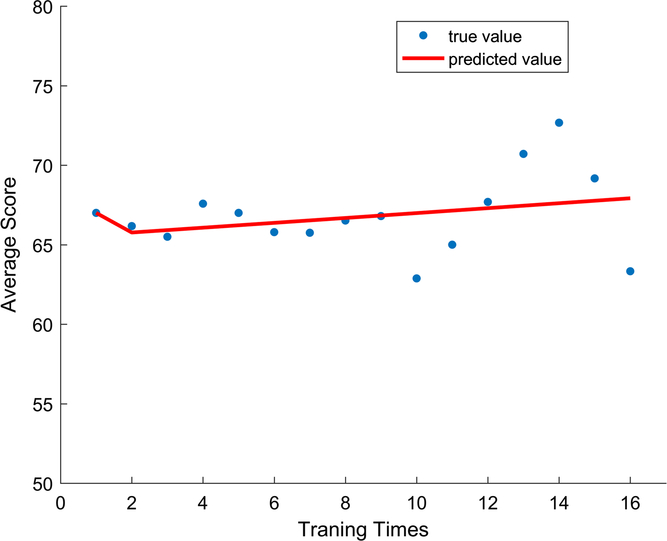
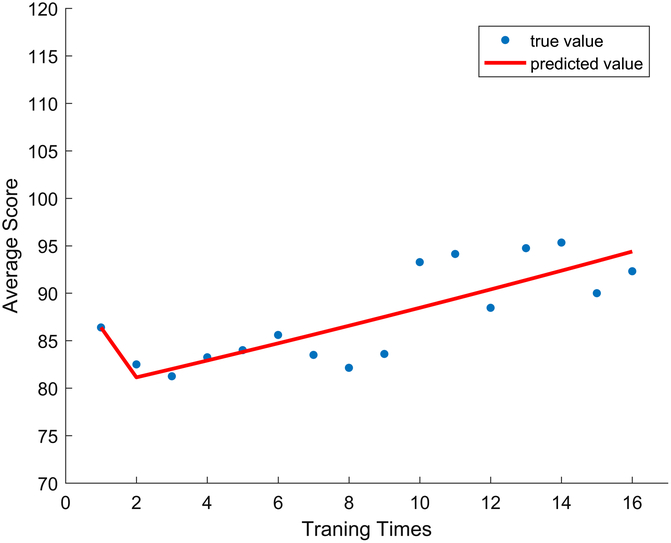
This study uses MATLAB to analyze the gray prediction model constructed with student scores predict the training results of the 10th and 11th students in the future, and visualize the analysis results, as Figures 5 and 6 show.
Preclass test history scores and gray model prediction scores.

Postclass test history scores and gray model prediction scores.

In the first to the ninth period, the average score of the students is close to the predicted value of the gray scale model, which also verifies that the mode has high fitness to student training data. Based on the historical data of training scores, the gray prediction model predicts the average score of 66 and 67 for the 10th and 11th grade students before class; the average score of the 10th and 11th trainees after class is 83 and 83.5.
According to the analysis, test variance ratio C test of the pretest and small error probability P test are 0.9433 and 0.5000, respectively, in pretest; in posttest, the values are 0.7222 and 0.7000, respectively. The model, with a developing coefficient of 0.04, is appropriate for the long-term prediction.Reference Yang, Zou and Kong 25
Through the results of the established gray prediction model performance, considering the development coefficient range detection, residual test, posttest difference test, and correlation test results, the model’s prediction accuracy is better. It also verifies the feasibility and accuracy of using the gray prediction model to optimize the constructed course system (Figure 1). According to the performance analysis of the model, the distribution of the fitted values is uniform, and the established gray prediction model has higher precision.
The gray model prediction value of the student’s score can reflect the overall running trend and characteristics of the historical training effect. It is the basis for timely adjustment of the teaching case and method. The feedback result forms the closed-loop feedback structure of the disaster medical training course system.
DISCUSSION
Disaster response is related to national development and social stability. The research of disaster medicine in China has attracted the attention of specialties in this field. The disaster response system has been significantly improved from 2008; however, compared with developed countries, we still have a long way to go. Many disaster responders who rush to the disaster scene lack professional training and special skills. Many do not understand the characteristics of medical disaster response, which makes the disaster response inefficient and ineffective. Although most health professionals have received medical education, they have received little training in systematic disaster medicine. Disaster emergency response is different from routine medical treatment. Thus, lack of training in disaster medicine, injury classification, teamwork, security, and other related topics will not allow providers to effectively respond to emergencies.
These problems have gained the attention of domestic scholars; therefore, NDLS courses were initiated in China in 2015. The course introduced advanced disaster management philosophy, but the original course is based on the situation of the United States, how to modify the curriculum to fit the China’s conditions has become a challenge for Chinese instructors. In response to the above problems, this study established a NDLS training course system with closed-loop feedback capability. The system can timely evaluate the NDLS training course based on the gray prediction of the students’ performance, and provide a basis for dynamically adjusting the lesson plans and adding cases to ensure that the training course system adapts to the dynamic development of China’s national conditions.
Disasters have caused tremendous economic losses and environmental damage to human beings, and have brought a wide range of health problems. With the increasing intensity and frequency of disasters in China, healthcare system has focused on planning and preparing for disaster response, especially in the field of education and training. Although most public health staffs have medical background, disaster response is a difficult career to get involved in without extensive experience in certain skill sets, such as disaster medicine, triage, coordination, team work, mental health care, communication, and safety.Reference Sorani, Tourani and Khankeh 1
This study takes NDLS disaster medical training as the research object and constructs a curriculum system with a closed-loop feedback structure. The feedback loop is based on the theory of gray prediction, which carries out medium- and long-term predictions on the trend of student training results. This allows continuous updates to the teaching cases and adjustments to the teaching methods to optimize the desired training effect. The analysis of teaching effects in the short-term and long-term shows the current training curriculum system conforms to the needs of our country, and the training effect is good. The research results can also serve as a reference for the construction of similar training systems in China. Emergency care may not be available, especially in the early hours after the disaster. In this situation, the public can play an important role in providing first aid. Accordingly, some agencies across the world have now provided civilian-based prehospital guidelines, public education, and exercises for communities. Reference Sorani, Tourani and Khankeh1, Reference Bobko, Harris and Thomas26, Reference Zhong, Clark and Hou 27
There is no comparability with other disaster courses in China as there are no standard disaster courses that can manage all types of hazard disasters in China. When the NDLS courses were translated and adopted, we found the PRE-DISASTER Paradigm and DISASTER Paradigm are the most effective parts. These parts provide a process and procedure for Chinese learners to respond to disasters. We also discovered some inadequacies in the courses: inappropriate teaching methods, poor participation, not relevant to Chinese learners (for example, American legal issues and government arrangements are not applicable for Chinese learners), etc. Considering so much similar feedback from learners, we have adjusted the course agenda. More information will be discussed in another article. The NDLS course instructors in China are working on developing different kinds of courses that are suitable for civilians and government officers without medical backgrounds.