Introduction
At the end of the thirteenth century, silver coins, described as being whiter in colour than before, suddenly became abundant in the Euro-Mediterranean world. For several decades, the shining white metal continued to flow across most of Eurasia, and then it abruptly disappeared. This was the ‘first silver century’ that the Eurasian world experienced, before silver extracted from Potosí flooded over the globe from the late sixteenth century to the mid seventeenth century, during the ‘second silver century’. Some thinkers, including Keynes, have identified this second influx of precious metals as the cradle of the modern capitalist world, although this is debatable.Footnote 1
This article tentatively suggests that the first silver century may have been the true origin of such ‘modernity’, while establishing the marked differences between the two silver centuries. Although regions of Eurasia have conventionally been regarded as standing alone, the article aims to demonstrate that the entire continent shared confluent streams of silver under the aegis of the great Mongol empire. The emphasis is placed on the difference between a vertical synchronization of currencies within a state’s borders, and a horizontal integration outside its borders. In this it differs from studies focusing only on the latter, such as the pioneering work by Janet Abu-Lughod.Footnote 2
This article further seeks to show the peculiarity of the second silver century (1570s–1640s) when compared to the first (1280s–1350s). It is what followed each period that reveals the significant differences between them. Behind the superficial similarity of a great influx of silver, the circulation of exchange mediums among ordinary people tells very different stories. The multiple strata of monetary circulation described here reveal the defects inherent in two common viewpoints. A. G. Frank, for example, pays attention only to horizontal movements of silver, or trade balances; whereas C. P. Kindleberger dichotomizes the usage of silver into coinage and hoard.Footnote 3
The significance of silver in Eurasian history
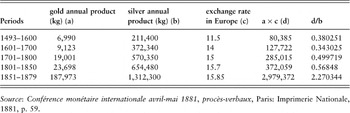
This study focuses on silver rather than gold because the latter did not play silver’s universal role before the eighteenth century. Table 1 was produced during discussions among European countries on the bimetallism that preceded the adoption of the gold standard in the late nineteenth century, and was often reproduced thereafter. It reveals that it was not until the gold booms of the mid nineteenth century that gold outweighed silver in importance. Throughout the eighteenth century, when the unit of account in terms of gold became popular in western Europe, the total value of gold production did not exceed half that of silver’s. In the period before 1700, gold accounted for just a quarter of all precious metals.
Estimates of annual production of gold and silver in the world accessible from Europe.

Source: Conférence monétaire internationale avril-mai 1881, procès-verbaux, Paris: Imprimerie Nationale, 1881, p. 59.
This article stresses the different functions of silver and gold as mediums of exchange, rather than the relative quantities in circulation. Silver and gold had such different attributes that they could not easily be aggregated into a single system. Considering the need for a currency that could anonymously circulate among people, the possibility of supplying a large quantity gave an advantage to silver over gold. Gold coins could supply a real standard of monetary unit but coins were likely to be in far from sufficient supply, even in the nineteenth century. They needed to be supplemented by great quantities of subsidiary coins and paper money. Thus, the maintenance of convertibility between substitutive currencies was crucial for a gold-centred monetary system, while a silver coinage alone could more flexibly supply what traders required.
In addition, the regions using gold as money were not contiguous. Though southern India and the Mediterranean continued to use gold as money, China only kept gold as treasure after the collapse of the Western Han (202 BCE–8 CE). In seventeenth-century Asia, the eastern part of Japan and, temporarily, some sultanates in Indonesia, such as Aceh, used gold.Footnote 4 However, the rest of Eurasia had its main monetary units in silver. Thus silver constituted the major proportion of monetary circulation at an intercontinental level up to the eighteenth century.
It is impossible to estimate the productivity of mines during the first silver century, but silver must have been dominant, even in Europe. It is true that an increasing supply of gold, especially from Africa, stimulated the coinage of gold in fourteenth-century Europe but other material evidence points to a continuing domination of silver. In particular, countries north of the Alps rarely minted any gold coins until the fourteenth century. Although Henry III of England tried to establish gold pennies in the middle of the thirteenth century, England depended almost entirely on a silver coinage until 1344. By striking gold écus, Louis IX of France resembled Henry III.Footnote 5 However, the French system was likewise ‘a silver standard supplemented by a valuable commodity’, the gold coin.Footnote 6 Similarly, the thirteenth- and fourteenth-century Byzantine hoards in the Caucasus consisted almost exclusively of silver coins, in contrast to earlier hoards containing only gold.Footnote 7
If we move back earlier than the thirteenth century, we find that neither silver nor gold was a universal medium for trade, underlining the significance of the silver centuries in global economic history. Before the thirteenth century, each major civilization kept its own distinctive monetary system, though there was some intercourse between them. China and its surrounding societies depended on copper cash, in denominations representing fractional values useful for daily transactions, despite the introduction of official paper currencies from the eleventh century. Whereas China had little precious metal circulating as money, the Euro-Mediterranean world, especially north of the Alps, was almost completely dependent on silver. However, though precious metals were convenient for merchants engaging in long-distance trade, they were not suitable for daily transactions. The Indian world used both precious metals and non-precious materials as currencies, though it was generally more akin to Europe.Footnote 8
Commodities also worked as mediums of exchange. All over the world certain grains or cloths commonly served for transactions in local markets. For example, the twelfth-century islanders of Rügen, off the coast of Germany, used linens as currency.Footnote 9 Thirteenth-century peasants in Xiu-zhou (Jiaxing) county in China brought rice to the market town of Weitang-zhen to exchange for salt or oil.Footnote 10 Unlike simple barter, in which two parties exchange something they want, these commodities worked as a medium to facilitate exchange. Such commodity currencies played an important role until later than is commonly imagined, even in Europe. For example, as late as 1760 in the Catalan area of the Pyrenees, villagers would take sacks of grain to market to pay for their purchases.Footnote 11 Indeed, a low dependency on coinage in ordinary people’s lives was prevalent in early modern Europe. In the Netherlands, which is believed to have been the most commercialized country in seventeenth-century Europe, the denomination of the most commonly minted coin coincided with the level of daily wages; supply of coins such as that only suited societies that depended on lump-sum payments. A combination of the dominance of big coins and long intervals between wage payments (for example monthly) meant that most ordinary people were unfamiliar with the use of cash.Footnote 12
A crucial difference between the Euro-Mediterranean world and China lay in the relationship between metallic and commodity currencies. Broadly speaking, and bearing in mind individual variation, medieval Europe lacked sufficient small-denomination currencies. England was an extreme case, where the shortage of small change caused bakers to change the size of loaves of bread according to the price of wheat.Footnote 13 In such a situation, the circulation of precious metal currencies and the mediation of exchange by commodity currencies operated quite separately, side by side. The gap between them was so large that the two spheres were complementary rather than substitutive. Except for urban residents, who depended more on daily purchases of foods, formal currency supplies had little bearing on the lives of ordinary people.
In East Asia, in contrast, the circulation of copper cash and commodity currencies overlapped in local markets, making their relationship substitutive rather than complementary. Unlike rulers in the Euro-Mediterranean region, the authorities had to consider the danger that a diminished supply of copper cash could affect grain transactions at the bottom levels of society. Symbolically, the Chinese imperial government distributed copper cash to villages suffering from famine, even at the end of the nineteenth century.Footnote 14 Clearly, a sufficient supply of copper cash was thought to encourage the trade of grain in local markets.
The supply of currencies by the authorities therefore differed in East and West. Put simply, in China the supply of currency was a measure of the emperor’s virtuous rule over commoners, whereas in Euro-Mediterranean societies it was a means for the authorities to supplement their budgets.Footnote 15Bian min (‘giving convenience to the people’) was a phrase frequently used in monetary affairs in China.Footnote 16 Benefiting the common people was only possible with a currency, such as copper cash, that could reach them. In contrast, as supplying small change is necessarily expensive, Euro-Mediterranean authorities tended to issue small-denomination currency only when substantial seigniorage could be gained.Footnote 17 Mint staff in England thus preferred to strike 64 penny groats from a pound of bullion, rather than 960 farthings.Footnote 18
Silver streams across Eurasia
The period from the end of the thirteenth century to the middle of the fourteenth century saw a conspicuous expansion of silver usage across Eurasia. In England, the mint recorded its largest issue of silver coinage before the Napoleonic Wars.Footnote 19 In Italy, the ratio in the price of gold to silver rose from 1:11 or 1:11.5 in 1285, to 1:15 at its peak in the 1320s.Footnote 20 In the Middle East, where silver had been in great demand since the tenth century, the supply became sufficient for the first time. Moreover, the silver in circulation appeared whiter in colour than before, which suggests that it came from a different source.Footnote 21 After 1295, silver bullion was no longer scarce in the Delhi sultanate, while the issue of silver coins by Bengali sultans surged significantly in the middle of the fourteenth century.Footnote 22 In Korea, the official history states that uncoined silver circulated by weight as currency in 1287 (although some silver had reportedly been issued about a century earlier in Korea, its circulation remained unconfirmed until that date).Footnote 23 All in all, the records suggest that silver became much more prevalent rather suddenly.
Conversely, in the last half of the fourteenth century, silver became rare across Eurasia as abruptly as it had become abundant. Towards the end of the fourteenth century, England and Egypt both suffered from a scarcity of silver. The London mint’s issuance drastically decreased, from 10,324 kg in the 1350s to 971 kg in the 1360s.Footnote 24 After this time, some English towns became dependent on local credit.Footnote 25 In Egypt, silver in circulation disappeared suddenly in 1359, coinciding with an abrupt fall in Bengal (discussed later).Footnote 26 Egypt then issued many copper coins.Footnote 27 No further issues of silver coins in large amounts by Bengali sultans are recorded until the end of the fifteenth century. Billons and copper coins dominated north Indian markets from the last quarter of the fourteenth century.Footnote 28 Meanwhile, the circulation of uncoined silver in Korea had already ended by this time. Eurasia in 1400 suffered from a common scarcity of silver.
While all this points to an interconnected process, it is necessary to consider the possibility that it was coincidental. Although changes in annual production of coins would provide the most suitable evidence, very few issuers have left consistent long-term data. The statistics from the London mint provide the best information from the late thirteenth century.
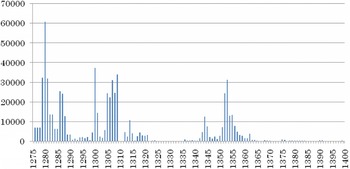
Although the first silver century witnessed the largest issuance of silver currencies by the London mint before the eighteenth century, annual fluctuations during the period in question are quite marked (see Figure 1). Coinage surged in the 1280s and again in the 1300s but rapidly decreased around 1320. The last big wave started in 1340 and had passed by 1360. The London mint reflected the import of foreign silver more sensitively than other mints in England, which suits the purposes of this article, given its focus on the circulation of currencies beyond administrative borders. Martin Allen has estimated that the circulation of silver in England peaked around 1330, rather than 1350, but the stress here is on issuance.Footnote 29
Annual silver output of the London mint 1273–1400 (kg). Data taken from H. A. Miskimin, ‘Money and money movements in France and England at the end of the Middle Ages’, in J. F. Richards, ed., Precious metals in the later medieval and early modern world, Durham, NC: Carolina Academic Press, 1983, pp. 90–2.

The simplest explanation of changes in London’s silver minting is that they reflected fluctuations in the production of European mines. The first half of the fourteenth century was indeed known for the prosperity of mines such as Ktona Hora in Bohemia and Igrésias in Sardinia. Although silver struck in London probably originated in part from these mines and Ktona Hora is thought to have increased production from around 1300, it subsequently developed only modestly, while Igrésias reached its peak before 1340. The second London minting peak after 1300 might be attributable to European silver production, since Venice experienced an increasing supply of silver from ‘Germans’ in 1306.Footnote 30 However, the first and third peaks of silver issuance in London, in 1279 and 1342, do not appear to coincide with production from these mines.Footnote 31 Though not so consistent as London, records of annual silver currency issuance in Paris and Flanders also show peaks around 1350.Footnote 32 Thus a rise in silver issuance was shared by European mints, even though ‘[b]y the middle of the fourteenth century the mining industry was almost everywhere plunged into a serious depression’.Footnote 33
To account for the unprecedented surge of silver issuance, we need to extend our scope beyond Europe. It was after the new coinage of 1279 that the significant increase of silver currency began in England (see Figure 1).Footnote 34 Silver output in the London mint increased from 7,000 kg in 1278 to 32,400 kg in 1279. Some might interpret this as resulting merely from recoinage, which took place from 1279 to 1281. However, no other reduction of the mint price had brought such a rapid surge in output, more than 60 metric tons in 1280 alone. Furthermore, London was not an isolated case. In 1278, in North Africa, particularly Tunis, silver became plentiful enough for its value to fall against gold. In Genoa, the relative value of silver against gold fell from 10 to 1 in the 1260s to 11 to 1 by the 1280s.Footnote 35 Thus, something unusual was happening to silver circulation across the entire Euro-Mediterranean, with echoes in eastern Eurasia from 1276.
In the mid 1270s, the Mongols finally conquered the Song dynasty, incorporating wealthy southern China into their empire. A contemporary observer stated that, when the Mongol army occupied the Lower Yangzi region, the richest area, in 1276, the minister Bayan ordered that the Mongol soldiers’ bags be searched for purloined silver.Footnote 36 The collected silver was cast into ingots of a particular form, yuanbao, and presented to Khubilai Khan, who later distributed them to nobles and officials.
Crucially, the Yuan dynasty did not mint coins but melted the silver that they collected into ingots. This signalled an irreversible change for the formerly nomadic rulers. As late as 1259, the Mongols cast a silver coin of Chinese style, dachao tongbao, which may have circulated under the name of tamgha in Central Asia.Footnote 37 The acquisition of a huge quantity of uncoined silver during the conquest of the Southern Song may thus have prompted the Yuan to abandon silver coinage forever. In another notable milestone, the Mongols created ingots out of the silver acquired during their expedition to the eastern frontier in 1286–87.Footnote 38 As this coincided with the first clear appearance of silver by weight in Korean history, the Mongol army may have brought their silver ingots to Korea. Meanwhile, archaeological excavations from Xinjiang (East Turkistan) demonstrate that these khanates kept silver coins with Arabic inscriptions.Footnote 39
Another major change was the issuance of official paper currency, initially known as zhongtong chao. Statistics in the official history of the Yuan show a steep increase in the issuance of paper money in the latter half of the 1270s. According to contemporary memoirs, paper money became non-convertible at this time, for the Yuan dynasty began to issue a new kind in 1287, the zhiyuan chao, which was not redeemable for metal.Footnote 40 In Korea, the circulation of silver ingots and the usage of zhiyuan chao coincided in 1287.
As long as official paper monies were available in China, abundant silver ingots could more easily be released for transport beyond Chinese territory and could circulate freely along Eurasian trade routes. According to a recent study, based on primary sources written in Uyghur, Turkistani commercial contracts, formerly expressed in terms of cloth or copper cash, underwent a drastic change to uncoined silver under Mongol rule.Footnote 41 Transactions using somo, a form of uncoined silver, thus led to unprecedented changes in the Central Asian caravan trade. Pegolotti noted the dominance of somo in transactions ranging from the Black Sea to northern China.Footnote 42
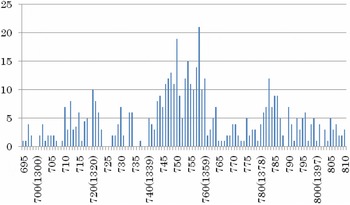
Central Asian caravan routes did not monopolize the movements of silver, for Figure 2 shows a peak of silver issuance by Bengali sultans around 1350. After a small surge in the early fourteenth century, numbers remained low until 1339 (AH 740), then increased rapidly, only to collapse in 1360 (AH 761). These statistics are based on museum catalogues and reports of unearthed hoards containing silver rupees issued by Bengali sultans. The trajectory around the mid fourteenth century appears generally to coincide with that of European mints, although Karim only identifies whether silver rupees with the inscription of a particular hijri year exist or not, and it is often unclear how many coins of each year are contained in a particular catalogue or hoard. My count is near the minimum, and thus real frequencies would probably be higher than those shown in Figure 2.Footnote 43 The sharp fall of 1359–60 is of particular interest, as it coincided with the disappearance of silver from Egypt in 1359, noted above.
Silver coinage issued by Bengal sultans, AH 695–810 (1295–1407 CE) (by frequency). Data taken from Abdul Karim, Corpus of the Muslim coins of Bengal (down to A.D. 1538), Dacca: Asiatic Society of Pakistan, 1960, pp. 9–65.

Bengal had no indigenous silver mines with significant production, and an important numismatic clue suggests origins in China. A hoard containing a large quantity of rupees, issued mainly during the mid fourteenth century, was found in Sylhet, inland in eastern Bengal. As the eastern frontier of Muslim rulers at that time, Sylhet was the gateway to Yunnan, in south-west China, by a trade route that passed through Burma. Other material evidence supports the hypothesis of a close relationship. Sylhet depended heavily on cowry shells as the main medium of exchange until the early nineteenth century, even for tax collection.Footnote 44 Yunnan was also famous for its cowry usage, with contracts for land purchases and other purposes drawn up in terms of cowries.Footnote 45 The prevalence of cowries, originating from the Maldive islands, shows that Yunnan and Bengal had strong economic connections.
The apparently synchronized output of silver coins in Bengal and London suggests the possibility that silver from China lay behind the phenomenon. As shown in Figures 1 and 2, silver coinage in the Bengali sultanate surged in 1339 and fell in 1360, while the silver output of the London mint increased in 1342 and plummeted in 1363. There is no evidence for a direct connection between Bengal and England but the overall historical circumstances suggest that this was more than a coincidence.
Furthermore, in the 1340s, at the very time that the issuance of silver in Bengal soared, a particular silver coinage, the gigliati, became popular in eastern parts of the Mediterranean, in places such as Rhodes, Miletus, and Adalia.Footnote 46 The weight of a gigliat is one-tenth of a Chinese liang (37.3 grams), and one hundredth of a somo, a popular silver ingot in the Kipchak khanate. The average weight of gigliati from Naples in the British Museum collection is 3.716 grams, whereas imitation coins from Rhodes in the same collection weigh only 3.475 grams.Footnote 47 The lightness of the imitation coins might have reflected both strong demand for the original article and short supply. However, genuine gigliati are thought to have been made from Sardinian silver.Footnote 48
Seventy years ago, Blake remarked on the westbound flow of silver from China under the Mongol empire. According to his argument, new silver coins minted in the Mediterranean region in the thirteenth to fourteenth centuries shone white, unlike the darker silver previously in circulation. Silver coins issued in Trebizond and Cyprus were literally called ‘white’ in local languages, owing to their appearance. Blake believed that the whiteness did not result from higher fineness but from trace amounts of antimony. The whiteness of these coins is thought to reveal their origin in Chinese mines, which produce ores containing antimony. Regrettably, Blake left no citation allowing us to trace the basis of his remarks.Footnote 49
However, a number of points support Blake’s assertions. First, metallurgical science proves that alloys of silver and antimony are white and brittle.Footnote 50 Second, silver ingots brought to Yemen in Chinese ships at the time seem to have been thought to be softer, also suggesting the presence of antimony.Footnote 51 Third, silver ore from China probably contained more antimony than elsewhere, as silver and copper ore were often found together. Thus, the districts where the Northern Song imposed copper tribute mostly overlapped with those paying in silver.Footnote 52 After the seventeenth century, Yunnan became the principal supplier of domestic copper for casting cash, as well as a supplier of silver. Chemical analysis shows that the mean content of antimony in coins fluctuated by period, with high-concentration coins bearing the era names of Shunzhi (1644–61), early Kangxi (1662–1722), and late Qianlong (1736–95). Years of low-antimony content closely coincide with the period when copper came mostly from Japan, and the chemical composition of these coins is very similar to that of Japanese copper ingots recovered from a Dutch wreck. In contrast, Shunzhi-era coins issued by the Yunnan mint contain a higher proportion of antimony, and Yunnan became known for its antimony deposits in the early twentieth century.Footnote 53 Thus, silver from Yunnan probably tended to be whiter and softer than other silver.
Mongol interest in Burma may have reflected the importance of trade to the Bay of Bengal, although the Mongols failed to maintain control over the country after toppling the Pagan dynasty in the late thirteenth century. The Mongols in China were generally in crisis towards the middle of the fourteenth century, and yet in 1338 they temporarily succeeded in establishing a garrison, the Bangya ‘Pacification Office’, at Pinya in the Shan States.Footnote 54 It was in that year that the Shan ruler of Pinya first sent an embassy to pay tribute to China.Footnote 55 Moreover, Bawdwin, later known for its silver production, was located along the caravan route from Dali in Yunnan to Pinya.
Change in China coincided, in part, with change in Bengal. From 1339 CE (AH 740) numismatic evidence from the Sylhet find confirms the continuous issuance of silver rupees. Those bearing the inscription of Mubarak Shah were issued in consecutive years from 1339 to 1349 CE (AH 740–50).Footnote 56 Mubarak Shah was the ruler who expanded his territory towards the south-east and the coast.Footnote 57 Thus, political and military developments in Yunnan and Bengal seem to have caused a flow of silver from China to India, via Burma, from 1339. Conversely, the decay of Shan rule in Burma, and the collapse of the Mongol empire in China, appear to have shut off the stream of silver in the early 1360s. By then, rebels against Mongol rule had already occupied the middle of China. In the first month of 1359, the same year that the scarcity of silver began in the Middle East, the rebel Chen Youliang occupied the region of Xinzhou, recorded as the district producing the largest volume of silver.Footnote 58 Even though actual causality is not proven, this is highly suggestive.
Yemeni sources accord with such changes in the flow of silver. Aden, guarding the southern entrance to the Red Sea, certainly transmitted silver from the East, believed to be from China, to the north during this period.Footnote 59 The export of ‘Arabian’ horses to the East brought goods, including silver, in the opposite direction.Footnote 60 Throughout the period, there are eyewitness accounts of Chinese ships reaching Aden, and the Rasulid ruler of Yemen sent an embassy with gifts to China in 1271. Crucially, though, silver coinage in Aden became lighter in 1359, the very year that silver became so scarce in Egypt.Footnote 61
All the information concerning money during this period suggests that a massive influx of uncoined silver after the 1270s bridged the gap between West and East, and that this influx suddenly ceased in the 1360s. The only hypothesis that can sufficiently explain all the facts is the rise of the Mongol empire, connecting both ends of Eurasia, followed by its collapse within less than a century. As protection costs in Central Asia seem to have been far higher than transportation costs, Abu-Lughod is probably correct in asserting that the Mongol peace contributed to creating ‘an environment that facilitated land transit with less risk and lower protective rent’.Footnote 62 The Mongol dynasty in China adopted silver for its administration systems far more positively than previous dynasties, so that attributing the flow of silver to the Mongol peace seems quite persuasive.
However, Abu-Lughod’s hypothesis requires significant modification, for the Mongols had conquered the Silk Road long before the 1270s, and were already collecting taxes in silver. In addition, the temporal frame of the silver flow does not fit a hypothesis that considers only peaceful trade. The statistics suggest that military campaigns and political events generated the flush of silver. Only the acquisition of stored silver from the Southern Song in 1276, and the development of the Burma trade route through military means in 1339, can explain surges of silver in the late thirteenth and mid fourteenth centuries. The direct causes of the sudden changes in the flow of silver must be kept distinct from underlying factors such as the Mongol peace.
Silver: commensurable but multiplied
Currencies did not move only because of trade, for armies carried large amounts of coins, ingots or plates of precious metals.Footnote 63 A flow for military purposes was rarely balanced in the short term by a stream in the opposite direction, although military missions might return with precious metals as booty, as Mongol troops did coming back from China in 1276. The armies of the Mongol empire were of unprecedented size and they seem to have carried significant quantities of silver with them, to maintain their logistics. A find of dachao tongbao, a Mongol silver coinage, from the Tianshui hoard (which contained no other coin) suggests that it was used in military camps.Footnote 64 Westbound movement of silver of this type might have made it easier for Euro-Mediterranean merchants to purchase products of Eastern origin. At the same time, the demand for products from the East, including porcelain, silk, and pepper, caused silver to flow from Europe to the East. Descriptions by contemporary witnesses such as Francesco Balducci Pegolotti suggest such an eastbound movement of silver.Footnote 65
That said, the reality might not have been so simple. According to a document written in Venetian dialect, merchants brought linen to Sarai, the capital of the Kipchak khanate, some time after 1345. There it was exchanged for somo, a silver ingot weighing almost 0.37 kg, or ten liang in Chinese weight. They continued eastwards to China, and converted their silver into paper money to purchase silk and other products.Footnote 66 The region surrounding the Black Sea was known for good horses, demand for which surged in India after battles against Mongols and Turks in the early fourteenth century.Footnote 67 Their export may well have brought silver to southern Russia.
With the exception of horses and cowry shells, we rarely find descriptions of the goods that were transported eastwards during the first silver century, but material evidence suggests that cobalt was among them. This mineral is essential for the manufacture of blue-and-white porcelain, which became popular in China and was exported as far as the eastern Mediterranean during the fourteenth century. Although China, especially Yunnan, produced cobalt, chemical analysis proves that Yunnan cobalt was only used for local production after the fifteenth century. The particular mineral used for finer blue-and-white porcelain in official workshops in Jingdezhen under the Yuan is thought to have been imported from abroad. Chemical analysis has identified the cobalt used in such porcelain as the same as ores from Germany and Italy, as well as from Xinjiang and Gansu in north-western China. Cobalt of the same chemical characteristics has been detected in Chinese porcelain found in Delhi, and the usage of finer cobalt in Jingdezhen seems to have begun only after 1325, peaking around 1350.Footnote 68 Cobalt may thus have moved eastwards to China’s official porcelain industry.
One cannot assume that only newly mined silver was placed in circulation at this time. Even though silver did not play a leading monetary role in China until the twelfth century, huge quantities of the metal are thought to have been stockpiled. One chronicle records that, before the collapse of the Northern Song in 1127, its imperial store kept eight million bars of silver.Footnote 69 If a bar weighed 23 liang, the stock amounted to 200 million liang, or roughly 7,000 tons.
There are several reasons why we should not view this figure as exaggerated. From the viewpoint of the Chinese dynasties, the stockpiling of silver was the result of their pursuit of copper. The Northern Song issued an astronomical number of copper coins, recorded as six billion coins per year at its peak in the eleventh century.Footnote 70 This amounted to 15,000 tons of copper. Finds of numerous Song coins in China and surrounding countries such as Japan suggest that this figure was not far from reality. As copper-bearing ore in China generally also contained silver in varying amounts, and as both peak periods and main regions of silver production approximately coincided with those of copper, the surge of copper-cash production would have been accompanied by an increased acquisition of silver.
The Song left more frequent records of silver, and more artefacts made of silver, than any earlier dynasty.Footnote 71 This dynasty also appears to have produced more silver ingots than any before the Qing (1644–1911).Footnote 72 Without this enormous quantity of silver, the Song could not have fulfilled the terms of their peace treaties, which stipulated an annual silver tribute to rival northern dynasties. Thus, the Southern Song paid 250,000 liang (nearly 10 metric tons) to the Jin. This gives substance to the claim that the Jin acquired thousands of tons of silver when they raided the city of Kaifeng, the former capital of the Northern Song, in 1127.Footnote 73 Significantly, the Jin were the first regime in Chinese history to collect taxes in silver.
Unlike silver ingots from the Northern Song, inscribed with names of officials, those from the late Southern Song mostly have the inscriptions of private shops and individuals.Footnote 74 In wealthy southern China, silver ingots were well distributed but they did not extend far beyond the sphere of circulation of silk, also used as a kind of currency and to pay tribute. In addition to eight million liang of silver, the Jin found forty-five million bolts of silk among the treasure of the Northern Song.Footnote 75 Silver ingots thus worked as a supplemental instrument for long-distance payment, and as a measure for storing wealth.
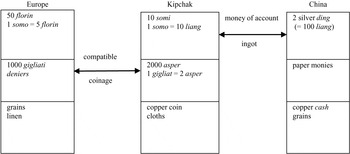
The Mongols not only employed silver for administrative payments but also encouraged its use in long-distance trade across the whole of Eurasia. Figure 3 shows the multiple strata of monies in use from the 1270s, with 100 liang, 10 somi, 2000 asper, 1000 gigliati, and 50 gold florin as roughly equivalent.
Multiple strata of monies.

Silver ingots, typically ding of 50 liang weight, were already popular in the tenth century.Footnote 76 They were compatible with the somo, another unit of uncoined silver, which weighed 10 liang in the Kipchak khanates, and which were also minted in Genoa and Venice for the Black Sea trade.Footnote 77 Silver coins such as the Neapolitan gigliat, containing 3.7 grams of silver, or one hundredth of a somo, also played an important role in linking the Mediterranean and Central Asia. According to Pegolotti, two Trebizond asper were exchanged for one Neapolitan gigliat in Rhodes.Footnote 78 Silver coins with inscriptions from the late thirteenth century, found in the Chagatai khanate and weighing 1.8–2.0 grams (almost half a gigliat, or one twentieth of a liang) may well have been asper. Footnote 79 Thus, a standard of roughly 37 grams (one liang, or one-tenth of a troy ounce) appeared established in many parts of Eurasia, where silver served for long-distance trade and taxation.
However, silver was not the only currency to widen its sphere of circulation at this time. In Japan, the payment of manorial tributes in copper cash, instead of rice, increased especially rapidly in the latter half of the thirteenth century.Footnote 80 This is shown by archaeological findings of more than three million Song copper coins in Japan to date.Footnote 81 A Javanese copper epitaph, inscribed around 1350, stated that contracts for land purchases were now expressed in terms of copper coins, unlike previous custom.Footnote 82
The usage of cowry shells also increased. Ibn Battuta, travelling around the Indian Ocean, recorded that large quantities of cowries collected in the Maldives islands were shipped to Bengal in exchange for rice.Footnote 83 As noted above, many contemporary observers witnessed the use of shell monies in Yunnan. Indeed, the Mongols tried in vain to restrict the import of new cowries, to encourage the circulation of official paper money.Footnote 84
This all suggests that an increasing supply of silver was part of an overall transformation of monetary circulation, occurring far beyond the control of Mongol regimes. When copper cash was exported from China, the policy of promoting paper money and discouraging coins seems to have roughly coincided with demand in Japan. Ōta found that copper cash began to be used there when the Chinese adopted a policy of employing only paper money, resulting in bans on copper cash, especially by the Jin in 1215 and by the Yuan in 1270.Footnote 85 Chinese coins had begun to circulate in Japan by the 1170s, and the circulation of huizi (paper money) became stabilized from the late 1160s to 1190 in the Southern Song.Footnote 86 However, Japanese demand for Chinese copper coins may initially have been for the casting of Buddhist statues, and only later for manorial payments.
Copper cash and cowries had a complementary relationship with silver when they circulated side by side, but silver circulated exclusively in the upper levels of the economy. Throughout the first silver century, silver neither appeared on lower-level markets, nor established close links with small denomination currencies in local markets. In England around 1300, when the mint recorded the largest issuance before the eighteenth century, the denominations of silver coins were typically not fractional enough for daily transactions by ordinary people. While financial administration was conducted in terms of silver by weight under the Mongols, contracts of the Huizhou region, written in the period, reveal that actual payments in former Southern Song territory were made in zhongtong chao, a paper money that was denominated in copper cash.Footnote 87 The Yuan tended to prohibit dealing in silver and gold by domestic private traders, to promote the circulation of official paper money.
Multiplicity of monetary usage was ubiquitous. In Yunnan, only official paper monies were issued and circulated domestically, while two major currencies – silver in the upper circuit and cowries from the Maldives in the lower circuit – independently formed inter-regional streams beyond the rulers’ jurisdiction. In the case of Tana on the Sea of Azov, the somo was used to purchase goods in long-distance trade, while the mint coined almost 200 aspers from a somo for local use. A Genoese statute of 1304 reckoned the Kipchak asper as equivalent to ten Genoese deniers.Footnote 88 A copper coin, the Byzantine folleri valued at a sixteenth of an asper, was employed to purchase vegetables and small items for urban use.Footnote 89
Thus, as indicated in Figure 3, money moved in multiple strata, and silver appeared to flow only along the upper stratum across Eurasia. Some circuits dynamically extended their connections beyond political units, but no local ruler could link them at a stable rate at will. In this sense, the commensurability of currencies with silver worked only in the highest tier of the trade circuit.
Silver actually circulated in a striking diversity of forms. Whereas the asper was issued in Tana, the Kipchak khanate, with its capital in Sarai in the lower Volga, minted the tamgha, another silver coin, of which 120 equalled a somo, according to Venetian merchants.Footnote 90 In Cyprus, Pegolotti stated that silver coins of various origins were commonly found together.Footnote 91 Not only coins, but also uncoined silver displayed significant variation. Ingots with the same inscription of 50 liang varied considerably in actual weight.Footnote 92
Most importantly, somo or ding represented conceptual monies of account, as well as concrete lumps of silver. Although uncoined silver moved along the trade routes, inter-regional business was generally conducted in terms of imaginary units, rather than actual ingots. Thus, unity across the continent was established according to conceptual units of account, while coined or uncoined silver itself was seriously diversified. If transactions had depended solely on real silver, shortages would repeatedly have led long-distance trade to the edge of collapse. This division between conceptual calculation and actual circulation worked to the greatest extent with paper monies.
At the eastern end of the continental trade routes, under Yuan rule, paper monies seem to have been denominated in terms of silver. According to documents unearthed from the Khara Khoto ruins in Inner Mongolia, official paper monies, particularly zhongtong chao, served for private contracts as well as official payments in the fourteenth century. Documents referring to zhongtong chao were recorded in units of silver by weight, for example a contract made in 1338 CE and another in 1341 CE. Payments of official salaries and official spending also appear to have been made in terms of zhongtong chao, or else referred to grains, such as wheat.Footnote 93
However, numismatic evidence suggests that paper monies actually had their face values denominated in terms of copper cash. Thus, zhongtong chao excavated from Inner Mongolia and Ningxia have denominations of 10 wen, 300 wen, and 500 wen. Zhiyuan chao found in tombs in central China are also denominated in copper cash.Footnote 94 The contracts found in Huizhou, central China, suggest that transactions in southern China were made according to the denominations of currencies actually in circulation. Some rents inscribed on stone in Ningbo, the most important port for maritime trade in central China, were recorded in terms of paper monies, with the denomination given in silver by weight.Footnote 95 Archaeological evidence thus reveals that, despite denomination in another monetary unit, transactions relating to business in south-east littoral areas, as well as along caravan routes, and governmental spending were deliberately expressed in terms of conceptual silver by weight.
The usage of official paper money in the northern periphery of Yuan territory also reveals a contrast with silver usage at the western end of the caravan routes. If typical, the contracts unearthed from Turkistan under the Chagatai, and from Inner Mongolia under the Yuan, corroborate Pegolotti’s observation that merchants from the West had to convert silver into paper money when entering China. With coinage and paper money alike, it is significant that both were linked to conceptual measures of silver by weight. It was commensurability across currencies, rather than actual movements of metal, that maintained a flow of trade across the continent.
This explains why supplies of silver across the continent contracted in tandem with the collapse of paper monies in the east. Ultimately, it was the availability of paper monies that encouraged silver to spread along the upper circuit (see Figure 3), as the successful limitation of silver usage among domestic private traders accompanied the popularity of paper money in China. Through imaginary money, the unit of silver by weight, a link could be maintained between silver coinages in the West and paper monies in the East, even when the supply of silver itself was far from meeting monetary demands at either end. As long as the export of silk and porcelain from the East succeeded in limiting the actual use of silver in domestic transactions, the West could ease the tensions arising from silver shortage. However, as soon as paper money ceased to be accepted, this pulled silver down from high to low market levels in the East, and the silver highway crossing the continent ceased to function.
The early Ming, having expelled the Mongols from China in the late fourteenth century, were apparently reluctant to depend on precious metals. In the early fifteenth century, the Yongle and Xuande emperors reacted negatively to proposals to exploit productive silver mines in the southern provinces.Footnote 96 The emperors criticized dependence on commercial profit, rather than lamenting metal shortages. It was not the exhaustion of silver ore that ended the first silver century but rather the collapse of the mechanism moving silver along long-distance trade routes.
Silver, once elevated to a high circuit, did not return to the previous position it had enjoyed under the Song. After the failure of incompatible paper currencies in Ming times, China gradually introduced uncoined silver into landtax payments in the fifteenth century. However, while the popularity of silver increased in tax payment and in business among merchants, monetary usages at the local level became more diversified. A memorial from 1503 states that Yunnan used shells, Jiangxi and Huguang rice, silver and cloth, and Shanxi and Shaanxi hides. Relatively few regions still employed copper coins, though the regions along the Grand Canal connecting Beijing and wealthy Jiangnan were an exception.Footnote 97 Though the situation was somewhat confused, it is clear that silver, by mediating between other currencies, became a key player among complementary monies in domestic transactions.
Western Europe suffered a serious shortage of silver in the fifteenth century. Allen estimates that silver circulation in England fell from between £700,000 and £900,000 in 1351, to between £150,000 and £200,000 in 1422.Footnote 98 Despite a certain increase in gold supplies, merchants in large cities thus developed a sophisticated payment system for long-distance trade. The network of exchange by bills facilitated long-distance trade without the need to transport precious metals. Lyon, in France, prospered as the hub of these networks until the first half of the sixteenth century. The bill of exchange was not written in terms of any existing currency but in terms of the écu, an imaginary unit. From the fourteenth to the sixteenth century, local silver coins issued by princes dominated western Europe.Footnote 99 Due to profiteering by seigniorage, silver coins in circulation became considerably diversified. For example, in late sixteenth-century France, 180 kinds of coins, belonging to more than twenty different sovereign areas, were in circulation. Here again, there was a clear contrast between a commensurable payment system in upper-level markets, based on a conceptual unit of account, and the diversity of actual currencies in lower-level markets.
All in all, the horizontal movement of silver along the highways crossing Eurasia did not result in vertical convection of currencies between strata. Commensurability in the high circuit across the continent was possible only when accompanied by a multiplicity of local usages of currency. The massive high-level silver flows in the first silver century resulted in the stratification of monetary usages, in both eastern and western Eurasia. In contrast, the second silver flood, two centuries later, laid the foundations for another episode in world history.
Multiple accounts with currency circuits or a single account cemented with credits
The following sentence by David Ricardo reveals the origin of the price-specie flow theory, which formed the theoretical basis for international trade in classical economics: ‘But the diminution of money in one country, and its increase in another, do not operate on the price of one commodity only, but on the prices of all, and therefore the price of wine and cloth will be both raised in England, and both lowered in Portugal.’Footnote 100 This excerpt confirms that, in the establishment of political economics, the interstate movement of money was already believed to influence the price levels of a country, and an increase or decrease in the price of a commodity was thought to affect its internationally traded volume. Within this framework, it would be impossible to accept multiple strata of monies, even across national boundaries, of the sort that existed in the thirteenth and fourteenth centuries.
Miskimin, trying in vain to show that Ricardo’s theory actually worked in the fourteenth century, was forced to conclude that the increase or decrease in the issuances of English and French mints had no effect on the movement of wheat prices. He supposed that the recipients of new money from the mints had an inelastic demand for grain, so the increased silver supply was first spent on the purchase of manufactured and luxury goods in international trade before it was transferred to the vast majority of the population, and could thus affect the price of wheat.Footnote 101 Miskimin’s observation was not shared by other specialists because, taking an average over a longer period, price movements by and large followed the total output of mints more closely.Footnote 102 However, even if domestically valid, Ricardo’s theory does not appear to be applicable to interstate relationships in the fourteenth century. Applying the findings of this study, silver could flow horizontally along interstate circuits but could not sink vertically to lower levels of the market. From this perspective, it was not at all strange that the grain market for commoners did not fluctuate according to the amount of silver supplied by the mints.
A brief survey of developments following the second silver century explains the gap between the actual monetary workings of the fourteenth century and Ricardo’s theory. Unlike the first silver century, the second one was followed by a century of small denomination currencies, copper coins, cowries, and the like. From the seventeenth to the eighteenth century, Asian countries increased domestic supplies of copper coins, and European states also began to issue them, with Sweden and Japan as the main suppliers of copper for Europe and Asia respectively.Footnote 103 For example, between 1654 and 1656, French mints issued copper coins to the value of 7,281,144 livres, equivalent to almost 40% of total coinage in these three years.Footnote 104 With this exceptionally large issue, the money of account finally found material expression in a copper coin.
As both precious and non-precious metals prevailed in markets across Eurasia, the difference in monetary usage at the two ends of the continent appears finally to have ended, to be replaced by fluctuations between small denominations and large ones. However, a new distinction emerged in the relationship between precious metal currencies and others. While, in Euro-Mediterranean societies, small denomination currencies depreciated within a monetary unit expressed in terms of silver or gold, in India and China small currencies kept their own monetary account, independent of silver, and sometimes appreciated against precious metals.
In China, whenever peasants bought products after the harvest, copper cash appreciated in terms of silver. The Arcot rupee, used by artisans and peasants, did likewise against the Sicca rupee in Bengal.Footnote 105 Though taxation in terms of official silver units had adverse affects, it added another fluctuation, rather than offsetting the appreciation of currencies for petty producers. A number of investigations of modern Chinese peasant households clearly show the seasonality of their sales and purchases. For example, in Changli (Hebei), peasants sold their crops at once after the harvest in the ninth month (roughly October) in 1942, and some of them attributed their selling to the need to pay tax and rent. Though the area was under Japanese occupation at the time, the author observed that the situation was almost the same as it had been before.Footnote 106
Logically, one would expect that the conversion of local currency into the official one would ease the shortage of the former, if payments of tax occurred simultaneously with the sale of peasant products in rural markets. Instead, the remittance of tax to upper-level offices added another fluctuation in the opposite direction at different periods. The peak season of remittances to the Board of Revenue in Beijing was the twelfth month (roughly January), although the arrival in provincial treasuries must have happened earlier than that.Footnote 107
Even excluding seasonal fluctuations, small currencies tended to appreciate over the long term in eighteenth-century India and China, as rural markets expanded in both societies.Footnote 108 In societies such as China where small currencies reached rural markets, the difficulty in collecting dispersed fractional currencies discouraged the re-floating of these currencies in upper-level markets. This gap between markets created complementary relationships among currencies.
Complementarity often took the form of currency circuits, which meant a coupling of a particular currency and a trade circuit.Footnote 109 Reports from 1770 on local markets in Bengal reveal that, even within one region, different monies were used commodity by commodity. Thus, the silver coin for trading rice was different from that for cloth.Footnote 110 Copper coins and cowries were preferred in business dealings with peasants and artisans.
Although Asian empires had standard monies for taxation, such as the kuping liang in China and the sicca rupee in India, some silver currencies worked as inter-regional currencies to knit together circuits of local currencies. Examples were the Spanish dollar in the eighteenth century, the Mexican dollar in East Asia, and the Maria Theresa dollar in the Middle East after the mid nineteenth century.Footnote 111 In the eighteenth century, the heterogeneity of silver usages was a striking feature in China and India, which were the main destinations of global silver flows.
In 1789, a Resident of Dacca, in his reply to queries from the English East India Company, stated that as many as fifty-two kinds of coins, of different weights and fineness, circulated in the town.Footnote 112 Importantly, the exchange rates among silver units fluctuated according to supply and demand. The same situation was found in China. The Shanggu Bianlan (‘Guidebook for merchants’), published in the latter half of the eighteenth century, shows that silver units differed by region. After the opening of the treaty ports in the nineteenth century, the situation became even more complicated. In early twentieth-century Hankow, more than forty kinds of silver liang might be used exclusively for a particular commodity, and the exchange rates fluctuated constantly.Footnote 113 Not only were there various currencies but even the same trader used plural units of account.
In terms of varieties of currencies, Europe did not appear to be very different from Asia. For example, throughout the seventeenth and eighteenth centuries, lower-level markets in England were filled with a variety of small token coins. In the middle of the seventeenth century, at least 2,600 shop-owners privately issued tokens in dominations of quarter, half, and one penny.Footnote 114 In extreme cases, ‘the circulation of each token was limited geographically to a few streets’.Footnote 115 In the late eighteenth century, tight restrictions on the legal tender supplied by the Bank of England induced metal manufacturers to produce local tokens.Footnote 116 However, despite their heterogeneous appearance, tokens were convertible to legal tender available over a broader area, for the unit of account was unified nationally.
Broadly speaking, the increasing supply of small denomination currencies in Euro-Mediterranean societies was for urban residents, rather than for peasants. Within cities, as Carlo Cipolla writes, ‘while the workers were paid with small coins, the big merchants and entrepreneurs selling their products usually wanted to be paid with the gold coins’.Footnote 117 The ‘mysterious’ depreciation of small coins during times when they were in short supply suggests the dominance of non-cash transactions in rural markets in Europe, regardless of credit or commodity currencies such as grain or cloth. Indeed, Luca Fantacci recently suggested that the continuous depreciation of small currencies in Europe was encouraged to avoid deflation.Footnote 118
In western Europe after the thirteenth century, gold coinage reappeared whenever silver coins became scarce and depreciated. The combination of physical scarcity and depreciation of silver may seem a contradiction. However, it expressed a complementarity with a less movable coin, for silver gradually lost its advantage against gold as the physical distribution of currencies became less important. In other words, a lesser dependence on currency in commercial activities enabled the less movable gold coin to become a real standard.
In some aspects, less currency-dependent societies appear to have been less anonymous. A strong characteristic of local markets in early modern England was their dependence on personal credit, mostly made only by oral agreement. The frequency of litigation among ordinary people in local market towns reveals that business was conducted more often personally than anonymously. The inventories show us that traders accumulated their assets not in cash but in commodities or credit.Footnote 119 A general tendency to rely on orally promised debts could already be found in local towns of late fourteenth-century England.Footnote 120
A lesser dependency on currency at the bottom of the market hierarchy made an autonomous monetary supply unnecessary. As far as the dependence on local credit was concerned, northern France shared the same tendency.Footnote 121 Generally speaking, French society resorted to payments by credit, or otherwise in commodities such as salt.Footnote 122 Dependence on credit meant that local transactions were easily expressed in terms of a monetary standard. Early modern Germany was divided politically into hundreds of sovereignties, and each city had its own monetary unit and settled all transactions with it. Though currencies of foreign origin could circulate, they could not be valued on their own terms.Footnote 123
A currency-independent economy such as England did not evolve in a linear manner out of a currency-dependent one such as China, as commercial activities developed. The difference between the two patterns represented divergent paths for societies that faced serious liquidity crises. Towards the end of the eighteenth century, China further developed local market activities, while preserving multiple market hierarchies. In contrast, countries such as England, which had been dependent on local credit rather than local currencies, advanced to markets where a single monetary unit dominated. In this very period, political economics was born, with the assumption that a single money should mediate all transactions under the same sovereign political authority.
Conclusion
History shows that silver had a higher propensity to localize than gold, and yet arguments about the global circulation of silver from the sixteenth century have overlooked this point. Local markets had strong seasonality in demand for money. Cyclical patterns in demand, and the depth of the gap between the busy and slack seasons, differed region by region and commodity by commodity. Compared with gold, silver was easier to disperse, and could reach lower circuits of the market, and was thus more easily adaptable to local needs. Some silver coins deteriorated sufficiently to supply the needs of petty traders, while others, keeping their original quality and appearance, circulated beyond national borders. Examples of the latter case were the Maria Theresa dollar in Africa and the Mexican dollar in East Asia, which remained popular until the early twentieth century. In short, although silver needed to be complemented to some extent by copper, cowries, and so on, it could supply the multiple demands of the market, which gold could not do until the eighteenth century.
However, silver’s flexibility in the face of various demands made it difficult to link its units of account with existing coins. A monetary unit of account denominated in silver tended to detach itself from coinages, in order to keep its ‘neutrality’. After the sixteenth century, the two giant absorbers of the metal, China and India, created multiple uses for silver, when governments and merchants created their own monetary units to keep their accounts. Such plurality had already emerged under the Mongol empire, on an even wider scale.
Whatever the extent of the contribution of Chinese silver to the boom from the late thirteenth to the mid fourteenth centuries, the circulation of silver across Eurasia heralded the emergence of a world economy, which was to follow the next silver flood, two centuries later. Without the widespread penetration of silver in the first silver century, the dependence on silver taxation in Asia and the strong desire for silver to purchase Asian products in Europe would not have ensued. In this sense, only the combination of these two tendencies could ignite the global flow of silver from South America in the second silver century.
However, the differences between the two periods remain significant. The first silver century discouraged borders, while the second one encouraged the building of clear territorial barriers. To be sure, artificial boundaries did not always succeed in excluding foreign currencies during and after the second silver century, but the crucial development was whether a country established a single unit of account with its territory. The dependence on credit in concluding transactions in local markets enabled the cementing of local monetary units to a standardized national unit. Currency-dependent societies encouraged the knitting together of horizontal networks among large cities, while credit-dependent societies created ladders between upper- and lower-level markets. In some nation-states, which depended on local credit instead of creating currency circuits, multiplicity in monetary circulation gradually disappeared. By contrast, Asian empires retained a wide variety of currencies, including ones of foreign origin. Consequently, monies became stratified, as they had done in the first silver century, when a combination of continent-wide commensurability in account and local diversity of currencies applied.
The contrast between currency circuits and a single monetary unit enhanced by credit reached a climax in the eighteenth century. As China continued to absorb silver, due to favourable trade balances under the Qing, the silver stock in the Board of Revenue in Beijing increased. The stock amounted to 84 million liang in 1783, which was six times larger than the annual receipts of the Board for the year.Footnote 124 However, the silver stock in China’s top circuit was not linked to the monetary circulation in lower circuits. Meanwhile, Britain, the largest importer of Chinese tea, accrued an increasing public debt due to warfare.Footnote 125 In 1783, the total public debt reached £245 million, which was almost twenty times as high as the annual tax revenue of £12 million. This huge debt is estimated to have been twenty times the expenditure of the Chinese state, with Qing expenditure around 35 million liang, with and a pound sterling equivalent to 3 liang.Footnote 126 However, all British transactions, from the public debt to daily purchases, were settled in a single unit of account, at least in principle. It might appear ironic that a country with such a tremendous debt was about to exercise world hegemony, but debt led to the significant development of the country’s long-term capital market, from which the government could continue to borrow.
The contrast did not represent a linear evolution from an economy dependent on a metal currency to one oriented towards credit. It was rather the result of different historical paths, one based on an autonomous currency supply and the other on a debt-based single unit of account. It has been argued here that the sprouts of these divergent movements were to be found in the first silver century, at the time of the Mongols’ Eurasian continental empire.