

Trans and other gender-nonconforming people (including nonbinary) are being harassed and attacked in gender-separated bathrooms (Beemyn et al., Reference Beemyn, Curtis, Davis and Tubbs2005; Seelman et al., Reference Seelman, Walls, Costello, Steffens, Inselman and Montague-Asp2012; Herman, Reference Herman2013; Seelman, Reference Seelman2014; James et al., Reference James, Herman, Rankin, Keisling, Mottet and Anafi2016; Kosciw et al., Reference Kosciw, Gretak, Giga, Villenas and Danischewski2016). According to the largest survey of the experiences of trans people in the USA to date (James et al., Reference James, Herman, Rankin, Keisling, Mottet and Anafi2016), 59% of respondents sometimes refrained from using a bathroom outside of their home in the previous year. The main rationale was fear of confrontation. The same survey also found that 24% were asked at least once in the previous year whether they were in the right bathroom and 9% were denied or stopped from using one. Finally, 12% of respondents were “verbally harassed, physically attacked, and/or sexual assaulted when accessing or while using a bathroom in the past year” (James et al., Reference James, Herman, Rankin, Keisling, Mottet and Anafi2016, p. 225), 32% refrained from drinking or eating to avoid bathroom use and 8% developed a urinary tract infection or other kidney-related problems due to refraining from using the bathroom. The situation is even worse for some subgroups (Seelman, Reference Seelman2014).
In order to address these issues and create a more inclusive, equal and safe environment for trans and other gender-nonconforming people, activists and academics have advocated for the introduction of (at least some) gender-neutral bathrooms (see, e.g., Beemyn et al., Reference Beemyn, Curtis, Davis and Tubbs2005, and references therein; Chapman, Reference Chapman2016; Seelman, Reference Seelman2016; Porta et al., Reference Porta, Gower, Mehus, Yu, Saewyc and Eisenberg2017; Vargas, Reference Vargas2017; Weinhardt et al., Reference Weinhardt, Stevens, Xie, Wesp, John, Apchemengich, Kioko, Chavez-Korell, Cochran, Watjen and Lambrou2017; Murchison et al., Reference Murchison, Agénor, Reisner and Watson2019). The intuition behind this move is that in spaces open to everyone, one's gender identity or expression would be less salient and the most common rationale for denying access to bathrooms – whether one ‘belongs’ there – would become moot (see also Seelman, Reference Seelman2016).
Gender-neutral bathrooms, however, have been met with resistance. Just consider the case of HB2 (2016). In February 2016, the city of Charlotte, North Carolina, passed Ordinance §7056, which extended the list of protected characteristics to include gender identity and expression, and brought bathrooms, showers and changing facilities under the scope of anti-discrimination legislation. Ordinance §7056 thus in effect guaranteed trans people the right to go into the bathroom of the gender that they identify with. The state legislature responded with HB2 in March 2016, the so-called ‘bathroom bill’, which voided the Charlotte ordinance and stipulated that bathroom access is restricted by the sex indicated on one's birth certificate. This led to a massive boycott of North Carolina by businesses and organizations, most notoriously by the National Basketball Association. In response, Charlotte rescinded its ordinance in December 2016 and the state legislature repealed HB2 and replaced it with HB142 (2017) in March 2017. The boycott is off, but HB142 remains controversial for the following reasons. First, it prohibits any local municipalities or government entities in the state from extending civil rights legislation to various protected characteristics including gender identity and expression until 2020. Second, it pre-empts them from regulating multi-stall bathrooms, showers and changing facilities for the indefinite future. This pre-emption would remain in place even if gender identity and expression were to become protected characteristics after 2020 at some level of local government. In other words, HB2 is gone, but so is the freedom of local governance to influence the scope of anti-discrimination legislation that existed before Ordinance §7056.
State legislatures in Texas and Washington, among others (Esseks, Reference Esseks2016), have considered bathroom bills that are similar to HB2 (SB6 (2017) and HB1011 (2017), respectively). The Washington bill stipulates that people should go to the bathroom of the sex indicated on their birth certificates, but it does include an exemption for people who require assistance inside a bathroom and for children under the age of ten, allowing them to use the bathroom that matches the gender of their caretaker or parent. No such bathroom bills have become law so far, but there remains widespread resistance to gender-neutral (especially multi-stall) bathrooms on both sides of the Atlantic (Pasha-Robinson, Reference Pasha-Robinson2016; Suk Gersen, Reference Suk Gersen2016; Burgess, Reference Burgess2017).
The issue that motivates many activists and academics to advocate for the introduction of (at least some) gender-neutral bathrooms is that trans and other gender-nonconforming people experience violence and harassment when using public facilities. There are, of course, other reasons for calling for the (partial) introduction of gender-neutral facilities. For instance, gender-separated bathrooms limit the gender expression autonomy of non-binary (Richards et al., Reference Richards, Bouman, Seal, Barker, Nieder and T'Sjoen2016; Matsuno & Budge, Reference Matsuno and Budge2017) and intersex (Seelman, Reference Seelman2016) individuals for whom no existing option reflects their identity. They also limit the gender expression autonomy of some cis people. The vast majority of personal care attendants are female, whereas there are roughly as many men as women who require a personal assistant (Corbitt, Reference Corbitt2016; Sager, Reference Sager2017). Furthermore, gender-separated bathrooms also pose ‘anxious dilemmas’ (Case, Reference Case, Molotch and Norén2010, 218) for parents who have to decide what to do when their young children want to use a public bathroom. Gender-neutral bathrooms would eliminate such dilemmas and offer more individuals in society a way of expressing their gender identity.
That being said, in this paper, we will mostly focus on the argument for gender-neutral bathrooms from the reduction of violence and harassment against trans and gender-nonconforming individuals, as this is the most common one in public debates. In response to this argument, one could ask: Are gender-neutral bathrooms the appropriate policy response to the violence and harassment? Might it not be better to offer trans people access to the bathroom of their choice and focus policy interventions on reducing the underlying prejudice that leads to violence and harassment? Policy interventions aimed at eliminating the existing prejudice against trans and other gender-nonconforming people are normatively required but unlikely to produce effects in the short run. Justice also demands interventions that produce beneficial consequences for people who are currently experiencing violence and harassment. And this is what gender-neutral bathrooms are intended to provide.
A behavioural approach to gender-neutral bathrooms
If the introduction of (at least some) gender-neutral bathrooms is normatively required, the question is what can be done to facilitate that. There are behavioural strategies that could overcome the resistance to gender-neutral bathrooms and increase the likelihood of their (partial) adoption. First, gender-neutral bathrooms have been poorly framed as being exclusively an accommodation for trans and gender-nonconforming individuals. They should be reframed as having much broader societal benefits. Second, there are several issues raised by critics of gender-neutral bathrooms, such as the safety of women and children, modesty and hygiene. These concerns can be addressed by various behavioural strategies.
The way a public policy issue is framed is known to influence how people respond to it. Framing taps into background information and pulls emotional triggers (Schuman & Presser, Reference Schuman and Presser1996; Nelson & Oxley, Reference Nelson and Oxley1999; Chong & Druckman, Reference Chong and Druckman2007). The importance of framing has also been observed with regards to policies related to LGBTQ+ rights. For instance, Johnson (Reference Johnson2012) finds that framing in media coverage of same-sex marriage as a moral issue (i.e., an issue of the moral acceptability of gay and lesbian relationships) increased the public's opposition to it, whereas framing it as an equality issue (i.e., an issue of the equality between heterosexual and same-sex couples) explains the increase in support over the period from 2004 to 2011 (see also Wilcox & Wolpert, Reference Wilcox, Wolpert and Rimmerman1996, Reference Wilcox, Wolpert, Rimmerman, Wald and Wilcox2000; Brewer, Reference Brewer2003). Moreover, McCabe and Heerwig (Reference McCabe and Heerwig2012) found that, among older Americans, the opposition to marriage equality is subject to framing: they are more strongly opposed when the issue is framed in terms of ‘homosexual couples’ and ‘same-sex couples’ than in terms of ‘gay and lesbian couples’.
Public policies affecting the trans community are framed in one of two ways: trans and allies frame trans-inclusive policies as bringing about more safety and equality, whereas opponents emphasize concerns about safety and modesty (Tadlock, Reference Tadlock, Taylor and Haider-Markel2014; Taylor & Haider-Markel, Reference Taylor and Haider-Markel2014; Taylor et al., Reference Taylor, Tadlock, Poggione and DiSarro2014). In an interview with the Boston Globe about an executive order banning discrimination against transgender workers in state government that was pending before the Massachusetts General Court, a trans woman said: “I want people to know we're no different than anyone else. We have families. We have jobs. We contribute in meaningful, lasting ways, and we need protection” (quoted in Tadlock, Reference Tadlock, Taylor and Haider-Markel2014, p. 25). And the Boston Globe stated in an editorial that “passing the bill would continue this Commonwealth's long tradition of equal rights; to do otherwise would be a deeply ungenerous act toward people who are far more exposed to bias than many other groups protected by anti-discrimination statutes” (‘A Matter of Simple Justice’, 2011). On the other hand, a representative of the Massachusetts Family Institute warned that the same piece of legislation would make (gender-separated) bathrooms and locker rooms accessible to “anyone who simply says they feel like that gender … the bottom line is we want safety, privacy and modesty …” (‘A Matter of Simple Justice’, 2011), and that it would “directly impact vulnerable children, as well as the safety, modesty, and decorum of all citizens” (Levenson, Reference Levenson2011).
To sum up, the current media coverage of gender-neutral bathrooms emphasizes the trade-off between the safety and equality benefits for trans and other gender-nonconforming individuals versus the safety and modesty burdens for cis individuals. We believe that there is another way of framing this policy issue, viz. in terms of the reduction in waiting times gender-neutral bathrooms bring about, which benefits both trans and cis individuals.
To make the case for this change in the way gender-neutral bathrooms are framed, a number of questions have to be answered. How would a policy of transforming gender-separated into gender-neutral bathrooms affect access to facilities? In particular, how would it affect waiting times given various architectural changes that one might implement? Clearly, it would equalize waiting times between women and men. Lines in front of the women's bathroom, especially in entertainment venues, are unfortunately a familiar sight, and potty parity – that is, parity between genders in access to bathrooms – has long been on the public agenda (Anthony & Dufresne, Reference Anthony and Dufresne2007). But what would parity imply? Would it bring women's waiting times closer to men's current waiting times? Or would it bring men's waiting times closer to women's current waiting times? Or will both men and women gain? In the next section, we show by means of simulations that gender-neutral bathrooms reduce waiting times and offer significant benefits to women. Moreover, we also demonstrate their potential for reducing overhead costs in firms willing to introduce them.
Second, concerns regarding gender-neutral bathrooms can be mitigated through behavioural strategies. They convey societal benefits, but a shift in attitudes is required. This is where nudging comes in. In fact, bathrooms have already attracted attention from behavioural economists: Bar-Hillel and Sunstein (Reference Bar-Hillel and Sunstein2017) address ergonomic aspects of hotel bathrooms, and Blackwell et al. (Reference Blackwell, Goya-Tocchetto and Sturman2018) experiment with techniques to increase handwashing. In the last section of the paper, we outline changes in the (choice and physical) architecture of gender-neutral bathrooms that would mitigate the objections that they are unsafe, elicit discomfort and are unhygienic.
Simulating gender-neutral bathroom usage
The model
The focus of our simulations will be the workplace.Footnote 1 We can reduce waiting times by making existing gender-separated facilities gender-neutral. We will also turn the reasoning on its head. A particular expected waiting time can be attained with fewer facilities under a gender-neutral policy than under a gender-separated policy. So, gender-neutral facilities allow for saving overhead costs. These are two respects in which the shift to gender-neutral facilities is more efficient and appeals to a larger constituency than just trans and gender-nonconforming individuals.
Table 1 provides the minimum number of gender-separated facilities that an employer must provide, given the number of people of each gender that a firm employs as laid out by the US Department of Labor's Occupational Safety and Health Administration (2011). We assume that firms have the same number of male and female employees and that they try to keep overheads down and install the minimum numbers of stalls according to federal legislation. (States, local municipalities and particular employers may have stricter requirements, but we will ignore this here.)
Minimum number of toilets per sex under US federal legislation.

For men's bathrooms, there are special provisions allowing firms to substitute urinals for toilets, but they have to retain a minimum of two-thirds of the required toilets. Hence, for 36–55 male employees, the firm can comply with the law by providing two stalls and one urinal. For firms with fewer than 35 male employees, urinals cannot replace toilets, hence we will assume (only) two stalls will be provided. In what follows, we first assume that there are no urinals and that a firm is providing the minimal number of facilities solely in terms of stalls. Later, we will bring urinals into the model.
With regards to gender-neutral facilities, the Occupational Safety and Health Administration stipulated that “[t]he employer does not have to provide separate toilet facilities for each sex when they will not be occupied by more than one employee at a time, can be locked from the inside, and contain at least one toilet” (1915.88(d)(1)(ii)(B)). However, the federal regulations remain silent on multi-user gender-neutral bathrooms, and most often decisions on facilities are dictated by state and municipal building codes. Indeed, “[c]onventional interpretations of building codes are among the greatest barriers to building the gender-neutral bathrooms of the future” (Hendricks, Reference Hendricks2018, p. 77). Most building codes are modelled on international guidelines such as the International Plumbing Code, the Uniform Building Code and the International Building Code. For instance, the latter stipulates: “Separate Facilities – Where plumbing fixtures are required, separate facilities shall be provided for each sex” (§2902.2, 2015 edition; see Kogan, Reference Kogann.d.). Such language adopted in state and local guidelines makes gender-neutral bathrooms impossible to build in certain jurisdictions. For this reason, academics and activists have been recently focusing on changing these international guidelines. And as a result of a campaign led by Stalled!, the 2021 edition of the International Plumbing Code will contain explicit directions for all single-user bathrooms to be made available for all genders and will allow for the introduction of multi-user gender-neutral facilities in public buildings (Luckel, Reference Luckel2019). The hope is that this change will in the future trickle down to states and municipalities that will amend their own regulations accordingly. In this paper, we take this for granted and assess the benefits in waiting times that would result from such a change.
We assume one ‘call of nature’ for each employee per 120 minutes at first. This is based on data that people tend to make six to seven visits to the bathroom per day (‘Urinary Frequency’, n.d.). If we also assume 16 waking hours and restrict bathroom usage to waking hours, then one bathroom visit per two hours seems reasonable.
What is the average time that men and women spend in the bathroom on a single visit? The small empirical literature on bathroom usage (e.g., Kyra, Reference Kira1976; Rawls, Reference Rawls1988; Anthony & Dufresne, Reference Anthony and Dufresne2007) offers widely diverging estimates. In this paper, we will follow the most recent study by Baillie (Reference Baillie, Fraser and Brown2009), who tracked 120 college students using public bathrooms in a library and found that women take on average 178.9 seconds while men take 118.4 seconds. We round these values to three minutes for women and two minutes for men.
For the simulations, we use the following algorithm. Suppose that we have n people requiring k bathrooms, with k being the minimum number of bathrooms for n employees according to Table 1. These n people all hear the ‘call of nature’ once at a particular time point that is indicated by a random number from 0 to 120 under a uniform distribution. Women occupy the bathroom for three minutes and men for two minutes. As a person arrives, they may find a free bathroom – in this case, there will be no waiting time – or they may have to queue. The number of minutes of waiting time in the queue is tallied. We run this simulation 10,000 times to secure robustness and calculate the average waiting times per employee for n = 1, 2, …, 150 male employees and n = 1, 2, …, 150 female employees for separated bathrooms and for n = 2, 4, …, 300 employees for gender-neutral bathrooms.Footnote 2
We will address the following questions by means of our model: (1) How much waiting time could be saved overall by making facilities gender-neutral? (2) How do low- versus high-occupancy environments affect the distribution of waiting-time costs and savings between men and women? (3) If we strive to keep waiting times fixed, could a firm cut down overhead costs by reducing the number of facilities?
Results
Gender-neutral bathrooms reduce expected waiting times
In Figure 1, we plot the expected waiting times per employee as a function of the number of employees for both gender-separated and gender-neutral facilities. The waiting time increases as the number of employees goes up. When it reaches a threshold (15, 35, 55, 80, 110 and 150 employees of each gender; see Table 1) at which a new stall is put in, the waiting time drops drastically and starts growing again as we add more employees.
Expected waiting times per employee as a function of the number of employees for 1–150 women (squares) and 1–150 men (circles) in gender-separated bathrooms and for 2–300 women and men (diamonds) in gender-neutral bathrooms.

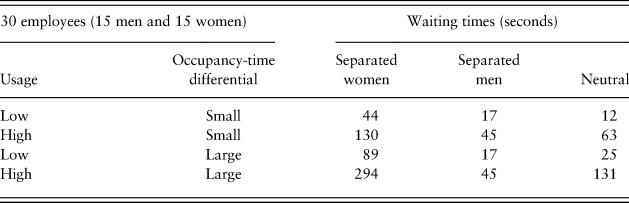
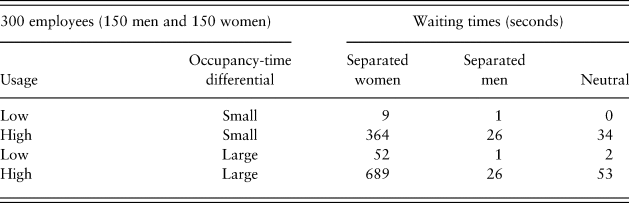
Figure 1 also differentiates between the effects on expected waiting times for women on the one hand and men on the other. It indicates how waiting times differ for women and men with the parameter values that we noted above, viz. one call of nature every two hours and women occupying the bathroom for three minutes and men for two minutes. What is surprising is that there are substantial differences in waiting time even though women only take 50% longer in expected bathroom occupancy time. At 30 employees (15 male and 15 female), the waiting time is about 2.5 times longer for women than for men. At 300 employees (150 males and 150 females), it is about nine times longer (see also Tables 2 & 3).
Expected waiting times in seconds for men and women in gender-separated and in gender-neutral bathrooms in different usages (low: two-hour versus high: one-hour intervals) and occupancy-time differentials (small: 2 and 3 minutes versus large: 2 and 4 minutes) in small firms.

Expected waiting times in seconds for men and women in gender-separated and in gender-neutral in different usage (low: two-hour versus high: one-hour intervals) and occupancy-time differentials (small: 2 and 3 minutes versus large: 2 and 4 minutes) in large firms.

What happens when we move to gender-neutral bathrooms? There are two effects at work. First, there is a vacancy effect. With gender-separated bathrooms, one may be waiting for a bathroom of one's own gender while the bathroom of the other gender is free. This waiting time is averted with gender-neutral bathrooms. Second, there is a pooling effect. The waiting time will be determined by the average occupancy time of the members in the pool of users for a particular bathroom.
For women, both effects push in the same direction. They can take advantage of a vacant bathroom that used to be male-only when the bathrooms that used to be female-only are all taken. Second, by merging the pool of male and female bathroom users, the women join a pool of bathroom users who have shorter occupancy times on average. So, both the vacancy effect and the pooling effect reduce the waiting times for women.
For men, the situation is more complicated. On the one hand, they can take advantage of a vacant bathroom that used to be female-only when the bathrooms that used to be male-only are all taken. So, the vacancy effect reduces their waiting time. On the other hand, by merging, the men join a pool of bathroom users who have longer occupancy times on average. So, the pooling effect increases their waiting time. Hence, the effects pull in opposite directions. If the vacancy effect wins out, then men will incur shorter waiting times. If the pooling effect wins out, then they will incur a cost of longer waiting times. What determines which effect will win out?
The vacancy effect has traction when bathrooms actually have periods of vacancy. In high-usage environments, vacancies are minimal, and the pooling effect will win out: men will lose. In low-usage environments, vacancies do occur, and the vacancy effect will win out: men will gain.
The pooling effect has traction when there is a substantial difference between occupancy times between men and women. In an environment of large occupancy-time differentials, the pooling effect will win out and men will lose. In an environment with small occupancy-time differentials, the vacancy effect will win out and men will gain.
So, how are women and men affected if we actually use the parameter values that we find in the literature? Figure 1 shows that men gain in a relatively low-usage environment with small occupancy-time differentials between the two sexes. As we move to a high-usage environment or to a large-occupancy-time differential environment, we will notice that men start to lose. For a high-usage environment, we assume one call of nature per hour (rather than per two hours), and for a large-occupancy-time differential environment, we assume occupancy times of two minutes for men and four minutes (rather than three) for women. We will just focus on a firm with 30 employees and a firm with 300 employees (see Tables 2 and 3).
What we learn is that men indeed start to lose in high-usage environments and in large-occupancy-time differential environments. But the losses of men are negligible, considering: (1) that women gain so much more in waiting-time reduction than what men lose in waiting-time increase; (2) that the advantage in waiting times men benefit from in the current setup violates parity; and (3) that the waiting time each employee experiences when using the bathroom adds up to lost hours throughout the day. Assuming a 9 to 5 workday under a gender-separated setup, a firm with 30 employees (15 men and 15 women) will lose approximately 1 hour of productivity (61.7 minutes), whereas a firm with 300 employees will lose over 1.5 hours of productivity (99 minutes) per day. In a gender-neutral setup, the small firm would only lose 6 minutes, whereas the large firm would lose 2.5 minutes. For larger firms, losses due to waiting times are bound to be longer when bathrooms are dispersed, as we argue below. What is important is the relative losses due to waiting times as we move from a gender-separated to a gender-neutral setup.
Gender-neutral bathrooms reduce overhead costs
Some firms may consider the status quo of bathroom waiting times to be acceptable with respect to both public health and productivity costs. If this is so, then they can service more employees with the same number of facilities by making bathrooms gender-neutral. So, what kind of gains can be secured following this reasoning? How many more employees can be serviced with the same number of facilities while keeping waiting times fixed?
To address this question, we need to ask: What current waiting times do firms consider to be acceptable – the times for the men or the times for the women? We propose that they consider the times for the men to be acceptable. If we consider the times for the women to be acceptable, then we could service many more employees with the same facilities, but we would be levelling down. Clearly, we should level up – that is, we should provide gender-neutral facilities on the more employee-friendly standards in the current arrangements, viz. the standards for the men.
The algorithm driving our simulation is as follows. For each threshold value that is such that, above this value, a new stall would have to be installed – that is, for 15, 35, 55, 80, 110 and 150 employees – we calculate the expected waiting time per male employee on the model with one call of nature per two hours. We then ask: How many more employees could we add if we were to move to gender-neutral facilities before we exceed these acceptable expected waiting times? We have listed these numbers in Table 4.
The number of employees that could be serviced with the existing facilities while not exceeding the thresholds of the current expected waiting times for male employees.

With these new minimal standards in a gender-neutral setting, nobody loses. Men face the same waiting times, the waiting times for women are equal to the men's and much shorter and the firm reduces overheads by creating space for facilities and procures a gain in productivity due to lower average expected waiting times for (male or female) employees.
The removal of urinals
An oft-heard objection regarding the gains in efficiency under a gender-neutral policy is that most male public bathrooms have urinals, which are time, space and water efficient. It is contentious whether one can retain urinals in gender-neutral multi-stall bathrooms. Architects take it as a challenge to design gender-neutral multi-stall bathrooms that include a section for urinals that provides the requisite privacy and that make both genders comfortable (Sanders & Stryker, Reference Sanders and Stryker2016; Davis, Reference Davis2017), but it is not clear that this challenge can be met.
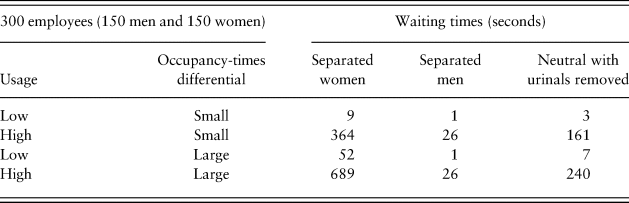
What happens to waiting times when we just remove urinals from the male bathrooms before turning them over into gender-neutral bathrooms? Small firms with at most 35 male employees that abide by minimal standards cannot put in urinals, as we indicated above. So, let us look at a large firm with 150 male and 150 female employees. If the male gender-separated bathroom respects minimal standards, then it will have four stalls and two urinals, while the female gender-separated bathroom will have six stalls. We take out the two urinals and make both bathrooms gender-neutral. On the one hand, making the bathrooms gender-neutral reduces waiting times, while, on the other hand, removing two facilities increases waiting times. So how does this all add up?
In Table 5, we see that women experience substantial reductions in waiting times in a gender-neutral setting, even if we simply remove the urinals from the formerly male bathrooms. Men do, however, pay a price: their loss of two facilities and opening up access to women brings about an increase in waiting times. This is more significant in high-usage or large-occupancy-time differential environments.
Expected waiting times in seconds for men and women in gender-separated (with urinals) and in gender-neutral (with urinals removed) facilities in different usages (low: two-hour versus high: one-hour intervals) and occupancy-time differentials (small: 2 and 3 minutes versus large: 2 and 4 minutes) in large firms.

Discussion
We have shown by means of simulations that gender-neutral bathrooms reduce expected waiting times and that under certain conditions either men gain or they only incur a reasonable increase in waiting time as compared to a gender-separate setting.
There are, of course, many respects in which our model is not quite truthful to reality. First, in our simulations, waiting times went down to negligible numbers for larger firms. But this does not quite reflect what is happening in the real world. For 30 employees, we have two toilets. For 300 employees, we have 12 toilets. Our simulations assume, in the case of 300 employees, that these facilities are all located in two centrally placed bathrooms each with six toilets that are originally gender-separated and then become gender-neutral. In this case, average waiting times go down as the firm increases in size.
However, in actual firms, these 300 employees are more likely to be spatially dispersed. Suppose that the 300 employees are spread out over six floors, with two toilets on each floor. If the employees would rather wait than travel between floors, then they would have waiting times for six groups of 50 employees, with each group waiting for two toilets. Then waiting times will be longer (rather than shorter) than for 30 employees waiting for two toilets.
The reality is somewhere in between: in large firms, bathrooms are to some extent spatially dispersed and employees are somewhat resistant to travelling between bathrooms to find a vacant one. Waiting times will be longer than what Figure 1 indicates for 300 employees. But they will not be as long as the waiting times for 50 employees with two toilets. Hence, in the end, waiting times will be comparable to the ones that we find in smaller firms.
What is more, larger firms have the option of turning only some of their existing gender-separated facilities into gender-neutral ones. This is indeed what has happened at the Home Office headquarters in the UK, where only about 50% of bathrooms were redesigned to accommodate all genders (Odling, Reference Odling2018). In theory, the outcome of such an accommodation is easy to predict: waiting times will improve compared to the status quo, but they will not reach the level of a full gender-neutral setup. However, this simple observation can be complicated by people's reactions. Indeed, at the Home Office (Odling, Reference Odling2018), female employees refused to use the new gender-neutral facilities. Just like in the case of the Barbican Centre (see below), this led to much longer waiting times for women and an improvement for men.
Second, we have assumed that the call of nature may come at random under a uniform distribution, but this is unrealistic as well. There is more pressure on the bathrooms at particular times of day (e.g., after a meeting, when people arrive in the morning after a long commute, after breaks that involve beverages etc.). The impact of this is predictable: waiting times will go up and, in generating a more high-usage environment, men will lose.
The results in this section point to a way of reframing gender-neutral bathrooms that will soften resistance. It is no longer an arrangement in which trans people benefit and cis people pay the price. By bringing waiting times into focus, we learn that women's waiting times drastically go down, while men's waiting times either go down or increase negligibly. Firms are able to save on overheads, and potty parity comes for free. Granted, this can also be achieved by setting the ratio of women's to men's facilities at two to one, as was done in the city of New York's 2005 Women's Bathroom Equity Act (Local Law §57, https://www1.nyc.gov/assets/buildings/local_laws/ll_5705.pdf). But this is at best costly and at worst impossible when one is dealing with listed buildings. Framed in this manner, gender-neutral bathrooms become a ticket that is much easier to sell.
Nudging towards greater acceptance
There are many critics of gender-neutral bathrooms. We will categorize their objections under three entries: gender-neutral bathrooms (1) are a threat to safety, (2) elicit discomfort and (3) are unhygienic. Each of these objections is multifaceted. We do not pretend we are able to bypass each objection. However, we will suggest various behavioural interventions that aim to mitigate these objections and assess how far they can reach.
Safety
To what extent do gender-neutral bathrooms pose a risk to women and girls? In a recent study, Barnett et al. (Reference Barnett, Nesbit and Sorrentino2018) have found one instance of a transgender person who allegedly committed a sex crime in a changing room; one case where a cisgender man claimed to identify as a woman and allegedly committed a sex crime in a women's locker room; 13 cases in the USA since 2004 and five overseas cases where cisgender men dressed up as women and entered bathrooms or changing rooms to commit crimes. This is a relatively small number of cases over 15 years, which appears to vindicate the view of several authors who construe the panic around access to bathrooms as being a moral panic – a panic about morality being under siege – rather than a real concern over safety (e.g., Westbrook & Schilt, Reference Westbrook and Schilt2014, p. 48; Brubaker, Reference Brubaker2016, pp. 79–80; Sanders & Stryker, Reference Sanders and Stryker2016, p. 779). However, the absence of evidence is not evidence of absence: gender-neutral bathrooms are still quite rare both in the USA and around the world (perhaps with the exception of Sweden), and assaults often go unreported. Indeed, in the USA in 2018, it is estimated that only approximately a quarter of rapes and sexual assaults were reported to police (Morgan & Oudekerk, Reference Morgan and Oudekerk2019).
Second, the scope of bathroom safety is broader than violent crimes. Gender-neutral bathrooms may prove to be unsafe for women because of harassment and intimidation. For instance, Women's Voices Wales has recently raised concerns about girls refusing to go to school in order to avoid period-shaming in gender-neutral facilities (Petter, Reference Peter2019).
There are architectural choices that can reduce the risk of both violent crimes and harassment in multi-stall bathrooms. Gender-neutral facilities could be designed as open-plan spaces without an outer door and with stall doors that are floor to ceiling.Footnote 3 Reimagined in this way, multi-stall bathrooms will come to resemble single-stall bathrooms from the perspective of users. Gender-neutral single-stall bathrooms are already more acceptable and have become the norm in many places. This new design for bathrooms has actually been proposed as a way of combating bullying in schools as well as a way of reducing violence in public restrooms (‘Publicly Available Toilets’, 2010; Lumby, Reference Lumby2017). This intervention requires us to do away with the old architectural impulse of providing safety through erecting walls (Sanders & Stryker, Reference Sanders and Stryker2016, pp. 783–784) and instead relies on informal social control (‘more eyes on the street’) to police wrongful activity: people walking down the corridors outside the bathroom space will have direct visual access to what is happening inside.
Furthermore, any changes in bathroom design should be gradual, starting in low-risk environments. A low-risk environment might be a theatre venue that has low alcohol consumption and high usage. Indeed, “by consolidating a greater number of people in one room rather than two, the … gender-neutral bathroom provides safety in numbers: increasing bathroom occupancy reduces risks of predation associated with being alone and out of sight” (Sanders & Stryker, Reference Sanders and Stryker2016, p. 783). This has the added advantage that it is a venue where potty parity is a pressing issue. Or it could be a progressive establishment, say an art institute, in which there is a will to make gender-neutral facilities work. Indeed, the Arts Centre in Camden (London, UK) has recently introduced gender-neutral facilities. We can carefully monitor safety issues in these venues and expand gradually from there to other locations.
That being said, even in these low-risk environments, attention should be given to how gender-neutral bathrooms are designed. A cautionary tale is that of the Barbican Centre in London, where facilities were made gender-neutral by changing the signs on the old gender-separated bathrooms to ‘bathrooms with urinals’ (and stalls, but this was only implied) and ‘bathrooms with stalls’. As a result, women avoided using the former male-only bathrooms, whereas men started using the former women-only bathrooms, thereby aggravating the problem of potty parity rather than resolving it (Grafton-Green, Reference Grafton-Green2017).
Third, gender-neutral bathrooms take away safe spaces for women. The concern in this case is not so much assault or harassment inside, but outside the bathroom. Unfortunately, gender harassment remains a significant (and underreported) problem in the workplace (Ilies et al., Reference Ilies, Hauserman, Schwochau and Stibal2003; Leskinen et al., Reference Leskinen, Cortina and Kabat2011; Feldblum & Lipnic, Reference Feldblum and Lipnic2016) and in entertainment venues (e.g., Graham et al., Reference Graham, Bernards, Abbey, Dumas and Wells2017; Mellgren et al., Reference Mellgren, Andersson and Ivert2018). To avoid harassment, women at times require an environment where men cannot follow them. Even the best design of a gender-neutral multi-stall bathroom cannot provide the safety of gender-separated women-only bathrooms.
Discomfort
Both men and women object to gender-neutral bathrooms on grounds of discomfort. This discomfort is a notion that needs unpacking.
Discomfort may be sheer queasiness. If this is what stands in the way of social change, then a nudge may be the answer. Gender-neutral facilities could be centrally placed, while some gender-separated facilities could be provided within walking distance. The hope is that people will progressively use the closer facilities more often and their queasiness will wear off.
Second, discomfort may be grounded in a medical condition. There are about 20 million people in the USA who suffer from paruresis or shy bladder syndrome – that is, the inability to urinate in the vicinity of other people (‘5 Facts about Paruresis’, n.d.). It is not known whether and to what extent their problems are compounded in gender-neutral settings. More research is required, but this may well be a condition that is beyond nudging.
Third, discomfort may be grounded in modesty or demureness. This type of discomfort is grounded in placing a moral value on privacy concerning human excretion functions. It may be nudgeable, but if the discomfort is based on such a moral value, then nudging becomes objectionable. In nudging away the discomfort, we are destroying a particular moral sensitivity. This would make the nudge illiberal, favouring one conception of the good over another.
In short, when opponents mention discomfort, we need to be careful before invoking nudging strategies. If discomfort is based on queasiness, then nudging is an appropriate response. If it is based on a medical condition, nudging is in vain and we should make sure that there are appropriate alternative options. If it is based on modesty or demureness, then nudging would be illiberal.
Hygiene
Some opponents of gender-neutral bathrooms object to them on hygienic grounds. One of the most common arguments against gender-neutral bathrooms involves the fact that men urinate standing up and as a consequence toilet seats and bathroom floors are unhygienic.
To begin with, urinating standing up is not a fact of male anatomy, but of culture. In Montaigne's Essays, originally published in 1580, he presents as an example of cultural relativity that women urinate standing up and men urinate squatting in some places (Reference Montaigne1978, ch. 23, p. 115). Indeed, urinating standing up is as much a function of early socialization as it is a function of the current ergonomic design of fixtures in bathrooms (Sanders & Styker, Reference Sanders and Stryker2016, pp. 784–785).
Behavioural policies could address this issue by nudging men to sit down on the toilet seat. This can be done by appealing to social norms. According to a 2007 poll of married couples in Japan, almost half of the husbands sit down (McCurry, Reference McCurry2007). Australian Men's Health also claims that 42% of married men sit down (but does not offer any references) and speculates that this number has surpassed the 50% mark by now (Adams, Reference Adamsn.d.). These kinds of articles in men's magazines can contribute to shifting social norms, irrespective of the accuracy of their claims.
Or, one could appeal to self-interest by underlining the health benefits of sitting down. The evidence is contested for men in general, but sitting down has been shown to be beneficial for patients with lower urinary tract symptoms (de Jong et al., Reference de Jong, Pinckaers, ten Brinck, Lycklama à Nijeholt and Dekkers2014). This research has also been covered in popular blogs (see, e.g., Vinopal, Reference Vinopal2018).
Finally, pictographs could be placed inside stalls encouraging sitting down (see, e.g., ‘immi.de – im Sitzen pinkeln’, n.d.). Some toilets in Germany have also been outfitted with a device called Spuk (or ghost). If one tries to raise the toilet seat, Spuk starts scolding: “Excuse me, but there's a penalty for peeing while standing in this house, you'd better not risk any problems and sit down!” (Connolly, Reference Connolly2004).
To sum up, behavioural strategies exist that could in principle address concerns raised by opponents to gender-neutral bathrooms. Their success and legitimacy, however, depend on the root of the objections. Moving forward, more public discussion and careful experimentation of different designs is required.
Conclusion
What our simulations purport to show is that gender-neutral bathrooms offer advantages that multiple groups can agree on. In low-usage and small-occupancy-time differential environments, expected waiting times for both men and women decrease. If we move to high-usage or large-occupancy-time differentials environments, expected waiting times for women substantially decrease, while for men they slightly increase. Assuming that we take expected waiting times for men to be a standard for maximally expected waiting times, we can reduce the number of toilets and achieve a reduction in the expected waiting times for (male or female) employees. If we take the current waiting times for men to be acceptable, then firms can reduce overhead costs by shifting to gender-neutral bathrooms. If we start from the more realistic assumption that urinals will need to be removed in gender-neutral bathrooms, then expected waiting times for men will increase, but expected waiting times for (male or female) employees will still decrease.
Our results permit us to reframe the debate. Gender-neutral bathrooms are not a zero-sum game between trans and other gender-nonconforming individuals versus cis individuals. Rather, they are win–win, or at least close to a win–win. They reduce waiting times for women (thereby securing potty parity) and either reduce (or, at worst, minimally increase) waiting times for men, and they permit firms to save on overhead costs. This new frame should make them more attractive to everyone.
Opponents mention safety concerns, discomfort and issues of hygiene. Architectural design can improve safety issues, but even well-designed gender-neutral multi-stall bathrooms may come at the cost of safe spaces for women. Discomfort is multifaceted and can be grounded in queasiness, fear, medical conditions or modesty. Nudging can address some types of discomfort, but not all. As to hygiene, social norms surrounding men's urination habits are being explored in the popular press, leading to cleaner stalls. In short, new architectural designs and behavioural strategies can increase the acceptability of gender-neutral multi-stall bathrooms, but they do have limitations, and resistance may remain unyielding.
Acknowledgments
We would like to thank Terry Kogan, Mary Anne Case, Alexandra Oprea and Jo-Anne Bichard for their comments on earlier versions of this paper. We are grateful to the audiences at the Second Annual PPE Society Meeting in New Orleans, the Philosophy, Politics and Economics Conference in honour of Luc Bovens at the London School of Economics and Political Science, the Formal Ethics 2017 conference at the University of York, the Center for Values and Social Policy at the University of Colorado, Boulder, the Philosophy, Politics, and Economics Network at Stockholm University and to two anonymous referees of this journal.