




No CrossRef data available.
IN SEARCH OF YAX NUUN AYIIN I: Revisiting the Tikal Project's Burial 10
Published online by Cambridge University Press: 19 July 2005
Abstract
Recent epigraphic decipherments suggest that the child of a Teotihuacan ruler was installed as the ruler of Tikal in a.d. 379. This paper reviews the excavation and osteology of the tomb of this king, Yax Nuun Ayiin I. Estimating the age at death of the skeletons, I found that the skeletons surrounding the principal occupant include at least one adult, who was distinguished by a rare style of dental decoration. I report strontium isotope ratios obtained from the teeth of four of these skeletons. Comparison with a larger data set of strontium isotope ratios on Tikal burials indicates that none of the sampled skeletons from Burial PTP-010 were foreigners to the Maya Lowlands. Although native Tikal children cannot be distinguished from the skeletons of children who lived at nearby Peten sites using strontium isotopes, these results do not support epigraphic readings that identify Yax Nuun Ayiin as a child of Teotihuacan.
Information
- Type
- Research Article
- Information
- Copyright
- © 2005 Cambridge University Press
In 1959, archaeologists from the University of Pennsylvania excavated a partially collapsed tomb beneath Structure 5D-34, a temple pyramid in the North Acropolis at Tikal, Guatemala (Figure 1). Enumerated Burial 10, hereafter referred to as Burial PTP-010,1
The Tikal Project was followed by the Proyecto Nacional Tikal from 1979 to 1985, which began a new burial enumeration. Confusion between burials in the two series is a potential problem for future scholarship. Therefore, I refer to all University of Pennsylvania Tikal Project burials with the prefix “PTP-” and all Proyecto Nacional burials with the prefix “PNT-” and urge other scholars to follow this convention.

Map of Mesoamerica showing the location of Tikal, Teotihuacan, and other sites mentioned in the text.
YAX NUUN AYIN AND THE TEOTIHUACAN CONNECTION
The nature of the relationship between the central Mexican city of Teotihuacan and the Maya has been debated for many years. Because Teotihuacan-style architecture, iconography, ceramics, and green Pachuca obsidian have been found at many sites in the Maya area, scholars have long suggested that the central Mexican state may have played a pivotal role in Early Classic Maya history. Although some degree of elite interaction between the distant cultures is widely accepted, the nature of this relationship is still unclear (Braswell 2003b). Some argue for a militaristic incursion of Teotihuacanos to key sites during the Early Classic period, while others propose that the foreign elements can be explained as appropriation of prestigious foreign symbols by indigenous Maya kings who aimed to reinforce their own local political authority (Demarest and Foias 1993).
At Tikal, evidence for contact with Teotihuacan is found in talud-tablero architecture in several parts of the site, especially in Group 6C-XVI (Laporte 1989), the Mundo Perdido complex (Laporte and Fialko 1995), and the East Plaza (Jones 1996). Iconographic elements on carved monuments and ceramics also suggest strong links with Teotihuacan (Coggins 1975, 1979). After studying the Tikal inscriptions in 1970, Tatiana Proskouriakoff (1993:8) was first to propose that Tikal had been invaded by Teotihuacanos in a.d. 378. Although Proskouriakoff's invasion hypothesis was discarded by subsequent epigraphers, recent work by David Stuart (2000), Simon Martin (2003) and Nikolai Grube (Martin and Grube 2000) supports the idea of a direct political and, perhaps, military relationship between the cities.
The Early Classic ruler Yax Nuun Ayiin I (First Crocodile, Curl Nose) evidently had strong ties with Teotihuacan. He is depicted in central Mexican costume on Stela 4 and on the sides of Stela 31. Yax Nuun Ayiin was inaugurated as ruler of Tikal in a.d. 379, and the event was overseen by a powerful lord named Siyah K'ak' (Fire-born, Smoking Frog). Siyah K'ak' is said to have “arrived” in the Tikal–Uaxactun area on 16 January a.d. 378, the day after the apparent demise of Tikal's ruler Chak Tok Ich'aak (Great Jaguar Paw). Since he is mentioned in the inscriptions at El Perú (a Maya city 80 km west of Tikal) some 8 days before he first arrived at Tikal, Siyah K'ak' seems to have come from the west (Stuart 2000). Both Stuart (2000) and Martin and Grube (2000; Martin 2003) argue that Yax Nuun Ayiin was the son of Spearthrower Owl, whose name glyph resembles the Teotihuacano lechuza y armas motif. Although Spearthrower Owl's accession to a throne and his death are reported in several inscriptions, exactly which polity he ruled over is unclear. It may have been Teotihuacan itself (Stuart 2000). He appears to have served as an overlord of sorts at several Peten sites (Martin 2003; Martin and Grube 2000). By contrast, it is significant that Yax Nuun Ayiin has a Mayan name (Stuart 2000). Indeed, Yax Nuun Ayiin may have had maternal connections to the previous dynasty at Tikal (Martin 1999). Since Spearthrower Owl reigned from a.d. 374 until his death in a.d. 439, Yax Nuun Ayiin may have been quite young when he came to the throne of Tikal in a.d. 379. Moreover, he is depicted in reduced size on Stela 31 as compared with his son Siyah Chan K'awil, where he is also referred to as a “k'atun lord,” meaning that he was younger than 20 years. Together these references imply that Yax Nuun Ayiin probably was still a child when he ascended to the throne of Tikal (Stuart 2000). He may have been selected to rule the city following the natural demise of Chak Tok Ich'aak, who perhaps left no more appropriate male heirs. If so, Siyah K'ak' may have served temporarily as the regent at Tikal, until the young boy came of age (Braswell 2003a; Harrison 1999).
Weaknesses in this scenario lie in the vague references to the location of Spearthrower Owl's home reign, and in the decipherment of key phrases concerning Siyah K'ak's arrival at Tikal, which may also be read to indicate that he was originally from Tikal (Braswell 2003a). Thus, alternative explanations are also consistent with the inscriptions. Indeed, Spearthrower Owl's connections with a “place of reeds”—which Stuart (2000) interprets to be Teotihuacan—may be a mythical honor, posthumously ascribed to Yax Nuun Ayiin's father, to justify a change in dynastic succession and legitimize the child king (Braswell 2003a). Changes in the iconographic programs employed on stelae erected during Yax Nuun Ayiin's reign, which portray the ruler as a Teotihuacano warrior in frontal pose, demonstrate a shift from earlier iconographic programs. James Borowicz (2003) argues that Yax Nuun Ayiin chose to emulate a foreign style, thus emphasizing his foreign connections rather than his local ancestry. Were he a foreigner whose claim to the throne rested on his maternal ancestry, the earlier program could arguably have better legitimized his claim to the throne than the militaristic foreign program that he adopted.
Rather than an externally motivated military incursion, factions within Tikal's royal family may have invited elite Teotihuacano diplomats or traders to intervene in Tikal's dynastic succession (Culbert 2005). T. Patrick Culbert argues that it is unlikely that a paramount ruler of Teotihuacan would have led a military expedition to distant Tikal and spent sufficient time in residence to have married and fathered Yax Nuun Ayiin, a perspective echoed by George Cowgill (2003). It is perhaps more likely that a woman of Tikal's royal lineage traveled to Teotihuacan, and her child was born and raised there. Ceramic and iconographic evidence from Tetitla, Tlailotlacan, and the Merchant's Barrio is consistent with a significant Maya elite presence at Teotihuacan in the Early Classic period (Taube 2003). Oxygen isotope ratios of some skeletons from the Feathered Serpent Pyramid at Teotihucan are also consistent with an origin in the Maya area (Spence et al. 2004; White et al. 2002). If Spearthrower Owl was indeed a ruler of Teotihuacan, then it would seem likely that his son might have been born at that site. Alternatively, Spearthrower Owl may have ruled over an unidentified Maya polity and married a royal woman from Tikal (Braswell 2003a). Political links to Teotihuacan may have been much weaker—or, indeed, fictitious—serving to validate a change in the line of succession among local Tikal royalty. Therefore, direct geochemical evidence obtained from Yax Nuun Ayiin's skeleton that can shed light on his childhood home may help to resolve this issue.
Clemency Coggins (1975:137–176) identified Burial PTP-010 as the likely grave of Yax Nuun Ayiin I. This tomb was located on the centerline of Structure 5D-34, in front of which Yax Nuun Ayiin's Stelae 4 and 18 had been reset. The tomb contained Manik III phase ceramics decorated with central Mexican deities and motifs. Among the ceramics is a tripod cylinder vessel bearing an inscription that Martin deciphers as “the drinking vessel of the son of Spearthrower Owl” (Martin and Grube 2000:33; personal communication 2003). Although other faunal remains were also present, the interment of a crocodile along with the human cadavers in the tomb is symbolically consistent with the identification of the grave as that belonging to “First Crocodile” (Harrison 1999). Yax Nuun Ayiin may have died in a.d. 404 (Martin and Grube 2000:33). In his detailed description of the North Acropolis excavations in Tikal Report No. 14, William Coe (1990) placed Burial PTP-010 in Structure 34's Time Span 5C, predating the radiocarbon date (P-284, a.d. 370–490) from the later Time Span 5A. Thus, Yax Nuun Ayiin's tomb must have been constructed in the first two decades of the fifth century a.d. (Coe 1990).
EXCAVATION AND CONTEXT OF THE HUMAN REMAINS
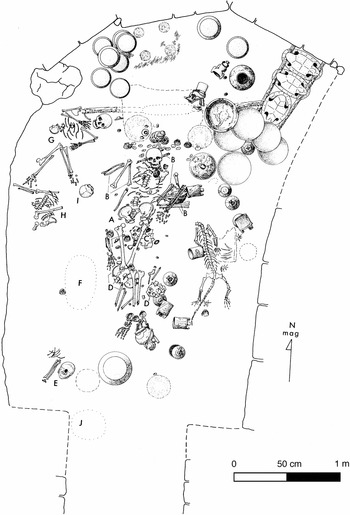
Excavation of Temple 5D-34 began in 1958, under the general supervision of Edwin Shook, director of the Tikal Project. Burial PTP-010 was encountered in May 1959. Stuart Scott supervised the North Acropolis excavations during the summer of 1959; however, the tomb excavation was continued by Shook, with some assistance from Aubrey Trik and Ann Chowning after Scott's departure on August 2 (Shook 1959). A detailed discussion of the excavation process is necessary here for several reasons: (1) several archaeologists supervised the excavation using different systems to enumerate the skeletons; (2) the skeletons were renumbered before publication in Tikal Report No. 14; and (3) the teeth have been intermingled in the course of subsequent osteological work. Because Coe's (1990:479–487) description of PTP-010 omits several key details that aid our identification of the skeletons, the following discussion is drawn primarily from original field notes (Scott 1959; Shook 1959), operation cards, and other unpublished notes in the Tikal Room archive at the University of Pennsylvania Museum of Archaeology and Anthropology. Table 1 contains the correlation between the field burial and lot designations for the skeletons and the alphabetic designations published in Coe (1990). The published map of the tomb in Figure 2 was pieced together by Coe from field notes and photographs; Figure 2 identifies each skeleton using Coe's alphabetic designations.
Skeletal remains from burial PTP-010, indicating correlation between field and published designations


Map of Tikal's Burial PTP-010 (modified from Coe 1990:Figure 160).
The tomb was found during north–south axial trenching of Structure 34 and first identified as a disturbance cutting east–west through the terrace floor (U.27) of the earlier Platform 5D-4-3rd (Coe 1990:479). Removing the fill, Scott encountered roughly hewn stairs carved from the structure fill and bedrock below. Following northward and down the stairs, he encountered a vertical cut face of bedrock that formed the north wall of the descending stairway. This entry stair had been filled with six layers of chert flakes and one layer of chert and obsidian debitage, comparable to that later found above many other royal burials at Tikal. Tunneling below this vertical face through dense fill, Shook (1959:24) described molds of two thick ropes and a wall of dense fill that blocked the entrance to the tomb. Breaking through this wall, the excavators found a large pile of rubble fallen from the bedrock ceiling of the tomb. The skeleton of a 6-year-old child was encountered at this point and later denominated Skeleton J. Scott (1959:178) described these bones as stained “pink, nearly red” and designated them “Burial 8.”
The imminent collapse of the bedrock ceiling over the tomb hampered further excavation, so work was halted, and excavators approached the tomb from above, removing the collapsing bedrock ceiling. Clearing the material over the tomb in May and June, excavators again reached the tomb contents in early July 1959. The “bedrock” consisted of a mix of large lime blocks, chalk, clay, and sand, but the tomb walls had originally been lined with limestone blocks that may also have helped to support the “bedrock” ceiling, and these had collapsed inward at the north end of the tomb, giving the appearance of a “beehive vaulting” (Shook 1959:25). Shook speculated that the ceiling was crumbling even as the tomb contents were being placed. Coe (1990:480) offered the interpretation that the ropes crossing the entry closure may have suspended the primary interment above the tomb floor.
Having constructed a wooden roof over the excavation, Scott excavated the tomb contents from south to north, beginning along the midline of the tomb. North of where the first child had been recovered, he encountered a second skull lying upside down in light gray/brown lime-rich soil. This was designated “Burial 12” and later renumbered Skeleton E. These bones had a pink tinge evident throughout the bone cortex. Scott (1959:178) speculated that the skeleton had been “sitting or otherwise contracted.” The skull and long bones of this adolescent were mingled with vertebrae from a smaller child. Scott inferred that the smaller bones pertained to “Burial 8” (J), which, like the bones of “Burial 12” (E), had been scattered with the collapse of the tomb's facing walls.
Moving northward, excavation began to uncover the central cluster of skeletons, including the extended supine principal occupant of the tomb. These four individuals, later designated Skeletons A, B, C, and D, were initially considered together by Scott as “Burial 14.” However, he commonly referred to the extended central adult skeleton (later redesignated A) as “Burial 14,” to the exclusion of the other remains. The cranium of “Burial 14” (A) was “definitely” not deformed (Scott 1959:217), although it was brightly colored red, especially on the frontal bones (Scott 1959:214). However, A's skeleton was mottled both red and black. Scott (1959:192) described the central cluster of skeletons as having been “laid on a feather or tapestry cloth that decayed to produce a black carbon deposit below the bones” that continued north of the skull of “Burial 14” (A). Slightly east of A's tibia, the skull of an adolescent was identified, and later designated individual D. This skeleton was covered by the “mantle,” which stained its bones dark brown. The skull of individual C was found under the left femur of the extended Skeleton A. Individual B appears to be a cluster of long bones located under the chest area of the principal occupant (Individual A) and may be the bones that Scott referred to as “Burial 17,” which he states were difficult to excavate because of close proximity to the central skeleton. To the west of the “Burial 14” remains, Scott briefly described a cluster of bone as “Burial 16,” which Coe designated on the burial map as Individual F.
Scott left Tikal on August 2, 1959 and the excavation was continued under Shook's supervision. Excavating eastward from the main skeleton, this team encountered the crocodile skeleton. Although Coe (1990:485) described the crocodile as “apparently headless,” Shook's (1959:26) notes indicate that Scott had previously removed the head. Excavation proceeded from east of the main skeleton northward and westward along the north margin of the tomb, which was in part delimited by a masonry wall. Shook (1959:27) described the human remains in the northwest portion of the tomb as follows:
West of the main skeleton's body were at least three skeletons of young individuals in various flexed positions. Skeleton A (bones and skull stained pink) was found on back, head to E.N.E., filed teeth, and a large jade ear plug with jade mosaic plug in hole of flare. Bodies well above tomb floor ±30 cm and lying on thin black film.
By “Skeleton A,” Shook is not referring to the tomb's principal occupant, but to the semiflexed skeleton that Coe later referred to as “Skeleton G.” This new enumeration system appears to have been implemented for human remains removed from the tomb after Scott's departure. “Skeleton B” presumably refers to Coe's “H” or “I” (Figure 2). At the end of August 1959, Shook (1959:42) summarized the human remains found in the tomb as follows: “main or chief skeleton and 7 plus young individuals from 6 years to adolescent (one with filed teeth). Burial 14 (chief), 8, 12, 13, 16, 20, A, and B. A has filed teeth.”
Oddly, Shook does not mention “Burial 17,” nor does Scott mention “Burial 13” or “20” in his notes. Coe's description of the tomb makes no mention of the filed teeth of Skeleton “A.” The lot card for PTP-010 indicates that the feature was “consolidated as Burial 10 by Shook and Coe” in October 1959, at which time the skeletons were renumbered.
THE OSTEOLOGY OF PTP-010
During the 1959 excavations, the human remains from Burial PTP-010 were studied in preliminary fashion by Chowning, who estimated age at death for several skeletons (Shook 1959:43). These were later studied by William Haviland, who provided the age estimates reported by Coe (1990:480–481). The skeletal remains exported to Philadelphia for study were mostly dental and include the majority of the PTP-010 remains that were curated. These dental remains were sent via A. V. Kidder in February 1964 to Allan G. Schiek, a Delaware dentist, for study. An inventory of teeth sent to Sheik indicates that the various individuals from PTP-010 had been “mixed up in 1962.” These are currently at the University of Pennsylvania Museum of Archaeology and Ethnology. In addition, some human remains and many artifacts excavated by the University of Pennsylvania have been curated in a warehouse at Tikal National Park. These include human bones and teeth from PTP-010.2
The Registro Department of the Instituto de Antropología e Historia assigned the number “17.1.1.3258” to the PTP-010 remains housed at Tikal National Park.
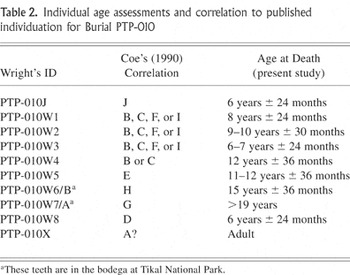
In Philadelphia, I was able to sort out most of the PTP-010 remains to reconstruct separate individuals using the enamel color, dentine color, crown shape, cusp patterns, stage of development, and position and patterning of enamel hypoplasias on the crowns. Although several mandibles and maxillae were labeled as to lot number or individual, or were in bags with lot numbers, it became clear that many of these did not match. Only individual PTP-010J appeared to be securely identified by the labels on the bone. Thus, I established a new individual enumeration system for eight of these reconstructed individuals, PTP-010W1 through W8. Teeth that I could not positively match to a specific individual were inventoried as PTP-010X. Table 2 contains a summary of these individuals, their best correspondence to the individuals reported in Tikal Report No. 14 (Coe 1990), and the estimated ages at death.
Individual age assessments and correlation to published individuation for Burial PTP-010

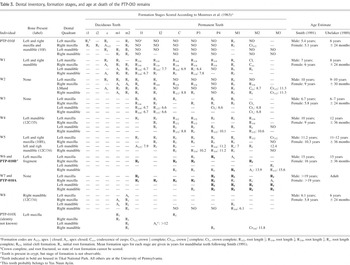
For each tooth, I scored the state of development following the system of Coenraad Moorrees and colleagues (1963) but added an inventory code (Rf) for teeth that had completed crown formation and considerable root formation but for which the apical margin of the root was damaged, preventing a precise estimation of root formation. Teeth that were present in dental crypts and thus could not be scored were designated “NO” for “present but not observable.” I estimated age at death using both Moorrees and colleagues' (1963) developmental standards for the permanent mandibular teeth (Smith 1991) and the formation/eruption table of Douglas Ubelaker (1989). Table 3 contains the inventory, formation stages, and age assessment for all of the dental remains from PTP-010. Alveolar bone associated with these individuals is also indicated in the table. Difficulty in discriminating stages during apex completion (Rc, A1/2, Ac) leads to some inconsistency in ages estimated for individual teeth from a single skeleton. Moreover, it should be noted that ages for teeth near completion indicate ages beyond which the individual survived. In some cases, the ages estimated using tooth formation (Smith 1991) are younger than those for formation/eruption (Ubelaker 1989), due to differences in the developmental standards between populations. Overall, I have found Ubelaker's table to function well with Maya dentitions; thus, the summary ages given in Table 2 emphasize these standards. In the following discussion, I use standard symbology to identify individual teeth.3
Each tooth is indicated by a letter (I, C, P, or M) designating the morphological class of the tooth, followed by a number indicating the tooth position within that class. The numbers are superscript for maxillary teeth or subscript for mandibular teeth. Upper-case letters designate the permanent dentition, while lower-case letters identify deciduous teeth. Hence, M2 indicates a permanent maxillary second molar.
Dental inventory, formation stages, and age at death of the PTP-010 remains

At Tikal National Park, a chocolate box labeled “Bu. 10” contained subadult skeletal material, a partial adult femur, and teeth. I was able to separate the teeth of two individuals, both of which initially appeared to be adults. Individual “PTP-010A” is represented by a nearly complete permanent maxillary dentition, excepting the right maxillary molars. The mandibular dentition consists of posterior teeth on both sides of the mouth from P4 to M3. Individual “PTP-010B” is less well represented, as indicated in Table 3. I suspected that both individuals had died during their adulthood, given the degree of attrition and the state of root formation. Although the apices of all roots for PTP-010A were damaged, the thickness of the most apical dentine preserved suggests completed development. Respectively, these dentitions match well with the teeth designated “PTP-010W7” and “PTP-010W6” at the University of Pennsylvania Museum, in terms of inventory, enamel color, root color, cusp morphology, and size. I believe that they belong to the same two skeletons, from which only a few teeth were exported for study, for whatever reason. The complete and intact right M3 root on dentition PTP-010W7 confirms that this individual had reached maturity before his or her death. By comparison with other skeletons from Tikal, the degree of attrition on the PTP-010A/W7 molars is consistent with death in young adulthood. By contrast, the right M3 of PTP-010W6 is incompletely formed, indicating an age of 15 to 16 years at death.
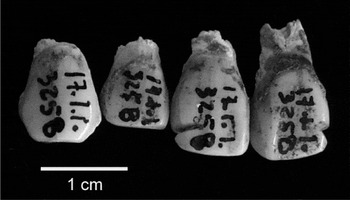
Skeleton PTP-010A from Tikal National Park shows an interesting pattern of dental decoration of the maxillary teeth, illustrated in Figure 3. This filing is consistent with Shook's description of the filed teeth of “Skeleton A” (redesignated G) and helps to confirm the identity of this dentition. Although the mamelons of erupting incisors are sometimes misidentified as filed notches, dental filing is seen exclusively in adult Maya skeletons (Wright 2003). Thus, the filing seen in this skeleton further supports an adult age assessment. Both I1s show deep notches cut into the distal aspect of the tooth well above the distal incisive corner. This form is somewhat different than that classified by Javier Romero Molina (1986) as Type B5, in which the distal incisive corner of the tooth is fully removed. The right I2 of this skeleton shows horizontal removal of the complete incisive margin, Romero's Type A4, a form that is very common on lateral incisors at Tikal and elsewhere in the Maya Lowlands. The right C1 shows some blunting of the cusp in a horizontal plane, parallel to the I2 filing. Hence, I scored this as a “possible” case of Type A4 filing. However, this may be simply due to mastication attrition. The mesial aspect of the C1 also shows a shallow notch at the level of the I2 filing, presumably inflicted unintentionally during the filing of the I2.

Filed maxillary teeth of Skeleton PTP-010G.
This side notch filing of the I1 is quite rare, and I did not see it in any of the Proyecto Nacional Tikal remains that I surveyed, nor is it illustrated in Romero's surveys (Romero Molina 1986). However, two similar cases occur in the Tikal Project collection (Haviland, personal communication 2000). Burial PTP-094 shows similar distal filing of the I1. This Early Classic burial was found beneath Structure 4H-4, the east shrine of a small domestic group. A second case is part of a more complex decoration pattern that included both double notching of the incisive margin (Type A2) as well as the distal filing of both I1s, angular removal of mesial and distal incisive corners (Type C6) of the right I2 (the left was not recovered), and squared removal of the distal incisive corner (Type B4) of both C1s. This dentition is from Operation 98L, in the Central Acropolis, and consists of secondarily deposited remains associated with Structure 5D-127 (Haviland, personal communication 2000). Unfortunately, neither dentition is available for study. Although classified as Type G3 (Buikstra et al. 2003), the distal notches on the I1 of the Copan ruler Yax Kuk Mo (Burial 95-2) also resemble the filed I1s of Skeleton PTP-010A. The notches on Yax Kuk Mo's I1 did not fully remove the corner of the tooth, and the teeth were also inlaid with jade.
Haviland had estimated the age of the principal skeleton of the PTP-010 tomb to be older than 35 years at death (Coe 1990:480), and Chowning had previously suggested an age older than 50 years at death (Shook 1959:43). Haviland's (1963:3) notes indicate that only two teeth were retained from this principal skeleton: a canine and a molar. It is unclear whether more were originally recovered. I inventoried teeth that could not be assigned to any of individuals W1 through W8 as PTP-010X. Among these teeth are two that may belong to adult skeletons. A permanent mandibular left canine shows complete development and closure of the apex, indicating an age older than 12 years. This tooth's morphology and color do not match the remaining teeth from PTP-010W6 or W7, although neither of these dentitions includes a left C1. In addition to lacking the marked hypoplasia seen on the right C1 of PTP-010W6, this tooth shows considerable attrition, inconsistent with the adolescent age at death of PTP-010W6. Although it is not certain that this canine derived from the central occupant of Burial PTP-010, it does represent the best available candidate for that skeleton. The second PTP-010X tooth of interest is a right M1 with a fractured root. However, it could conceivably belong to Skeleton W3 for which there is no antimere for comparison. These are the only PTP-010X teeth that could conceivably have belonged to Yax Nuun Ayiin. The remaining teeth listed under PTP-010X pertain to the accompanying individuals but cannot be definitively assigned to a specific skeleton.
Due to restricted laboratory space, a large number of human remains from Tikal were discarded in the field. In fairness, excavators in the 1950s and 1960s could not have predicted the value of these materials in the context of the future osteological and chemical methods. The discarded material included most of the postcranial material from PTP-010; however, a small amount of material is still stored at Tikal National Park. A complete subadult left humerus diaphysis measures 180 mm in length. Comparison with Maya skeletons aged by dental development, this length indicates death near 7 or 8 years of age (Marie Danforth, personal communication 2003). A second fragmentary subadult humerus is larger, indicating that it derives from an older adolescent. A subadult left ulna measures 185 mm in length, suggesting an adolescent of 9 to 15 years. A left unfused distal femoral epiphysis is also preserved. Two adult bones may belong to either individual A or individual G. A fragment from the proximal diaphysis of a left femur is very large (midshaft circumference = 98 mm) and consistent with a mature adult male. A complete left radius positioned in the Burial PTP-116 diorama of the Museo Sylvanus Morley at Tikal is marked “10” in pencil and may be from Yax Nuun Ayiin, but it could also have derived from Skeleton G. I was unable to locate additional PTP-010A remains that Haviland (1963:3–4) reported saving. Several drawers at Tikal National Park contain unlabeled bones, and these may include some material from PTP-010.
This osteological survey of the Burial PTP-010 remains concludes a somewhat different assessment of the tomb contents than that previously reported. Differences in age assessments are likely explained by misidentification of molar positions in the original study and improved standards for dental maturation. Possible correlations to Coe's skeleton numeration are indicated in Table 2; however, it is not possible to compare age estimates directly because the identity of several dentitions is not certain. Several skeletons are younger than the ages reported by Coe (1990). Three skeletons were 6 years of age at death, whereas Coe reported only one skeleton as young as 7 years. Rather than a single adult skeleton, the tomb contains at least two adults. One of these was located in the northwest corner of the tomb and is unique in showing filed teeth. This skeleton was labeled PTP-010A and corresponds to Coe's Skeleton G. The second adult is represented only by a permanent mandibular canine (PTP-010X); this tooth probably represents Yax Nuun Ayiin. Morphologically, all of the teeth from Burial PTP-010 resemble those from other Tikal contexts. Most of the PTP-010 teeth show enamel hypoplasias and in this regard are not superficially different in childhood health experience from other Tikal burials.
USING STRONTIUM ISOTOPES TO TRACK MIGRATION
Strontium (Sr) substitutes for calcium (Ca) in the mineral phase of bones and teeth. Although the absolute abundance of Sr taken up into bone is affected by the composition of the diet, the relative abundance of the stable isotopes of Sr (86Sr, 87Sr) is not measurably changed as the element moves through the food web. In foods, ratios between the isotopes vary geographically with soil values because of the different geological origin and age of underlying bedrock (Dasch 1969; Faure 1986; Faure and Powell 1972). These food values are in turn recorded in the isotope ratios of the teeth and bones of consumers as Sr is incorporated into the growing skeletal tissues. Strontium's radiogenic stable isotope, 87Sr, is produced from the decay of rubidium (Rb) and is conventionally reported as a ratio to non-radiogenic 86Sr—that is, 87Sr/86Sr. Very old rocks of high Rb/Sr composition have high 87Sr/86Sr ratios, while younger rocks, and those with low Rb/Sr ratios have dramatically lower 87Sr/86Sr ratios.
Because these bedrock isotopic ratios are averaged in soils, plants, and, in turn, the animals from a region, they provide very specific average signatures of local environments. These geologic signatures are incorporated into the skeletal tissues of animals and humans, and preserved in archaeological remains (Ericson 1985; Ezzo et al. 1997; Grupe et al. 1997; Price et al. 1998; Price et al. 1994; Schweissing and Grupe 2003). For instance, at Teotihuacan, T. Douglas Price and colleagues (2000) have found extremely good concordance between the strontium isotope ratios of modern rabbits and archaeological humans. Tooth enamel is especially useful as a sample tissue because it preserves the isotopic signal of the diet consumed in childhood when the teeth developed. Thus, the teeth of individuals who migrated and came to be interred in a region that is geologically distinct from their childhood homes show 87Sr/86Sr ratios that are different from those in the teeth of local children. Moreover, tooth enamel is very resistant to diagenetic exchange with soil during burial because of its highly crystalline structure and its low porosity (Kohn et al. 1999; Lee-Thorp and Sponheimer 2003; Montgomery et al. 1999).
Ongoing research on a larger series of Tikal burials (Wright 2005), and analyses of burials from Teotihuacan (Price et al. 2000), Kaminaljuyu (Wright 2004; Wright et al. 2002), and other sites provide comparative data that permit us to identify the skeletons of migrants who died at Tikal. Strontium isotope analyses are especially well suited to testing the hypothesis that Teotihuacanos may have been buried at Tikal because of the disparate geology of the two sites. Strontium isotope ratios of soils and foods at Teotihuacan are a product of the volcanic geology of central Mexico. 87Sr/86Sr ratios are low at Teotihuacan because of both the young age of the volcanic soils and the low Rb content of volcanic material. By contrast, soils at Tikal are derived from much older Paleocene/Eocene limestone bedrock and show strontium isotope ratios that are substantially higher than at Teotihuacan. Thus, an individual born at Teotihuacan would show much lower 87Sr/86Sr ratios in their teeth than the ratios of individuals born locally at Tikal.
I collected tooth enamel samples from three permanent teeth from Burial PTP-010 and sampled two deciduous mandibular canines that had previously been sectioned for study of enamel defects (Danforth 1989). These include the probable tooth of Yax Nuun Ayiin as well as three of his companions in the tomb. The enamel samples are from the PTP-010X canine that I believe belongs to Yax Nuun Ayiin and two first molars from the adult Skeleton G (PTP-010A, PTP-010W7). One deciduous canine dentine sample is from Skeleton J. The second deciduous canine was labeled “E or F.” It is unlikely to belong to PTP-010W5 (E), which should have lost all deciduous canines before he or she died at age 11 or 12 years. This sample could belong to any of Skeletons PTP-010W1, W2, or W3. Dentine does not remodel like bone, so it captures a childhood dietary signal comparable to that of enamel. Although dentine is more likely to be affected by diagenesis than enamel (Budd et al. 2000; Montgomery et al. 1999), I decided to sample these deciduous teeth since they were already sectioned, and I did not wish to damage more teeth than necessary. I did not sample the adult femur or radius from PTP-010 (which may or may not belong to Yax Nuun Ayiin) because bone is often poorly preserved at Tikal, so it is possible that these bones could be contaminated by diagenetic Sr, which would give a false local value. Moreover, since Yax Nuun Ayiin lived some 25 years at Tikal after assuming the throne, we would expect his bone to show a local signal—regardless of his place of birth—because bone is continually remodeled and incorporates recent dietary elements throughout life.
ANALYTIC METHODS
The three permanent teeth sampled were each photographed prior to sampling. We made casts of the teeth using super-hard epoxy for casting and President's Jet medium-body polysiloxane for the molds. These casts replaced the original tooth in the collections. Each enamel sample was mechanically cleaned of soil, dentine, and surface discoloration using a Foredom drill with a carbide drill bit. Because of the thin enamel remaining on the two samples from deciduous teeth, I sampled dentine for these two individuals. Discolored dentine was similarly removed from the two deciduous teeth. The samples were further cleaned by sonicating them in deionized water (18 MΩ) for 15 minutes. After rinsing, 5% ultrapure acetic acid was added to each vial, and the samples were warmed at 80°C in a drying oven for approximately 24 hours. This treatment aims to remove diagenetic material that may have contaminated the samples during burial. The dried samples were transferred to sterile silica glass tubes and ashed in a muffle furnace at 825°C for 8 hours. The ashed samples were then transferred to sterile Savilex digestion vials, and they were digested in hot ultrapure concentrated nitric acid, dried in a sterile laminar flow drying box, and dissolved in ultrapure 2.5 N hydrochloric acid. Cation exchange chromatography was used to isolate the strontium, using 2.5 N hydrochloric acid as the mobile phase.
The strontium samples were mounted on zone-refined tantalum filaments, and strontium isotope ratios were measured using the GV Instruments Sector 54 thermal ionization multiple collector mass spectrometer (TIMS) at the University of North Carolina. 87Sr/86Sr ratios were corrected for mass fractionation in the instrument using the exponential mass fractionation law and 86Sr/88Sr equal to .1194. Over the past several years, repeated 87Sr/86Sr analyses of the NIST SRM 987 strontium carbonate standard at University of North Carolina–Chapel Hill average .710242 (Knudson et al. 2004). Samples analyzed on the Micromass Sector 54 spectrometer typically show an internal precision (SE) of .000006 to .000010, based on 100 dynamic cycles of data collection.
STRONTIUM-ISOTOPE RESULTS AND IMPLICATIONS
I have analyzed tooth enamel from a large series of Tikal skeletons that help to define a local 87Sr/86Sr range for the site. One might identify a local strontium-isotope ratio for Tikal using all of the 87Sr/86Sr data collected so far (N = 83 samples; mean = .70804). However, a number of samples lie far from this mean and are presumably skeletons of individuals born elsewhere. Assuming that all individuals at Tikal consumed locally grown foods and treated maize with local lime, one would expect the Sr values to be normally distributed. Comparison of the Tikal data with the normal distribution identifies the range between .70766 and .70850 as the local value for Tikal, with a mean of .70812 (Wright 2005). The mean difference between repeat analyses of eight Tikal teeth is .00018, less than the standard deviation of this “local” sample. I consider any skeletons with tooth enamel 87Sr/86Sr ratios outside of this range (.70766–.70850) to be likely migrants, born at sites distant from Tikal. These results are broadly consistent with 87Sr/86Sr measurements on water (.70802), plants (.70784), and rock (.70813, .70779) from Tikal reported by Hodell and colleagues (2004), and with data for rodents (.70790) and Pomacea (.70779) collected outside the park boundaries. However, the mean values of the human data are slightly higher than the comparative data, perhaps due to 87Sr/86Sr enrichment from imported sea salt (Wright 2005). By contrast, Price and colleagues (2000) found 87Sr/86Sr ratios of enamel at Teotihuacan to be approximately .7047. It is important to note that the range of variation seen among the Tikal samples is about an order of magnitude smaller than the difference between the mean ratios of Tikal and Teotihuacan. Therefore, it should be an easy task to distinguish between individuals who spent their childhood at Tikal and Teotihuacan.
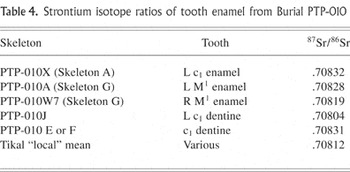
Table 4 contains the strontium-isotope ratios of five teeth from Burial PTP-010. From Skeleton G, I collected enamel samples from both the remains in Guatemala (PTP-010A) and at the University of Pennsylvania (PTP-010W7). These results are within the range of measurement error that we might expect if the two teeth were from the same skeleton. All of the teeth have 87Sr/86Sr ratios that lie within one standard deviation of the local mean for Tikal tooth enamel. None can be identified as migrants from other sites, and none approach the much lower 87Sr/86Sr ratios measured for Teotihuacan tooth enamel and bone (.7047; Price et al. 2000).
Strontium isotope ratios of tooth enamel from Burial PTP-010

The PTP-010X C1 that may belong to Yax Nuun Ayiin also shows a local 87Sr/86Sr value, .70832. This value is the highest among the teeth sampled from the tomb and lies above the mean of all human samples measured from Tikal to date (Wright 2005). The tooth enamel sampled from PTP-010X forms between birth and 3 years of age and therefore averages Sr ingested at that time. For nursing infants, Sr is obtained from breastmilk that reflects both the 87Sr/86Sr of the maternal diet and of the mother's skeletal Sr stores, which are brought into circulation through bone remodeling. If Yax Nuun Ayiin's mother was a woman from Tikal who moved to Teotihuacan shortly before or immediately after his birth, her breast milk would have 87Sr/86Sr intermediate between that of the diet she consumed in Teotihuacan (.7047) and that of Tikal (.7081), where she had previously lived. However, nursing infants must begin to consume additional foods by 1 year of age or they will be stunted; maize gruels (atole) are common weanling diets in Mesoamerica and are typically prepared with alkaline-processed maize (nixtamal) that is high in Sr. Although nursing might have continued for several years after the child began to eat additional foods (Wright and Schwarcz 1998), the sampled portion of the PTP-010X tooth includes enamel that would have formed when the child was no longer exclusively breastfeeding. Since breastmilk is low in Sr, this dietary Sr would have shifted the child's 87Sr/86Sr closer to a Teotihuacan value. Thus, if Yax Nuun Ayiin was born at Teotihuacan, or spent a significant time there before reaching 3 years of age, we would expect his canine to show a slightly higher 87Sr/86Sr than the local Teotihuacan value. However, this value would be considerably lower than the 87Sr/86Sr for Tikal.
The PTP-010X C1 shows the highest 87Sr/86Sr of the teeth sampled from the tomb, so it is the most distant from the expected value for Teotihuacan. Had it shown a 87Sr/86Sr that was substantially lower than the remaining Tikal data, this would have lent further support for its identity as Yax Nuun Ayiin. Although the inventory of teeth sent to Sheik indicates that the individuals of PTP-010 had been mixed among themselves before they were shipped to him, there is no evidence that teeth from other burials were mixed with burial PTP-010. Thus, it is reasonable to conclude that this tooth does represent Yax Nuun Ayiin and that he spent his childhood at or near Tikal. Moreover, the data for teeth from the peripheral skeletons indicate that they were also local children.
DISCUSSION
This work can neither conclusively confirm nor reject the possibility that central Mexicans had a substantial physical presence at Tikal. However, the evidence for highland Mexican skeletons in Burial PTP-010 at Tikal is quite weak indeed. The best available candidate for Yax Nuun Ayiin's remains shows a strontium isotope ratio consistent with those of a local Tikal child. Moreover, the presumptive sacrificial victims who accompanied him in the grave were also local children. None of the skeletons sampled had lived at Teotihuacan during the childhood ages at which their teeth had formed or they would show much lower 87Sr/86Sr ratios. The values I obtained for the PTP-010 teeth also differ markedly from tooth enamel we have measured at Kaminaljuyu, about .7044 (Wright 2004 and unpublished data) and bone from Copan, about .7064 (Buikstra et al. 2003), indicating that these individuals did not spend their childhood at either of these key sites. Matacapan, a Gulf lowland site with strong ties to Teotihuacan, is also an unlikely point of origin for the PTP-010 skeletons, since it is located in a volcanic area and would thus have 87Sr/86Sr ratios like those of Teotihuacan and Kaminaljuyu.
It is important to note, however, that the local strontium-isotope range defined earlier for Tikal is not one that belongs exclusively to Tikal. Rather, this ratio is largely a product of the Paleocene/Eocene sedimentary geology of the central Peten region in which Tikal is located. Hodell and colleagues (2004) measured soil, flora, and water samples collected from across the Maya region. These data cluster into five broad geographic groups: (1) the northern Maya Lowlands; (2) the southern Maya Lowlands; (3) the Maya Mountains; (4) the Maya Highlands and Pacific coast; and (5) the Motagua Valley and Copan. These groupings are consistent with data from tooth enamel of both archaeological humans and faunal remains that we have sampled from several different sites (Buikstra et al. 2003; Wright 2003; Wright, Price, and Burton, unpublished data). Unfortunately, the data currently available indicate that 87Sr/86Sr alone may not discriminate between sites located within any one of these zones. Thus, the skeletons in Burial PTP-010 may have been born at any site located in a similar geological context to that of Tikal. This would include the Peten, the Usumacinta/Pasión drainage, and the southern part of the Yucatan peninsula.
The contemporaneous tombs from Kaminaljuyu provide a key comparative database to Burial PTP-010. There, strontium (Wright, unpublished data) and oxygen isotope analyses (Valdés and Wright 2003; White et al. 2000) indicate that several of the adolescent skeletons that accompany the central tomb skeletons were those of foreign children, and that these foreigners came from at least two different, lowland regions. Thus, we should not be too quick to assume that the accompanying skeletons in PTP-010 were not captives, tribute, or gifts from neighboring Peten polities.
The lack of central Mexican skeletal remains among the PTP-010 material is consistent with more recent study of the tomb's contents. Although several of the vessels are decorated with Teotihuacan imagery, Culbert (2005) argues that the decoration was applied in the Maya area. Moreover, neutron activation analyses of five vessels from PTP-010 have not yet demonstrated that any of them were manufactured in Teotihuacan. At least two vessels in the tomb were imported to Tikal (from Veracruz and probably the southeastern Maya area). Another two vessels do not match any known production locales and differ from all Teotihuacan ceramics analyzed to date (Reents-Budet et al. 2004). Nevertherless, ongoing neutron activation analyses of ceramics from Teotihuacan may necessitate that these conclusions be revised (Reents-Budet, personal communication 2004).
Although the strontium isotope evidence cannot conclusively demonstrate that Nuun Yax Ayiin I was a local Tikal child, it strongly points to a local Peten childhood for this important Early Classic king. There is no evidence for central Mexican individuals in the tomb. Therefore, these data support interpretations of the epigraphic readings that either (1) identify Yax Nuun Ayiin I as a member of a local Tikal lineage, born at Tikal; or (2) propose that Spearthrower Owl reigned over a site located in the Maya heartland. It is unlikely that Yax Nuun Ayiin was a foreign-born king imposed by emissaries from Central Mexico.
RESUMEN
El deciframiento reciente de los textos jeroglíficos del clásico temprano ofrece un nuevo entendimiento de la historia dinástica de Tikal. Los epígrafos proponen que el hijo de un gobernante de Teotihuacan fue instalado en Tikal como gobernante en 379 d.C. Se presenta un resumen de la historia de la excavación de la tumba PTP-010, por arqueólogos de la Universidad de Pennsylvania, el cual se ha identificado como la tumba de este presunto gobernante extranjero, Yax Nuun Ayiin I y presenta un nuevo análisis osteológico de su contenido. Aunque muchos de los restos no fueron guardados y varios se mezclaron entre si, fue posible estimar la edad de muerte de los esqueletos. Al contrario de la descripción publicada sobre la presencia de nueve niños sacrificados en la tumba, encontramos que los esqueletos que rodeaban el difunto principal incluyen un adulto, quien fue distinguido por un estilo poco usual de decoración dental. Analizamos los isótopos estables de estroncio de muestras dentales de cuatro de estos esqueletos. La comparación con la proporción isotópica promedio obtenida de una serie grande de esqueletos de Tikal nos indica que ninguno de los esqueletos analizados del PTP-010 era extranjero de las tierras bajas mayas. Aunque el análisis isotópico de estroncio no permite diferenciar entre los niños nativos de Tikal y los esqueletos de individuos quienes pasaban su niñez en sitios peteneros cercanos, es evidente que nuestros resultados no apoyan a los desciframientos jeroglíficos que identifican a Yax Nuun Ayiin I como un individuo que nació en Teotihuacan.
ACKNOWLEDGMENTS
Osteological analysis of Tikal skeletal remains has been possible thanks to financial support from National Science Foundation (SBR-9870351), Texas A&M University's Office of the Vice President for Research, the College of Liberal Arts, and Office of the Assistant Provost for International Programs. Strontium isotope ratio measurement of the samples reported here was funded by a grant from the Ahau Foundation, Inc. The University Museum of the University of Pennsylvania and the Instituto de Antropología e Historia of Guatemala kindly granted permission to sample the PTP-010 remains. I thank Sharon Aponte, Peter Harrison, Bill Haviland, and Chris Jones for their enthusiastic support and for access to unpublished material. Andrew Scherer and Cassady Yoder assisted with inventory of the PTP-010 dentitions. I thank Paul Fullagar of the University of North Carolina, Chapel Hill, for the TIMS analyses and Jim Burton and Doug Price of the Laboratory for Archaeological Chemistry, University of Wisconsin, Madison, for assistance with sample preparation and for their helpful suggestions on this manuscript. I thank Pat Culbert, Francisco Estrada-Belli, Peter Harrison, and Janet Montgomery for their helpful comments on the manuscript.
References
REFERENCES
Borowicz, James
2003
Images of Power and the Power of Images: Early Classic Iconographic
Programs of the Carved Monuments of Tikal. In
The Maya and Teotihuacan: Reinterpreting Early Classic
Interaction, edited by
Geoffrey R. Braswell, pp.
217–235.
University of Texas Press,
Austin.
Braswell, Geoffrey R.
2003a
Introduction: Reinterpreting Early Classic Introduction. In
The Maya and Teotihuacan: Reinterpreting Early Classic
Interaction, edited by
Geoffrey R. Braswell, pp.
1–43.
University of Texas Press,
Austin.
Braswell, Geoffrey R.
2003b
The Maya and Teotihuacan: Reinterpreting Early Classic
Interaction.
University of Texas Press,
Austin.
Budd, Paul,
Janet Montgomery,
Barbara Barreiro, and
Richard G. Thomas
2000
Differential Diagensis of Strontium in Archaeological Human Dental
Tissues.
Applied Geochemistry
15:687–694.Google Scholar
Buikstra, Jane E.,
T. Douglas Price,
Lori E. Wright, and
James H. Burton
2003
Tombs from the Copán Acropolis: A Life History
Approach. In
Understanding Early Classic Copan, edited by
Ellen E. Bell,
Marcello A. Canuto, and
Robert J. Sharer, pp.
185–206.
University Museum,
University of Pennsylvania, Philadelphia.
Coe, William R.
1990
Excavations in the Great Plaza, North Terrace and North Acropolis of
Tikal, vol. 2.
Tikal Report No. 14.
University Museum, University of Pennsylvania,
Philadelphia.
Coggins, Clemency C.
1975
Painting and Drawing Styles at Tikal: An Historical and Iconographic
Reconstruction.
Ph.D. dissertation,
Department of Anthropology, Harvard University,
Cambridge, MA.
Coggins, Clemency C.
1979
A New Order and the Role of the Calendar: Some Characteristics of
the Middle Classic Period at Tikal. In
Maya Archaeology and Ethnohistory, edited by
Norman Hammond and
Gordon R. Willey, pp.
3–20.
University of Texas Press,
Austin.
Cowgill, George L.
2003
Teotihuacan and Early Classic Interaction: A Perspective from
Outside the Maya Region. In
The Maya and Teotihuacan: Reinterpreting Early Classic
Interaction, edited by
Geoffrey R. Braswell, pp.
345–335.
University of Texas Press,
Austin.
Culbert, T. Patrick
2005
Intervención política en las tierras bajas
mayas. In
Memorias de la V Mesa Redonda de Palenque, June 2–5,
2004.
Instituto Nacional de Antropología e Historia,
Mexico City, in press.
Danforth, Marie Elaine
1989
A Comparison of Childhood Health Patterns in the Late Classic and
Colonial Maya using Enamel Microdefects.
Ph.D. dissertation,
Department of Anthropology, Indiana University,
Bloomington.
Dasch, E. Julius
1969
Strontium Isotopes in Weathering Profiles, Deep-Sea Sediments, and
Sedimentary Rocks.
Geochimica et Cosmochimica Acta
33:1521–1552.Google Scholar
Demarest, Arthur A., and
Antonia E. Foias
1993
Mesoamerican Horizons and the Cultural Transformations of Maya
Civilization. In
Latin American Horizons, edited by
Don S. Rice, pp.
147–191.
Dumbarton Oaks Research Library and Collection,
Washington, DC.
Ericson, Jonathon E.
1985
Strontium Isotope Characterization in the Study of Prehistoric Human
Ecology.
Journal of Human Evolution
14:503–514.Google Scholar
Ezzo, Joseph A.,
Clark M. Johnson, and
T. Douglas Price
1997
Analytical Perspectives on Prehistoric Migration: A Case Study from
East-Central Arizona.
Journal of Archaeological Science
24:447–466.Google Scholar
Faure, Gunter
1986
Principles of Isotope Geology.
John Wiley,
New York.
Faure, Gunter, and
J.L. Powell
1972
Strontium Isotope Geology.
Springer-Verlag,
New York.
Grupe, Gisela,
T. Douglas Price,
Peter Schröter,
Frank Söllner,
Clark M. Johnson, and
Brian L. Beard
1997
Mobility of Bell Beaker People Revealed by Strontium Isotope Ratios
of Tooth and Bone: A Study of Southern Bavarian Skeletal Remains.
Applied Geochemistry
12:517–525.Google Scholar
Harrison, Peter D.
1999
The Lords of Tikal: Rulers of an Ancient Maya City.
Thames and Hudson,
London.
Haviland, William A.
1963
Unpublished Field Notes of William Haviland, Tikal Project Notebook
63-18. Tikal Project Archives, University of Pennsylvania Museum of
Archaeology and Anthropology, Philadelphia.
Hodell, David A.,
Mark Brenner,
George Kamenov,
Rhonda Quinn, and
Susan C. Anton
2004
Spatial Variation of Strontium Isotopes
(87Sr/86Sr) in the Maya Region: A Tool for
Tracking Ancient Human Migration.
Journal of Archaeological Science
31:585–601.Google Scholar
Jones, Christopher
1996
Excavations in the East Plaza of Tikal.
Tikal Report No. 16.
University Museum, University of Pennsylvania,
Philadelphia.
Knudson, K.J.,
T. Douglas Price,
J.E. Buikstra, and
D.E. Blom
2004
The Use of Strontium Isotope Analysis to Investigate Tiwanaku
Migration and Mortuary Ritual in Bolivia and Peru.
Archaeometry
46:5–18.Google Scholar
Kohn, Matthew J.,
Margaret J. Schoeninger, and
William W. Barker
1999
Altered States: Effects of Diagenesis on Fossil Tooth
Chemistry.
Geochimica et Cosmochimica Acta
63:2737–2747.Google Scholar
Laporte, Juan Pedro
1989
Alternativas del clásico temprano en la relación
Tikal-Teotihuacan: El Grupo 6C-XVI, Tikal, Petén.
Ph.D. dissertation,
Universidad Nacional Autónoma de México,
Mexico City.
Laporte, Juan Pedro, and
Vilma Fialko
1995
Un reencuentro con Mundo Perdido, Tikal, Guatemala.
Ancient Mesoamerica
6:41–94.Google Scholar
Lee-Thorp, Julia, and
Matt Sponheimer
2003
Three Case Studies Used to Reassess the Reliability of Fossil Bone
and Enamel Isotope Signals for Paleodietary Studies.
Journal of Anthropological Archaeology
22:208–216.Google Scholar
Martin, Simon
1999
The Baby Jaguar: Dynastic Legitimation at Early Classic Tikal. Paper
presented at the Americanist Seminar Series, Museum of Mankind, British
Museum, London, February
24.
Martin, Simon
2003
In the Line of the Founder: A View of Dynastic Politics at
Tikal. In
Tikal: Dynasties, Foreigners, and Affairs of State, edited by
Jeremy A. Sabloff, pp.
3–45.
School of American Research Press,
Santa Fe, NM.
Martin, Simon, and
Nikolai Grube
2000
Chronicle of the Maya Kings and Queens: Deciphering the Dynasties of
the Ancient Maya.
Thames and Hudson,
London.
Montgomery, Janet,
Paul Budd,
A. Cox,
P. Kraus, and
Richard G. Thomas
1999
LA-ICP-MS Evidence for the Distribution of Pb and Sr in
Romano-British Medieval and Modern Human Teeth: Implications for Life
History and Exposure Reconstruction. In
Metals in Antiquity: Proceedings of the International
Symposium, edited by
S.M.M. Young,
A.M. Pollard,
Paul Budd, and
R.A. Ixer, pp.
290–296.
Archaeopress,
Oxford.
Moorrees, Coenraad F.A.,
Elizabeth A. Fanning, and
Edward E. Hunt, Jr.
1963
Age Variation of Formation Stages for Ten Permanent Teeth.
Journal of Dental Research
42:1490–1502.Google Scholar
Price, T. Douglas,
Gisela Grupe, and
Peter Schroter
1998
Migration in the Bell Beaker Period of Central Europe.
Antiquity
72:405–411.Google Scholar
Price, T. Douglas,
Clark M. Johnson,
Joseph A. Ezzo,
E. Erickson, and
James H. Burton
1994
Residential Mobility in the Prehsitoric Southwest United States: A
Preliminary Study Using Strontium Isotope Analysis.
Journal of Archaeological Science
21:315–330.Google Scholar
Price, T. Douglas,
Linda Manzanilla, and
William D. Middleton
2000
Immigration and the Ancient City of Teotihuacan in Mexico: A Study
Using Strontium Isotope Ratios in Human Bones and Teeth.
Journal of Archaeological Science
27:903–913.Google Scholar
Proskouriakoff, Tatiana
1993
Maya History.
University of Texas Press,
Austin.
Reents-Budet, Dorie,
Ronald L. Bishop,
Ellen E. Bell,
T. Patrick Culbert,
Hattula Moholy-Nagy,
Hector Neff, and
Robert J. Sharer
2004
Tikal y sus tumbas reales del período clásico
temprano: Nuevos datos químicos de las vasijas de
cerámica. In
XVII Simposio de Investigaciones Arqueológicas en Guatemala,
July 21–25, 2003, edited by
Bárbara Arroyo L. and
Juan Antonio Valdés, pp.
803–818.
Ministerio de Cultura y Deportes,
Instituto de Antropología e Historia, Asociación
Tikal, Guatemala City.
Romero Molina, Javier
1986
Catálogo de la Colección de Dientes Mutilados
Prehispánicos: IV parte.
Instituto Nacional de Antropología e Historia,
Mexico City.
Schweissing, Matthew Mike, and
Gisela Grupe
2003
Stable Strontium Isotopes in Human Teeth and Bone: A Key to
Migration Events of the Late Roman Period in Bavaria.
Journal of Archaeological Science
30:1373–1383.Google Scholar
Scott, Stuart
1959
Unpublished Field Notes of Stuart Scott, Tikal Project Notebook
59-17. Tikal Project Archives, University of Pennsylvania Museum of
Archaeology and Anthropology, Philadelphia.
Shook, Edwin M.
1959
Unpublished Field Notes of Edwin M. Shook, Book 64: Tikal Project
Notebook 59-1. Department of Archaeology, Universidad del Valle de
Guatemala, Guatemala City.
Smith, B. Holly
1991
Standards of Human Tooth Formation and Dental Age
Assessment. In
Advances in Dental Anthropology, edited by
Mark Kelley and
Clark S. Larsen, pp.
143–168.
Wiley-Liss,
New York.
Spence, Michael W.,
Christine D. White,
Fred J. Longstaffe, and
Kimberley R. Law
2004
Victims of the Victims: Human Trophies Worn by Sacrificed Soldiers
from the Feathered Serpent Pyramid, Teotihuacan.
Ancient Mesoamerica
15:1–15.Google Scholar
Stuart, David
2000
“The Arrival of Strangers”: Teotihuacan and Tollan in
Classic Maya History. In
Mesoamerica's Classic Heritage: Teotihuacan to the
Aztecs, edited by
David Carrasco,
Lindsay Jones, and
Scott Sessions, pp.
465–513.
University Press of Colorado,
Boulder.
Taube, Karl A.
2003
Tetitla and the Maya Presence at Teotihuacan. In
The Maya and Teotihuacan: Reinterpreting Early Classic
Interaction, edited by
Geoffrey R. Braswell, pp.
274–314.
University of Texas Press,
Austin.
Ubelaker, Douglas H.
1989
Human Skeletal Remains: Excavation, Analysis, Interpretation.
Smithsonian Institution Press,
Washington, DC.
Valdés, Juan Antonio, and
Lori E. Wright
2003
The Early Classic and Its Antecedents at Kaminaljuyu: A Complex
Society, with Complex Problems. In
Understanding Early Classic Copan, edited by
Ellen E. Bell,
Marcello A. Canuto, and
Robert J. Sharer, pp.
327–346.
University Museum,
University of Pennsylvania, Philadelphia.
White, Christine D.,
Michael W. Spence,
Fred J. Longstaffe, and
Kimberley R. Law
2000
Testing the Nature of Teotihuacán Imperialism at
Kaminaljuyú using Phosphate Oxygen Isotope Ratios.
Journal of Anthropological Research
56:535–558.Google Scholar
White, Christine D.,
Michael W. Spence,
Fred J. Longstaffe,
Hilary Stuart-Williams, and
Kimberley R. Law
2002
Geographic Identities of the Sacrificial Victims from the Feathered
Serpent Pyramid, Teotihuacan: Implications for the Nature of State
Power.
Latin American Antiquity
13:217–236.Google Scholar
Wright, Lori E.
2003
Aspectos biológicos de la identidad entre los antiguos
mayas. In
IV Congreso Internacional de Mayistas, Memoria, 2 al 8 de agosto de
1998, Antigua, Guatemala, edited by
Mario H. Ruz,
M. Ayala Falcon,
Ana Luisa Izquierda,
M.C. León Cazares,
Tomás Perez Suarez, and
M.C. Valverde Valdés, pp.
33–44.
Instituto de Investigaciones Filológicas,
Centro de Estudios Mayas, Universidad Autonoma de Mexico, Mexico
City.
Wright, Lori E.
2004
Osteological Investigations of Ancient Maya Lives. In
Continuities and Change in Maya Archaeology, edited by
Charles Golden and
Greg Borgsted, pp.
201–215.
Routledge,
New York.
Wright, Lori E.
2005
Identifying Immigrants to Tikal, Guatemala: Defining Local
Variability in Strontium Isotope Ratios of Human Tooth Enamel.
Journal of Archaeological Science
32:555–566.Google Scholar
Wright, Lori E., and
Henry P. Schwarcz
1998
Stable Carbon and Oxygen Isotopes in Human Tooth Enamel: Identifying
Breastfeeding and Weaning in Prehistory.
American Journal of Physical Anthropology
106:1–18.Google Scholar
Wright, Lori E.,
Douglas T. Price,
J.H. Burton, and
Peter Rank
2002
Teotihuacanos at Tikal and Kaminaljuyu?
Paper presented at the 67th Annual Meeting of the Society for
American Archaeology, 20–24 March, Denver.

Skeletal remains from burial PTP-010, indicating correlation between field and published designations
Map of Tikal's Burial PTP-010 (modified from Coe 1990:Figure 160).
Individual age assessments and correlation to published individuation for Burial PTP-010
Dental inventory, formation stages, and age at death of the PTP-010 remains
Filed maxillary teeth of Skeleton PTP-010G.
Strontium isotope ratios of tooth enamel from Burial PTP-010
 You have
Access
- 37
- Cited by