In a post-conflict setting such as Cambodia, which in recent history has witnessed some of the most devastating destruction imaginable, insecurity is experienced by men and women alike. It is related both to memories of brutality and disruption and to the growing competition for diminishing resources in the new, predatory political economyFootnote 1 against the backdrop of a culture of impunity and the corruption and politicisation of the judiciary.Footnote 2 In this scenario, gender has particular implications.
In the course of eight months of anthropological fieldwork in Cambodia between 2002 and 2007, carried out mainly in villages in the Northwest, I met villagers who were not only seeking but also creating security for themselves and others by appealing to rather than opposing prevailing norms, including those that might at first appear to mute and disempower women. This article uses some of what I observed and heard to look beyond the mundane workings of gender order as it is finding expression in today's historically novel climate and to explore how some Cambodians access higher levels of meaning and achieve security by moving beyond social patterns of misrecognition.
The existential conundrum of reconciling social differentiation with spiritual unity has occupied people throughout time, from the ancient mystics,Footnote 3 through classical social theorists (such as Karl Marx, Emile Durkheim and Max Weber) to contemporary intellectuals and popular thinkers.Footnote 4 Gender is one of the primary principles of social differentiation and the relationship between gender and security has become a focus of interest among academics in recent years. Much of the resulting literature is rooted in the feminist paradigm and it engages in debate about security as defined by scholars of security studies. The feminists emphasise the distinctiveness of the genders and challenge that women suffer particular kinds of vulnerability and violence both in conflict-affected settings and in peacetime, but that these tend to be blanked out of patriarchal security discourse.Footnote 5 The feminist stance also fed into development thinking, particularly in the 1980sFootnote 6, challenging the status quo, promoting self-assertion by women, breaking with gender convention and urging for reform. The assumption is that to enhance their security, women need to act concertedly against the misogynistic ways in which the genders are differentiated in virtually any culture. What tends to be overlooked from this position, however, is the way in which culture may simultaneously provide avenues for men and women to achieve security in concert with the maintenance of a seemingly androcentric gender order.
As in many parts of the world, the gender order of everyday life and of religious practice in Cambodia would seem to reproduce the misrecognition of women.Footnote 7 I would certainly not contest the contention that there is a crying need for social change in Cambodia that will help strengthen the position of vulnerable women in concrete ways.Footnote 8 However, the international discourses of security, development and feminism that undergird intervention in Cambodia and elsewhere are largely ‘etic’ — relying on the understandings of scientific observers who are outside of the cultural systems they propose to discuss and to alter. These discourses are primarily based upon an interest in the social and cultural forces at work in the differentiation of the genders. In general, their proponents tend not to concern themselves with how both women and men may avail themselves of their own cultural resources to overcome gender inequity in non-confrontational ways. Exploring the discourses and practices that members of a given society find meaningful may therefore encourage reflection upon some shortcomings in current security, development and feminist discourse.
I present, first, a body of background material concerning Cambodian gender ordering and then the stories of two women who have moved beyond its apparent constraints. The material is analysed by borrowing and adapting some of the ideas that Roy Rappaport developed in his study of religion and ritual among the Maring of New Guinea.Footnote 9 While a straight application of Rappaport's model does not embrace the cross-cutting social effects of class, political affiliation and economic status in the Cambodian context, it may provide a guide to the way in which, by navigating multiple and overlapping levels of meaning, some Cambodians are negotiating and even inverting gender order in ways that can be transformative, emancipatory and healing; this shows how some of the insecurity of everyday life may be resolved by appealing to an overarching scheme of security-ensuring cosmic order.
Gender and vulnerability in Cambodia
Cambodians today, from all walks of life, frequently express concern about the current decay of tradition and moral order. In their pursuit of legitimacy, the powerful exploit this anxiety — securitising culture and identifying threats to it.Footnote 10 They are also often keen sponsors of temples and this allows them to accumulate merit (bon) and religious repute. The poor, however, often see this as hypocrisy. They also try to support their temples, often in the hope of regenerating a source of religious authority that might put a moral restraint on the excesses of the elite.Footnote 11
Although both menFootnote 12 and women suffer insecurity in contemporary Cambodia, women – especially poor women – may be exposed to particular kinds of vulnerability because of the way in which morality is now often feminised in Cambodian political rhetoric;Footnote 13 as has been noted in neighbouring Vietnam,Footnote 14 in the face of global capitalist integration, women provide the cultural substrate also in Cambodia for society's ideals about ‘national traditions’. Women who are considered to commit moral crimes – and, by implication, threaten the moral standing of the nation – are deprived of protection, not only by men but also by women.
Women suspected of having sexual relations with high-ranking officials have been murdered or had battery acid thrown in their faces, not infrequently orchestrated by jealous wives,Footnote 15 while the elite turn a blind eye or condone it. In July 1998, one of Cambodia's most popular actresses, whose diary revealed that she had probably been the prime minister's lover, was fatally shot at close range. The case remains unresolved though it is rumoured that the prime minister's wife was behind the attack. The impunity with which such crimes can be committed by those in authority has blazed a trail for copy-cat crimes all over the country. The discursive blending of female subordination with national cultural ideals makes less-protected female trangressors ready targets for gender-based disciplining, which requires nothing more of officials and better-protected women than their permissiveness. With the demise of the ‘Khmer Rouge panopticon’ surveillanceFootnote 16 and the dawning of an age of capitalist precariousness ‘discipline … is self-propelling and self-reproducing and needs no foremen or corporals to supervise its constantly replenished supplies’.Footnote 17
It is in this climate of gendered politics of insecurity that quests for moral order and security through religion may be understood. Although Cambodian women are forbidden to become fully ordained and they may not wear orange robes or conduct alms rounds, the realm of religious power in Cambodia extends beyond that of formal Buddhism and offers ways for women to transcend some of the risks and inequalities associated with their gender. Acquisition of religious identity may reward women with recognition as regenerators of morality. The religious realm thus offers women some hope of protection, power and transcendence of gender vulnerability.
Sanctity and meaning
In his study of the liturgical rituals of the Maring of New Guinea, RappaportFootnote 18 identifies three integrated sets of principles: codes of conduct, cosmological axioms and ultimate sacred postulates. He then shows how these continually map epistemology onto metaphysics and, conversely, fashion mundane knowledge according to notions of ultimate meaning.
Codes of conduct are the moral norms of everyday life. They are contingent and adaptable and are concerned with pragmatic knowledge, rules and taboos. This is the level of custom and tradition, particularly with regard to gender. Cosmological principles, which are less flexible, comprise the organising distinctions of the universe: oppositions between qualities that are associated with the ultimate sacred but which also exist in physical and social phenomena, typically the relationship between the sexes. At the highest level of meaning are ultimate sacred postulates, or final truths about the world. These are abstract, durable and relatively immutable. They sanctify the entire system of understandings in accordance with which people conduct their lives; they assert how the world is and ought to be.
Although I find it useful to think with Rappaport's tripartite model of levels of meaning, I do not wish to labour a comparison between Maring and Khmer religion. I nevertheless find the notions of codes, principles and postulates helpful in trying to understand how gender may be enacted by Cambodians who are trying to re-establish meaning, order and security in the aftermath of conflict and in an era of rapid socio-cultural change.
Conducting gender in Cambodia
Cambodian codes of conduct for women traditionally portrayed the ideal Khmer woman as virtuous and self-sacrificing for the welfare of her family or society.Footnote 19 This is not to deny that women may wield various kinds of secular power; women inherit and generally hold primary responsibility for household finances. However, a woman's virtue, particularly in relation to sexuality, remains crucial to the status of both herself and her male relatives.
Around the fourteenth century, Khmer Buddhist monks began composing codes of moral instruction for the laity. These were known as chbap and they included a set of specific codes for men (chbap broh) and for women (chbap srey). These are still taught in some Cambodian schools today. According to the chbap srey women should respect their parents and husbands, make a harmonious home, be frugal, speak softly, always forgive their husbands and conceal any difficulties in their household from gossiping neighbours. Gender hierarchy has it that the meritorious man is one possessed of power and strength, while the meritorious woman is possessed of virtue, particularly her sexual virtue.Footnote 20 Numerous popular stories describe the moral duties of wives to nourish the rectitude of wayward men, when it comes to both sexual and other forms of male misdemeanour.
Rappaport noted that codes of conduct adjust readily to historical change. In a complex society such as Cambodia, I would add that they also vary according to the social class and political status of those who enact them. A Cambodian mother's duties, for instance, are to provide ‘shade’ – shelter, safety and prosperity – for her children.Footnote 21 A Khmer woman's relationship to her children is a feminine microcosm of the ideal masculine kingdom; a mother should shade her children as the ruler should shade his subjects. The Khmer Rouge regime of 1975–79, however, promoted communist gender equality, which brought new influences to bear upon experiences and perceptions of womanhood and made children the property of ‘Angkar’, the Party (as represented by both women and men), rather than of their parents. At a political rally that Judy Ledgerwood attended in 1993,Footnote 22 a male politician referred to one of the women sitting beside him as a ‘big mother’. Blending an appeal to tradition with conduct deriving from recent history, she was dressed in white, like a Buddhist renunciant, although she was an army general. The politician announced that she would not address the audience because she was ‘too strong’. While her clothing expressed the gender neutrality of religious renunciation and the virtue this implies, her military role combined traditional ideals of hard-working village wifehood with the dynamism of revolutionary womanhood.
Refugee women who return from abroad have also brought with them new ideals of strong womanhood, expressed in political action.Footnote 23 Norms for conduct are therefore complex and are negotiable within dynamic relations of power; this means that vulnerability varies greatly, although there is much to suggest that poorer, marginalised women are today, as a group, particularly exposed to gender-based violence and discrimination.Footnote 24 I am suggesting here though that the way in which everyday conduct responds to ongoing trends and pressures is also informed by more resilient and persistent principles of meaning.
Gender principles of the Khmer cosmos
Like that of the Maring, Khmer cosmology relies upon interdependence between the two gender realms. In the Khmer case the order-generating centre is represented as masculine, while the nurturing, life-giving as well as life-taking periphery is represented as feminine. This principle finds expression in various legends and taboos and it influences ritual and everyday understandings of decorum.
One Cambodian origin myth describes how a foreign (Indian) man married an indigenous nagi, or dragon princess, of the watery underworld and the land of Cambodia was then born. In one version, the Indian is a Brahman named Kaundinya who has a magic arrow. One day he steers his ship towards the shores of a waterlogged Cambodia and the nagi paddles out to greet him but he shoots her boat with his arrow and frightens her into marrying him. He then presents her with clothing and her father returns the favour by draining the land for the newlyweds to live on. The union is between domesticating and civilising culture (male) and untamed, creative but dangerous nature (female), between sun and moonFootnote 25 — it is the fundamental opposition of the universe.
Feminine power may also protect masculine power, as in the case of the earth deity who is known in Cambodia as Neang Khanghing Preah Thoranee (lady princess earth). Although she does not appear in the Pali canon, the earth deity's biography is popularly related to the Buddha's achievement of enlightenment.Footnote 26 When the Bodhisattva was meditating and approaching enlightenment, the evil Mara brought warriors, wild animals and his evil daughters to try to prevent him from succeeding. The Bodhisattva then touched the earth with his right hand and the earth deity rose up as a beautiful woman who drove away the evil forces. She is often portrayed in Cambodia wringing out her long hair to produce a river, which drowns Mara and his army. In other words, female mythical agency is essential to the Buddha's enlightenment; by protecting the supreme – masculine – embodiment of merit, the earth deity thus secures a moral and cosmological order.Footnote 27
A further example of these principles is that of the taboo against a menstruating woman coming too close to silkworms because she will halt silk production. Similarly, it is held that if a pregnant woman comes close to the construction site of a bridge or dam (sites of controlling water), the structure will collapse. There are many stories in Cambodia of pregnant women being killed and then buried in the foundations for reinforcement of these structures so that her power strengthens rather than undermines civilisation.Footnote 28 Female power is not only dangerous to the masculine-marked structures of civilisation; the capricious bray spirit (the spirit of women who die a violent death, or die while still virgin or while giving birth) is also particularly dangerous for young or parturient women. However, if the bray is ritually installed into the pedestal beneath a Buddha statue in a temple so that she is overpowered by the Buddha, she will protect the Buddha by punishing anyone who desecrates the temple. Bray are also said to also reside in the temple's canoe, which is used for the annual water festival races. With ritual ministrations and chanting, the monks can domesticate her power to vitalise the canoe.Footnote 29
A theme that emerges from such ideas is that the feminine principle, when restrained and subordinated to the masculine, is invigorating, supportive and protective; when it is not, it becomes destructive and disruptive.
Ultimate order
Rappaport, like others,Footnote 30 identified the basis of ontological security in the mother–child relationship and early pre-social experiences of dependency and trust. Rappaport sees the personal sense of security that is nurtured in these non-discursive, mammalian emotional processes as the forerunner of religious or ‘numinous’ experience, which he describes as an undifferentiated experience of love, fear, dependence, fascination, unworthiness, majesty and connection.Footnote 31 The deep sense of security of childhood or the analogous ‘numinous’ experience can be periodically recharged by using ritual and what might be considered key symbols, in Sherry Ortner'sFootnote 32 terms, to generate a feeling of connection with the core values and sacred postulates of the community with which a person identifies. The sacred postulates of the Khmer may, I suggest, be discerned in the notion of dhamma. The Pali word dhamma (meaning the Buddha's teachings but also ultimate reality, the righteous and natural order of things) becomes thomm Footnote 33 in Khmer, a word that also forms the stem of many Khmer words such as normal, justice, civilisation, nature and morality. I suggest that in Cambodia, rituals and symbols that connect people to the postulates of dhamma can regenerate a sense of primordial security for some of the women who experience gender-based vulnerability in everyday life.
According to Khmer Buddhist theory, the harmonious continuance of the world depends on righteous leadershipFootnote 34 — leadership that follows the dictates of dhamma.Footnote 35Dhamma Footnote 36 is concentrated in the Buddhist temple, its monks and images; the Buddha image situated in the shrine is traditionally ritually transformed from a piece of stone into a vital being upon installation.Footnote 37 In this way the Buddha becomes a condensation of world-ordering power that is at the centre of both microcosm and macrocosm.
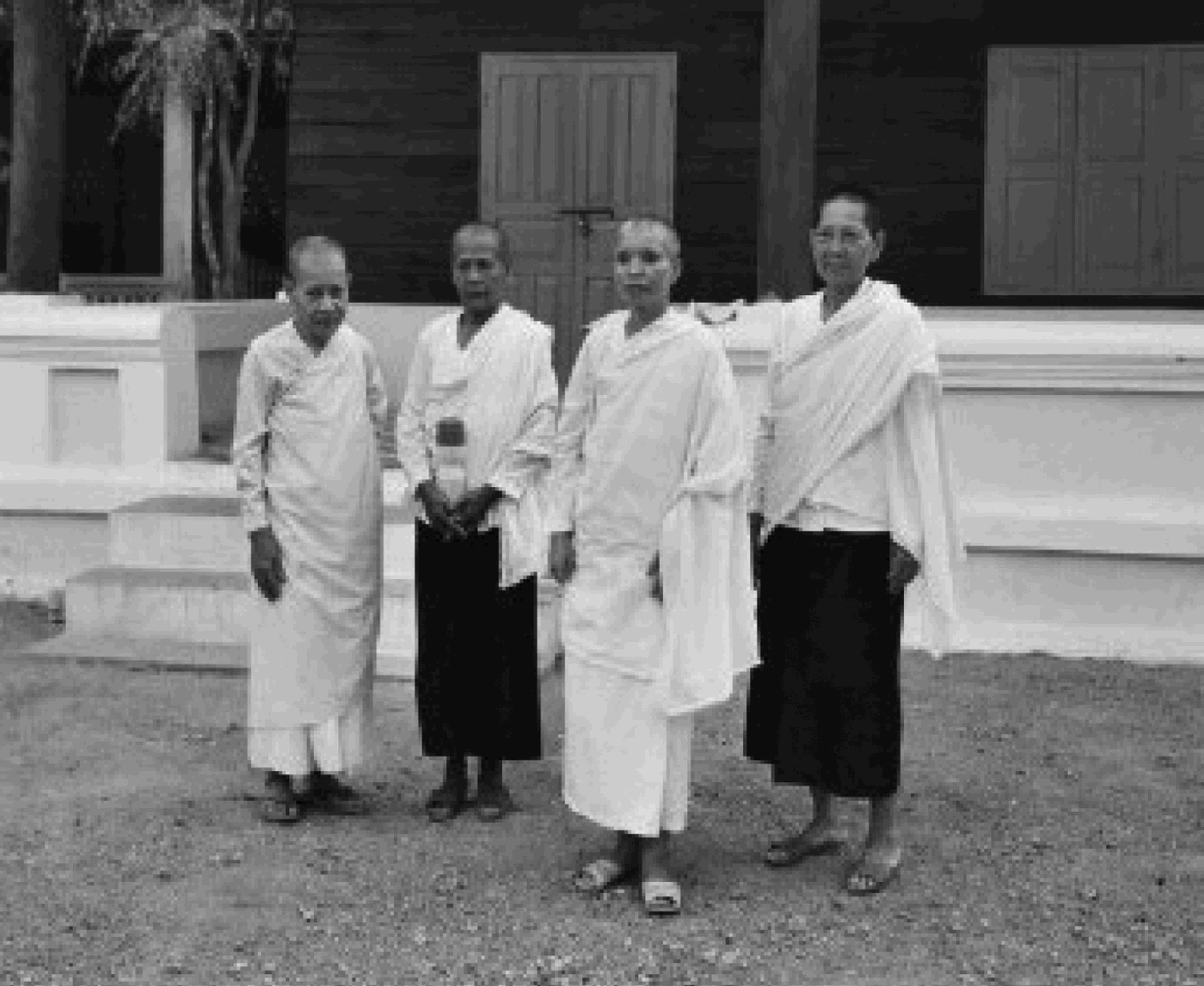
The transition from feminine periphery to masculine, ordering centre is echoed in the Theravada Buddhist ordination rituals of Cambodia and other parts of Southeast Asia. A man who is about to be ordained is referred to as neak (naga), which commonly means the dragon-snake of the underworld — an indeterminate creature, part human and part beast. Legend has it that the neak long ago transformed itself into a human and ordained as a monk but one day transformed back into a snake. When the Buddha heard about this he ordered the neak to return to lay life because animals were not allowed to ordain. However, in commemoration of the conversion of uncivilised beast to civilised human, the Buddha decreed that all ordination candidates from that time on would be referred to as neak.Footnote 38 During the period when aspirants for ordination are referred to as neak, there is also a certain feminisation of their appearance.Footnote 39 They are often dressed in colourful sarongs similar to those worn by women and they wear a feminine cloth over their left shoulder of embroidered white cotton or brightly coloured fabric (see Illustration 1).
Four neak awaiting ordination (author's photograph)

This apparent feminisation of the initiate might seem to exaggerate the transition into civilised manhood, though the shaving of the head and eyebrows are also de-gendering; the ascetic realm is highly ambiguous, being both the epitome of refined masculinity but being also transcendent of gender altogether. The ultimate order of dhamma that initiates approximate when they ordain is pre-order — it both extinguishes and generates all distinction such as female/male and death/life.
It is important, however, not to map the feminine associations of unordered nature and the masculine associations of ordered civilisation directly onto the social world of men and women; indeed it is the contradictions and tensions between these levels that are so intriguing. Rappaport's scheme offers a way to make distinctions between lower levels of meaning, in which men and women belong to separate social spheres, and higher levels in which the polarity of masculine and feminine may be merged through reference to core values and ultimate meaning. This recalls the ambiguity that David Chandler notes in his acclaimed essay ‘Songs at the edge of the forest’.Footnote 40 Through his examination of Khmer folktales, Chandler notes that:
there was a moral order for everyone … based on prescription … largely Buddhist in orientation, on the one hand, and perceptions rooted in the real world on the other. The first was a celebration of hierarchical arrangements, operating ideally, in the common good. The second was an attempt to survive inside the framework of what was going on. [People called on the discourses found in such literature] … to relieve the pain that came from living in the world.Footnote 41
Cambodian men as well as women may seek refuge and relief from everyday suffering, then, in the ideal, sacred order represented by dhamma.
Spiritual power and gendered boundaries
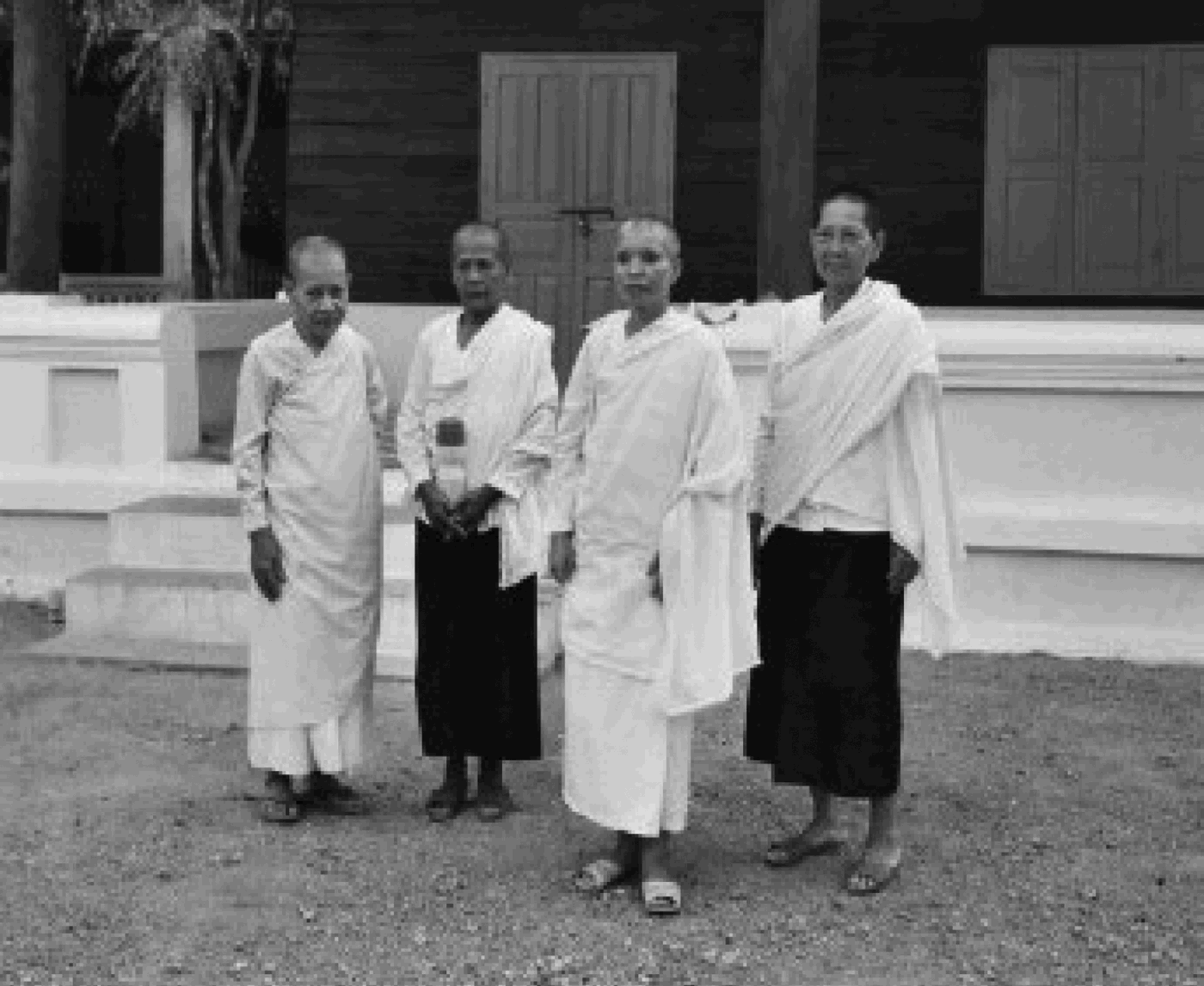
Efforts have been made to reintroduce full ordination for women in Sri Lanka and ThailandFootnote 42 but this has had little impact in Cambodia, though there is evidence that Cambodia has had an ancient tradition of female asceticism that once granted women considerable religious power.Footnote 43 There has been a rapid expansion of female religious asceticism since religion was once again permitted after its abolition under the Khmer Rouge regime of 1975–79. Women who shave their heads and thus de-gender themselves like the monks, and who live in a monastery or hermitage and follow either 10 or eight of the Buddhist precepts, are known as don chee Footnote 44 in Cambodia. Those who follow 10 precepts wear white while those who follow eight may wear a black skirt (see Illustration 2). As is the case for men who become monks, a woman who becomes a don chee ritually removes herself from the world of sex and procreation.
Don chee (author's photograph)
With a few, though significant, exceptions, don chee are middle-aged or older. Traditionally a young man would have been expected to spend a period of time as a monk as a rite of transition into manhood. This is not the case for a young woman. She might enter the temple later in life but, since she may not perform alms rounds or rely on the merit-making community for support, she must depend on her relatives and children.
Although everyday Cambodian gender codes exclude all women from the core realm of formal religion, women may nevertheless become empowered through it in various ways. The women I introduce below have been selected not because they are representative but because they are illustrative of how Cambodian women may use religion creatively to dissolve the strictures of gender, invert gender hierarchy and access ordering power in ways that can resolve their own insecurity and even enable them to become providers of security for others. Such women are important because they may inspire new trends in society.
Loak Kruu
In 2006, I met an eight-precept don chee in her early fifties who was running a meditation centre not far from the town of Siem Reap.Footnote 45 Her clients and the local people referred to her as Loak Kruu. She was married with five adult children, three of whom remained living with her husband in the local village while Loak Kruu lived permanently at her meditation centre. Her husband was the principal of the local primary school and he taught meditation in the evenings. In 1995, Loak Kruu was still a laywoman who followed five precepts, but she attended the inauguration conference of the Association of Nuns and Laywomen of CambodiaFootnote 46 and it was there that she decided to shave her head and become a don chee.
She subsequently learned how to practise insight (Vipassana) meditation under the tutelage of the Venerable Sam Bunthoeun,Footnote 47 who founded a large Vipassana centre in the late 1990s at the foot of Udong mountain, about half an hour's drive from Phnom Penh. In his lifetime, Sam Bunthoeun established a formal curriculum for the study of Vipassana and in this way trained up monks, don chee as well as laymen and laywomen as teachers who disseminate the teachings all over the country. Although older people remember the meditation method being practised long ago, enmeshed with traditional religious practice, as a movement Vipassana is a new, post-war development in Cambodia. Its post-war rarefication antagonises some, but the movement has also somewhat formally democratised Buddhism by bringing clergy and laity, men and women together to acquire a form of Buddhist expertise on more or less equal terms.
Loak Kruu's first child was born in 1974, a few months before the Khmer Rouge took control of the country. Some 20 days after the birth she heard gunfire and fainted, probably from fear, she said. After this she suffered from ‘lack of blood’ and heart problems. When the Khmer Rouge regime ended she was left with chronic low-back pain. When she began learning Vipassana, she related, she began to bleed from her uterus and the blood she lost was black. After this, she was cured and never had problems again. What had happened, she explained, was that she had learned how to overcome fear.
She then began teaching others back in her home village, including monks from the local temple. Soon grateful learners started to make donations. In 1997, the head monk of the local temple donated an area of temple land adjacent to the temple area for her to use for her meditation centre.
The donations enabled Loak Kruu to build several concrete cottages and a meditation hall. When I visited her, people were coming to consult her for a range of physical and psychosocial complaints: strokes, fractures, back pain, ‘insanity’, depression, incest and more. The majority of her clients were women. Some of them had built their own cottages and at the time of my visit some 60 people were apparently permanent residents at the centre.
I interviewed some of her clients. An elderly monk was staying in one of the concrete cottages with a young novice. Like everyone else, the monk referred to his teacher as Loak Kruu. He said that he had come to learn meditation so that he could deal with residual fear from the past. He had formerly been a fruit farmer. Before the Khmer Rouge regime he had had a wife and eight children, but his wife died in 1975 and for the remainder of the Khmer Rouge period, he had stayed on a mountain in Kompong Thom province:
Pol Pot wanted to kill me. He planned to kill all the people of Cambodia. There was no freedom to walk anywhere. It was a prison without walls. Whenever I heard shooting I always hoped it was someone who had come to free us. The Buddha always taught good so if we study dhamma we can become good.
He remarried after the fall of the Khmer Rouge in 1979 and had two more children. When he ordained in 2000, he left his land and house to his children and wife. He told me he had been suffering from heart problems and often felt afraid. He had tried to meditate but did not know how to. He and the novice had been at Loak Kruu's centre for only five days when I met them but already the monk said he was feeling better. He planned to stay for one month with Loak Kruu to learn meditation properly and then he would go back to his temple and teach the monks there because they all wanted to learn. He was, clearly, seeking not just knowledge and accomplishment but also to be healed.
A young woman I met at the centre had become one of Loak Kruu's closest assistants. She was then probably in her early thirties. One of her legs was deformed and she had a severe limp. She told me that her father had died when her mother was expecting her. When she was seven or eight years old, her mother also died, leaving her in the care of her drunkard stepfather. On one occasion, he sent her to buy alcohol for him but she was afraid, so he beat her so badly that he broke her leg, which never healed properly. She then went to stay with a great aunt, but from that time on she had been unable to walk. However, about two years before I met her she had had a dream in which she saw Loak Kruu, whom she had never met, sitting on a lotus flower. Shortly afterwards someone told her about Loak Kruu and she came to find her. Loak Kruu taught her to meditate and soon she began walking again. She decided to stay at the centre to serve Loak Kruu from then on.
Other clients told similar stories of intolerable life circumstances that Loak Kruu had helped them deal with or leave. Loak Kruu told me once a gang of five youths had turned up at the centre, so she taught them to meditate and not long afterwards three of them ordained as monks.
Although her female personhood tied her to conventional gender order and she was beholden to the (male) sangha for her land, her power defied male superordination. Even monks who were older than her consulted her — not simply for her authority as an instructor but because she embodied security-providing dhamma.
Thida and her spirits
The biography of the second woman I shall present here, whom I called Thida, is woven around a theme that is typical of Cambodian mediums: ‘Mediums are supposed to respect the Buddhist virtues and to follow the precepts of the dhamma or risk losing their power – a power for which the Buddha will be the final guarantee.’ (p. 160)Footnote 48 She was in her late forties when I met her in 2005 and was farming rice in her village, not far from the city of Battambang in northwestern Cambodia. She had 11 children, of whom the older ones were working with her husband on the farm. She was living with her husband and younger children in a dilapidated wooden house at one edge of the village, beside a stream. She received her land through reallocation by the commune chief after the fall of the Khmer Rouge and much of it was too far away or of too poor quality to be farmed. However, she looked after wealthier people's cows and in payment was allowed to keep some of the calves, which she could then milk or sell.
Thida was the vehicle of several parami Footnote 49 spirits, three male ones and three female and under their protection was not allowed to slaughter animals. The most significant of these spirits were an elderly monk, known as Loak Ta (literally grandfather) and the spirit of an elderly renunciant woman, Yeay Lach (literally grandmother Lach). Loak Ta, Thida explained, protected her from maltreatment by ill-wishers.
Thida explained that some 16 years earlier an elderly monk had come to her village and told her that Yeah Lach's then vehicle would soon be dead and that she wanted to find a new person to house her. Thida knew nothing about Yeah Lach and took no notice but noticed that after the monk left she would become upset when she saw animals being killed and from then on, she was unable to raise animals for food or to slaughter them herself.
Thida did not want spirits to enter her body because she was poor and only had time to make money to feed her family. However, her neighbour's child fell sick one day and Thida realised she intuitively knew what had to be done to heal the child. She advised the parents and, sure enough, the child recovered. Word soon spread to other villagers and her neighbour then insisted that she invite the spirit into her body. Eventually, some six years before I met her, she agreed and when the spirit entered her for the first time she lost awareness of what she was saying or doing. When her trance lifted she could not remember anything that had happened and she only learned about it later from her neighbour:
I was told by my neighbour that I prayed dhamma … but I have never learnt how to read or write and I have never studied dhamma. … I could tell people what to do for their disease and could tell them about Khmer traditional medicines .… And then I noticed that if I tried to sell vegetables I could make a little profit but if I tried to sell animals for slaughter I always made a loss.
When I met Thida, she said she sometimes remembered what happened when the spirit entered her and sometimes not. She did not wear any special clothing to invite the spirit, and she did not shave her head. She said she was unable to follow all the precepts she would like to because she had to do business and keep her family. She made clear that she could only help people with problems arising from their feelings but she could not cure AIDS, heart disease or lung disease.
Thida described how Yeay Lach was the spirit of a Buddhist renunciant woman who had once lived in the forest and who had no desire, was completely honest and had a parami.
I dream of Yeay Lach almost every night and sometimes Yeay Lach appears to me as herself, but sometimes I see her as a tiger or I hear her as sound .… When Yeay Lach came to stay in my body I became kind and always wanted to help other people who had problems. Before that I thought only about my own family, I wanted my family to become rich and I didn't care about other people .… If I make a lot of money because people have made donations after I have healed them or done water sprinkling for them Yeay Lach always comes to me in a dream and tells me to give that money to the temple and to the monks to make merit .… One time I kept the money for my family but Yeay Lach came in a dream and frightened me because I didn't take the money to the temple for the monks.
I learned of Thida's abilities through a monk living at a temple that was under construction some 15 kilometres from Battambang, but in a different direction from Thida's house. The monk told me that Thida's parami Loak Ta was the eldest of a set of five parami. He explained that the head monk of his temple was the vehicle of the youngest ‘brother’ of the spirit sibling set, though the head monk never went into a trance. The temple, which I refer to as Wat Thmei,Footnote 50 had not yet consecrated its ordination hall but some 18 monks and a handful of elderly don chee were living there. The head monk was a charismatic individual in his mid-thirties and he was very popular, both because he attracted generous funding for the construction of the temple and because he was a successful healer.
Lay people at the temple and Thida both related how the head monk at Wat Thmei would send patients to Thida if he was unable to heal them. This, I was told, was not because Thida's power was stronger, it was just that some problems required the intervention of a parami through possession trance and a monk is not allowed to invite spirits to enter or control him. Thida remarked that,
Monks are always better than lay people … because monks have more precepts than common people .… Even though I may have the same knowledge as a monk I must still pay respect to the monk because the monk is the follower of Buddha.
We have different skills. The head monk can heal disease directly by using medicine and some Pali … but the head monk cannot exorcise the ghost spirit that stays in the body of a patient. When a patient has a ghost spirit I can invite my parami to chase that spirit away because my parami can talk to the ghost spirit. A monk cannot invite a spirit to come and control him like this.
A monk from Wat Thmei informed me that the head monk's parami was sometimes overwhelmed when angry ancestor spirits entered the body of a patient and caused problems. In intractable cases like this, or in cases of problems specifically related to womanhood, the head monk would therefore send the victim to Thida so that Yeay Lach could tell the patient how to appease the spirit with offerings. Sometimes the head monk would ask patients to go to Thida first and then return to him for water blessings and perhaps some Khmer traditional medicine.
Thida discovered her connection to the head monk of Wat Thmei, which was not her local temple, through dreams in which Loak Ta informed her of their spiritual kinship. Thida and others all explained to me that since the monk's parami was younger than her parami, it had to pay respect to Loak Ta, a situation which would appear to invert the normal hierarchical ordering of clergy and laity, or man and woman. When Loak Ta guided Thida to the head monk at Wat Thmei for the first time she immediately fell under the spirit's control as she entered the temple grounds. The head monk came out to greet her, brought her inside the temple building and began to serve her, as if he were a younger brother serving an older sibling. When I spoke to the head monk later, he and others at the temple confirmed that he continued serving Thida after this first encounter even when there was no spirit present in her body.
The relationship between Thida and the head monk reveals a complex web of cross-cutting hierarchies as well as patterns of complementarity and interdependence that surpass hierarchy. In terms of social codes, Thida, as a laywoman, is ‘inferior’ to the monk. The monk – upholder of the Buddhist precepts, bearer of the orange robe and inhabitant of the sacred space inside the limits (sima) of the temple – is closer to the centre of masculine power and order represented by the Buddha. Yet in the cosmological realm of the parami, this order can be dissolved; the monk's parami pays respect to its elder brother Loak Ta. It is tempting to say that the realm of ancestral and tutelary spirits is Brahmanist or animist and to contrast it with the Buddhist order, but such a division is complicated by the fact that Loak Ta is the spirit of a Buddhist monk, and the term parami is a Buddhist technical term. So, the various principles of order – religious/lay, senior/junior, sacred/profane, Buddhist/Brahmanist and gender – all appear unfixed and continually taking shape, falling in and out of focus as other oppositions become dominant or recessive according to the specificities of the moment and context.
Conclusion
The religious careers of the two rural women I have described above are unusual and perhaps problematic from the perspective of those who claim to represent orthodox, canonical Buddhism. But their practices resonate with local Cambodian understandings of core values and postulates. Both of these women have gathered clienteles and are awarded legitimacy by monks and laypeople alike. However unorthodox their activities then, and however much they may appear to depart from everyday norms of conduct, the services they offer to those who turn to them inform us about their world.
An understanding of Cambodian everyday gender codes alone may fuel current feminist and security discourse without taking account of the complexity of Cambodian cultural reality. Without ignoring the numerous differences between Maring and Khmer religious universes, I suggest that Rappaport's tripartite hierarchy of meaning – codes, principles and postulates – may help make sense of some of the contradictions and possibilities within Cambodian renderings of gender. Despite, or perhaps because of the limitations and rigors of everyday codes, some people move beyond them and reach into more enduring principles and postulates that can enable them to burst gender constraints. The two women discussed in this paper, for example, surpass the codes by which women are misrecognised in the Buddhist religious realm. Each in her own way has achieved a form of authority that allows her to breach custom. Loak Kruu brings the powers of meditation, which, like parami are popularly couched in the order of dhamma, to bear upon worldly disorder. Reaching into the cosmological realm of righteous parami and their battles with dangerous forces, Thida similarly brings order to bear upon her clientele's experiences of mundane disorder.
By drawing on what I have referred to here as higher levels of meaning, these women find protection and empowerment through their religious practice. There are many cases in Cambodia of women who enter the nunhood following experiences of sexual abuse.Footnote 51 By shaving the head and wearing renunciant clothing a woman may deflect sexual danger. A man who flouts the dhamma by violating the body of an ascetic takes serious kammic risks, which at least in most cases operate as a deterrent. There are also examples of female victims of abuse, who, by becoming religious renunciants, manage to recover moral status.Footnote 52 Importantly, their religious agency may be valued and accredited by some male monks who are prepared to neutralise gender in their dealings with these women.
I have proposed that the numinous experience referred to by Rappaport may alert us to the feeling of security enjoyed analogously by both the well-cared-for infant and the well-protected citizen or subject. In Cambodia, I suggest, the righteous provider–protector in both instances may garner legitimacy through appealing to notions of the ultimate sacred order of the universe, popularly understood through the concept of dhamma. It follows that the powerful person who exercises this power unrighteously (departs from dhammic moral order) is a source of insecurity for his or her dependents. If this is the cultural logic, then it makes sense that people may try to resolve fear and feelings of insecurity by seeking refuge in what they perceive to be dhamma. Although the codes of orthodox religion may seem to privilege men as custodians of dhamma (as the teachings of the Buddha), dhamma as the eternal order of the universe is pre-gender, above gender. The monk who sought relief from his fear at Loak Kruu's meditation centre demonstrates that Cambodian religious practice is not rigidly constrained by a code of gender asymmetry. In fact, it opens possibilities for dispensing with everyday norms of conduct and allows gender to be negotiated or simply ignored.
Although taking recourse to the spiritual realm does not mean flouting gender order, this does not necessarily imply that gender injustices are accepted fatalistically or with resignation. The coalescence of the numinous and the undeniable yields a potent admixture of unquestionable knowledge about the correct ordering of the social and natural world; it may therefore furnish a source of critique. Recourse to core values may regenerate hope in a world felt to have gone awry and may be profoundly healing — perhaps particularly so for women since it is an arena in which they may legitimately accumulate power over men. Suspending judgement and exploring the messages inherent in stories like those above may enrich our understandings. The lenses of security studies and feminist critiques may, I suggest, have blind spots about the potential within people's own cultural resources that permit creative individuals to critique and alter experiences and relationships between women and men in ways that may have considerable cultural resonance locally.