Introduction
Canadian agricultural production has seen a rapid shift to no-till systems with the goal of sustainability. No-till practices have been reported to reduce erosion, improve soil fertility, and enhance soil water retention (Campbell et al. Reference Campbell, Lafond, Moulin, Townley-Smith, Zentner, Paul, Elliott, Paustian and Cole1997; Mostaghimi et al. Reference Mostaghimi, Younos and Tim1992; Smika and Unger Reference Smika and Unger1986). As producers reduce the use of tillage, preplant (PP) herbicides have become particularly important for weed control. One of the main contributors to soybean and corn yield loss is weed interference (Vissoh et al. Reference Vissoh, Gbehounou, Ahanchede, Kuyper and Roling2004). Previous studies have found that the presence of weeds can reduce corn grain yield by up to 90% (Harrison et al. Reference Harrison, Regnier, Schmoll and Webb2001). In a meta-analysis, soybean and corn yield loss in North America was estimated to be 52% and 50%, respectively, in the absence of any weed management tactics (Soltani et al. Reference Soltani, Dille, Burke, Everman, VanGessel, Davis and Sikkema2016, Reference Soltani, Dille, Burke, Everman, VanGessel, Davis and Sikkema2017). Weed control in no-till systems can be difficult, because it precludes use of mechanical tillage and herbicides requiring mechanical incorporation. Early weed control (minimum of 2 wk) when planting into a no-till field is essential to ensure a clean seedbed and reduce plant-to-plant competition upon emergence (Stougaard et al. Reference Stougaard, Kapusta and Roskamp1984). A common practice in corn and soybean production in Ontario is to apply a PP herbicide followed by selective POST herbicides.
Synthetic auxins or growth regulators (WSSA Group 4) were the first selective broadleaf herbicides used in agriculture and are commonly used as a PP herbicide. Previous research has reported varying soybean and corn responses to Group 4 herbicides. Soybean is relatively sensitive to Group 4 herbicides; Thompson et al. (Reference Thompson, Steckel, Ellis and Mueller2007) reported that the minimum PP intervals for 2,4-D and dicamba are 7 and 14 d, respectively. Soybean injury symptoms caused by the synthetic auxin herbicides include stem twisting, swelling and elongation, leaf distortion described as strapping, turtle backing, and cupping, and root inhibition, which are followed by chlorosis, necrosis, and soybean death (Cobb and Reade Reference Cobb and Reade2010; Grossman Reference Grossman2000). Corn is more tolerant to Group 4 herbicides; dicamba can be applied PRE and POST in corn, up to the five-leaf stage, whereas 2,4-D can applied up to the six-leaf stage (Anonymous 2014, 2016). Although 2,4-D and dicamba are registered for weed management in corn, crop injury may occur; corn injury is influenced by application rate, timing, environmental conditions, soil type, and hybrid (Guzman and Wolf Reference Guzman and Wolf1953). Corn injury symptoms caused by the Group 4 herbicides include brace-root malformation, lodging, goose-necking and brittle snap of stems, leaf rolling, and poor kernel set (OMAFRA 2017).
Halauxifen-methyl is a new Group 4 herbicide that provides broadleaf weed control and is available in a number of commercialized, formulated products. Halauxifen-methyl (5 g ha−1) is currently registered for use as a PP herbicide in no-till corn and soybean for the control of annual broadleaf weeds, specifically glyphosate-resistant biotypes. The current product label in Canada states that halauxifen-methyl must be applied at least 7 and 5 d before planting soybean and corn, respectively. Halauxifen-methyl is broken down rapidly by microbial degradation in the soil, resulting in no residual control. The narrow application window, coupled with the lack of residual activity, limits the utility of this herbicide alone. Previous literature reported that when applied prior to planting cotton, halauxifen-methyl caused less crop injury (9%), compared to 2,4-D (21%) and dicamba (26%) (Askew et al. Reference Askew, Cahoon, York, Flessner, Langston and Ferebee2019). Similarily, Zimmer et al. (Reference Zimmer, Young and Johnson2019) reported that halauxifen-methyl applied prior to seeding soybean caused minimal injury and had no effect on yield. The results from the aforementioned studies, coupled with observed corn tolerance to Group 4 herbicides, raise the question whether the application window for halauxifen-methyl in corn and soybean could be expanded.
Although there are reports in the literature on the tolerance of soybean and corn to other Group 4 herbicides (2,4-D and dicamba), there is little published research available on the tolerance of soybean and corn to halauxifen-methyl applied at varying rates and application timings, specifically early POST. The hypothesis for these studies was that halauxifen-methyl (5 g ha−1) applied PP, PRE, or early POST will cause ≤10% soybean and corn injury. The objective of these studies was to determine the effect of halauxifen-methyl application timing and rate on soybean and corn.
Materials and Methods
Experimental Methods
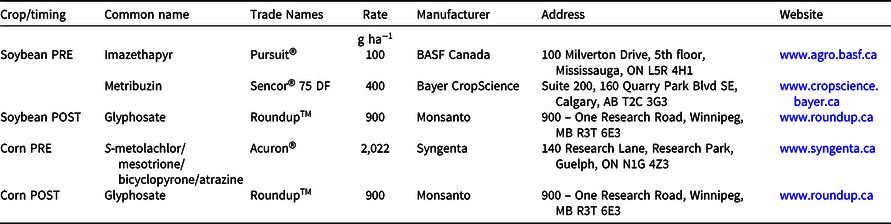
Studies were completed over a 2-yr period (2018 and 2019). Each study consisted of six no-till field experiments conducted on the Huron Research Station (43.318196°N, 81.500484°W) and University of Guelph Ridgetown Campus (42.439420°N, 81.882133°W). Corn was the preceding crop to the soybean experiments and wheat was the preceding crop to the corn experiments. The soybean and corn experiments were maintained weed-free to remove the confounding effect of weed interference with herbicide treatments followed by hand weeding as required (Table 1).
Weed-free maintenance application treatments for corn and soybean experiments conducted in 2018 and 2019.

Experiments were arranged in a factorial design. Factor One was three rates of halauxifen-methyl (0, 5, 10 g ha−1), and Factor Two was five application timings. Application timing treatments for the soybean experiments were 14 d preplant (DPP), 7 DPP, 1 DPP, 5 d after seeding (DAS), and cotyledon–unifoliate stage (VE-VC). Application timing treatments for the corn experiments were 10 DPP, 5 DPP, 1 DPP, 5 DAS, and spike–one leaf stage (VE-V1). The glyphosate-resistant soybean cultivar ‘DKB28-15’ (Monsanto, St. Louis, MO) was planted with a no-till planter in rows spaced 75 cm apart approximately 4 cm deep at a rate of approximately 380,000 seeds ha−1. Glyphosate- + glufosinate-resistant corn DKC53-56 (Monsanto, St. Louis, MO) was planted with a no-till planter in rows spaced 75 cm apart approximately 5 cm deep at a rate of approximately 80,000 seeds ha−1. Plots were 2.25 m wide by 8 m long (three rows per plot) in long-term no-till fields. Treatment applications were made with a CO2-pressurized backpack sprayer calibrated to deliver spray solution at 200 L ha−1 and fitted with a 1.5-m boom and four Hypro ULD12002 nozzles producing a 2.0-m spray width.
For both soybean and corn experiments, visible crop injury was evaluated at 1, 2, 4, and 8 wk after the last application (WAA). The last application was VE-VC in soybean and VE-V1 in corn. Crop injury was assessed using a 0 to 100 scale (0 indicating no visible injury and 100 indicating total plant death). At 4 WAA, corn and soybean plant population, biomass, and height were assessed. Plant population was assessed by randomly placing a 0.5-m stick between two adjacent rows and counting the number of soybean plants, and by randomly placing a 1.0-m stick and counting the number of corn plants in two adjacent rows. Aboveground plant biomass was determined by harvesting the same plants as counted for population at the soil surface, placing them in a paper bag, drying in a kiln, and then weighing the plants. Plant height was determined by recording the average height of 10 randomly selected plants per plot; soybean height was measured from the soil surface to the uppermost growing point, and corn height was from the soil surface to the top-most extended leaf height. In the corn experiments, brace-root malformation was assessed at 12 WAA. Brace-root malformation was reported as percent incidence across the plot and percent severity of affected plants. Cob deformation (ear pinching) and barren plants (corn plants with no cob) were assessed just prior to corn harvest. Cob deformation was assessed by checking 10 randomly selected plants per plot and reporting the severity. Barren plants were reported as the total number of barren plants per plot. Soybean and corn were harvested at maturity using a small-plot combine, and grain moisture content and weight were recorded. Grain yield was corrected to 13% moisture for soybean and 15.5% moisture for corn.
Statistical Analysis
Each parameter was subjected to a variance analysis using the GLIMMIX procedure in SAS (version 9.4) statistical software (SAS Institute, Cary, NC). The model fixed effects were the herbicide rate (Factor One), application timings (Factor Two), and the two-way interaction between rate and application timing. An F-test was carried out to determine the significance of the fixed effects (rate, timing, rate by timing). The model random effects were site (year and location), replicate nested within site, replicate-by-herbicide rate interaction, timing-by-site interaction, and rate-by-site interaction. A restricted log-likelihood test was used to determine the significance of the random effects. A Shapiro-Wilk test and plots of studentized residuals were used to confirm error assumptions (homogeneous, mean equal to 0, normally distributed). A significance value of α = 0.05 was used for all analyses, although it was noted when there was a significance value of α = 0.01. All assessment parameters were fit to a normal distribution and the corresponding identity link. The control plots that received a halauxifen-methyl rate of 0 were not included in the visible-injury analysis at all assessment timings, although they were independently compared to zero. Least-square means were calculated for rate, timing, and rate by timing, separated using a Tukey-Kramerʼs test and assigned letters using the slicediff option. If the two-way (rate by timing) interaction was not significant for a parameter, only the main effects (rate or timing) were presented. Standard error was calculated in SAS 9.4.
Results and Discussion
Soybean
Injury
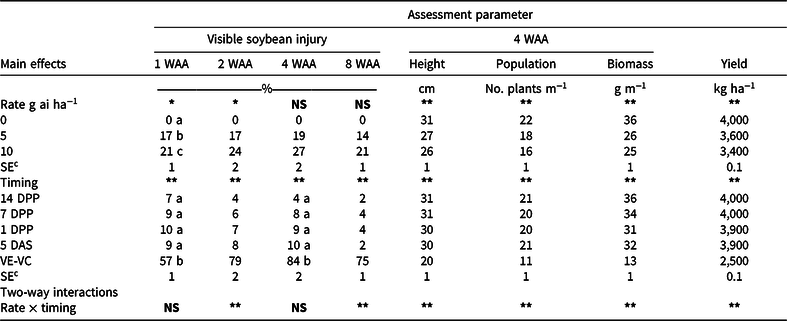
Soybean injury symptoms included stem curvature, leaf distortion, chlorosis and necrosis, and plant death. For visible soybean injury 1 WAA, there was an effect of halauxifen-methyl rate and application timing (Table 2). Halauxifen-methyl applied at 5 and 10 g ha−1 (hereafter referred to as the 1× and 2× rates) caused 17% and 21% soybean injury, respectively, when averaged across application timing. Halauxifen-methyl caused 7% to 10% visible soybean injury when applied at 14 DPP, 7 DPP, 1 DPP, and 5 DAS and averaged across application rates; however, injury increased to 57% when applied at VE-VC averaged across application rates. For visible soybean injury 4 WAA, there was no effect of halauxifen-methyl rate, but there was an effect of application timing. The response at 4 WAA was similar to 1 WAA for visible soybean injury; halauxifen-methyl applied at 14 DPP, 7 DPP, 1 DPP, and 5 DAS caused 4% to 10% injury compared to 84% when applied at VE-VC.
Main effects of halauxifen-methyl rate and application timing for visible soybean injury at 1, 2, 4, and 8 wk after last application (WAA), height, population, biomass, and yield. Results of six experiments conducted in Ontario, Canada in 2018 and 2019.a,b

a Abbreviations: DPP, days pre-plant; DAS, days after seeding; VE-VC, cotyledon–first unifoliate growth stage.
b Means followed by the same letter within a column are not significantly different (P < 0.05); means were only separated if two-way interaction was not significant.
c Standard error of the mean; *statistically significant at P < 0.05, **significant at P < 0.1; NS, not significant (P < 0.05).
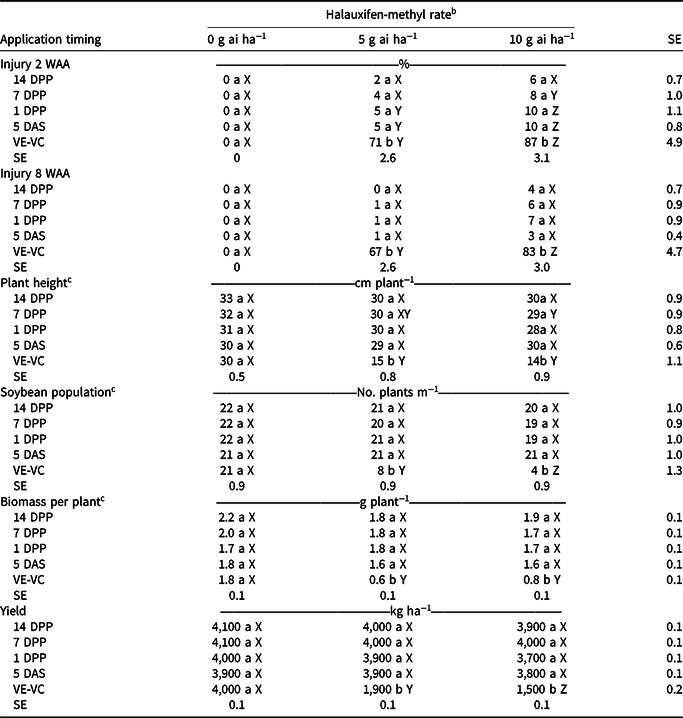
There was a rate-by-timing interaction for visible soybean injury 2 and 8 WAA, height, population, biomass, and yield; therefore, the simple effects are presented (Table 3). At 2 WAA, halauxifen-methyl at the 1× and 2× rates applied 14 DPP, 7 DPP, 1 DPP, or 5 DAS caused ≤5% and ≤10% visible soybean injury, respectively; there was no difference among the four application timings when applied prior to soybean emergence. In contrast, when the application timing was delayed to VE-VC, the 1× and 2× rates caused 71% and 87% visible soybean injury, respectively. When applied 14 and 7 DPP, there was no difference in visible soybean injury at the 1× or 2× rate at most evaluations. These findings are similar to Zimmer et al. (Reference Zimmer, Young and Johnson2018), who found no soybean injury when halauxifen-methyl was applied 13 to 14 DPP. When halauxifen-methyl was applied at 1 DPP, 5 DAS, and at VE-VC, there was greater soybean injury with the 2× rate of halauxifen-methyl compared to the 1× rate.
Interaction of halauxifen-methyl rate and application timing on visible soybean injury at 2 and 8 wk after last application (WAA), and soybean height, population, biomass, and yield. Results of six experiments conducted in Ontario, Canada in 2018 and 2019.a

a Abbreviations: DPP, days pre-plant; DAS, days after seeding; VE-VC, cotyledon–first unifoliate growth stage.
b Means followed by the same lowercase letter within a column (a, b) or uppercase letter in the row (X–Z) are not significantly different (P < 0.05).
c Plant height, population, and biomass were assessed at 4 WAA.
With applications at 14 DPP, 7 DPP, 1 DPP, or 5 DAS, there was no difference in visible soybean injury with halauxifen-methyl applied at the 1× and 2× rates at 8 WAA. There was an increase in soybean injury when halauxifen-methyl was applied at the VE-VC stage; injury increased to 67% (1× rate) and 83% (2× rate). A previous study conducted by Thompson et al. (Reference Thompson, Steckel, Ellis and Mueller2007) found that 2,4-D ester applied 14, 7, and 0 DPP resulted in 4%, 11%, and 16% soybean injury, respectively, when assessed 14 DAS. Additionally, dicamba applied at 14, 7, and 0 DPP resulted in 17%, 38%, and 73% injury 2 wk after planting, respectively (Thompson et al. Reference Thompson, Steckel, Ellis and Mueller2007). In those studies, both 2,4-D and dicamba resulted in more injury, compared to the observed soybean injury with halauxifen-methyl in this study. The difference in soybean sensitivity among Group 4 herbicides is consistent with Kelley et al. (Reference Kelley, Wax, Hager and Reichers2005), who reported higher injury with dicamba compared to 2,4-D applied PP. Additionally, the apparent relationship between increased crop injury as Group 4 herbicide rate increased and application was delayed is consistent with Slife (Reference Slife1956), who found that soybean injury and yield losses increased with 2,4-D rate and later POST application timing.
Height, Population, and Biomass
A similar trend to visible soybean injury was observed regarding the effect of application rate and timing on soybean height, population, and biomass at 4 WAA (Table 3).
The application of halauxifen-methyl at 14 DPP, 7 DPP, 1 DPP, or 5 DAS at the 1× and 2× rate had no effect on soybean height (Table 3). In contrast, when the application was delayed to VE-VC, the 1× and 2× rates reduced soybean height 50% and 53%, respectively (Table 3).
The application of halauxifen-methyl at 14 DPP, 7 DPP, 1 DPP, or 5 DAS at the 1× or 2× rate had no effect on soybean population (Table 3). In contrast, when the application was delayed to VE-VC, the 1× and 2× rates compared to zero reduced soybean population 62% and 81%, respectively. These findings are consistent with findings from Zimmer et al. (Reference Zimmer, Young and Johnson2019), who reported that halauxifen-methyl applied PP at 5 g ha−1 had no effect on plant population.
Similarly, the application of halauxifen-methyl at 14 DPP, 7 DPP, 1 DPP, or 5 DAS at the 1× or 2× rates had no effect on soybean biomass 4 WAA (Table 3). In contrast, when the application was delayed to VE-VC, the 1× and 2× rates reduced soybean biomass 67% and 58%, respectively.
Yield
The application of halauxifen-methyl at 14 DPP, 7 DPP, 1 DPP, or 5 DAS at the 1× or 2× rate had no effect on soybean yield (Table 3). In contrast, when the application was delayed to VE-VC, the 1× and 2× rates reduced soybean yield 53% and 62%, respectively. Similar to this study, Zimmer et al. (Reference Zimmer, Young and Johnson2019) reported no significant decrease in soybean yield when halauxifen-methyl was applied PP at varying PP intervals. Previous studies have reported a significant decrease in soybean yield when Group 4 herbicides were applied POST (Kelley et al. Reference Kelley, Wax, Hager and Reichers2005; Krausz et al. Reference Krausz, Kapusta and Matthews1993; Thompson et al. Reference Thompson, Steckel, Ellis and Mueller2007).
Corn
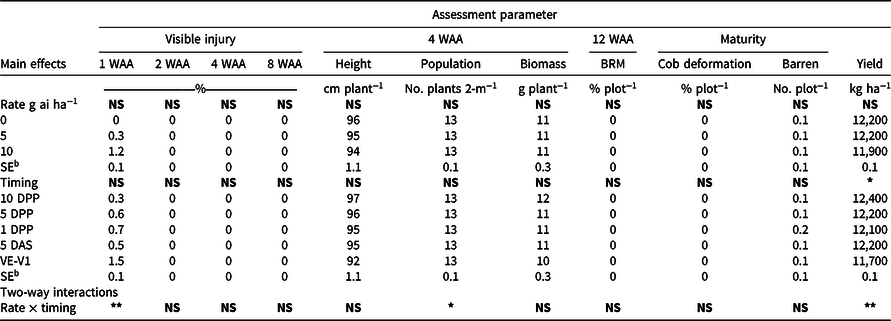
There was a rate-by-timing interaction for visible corn injury at 1 WAA, population, and yield (Table 4). For all other parameters (visible corn injury at 2, 4, and 8 WAA, height, biomass, brace-root malformation, cob deformation, and barren plants), there was no effect of halauxifen-methyl application rate, timing, or rate by timing.
Main effects of halauxifen-methyl rate and application timing on visible corn injury at 1, 2, 4, and 8 wk after last application (WAA), height, population, biomass, and yield. Results of six experiments conducted in Ontario, Canada in 2018 and 2019.a

a Abbreviations: BRM, brace-root malformation; DPP, days pre-plant; DAS, days after seeding; VE-V1, emergence to first leaf collar growth stage.
b Standard error of the mean; * statistically significant at P < 0.05, **significant at P < 0.01; NS, not significant (P < 0.05).
Injury
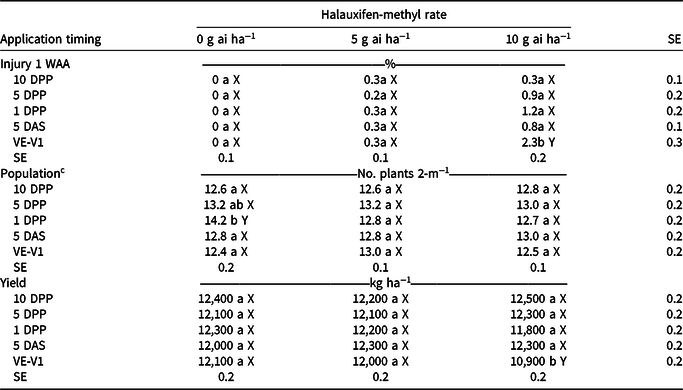
Halauxifen-methyl (1× and 2× rate) at all application timings caused ≤2.3% visible corn injury at 1 WAA (Table 5). There was no effect of application timing (10 DPP, 5 DPP, 1 DPP, 5 DAS, or VE-V1) on visible corn injury 1 WAA when halauxifen-methyl was applied at the 1× rate. In contrast, at 1 WAA the 2× rate caused greater corn injury when applied at the VE-V1 stage than when applied at 10 DPP, 5 DPP, 1 DPP, or 5 DAS. When applied at 10 DPP, 5 DPP, 1 DPP, or 5 DAS, there was no difference in visible corn injury at the 1× or 2× rate. In contrast, when halauxifen-methyl was applied at VE-V1 there was greater visible corn injury at the 2× rate (Table 5).
Interaction of halauxifen-methyl rate and application timing on corn injury at 1 wk after last application (WAA) and corn height, population, biomass, and yield. Results of six experiments conducted in Ontario, Canada in 2018 and 2019.a,b

a Abbreviations: DPP, days pre-plant; DAS, days after seeding; VE-V1, emergence to first leaf collar growth stage.
b Means followed by the same letter within a column (a, b) or row (X–Z) are not significantly different (P < 0.05).
c Plant population was assessed at 4 WAA.
Population and Yield
Corn population in the control plots of halauxifen-methyl applied at 0 g ha−1 at 1 DPP was greater compared to the other application timings or rates. The authors attribute this to experimental variability, and they do not consider it a true effect. There was no effect of application timing (10 DPP, 5 DPP, 1 DPP, 5 DAS, or VE-V1) on corn yield when halauxifen-methyl was applied at the 1× rate. In contrast, halauxifen-methyl applied at the 2× rate caused a 10% yield reduction when applied at the VE-V1 stage compared to applications at 10 DPP, 5 DPP, 1 DPP, or 5 DAS (Table 5).
A study conducted by Soltani et al. (Reference Soltani, Shropshire and Sikkema2018) reported similar results when assessing corn tolerance to 2,4-D. When 2,4-D was applied at V1 at the 1× and 2× rates, corn injury did not exceed 7% 1 wk after application; the observed injury was transient, with lower injury at later assessment dates. Similarly, applications of 2,4-D at V1 did not affect plant height or result in brace-root malformation. Finally, the application of 2,4-D applied POST did not have an impact on corn yield; in contrast, halauxifen-methyl applied at the 2× rate reduced corn yield.
In summary, these studies provide evidence that the current recommended PP application intervals of 7 DPP in soybean and 5 DPP in corn for halauxifen-methyl may be conservative. The results from this study support an expansion of the application timing window from 7 and 5 DPP to closer to planting time in both corn and soybean. Although minimal visible injury was observed in soybean when halauxifen-methyl was applied 5 DAS, soybean yield was not affected. Similarly, corn yield was not affected when halauxifen-methyl was applied 5 DAS. However, future studies should be conducted with varying soil types, cultivars, and cropping systems. The expansion of the application window would allow producers more flexibility, especially in springs with frequent rain events. In addition, the later application may improve weed control, because more weeds will have emerged at the time of halauxifen-methyl application, such as glyphosate-resistant Canada fleabane (Erigeron canadensis L.).
Acknowledgments
Funding for this project was provided by Corteva Agriscience Inc. No other conflicts of interest have been declared.