

In 1945, Hugh MacLennan published a novel with an evocative title: Two Solitudes. This expression neatly encapsulates the idea of absence of communication or lack of knowledge and understanding between anglophones and francophones in Canada. More than 60 years after the publication of MacLennan's novel, François Rocher (Reference Rocher2007) published “The End of the ‘Two Solitudes’? The Presence (or Absence) of the Work of French-Speaking Scholars in Canadian Politics” and showed that there was a major lack of communication between English- and French-speaking scholars working in the field of Canadian politics. The author demonstrated that references to French-speaking scholars were systemically absent (that is, either ignored or excluded) from English-speaking scholars’ scientific production. Rocher's conclusion is quite revealing, as it directly challenged our attainment of the implicit objective of having an inclusive and a comprehensive political science in Canada. The failure to attain this objective generates a biased representation of scholarly work in Canada and overrepresents issues considered relevant by the English-speaking academic community (at the expense of French-speaking scholars, as well as other communities, such as Indigenous peoples).Footnote 1
In this article, we tackle the possibility that the systemic underrepresentation of French-speaking scholars in Canadian politics (despite, as we will discuss, the availability of their work in English) is a phenomenon deeply rooted in Canadian universities. We thus focus on the language of the authors. To test our hypothesis, we have relied on two datasets. First, we constructed an original dataset based on 351 syllabi from 42 Canadian universities across the 10 provinces, including English, French and bilingual institutions. Second, we built on an existing dataset from McMahon et al. (Reference McMahon, Alcantara and Stephenson2020) based on the reading lists for comprehensive qualifying field exams in Canadian politics. This way of proceeding allowed us to examine how undergraduate and graduate students are socialized when being taught Canadian politics.
Our findings point to a lack of both inclusiveness and comprehensiveness in the field of Canadian politics. To be blunt, francophone authors are, despite the dissemination of their research in English-language outlets (thus accessible to unilingual English-speaking scholars), systemically absent or underrepresented in the assigned readings of Canadian politics courses, as well as in the comprehensive doctoral field exams. Faculties in Canadian universities thus convey a very partial conception of what issues should be covered by the core readings in the field of Canadian politics, and yet those readings determine the significant normative issues, the most relevant approaches, the most appropriate answers, and so forth.
These results inform us about the current faculties’ conceptions of Canadian politics and show that many cohorts of students (who will constitute tomorrow's faculty, public servants, and so forth) have been socialized within partial representation of the field. They will likely unconsciously replicate these biases. While more work needs to be done on the study of representation from different groups in Canadian universities (for example, women, Indigenous people, people of colour, and so forth), we believe that our findings are important and worrisome and show that intersectional approaches to Canadian politics should include language in their analysis.
Canadian Politics, the Discipline and the Importance of Language
Bilingualism is a key feature of Canadian identity, and Canada formerly adopted the Official Languages Act more than 50 years ago (Chouinard, Reference Chouinard2021). While governments do not always comply with the legal requirements (Chouinard and Normand, Reference Chouinard and Normand2020) and elected representatives do not always hold views that are in line with the law, research on public opinion shows quite strong public support for bilingualism across Canada, despite regional variations (Dufresne and Ruderman, Reference Dufresne and Ruderman2018; MacMillan, Reference MacMillan2021). In addition to the strong symbolic value, bilingualism and the presence of the French language (or, more broadly, the representation of francophones) is critical in Canadian political life (Gagnon, Reference Gagnon2014). After all, French-speaking citizens still constitute over one-fifth of the population, representing a substantial political presence. Issues around language are important in Quebec, but they are also important for francophone minorities in the rest of Canada (Belliveau, Reference Belliveau2021; Zaninetti, Reference Zaninetti2013). Moreover, bilingualism is at the heart of several pan-Canadian issues, such as the appointment of judges at the Supreme Court of Canada, the appointment of the governor general of Canada, and the promotion process in the federal public service (Proulx, Reference Proulx2021).
Overall, Canada recognizes that French (and the representation of French-speaking citizens) is essential for diversity in the everyday lives of many Canadians, and social scientists (political scientists, sociologists, economists, and so forth) make it clear that analyzing language is crucial to understanding one's society. Hence, it is reasonable to expect institutions of higher education, especially universities that produce research, to value the work of both English- and French-speaking scholars in their attempt to better understand and represent the country. It is also reasonable to expect scholars of Canadian politics to be particularly aware of the importance of the representation of scholars from both national languages in shaping Canadian politics, as it is a salient dimension of political life.
We expect French-speaking scholars to be aware of the scientific production of their anglophone colleagues. Likewise, we should expect English-speaking scholars to be conversant with the scientific production of their francophone colleagues. This idea is in line with Marland's (Reference Marland2017) discussion of the Canadian Journal of Political Science/Revue canadienne de science politique (CJPS)—that is, the leading political science journal in Canadian politics. Among other things, Marland wrote that the journal is committed to official bilingualism, a commitment that is expressed notably “in its formal title; as co-publication on behalf of the Canadian Political Science Association (CPSA) and the Société Québécoise de Science Politique (SQSP); the appointment of English and French co-editors; a bifurcated editorial board; the publication of articles in either language; and requiring abstracts in both languages” (Marland, Reference Marland2017: 82). O'Neill (Reference O'Neill2020) and Papillon et al. (Reference Papillon, O'Neill, Bourque, Marland and White2019) also discussed the journal's mission and some complementary elements regarding language. Normatively speaking, it seems very difficult to challenge the assertions that Canadian political science, as a discipline, should aim to be a more inclusive science and that neglecting a significant community of the country will not bring us closer to that objective.
In this article, we focus on scholars’ language, but it is worth noting that the same rationale applies to the representation of different groups, such as women and Indigenous peoples (Choquette, Reference Choquette2017; Dion and Mitchell, Reference Dion and Mitchell2020; Everitt, Reference Everitt2021; Hardt et al., Reference Hardt, Kim, Smith and Meister2019; Kim, Reference Kim2017). As in the case of other groups, one of the most significant normative reasons for encouraging Canadian politics scholars to include the work done by speakers of the other official language is to enrich their own findings. Doing so would provide the Canadian political science community, as a whole, with a more accurate picture of the object of its study, of how the topics are being scrutinized and of the most common answers to the puzzles. All in all, including the language of scholars (English-speaking or French-speaking) whose work is assigned in higher education appears to be crucial for producing studies of Canadian politics that are both inclusive and comprehensive.
Of course, representation can take different forms. In this research, we argue that the assigned readings in Canadian politics courses and comprehensive doctoral field exams are critical components of representation for several reasons. First, the lack of francophone representation would decrease students’ awareness of different points of view on Canadian politics. Second, course syllabi and the assigned readings for the comprehensive exams are among the most important socialization tools to make students more sensitive to their environment. If they are socialized with blind spots, the underrepresented perspectives will likely remain when today's students become tomorrow's faculty. Tolley (Reference Tolley2020: 47) neatly encapsulated these two points when she noted that textbooks “frame students’ understanding of the discipline and signal which topics are important.” We completely agree. Third, limited exposure to topics and work on Canadian politics could potentially affect the number of citations, which are highly relevant for promotion and visibility, and this would be unfair to those who produced the unquoted research. Fourth, students’ exposure, particularly at the undergraduate level, to scholars with whom they can identify might foster their interest in a given topic and influence their attitudes with respect to their academic success (Gillooly et al., Reference Gillooly, Hardt and Smith2021).
While much research has focused on analyses of syllabi in different disciplines,Footnote 2 we know very little about how Canadian politics is taught and nearly nothing about the authors assigned as required readings. Recently, Tolley (Reference Tolley2020) provided an important contribution by analyzing the representation of immigrants and minorities (as a subject matter) in five major English-language political science textbooks. She found that this subject matter is underrepresented and that it is usually “buried” (or “siloed”) in a diversity-specific chapter (see Tolley's Table 3). As we mentioned above, Rocher (Reference Rocher2007) also examined Canadian politics textbooks (published between 1995 and 2005). In his case, he focused on citation patterns and language and concluded that the field of Canadian politics is neither inclusive nor comprehensive due to the underrepresentation of francophone scholars. In other words, there are two language-based solitudes in the study of Canadian politics.
Moreover, McMahon et al. (Reference McMahon, Alcantara and Stephenson2020) examined the reading lists for the comprehensive qualifying field examinations in Canadian politics at the graduate level. Focusing on the contents of the lists, the authors concluded that, contrary to what is usually assumed in the field, the high levels of variance in the reading lists suggest a limited shared common knowledge base. We discuss their study in greater detail and further explore their dataset in our report on Study 2 below. Murphy and Wigginton (Reference Murphy and Wigginton2020) also focused on the graduate-level comprehensive exams in the field of international relations and the academic journals that were selected for the related reading lists. The authors concluded that “Canadian IR [international relations] continues to perpetuate the anglo-normativity writ large ” (22, emphasis in original), with most of the journals being US-based or UK-based (while French works are rare and not necessarily from Canadian-based journals).Footnote 3 Finally, Everitt (Reference Everitt2021) devoted her recent presidential address to the members of the Canadian Political Science Association (CPSA) to the problem of “academic absences” and raised fundamental issues in connection with it. Focusing on the people involved in the association and political science departments, she showed that some traditionally underrepresented groups are becoming more present, although they are still underrepresented and are usually burdened with more invisible labour. Everitt mentions that language is what used to divide the CPSA. Despite the importance of her work, Everitt does not integrate language into her intersectional perspective (the word language comes up twice in the entire presidential address), which we believe is a major limitation.
Overall, we need more research to get a better sense of how Canadian politics is taught, at all levels, across the country, and we hope that our work will be an additional step forward in that direction. As we have mentioned, we do not believe that language is the only characteristic that matters, but we are of the view that it is crucial. Yet what would be a fair representation in terms of language? What should we expect from an inclusive and comprehensive set of readings on Canadian politics? It is an important challenge to develop a clear benchmark.
Ideally, we would have access to an indicator measuring the proportion of work published in Canadian politics and produced by francophones out of the total of research in the field. We do have access to such measures. We believe that it is reasonable to expect a proportion of francophone authors roughly proportional to the population—in other words, about 23 per cent (Office of the Commissioner of Official Languages, 2016). However, to get a better sense of the representation of francophone scholars in the scientific production of work on Canadian politics, we examined the publications in the discipline's flagship journal—that is, CJPS—from 2000 to 2022. Out of 823 pieces of research that we coded, 87 per cent were published in English and 13 per cent in French. Focusing solely on the work published in English for reasons related to potential language barriers that we discuss in the next paragraph, 21 per cent of the research includes at least one francophone author.Footnote 4 This is very close to the overall population. If one focuses on the 2017–2019 period, which is the timeline for which we collected data in Study 1, this proportion increases to 36 per cent (still only among publications in English). Including work published in French, of course, boosts the proportion of work on Canadian politics produced by francophones, which corresponds to 31 per cent for the 2000–2022 period and 39 per cent for the 2017–2019 timeline. All in all, several indicators could be used, and data from CJPS suggests that, if anything, using the general population as the benchmark is conservative. We thus use this proportion as the key benchmark, but we also contrast our findings with other proportions taken from CJPS's outputs and mentioned above. Our main conclusion is unchanged regardless of the indicator used: French-speaking scholars are systematically underrepresented or completely absent.
One might be tempted to raise the issue of language barriers, since anglophone scholars might simply not be as bilingual as their francophone colleagues and would thus not be able to read works published by their francophone colleagues. This potential barrier is an important consideration that needs to be addressed. However, we believe that it is very unlikely that language barriers would be a major reason for the potential underrepresentation of francophone scholars in assigned readings on Canadian politics.
First, many textbooks for which a co-author team includes francophone(s) are published in or translated into English. They are readily accessible to anglophone scholars. Second, and most importantly, there are clear structural incentives for researchers to publish in English—notably, promotions, visibility and citations (Imbeau and Ouimet, Reference Imbeau and Ouimet2012). The outcome is that even people who say French is their first language usually publish in English. Almost a decade ago, Cornut and Roussel (Reference Cornut and Roussel2011) noted an increase in the proportion of English scientific publications produced by francophones. Moreover, Rocher and Stockemer (Reference Rocher and Stockemer2017) showed that even people with French as their mother tongue (that is, those most likely to publish in French) have little chance of publishing exclusively or substantially in French. The probability that a francophone will publish exclusively in French is only 4.2 per cent, and the probability that a large proportion of their work will be published in French is not very high, either, at 24.8 per cent (Rocher and Stockemer Reference Rocher and Stockemer2017: 111). In other words, French-speaking scholars publish much more in English than they do in French. In Canada, as elsewhere in the Western world, English has become the lingua franca of political science (Blais, Reference Blais2018), especially among younger scholars (Stockemer and Wigginton, Reference Stockemer and Wigginton2019).
However, we agree with Rocher (Reference Rocher2007) that even if language barriers were at play, this argument would be a poor excuse from people who claim to be interested in humans and their interactions in society. This idea is also reiterated by Godbout (Reference Godbout2017), who claims that we should expect anglophone colleagues to engage with francophones’ works and research interests. In the next section, we turn to our first study, which is on the representation of francophones and anglophones in Canadian politics syllabi.
Study 1: Syllabi in Canadian Politics
Data and Indicators
For Study 1, we generated an original dataset. Our goal in collecting the data was to include as many courses as possible in the field of Canadian politics from as many universities as possible throughout the country. We focused on the most relevant departments/schools at each university by including the one closest to political science. We covered general Canadian politics courses such as Introduction to Canadian Government, but we also included more advanced topics, usually optional courses (for example, Indigenous Politics, Public Administration in Canada, and so forth), as well as provincial politics–oriented courses, such as Alberta politics, Ontario politics and Quebec politics. We also included the most recent courses (that is, from the most recent academic year) from both undergraduate and graduate courses.
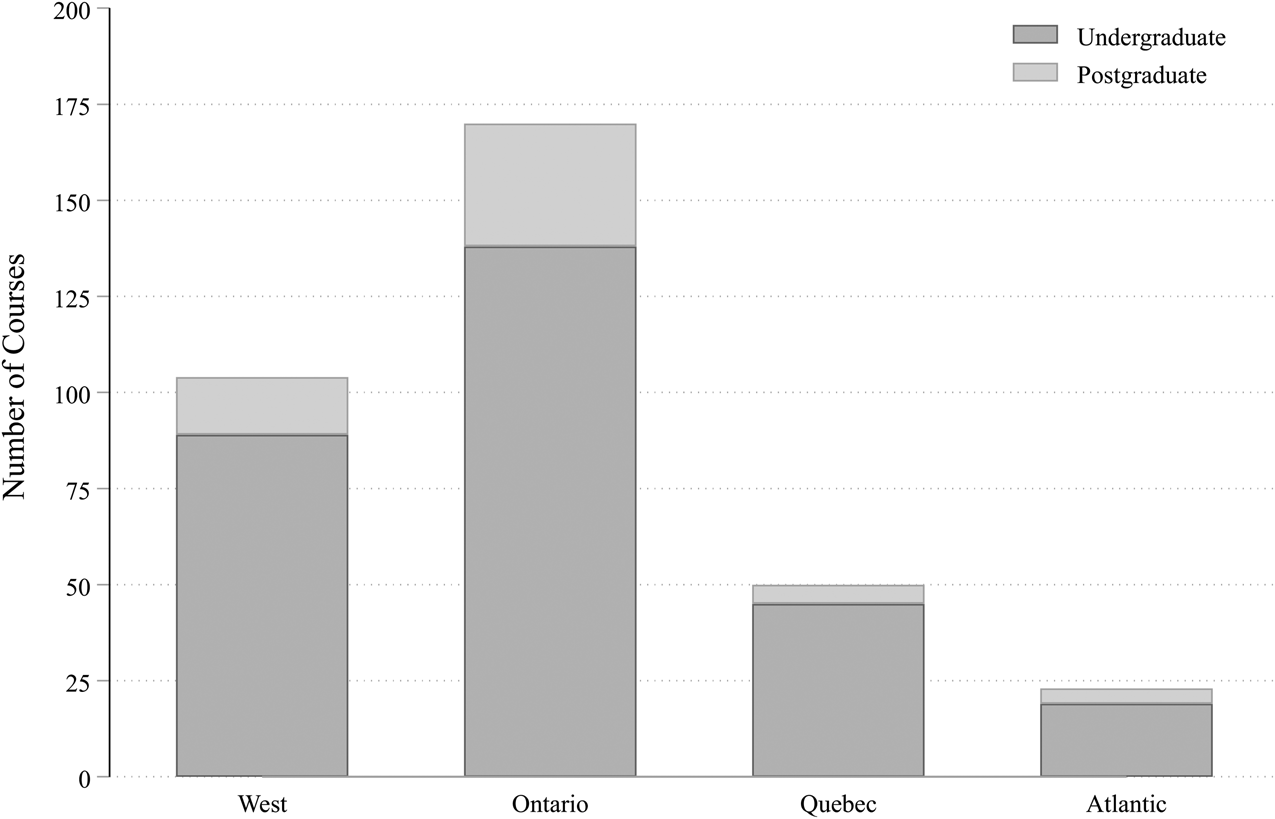
With this scope in mind, we first looked at each institution's website to see if we could download the syllabi for the most recent academic year. When this was possible, we did not contact the university, as we could access all the necessary material. If we could not find the syllabi, we contacted the departments/schools. We did so with the ethical approval of the School of Political and Social Science of the University of Edinburgh. In line with the ethics guidelines of the institution (which include promising anonymity to the professors and institutions that shared their syllabi with us), we anonymized the names of the universities—which is the same approach used by McMahon et al. (Reference McMahon, Alcantara and Stephenson2020), among others. Most of the administrations were very receptive to our information request. That said, some institutions did not want to share their syllabi or simply did not respond to our messages (or our follow-up requests). Overall, we were able to gather data for 42 Canadian universities. Most major universities are included. A majority (30 out of 42) are English universities, 6 are French institutions, and 6 are bilingual. It is not a perfect dataset, since we are missing information from some institutions. However, we cover a substantial proportion of Canadian universities and assembled an insightful data source.Footnote 5 An overview of the dataset is presented in Figure 1, displaying the number of (undergraduate and postgraduate) courses per region.Footnote 6
Number of undergraduate and postgraduate courses across regions (Study 1)

Overall, we have a total of 351 courses across 42 universities. Each course has about 25 assigned mandatory readings in its syllabus. In total, we coded 9,388 assigned readings. We focused on these readings, which means that we did not include “further,” “additional,” or “optional” readings. We believe it is reasonable to assume that the required readings are seen as more important (from the lecturers’ perspective, as well as with respect to students’ socialization in the field) than the optional ones. There is some variation in what kind of readings are listed in Canadian politics syllabi, which affects the total number of readings that we coded. Some courses have only one reading (for example, a textbook written by a single author), other courses use an edited textbook with different authors mobilized throughout the course, and some courses do not have textbooks and instead focus on articles. We do not believe this variation is an issue for our inquiry, as we have no reason to expect the number of assigned readings and authors used per course to be systematically correlated with the representation of francophone authors.
We coded the following information for each reading: number of authors, whether there was at least one francophone among them, the proportion of francophones among them, and the year of publication. Moreover, when an edited textbook was used throughout a given course, we coded each assigned chapter independently. Hence, in our dataset, an edited textbook can provide variance regarding the language of the authors.Footnote 7 The coding was done manually by the authors and with the help of a research assistant, to whom we are grateful. On the key variable of whether an author is francophone or anglophone (that is, whether someone's mother tongueFootnote 8 is French or English), we did not have doubts for the vast majority of cases, based on our existing personal knowledge and easily accessible information (first name, last name, the current institution, and where the PhD, master's, and bachelor's degrees were obtained). In the few cases where we weren't sure—which was less than 10 per cent of authors—we discussed within our group of co-authors or reached out to our network (especially people from the same institution as the authors). We were able to obtain an answer in most cases, which usually confirmed the expected language by the coder. When we were unable to code an author as either francophone or anglophone, we coded them as missing; these cases represent less than 3 per cent of the total entries. Overall, it is an imperfect method, but we are very confident that we are systematically accurate and that, as is the case for several studies on variables such as gender, it is worth conducting such an inquiry despite (a few) potential errors.
Findings
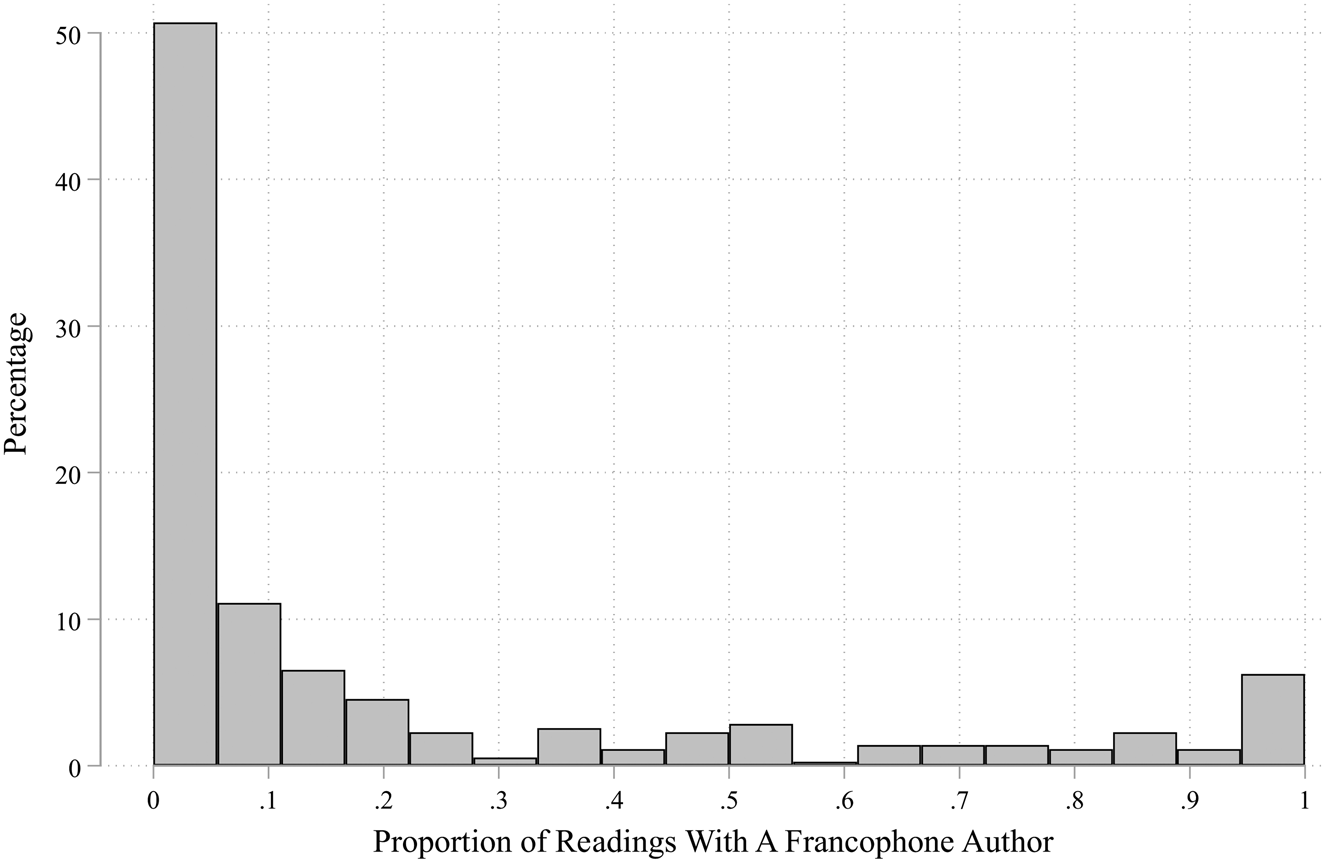
Our core findings for Study 1 consist of a set of simple but crucial descriptive statistics. At the outset, we show the overall proportion of assigned readings that include at least one francophone author. Figure 2 shows the distributions of the proportion of at least one francophone across all 351 courses. The histogram shows values that are far from normally distributed. They are skewed to the left (lower values on the proportion of readings with at least one francophone author). In fact, the modal value—that is, the most frequent value among all observations—is 0, with about 38 per cent of the sample (N = 133).
Proportion of mandatory readings with one francophone author in Canadian politics courses (N = 351)

Given the distribution shown in Figure 2, it is much more insightful to examine the median than the mean. Overall, the median is .05. That is, one-half of the courses include less than 5 per cent of readings with at least one French-speaking scholar author, and the other half of the courses include more than 5 per cent of such readings. Another way to look at the results is to consider the number of courses in which at least one-fifth of the readings includes a francophone author. This proportion corresponds to about 28 per cent (that is, 100 out of 351 courses). Considering a higher threshold of inclusivity, such as 31 per cent, corresponding to the proportion of francophone authors included in CJPS's publications (2000–2022), only 24 per cent (N = 85) of the courses would meet this standard. This is the big picture, but we provide findings for subgroups based on the institution's language and regions in Figure 3 below.
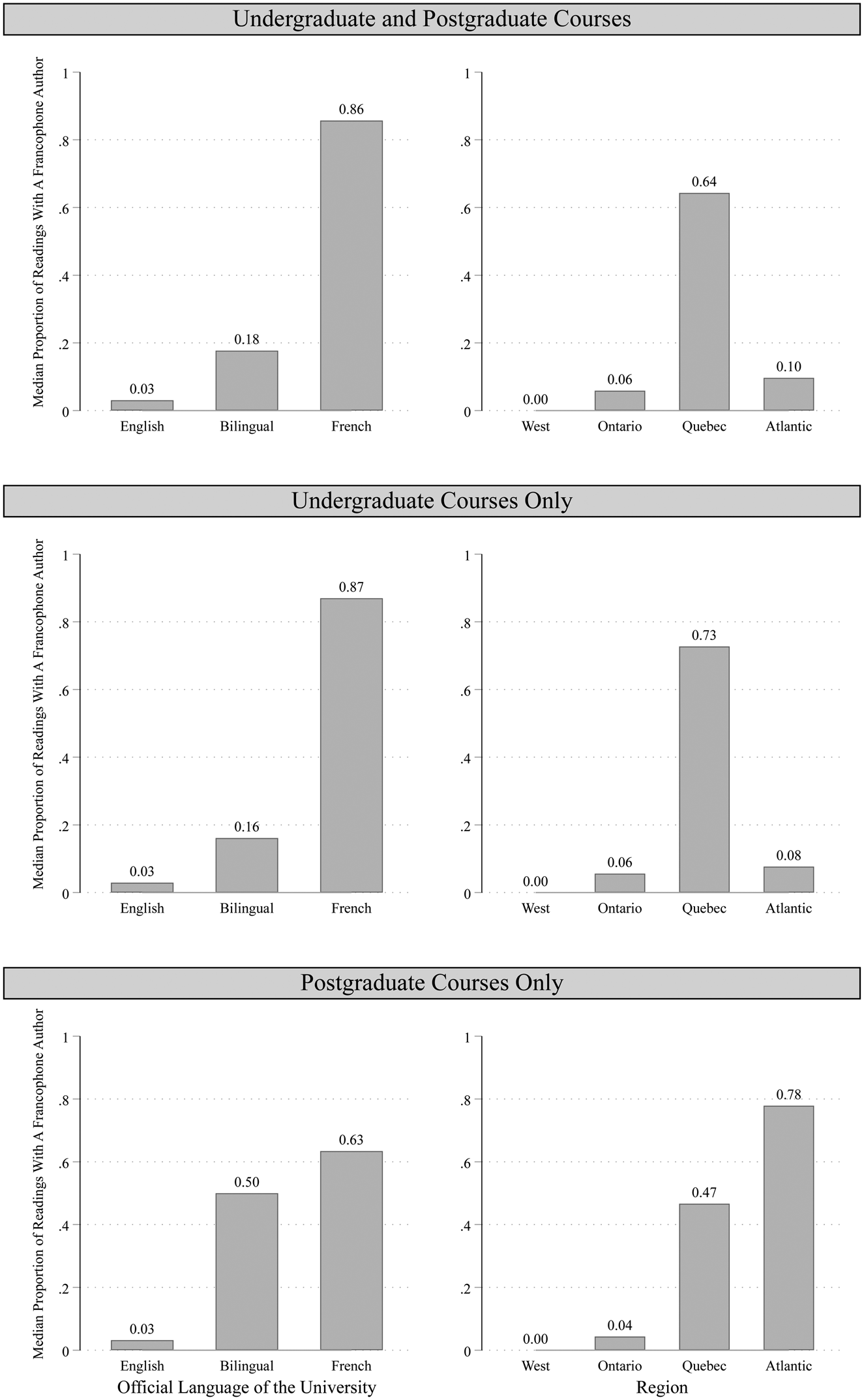
Median proportion of readings with one francophone author in Canadian politics courses, by language of the university and regions

The first panel of Figure 3 shows the median proportions of readings with at least one francophone author when we combine both undergraduate and postgraduate courses. Clearly, the language of the institution matters a lot. The median is .03 in English institutions, .18 in bilingual ones, and .86 in French institutions. It is very hard not to have the “two solitudes” in mind when looking at these numbers. Analyses by region also show a huge gap. For example, in the West, the median is 0; in Ontario, it is .06; in the Atlantic, it is .10; and in Quebec, it is .64. The second and third panel of Figure 3 displays the findings for undergraduate and postgraduate courses separately. Results are similar for undergraduate courses. Regarding postgraduate courses, the variation comes from categories with little variance. For example, the value for bilingual among the postgraduate courses relies on seven courses, and there were only four courses in our dataset for the postgraduate level in the Atlantic.
What can we learn from these findings? We believe that these data are a significant source of information about undergraduate and graduate students’ exposure to points of view on Canadian politics and that the main takeaway is that a clear majority of Canadian universities must revise their syllabi to achieve a more inclusive environment when it comes to Canada's two official languages. One can hold different views about the extent to which the material used to teach Canadian politics should include francophone authors, but since the readings of 133 courses out of 351 included no francophone authors at all, we believe that we have a strong case that francophones are underrepresented (when not totally absent). Beyond this statistic, the fact that half of the courses have a proportion of compulsory readings by francophone authors that is less than 5 per cent is also very revealing.
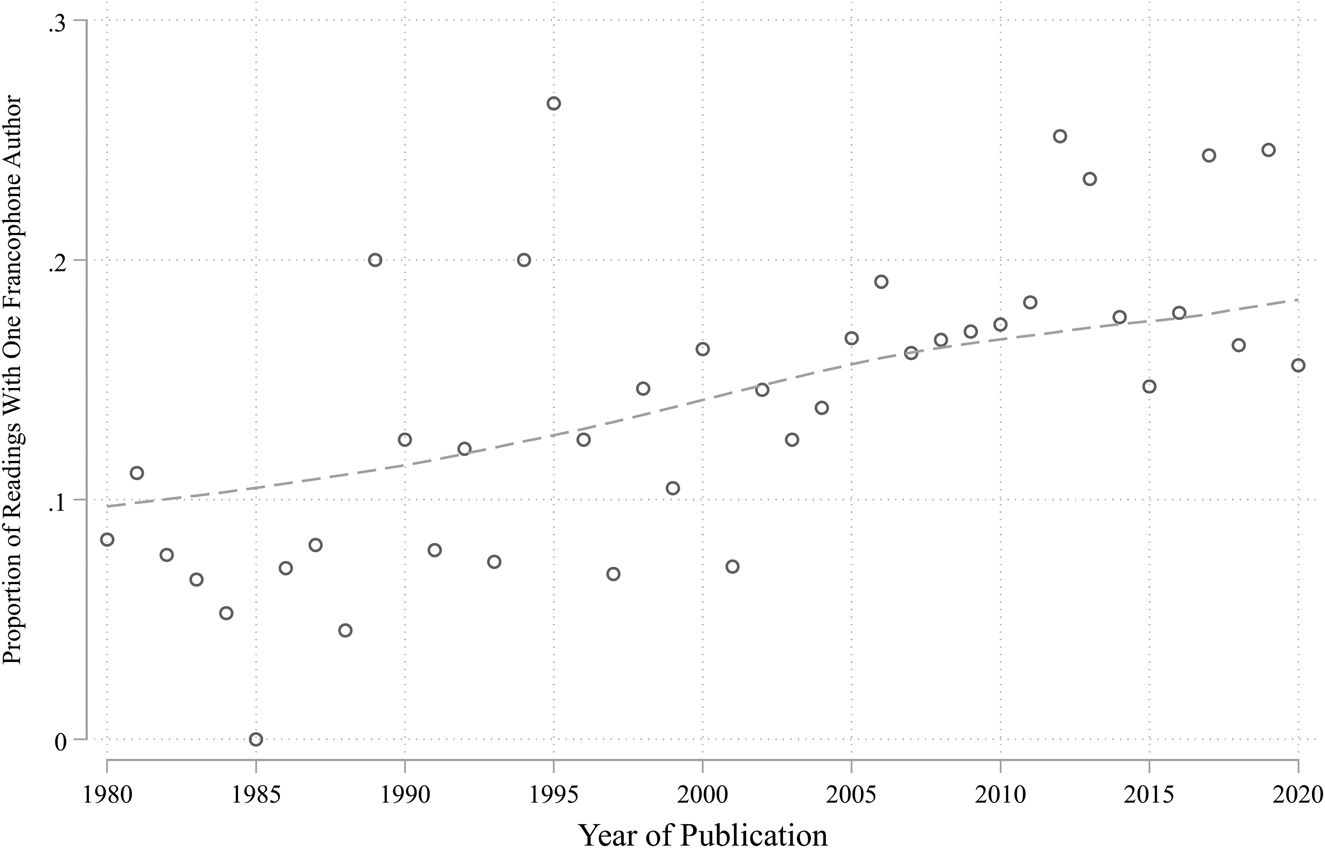
On a slightly more optimistic note, assigned readings published more recently have higher proportions of francophone authors. Figure 4 below shows the mean proportion of readings with at least one francophone author over the year of publication of the readings. There were assigned readings published before 1980, but it constitutes our starting point because it is the year from which our data always include more than 10 readings per year. The local regression included makes it possible to detect potential nonlinear patterns (although the trend has been quite linear since the 1980s). The proportion of readings with francophone authors has constantly increased, from about 10 per cent to approximately 17 per cent. This finding is interesting, but we remain only slightly optimistic for two reasons. First, a certain plateau will likely be reached, as older works are more likely to be considered “classic” or “must-read” and will thus be more likely to remain in the syllabi. Second, even the highest average at the end of the trend—that is, 17 per cent—is barely a fair share of francophone authors, which as mentioned above, should minimally be around one-fifth. That said, the trend is encouraging.
Representation of francophone authors in Canadian politics syllabi, by the year of publication
Note: Each data point represents the mean proportion of readings with at least one francophone for each year (1980–2020). A local regression with a kernel (Epanechnikov) function and a bandwidth of 0.8 is included.

We cannot test whether the better representation of French authors for more recent work illustrated in Figure 4 is due to more awareness and deliberate choices from faculty across Canada or whether it is due to an increase in the amount of work published by francophones (or both). However, as we coded the publications from CJPS from 2000 to 2022, we examined the over-time trend. As shown in the Figures A1 and A2 of the online appendix, the proportion of work published in CJPS for which there is at least one francophone author steadily increased over the past two decades. For example, about a quarter of publications included a French-speaking scholar during the 2000–2010 period, which increased to about 36 per cent in 2011–2020. Hence, the better representation of francophones in more recent work might be due to increased representation on the supply side (that is, the proportion of work published in the field).
Study 2
Data and Indicators
In the second study, we use the publicly accessible dataset from McMahon et al. (Reference McMahon, Alcantara and Stephenson2020). The authors collected the data as part of an insightful research study on Canadian politics’ comprehensive qualifying field exams. The number of universities is lower than for Study 1 (N = 16, instead of 42) because only institutions with a PhD program could be included. The authors examined the reading lists for the comprehensive exams from the 16 institutions to analyze whether there is such a thing as a unified field of Canadian politics. Their main conclusion was that, contrary to what is usually assumed, the high levels of variation in the reading lists mean that there is no shared common knowledge base.
With respect to language, McMahon et al. (Reference McMahon, Alcantara and Stephenson2020) write that “white, male, and English-Canadian voices have long dominated the scholarly community at the expense of French, Indigenous, and other racial and ethnic minority voices” (McMahon et al., Reference McMahon, Alcantara and Stephenson2020: 95).Footnote 9 They also state: “Despite being a bilingual country with a bilingual national association, the reading lists were decidedly not.” There were, on average, 184 readings per list; in the case of universities outside Quebec, approximately 3 readings per list were written in French. For Quebec universities, this number increased to about 28 readings per list. While McMahon et al. focused on the language of the research and not on that of the authors, their findings were quite in line with the general idea of overwhelming dominance by English-speaking scholars (even in Quebec) in the field of Canadian politics.
Thanks to McMahon et al. making the data publicly available, we could further expand their analysis by adding another variable to examine whether the assigned readings included a francophone author. We used the same approach as for Study 1 in order to generate the information for this variable. We also excluded readings for which there was no “author,” such as documents from the Government of Canada and by official commissions. Overall, we have gathered the information for 2,894 readings.
Findings
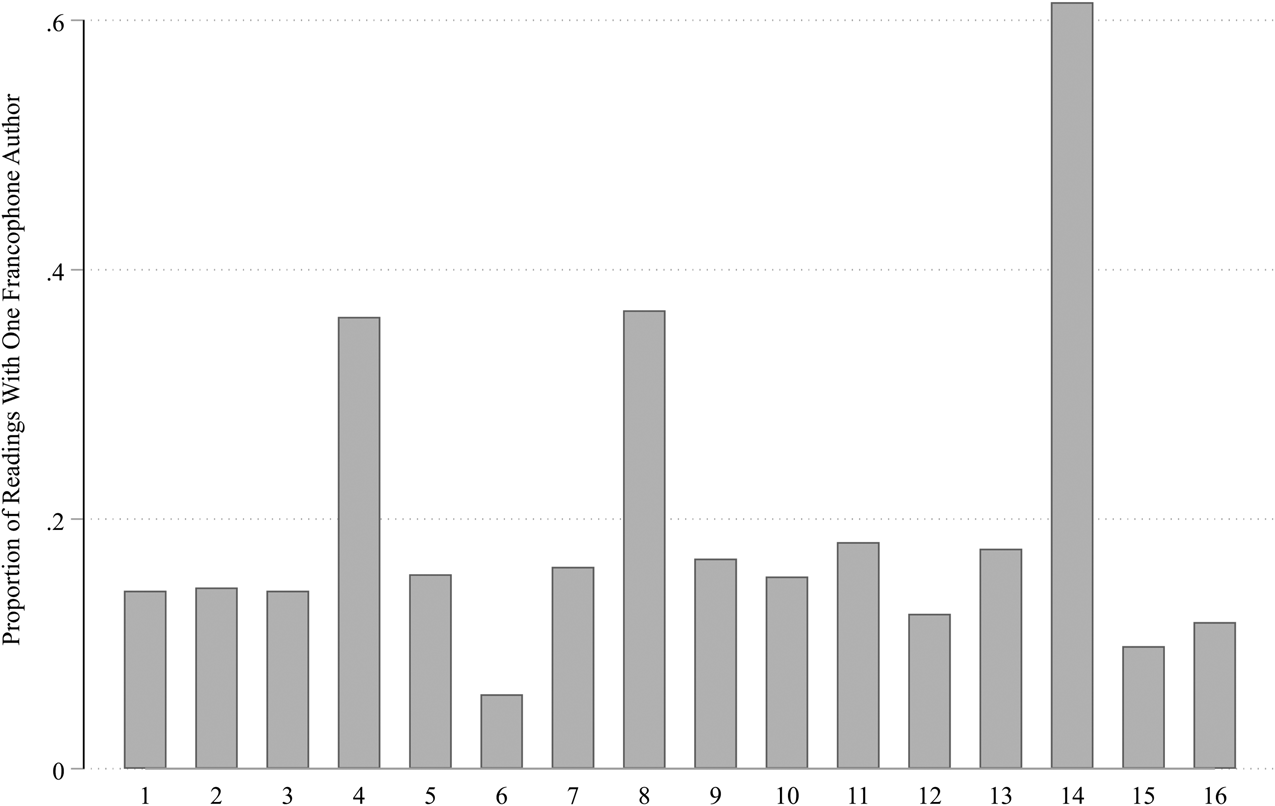
As for Study 1, the key finding relies on a descriptive visualization of the proportion of readings with at least one francophone author. Figure 5 shows these results across the 16 universities for which we have data and their respective reading lists for their comprehensive exams on Canadian politics. There are three clear outliers with much higher values (.362, .367 and .614) than all the others. They drive the mean to .198. The median is lower, at .155. Although the findings point to the underrepresentation of francophone scholars, we must note that they indicate a better representation than in Study 1 on Canadian politics syllabi.
Representation of francophone authors in comprehensive exam reading lists
Note: Each bar represents an anonymized university.
N = 16; mean = .198; median = .155

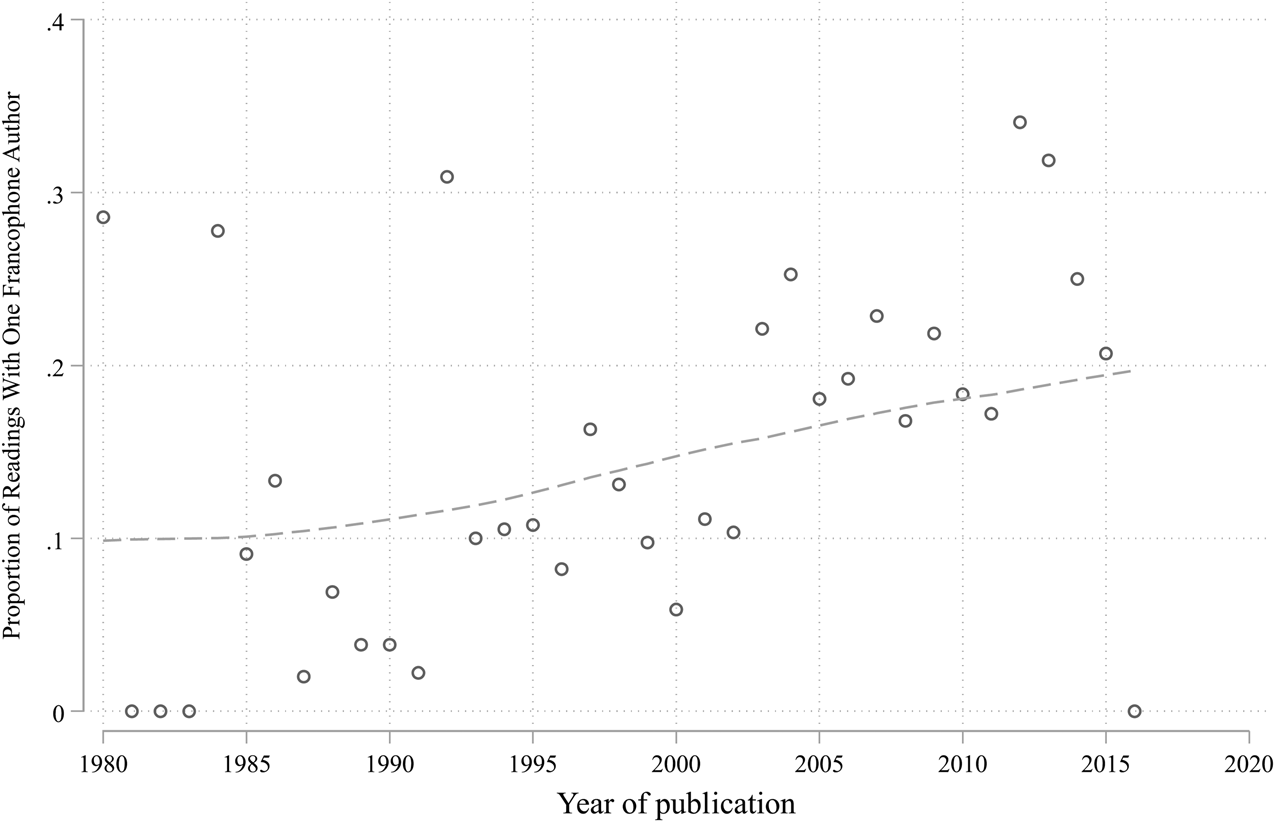
That said, if we exclude the three outliers, we end up with 13 universities that do not reach 20 per cent (which is, as discussed previously, a conservative threshold). Hence, our main takeaways are twofold. First, the conclusion from Study 1—namely, that francophone scholars are systemically underrepresented in readings on Canadian politics—still applies. However, the proportion of readings by francophone scholars on comprehensive exams is higher compared to readings in Canadian politics syllabi. As was the case in Study 1, in Study 2 more recently published work is more likely to include at least one francophone co-author. We included the years from 1980 to 2017 because they always have more than 10 observations per year. We plotted the results in Figure 6 (with a local regression, allowing for nonlinear patterns). As shown below, the trend is strikingly similar to the one we found in Study 1, starting at about .1 and increasing to almost .2. For the reasons detailed in Study 1, this trend is encouraging but calls for moderate optimism.
Proportion of readings with one francophone author, across years of publication
Note: Each data point represents the mean proportion of readings with at least one francophone for each year (1980–2017). A local regression with a kernel (Epanechnikov) function and a bandwidth of 0.8 is included.

Discussion and Implications
We believe that it is important to understand how Canadian politics is taught as a discipline. What is taught can substantially affect students at the graduate and undergraduate levels. Among other issues, the extent to which students are exposed to biased views favouring the representation of some groups of scholars in the field will have an impact on their perspective of the discipline when they work on their master's theses or PhD dissertations and when they form the new generation of faculty members in Canadian universities. However, we still know too little about how Canadian politics is taught. There have been a few exceptions, such as the insightful work of Tolley (Reference Tolley2020) and Everitt (Reference Everitt2021), which has provided a better understanding of our blind spots on the discipline.Footnote 10 However, to our knowledge, there is no systematic analysis that incorporates information on language—and would thus build on Rocher's (Reference Rocher2007) findings.
This article aims to contribute, by focusing on language, to a better understanding of how we teach Canadian politics. So far, the few research studies that have adopted an intersectional approach to studying representation in the field of Canadian politics have not, in our view, seriously considered the issue of language. These authors have provided very significant contributions, notably regarding the representation of women, immigrants and Indigenous peoples, but we are left without a thorough analysis of language-related representation.
We have attempted to address this shortcoming by providing two studies focusing on readings assigned to students of Canadian politics and the extent to which francophone authors have been represented in the field. In Study 1, we generated an original dataset based on the Canadian politics syllabi of 42 Canadian universities. The results were crystal clear: francophone authors were either completely absent (0 per cent being, by far, the most typical case—see Figure 2) or underrepresented. We can thus conclude that there is a clear and substantial underrepresentation of francophone authors in Canadian politics syllabi, even if they publish in English (Blais, Reference Blais2018; Rocher and Stockemer, Reference Rocher and Stockemer2017; Stockemer and Wigginton, Reference Stockemer and Wigginton2019). In Study 2, we focused on the reading lists for comprehensive doctoral qualifying field exams in Canadian politics. Expanding on the dataset from McMahon et al. (Reference McMahon, Alcantara and Stephenson2020), we added a new variable— namely, the language of the authors. The results were twofold. On the one hand, there is a representation gap, as was clear from Study 1. On the other hand, the gap is smaller for the reading lists of comprehensive exams (Study 2), as about 15 per cent of readings include at least one francophone author.
Altogether, our findings show that the way we socialize students in the field is characterized by a clear underrepresentation of francophones. Canadian politics should ideally be taught without major blind spots. We know that there are weaknesses regarding the representation in syllabi of women and racialized Canadians. We should invest additional efforts to be more inclusive in that regard—not only for normative reasons but also for a better, more inclusive and more comprehensive science. We believe that the underrepresentation of francophones also deserves serious and immediate attention: we should do more to include francophone authors when designing syllabi and developing reading lists for comprehensive examinations.
There are major reasons for encouraging the dissemination and knowledge of works published by francophone scholars within the field of political science. First, francophone scholars likely bring in different sensibilities, since—while having a solid knowledge of research produced in the Anglo-American tradition—they have often times been trained in continental Europe or by mentors in Canadian universities who have trained in Europe.Footnote 11 As a result, their understanding of social and political matters could help cast new light when the time comes to assess key public policies related to, among others, federalism, welfare state and secularism. Second, it is crucial to develop a political science that can pay attention to the location where one resides. For example, appraising public policies related to regional development would be seen differently if one primarily lives in the Atlantic region, Quebec, Ontario or the Prairies. As the vast majority of political scientists in Quebec are French-speaking, including francophones in Canadian political science is necessary to include Quebec and other francophone communities across the country. Third, it is crucial to imagine ways and venues to develop a more inclusive political science where members of the two principal linguistic communities can share their views and test their ideas in an open forum that solicits and welcomes the views of everyone. This would lead to the development of pan-Canadian research teams that can appraise broader issues such as health policy (for example, pan-Canadian response to a pandemic), economic policy (for example, dirigisme versus laissez-faire), international relations (for example, the Commonwealth, La Francophonie), and so forth. Fourth, encouraging a political science that values the work of francophones from all regions of the country would give added value to the work both of members of francophone communities living in minority environments and of members in Quebec. Reconciling the solitudes is not simply a goal to be attained; it is a worldview to be shared and emulated.
Unfortunately, our findings suggest that some internal biases are deeply rooted. Tomorrow's scholars, those who will write the next textbooks and the next must-read articles to be assigned in courses, will have been socialized with a non-inclusive corpus of compulsory readings. This is true for undergraduate students, as well as graduate students who take comprehensive exams in Canadian politics. Of course, these biases might vary somewhat based on contextual factors, but overall and other things being equal, the failing is so serious that we should take note of it countrywide. It remains highly puzzling why, after more than 50 years of official bilingualism in Canada, professors of Canadian politics have not become more sensitive to the work of their francophone colleagues. Explaining such a shortcoming is definitely an essential topic for future research—for which we hope to have provided a useful foundation. Other studies could focus on different types of corpora, such as grant applications for Canadian funding institutions (Marcoux, Reference Marcoux2018) and presidential addresses of the CPSA (Lucas, Reference Lucas2013), and also explore other subfields in political science. However, as we have pointed out, investigating the issue of language is highly relevant for a sound and a more grounded development of the study of Canadian politics.
What can be done? There are structural and individual considerations. Institutions should invite individuals to be increasingly aware of their own biases and the resulting lack of representation. Just as institutions such as the CPSA aim to reduce the number of “manels” (panels that include men only) when events are being organized under its leadership, we should expect departments to sensitize colleagues when the presence of francophone scholars is nil, feeble or overwhelmingly underrepresented in Canadian politics courses. Institutions are expected to provide leadership. Other minorities suffering from systemic discrimination regarding representation should also benefit from such proactive measures to make the discipline more inclusive and comprehensive. In light of the ongoing discussions with respect to best practices in equity, diversity and inclusion in research and teaching throughout the country, we are of the view that to attenuate the weaker presence of francophone authors in syllabi and comprehensive examinations, departments of political science ought to play a more active role. Measures could vary from one institution to another, given their differences in governance. There is one key action, however, that could affect both institutional reviews of syllabi and comprehensive exams, as well as informal individual evaluations and discussion: when fostering equity, diversity and inclusiveness, guidelines should include language as one of the key characteristics (among other important ones) for which, as a discipline, we should do better.
Conflict of interests
The authors declare no conflict of interest.