Introduction
Modern chitons are diverse and abundant along the west coast of North America (Smith, Reference Smith1977). Chitons are particularly common and ecologically important in the intertidal and shallow subtidal regions of the eastern Pacific (Eernisse et al., Reference Eernisse, Clark, Draeger and Carlton2007). However, the rich extant diversity of Polyplacophora in this region contrasts with their relatively sparse fossil record along the western margin of North America, particularly from pre-Pliocene rocks.
Polyplacophora are somewhat poorly represented in the fossil record due to factors such as the aragonite mineralogy and thin shell plates that make them prone to dissolution (Cherns and Wright, Reference Cherns and Wright2000), the typically high-energy depositional environments in which they live, plus inadequate sampling of sedimentary rocks for fossil chitons (Puchalski et al., Reference Puchalski, Eernisse and Johnson2008). Most records of Cenozoic fossil chitons from western North America are from the Pleistocene (e.g., Arnold, Reference Arnold1903; Berry, Reference Berry1922, Reference Berry1926; Addicott, Reference Addicott1966), complemented with a few assemblages from the Pliocene (Vendrasco et al., Reference Vendrasco, Eernisse, Powell and Fernandez2012), Eocene/Oligocene (Squires and Goedert, Reference Squires and Goedert1995), and Paleocene (Dell'Angelo et al., Reference Dell'Angelo, Bonfitto and Taviani2011).
The coastal environment of western North America changed significantly during the Miocene with the onset of a cold-water upwelling regime, leading to a diversification of many coastal marine species such as kelp, abalone, crabs, and fish (Jacobs et al., Reference Jacobs, Haney and Louie2004). The overall cooling trend continued into the Pliocene–Pleistocene, maintaining cold waters and associated high nutrient conditions that still characterize the eastern Pacific today. This enriched environment supports the high abundance and diversity of chitons that presently occur in the region.
The Late Miocene is the time of an adaptive radiation of the common North Pacific family Mopaliidae, including the genus Mopalia, as deduced by Kelly and Eernisse (Reference Kelly and Eernisse2008) from molecular data and the fossil record. The high diversity of the Pliocene chiton assemblage from the San Diego Formation of southern California (Vendrasco et al., Reference Vendrasco, Eernisse, Powell and Fernandez2012) is consistent with adaptive radiations of other chiton lineages during or around the Miocene. However, the nature and precise timing of the faunal changeover and rapid diversification of Polyplacophora in the northeast Pacific will remain unclear until additional Cenozoic, and especially Miocene, chiton fossils from the region are located, identified, and reported. The chiton assemblage described herein will help towards this goal.
Geologic setting
The chiton fossils were extracted from sedimentary rocks referred to the “Imperial” Formation s.l. exposed in Super Creek, Riverside County, California, ~15 km NNW of Palm Springs. Specifically, the samples were collected in a stream bluff on the east side of Super Creek at 33°57′12.97″N, 116°37′34.22″W, LACMIP (Los Angeles County Museum of Natural History, Invertebrate Paleontology) Locality 43085.
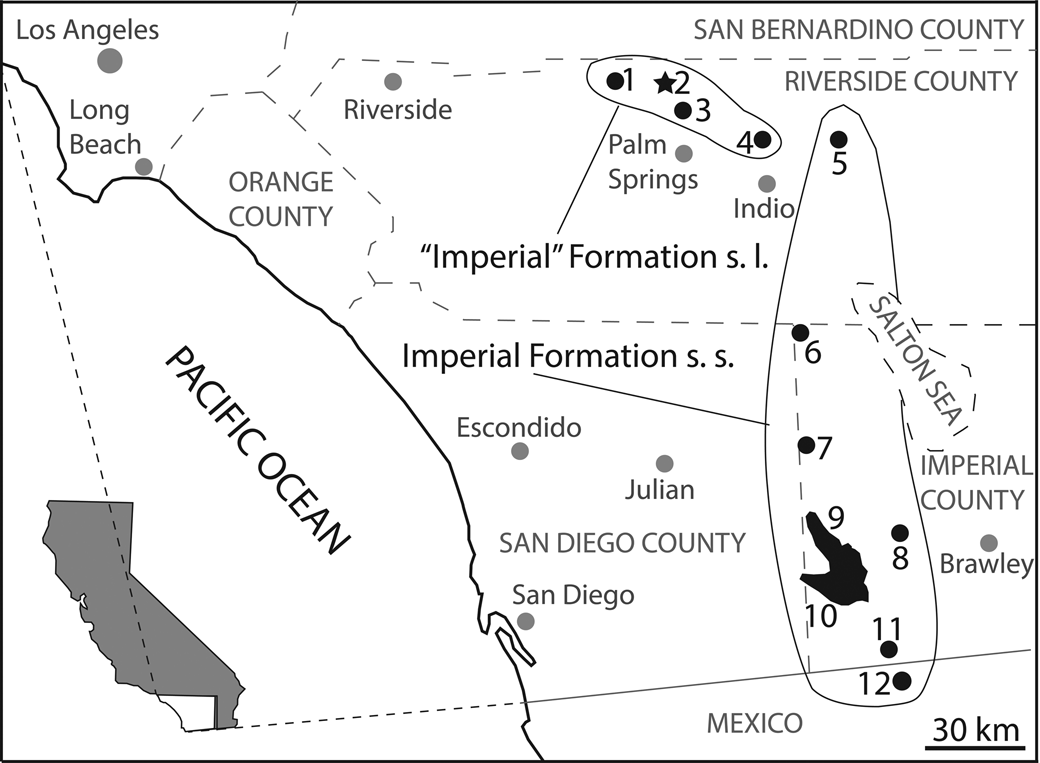
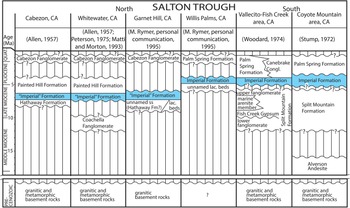
Here the name Imperial Formation (without quotes) is meant in the strict sense (sensu stricto, s.s.), referring to proto-Gulf of California related marine sedimentary rocks mostly of Pliocene age, although some are as old as Late Miocene. These deposits occur mostly in Imperial and San Diego counties and include the area where the Imperial Formation was originally described. The name “Imperial” Formation (with quotes and used in the broad sense, sensu lato; s.l.) is used here to refer to proto-Gulf of California related marine rocks with tropical fauna, mostly of Miocene age, from Riverside County that yielded the chiton fossils here. These rocks of the “Imperial” Formation s.l. have a different age, provenance of sediments, and lithology than the type Imperial Formation s.s. The name Lion Sandstone (Vaughan, Reference Vaughan1922) was proposed for these rocks near Lion Canyon, but this name was ignored by later workers under the impression that these rocks were equivalent to the Imperial Formation s.s.—an assumption that since then has been proven false (Powell, Reference Powell1986, Reference Powell1987, Reference Powell1988, Reference Powell1995; Powell and LaFollette, Reference Powell and LaFollette2012). The formal (re-)naming of the rocks from Super Creek referred to as the “Imperial” Formation s.l. will be treated in a future publication by CP. The locations of outcrops of the Imperial Formation s.s. and s.l. are illustrated in Figure 1, and a correlation chart showing their stratigraphic relationships is depicted in Figure 2.
Outcrop areas of the “Imperial” Formation s.l. and Imperial Formation s.s. in southern California and the northern Baja California peninsula. “Imperial” Formation s.l.: (1) Cabazon (Lion Canyon); (2) Super Creek (Whitewater); (3) Garnet Hill; (4) Indio Hills. Imperial Formation s.s.: (5) Willis Palms; (6) Travertine Point; (7) Ocotillo Wells State Vehicle Recreation Area; (8) Superstition Mountain; (9) Fish Creek Mountains; (10) Coyote Mountain; (11) Yuha Buttes, southern California; (12) northern Cucupa Mountain, east of Mexicali, Baja California Norte, Mexico. The chiton fossils described here came from the “Imperial” Formation s.l. at Super Creek (Whitewater), location 2 on this map marked with a star.

Correlation chart showing stratigraphic sections for Late Miocene “Imperial” Formation s.l. and Late Miocene to Pliocene Imperial Formation s.s. Localities are shown in Figure 1. Chitons described here were recovered from rocks of the “Imperial” Formation at Whitewater, CA (Super Creek). Sections are organized from northwest to southeast and include the “Imperial” Formation s.l. at Lion Canyon (Cabezon, CA), Super Creek (Whitewater, CA), Garnet Hill, and the Imperial Formation s.s. in the Indio Hills (Willis Palms, CA), Riverside County, and in Imperial and San Diego counties from the Split Mountain Gorge/Vallecito area, and the Coyote Mountains. Note the age difference between the “Imperial” Formation in Riverside County (and northern San Diego County for Willis Palms, Indio Hills) and the Imperial Formation in Imperial and San Diego counties. The Imperial Formation at Willis Palms (Indio Hills) correlates with the type exposures in Imperial and San Diego counties. The ages of all boundaries are approximate. Numerical age estimates for these Formations were derived from: Peterson, Reference Peterson1975; Ruisaard, Reference Ruisaard1979; Matti et al., Reference Matti, Morton and Cox1985; Rymer et al., Reference Rymer, Sarna-Wojcicki, Powell and Barron1994, Reference Rymer, Powell, Sarna–Wojcicki and Barron1995; and McNabb et al., Reference McNabb, Dorsey, Housen, Dimitroff and Messé2017. Abbreviations: Congl. = conglomerate; Fm = Formation; lac. beds = unnamed lacustrine beds; QUAT. = Quaternary; ss = sandstone. In part after McDougall (Reference McDougall2008).

The Super Creek “Imperial” Formation lies between granite basement below and marine to subaerial deposits of the Painted Hill Formation above. The “Imperial” Formation consists of two unnamed units: a sandstone/breccia member at the base and an overlying sandstone/siltstone member. The lower member consists of small synclinal deposits up to 30 m thick over the granite basement and is located only in the southern part of the outcrop area. Deposition began here via the incursion of marine waters from the proto-Gulf of California into southern California. The paleoenvironment of the lower unit is one of pocket bays along rocky headlands (Powell, Reference Powell1986). The upper member is up to 100 m thick and consists of fossiliferous fine-grained sandstone and siltstone with rare beds of pebbly breccia. This upper unit interfingers with the overlying Painted Hill Formation near its top. Depositional water depth increased from intertidal in the lower unit to continental shelf or possibly upper slope above the base to the middle of the upper unit, then decreased, culminating in a subaerial sandstone near the top of the upper member (Powell and LaFollette, Reference Powell and LaFollette2012).
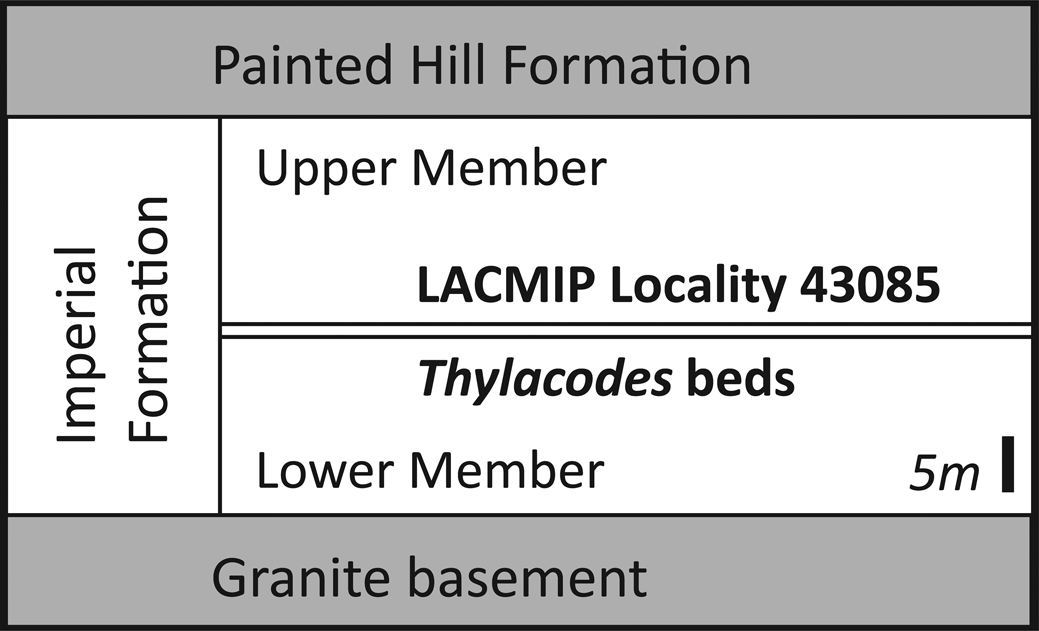
The transition between the two informal members of the “Imperial” Formation at Super Creek (Fig. 3) is recognized as a 0.2–2.0 m thick zone of bed(s) that are rich in broken tubes of the vermetid gastropod Thylacodes Guettard, Reference Guettard1770, as well as other small (<2 cm) shelly and skeletal remains. These layers previously were referred to as the ‘worm tube beds’ and were later recognized as the vermetid gastropod Thylacodes, formerly Serpulorbis Sasso, Reference Sasso1827 (LaFollette, Reference LaFollette2012). The chiton fossils were recovered from the section on the northeast side of Super Creek where two distinct beds of Thylacodes are separated by about a half meter of fine-grained sediment. The chiton fossils were extracted from ~50 cm thick siltstone beds between and just above the two beds of cemented Thylacodes tubes (Fig. 3). These beds also contain a rich fauna of mollusks, barnacles, bryozoans, and corals. The silt matrix in which the chiton fossils were embedded is rich in aragonite shell material and breaks down in water. Aragonite shell material is otherwise virtually absent in the Super Creek area, with aragonite shells typically represented only by molds and casts, or white powder.
Composite section of the “Imperial” Formation s.l. along Super Creek, east of the Whitewater River, north of Palm Springs, Riverside County, California. The chiton fossils described here came from LACMIP locality 43085, between and just above the two Thylacodes tube beds preserved in this region.

The sedimentary rocks at Super Creek previously were considered to belong to the Imperial Formation s.s. (Woodring, Reference Woodring1932; Bramkamp, Reference Bramkamp1935), based on biostratigraphic evidence rather than a lithologic correlation (Powell and LaFollette, Reference Powell and LaFollette2012). The rocks at Super Creek (“Imperial” Formation) were deposited during the Late Miocene (McDougall et al., Reference McDougall, Poore and Matti1999), and differ from rocks of the Imperial Formation s.s. in their provenance, lithology, and fauna, including the percentage of Caribophile taxa (Powell and LaFollette, Reference Powell and LaFollette2012). McDougall (Reference McDougall2008) used microfossil biostratigraphy and sea level highstands to constrain the age of the Super Creek “Imperial” Formation to between 6.3–6.0 Ma (Late Miocene).
Materials and method
Approximately 1,500 kg of sedimentary rocks were collected in bulk by the late Mark Roeder and one of us (PL) from Super Creek at LACMIP locality 43085 (Fig. 1) at various times between 2009 and 2014. All the collected rocks were washed and sieved using a motorized 10-screen archaeological washer to extract fossils from the matrix. The fossils were then sorted by Diane A. Jovee and one of us (PL), and the chiton fossils then photographed using a CCD-microscope setup as well as macrophotography and image stacking. All measurements were made using ImageJ (Rueden et al., Reference Rueden, Schindelin, Hiner, DeZonia, Walter, Arena and Eliceiri2017).
Repositories and institutional abbreviations
All specimens described in this study are deposited with the Los Angeles Museum of Natural History, Invertebrate Paleontology collections (LACMIP) (Hendy et al., Reference Hendy, Walker and Mertz2020). New taxa described in this paper have an additional LACMIP type number, which follows the Hendy et al. (Reference Hendy, Walker and Mertz2020) specimen numbers in parentheses. Other repositories mentioned in the Systematic Paleontology section include the Natural History Museum (NHMUK) and the United States National Museum (USNM).
Systematic paleontology
Introduction
Certainty in species-level identification is elusive with many chiton fossils, including geologically young ones because diagnoses of modern chitons refer to features that in fossils are missing (e.g., soft parts, girdle elements) or are often abraded (e.g., tegmental sculpture, slits in insertion plates). Also, descriptions of living chiton species typically refer to characters in all three valve types (head, intermediate, tail), whereas a chiton species in a given assemblage is often known only from one or two of these types. Thus, classifying individual shell plates or their fragments at the species level is often problematic, particularly when features such as tegmental sculpture and articulamentum characters are worn. We use open nomenclature in some cases to reflect the uncertainty, and propose new species only when the preserved tegmental sculpture and/or other traits in the set of fossils clearly fall outside the range of those in previously described species. We utilize the chiton classification scheme presented by Sirenko (Reference Sirenko2006), and the terminology of chiton valves as summarized by Smith (Reference Smith and Moore1960) and Schwabe (Reference Schwabe2010).
Tail valves tend to be the most robust valve type in Polyplacophora. Thus it is not surprising that these are the most common type of shell plate preserved in this assemblage, as with many other fossil chiton accumulations. Fortunately, the tail valve contains many characters useful in the classification of modern chitons, including: relative placement of the mucro along the midline from anterior to posterior; details of both types of tegmental sculpture present on the surface of the valves (in the ante- and post-mucronal tegmental areas); outline of sutural laminae; and number of slits in the terminal insertion plate. The tail valve is the most useful of the three valve types in terms of classification and taxonomy (Schwabe, Reference Schwabe2010).
Class Polyplacophora Gray, Reference Gray1821
Order Chitonida Thiele, Reference Thiele1909
Family Callistoplacidae Pilsbry, Reference Pilsbry1893
Diagnosis
Strong tegmental sculpture of thick ridges on head valve, lateral areas of intermediate valves, and post-mucronal area of tail valve. Slit rays and insertion teeth typically correspond to these ridges (Smith, Reference Smith and Moore1960).
Remarks
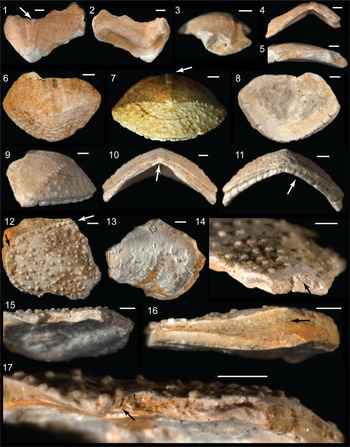
Four abraded and somewhat incomplete valves in this assemblage (Fig. 5.14, 5.15, 5.17–5.20) show the distinctive tegmental sculpture characteristic of Callistoplacidae, but without sufficient detail to warrant a finer classification at this time. These specimens are classified at present as Callistoplacidae sp. indet.
Genus Callistochiton Carpenter in Dall, Reference Dall1879
Type species
Callistochiton palmulatus Carpenter in Dall, Reference Dall1879
Remarks
Philip P. Carpenter had been working on the systematic description of chitons when he passed away in 1877, leaving behind unpublished written documents that identified and described many new chiton species. After his death, both Dall (Reference Dall1879) and Pilsbry (Reference Pilsbry1893) used Carpenter's unpublished writings (referred to as MSS. and MS. by Dall, Reference Dall1879, and Pilsbry, Reference Pilsbry1893, respectively) to publish the descriptions of new taxa. Both Dall, Reference Dall1879, and Pilsbry, Reference Pilsbry1893, listed Carpenter as the taxonomic authority of these new genera and species; for these cases, the taxonomic citations are listed herein as Carpenter in Dall, Reference Dall1879, and Carpenter in Pilsbry, Reference Pilsbry1893, respectively.
Callistochiton cf. C. elenensis (Sowerby in Broderip and Sowerby, Reference Broderip and Sowerby1832)
Figure 4
Type specimens
A holotype of Callistochiton elenensis was not designated. Kaas and Van Belle (Reference Kaas and Van Belle1994) located the collection from which the description was made (NHMUK 20150526), and found therein five dried specimens on a plate. From this collection, Kaas and Van Belle (Reference Kaas and Van Belle1994) designated a lectotype (NHMUK 20150526b) and four paralectotypes (NHMUK 20150526a, c–e) of Callistochiton elenensis, separating out the remaining specimen (NHMUK 20150526f) as Callistochiton pulchrior Pilsbry, Reference Pilsbry1893.
Diagnosis
Head valves and post-mucronal area of tail valves with 6–8 thick, radial ribs, and pronounced, more-or-less straight longitudinal ridges and less-pronounced transverse ridges in central area of intermediate valves and pre-mucronal area of tail valves; tail valve with low elevation, mucro a bit anterior from mid-length, and gently convex post-mucronal area.
Occurrence
The specimens described here were all recovered from the Super Creek locality of the “Imperial” Formation, LACMIP locality 43085.
Description
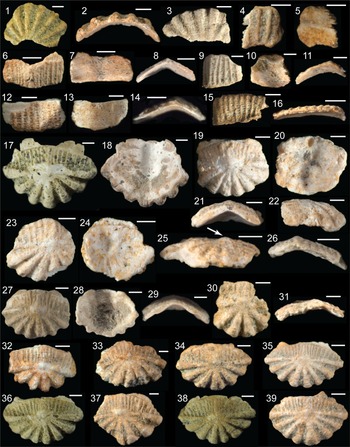
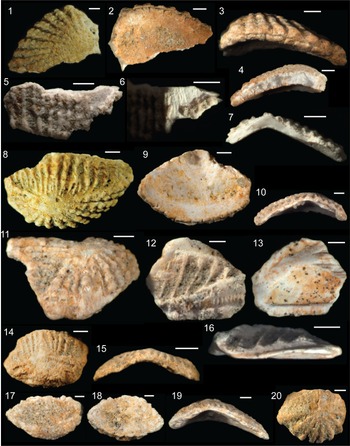
The valves are small (typically 2–3 mm in length) and thick; head valves semi-circular in dorsal view, with about eight prominent ribs radiating from apical region (Fig. 4.1), width of ribs nearly equal to or a bit greater than that of interspaces between them; ribs roughly semi-circular in cross section (Fig. 4.2). Intermediate valves with prominent, straight longitudinal ridges (20 or a few more) in central area, with slight latticing from faint transverse ridges (Fig. 4.9, 4.12, 4.15); sutural laminae relatively long (Fig. 4.6); tail valves with slightly raised mucro (Fig. 4.25) situated a bit anterior from mid-length (between 0.34–0.45 of midline); pre-mucronal area with about 20 distinct longitudinal ridges and finer transverse ridges forming a weak lattice (Fig. 4.32); post-mucronal area with 6–8 prominent ribs that radiate from mucro (Fig. 4.17, 4.27, 4.32–4.39); merged granules within ribs are indistinct (Fig. 4.17); sutural laminae are somewhat trapezoidal (Fig. 4.17), with large space between them occupied by a short jugal lamina; overall low elevation with pre-mucronal area relatively straight and post-mucronal area gently convex (Fig. 4.25).
Specimens of Callistochiton cf. C. elenensis (Sowerby in Broderip and Sowerby, Reference Broderip and Sowerby1832) from the “Imperial” Formation at Super Creek, California, LACMIP locality 43085. In all dorsal and ventral views of valves, anterior is towards the top of the page. In anterior, posterior, and lateral views (profiles) of valves, dorsal is towards the top of the page: (1–3) head valves; (4–16) intermediate valves; (17–39) tail valves. (1, 2) Dorsal and anterior views of LACMIP 43085.33; (3) dorsal view of LACMIP 43085.37; (4, 5) dorsal and ventral views of LACMIP 43085.42; (6–8) dorsal, ventral, and anterior views of LACMIP 43085.38; (9–11) dorsal, ventral, and posterior views of LACMIP 43085.39; (12–14) dorsal, ventral, and anterior views of LACMIP 43085.40; (15, 16) dorsal and anterior views of LACMIP 43085.41; (17, 18) dorsal and ventral views of LACMIP 43085.22; (19–22) dorsal, ventral, anterior, and lateral views of LACMIP 43085.19; (23–26) dorsal, ventral, lateral, and anterior views of LACMIP 43085.20, arrow in (25) points to mucro; (27–29) dorsal, ventral, and anterior views of LACMIP 43085.30; (30, 31) dorsal and anterior views of LACMIP 43085.36; (32) dorsal view of LACMIP 43085.28; (33) dorsal view of LACMIP 43085.26; (34) dorsal view of LACMIP 43085.27; (35) dorsal view of LACMIP 43085.29; (36) dorsal view of LACMIP 43085.23; (37) dorsal view of LACMIP 43085.24; (38) dorsal view of LACMIP 43085.21; (39) dorsal view of LACMIP 43085.25. All scale bars 0.5 mm.

Materials
Two head valves, five intermediate valves, and seventeen tail valves from LACMIP locality 43085.
Remarks
The thick valves and heavy sculpturing, in particular the robust ribs on the tail valve, indicate these are members of the family Callistoplacidae. Kaas and Van Belle (Reference Kaas and Van Belle1994) distinguished five genera that they included in this taxon (their subfamily Callistoplacinae) by girdle characters that are missing in these fossils. Similarly, Smith (Reference Smith and Moore1960) had indicated earlier that Callistoplax Carpenter in Dall, Reference Dall1882, is distinguished from Callistochiton by the occurrence of a relatively nude girdle. Nevertheless, these fossils can be differentiated from the genus Calloplax Thiele, Reference Thiele1909, and Ceratozona Dall, Reference Dall1882, because those genera are characterized by a subcentral mucro in the tail valve (Ferreira, Reference Ferreira1978; Kaas and Van Belle, Reference Kaas and Van Belle1994). The fossils differ from the monotypic genus Callistoplax in having a tail valve with a more anterior mucro, more-pronounced troughs between radial ribs, and with insertion slits that correspond to ribs. The fossils differ from other species of Callistochiton in the following ways: Callistochiton pulchellus (Gray, Reference Gray and Gray1828) lacks distinct longitudinal ridges in central and pre-mucronal tegmental areas; C. decoratus Carpenter in Pilsbry, Reference Pilsbry1893, C. crassicostatus Pilsbry, 1893, and C. pulchrior Carpenter in Pilsbry, Reference Pilsbry1893, have a more posterior mucro in tail valve; C. shuttleworthianus Pilsbry, Reference Pilsbry1893, C. expressus (Carpenter, Reference Carpenter1865), C. righii Kaas and Van Belle, Reference Kaas and Van Belle1994, C. aesthenes (Berry, Reference Berry1919), C. leei Ferreira, Reference Ferreira1979, C. colimensis (Smith, Reference Smith1961), and C. portobelensis Ferreira, Reference Ferreira1976, lack the strong ribs in head valves and the post-mucronal area of tail valves; C. porosus Nierstrasz, Reference Nierstrasz1905, from the west Atlantic has similar sculpturing but has fewer ribs in the post-mucronal area of the tail valve; C. laticostatus Kaas and Van Belle, Reference Kaas and Van Belle1994, has more angled longitudinal ridges, more distinct granules in the ribs, and a much greater extent of the pre-mucronal area in tail valves; and C. palmulatus Carpenter in Dall, Reference Dall1879, has much taller and more spherical tail valves.
The “Imperial” Formation specimens share with Callistochiton elenensis the most character states, including: heavy sculpturing of about eight thick radial ribs on head valves and post-mucronal area of tail valves; distinct longitudinal ridges on central area of intermediate valves and pre-mucronal area of tail valves; low elevation of tail valve, with flat mucro with gently convex post-mucronal area; and same size range (e.g., tail valves of the fossil species range from 2–3 mm in length, compared with ~3 mm for the syntype illustrated by Kaas and Van Belle, Reference Kaas and Van Belle1994). However, the specimens differ somewhat from C. elenensis in having: more rounded sutural laminae in tail valves; shorter jugal plate between sutural laminae of tail valves; straighter longitudinal ridges in the flatter pre-mucronal area of tail valves; and more-pronounced sculpturing in the post-mucronal area. Nevertheless, given the high degree of variation, especially of tail valves, of modern C. elenensis, it is unclear whether these fossils belong to a species other than C. elenensis.
In particular these fossils are most similar to specimens previously assigned to Callistochiton gabbi (Pilsbry, Reference Pilsbry1893). This species was synonymized with C. elenensis without explanation by Kaas and Van Belle (Reference Kaas and Van Belle1994). Originally, Pilsbry (Reference Pilsbry1893) named C. gabbi and had not seen C. elenensis, but distinguished it from C. gabbi via the original drawings (Sowerby in Broderip and Sowerby, Reference Broderip and Sowerby1832) based on a higher projecting mucro in the tail valve in C. elenensis. Ferreira (Reference Ferreira1979), in his monograph on Callistochiton in the eastern Pacific, maintained C. gabbi as a valid species, but did not comment directly on distinguishing it from C. elenensis. Ferreira (Reference Ferreira1979) listed the geographic range of C. gabbi as the entire Gulf of California south to Ecuador; the geographic range of C. elenensis he inferred as occurring only to the south of the Gulf of California. Kaas and Van Belle (Reference Kaas and Van Belle1994) examined specimens they considered syntypes of C. elenensis, and considered the mucro in this species to be depressed, in contrast to Pilsbry's claim. Ferreira (Reference Ferreira1979) argued that C. elenensis has a head valve with 11–12 ribs, distinct from C. gabbi with 8–10 ribs. Another possible distinguishing characteristic between these two species relates to the width of the ribs relative to spaces between them—in C. gabbi, the ribs are relatively wider than in C. elenensis. Whether C. gabbi is a valid species, however, is a subject for a broader treatment of Callistochiton. Overall, these fossils are more similar to the C. gabbi form of C. elenensis sensu lato, and they may have been ancestral to the species living today in the Gulf of California. Clark (Reference Clark2000) described a single modern chiton specimen from rhodolith beds of the Gulf of California as Callistochiton sp. cf. C. elenensis and suggested it might be a juvenile of C. elenensis. The fossils here differ from C. cf. C. elenensis of Clark, Reference Clark2000, in having a jugal lamina on the valves, being less highly elevated, and larger.
Callistochiton elenensis sensu stricto occurs from 15 km north of Mazatlan, Mexico, down to Ecuador, with a recorded depth range of low intertidal to possibly 90 m, whereas Callistochiton gabbi was reported to have a similar range, but also occurs throughout the Gulf of California, from the low intertidal to possibly 73 m (Ferreira, Reference Ferreira1979). Reyes-Gómez (Reference Reyes-Gómez2016) listed a similar depth range of shallow subtidal to 70 m and a distribution from the southern Gulf of California to the Mexican Tropical Pacific for C. elenensis. No fossils assigned to either C. gabbi or C. elenensis have been previously recorded.
Family Chaetopleuridae Plate, Reference Plate1899
Remarks
Tegmental sculpture in this family is distinct, dominated by pustules that in central areas often coalesce into beaded longitudinal riblets. Sutural laminae are normally widely spaced in this family. One abraded valve (Fig. 5.12, 5.13, 5.16) shows the distinctive tegmental sculpture of beaded riblets and rows of granules and wide apophyses, both characteristic of Chaetopleuridae, but without sufficient detail to warrant a finer classification at this time. This specimen is classified at present as Chaetopleuridae sp. indet.
Specimens of Calloplax roederi n. sp. (1–11), Chaetopleuridae sp. indet. (12, 13, 16), and Callistoplacidae sp. indet. (14, 15, 17–20) from the “Imperial” Formation at Super Creek, California, LACMIP locality 43085. In all dorsal and ventral views of valves, anterior is towards the top of the page. In anterior, posterior, and lateral views (profiles) of valves, dorsal is towards the top of the page. (1–11) Calloplax roederi n. sp.: (1–4) head valve, paratype, LACMIP 43085.47 (LACMIP Type 14900) in dorsal, ventral, anterior, and posterior views; (5–7) intermediate valve, paratype, LACMIP 43085.47 (LACMIP Type 14901) in (5) dorsal view, (6) dorsal close-up view with eroded valve surface on right side showing aesthete channels, and (7) anterior view; (8–11) tail valve, holotype, LACMIP 43085.47 (LACMIP Type 14899) in dorsal, ventral, anterior, and lateral views. (12, 13, 16) Chaetopleuridae sp. indet.: dorsal, ventral, and anterior views of intermediate valve, LACMIP 43085.45. (14, 15, 17–20) Callistochitonidae sp. indet: (14, 15) dorsal and anterior views of tail valve, LACMIP 43085.46; (17–19) dorsal, ventral, and anterior views of tail valve, LACMIP 43085.43; (20) dorsal view of tail valve, LACMIP 43085.44. All scale bars 0.5 mm.

Genus Calloplax Thiele, Reference Thiele1909
Type species
Calloplax janeirensis (Gray, Reference Gray and Gray1828).
Diagnosis
Head valve, lateral areas of intermediate valves, and post-mucronal area of tail valves with radial ribs made up of distinct pustules; central area of intermediate valves and pre- mucronal area of tail valve with longitudinal, typically granulose, ridges. Mucro sub-central, with steep slope to post-mucronal area.
Remarks
There has been a disagreement about the family affiliation of Calloplax. It has sometimes been assigned to the Chaetopleuridae Plate, Reference Plate1899 (e.g., Thiele, Reference Thiele1929; Bergenhayn, Reference Bergenhayn1930; Smith, Reference Smith and Moore1960; Kaas, Reference Kaas1972; Ferreira, Reference Ferreira1982) and at other times the Callistoplacidae (e.g., Smith and Ferreira, Reference Smith and Ferreira1977; Ferreira, Reference Ferreira1978; Van Belle, Reference Van Belle1978; Kaas and Van Belle, Reference Kaas and Van Belle1994; Sirenko, Reference Sirenko2006; Schwabe, Reference Schwabe2009). Ferreira (Reference Ferreira1982) listed the characters that Calloplax shares with both Callistochiton (elongate body; strong tegmental sculpture of radial ribs; correspondence between ribs and insertion slits on end valves; and typically upswept valve 7) and Chaetopleura Shuttleworth, Reference Shuttleworth1853 (pustulose tegmental sculpture; small scales with spicules on dorsal surface of the girdle; and radula with wide, sub-quadrangular median tooth and tricuspid major lateral teeth). Lyons (Reference Lyons1985) provided a more detailed comparison between Chaetopleura and Calloplax, concluding that the variation of Calloplax is encompassed within Chaetopleura and that Calloplax should be considered a junior synonym of Chaetopleura. A deeper analysis is needed to clarify this issue, but for now we retain Calloplax as others have (e.g., Kaas and Van Belle, Reference Kaas and Van Belle1994; Sirenko, Reference Sirenko2006; Schwabe, Reference Schwabe2009). Based on the strong similarities between Calloplax and Chaetopleura, we classify both in the Chaetopleuridae as did Ferreira (Reference Ferreira1982).
Calloplax occurs in three distinct areas: the Galápagos Islands, the subtropical coast of Chile, and the Caribbean (Kaas and Van Belle, Reference Kaas and Van Belle1994). Fossil representatives of this genus have not previously been reported.
Calloplax roederi new species
Figure 5.1–5.11
Type specimens
Holotype (Fig. 5.8–5.11; LACMIP 43085.47 (LACMIP Type 14899); tail valve) and two paratypes (Fig. 5.1–5.7; LACMIP 43085.48 (LACMIP Type 14900), and LACMIP 43085.49 (LACMIP Type 14901); one head and one intermediate valve).
Diagnosis
Head valve and post-mucronal area of tail valve with neat rows of distinct, domical granules. Pre-mucronal area of tail valve with pronounced wavy, branching, longitudinal ridges. Mucro of tail valve just posterior to midpoint.
Occurrence
Only known from the Super Creek locality of the “Imperial” Formation, LACMIP locality 43085.
Description
Valves small (2–3 mm in length) and thick (Fig. 5.4, 5.6, 5.10). Head valve semi- circular (Fig. 5.1), with an estimated 20 rows of granules emanating from apical region; rows straight and comprise distinct, partly merged granules; >10 granules per row; granules become larger near the distal (antero-lateral) margin of the valve. Central area of intermediate valves and pre-mucronal area of tail valve with widely spaced, pronounced longitudinal ridges; many of these ridges show faint outlines of the granules from which they formed. These longitudinal ridges branch in places, for example near the boundary between pre- and post-mucronal areas of the tail valve (Fig. 5.8). Mucro of tail valve just barely to posterior of midline (0.56 along midline in the holotype; Fig. 5.11); pre-mucronal area forms a broad horizontal shelf with nearly straight dorsal margin. Number of radial ribs in tail valve estimated to be ~18.
Materials
One head, one intermediate, and one tail valve from LACMIP locality 43085.
Etymology
Named after the late Mark Roeder, who, along with one of us (PL), collected the rocks from which the specimens described herein were extracted, and whose mechanized table washer was used to free the fossils from matrix.
Remarks
The heavy sculpturing, particularly of large granules in the head valve and post- mucronal area of tail valves, indicates this set of fossils belongs to the Callistoplacidae. Kaas and Van Belle (Reference Kaas and Van Belle1994) distinguished the genera within this group (their Subfamily Callistoplacinae) by girdle characters, and thus it is possible that these fossils belong to a different genus of the family. However, the similarity in tegmental sculpture is greatest with modern members of Calloplax, and so we classify the new species as a member of this genus. In particular, the pustulose nature of the large radial ribs and longitudinal ridges in these fossils are more characteristic of Calloplax than Callistochiton. In addition, the mucro of the tail valve is sub- central, as expected for Calloplax.
The closest match in tegmental sculpturing is with Calloplax janeirensis (Gray, Reference Gray and Gray1828), the type species of the genus. Calloplax roederi n. sp. and C. janeirensis share tall, radial ribs that are coarsely granulose (see Ferreira, Reference Ferreira1978), but they differ in that C. janeirensis has a greater number of more distinct granules on the head valve and post-mucronal area of tail valve, stronger longitudinal ridges in the pre-mucronal area of the tail valve, and more radial ribs on end valves. Calloplax roederi n. sp. differs from other, similar chitons in these ways: there are more rows of granules on the tail valves than in Calloplax duncana (Dall, Reference Dall1919); the rows of granules are better organized than in Chaetopleura staphylophera Lyons, Reference Lyons1985; it lacks the upraised portion of the pre- mucronal area of Ischnoplax incurvata (Leloup, Reference Leloup1953); and it differs from Callistochiton crassicostatus in having a more anterior mucro and many more longitudinal ribs of granules.
The type species of the genus, Calloplax janeirensis, is common throughout the Caribbean Province, from around Florida, many Caribbean Islands, and down to Brazil, with its type locality in Central America (Ferreira, Reference Ferreira1978). Other species of Calloplax occur in the Galápagos Islands and in the warm-temperate regions of Chile (Ferreira, Reference Ferreira1978).
Genus Chaetopleura Shuttleworth, Reference Shuttleworth1853
Type species
Chiton peruvianus Lamarck, Reference Lamarck1819, by subsequent designation (Dall, Reference Dall1879).
Chaetopleura cf. C. lanuginosa mixta (Dall, Reference Dall1919)
Figure 6.12–6.17
Type specimens
A holotype was not designated for Tonicia mixta in the original description (Dall, Reference Dall1919). There were three specimens associated with the original lot, USNM 110345. Smith (Reference Smith1977) designated a lectotype, but it was initially unclear which specimen was meant since USNM 110345 contained three specimens: two complete and a set of disarticulated valves. Ferreira (Reference Ferreira1983), comparing specimens in the lot to Smith's color slides, determined which specimen was meant to be the lectotype (taking original number USNM 110345) and designated another the paralectotype, with the disarticulated valves belonging to a separate species.
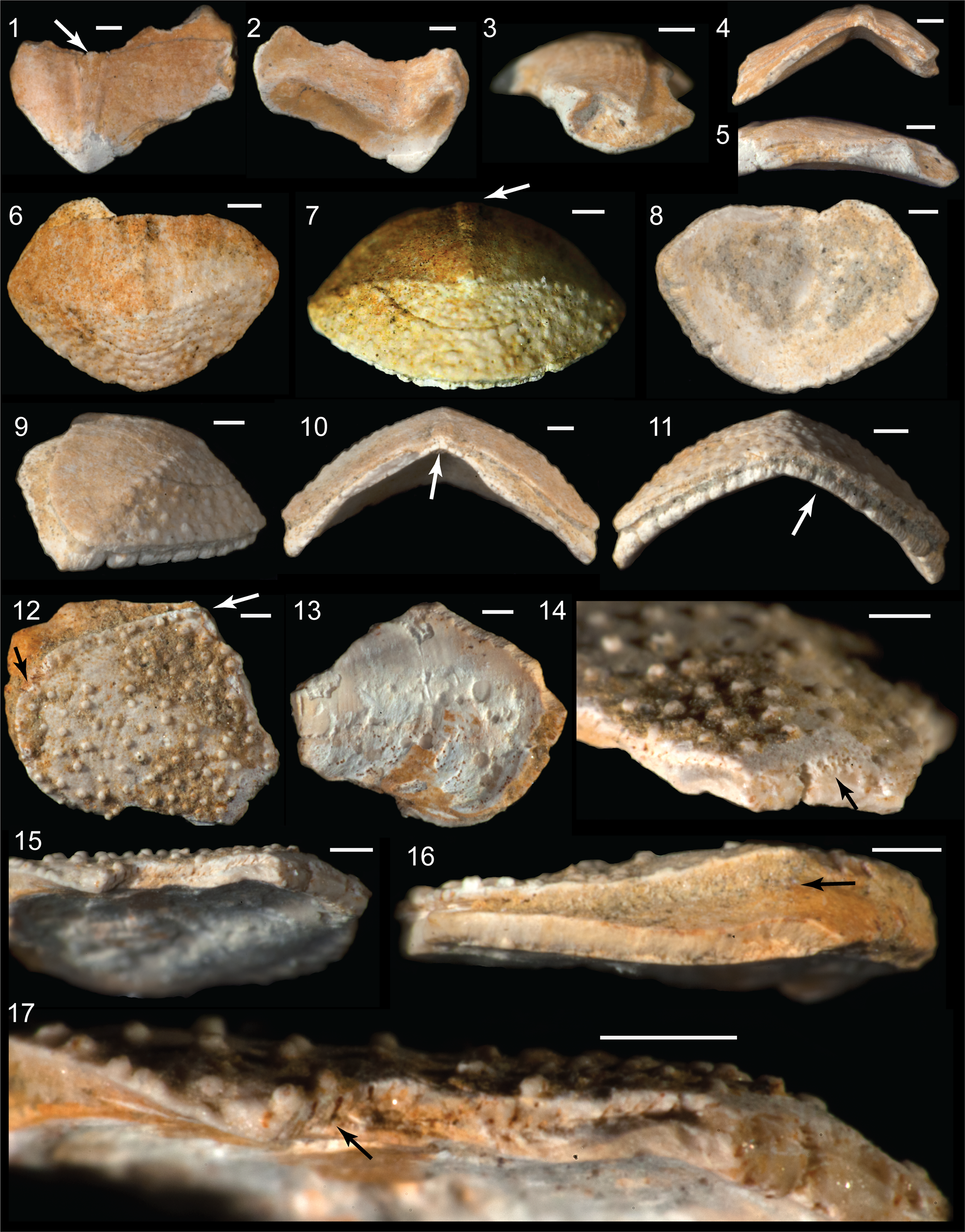
Specimens of Chiton solaris n. sp. (1–11) and Chaetopleura cf. C. lanuginosa mixta (Dall, Reference Dall1919) (12–17) from the “Imperial” Formation at Super Creek, California, LACMIP locality 43085. In all dorsal and ventral views of valves, anterior is towards the top of the page. In anterior, posterior, and lateral views (profiles) of valves, dorsal is towards the top of the page. (1–5) Chiton solaris n. sp., paratype, intermediate valve, LACMIP 43085.51 (LACMIP Type 14903) in dorsal, ventral, lateral, anterior, and posterior views; arrow in (1) shows jugal ridge; (2) shows callus along posterior 2/3 of length. (6–11) Chiton solaris n. sp., holotype, tail valve, LACMIP 43085.50 (LACMIP Type 14902) in antero-dorsal, postero-dorsal, ventral, lateral, anterior, and posterior views; arrow in (7) shows jugal ridge; arrow in (10) shows jugal lamina with pectinations; arrow in (11) shows pectinated insertion plates. (12–17) Chaetopleura cf. C. lanuginosa mixta, intermediate valve, LACMIP 43085.52: (12) dorsal view (13) ventral view; (14) view of medio-posterior region of valve; (15) view of break near midline of valve; (16) view of anterior margin, showing sutural lamina and tegmental eave; and (17) enlarged view of (15). White arrow in (12) shows short zone of crenulations along antero-lateral margin of tegmentum, black arrow in (12) shows boundary between lateral and central tegmental areas of the valve; arrows in (14) and (17) show exposed aesthete canals; arrow in (16) shows boundary between outer, spongy tegmentum shell layer and stronger crossed-lamellar rich hypostracum/articulamentum layers. All scale bars 0.5 mm.
Diagnosis
Tegmental surface contains large, domical, irregularly spaced pustules (granules); in lateral areas, the pustules are loosely organized into rows diverging from the apical region to the antero-lateral margin; in the central area, the pustules have a more haphazard distribution. Distal margin of tegmental surface with crenulations.
Occurrence
This fossil was recovered from the Super Creek locality of the “Imperial” Formation, LACMIP locality 43085.
Description
Intermediate valve ~3 mm long at midline. Valve thick (Fig. 6.16), large, domical, widely spaced pustules unevenly distributed over tegmental surface; arranged loosely in rows in the lateral areas, with rows diverging towards antero-lateral margin of shell plate. In central area of the tegmental surface, pustule distribution is less regular (Fig. 6.12). Otherwise the tegmental surface is ornamented with pores from the aesthete canals, faint growth lines, and a short zone of crenulations along the anterior and lateral tegmental margin (Fig. 6.12). Anterior margin of tegmentum on either side of valve midline is straight and angled in a posterior direction towards the lateral margin. Articulamentum exposed along most of anterior and lateral margins of intermediate valves, with one slit per side, and without a clear division between insertion plate and sutural lamina (Fig. 6.12).
Materials
Single intermediate valve, LACMIP 43085.52, from the “Imperial” Formation, LACMIP locality 43085.
Remarks
Smith (Reference Smith1977) considered the specimens that Dall (Reference Dall1919) described as Tonicia mixta to belong instead to Chaetopleura. Ferreira (Reference Ferreira1983) synonymized Chaetopleura mixta with C. lanuginosa, suggesting that the type specimens of Chaetopleura mixta have a morphology within the range of C. lanuginosa. Kaas and Van Belle (Reference Kaas and Van Belle1987) noted the nearly identical characteristics between Chaetopleura lanuginosa and C. mixta. However, the discontinuous occurrence of the two taxa (C. mixta is exclusive to the upper Gulf of California whereas C. lanuginosa is known only from the Pacific coast of the Baja California peninsula) led Kaas and Van Belle (Reference Kaas and Van Belle1987) to erect the subspecies Chaetopleura lanuginosa mixta to encompass the specimens from the Gulf of Mexico.
The random pattern of large pustules, with one slit per side of the intermediate valve, and significant exposure of articulamentum indicate this specimen is a member of the genus Chaetopleura. The size and spacing of the granules are the same as in Chaetopleura lanuginosa lanuginosa (compare Fig. 6.12 with Kaas and Van Belle, Reference Kaas and Van Belle1987, fig. 46.8). Another shared feature is that abraded pustules have a crater-like or porous central region (Fig. 6.12). However, this fossil differs from C. lanuginosa lanuginosa in having a straight and crenulated anterior margin of the tegmentum, and larger, less-organized, and more widely spaced pustules in the central area of intermediate valves. The subspecies Chaetopleura lanuginosa mixta (Dall, Reference Dall1919) occurs in the northern part of the Gulf of California, from the intertidal zone to shallow subtidal (Reyes-Gómez, Reference Reyes-Gómez2016), and so may be closely related to this fossil species. From the original description (Dall, Reference Dall1919), the pustules in C. lanuginosa mixta appear to be much smaller than those in these fossil specimens. These characteristics of C. lanuginosa mixta are reinforced in the description and specimen illustrated by Kaas and Van Belle (Reference Kaas and Van Belle1987). However, other specimens, including in Reyes-Gómez (Reference Reyes-Gómez2016) and from the Natural History Museum Rotterdam (MolluscaBase, 2020), indicate that the C. lanuginosa specimens from the Gulf of California (by default classified as C. lanuginosa mixta) can have larger pustules, which is more reminiscent of what occurs in these fossil specimens.
Modern representatives of Chaetopleura lanuginosa lanuginosa occur in the intertidal zone along the west coast of the Baja California peninsula, with type locality in Todos Santos Bay (Kaas and Van Belle, Reference Kaas and Van Belle1987). Chaetopleura lanuginosa has been recorded in Pleistocene deposits near San Quintin on the Pacific side of the Baja California peninsula (Berry, Reference Berry1926). Chaetopleura lanuginosa mixta occurs in the upper Gulf of California from the intertidal zone to 15 m depth (Reyes-Gómez, Reference Reyes-Gómez2016), and is particularly common around Guaymas on the mainland side (D. Eernisse, personal communication, 2021).
Family Chitonidae Rafinesque, Reference Rafinesque1815
Remarks
Of the defining characters for the family listed by Kaas et al. (Reference Kaas, Van Belle and Strack2006), the most useful is the presence of pectinated, or finely slit, insertion plates. This traditionally has been viewed as a diagnostic character for the family (Smith, Reference Smith and Moore1960). Bullock (Reference Bullock1988) objected to this single-character classification because it unites species with very different girdle ornamentation, although the pectinations in chitonids are distinct. Grooves and fine slits between insertion teeth, like chitonid pectinations, occur more broadly throughout the Polyplacophora. For example, many members of the Family Chaetopleuridae Plate, Reference Plate1899, have grooves at the distal end of insertion plates, referred to by Kaas and Van Belle (Reference Kaas and Van Belle1987) as rugose or crenulated. Furthermore, Paleozoic chitons, such as Glyptochiton (see Smith, Reference Smith1971), Schematochiton arthurcooperi (Smith, Reference Smith1976) (see Smith, Reference Smith1976; Hoare, Reference Hoare2002), and multiplacophorans (see Hoare and Mapes, Reference Hoare and Mapes1995), all have grooved or pectinated insertion plates, and it is clear that none of them is a chitonid. This and other evidence show clearly that pectinated insertion plates have originated multiple times in Polyplacophora (Eernisse and Vendrasco, Reference Eernisse and Vendrasco2017).
Members of two of the three subfamilies of the Chitonidae, the Acanthopleurinae Dall, Reference Dall1889, and Toniciinae Pilsbry, Reference Pilsbry1893, are the only chitons known to have relatively large, pigmented eyes within the shell in addition to normal aesthetes. There is no clear evidence for such large chambers in these fossils, so we classify them as members of Chitoninae, which is the remaining subfamily of the Chitonidae.
Genus Chiton Linnaeus, Reference Linnaeus1758
Type species
Chiton tuburculatus Linnaeus, Reference Linnaeus1758, by subsequent designation (Dall, Reference Dall1879).
Remarks
Members of this genus are common in the tropical eastern Pacific and Caribbean (Bullock, Reference Bullock1988). Tegmentum sculpture is varied. Insertion teeth usually deeply pectinate.
Chiton solaris new species
Figure 6.1–6.11
Type specimens
Holotype (Fig. 6.6–6.11) LACMIP 43085.50 (LACMIP Type 14902) and paratype (Fig. 6.1–6.5) LACMIP 43085.51 (LACMIP Type 14903).
Diagnosis
Central area of intermediate valve and pre-mucronal area of tail valve with pronounced jugal ridge on an otherwise relatively smooth tegmental surface. Post-mucronal area of tail valve with somewhat irregularly spaced large granules (pustules). Diagonal line of tail valve made up of a row of large granules. Mucro of tail valve slightly posterior of midpoint. Insertion plates with numerous pectinations in addition to slits.
Occurrence
Only known from the Super Creek locality of the “Imperial” Formation, LACMIP locality 43085.
Description
Valves small (1.5–2.5 mm in length) thick (Fig. 6.4, 6.9–6.11), and strongly carinated (Fig. 6.4, 6.10, 6.11). Intermediate valve with apical angle of 104°; pronounced jugal ridge (Fig. 6.1); central area tegmental sculpture of very faint growth lines and longitudinal ridges; large, broad sutural laminae that extend along nearly the entire anterior margin; ventral view shows pronounced callus along the anterior region of intermediate valve (Fig. 6.2). Tail valve thick, oval, wider than long; mucro at 0.56 of length along midline; pre-mucronal area slightly convex, post-mucronal area straight at midline (Fig. 6.9); pre-mucronal area with jugal ridge (Fig. 6.7) and otherwise faint tegmental ornamentation; post-mucronal area with large, somewhat uneven granules at high density (Fig. 6.7); diagonal line marked by a row of large granules (Fig. 6.9); sutural laminae extensive, grading into insertion plates at lateral valve margin (Fig. 6.9); estimated to have 12–14 slits, with dense pectinations on insertion teeth (Fig. 6.11).
Materials
One intermediate and one tail valve from LACMIP locality 43085.
Etymology
From the Latin solaris, referring to the sun, reflecting the pattern on the dorsal surface of the tail valve (Fig. 6.7) wherein the post-mucronal area is reminiscent of the solar surface and the jugum is like a solar flare.
Remarks
The pectinated insertion plates indicate these fossils belong to the Chitonidae, and the deep pectinations are consistent with the Subfamily Chitoninae and Chiton in particular. In Chiton solaris n. sp., the jugal ridge (Fig. 6.1, 6.7), depth of the pectinations (Fig. 6.8), and the presence of distinct slits in the jugal lamina (plate) (Fig. 6.10) are consistent with the Chitonidae and inconsistent with the Chaetopleuridae.
The jugal ridge is reminiscent of what occurs in Acanthochitona Gray, Reference Gray1821 (Suborder Acanthochitonina Bergenhayn, Reference Bergenhayn1930), but a number of features definitively indicate this species is not an acanthochitonid, including: granule shape (rounded instead of flat-topped); pectinations in insertion plates; and much greater proportion of dorsal surface of shell plates covered by tegmentum. Compare these fossils with the east Pacific acanthochitonids illustrated by Watters (Reference Watters1990).
Classifying down from the Chitonidae using the taxonomic key in Kaas et al. (Reference Kaas, Van Belle and Strack2006), the Chitoninae lack pigmentary eyes while the Toniciinae and Acanthopleurinae have them. These would be reflected in larger than normal, haphazardly arranged pores on the dorsal surface of the tegmentum. Some larger pores can be seen in various places over the valve surface, but based on the weathered valve surface and their haphazard distribution, it seems more likely that the enlarged pores were produced by abrasion of a surface with only normal aesthete pores down to the level of megalaesthete chambers. Thus, this species probably belongs in the Chitonina. Chiton is the most common and widespread member of the Chitoninae, and the distinct pectinations in the insertion plates of the fossils prompt classification within the genus Chiton. The valve sculpture pattern in this new species is distinct and previously unknown from any member of Chiton in particular and Polyplacophora in general.
Discussion
Chiton fossils are rare components of many Pleistocene marine deposits and Holocene midden piles along the west coast of California and Mexico (Berry, Reference Berry1922, Reference Berry1926). Older Cenozoic chiton occurrences from the east Pacific are sporadic and sparse (Dell'Angelo et al., Reference Dell'Angelo, Bonfitto and Taviani2011), although a massive assemblage of fossil chitons was recovered from the Pliocene San Diego Formation in southern California (Vendrasco et al., Reference Vendrasco, Eernisse, Powell and Fernandez2012), and many chiton fossils have been found in Eocene and Oligocene deposits in Washington State, USA (Squires and Goedert, Reference Squires and Goedert1995; Dell'Angelo et al., Reference Dell'Angelo, Bonfitto and Taviani2011). The chiton assemblage described here provides a glimpse into the chiton fauna that lived in the early Gulf of California, and some of these chitons are distinctly different than those in Pliocene and Pleistocene deposits of southern California and the outer coast of west Mexico (Berry, Reference Berry1922; Vendrasco et al., Reference Vendrasco, Eernisse, Powell and Fernandez2012).
All the chiton fossils in this assemblage had thick shell plates (e.g., Figs. 4.11, 4.29, 5.4, 5.11, 5.19, 6.4, 6.10, 6.16). Tail valves in particular are overrepresented in this assemblage, making up 60% of the chiton fossils, compared with an original distribution in the living animals of 12.5% (in each living chiton there is one head valve, six intermediate valves, and one tail valve). The tail valves tend to be the most robust in chitons, especially in the Callistoplacidae (Vendrasco, Reference Vendrasco1999; Vendrasco et al., Reference Vendrasco, Eernisse, Powell and Fernandez2012). Thus it is likely that other chiton species, with less-durable shell plates, occurred in the original community, but were not preserved.
The chiton fossils were recovered from the transitional beds between the two informal units of the “Imperial” Formation. These layers are rich in fragments of tubes of Thylacodes, an intertidal dweller, so this assemblage has a clear shallow water component. Overall the fauna from this bed indicates depositional water depths between the intertidal zone and 30 m, and may represent storm debris from the intertidal zone washed offshore to overlie a silty sea floor (LaFollette, Reference LaFollette2012). The genera and families from this bed are mostly similar to those of the northern Gulf of California today, with a distinct component of taxa today found in the Caribbean, not the east Pacific (LaFollette, Reference LaFollette2012).
All units combined, the Super Creek sedimentary rocks of the “Imperial” Formation have yielded a diverse fauna that includes benthic and planktonic foraminifera, bryozoans, brachiopods, corals, arthropods, vertebrates, and mollusks. At least 172 mollusk species have been extracted from these rocks, over 8% of which are classified as caribphiles (i.e., taxa that formerly lived in the Tertiary Caribbean Province and are now extinct in the east Pacific; Powell and LaFollette, Reference Powell and LaFollette2012). The Tertiary Caribbean Province represents a large tropical sea that existed between the Caribbean and the east Pacific between the Eocene and Pliocene (Woodring, Reference Woodring1966; Smith, Reference Smith1991), which allowed for faunal interchange during this time. One of us (CP) is currently working on a detailed analysis of the geology and molluscan paleontology of the Super Creek beds.
Some of the chiton fossils in this assemblage are similar to Callistochiton elenensis, a species common today throughout the Gulf of California, so it seems that these lineages have remained there even while waters became a bit warmer and/or cooler over time. Another set of chiton valves in this assemblage belongs to Calloplax, a widespread genus that today occurs in three isolated regions: the Galápagos Islands, the southeast Pacific along Chile, and the Caribbean/western Atlantic along Brazil (Smith and Ferreira, Reference Smith and Ferreira1977). This distribution indicates that Calloplax predates the Pliocene formation of the Isthmus of Panama (Ferreira, Reference Ferreira1978). The fossils described here show that members of this genus also dispersed to the proto-Gulf of California. The other species in this assemblage is tentatively assigned to Chiton, a genus that presently occurs in the Caribbean and the east Pacific at lower latitudes. The polyplacophoran fossils in this assemblage show a paleobiogeographic pattern consistent with that of the combined fauna of the “Imperial” Formation: a mixture of lineages known today from the Caribbean with those common today in the Gulf of California (Powell and LaFollette, Reference Powell and LaFollette2012).
Acknowledgments
We thank the late M. Roeder for assistance in the field, K. Barwick for assistance with photography, D. Jovee for sorting chiton fossils from washed residue, and L. Groves for access to the LACM Malacology collections. This manuscript benefited from generously detailed and helpful reviews from E. Schwabe and D. Eernisse and editing from P. Yacobucci and J. Jin.