Introduction
Access to contraception remains a cornerstone of fertility control in the United States. Contraceptive patterns change over the life course, with easily reversible forms of family planning, such as the contraceptive pill or the condom, the most widely used methods for women in their teens and twenties (Jones et al., Reference Jones, Mosher and Daniels2012). By ages 30–34, however, tubal ligation is the modal form of contraception used by American women, employed by 20.9% of all women and by 30.0% of women who are using birth control (Jones et al., Reference Jones, Mosher and Daniels2012). This figure rises with age, so that by ages 40–44, 38.1% of all women, and 50.6% of women using birth control, rely on female sterilization to prevent pregnancy (Jones et al., Reference Jones, Mosher and Daniels2012).
Tubal ligation has several advantages for women who do not desire additional children, as it is both permanent and more effective than other methods of contraception (Hendrix et al., Reference Hendrix, Chauhan and Morrison1999; Schwingl & Guess, Reference Schwingl and Guess2000; Melville & Bigrigg, Reference Melville and Bigrigg2008). Vasectomy offers the same advantages, but is furthermore safer, cheaper, less invasive and results in fewer complications and fewer fatalities than tubal ligation (Hendrix et al., Reference Hendrix, Chauhan and Morrison1999; Schwingl & Guess, Reference Schwingl and Guess2000; Shih et al., Reference Shih, Turok and Parker2011). Yet vasectomy is used far less frequently than tubal ligation: only 11.4% of women aged 30–44 rely on a partner’s vasectomy to prevent pregnancy, versus 29.7% who rely on tubal ligation (Jones et al., Reference Jones, Mosher and Daniels2012). Even among married or cohabiting women aged 15–44, for whom lack of a male partner is not a reason for not using vasectomy for family planning, 22.1% rely on tubal ligation to prevent pregnancy versus 10.6% who rely on partner’s vasectomy (Mosher & Jones, Reference Mosher and Jones2010).
Many experts in family planning have called attention to the many advantages of male sterilization over female sterilization (Barone et al., Reference Barone, Johnson, Luick, Teutonico and Magnani2004; Brechin & Bigrigg, Reference Brechin and Bigrigg2006; Dassow & Bennett, Reference Dassow and Bennett2006; Melville & Bigrigg, Reference Melville and Bigrigg2008; Borrero et al., Reference Borrero, Moore, Creinin and Ibrahim2010). Others have argued that vasectomy should be preferred over tubal ligation (Hendrix et al., Reference Hendrix, Chauhan and Morrison1999; Shih et al., Reference Shih, Turok and Parker2011, Reference Shih, Dubé and Dehlendorf2013), while also noting that the preference for tubal ligation over vasectomy is poorly understood (Bumpass et al., Reference Bumpass, Thomson and Godecker2000; Schwingl & Guess, Reference Schwingl and Guess2000; Eisenberg et al., Reference Eisenberg, Henderson, Amory, Smith and Walsh2009; Anderson et al., Reference Anderson, Jamieson, Warner, Kissin, Nangia and Macaluso2012; Sharma et al., Reference Sharma, Le, Sheth, Zargaroff, Dupree, Cashy and Brannigan2013). A theoretical framework that explains the preference for tubal ligation over vasectomy is lacking but needed.
There are many potential benefits to understanding the strong preferences observed for an elective surgical procedure that impacts millions of American women. This paper introduces a theoretical model for voluntary sterilization based on life history theory, placing women’s preferences for surgical sterilization in the context of trade-offs and the reliability of male parental investment, before developing and testing four predictions for tubal ligation using a national sample of American women.
Patterning of voluntary sterilization
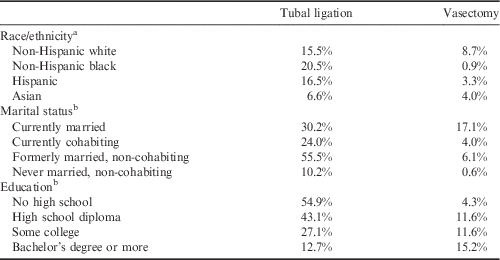
The prevalence of tubal ligation and of vasectomy is known to correlate with a number of variables, although the reasons underlying these patterns are not well understood. Table 1 summarizes women’s reliance on female and male sterilization by race/ethnicity for American women aged 15–44, using data from the 2006–2010 wave of the National Survey of Family Growth (Jones et al., Reference Jones, Mosher and Daniels2012). As the table reveals, the prevalence of tubal ligation is highest among blacks, fairly high among Hispanics and whites and much less common among Asians. Reliance on a male partner’s vasectomy is much less common than tubal ligation for every ethnic group, being highest among whites and lowest among blacks.
Prevalence of reliance on voluntary sterilization among American women aged 15–44, 2006–2010

Data from Jones et al. (Reference Jones, Mosher and Daniels2012).
a All women aged 15–44.
b Women aged 15–44 using contraception.
Table 1 also summarizes reliance on sterilization by marital status and by education for American women aged 15–44 using contraception. For every marital status, tubal ligation is more popular than vasectomy. The discrepancy is narrowest for married women (with nearly twice as many women relying on tubal ligation than vasectomy). Formerly married non-cohabiting women are the most likely to rely on tubal ligation, while never-married non-cohabiting women are the least likely; the latter are also the least likely to rely on vasectomy. Women without a committed male partner cannot rely on vasectomy for family planning, but even cohabiting women are six times as likely to rely on tubal ligation as vasectomy. Sterilization patterns also vary by education level. Reliance on tubal ligation decreases with education, while reliance on a male partner’s vasectomy increases with education. Tubal ligation is far more common than vasectomy as a form of family planning for every level of education below a bachelor’s degree, but women with a bachelor’s degree or higher are more likely to rely on vasectomy than tubal ligation.
In addition to race/ethnicity, marital status and education, several other variables are associated with sterilization prevalence. Among American women aged 15–44 using contraception, voluntary sterilization decreases with income (Jones et al., Reference Jones, Mosher and Daniels2012), while women with private health insurance are only about half as likely to undergo tubal ligation as women on Medicaid (Bass & Warehime, Reference Bass and Warehime2009; Chan & Westhoff, Reference Chan and Westhoff2010; White & Potter, Reference White and Potter2014). Anderson et al. (Reference Anderson, Warner, Jamieson, Kissin, Nangia and Macaluso2010) suggested that the high rate of tubal ligation observed among women with low socioeconomic status may be due to women who use Medicaid during pregnancy being more likely to have a subsequent tubal ligation. Regional location also plays a role; vasectomy is more popular in the western US than the south, while tubal ligation is twice as prevalent in the south than the west (Bumpass et al., Reference Bumpass, Thomson and Godecker2000; Borrero et al., Reference Borrero, Moore, Creinin and Ibrahim2010; Chan & Westhoff, Reference Chan and Westhoff2010).
The decision to undergo sterilization is closely associated with having reached desired completed family size. Among American women aged 15–44 using contraception, 10.7% of those who have one child have undergone tubal ligation, versus 46.6% of those with two or more children (Jones et al., Reference Jones, Mosher and Daniels2012). Having all the children they wanted is the most common reason given by women who have experienced tubal sterilization (Chandra et al., Reference Chandra, Martinez, Mosher, Abma and Jones2005), while experiencing an unintended pregnancy increases the odds of tubal ligation (Forste et al., Reference Forste, Tanfer and Tedrow1995; Borrero et al., Reference Borrero, Moore, Qin, Schwarz, Akers, Creinin and Ibrahim2009a).
Thus, while an existing literature describes the preference for tubal ligation over vasectomy and identifies demographic correlates of these two forms of voluntary sterilization, no existing theory adequately explains why tubal ligation is so strongly preferred over vasectomy. The next section offers an explanation drawn from life history theory for the patterning of sterilization observed among American women.
Life history theory
Life history theory is the study of life history traits – the key maturational and reproductive events and processes that define the life course, such as age at sexual maturity, age at first birth, interbirth interval, age at last birth, age at death and so forth (Roff, Reference Roff1992; Stearns, Reference Stearns1992). Life history theory focuses on the role of trade-offs in reproductive decision-making, particularly trade-offs between current and future reproduction, or between investing in existing children or initiating a relationship with a new partner (i.e. parental effort vs mating effort) (Trivers, Reference Trivers1972; Low, Reference Low1978). This is essentially a trade-off between offspring quantity vs quality. Life history theory has been used to examine numerous reproductive and parenting behaviours in humans (see e.g. Gray & Anderson, Reference Gray and Anderson2010; Kramer, Reference Kramer2010; Sear, Reference Sear2015; Coall et al., Reference Coall, Tickner, McAllister and Sheppard2016, for recent reviews).
A life history perspective calls attention to sex-specific trade-offs associated with life history traits. Women have a fixed reproductive span and a long post-reproductive span, limiting the maximum number of offspring they can produce but allowing a long time-frame for investment in existing offspring. Men, in contrast, have a longer potential reproductive lifespan, especially if they partner (or re-partner) with much younger women (Gray & Anderson, Reference Gray and Anderson2010). Humans are unusual among mammals in that women typically raise several dependent offspring at once, and require assistance from others in providing for their children (Kaplan et al., Reference Kaplan, Hill, Lancaster and Hurtado2000). Women receive help raising children from numerous sources, including extended kin networks (Kramer, Reference Kramer2010; Sear & Coall, Reference Sear and Coall2011). Cross-culturally a woman’s support system often includes the father of her children (Gray & Anderson, Reference Gray and Anderson2010). Women who raise children alone are likely to face greater costs than women with strong support systems, though in modern industrialized economies it is possible to pay non-kin to take care of offspring, and government assistance may take the place of reduced paternal or kin investment (Anderson & Low, Reference Anderson and Low2003; Kramer, Reference Kramer2010).
While men invest in children at extremely high levels by the standards of most mammals, paternal investment typically declines following union dissolution as men reallocate resources to new relationships (Anderson et al., Reference Anderson, Kaplan and Lancaster1999). To a certain extent, men and women face different quantity/quality trade-offs regarding reproduction: women pay higher costs for reproduction, while men have the potential to produce more children (at the expense of less investment per child) than women (Borgerhoff Mulder, Reference Borgerhoff Mulder1992; Penn & Smith, Reference Penn and Smith2007). Cultural and socioeconomic factors can ameliorate these patterns. More educated parents, for example, may receive higher returns per unit investment in terms of child quality, and may thus invest more in offspring (Becker, Reference Becker1991; Kaplan, Reference Kaplan1996), while legally mandated child support obligations can require men to invest in children from previous unions, reducing their ability to produce subsequent offspring (Anderson, Reference Anderson2011).
While fathers are typically involved in raising children in most cultures, there is tremendous variance within populations, with some men highly engaged in paternal care, and others not at all (Gray & Anderson, Reference Gray and Anderson2010; Kramer, Reference Kramer2010). A life history perspective, drawing on game theory, notes that men and women are expected to react and counter-react to the reproductive and investment decisions made by each other (e.g. Chase, Reference Chase1980; Borgerhoff Mulder, Reference Borgerhoff Mulder1992). Children are in effect a collective good: both parents receive fitness benefits from a child who survives to reproduce, but one parent can potentially defect and leave the other parent to pay the cost of raising the child while still receiving fitness benefits if the child survives to reproduce (Anderson et al., Reference Anderson, Kaplan and Lancaster1999; Anderson & Starkweather, Reference Anderson and Starkweather2017). Collective action problems have long puzzled experts studying co-operation, and biparental care is an important example of this. Why should two parents co-operate to raise a child if each can free-ride, letting the other parent do the work and yet still gain the benefits (Maynard Smith, Reference Maynard Smith1977; Weiss & Willis, Reference Weiss and Willis1985; Clutton-Brock, Reference Clutton-Brock1991)? Due to the constraints of internal fertilization, among mammals it is the male who has the earliest opportunity to defect, leaving the female to bear the full costs of reproduction (Alexander, Reference Alexander1974).
A woman who anticipates that her male partner might end their relationship and cease or decrease investment in their children has a greater incentive to prevent future pregnancies with that man than a woman who expects the male to remain with her and continue to invest in their joint offspring (Hill & Low, Reference Hill and Low1992). This theory explains in part the patterning of elective abortions, whose prevalence is highest among unmarried women, when pregnancies are unplanned, or when paternity confidence is low (Anderson et al., Reference Anderson2006; Hill & Low, Reference Hill and Low1992; Lycett & Dunbar, Reference Lycett and Dunbar1999; Tullberg & Lummaa, Reference Tullberg and Lummaa2001). There is also evidence that when males do not acknowledge paternity – i.e. are not listed on a child’s birth certificate – women invest less in the pregnancy, producing babies that are more likely to be low birth weight or premature (Anderson, Reference Anderson2017).
Life history theory, with its emphasis on trade-offs as an explanatory force shaping reproductive decisions, offers a powerful theoretical model for examining voluntary sterilization patterns. Sterilization is most likely to be chosen by individuals who do not desire any future offspring. From a life history perspective, fertility-stopping behaviour will be favoured when it increases the quality of existing offspring, for example by safeguarding resources for existing children, which may explain the evolution of menopause in humans (e.g. Hawkes et al., Reference Hawkes, O’Connell and Blurton Jones1997; Peccei, Reference Peccei2001). In other words, reproductive cessation is favoured when the costs of an additional child (in terms of reduced investment for existing children) are greater than the benefits from reproduction. This perspective proposes that the observed sex-specific patterns of sterilization can be understood in the framework of life history trade-offs: the costs and benefits of sterilization vary for men and women because the sex-specific costs of having a baby vary with parental age, with the number of existing offspring, with parental ability to produce embodied capital in offspring and with the likelihood of subsequent union formation or dissolution. Using this theoretical perspective, the following four new predictions are proposed regarding voluntary sterilization patterns among American women.
Predictions
While nearly all reproduction in the United States once occurred within the context of married heterosexual couples, that is no longer the case. Data from 2006 to 2010 suggest that 45.5% of first births to women aged 15–44, and 41.4% of first births to men aged 15–44, are to unmarried individuals (Martinez et al., Reference Martinez, Kimberly and Anjani2012). Among first births in the US, 21.9% of women and 25.4% of men cohabit with their unmarried partner, while 23.6% of women and 16.0% of men do not live with their child’s other parent. Among women and men aged 15–44 who have ever had a biological child, 42.2% of women and 39.6% of men report ever having a non-marital birth, which includes 30.3% of women and 33.0% of men who had a cohabiting non-marital birth (Martinez et al., Reference Martinez, Kimberly and Anjani2012).
A woman’s marital status at the time of her first birth impacts her subsequent marital and fertility history. Anderson and Low (Reference Anderson and Low2003) found that American women who were unmarried at the time of their first birth married later, spent fewer years married and were less likely to be married at age 45, compared with women who were married before the birth of their first child. Unmarried first births were associated with 0.27 fewer lifetime births once age at first birth was controlled for (Anderson & Low, Reference Anderson and Low2003). Unmarried women are also more likely to have subsequent unplanned and non-marital pregnancies (Guzzo & Hayford, Reference Guzzo and Hayford2010, Reference Guzzo and Hayford2011), and are also more likely to delay subsequent fertility or not to have a second child following their first birth (Martinez et al., Reference Martinez, Kimberly and Anjani2012). Manlove et al. (Reference Manlove, Logan, Ikramullah and Holcombe2008) found that non-marital first births tripled the odds of subsequent births being non-marital. Men are more likely to have low paternity confidence in a pregnancy and are less likely to invest in the child when a pregnancy was unexpected or if the couple was not married, suggesting that unplanned or non-marital pregnancies can result in greatly reduced male investment in children (Anderson et al., Reference Anderson2006, Reference Anderson, Kaplan and Lancaster2007). Thus, a non-marital birth may be associated with reduced male commitment to invest in the child.
Parity and marital status interact with demand for sterilization in sex-specific ways. The costs of reproduction increase for women who already have children, and are highest if a woman does not have firm male commitment to invest in her children (Hill & Low, Reference Hill and Low1992). Women who live with a male partner have more secure male commitment to invest in offspring than women who do not live with their partner, but cohabitational relationships are less stable than marriages: half of cohabitating unions end in less than 2 years, and 90% within 5 years (Lichter et al., Reference Lichter, Qian and Mellott2006), while the likelihood of cohabitation transitioning to marriage has decreased in recent years (Guzzo, Reference Guzzo2014b). Women who already have children and who are not in a relationship may face the highest costs from a pregnancy, as it would both decrease their ability to invest in existing offspring, and impose additional costs if they have to raise the child alone. Married women, in contrast, have the most secure male investment, and are less likely to pay high costs from additional fertility. This leads to Prediction 1: Tubal ligation will be most common in unpartnered women with children, and least common in married women with no children.
All else being equal, women who begin childbearing at younger ages will achieve their desired completed family size earlier than women who begin having children at later ages, and age at first birth is inversely correlated with completed fertility (Low et al., Reference Low, Simon and Anderson2002; Anderson & Low, Reference Anderson and Low2003). Women may postpone having children for many reasons, such as completing higher education, pursuing a career or delays in finding a suitable partner (Huber et al., Reference Huber, Bookstein and Fieder2010; Amin & Behrman, Reference Amin and Behrman2014). Women who delay the initiation of childbearing sufficiently are less likely to attain desired completed family size by the time fecundity begins to decline and menopause approaches. Since tubal ligation is used only by women who firmly desire no more children, this leads to Prediction 2: The prevalence of tubal ligation decreases with age at first birth.
While it is well established that tubal ligation decreases with education and female reliance on a partner’s vasectomy increases with education (see Table 1), no study has directly examined whether the effects of education interact with other variables, such as union status or parity. Education is associated with increased returns to parental investment in children, but will influence the costs of reproduction differently for men and women (Kaplan et al., Reference Kaplan, Lancaster, Tucker and Anderson2002). Education delays fertility for women, leading to a later age at first birth, so that more educated women have fewer children and are more likely to remain childless (Low et al., Reference Low, Simon and Anderson2002; Amin & Behrman, Reference Amin and Behrman2014). Thus, more educated women will have fewer or no children at later ages, increasing the opportunity costs of sterilization. Highly educated women have lower divorce rates (Martin & Parashar, Reference Martin and Parashar2006), suggesting that they are more likely to obtain long-term male investment in their offspring should they have a child. Less educated women have earlier age at first birth, achieve desired family size at younger ages and may have less secure male investment in offspring. This leads to Prediction 3: Tubal ligation will be least common among highly educated women without children, and most common among less educated women with children.
Multi-partnered fertility – having children with more than one partner across the life course – is increasingly common in the United States. Guzzo (Reference Guzzo2014a) reported that 13% of men aged 40–44, and 19% of women aged 41–49, have experienced multi-partnered fertility. More recent estimates suggest that 20.6% of American parents with two or more children have multi-partnered fertility (Monte, Reference Monte2017). Among people who already have children, multi-partnered fertility will alter the costs and benefits of sterilization differently for men and women, compared with those who have had children through only one partner, and will interact with union status. Women who are married can expect more long-term commitment from the latest father of their children than women who are cohabiting or not living with the father of their most recent child. Women who have had children through multiple partners have probably received reduced cumulative investment in their existing offspring due to male departure and gaps between partners, and may expect to shoulder more of the costs of additional reproduction with a man who may not remain with her. Male investment in offspring typically declines following divorce or union dissolution (Weiss & Willis, Reference Weiss and Willis1993; Anderson et al., Reference Anderson, Kaplan and Lancaster1999), and child support paid by men declines following a woman’s subsequent fertility with a new partner (Meyer & Cancian, Reference Meyer and Cancian2012), suggesting that a woman who has a child with a new partner has to balance not only the risk that the new partner might not be an involved father, but also that her previous partners might decrease their investments in her existing offspring. One reason men give for decreasing child support payments is a perceived concern that women might be spending it on themselves or their new partners rather than on their children (Weiss & Willis, Reference Weiss and Willis1993; Arendell, Reference Arendell1995). Overall, women’s multi-partnered fertility has been shown to be associated with reduced social and financial support (Harknett & Knab, Reference Harknett and Knab2007). Even in recent American cohorts, non-marital births are still likely to be followed by multi-partnered fertility (Cancian et al., Reference Cancian, Meyer and Cook2011; Gibson-Davis, Reference Gibson-Davis2014), implying reduced or intermittent investment by men in children. Having more numerous long-term relationships, and having children through multiple men, will increase the costs of reproduction for women, as they are more likely to face raising children without male support, or with reduced male support, as men adjust their investment in response to the presence of the woman’s new partner (Weiss & Willis, Reference Weiss and Willis1993; Anderson et al., Reference Anderson, Kaplan and Lancaster1999). This leads to Prediction 4: Among women with two or more children, the prevalence of tubal ligation will increase with the lifetime number of significant partners a woman has had.
While some of the demographic patterns of tubal ligation are well established (reviewed above), none of these four predictions derived from life history theory has been formally stated in the published literature, or tested using existing data. The current paper does this, using data on voluntary sterilization from a national sample of American women.
Methods
Data
These four predictions concerning tubal ligation were tested using data from the National Survey of Fertility Barriers (NSFB). The NSFB is a nationally representative telephone survey of 4712 women aged 25–45, collected between 2004 and 2007 by the Survey Research Center at the Pennsylvania State University and the Bureau of Sociological Research at the University of Nebraska-Lincoln (Johnson et al., Reference Johnson, McQuillan, Jacob, Greil, Lacy and Scheuble2009). The sample was selected to be representative of all female adults living in households with a land-line telephone in the contiguous United States, and the study design oversampled African-American and Latina women. Woman who had one child, no plans for additional children and no history of fertility problems were under-sampled. The overall response rate for the telephone interview was 37.2%, typical for telephone surveys, and the demographic distributions of the NSFB are consistent with those obtained from the NSFG and the Current Population Survey (Johnson et al., Reference Johnson, McQuillan, Jacob, Greil, Lacy and Scheuble2009).
With its focus on the biomedical barriers to fertility, the NSFB provides detailed reproductive histories, including data on contraception and sterilization, for a nationally representative sample of women. The NSFB is less desirable for studying contraception and sterilization patterns among men, because men were included in the study only if they are partnered to a sampled woman. Thus the current study focused on patterning of tubal ligation among American women.
Of the 4712 female respondents to the NSFB, 69 were dropped due to missing data on variables used in the analysis. A further 40 women who self-identified as lesbians were also dropped, as they were unlikely to be at risk of tubal ligation for contraceptive purposes. Lastly, 451 women who were surgically sterile for reasons excluding tubal ligation were also dropped, as is typical of most studies of sterilization (see Shreffler et al., Reference Shreffler, McQuillan, Greil and Johnson2015, for an exception). This includes hysterectomy, ovariectomy and unspecified surgical sterilization. These types of sterilization are typically non-elective and may be medically necessitated. Women with tubal ligation are less likely to undergo hysterectomy (Leidy, Reference Leidy1999), and hysterectomy probably represents a different decision pathway than voluntary sterilization. The final analytical sample contained 4152 women, and included 750 (18.1%) who had undergone tubal ligation.
Variables
The independent variable, tubal ligation, was a constructed dichotomous measure denoting that the woman indicated she had had surgery (specifically tubal ligation) to prevent pregnancy. Control variables included race/ethnicity, coded as a set of dummy variables (white non-Hispanic, black non-Hispanic, Hispanic and other race/ethnicity), age at the time of interview and parity (number of children born) at the time of interview. Education was coded as five dummy variables (from less than high school to postgraduate degree). Current marital status was either currently married, currently cohabiting or non-cohabiting, and was coded as a set of dummy variables. Age at first birth, lifetime number of cohabiting partners and lifetime number of marriages were all measured retrospectively. It is possible that lifetime number of cohabiting partners and lifetime number of marriages might over-count individuals, if the respondent lived with a man before marrying him. However, lifetime number of cohabitations and number of marriages were relatively weakly correlated (Spearman’s rho=−0.1859, n=4159, p<0.0001), and of the 2764 respondents in the analytical sample who indicated zero cohabitations, 2425 (87.7%) had been married at least once, suggesting that these measures did not double-count partners. These two variables were thus treated as separate measures in the analysis.
Analysis
Descriptive statistics (means or percentages) for the variables used in the analysis were weighted to make them nationally representative. The outcome of interest – whether a woman had undergone tubal ligation – was modelled using logistic regression, with results presented as odds ratios (ORs). Multivariate models controlled for race/ethnicity, age and education, with other variables added depending on the prediction being tested. All analyses used Stata/SE 14.2 (StataCorp, 2015).
Results
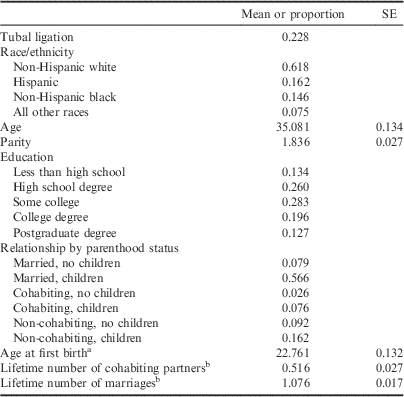
Descriptive statistics for the analytical sample are presented in Table 2. Means and percentages are weighted; sample sizes are unweighted. Overall, 22.8% of women in the sample had undergone tubal ligation. The majority (62%) of the sample were white, and the mean age was 35. Women in the sample had an average of 1.8 children. The modal educational level was ‘some college’ (28% of the sample), with one-third having a college degree or beyond. The majority (57%) were married with children. The average age at first birth was almost 23, and women in the sample averaged 0.5 lifetime cohabiting partners and 1.1 lifetime spouses.
Summary statistics for the analytical sample of American women aged 25–45, National Survey of Fertility Barriers, 2004–2007
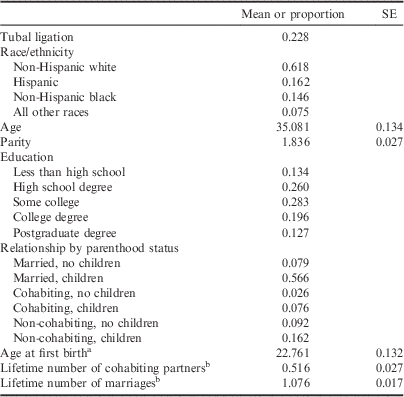
N=4152.
a N=3035.
b N=2190 (restricted to women with two or more children).
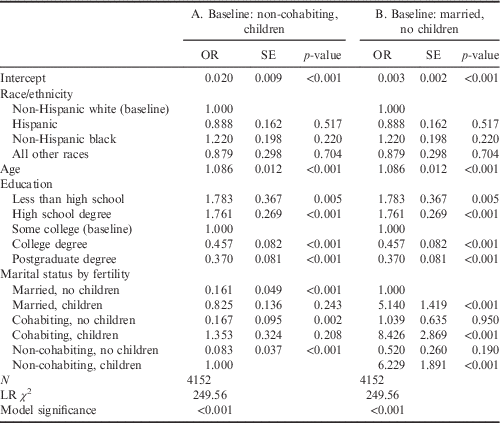
Prediction 1, that tubal ligation will be most common in unpartnered women with children and least common in married women with no children, is tested in Table 3. In model A, non-cohabiting women with children were the omitted baseline. Compared with them, women without children, regardless of marital status, were less likely to have experienced tubal ligation, while married and cohabiting women with children did not differ from non-cohabiting women with children. In Model B, married women without children were the baseline. Compared with them, all mothers, regardless of marital status, were more likely to be sterilized, while cohabiting and non-cohabiting women without children did not differ from married women without children.
Logistic regression of tubal ligation by relationship and parenthood status

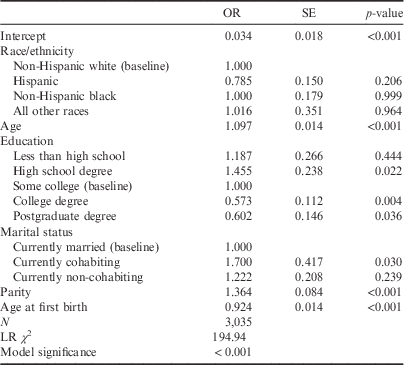
Table 4 presents a multivariate logistic regression model testing Prediction 2 – that the odds of tubal ligation decrease with age at first birth. After controlling for background factors, the odds of sterilization decreased with age at first birth (annual OR=0.92). A 5-year delay in first birth thus reduced the odds of tubal ligation by 67.4%; a 10-year delay reduced the odds of tubal ligation by 45.4%.
Logistic regression of tubal ligation by age at first birth (women with children only)

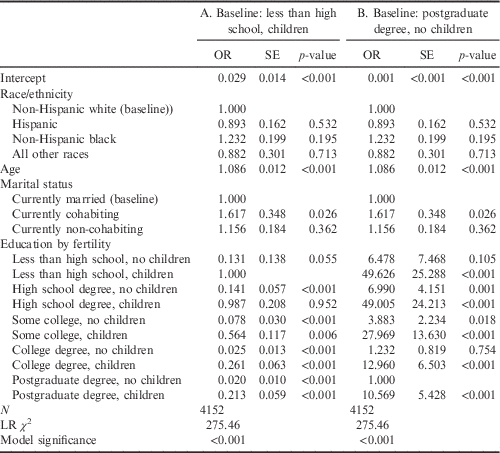
Table 5 presents a multivariate logistic regression model which tests Prediction 3 – that tubal ligation will be least common among highly educated women without children and most common among less-educated women with children. In model A, in which women with less than high school who had children were the baseline, all other groups of women with higher education, both mothers and non-mothers, were less likely to have undergone tubal ligation, with the exception of mothers with high school degrees, who were not significantly different from the baseline. In model B, women with postgraduate degrees and no children were the omitted baseline. Compared with them, all other women, regardless of fertility, were significantly more likely to have experienced tubal ligation, with two exceptions: women without children who had either less than high school or a terminal college degree did not differ from women with postgraduate degrees and no children.
Logistic regression of tubal ligation, by education and parenthood

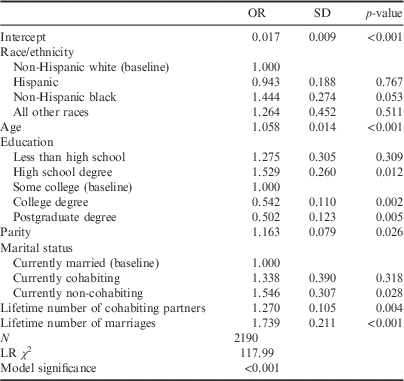
Lastly, Table 6 presents a multivariate regression model that tests Prediction 4 – that the prevalence of tubal ligation will increase with the lifetime number of significant partners a woman has had (a proxy for multi-partnered fertility), for women with two or more children. All else being equal, each additional cohabiting partner significantly increased the odds of tubal ligation (OR=1.23), as did each additional marriage (OR=1.70).
Logistic regression of tubal ligation, by lifetime number of cohabiting partners and marriages, women with two or more children only

Discussion
This paper used data from the National Survey of Fertility Barriers (NSFB) to examine voluntary sterilization among a nationally representative sample of American women, testing four predictions derived from life history theory. Some demographic patterns of tubal ligation are well established, such as that it increases with age and parity, decreases with education and varies by race/ethnicity and marital status (Borrero et al., Reference Borrero, Schwarz, Reeves, Bost, Creinin and Ibrahim2009b; Jones et al., Reference Jones, Mosher and Daniels2012; Shreffler et al., Reference Shreffler, McQuillan, Greil and Johnson2015). However, a life history perspective, focusing on sex-specific reproductive trade-offs, calls attention to the greater economic costs associated with fertility among women who do not have reliable male commitment to investment. None of the four predictions developed in this paper has been presented or tested in the existing literature.
The predictions were generally supported by the data, with one notable exception. Prediction 1 was not supported. The model had predicted an interaction between marital status and fertility, with unmarried mothers the most likely to have undergone tubal ligation, and married women without children the least. Marital status appeared to have little relationship with sterilization in this model; rather, the distinction was between women with children (all of whom had increased odds of tubal ligation) and women without children (whose odds of tubal ligation were all significantly decreased). While marital status has been found to be associated with tubal ligation in other studies (e.g. Godecker et al., Reference Godecker, Thomson and Bumpass2001; Bass & Warehime, Reference Bass and Warehime2009; Borrero et al., Reference Borrero, Moore, Qin, Schwarz, Akers, Creinin and Ibrahim2009a, Reference Borrero, Schwarz, Reeves, Bost, Creinin and Ibrahimb; Eeckhaut, Reference Eeckhaut2015; see Shreffler et al. (Reference Shreffler, McQuillan, Greil and Johnson2015) for an example in which marital status is non-significant), in the present study it was having had children, not current marital status, that is associated with tubal ligation. The NSFB does not record marital status at the time of sterilization, however, and it is possible that it had changed over time for the women in the sample (unlike fertility status, which cannot change following tubal ligation). Additionally the meaning of marriage may be changing over time. Marriage is increasingly viewed as a capstone rather than a cornerstone accomplishment – something one aspires to after one has achieved success, rather than something one does at the beginning of one’s adult life (Cherlin, Reference Cherlin2004). Marriage rates vary by education level, with higher prevalence being observed among highly educated Americans (Cherlin, Reference Cherlin2010). These factors may suggest that marriage is not as a strong a predictor of male parental investment as it once was, at least for some groups.
The other predictions were supported by the data. The odds of tubal ligation decreased with age at first birth, suggesting that women who delay fertility are less likely to have achieved desired family size before menopause (Prediction 2). Tubal ligation was least common among highly educated women without children (who are both most likely to have procured stable male commitment, as well as to possess the resources to raise children without additional support, if necessary), and most common among less-educated women with children (who are less likely to have secure male commitment should they have another child, and to have fewer resources of their own to invest in additional children) (Prediction 3). Lastly, a woman with a history of multi-partnered fertility and/or more numerous significant relationships may face greater likelihood of reduced male investment (in both existing and subsequent offspring) should she have another child. The data, while unable to test for effects of multi-partnered fertility directly, show that the odds of tubal ligation increase with both the number of cohabiting partners and the number of spouses a woman has had (Prediction 4).
These results suggest that a life history perspective can offer important insights into the patterning of voluntary sterilization, and help answer the question of why tubal ligation, despite its greater costs and risks, remains a much more popular form of contraception than vasectomy. Because women face greater costs from reproduction than men, women who are less likely to have male commitment to childraising face greater incentive to prevent further reproduction than women who have secure male investment. Because tubal ligation is a reliable form of permanent contraception, it remains the method of choice for a substantial number of American women, particularly those who have already reached their desired family size and who either do not have a reliable long-term male partner or who do not have the resources to be able to raise another child without compromising their investment in existing children.
The results of this paper may have some bearing on evolutionary models of the demographic transition. Despite access to high levels of wealth and other resources, fertility in industrialized populations is far lower than fertility observed in non-industrialized populations (Lam, Reference Lam2011). Since fertility is predicted to increase with resource acquisition, models of reproductive fitness suggest that the low fertility observed in modern societies is not adaptive (Vining Reference Vining1986; Kaplan et al., Reference Kaplan, Lancaster, Johnson and Bock1995; Kaplan et al., Reference Kaplan, Lancaster, Tucker and Anderson2002; Low et al., Reference Low, Simon and Anderson2002; Lawson & Mace, Reference Lawson and Mace2011). Contraception is not required for a demographic transition to occur (the earliest demographic transitions occurred before the advent of modern birth control), but the demand for contraception is clearly related to demand for fertility reduction, and levels of unwanted pregnancy and of abortion would be much higher if contraceptive sterilization were less common (Bumpass et al., Reference Bumpass, Thomson and Godecker2000; Lam, Reference Lam2011). One of the leading evolutionary paradigms for explaining the demographic transition is Kaplan’s (Reference Kaplan1996) theory of embodied capital, in which fertility reduction occurs because the pay-offs to investment in children are so much higher in modern wage economies than in traditional subsistence economies. The results of this paper are consistent with Kaplan’s suggestion that fertility reduction occurs to increase investment in existing offspring. As noted above, the women most likely to pursue voluntary sterilization are women with children who lack reliable male support in the event of another birth. For these women, further children would necessitate a reduction in their ability to invest in the children they already have. Sterilization is an effective means of achieving this goal.
The life history perspective presented in this paper is consistent with explanations offered elsewhere in the literature for the patterning of tubal ligation, though these typically do not stress the role of trade-offs in the decision-making process. Dudgeon and Inhorn (Reference Dudgeon and Inhorn2004, p. 1383) noted that ‘the absence of a stable male partner may be one of the most important determinants of women’s desire to avoid a pregnancy, especially for young women and women with few resources.’ Forste et al. (Reference Forste, Tanfer and Tedrow1995) noted that lower socioeconomic couples face higher opportunity costs for unintended pregnancies (though the issue in the present model is whether the man in the couple is committed to investment in the child and not the overall opportunity costs). Godecker et al. (Reference Godecker, Thomson and Bumpass2001) noted that blacks have lower rates of marriage and higher rates of cohabitation than whites, as well as higher rates of tubal ligation. They argued that black women may favour tubal ligation because they are aware of the lower likelihood of marriage and are thus less concerned about maintaining their ability to conceive with a future husband. The life history perspective would argue, in contrast, that it is not the lack of opportunity to conceive with a future husband that drives the decision to undergo tubal ligation, but the reduced likelihood of male parental investment in the event of conception. Godecker et al. (Reference Godecker, Thomson and Bumpass2001, p. 41) found that divorced women had higher rates of tubal ligation than currently married women (contrary to their prediction), and suggested that ‘they may be less willing to take a chance of ending up with more children as a single parent’. Godecker et al. (Reference Godecker, Thomson and Bumpass2001) also suggested that demand for tubal ligation is higher among black women than white women because black women complete their desired family size earlier and thus have more years at risk of contraceptive failure if they use other methods, while Shapiro et al. (Reference Shapiro, Fisher and Diana1983) argued that because minority women have more children at younger ages, they are less likely than white women to desire children at older ages. While these explanations for race/ethnic disparity in demand for sterilization imply that age at first birth is related to tubal ligation, Prediction 2 makes this connection more directly (and the predicted relationship applies to all women, not just minorities). Lastly, Westhoff and Davis (Reference Westhoff and Davis2000) discussed the trade-offs involved in sterilization, but not in the context of current vs future reproduction, or of offspring quantity vs quality. Rather, they noted that the complications of pregnancy for women with medical problems may mean that the small risk associated with tubal ligation is outweighed by the large risk associated with another pregnancy. Thus, they argued that tubal ligation is a means of reducing the risk of future medical problems for these women. This is consistent with Geronimus’ weathering hypothesis, which predicts that early childbearing is advantageous for some groups due to deteriorating health and increased mortality risks as women age (Geronimus, Reference Geronimus1996; Cohen, Reference Cohen2016). Further work should focus on the influence of future health perceptions on voluntary sterilization.
It is worth nothing that the patterning of tubal ligation for age and education presented in Tables 3–6 is consistent with the findings from other literature: tubal ligation increases with maternal age, and decreases with maternal education (Anderson et al., Reference Anderson, Jamieson, Warner, Kissin, Nangia and Macaluso2012; Jones et al., Reference Jones, Mosher and Daniels2012; Shreffler et al., Reference Shreffler, McQuillan, Greil and Johnson2015). Race/ethnicity, however – and in contrast to most other studies – was not found to be significantly associated with tubal ligation in the present study. Only among women with two or more children was there a marginally significant effect of race/ethnicity (Table 6): specifically, African-American women were marginally more likely to have undergone tubal ligation than white women (OR=1.44, p=0.053). While many studies performing multivariate regression have found that race/ethnicity remains a statistically significant predictor of tubal ligation (Bass & Warehime, Reference Bass and Warehime2009; Borrero et al., Reference Borrero, Schwarz, Reeves, Bost, Creinin and Ibrahim2009b; Bumpass et al., Reference Bumpass, Thomson and Godecker2000; Godecker et al., Reference Godecker, Thomson and Bumpass2001; Shreffler et al., Reference Shreffler, McQuillan, Greil and Johnson2015), others have found that the effects of race/ethnicity disappear once other background variables are controlled for (Borrero et al., Reference Borrero, Moore, Qin, Schwarz, Akers, Creinin and Ibrahim2009a; Anderson et al., Reference Anderson, Warner, Jamieson, Kissin, Nangia and Macaluso2010, Reference Anderson, Jamieson, Warner, Kissin, Nangia and Macaluso2012). White and Potter (Reference White and Potter2014) found that Latina women were more likely than whites to undergo postpartum sterilization (i.e. tubal ligation following birth while still in the hospital), but that race/ethnicity was not a significant predictor of interval tubal ligation (i.e. sterilization occurring one month or more postpartum).
Additional alternative hypotheses may help explain the patterns observed for tubal ligation. While the inverse relationship between tubal ligation and education is consistent with the trade-offs model outlined in this paper, it is possible that more educated women have greater contraceptive efficacy and are more adept at using other methods of family planning. For example, women with higher education are much more likely to use the contraceptive pill than women with less education (Mosher et al., Reference Mosher, Martinez, Chandra, Abma and Willson2004). They may also have access to forms of insurance that pay for reversible contraception. System-level factors may also play a role in influencing the choice of tubal ligation versus other, reversible forms of contraception. For example, minority women may be preferentially counselled to undergo tubal ligation, and are more likely to attend public clinics that offer tubal ligation as a predominant form of contraception (Borrero et al., Reference Borrero, Schwarz, Reeves, Bost, Creinin and Ibrahim2009b; Chan & Westoff, Reference Chan and Westhoff2010; Dehlendorf et al., Reference Dehlendorf, Rodriguez, Levy, Borrero and Steinauer2010). Although a history of coerced sterilization may make women from ethnic minorities distrust surgical sterilization (Dehlendorf et al., Reference Dehlendorf, Rodriguez, Levy, Borrero and Steinauer2010; Shih et al., Reference Shih, Turok and Parker2011; Shreffler et al., Reference Shreffler, McQuillan, Greil and Johnson2015), there is some evidence that minorities have higher concerns about the safety of reversible birth control (Dehlendorf et al., Reference Dehlendorf, Rodriguez, Levy, Borrero and Steinauer2010). Access to reliable information about contraceptive options may vary by race/ethnicity as well. Minority women have been found to be more likely to harbour misconceptions about sterilization, such as that tubal ligation reverses naturally after several years, or that vasectomy impairs male sexual function (Borrero et al., Reference Borrero, Abebe, Dehlendorf, Schwarz, Creinin, Nikolajski and Ibrahim2011). Because most tubal ligations are performed by gynaecologists and most vasectomies by urologists, women seeking reproductive counselling from their obstetrition/gynaecologist are more likely to receive information only about tubal ligation (Shih et al., Reference Shih, Turok and Parker2011, Reference Shih, Dubé and Dehlendorf2013). Lastly, gendered concepts of contraceptive responsibility among some ethnic groups may place the burden of family planning on women rather than men, effectively ruling out vasectomy as an option (Shih et al., Reference Shih, Turok and Parker2011; Sharma et al., Reference Sharma, Le, Sheth, Zargaroff, Dupree, Cashy and Brannigan2013), especially if masculinity is strongly associated with the ability to procreate (Eisenberg et al., Reference Eisenberg, Henderson, Amory, Smith and Walsh2009; Shih et al., Reference Shih, Turok and Parker2011). While the life history model developed in the present paper emphasizes individual-level factors in reproductive decision-making, it does not deny the importance of structural factors such as socioeconomic and racial/ethnic variation in access to contraception, insurance status or cultural beliefs. Note that the success of life history theory does not mean that other theories do not have explanatory value. They may merely explain the same phenomenon at different levels, with ultimate explanations (such as life history theory) explaining why a trait or pattern occurs, while proximate explanations explain how a trait or pattern occurs (Scott-Phillips et al., Reference Scott-Phillips, Dickins and West2011).
There are important public health benefits to understanding why tubal ligation is the most common form of family planning choice by American women over 30. Although it is a fairly safe procedure, complications (including uterine tears, ectopic pregnancies and mortality) are approximately 20 times more common with tubal ligation than vasectomy (Hendrix et al., Reference Hendrix, Chauhan and Morrison1999). An increase in vasectomy and a corresponding decrease in tubal ligation could save millions of dollars (Hendrix et al., Reference Hendrix, Chauhan and Morrison1999) – an important point to consider given that a large fraction of tubal ligations are funded by Medicaid (Bass & Warehime, Reference Bass and Warehime2009). Although vasectomy is covered by Medicaid in most states, fewer than 1% of vasectomies in the US were paid for by Medicaid, versus 40% of tubal ligations (Anderson et al., Reference Anderson, Jamieson, Warner, Kissin, Nangia and Macaluso2012). However, as the current study demonstrates, the women most likely to seek out tubal ligation are those who do not have a long-term male partner, and thus are unlikely to be able to rely on vasectomy for family planning. It might be more realistic to offer these women access to long-acting reversible contraception (LARC) instead of vasectomy as an alternative to tubal ligation, although there is debate as to whether the reintroduction of the intrauterine device (IUD) to the American market, following its withdrawal in the 1980s, has resulted in a decline in tubal ligation (Chan & Westhoff, Reference Chan and Westhoff2010; Finer et al., Reference Finer, Jerman and Kavanaugh2012). Even among married couples, tubal ligation far exceeds vasectomy in popularity, suggesting that biases in reproductive counselling directing women towards tubal ligation may be at play (Shih et al., Reference Shih, Turok and Parker2011).
A few limitations of the study should be mentioned. The NSFB data were self-reported, and thus subject to recall bias. The cross-sectional nature of the data means that the respondent’s age and marital status at the time the decision for tubal ligation was made were unknown (Eeckhaut, Reference Eeckhaut2015). Also unknown were her insurance coverage, income or geographic location at the time of the surgery, all of which may influence sterilization patterns (Bass & Warehime, Reference Bass and Warehime2009; Borrero et al., Reference Borrero, Moore, Creinin and Ibrahim2010; Chan & Westhoff, Reference Chan and Westhoff2010; White & Potter, Reference White and Potter2014). These variables were not included in the current analyses as they can change greatly over time, and thus current values may not be reliable proxies for past values. Additionally, there was no information on multi-partnered fertility for this sample; the number of marriages and cohabiting partners was only a proxy for this variable. The NSFB sampled women, and their male partners; it was not possible to examine sterilization choices by unpartnered men, and analysis of vasectomy patterns from a life history theory perspective are postponed to a subsequent paper using a different dataset.
In conclusion, using a nationally representative sample of American women, four predictions drawn from life history theory about the patterning of tubal ligation were tested. The results are consistent with the hypothesis that women seek voluntary sterilization when the costs of future reproduction are likely to be high due to decreased likelihood of committed male investment. This theoretical perspective may help explain why, despite the higher costs and complications associated with tubal ligation, it remains a much more popular form of family planning than vasectomy in the US.
Acknowledgments
The author thanks Alexandra Alvergne, Loretta Bass, Julia McQuillan and an anonymous reviewer for helpful comments on this paper. The National Survey of Fertility Barriers public use dataset is available from http://sodapop.pop.psu.edu/.