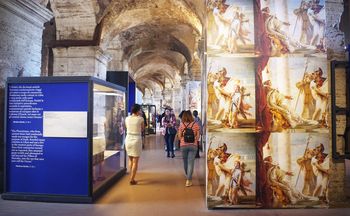
As part of a series of events on ancient Mediterranean cultures, the Archaeological Park of the Colosseum hosted an exhibition on Carthage in the very heart of Rome (27 September 2019–29 March 2020). The intention of the organizers was to bring to the public an image of Carthage and of Carthaginian culture that goes beyond their connotation as ‘exotic’, speaking of interrelationships and exchanges across the Mediterranean. The concept of understanding what is other from our culture is of particular current relevance, given the political agendas of various western countries and the growing impact of demagogic movements, which are trying to deny – rather anachronistically – the vitality of such contacts in a world that is becoming more and more interconnected. The exhibition took place in the gallery on the first level of the Colosseum, and in the Temple of Romulus and Domitian's Ramp in the Roman Forum. The selected time frame was a broad one, spanning from the Phoenician to the Christian period, and engaging with the reception of Carthage in the post-antique age (Fig. 1).
Carthago, the Immortal Myth: exhibition gallery in the Colosseum (photo N. Mugnai, su concessione del Ministero per i beni e le attività culturali e per il turismo–Parco Archeologico del Colosseo).

Two publications were released to accompany the exhibition: a collection of essays, available in Italian and English, and a catalogue of the objects on display (‘cat.’ from this point on). The two books complement each other, so readers are encouraged to look at both – perhaps not the most affordable solution, but all in all it is worth the expense, as the retail price of these volumes is reasonable enough. The intended readership is mainly a general public, although students and researchers will also find material to put to use. The essays are grouped into seven thematic sections. Most of the texts tend to be short (c. 1–2 pages), but each is provided with a useful list of references to further reading; the general bibliography is reunited at the end of the volume. These texts are written by a range of international scholars, who offer authoritative accounts based on their research.
Section 1 looks at the question of the Eastern origins of Carthage (19–73). When dealing with the Phoenicians, it would be impossible not to mention the debate on whether the people who lived on the Levantine shore ever called themselves ‘Phoenician’. This term was first used in Homer's Iliad in the eighth century BC, and is then employed in later Greek and Roman sources. Scholars such as Sader and Quinn present arguments against the existence of a conscious Phoenician identity, or of a unified Phoenician state (19–24, 54–55); in contrast, Bondì argues that there was a substantial collective unity in the Levant, which was the basis for the Phoenician expansion in the Mediterranean (50–54). Whatever our view on this matter, it is salutary that diverging academic opinions are expressed here. This fits well with the renewed interest towards Phoenician and Punic studies in the Anglophone world, as demonstrated by the recent appearance of English-language publications (López-Ruiz and Doak Reference López-Ruiz and Doak2019; Quinn Reference Quinn2018; Quinn and Vella Reference Quinn and Vella2014). The Levantine material culture was illustrated in the exhibition by bronze figurines dating back to the second millennium BC (cat., 30–31), and by objects such as domestic amphorae, small glass vessels and gold jewellery, which found their way across the Mediterranean from the ninth century BC onwards (cat., 40–44). The presence of the Phoenicians in North Africa is a mix of legend and history, with Carthage having been traditionally founded by colonists from Tyre in 814–13 BC. The relationship between Carthage and other North African early foundations is explored by Amadasi Guzzo and Xella (62–63). In addition to the assessment of external colonizing influences on the urbanism of North Africa, one should not forget about the role of local elements too, as shown by tenth- and ninth-century BC urban evidence that is now being more thoroughly investigated (see the observations in Mattingly Reference Mattingly, Mugnai, Nikolaus and Ray2016).
Section 2 examines the urban features of Punic Carthage (75–93). It opens with an essay by Fantar on the mythical foundation of the city and the story of Elissa-Dido (75–78). A miniature from the Vergilius Vaticanus codex, depicting Dido's suicide on a pyre, effectively illustrates a tragic myth that was adopted and reinterpreted by Classical authors (cat., 25). Our knowledge of the urbanism of Carthage is much indebted to the UNESCO international missions that have worked at this site since 1974. As discussed by Docter and Fumadó Ortega (86–90), some of the most significant results concern our understanding of Punic domestic architecture. The residential quarters at Carthage were divided in regular allotments, following an urban grid organized per strigas and datable to as early as the eighth century BC – thus well predating the diffusion of the conventional Hippodamian layout. Houses had multiple storeys, and their flat roofs were designed to provide an extra space for domestic activities.
The broader Mediterranean dimension of Punic culture is analysed in section 3 (95–117). Bondì outlines the different trajectories of the Carthaginian expansion over Sicily, Sardinia, Spain and the Balearic Islands, looking at both textual and archaeological evidence (95–98). The necessity of negotiating with other cultures is well exemplified by the case of Sicily, which came to be divided into two cultural spheres, respectively of Punic and Greek influence, from the sixth century BC. Spatafora discusses the extent of the Punic presence in Sicily (100–102), not only by looking at the well-known settlement of Mozia, but also at Palermo, where current archaeological research is providing a wealth of new data on local urbanism and material culture. On balance, it must be observed that Sicilian architectural and urban evidence that was once described as typically Phoenician or Punic, in particular from sites such as Solunto and Monte Adranone, has been recently called into question (De Vincenzo Reference De Vincenzo2013).
Section 4 is the most extensive of the volume (119–93), covering many aspects of daily life in the Punic world. By assessing historical sources and epigraphic materials, Manfredi and Secci describe the main features of political and administrative life at Carthage (119–24). Much emphasis in this section is placed on artistic productions, which include some of the most visually attractive objects on display. As explained by Le-Meaux (125–29), the production of glass-paste pendants reproducing bearded male heads should probably be recognized as a factory mark of Carthage's ateliers (cat., 76–77). Other artefacts that have become an icon in our popular perception of Punic culture are the renowned terracotta ‘grinning masks’ (cat., 80). Fariselli elucidates on how these models were produced and distributed across the Mediterranean, not only by Carthage, but also from a range of sites including Tharros, Cadiz and the island of Ibiza (130–31). Trade was obviously a major component of the Phoenician and Punic world, and Medas outlines the trajectories of this pan-Mediterranean network (148–54). The Punic ship recovered in the 1970s by Honor Frost in the sea off Marsala (now housed in the Baglio Anselmi Archaeological Museum) represents an unicum, which has enhanced our comprehension of ancient naval carpentry and the organization of the ship cargo. The exhibition displayed a selection of amphorae, jars, cups, animal bones, ship ropes, nails and lining plates from this ship (cat., 54–57).
Religion played an important role in daily life; the Carthaginian pantheon shows both elements of continuity and innovation with the Phoenician one, as argued by Minunno (167–68). Baal Hammon, Tanit and Melqart were the principal deities, which would be assimilated into the Greco-Roman pantheon, respectively as Zeus/Jupiter, Hera/Juno and Heracles/Hercules. Religion and the representations of deities, however, were subject to local interpretations across the Punic world. The terracotta statuette known as ‘Lady of Ibiza’ is probably to be identified with Tanit, but its iconography has unique features that are typical of the Iberian and Balearic artistic productions (cat., 106–107). Central to Phoenician and Punic religion was the tophet, where ceremonies and sacrifices would be performed. Rather surprisingly, archaeological evidence of such buildings in the Punic world is not abundant, as discussed by Xella (172–75). Only ten examples can be securely identified, including the largest known tophet from Carthage, and other major ones such as those at Tharros and Mozia, with chronologies of use ranging from the ninth–eighth century BC up to the first century AD.
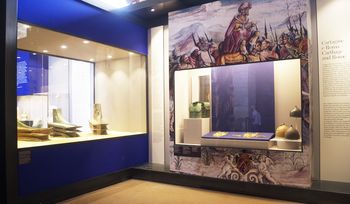
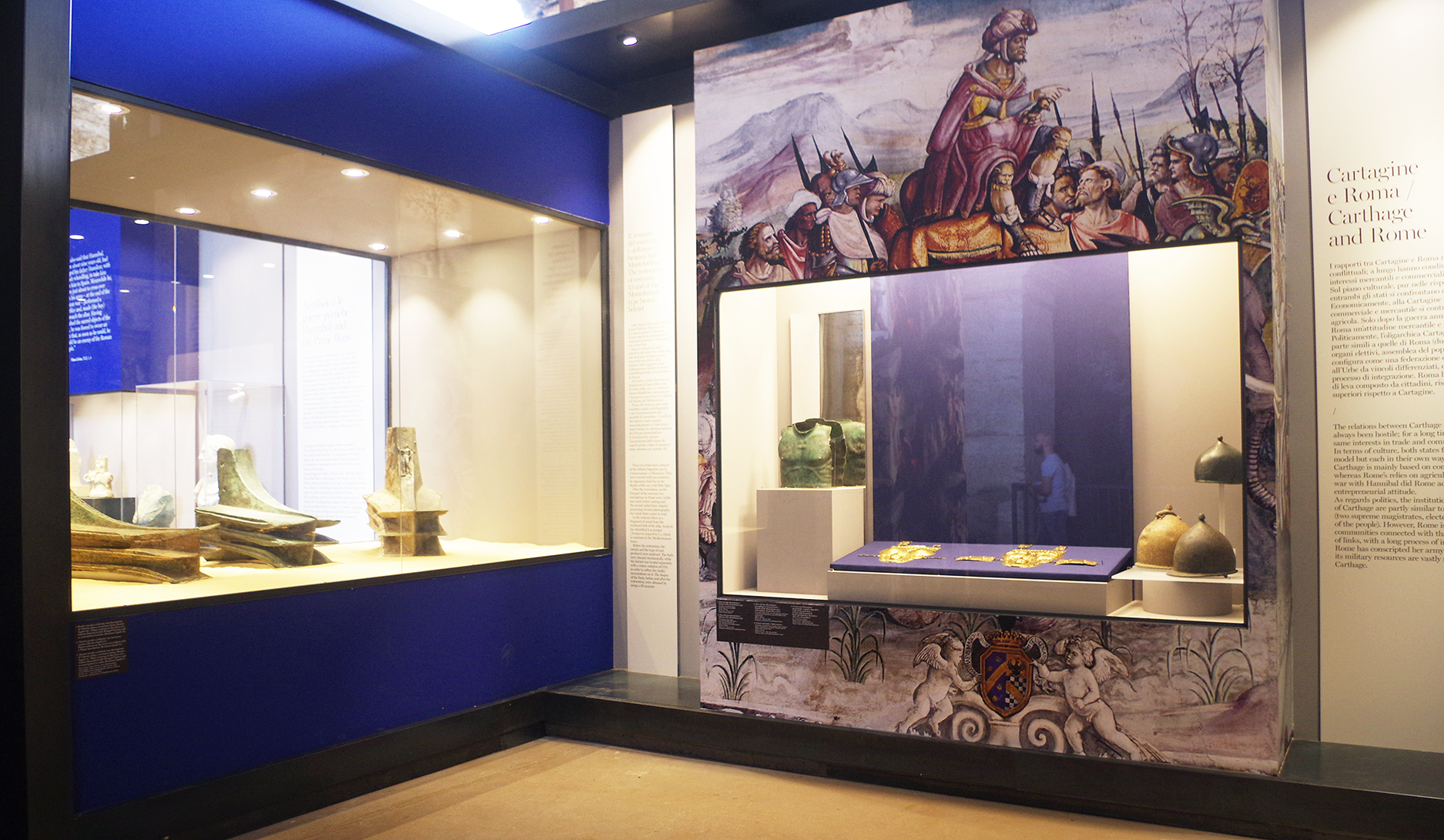
Section 5 engages with a key historical moment: the encounter and conflict between Carthage and Rome (195–228). Brizzi comments on the socio-political life of these two civilizations, from the first treaty of 509 BC to the breaking point of 264 BC (195–97). While one would normally associate Carthage and Rome with war, Xella and Zamora López remind us that Rome was also interested in the life and culture of her rival city. This is demonstrated by Plautus’ comedy Poenulus (early second century BC), where the Roman audience was led to sympathize with the story of the Carthaginian protagonist (197–98). The focal part of the exhibition was the narrative of the First Punic War (264–41 BC) and the Battle of the Aegates Islands, which was fought on 10 March 241 (Fig. 2). This naval battle evokes the memory of the late Sebastiano Tusa, who has immensely enhanced our understanding of this major historical event, thanks to his underwater explorations in the sea off Levanzo. The exhibition brought to the public a selection of military equipment, either recovered during the latest research and from other contexts: Montefortino-type helmets, shin-guards, spear heads, as well as a richly decorated Carthaginian cuirass from the Bardo Museum (cat., 130–33). The highlight was represented by three bronze ship rostra from the Aegates (cat., 134). These discoveries are briefly summarized in the essay by Murray and Tusa (208–209), while readers are redirected to the detailed accounts published recently (in particular Royal and Tusa Reference Royal and Tusa2020). Visitors to the exhibition could enjoy a nicely produced video explaining the research and discoveries with the aid of digital reconstructions.
Carthage and Rome at war: bronze ship rostra, armours and helmets (photo N. Mugnai, su concessione del Ministero per i beni e le attività culturali e per il turismo–Parco Archeologico del Colosseo).
The Second Punic War (218–201 BC) is described by looking at the city of Rome. Galli and Ismaelli provide a summary of their latest research in the Roman Forum, in the area of the Vicus Tuscus, where the house of Scipio Africanus was located (210–12). Archaeological excavations underneath the later Basilica Sempronia/Julia have brought to light the foundations of a residential complex, which is likely to be identified with Scipio's house. Tied with the events of the Second Punic War was the introduction of the cult of Cybele (Magna Mater) on the Palatine in 204 BC, as narrated by D'Alessio (213–14). The so-called ‘Navisalvia’ altar from the Capitoline Museums (cat., 137) depicts the arrival of the ship with the goddess Cybele on the bank of the Tiber. Following the destruction of Carthage in 146 BC, Rome came in possession of a vast territory; Roman culture started to find its way into a world that had been dominated by Punic elements. Schäfer and Schön (224–26) describe this transition with the example of recent research on the acropolis of Cossyra (island of Pantelleria). These finds formed part of the exhibition display in the Temple of Romulus. During excavations carried out in August 2019, a votive table was recovered, datable to the second century BC (cat., 141). The table is a patchwork of recycled pieces; the upper slab features a Punic inscription dedicated to ‘the son of the Just One’. Cossyra has yielded evidence for the diffusion of the Imperial cult from the Julio-Claudian period onwards, as demonstrated by the marble heads of Julius Caesar, Antonia the Younger, and the emperor Titus from the acropolis (cat., 144). The penetration of Roman culture into North Africa is well exemplified by the introduction of the cult of Saturn, which assimilated some of the features of the Punic Baal Hammon (Xella, 226–28). A curious statue of the enthroned god Saturn (cat., 149), from the Bardo Museum but of unknown provenance, shows the composite nature of this deity.
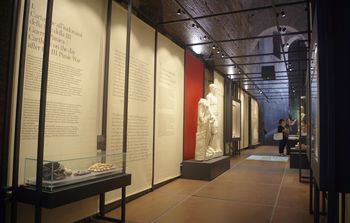
Section 6 describes the evolution of Carthage's cityscape from its refoundation as an Augustan colony to the Christian period (230–63). This section is quite short, to be seen more as an appendix to the rest of the exhibition, although its location inside Domitian's Ramp was suggestive. The organizers’ choice was understandable; trying to engage with Roman-period Carthage and its influence across the whole of North Africa would have required an exhibition of its own. Just to mention the field of architecture and art, Carthage was an active player in fostering the circulation of typical Romano-Carthaginian styles, which were adopted by the North African elites from the second century AD onwards (Pensabene Reference Pensabene and Mastino1989). For a more detailed, yet widely accessible, account of Imperial Carthage, readers should look at the essays reunited in the volume by Aounallah and Mastino (Reference Aounallah and Mastino2018). With regard to the present book, the urban features of Carthage under the Roman Empire are outlined by Mastino (230–32, 236–37) and Vismara (237–40). Domestic architecture and mosaics are one of the main features, as discussed by Rinaldi and Novello (241–49). The exhibition included two third-century mosaics with wrestlers from Gigthis, although the marble funerary statue of a charioteer and his wife from Carthage (cat., 154) proved to be the target of most visitors’ attention. The fifth/sixth-century mosaic of the ‘Lady of Carthage’ (cat., 165) is a well-chosen example of Christian-era art, which concluded this part of the exhibition's itinerary (Fig. 3).
Roman and Christian Carthage on display inside Domitian's Ramp (photo N. Mugnai, su concessione del Ministero per i beni e le attività culturali e per il turismo–Parco Archeologico del Colosseo).

Finally, the rediscovery and reception of Carthage in the modern world are commented upon in section 7 (265–89). Duplà points out how the figures of Hannibal and Dido have always attracted interest (274–76), from Slodtz's marble statue of the victorious Hannibal after the Battle of Cannae (1687–1704) to Turner's renowned painting The Rise of the Carthaginian Empire (1815). Flaubert's novel Salammbô (1862) is a major attempt of a historical novelization, which was supported by the author's field trips to visit the sites where his story took place (García Jurado, 280–82). With regard to the seventh art, the motion picture Cabiria (1914), directed by Giovanni Pastrone and co-written with Gabriele D'Annunzio, wass a Leitmotif of this exhibition. A replica statue of the monstrous (imaginary) Moloch was placed at the entrance on the ground level of the Colosseum, while a screen showed scenes from the film at the end of the gallery on the first level. In her essay, García Morcillo describes how Cabiria has influenced later cinematographic productions (283–85). The centrality of the Carthaginian myth in contemporary popular culture is also well attested by comic books and videogames (Mensuro and Boschloos, 285–89).
To conclude, one can say that the exhibition and the related publications succeeded in establishing a positive dialogue with their target audience. They attempt to present a lively and dynamic picture of ancient Carthage, which is not just the one seen from the viewpoint of victorious Rome. Undoubtedly the richness and variety of the selected materials will raise the interest of many. The collection of essays and the catalogue are nicely produced; they will be a valuable addition to the holdings of university and museum libraries. One must note that there are occasional typographic errors in some of the essays (at least in the Italian edition); however, these are generally minor and do not affect the comprehension of the text. Readers may be more puzzled by the fact that the catalogue is not broken down into the same thematic sections as the essays, although its format makes it easy to navigate nonetheless. Perhaps some of the images could have been reproduced at a larger scale, such as the three ship rostra (cat., 134) and the statue of Saturn (cat., 149), but otherwise photographs are of good size and quality. The Archaeological Park of the Colosseum is therefore to be congratulated on a successful initiative. It is to be hoped that the aims of this exhibition will not remain isolated in the context of cultural heritage dissemination. This should be seen as an encouragement for people to keep visiting the numerous museums which have loaned pieces from their collections. The Bardo Museum is in need of such constant international attention, after the tragic events of 18 March 2015, but the same applies to smaller, and sometimes lesser known, museums. One of these is the antiquarium housed in the former Stabilimento Florio on the island of Favignana (Trapani), where visitors can fully experience the story and the recent rediscovery of the Battle of the Aegates Islands.