Implications
Both nutritional consequences and learning may affect ruminants’ food acceptance and preference. Our study explores some conditions of potential interaction between these processes. We show that sheep increased their intake of a low-nutritious food when followed by high-nutritious supplements in daily sessions. In addition, animals later presented a stronger preference for the low-nutritious food compared with controls in a choice test. These results may be a first step in the study of intake induction in livestock species. Knowledge of the determinants of induction may contribute to the development of livestock management strategies attempted to increase animals’ preference for low-nutritious species to help overcome issues associated with selective grazing such as loss of plant diversity and sustainability of pasturelands.
Introduction
The nutritional composition of foods is an important determinant of animals’ food acceptance and preference. Nonetheless, the interaction of foodstuffs at different levels in the experience of the animal affects food intake and choice beyond the intrinsic properties of foods (Flaherty, Reference Flaherty1996; Provenza et al., Reference Provenza, Villalba, Dziba, Atwood and Banner2003). For instance, the specific array of plants encountered and the sequence of encounters could turn out to be crucial in determining nutritional consequences, as well as the level of consumption of each species in ruminants (e.g. see Meuret et al., Reference Meuret, Viaux and Chadoeuf1994; Meuret, Reference Meuret1996; Villalba and Provenza, Reference Villalba and Provenza2005; Bergvall et al., Reference Bergvall, Rautio, Kesti, Tuomi and Leimar2006 and Reference Bergvall, Rautio, Luotola and Leimar2007). These effects that transcend what would be expected based on the intrinsic properties of plants may occur because of digestive synergies (or antagonisms) among foodstuffs, associative learning and comparison processes or the interaction between these mechanisms. We explore some of these possibilities in the present study.
Here, we focussed on a phenomenon called intake ‘induction’ or ‘facilitation’, which consists of augmented consumption of a food in the first part of a food sequence when the food in the second part is of higher hedonic value (i.e. more preferred; e.g. Flaherty and Grigson, Reference Flaherty and Grigson1988; Weatherly et al., Reference Weatherly, Nurnberger and Hanson2005). For example, rats having 3-min access to a solution of 0.15% saccharin increased their licking rate of this solution when they had an upcoming 3-min access to a highly preferred 32% sucrose solution in the same drinking spout, relative to when they just had the 0.15% saccharin solution in both periods (Weatherly et al., Reference Weatherly, Nurnberger and Hanson2005).
Our objective was to explore the determinants of intake induction, as well as its consequences on sheep's food intake and preference. We tested whether sheep's initial consumption of a low-nutritious food (oat hay) could be increased through subsequent feeding of very limited amounts of high-nutritious foods (soya bean meal or ground corn).
Material and methods
The experiment took place at the ‘Centro de Recursos Naturales Renovables de la Zona Semiárida’ (CERZOS), located in Bahía Blanca (38°44′S; 62°16′W), Argentina, from February to April 2009. All maintenance and experimental protocols fulfilled animal welfare regulations of the Universidad Nacional del Sur, Bahía Blanca, Argentina, and adhered to the Association for the Study of Animal Behaviour/Animal Behavior Society Guidelines for the Use of Animals in Research (2006).
Animals
A total of 24 male Corriedale sheep (Ovis aries), of 4 ± 0.3 (mean ± 1 s.d.) months of age and 26.59 ± 3.92 kg of BW, were brought to the CERZOS facilities in mid-February 2009. They spent the first 2 weeks in a communal enclosure (200 m2), and 1 week before the experiment started they were transferred to individual pens (3 m2) under a protective roof. Throughout the pre-experimental and the experimental periods, animals had free access to fresh water and mineral supplements, and were fed ad libitum alfalfa pellets for 45 min at 1800 h every day. The nutrient composition of all feeds used in the experiment is presented in Table 1. At the start of the experiment, animals had no experience with any of the foods involved in the experimental sessions.
Nutrient composition of foods used in our study

ME = metabolizable energy; CP = crude protein; NDF = neutral detergent fibre.
Procedure
Preliminary choice test between soya bean meal and ground corn
The day before the First supplemented phase started, all animals were presented with a choice between ad libitum soya bean meal and ad libitum ground corn for 5 min. Soya bean meal and ground corn had similar particle sizes (∼1 to 2 mm). The relative intake of each food was used as an estimate of preference. The time window used to assess preference (5 min) was similar to the time it took animals to finish the supplements presented in sessions of both the First and the Second supplemented phases. The goal of this choice test was to have a prediction of intake induction on the basis of a hedonic hypothesis (i.e. the higher the preference for a supplement, the higher the induction caused by that supplement).
First supplemented phase
Before supplemented sessions began, animals were randomly assigned to three independent groups balanced by BW and corn–soya bean preference: group soya bean (hereafter ‘GS’, n = 8), group corn (hereafter ‘GC’, n = 8) and group oat hay (hereafter ‘GH’, n = 8). Animals were presented with one supplemented session per day that started at 0900 h. A supplemented session consisted of two parts of 20 min each, separated by 5 min (the time it took to remove the bowls of the first part and place the bowls corresponding to the second part of the session). Preliminary observations showed that 20 min of access to oat hay was approximately the minimal access time that did not significantly affect animals’ intake in a single bout of consumption of oat hay under the present deprivation regime (i.e. after some days of training, sheep ended up eating the same amount of oat hay in 20 min than the amount they could eat in an hour). Food bowls used in both parts of the sessions were almost identical in terms of shape and colour (half 20 l barrels of black plastic), and their location – either the right or left position in the pen – was determined randomly for each animal and session. During the first part of a supplemented session, all animals had ad libitum access to oat hay. Oat hay was grounded to obtain a particle size of ∼1.5 cm. During the second part of a session, animals had access to soya bean meal, ground corn and oat hay in groups GS, GC and GH, respectively. The amount of food offered in the second part of a session was restricted to 0.4% of the individual BW, that is, approximately a mean of 110 g of supplement per animal. The bowl with the second food in the sequence was left in the pen for 20 min; however, animals took just a few minutes (∼5 min) to finish the supplements. We measured daily consumption of foods fed in supplemented sessions, and of alfalfa pellets in the afternoon meal, as the difference between offered and refused amounts of food. Individual daily consumption was expressed as grams consumed per kilogram of BW (g/kg BW).
The First supplemented phase lasted until intake of oat hay was stable in three consecutive sessions as evidenced by a non-significant session × treatment interaction in the ANOVA. We eventually ran 14 sessions in this phase.
Offered foods were daily sampled for the determination of dry matter content. Dry samples were then grounded to pass through a 1-mm screen (Wiley Mill, Thomas Scientific, Swedesboro, NJ, USA), and were analysed for crude protein (CP) content by the Kjeldahl procedure (Association of Official Analytical Chemists, 1990) and for neutral detergent fibre (NDF) by the detergent system (Goering and Van Soest, Reference Goering and Van Soest1970). Metabolizable energy (ME) estimates were obtained from tabulated composition data for all foods (National Research Council, 1985), checking for similarities between tabulated and current foods in CP and NDF contents. Total daily consumption (i.e. including intake in the experimental session in the morning plus consumption of alfalfa pellets in the afternoon) of CP and ME was estimated on the basis of intake data and chemical analysis of foodstuffs.
Choice test between oat hay and alfalfa hay
The day after the First supplemented phase was completed, all the animals were presented with a choice test between oat hay and alfalfa hay. Similar to oat hay, alfalfa hay was grounded to obtain a particle size of ∼1.5 cm. As can be seen in Table 1, alfalfa hay was of higher nutritional quality than oat hay; however, alfalfa hay was unfamiliar to animals. According to our experience, sheep familiar with alfalfa hay show an almost absolute preference for alfalfa hay over oat hay. In contrast, sheep may consume alfalfa hay more cautiously if the food is novel (Launchbaugh et al., Reference Launchbaugh, Provenza and Werkmeister1997). Therefore, the present choice test served to evaluate whether the experimental treatments affected animals’ tendency to switch from the familiar oat hay to a more nutritious novel food (alfalfa hay) when a choice is available. This preference test also presented a chance to assess the extent to which a potential induction effect in supplemented sessions generalized to a choice situation.
The choice session started at 0900 h when two bowls of food, one filled with ad libitum oat hay and the other with ad libitum alfalfa hay, were offered to each animal for 20 min (the location of each food bowl – whether it was the right or the left position in the front of the pen – was determined randomly for each animal). Offered and refused oat hay and alfalfa hay were weighed in order to determine consumption and estimate preference. After the choice test, all sheep were released into the communal enclosure for a week (this practice of letting animals spend some days in the communal enclosure after several days in individual pens is meant to improve their welfare).
Non-supplemented phase
Once back in their respective individual pens, animals were re-trained for three sessions (at a rate of one session/day) with the same contingencies experienced in sessions of the First supplemented phase: 20 min of ad libitum access to oat hay, followed by 0.4% BW of soya bean meal, ground corn and more oat hay for animals in groups GS, GC and GH, respectively.
Non-supplemented sessions began the day after the third re-training session and were also run at a rate of one per day. They were exactly the same for all animals across treatments, and consisted of 20 min of access to oat hay followed by the presentation of no food in the second part of the sessions. We ran non-supplemented sessions until all groups showed a similar average intake of oat hay as indicated by non-significant differences in the ANOVA. In the end, we ran nine non-supplemented sessions, after which all sheep were released into the communal enclosure for a week.
The Non-supplemented phase served to disambiguate a confounding variable in the First supplemented phase where groups GS and GC differed from group GH in two respects: (1) the presence of supplementation in the second part of sessions and (2) the total time of access to oat hay (whereas groups GS and GC had only 20 min of access to oat hay, group GH had 40 min of access to oat hay, that is, two parts of 20 min each). If intake induction in the First supplemented phase responded to the presence of supplements, oat hay intake in groups GS and GC should approach the intake level of group GH during non-supplemented sessions. In contrast, if intake induction in the First supplemented phase was an artefact of group GH showing less intake in the first part of the sessions, because of the extra time of access to oat hay, the intake level of group GH should approach that of groups GS and GC during non-supplemented sessions (i.e. where all groups had only 20 min of access to oat hay).
Second supplemented phase: supplemented sessions with a different control group
A day after sheep were placed back in their respective individual pens, we started the Second supplemented phase. The only difference between the First and the Second supplemented phases was in the experience given to animals in the control group. After the initial part of the session, animals from the control group received no food (hereafter ‘NF’, n = 8), instead of receiving more oat hay as was done in the First supplemented phase. Animals from groups GS and GC received 0.4% BW of soya bean meal and ground corn, respectively, after having 20 min of access to oat hay as was done in the First supplemented phase. In contrast to group GH of the First supplemented phase, using group NF equalized the time of access to oat hay in all groups. Hence, the control's lower intake in the first part of the sessions would not be interpretable as resulting from those animals having extra access time to oat hay. Sessions of the Second supplemented phase were run until mean consumption of oat hay showed stability as evidenced by a non-significant group × session interaction in the ANOVA of the last three sessions. We eventually ran 15 sessions in this phase, after which animals were released into the communal enclosure.
Statistical analyses
Preliminary choice test between soya bean meal and ground corn
To analyse the preference between soya bean meal and ground corn, we squared-arcsine transformed the proportion of consumption of each food (intake of soya bean/total intake in the choice session) and we conducted a t-test where the average choice proportion was compared against 0.5 indifference.
First supplemented phase
To analyse oat hay consumption during supplemented sessions, we used a one-way ANOVA with three independent treatments (between-animal factor) and sessions as repeated measures. First, all supplemented sessions were included in the analysis to assess a possible group × session interaction during learning. Second, the last three supplemented sessions were analysed to assess intake stability and group differences during asymptotic intake. Animals were the experimental unit and the only random term of the model. The within-animal covariance matrix was modelled with a compound symmetric structure, which proved to have the best fit for the data involved in all the tests according to Schwarz's Bayesian criterion (Littell et al., Reference Littell, Henry and Ammerman1998). All ANOVAs were performed using the PROC MIXED procedure of SAS statistic software (SAS Institute Inc., Cary, NC, USA). We used Tukey's HSD test for post-hoc comparisons between groups.
Intake of ME and CP was calculated for each training day as the sum of consumption in the morning experimental session (intake of oat hay plus intake of more oat hay, ground corn or soya bean meal) and the afternoon meal (intake of alfalfa pellets). We used a one-way ANOVA to assess group differences in ME and CP intake: first, in the supplemented phase as a whole (i.e. using an overall mean for each animal) and, second, in the last three supplemented sessions (i.e. when stability in oat hay consumption was reached).
Choice test between oat hay and alfalfa hay
Choice proportions were squared-arcsine transformed before analyses. First, we assessed whether choices differed from the 0.5 indifference using independent t-test for each group (GS, GC and GH). Second, choice proportions were compared among groups using a one-way ANOVA with group as between-animal factor and animals as the random term of the model. Tukey's HSD tests were used to make post-hoc pair-wise comparisons.
Non-supplemented phase
Oat hay consumption in re-training and non-supplemented sessions was analysed using a one-way ANOVA with group as the between-animal factor and sessions as repeated measures. We also calculated an absolute difference score to estimate the change in consumption of oat hay from re-training to non-supplemented sessions. To obtain this value, we first computed the mean re-training intake of oat hay for each animal (i.e. mean intake in the three re-training sessions) and then calculated the absolute difference between intake of oat hay in each non-supplemented session and the mean re-training intake. The absolute difference score was analysed using a one-way ANOVA with group as the between-animal factor and sessions as repeated measures. Lastly, we calculated 95% confidence intervals of the absolute difference score for the last three non-supplemented sessions in each group to assess whether the change in consumption of oat hay from re-training to the phase with no supplements had been significant (i.e. if the interval did not include the zero).
Second supplemented phase
Intake of oat hay, ME and CP in the Second supplemented phase was analysed as described for the First supplemented phase. The α value was set at the 0.05 level.
Results
Preliminary choice: soya bean meal v. ground corn
The mean (±1 s.e.) proportion of grams of corn consumed over total grams consumed was 0.66 (±0.06). A t-test of this average value against 0.5 indifference showed that consumption of ground corn was significantly higher than that of soya bean meal (t 23 = 2.65, P < 0.01). We took this result as indicative of an average preference for ground corn over soya bean meal when these supplements were offered in a short time interval similar to those used in the First and the Second supplemented phases.
First supplemented phase
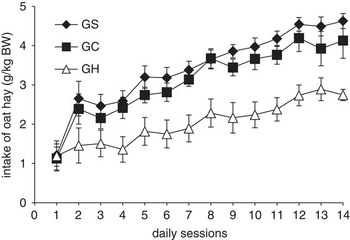
Mean consumption of oat hay gradually increased in each group, although the increment was more pronounced in groups GS and GP than in group GH (Figure 1). The ANOVA of consumption in the 14 supplemented sessions showed effects of group (F 2, 21 = 7.84, P < 0.003), session (F 13, 273 = 58.85, P < 0.001) and group × session interaction (F 26, 273 = 2.38, P < 0.001). This significant interaction stems from the fact that groups did not differ in the early sessions but did so in the final sessions of this phase. In the last three supplemented sessions, consumption of oat hay was different across groups (ANOVA, F 2, 21 = 9.72, P < 0.001) but stable as indicated by a non-significant group × session interaction (F 4, 42 < 1.00, P = 0.61; session, F 2, 42 < 1.00, P = 0.84). Tukey's HSD tests showed that consumption of oat hay in the last three supplemented sessions was higher in groups GS and GC than in group GH (Q 8, 8 = 6.37 and Q 8, 8 = 4.67, respectively, both P's < 0.01), but not significantly different between groups GS and GC (Q 8, 8 = 1.70, P = 0.46).
Mean daily intake of oat hay (g/kg body weight, BW) in the first part of sessions in the First supplemented phase as a function of group. Oat hay was followed by soya bean meal in group GS (n = 8), by ground corn in group GC (n = 8) and by more oat hay in group GH (n = 8). Error bars denote ±1 s.e.

Mean daily ME intake did not reliably differ across groups neither in the 14 training days as a whole (ANOVA: F 2, 21 = 1.29, P = 0.30) nor in the last 3 training days (mean kcal/kg BW (±1 s.e.) of the last 3 training days: GS, 69.81 (±3.44); GC, 69.04 (±6.47); and GH, 60.59 (±3.33); ANOVA: group, F 2, 21 = 1.81, P = 0.19; day, F 2, 42 = 0.63, P = 0.54; group × day interaction, F 4, 42 = 0.71, P = 0.59). Average consumption of CP was significantly higher in group GS than in groups GC and GH as assessed both in the 14 training days as a whole (ANOVA, F 2, 21 = 8.12, P < 0.003; Tukey's HSD test: GS v. GC, Q 8, 8 = 6.93, P < 0.006; GS v. GH, Q 8, 8 = 6.64, P < 0.008; GC v. GH, Q 8, 8 = 0.29, P = 0.99) and in the last 3 training days (mean g/kg BW of CP intake (±1 s.e.) in the last 3 training days: GS, 7.52 (±0.23); GC, 5.47 (±0.35); and GH, 5.65 (±0.29); ANOVA, group, F 2, 21 = 14.89, P < 0.001; day, F 2, 42 = 0.60, P = 0.55; group × day interaction, F 4, 42 = 0.75, P < 0.56; Tukey's HSD test: GS v. GC, Q 8, 8 = 6.96, P < 0.001; GS v. GH, Q 8, 8 = 6.35, P < 0.001; GC v. GH, Q 8, 8 = 0.35, P = 0.90).
Choice test between oat hay and alfalfa hay
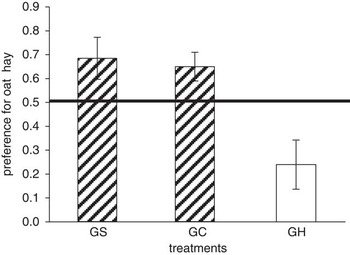
Animals in groups GS and GC showed a preference for oat hay (t-test against indifference: GS, t 7 = 2.12, P < 0.05; GC, t 7 = 2.47, P < 0.05), whereas those in group GH showed a preference for alfalfa hay (t 7 = 2.59, P < 0.05; Figure 2). The ANOVA of squared-arcsine transformed proportions showed an effect of group (F 2, 21 = 0.02, P < 0.01). Tukey's HSD tests showed that the preference for oat hay over alfalfa hay was similar between groups GS and GC (Q 8, 8 = 0.51, P = 0.96) and that both groups presented proportion scores higher than those of group GH (GS v. GH: Q 8,8 = 7.58; GC v. GH: Q 8,8 = 7.06; both P's < 0.01; Figure 2).
Choice test between oat hay and alfalfa hay after 14 sessions where oat hay was followed by soya bean meal in group GS (n = 8), by ground corn in group GC (n = 8) and by more oat hay in group GH (n = 8). Preference for oat hay was calculated as grams of oat hay ingested divided by the total grams of food ingested in the choice test. A preference score above 0.5 indicates preference for oat hay, and below 0.5 indicates preference for alfalfa hay. Error bars denote ±1 s.e.

Non-supplemented phase
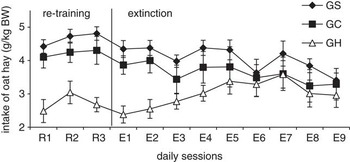
In re-training sessions, animals from all treatments immediately responded to oat hay consumption as they did by the end of the First supplemented phase (see Figure 3). The ANOVA of oat hay consumption across the three re-training sessions showed effects of treatment (F 2, 21 = 14.12, P < 0.001) and session (F 2, 42 = 5.22, P < 0.01) but no significant group × session interaction (F 4, 42 = 0.76, P = 0.55). Tukey's HSD test of mean re-training intake showed similar consumption of oat hay in groups GS and GC (Q 8, 8 = 1.83, P = 0.51) and both higher than those in group GH (Q 8, 8 = 7.80 and Q 8, 8 = 5.97, respectively, both P's < 0.01).
Mean daily intake of oat hay (g/kg body weight, BW) in the first part of re-training and non-supplemented sessions. In re-training sessions, oat hay was followed by soya bean meal in group GS (n = 8), by ground corn in group GC (n = 8) and by more oat hay in group GH (n = 8). In non-supplemented sessions, oat hay was followed by an empty feeder in all groups. Error bars denote ±1 s.e.

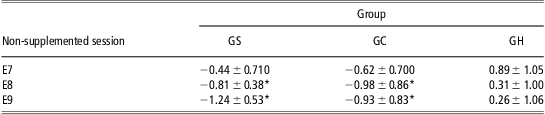
Relative to re-training, oat hay intake seemed to decrease in animals from groups GS and GC, and increase in animals from group GH across non-supplemented sessions (see Figure 3). However, as shown in Table 2, 95% confidence intervals of the absolute difference in consumption between non-supplemented sessions and mean re-training intake suggest that oat hay intake did not reliably change between phases in group GH. In contrast, groups GS and GC significantly decreased their oat hay consumption from re-training to non-supplementation (see Table 2). The ANOVA of the absolute difference in consumption between each non-supplemented session and the mean re-training consumption showed that mean intake changed differently across non-supplemented sessions and groups (group, F 2, 21 = 5.05, P < 0.05; session, F 8, 168 = 4.05, P < 0.001; group × session interaction, F 16, 168 = 3.26, P < 0.001). Tukey's HSD tests showed that groups GS and GC presented very similar absolute difference scores (Q 8, 8 = 0.03, P = 0.98), which, in turn, differed from those of group GH (GS v. GH: Q 8, 8 = 4.89, P < 0.01; GC v. GH: Q 8, 8 = 4.92, P < 0.01). At the end of the Non-supplemented phase, consumption of oat hay, although still variable across sessions (ANOVA of the last three non-supplemented sessions: F 2, 42 = 18.62, P < 0.001), was similar among groups (group, F 2, 21 < 1.00, P = 0.49; group × session interaction, F 4, 42 = 1.60, P = 0.19; Figure 3).
Intake change from re-training to non-supplemented sessions

GS = group soya bean; GC = group corn; GH = group oat hay; CI = confidence interval.
Mean (±95% CI) absolute difference in the intake of oat hay between the last three non-supplemented sessions and re-training. The re-training intake score for each animal was calculated as its mean consumption during the three re-training sessions. In re-training sessions, oat hay was followed by soya bean meal in group GS (n = 8), by ground corn in group GC (n = 8) and by more oat hay in group GH (n = 8). In non-supplemented sessions, oat hay was followed by no food in all groups. Positive values indicate an increment, whereas negative values indicate a decrement in consumption during non-supplemented sessions (relative to re-training). Error terms denote 95% CI, thus intervals excluding zero (*) indicate a significant difference in consumption between that non-supplemented session and re-training.
Second supplemented phase
One animal from group NF became ill and was removed from the experiment; hence, analyses for this group were done with n = 7.
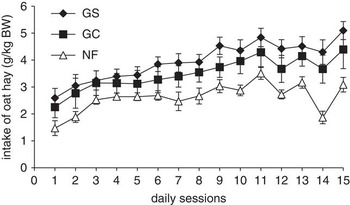
Figure 4 presents mean intake of oat hay for each session of the Second supplemented phase as a function of group. The ANOVA of consumption in the 15 supplemented sessions showed effects of group (F 2, 20 = 4.59, P < 0.03) and session (F 14, 280 = 21.99, P < 0.001), but no group × session interaction (F 28, 280 = 1.29, P = 0.15). Tukey's HSD tests showed that mean consumption of oat hay in the supplemented phase as a whole was higher in groups GS and GC than in group NF (GS v. NF: Q 8, 7 = 5.99, P < 0.01; GC v. NF: Q 8, 7 = 3.93, P < 0.05), whereas groups GS and GC did not significantly differ (Q 8, 8 = 2.12, P > 0.10). The analyses of the last three sessions where intake of oat hay was seemingly at its asymptote showed an effect of group (F 2, 20 = 6.16, P < 0.01) and session (F 2, 40 = 15.56, P < 0.001), but no group × session interaction (F 4, 40 = 1.86, P > 0.10). Tukey's HSD test of the average oat hay intake in the last three sessions showed a non-significant difference between groups GS and GC (Q 8, 8 = 1.46, P = 0.55), and higher intakes in groups GS and GC than in group NF (Q 8, 7 = 4.93 and Q 8, 7 = 3.55, respectively, both P's < 0.05).
Mean daily intake of oat hay (g/kg body weight, BW) in sessions of the Second supplemented phase. Animals in groups GS (n = 8) and GC (n = 8) received soya bean meal and ground corn, respectively, after access to oat hay, whereas animals in group NF (n = 7) received no food after the initial 20 min of access to oat hay; hence, all groups had the same overall time of access to oat hay in a session. Error bars denote ±1 s.e.

Mean intake of ME during the last 3 training days differed among groups (F 2, 21 = 5.47, P < 0.05; mean kcal/kg BW (±1 s.e.), GS, 90.93 (±3.54); GC, 82.15 (±4.37); and NF, 73.55 (±3.12)). More specifically, group GS had a higher mean intake of ME than group NF (Tukey's HSD test for unequal N, Q 8, 7 = 4.17; P < 0.05; GC v. NF, Q 8, 7 = 1.81; P = 0.45; GC v. GS, Q 8, 8 = 1.39; P = 0.23). Mean intake of CP during the last three training sessions also differed across groups (ANOVA: F 2, 20 = 13.31, P < 0.001; mean g/kg BW (±1 s.e.); GS, 8.17 (±0.30); GC, 6.09 (±0.36); and NF, 6.22 (±0.26)). The main effect of group resulted from a higher intake of CP in group GS than in groups GC and NF (Tukey's HSD test for unequal N, Q 8, 8 = 6.58, Q 8, 7 = 5.79, respectively, both P's < 0.01; GC v. NF, Q 8, 7 = 0.47, P = 0.85).
Discussion
Our results showed a reliable induction effect in the level of consumption of a low-nutritious food (oat hay) when followed by nutrient supplementation (soya bean meal or ground corn) relative to controls not supplemented during experimental sessions. Importantly, supplemented animals later preferred oat hay over alfalfa hay in a short choice test, whereas controls showed the reverse preference (i.e. preferred alfalfa hay over oat hay). In addition, we obtained similar induction effects whether supplemented sheep were compared against controls that had access to oat hay in only one or both parts of the sessions. That is, the induction effect was still apparent even after controlling for the total access time to oat hay. This consistent finding across experimental phases suggests that the present intake induction is unlikely to be an artefact of controls’ lower intake because of a sensorial overstimulation with the low-quality food. A word of caution should be warranted, given the possibility that control group's performance in the Second supplemented phase was affected by the contingencies the controls experienced in the First supplemented phase, as the same animals served as controls in both supplemented phases. In any case, the crucial role of the subsequent supplements in the induction effect was confirmed in non-supplemented sessions, where animals from groups GS and GC decreased oat hay consumption when it was not followed by the respective supplements. In turn, we found no reliable evidence that controls changed their intake of oat hay when we presented them with no food instead of more oat hay in the second part of the sessions. To our knowledge, this is the first time that intake induction has been assessed with different types of supplements, which allows us to derive some conclusion about the presumed mechanisms underlying induction, as discussed next. These findings contribute to our knowledge of the determinants of short-term regulation of food intake and preference in sheep. The present study, however, did not assess the persistence of the learned patterns of consumption and choice; hence, the role of intake induction in long-term feeding regulation remains to be tackled in future research.
The standard interpretation of our results according to the induction literature would be to consider that consumption in the first part of the session was modulated by a learned association between the first and the second food in the sequence (e.g. Lucas et al., Reference Lucas, Timberlake, Gawley and Drew1990; Weatherly et al., Reference Weatherly, Nurnberger and Hanson2005 and Reference Weatherly, Huls and Kulland2007). A nutritional account needs to be considered first before confidently accepting the learning interpretation.
Discarding a nutritional account
A possibility could be that changes in consumption of oat hay were the consequence of differential nutritional states of animals across groups. Supplements with a high protein–energy ratio help fibre digestion in ruminants fed low-nutritious or high-fibre forages (Sanson et al., Reference Sanson, Clanton and Rush1990; Matejovsky and Sanson, Reference Matejovsky and Sanson1995); hence, the increased intake of oat hay in group GS relative to group GH might be attributable to the higher intake of CP in the former group. The fact that animals in group GC presented higher consumption of oat hay than those in group GH, but these two groups did not differ in mean daily intake of either CP or ME, is, however, inconsistent with this nutritional explanation. In addition, even when intake of CP was higher in group GS than in group GC, intake of oat hay did not significantly differ between these two groups in any phase of the experiment. Therefore, our results suggest that sheep may respond to supplementation in an anticipatory manner, namely as a function of learning and not simply in terms of nutritional or post-ingestive state at the time of consumption and choice.
A different explanation mentioned by an anonymous reviewer involves the possibility that controls inhibited their intake of oat hay because of nutritional overstimulation (nutrient specific satiety) with the low-quality food. In our opinion, there are several facts that make the nutritional overstimulation idea an unlikely explanation for the present findings. First, the low-quality food (oat hay) was characterized by low nutrient concentration and low nutrient release during digestion. However, even assuming the possibility of a nutritional overstimulation, summing up the intake of oat hay from the two parts of a session in the First supplemented phase shows that controls’ (group GH) daily intake of oat hay was similar to that of the other two groups (mean (±1 s.e.) grams of oat hay consumed in the last 3 training days, GS: 4.55 (±0.19), GC: 4.08 (±0.40) and GH: 3.91 (±0.44)). In addition, the lack of a reliable change in the controls’ performance during the Non-supplemented phase (when the time of access to oat hay was reduced to a half relative to the previous phase), as well as the fact that the other two groups approached controls’ intake level once they were not supplemented, suggests that controls’ intake in the last sessions of the Non-supplemented phase was not influenced by any prior overstimulation with oat hay. Lastly, the appearance of intake induction in the Second supplemented phase in which subjects from all groups had the same time of access to oat hay weakens the status of the nutritional overstimulation explanation too.
The mechanism of intake induction in sheep
In the present study, sheep showed a significant preference for ground corn over soya bean meal when offered in a choice test, where the time of access to these supplements was similar to that used in supplemented sessions. This result suggests that induction could have been stronger in group GC (i.e. where ground corn was the supplement) than in group GS (i.e. where soya bean meal was the supplement), should the hedonic properties of the second food in the sequence be the main determinant of the induction effect. However, mean consumption of oat hay was similar between groups GS and GC (even consistently higher in GS than in GC across sessions of both supplemented phases, although these differences were never significant). In this sense, our data suggest that the intrinsic hedonic properties of the supplements were not the only factor responsible for the induction effect found. Hedonic and post-ingestive processes might have interacted in determining the intake level of oat hay. Indeed, under present levels of supplementation, soya bean meal has been shown to benefit fibre digestion to a larger extent than ground corn (Matejovsky and Sanson, Reference Matejovsky and Sanson1995; Koster et al., Reference Koster, Cochran, Titgemeyer, Vanzant, Abdelgadir and St-Jean1996; Moore et al., Reference Moore, Brant, Kunkle and Hopkins1999). However, this idea needs further testing. As the post-ingestive advantage of soya bean meal over ground corn in aiding fibre digestion changes with the level of supplementation (e.g. Sanson et al., Reference Sanson, Clanton and Rush1990), an interesting continuation of the present study could be to assess oat hay intake while systematically varying the amount of the subsequent supplementation in daily sessions. Besides, non-nutritional flavours, such as artificial sweetener, could be used to further disentangle the contribution of purely hedonistic factors to intake induction.
Lastly, we postulate that the induction effect seen in groups GS and GC may have resulted from an association between perceptual properties of oat hay (e.g. smell, taste, texture, colour) and the presumed hedonic and post-ingestive consequences of the subsequent supplements (e.g. see Ackroff, Reference Ackroff2008). This idea is consistent with evidence from both ruminants (Villalba and Provenza, Reference Villalba and Provenza1997 and Reference Villalba and Provenza1999) and monogastric species (Sclafani and Nissenbaum, Reference Sclafani and Nissenbaum1988) showing that intra-gastric infusion of nutrients can condition a preference towards a previously consumed food or flavour. This hypothesis could be further tested using food sequences that either increase or decrease in nutritional quality, compared against controls always receiving the same food.
Practical implications
The present study generalizes induction effects from laboratory animals (mainly rats and pigeons) to a small ruminant, the sheep, thus incorporating an applied and productive dimension. One general implication sustained by the present results and the literature on incentive relativity is that the animal responds and learns about foods beyond their intrinsic (e.g. nutritional) properties: whether food incentives are presented in isolation, combination or sequence matters (see Flaherty, Reference Flaherty1996; Bergvall et al. Reference Bergvall, Rautio, Kesti, Tuomi and Leimar2006 and Reference Bergvall, Rautio, Luotola and Leimar2007; Catanese et al., Reference Catanese, Distel, Rodríguez Iglesias and Villalba2010 and Reference Catanese, Freidin, Cuello and Distel2011, for examples in ruminants). This may be a consequence of learning and comparative processes, as well as nutritional and digestive interactions among foods, and should be taken into account when intending to affect animals’ diet selection. One limitation of our study is that, as evidenced in the Non-supplemented phase, the persistence of intake induction was short-lived. Future studies could focus on assessing conditions of further persistence of the reported phenomenon.
All in all, we believe, as other researchers do (e.g. Mote et al., Reference Mote, Villalba and Provenza2008), that it would be useful to develop rangeland management practices meant to improve livestock's acceptance and preference of low-nutritious foods that animals commonly reject. Increasing dietary breath might alleviate the persistent selection pressure that animals exert over plant species of higher nutritional quality, thus reducing undesirable changes in the botanical composition of pasturelands (Milchunas et al., Reference Milchunas, Sala and Lauenroth1988; O’ Connor, Reference O’ Connor1991; Provenza et al., Reference Provenza, Villalba, Dziba, Atwood and Banner2003). The study of intake induction in livestock species may help in achieving such an applied end, and this paper is a step in that direction.
Acknowledgements
This research was supported by a grant of the Agencia Nacional de Promoción Científica y Tecnológica de la República Argentina to RAD (PICT 170, Préstamo BID) and fellowships from the Consejo Nacional de Investigaciones Científicas y Técnicas de la República Argentina (CONICET) to EF and FC and from the Comisión de Investigaciones Científicas de la Provincia de Buenos Aires (CIC) to MIC. The authors thank Nilda Didoné who did the chemical analysis of the foods.