INTRODUCTION
Cetaceans—with special reference to odontocetes—are susceptible to chemical stress from chronic exposure to xenobiotic compounds. Indeed, their ‘top predator’ position within the marine food chain implies a consequent ability to accumulate large amounts of immunotoxic environmental contaminants in their body tissues (Fossi et al., Reference Fossi, Marsili, Casini and Bucalossi2006). In this respect, a number of studies have addressed the synergistic role possibly exerted, along with Morbillivirus and other biological pathogens, by persistent organic pollutants (POPs), such as polychlorinated biphenyls (PCBs) and dichlorodiphenyltrichloroethane (DDT) (Van Bressem et al., Reference Van Bressem, Raga, Di Guardo, Jepson, Duignan, Siebert, Barrett, Santos, Moreno, Siciliano, Aguilar and Van Waerebeek2009). More in detail, a reduction of phagocytosis has been reported after in vitro exposure of both neutrophils and monocytes from different cetacean species to PCBs (Levin et al., Reference Levin, Morsey, Mori and De Guise2004, Reference Levin, Morsey, Mori, Nambiar and De Guise2005), while Morbillivirus genus members are unequivocally known as highly lymphotropic pathogens for their hosts, in which they are able to cause a profound immunosuppression (Di Guardo, Reference DiGuardo2012; Sato et al., Reference Sato, Yoneda, Honda and Kai2012). In 2007, following the occurrence of a Dolphin Morbillivirus (DMV) epidemic in the Mediterranean Sea (Fernández et al., Reference Fernàndez, Esperon, Herraez, De Los Monteros, Clavel, Bernabe, Sanchez-Vizcaino, Verborgh, De Stephanis, Toledano and Bayon2008; Keck et al., Reference Keck, Kwiatek, Dhermain, Dupraz, Boulet, Danes, Laprie, Perrin, Godenir, Micout and Libeau2010), the Italian Ministry for the Environment funded a research aimed at assessing the presence of infectious agents of concern for cetacean health and conservation, such as DMV and Toxoplasma gondii (Van Bressem et al., Reference Van Bressem, Raga, Di Guardo, Jepson, Duignan, Siebert, Barrett, Santos, Moreno, Siciliano, Aguilar and Van Waerebeek2009; Di Guardo et al., Reference Di Guardo, Proietto, Di Francesco, Marsilio, Zaccaroni, Scaravelli, Mignone, Garibaldi, Kennedy, Forster, Iulini, Bozzetta and Casalone2010).
We report herein the preliminary findings obtained, with special emphasis on the existence of any cause–effect relationships between the presence of infections caused by the aforementioned pathogens and the tissue levels of POPs measured in the cetaceans under study.
MATERIALS AND METHODS
Twenty-seven stranded animals were included in the study: 15 striped dolphins (Stenella coeruleoalba Meyen, 1833), nine bottlenose dolphins (Tursiops truncatus Montagu, 1821), two sperm whales (Physeter macrocephalus Linnaeus, 1758) and one fin whale (Balaenoptera physalus Linnaeus, 1758). Moreover, 47 skin biopsies were obtained from the following free-living species by means of biopsy darts launched with a crossbow (for fin and sperm whale) or by means of a 2.5 m biopsy pole: 28 striped dolphins, two sperm whales, 12 long-finned pilot whales (Globicephala melas Traill, 1809) and five fin whales.
Organochlorine (OC) levels were investigated in the subcutaneous adipose tissue (blubber) of striped dolphins, common bottlenose dolphins, sperm whales and fin whale, all of which were found dead stranded (up to 10 days) along the north-western Italian coastline in the 2007–2009 period. The OC levels were investigated also in the blubber of ‘free-ranging’ specimens sampled with the biopsy technique. A high resolution capillary gas chromatograph, equipped with an electron capture detector (63Ni ECD) (Agilent 6890/N), was the analytical instrument used for the quantitative and qualitative analysis of OCs (PCBs and DDT), in agreement with the US Environmental Protection Agency (EPA) 8081/8082 Guidelines. The gas chromatograph was provided with an SPB-5 bonded phase in a 30 m long fused silica capillary column. Evidence of Morbillivirus and Toxoplasma gondii infections was searched by means of suitable immunohistochemistry (IHC), molecular biology (PCR, RT-PCT) and/or serological techniques, as reported in detail elsewhere (Di Guardo et al., Reference Di Guardo, Proietto, Di Francesco, Marsilio, Zaccaroni, Scaravelli, Mignone, Garibaldi, Kennedy, Forster, Iulini, Bozzetta and Casalone2010; Pretti et al., Reference Pretti, Mancianti, Nardoni, Ariti, Monni, Di Bello, Marsili and Papini2010).
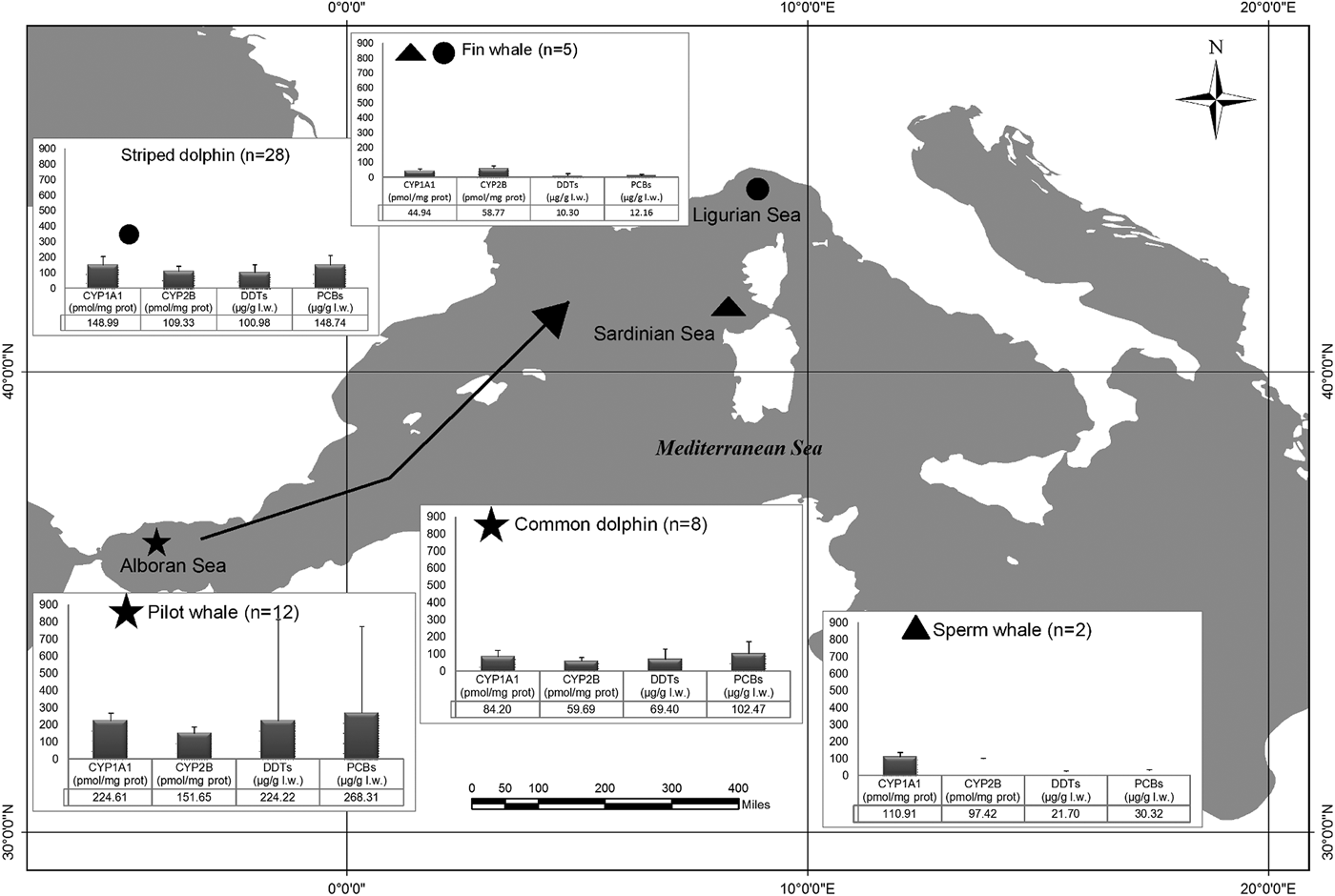
Finally, with the specific aim of establishing the toxicological status of cetacean sub-populations living in the north-western Mediterranean Sea, OC levels, as well as associated biomarker responses (CYP1A1 and CYP2B), were investigated by means of skin biopsy samples obtained from free-ranging specimens in the Alboran, Ligurian and Sardinian Seas (Figure 1). The CYP1A1 and CYP2B are two cytochrome P450 (CYP) isoforms, which is the most important metabolic/detoxifying enzyme system in mammals and thereby a powerful biomarker of exposure; both isoforms have been detected in cetacean skin and induction of these was found after exposure to lipophylic contaminants such as OCs, PAHs and BFR in vitro and in field studies (Fossi et al., Reference Fossi, Casini, Bucalossi and Marsili2008; Montie et al., Reference Montie, Fair, Bossart, Mitchum, Houde, Muir, Letcher, Mc Fee, Starczak, Stegemam and Hahn2008).
PCBs, DDT levels and the biomarker (CYP1A1; CYP2B) induction responses in the free-ranging specimens sampled in the study area (Alboran, Ligurian and Sardinian Seas). The arrow shows the spatial sequence of both the 1990–1992 and 2006–2008 DMV epidemics in the Mediterranean Sea.

CYP1A and CYP2B biomarkers' analysis was also performed on the aforementioned skin biopsy samples with western blot (WB) technique. In this respect, induction of CYP1A is known to be mediated by the aryl hydrocarbon receptor (AHR) pathway, which is activated in turn by polycyclic aromatic hydrocarbons (PAHs) and planar halogenated hydrocarbons (PHaHs); therefore, CYP1A1 and AHR are widely used as diagnostic markers of exposure to these compounds also in aquatic mammals, while CYP2B induction is believed to follow globular lipophilic pollutant exposure (Fossi et al., Reference Fossi, Casini, Bucalossi and Marsili2008). For WB analysis, S9 fractions of skin tissue homogenates (in duplicate for each sample) were separated by SDS-PAGE (10% polyacrylamide gels—Criterion XT Precast Gel, BioRad) and blotted onto nitrocellulose sheets for 1 h at the constant voltage of 200 V. The membranes were saturated by incubating them with a blocking solution (3% gelatin dissolved in Tris buffered saline containing 0.05% Tween-20, TTBS) for 1 h at room temperature. Primary polyclonal rabbit antibodies (Abs) (Oxford Biochemical Research, Oxford, MI, USA) were used. Goat anti-rabbit CYP1A1 and anti-CYP2B Abs, respectively diluted 1:5000 and 1:1000 in TTBS-1% gelatine, were incubated overnight at room temperature with the aforementioned cetacean proteins–primary Abs mixture. Incubation with an anti-rabbit horseradish peroxidase (HRP)-labelled secondary Ab (1:3000 final dilution) was subsequently carried out for 1.5 h at room temperature, with protein detection being performed according to the BioRad Immun-Star HRP Chemiluminescent Kit booklet, utilizing standardized times. In order to validate WB analysis of CYP1A1 and CYP2B as a semi-quantitative detection tool in biopsies, in each WB run an internal standard (skin standard) was also analysed. This was obtained from the skin of a stranded bottlenose dolphin, found a few hours after death; levels of the two cytochromes were analysed in the skin and liver of this specimen using a spectrometric method, followed by a series of calibration curves of CYP450, which were analysed in triplicate. A triplicate skin standard (SS) was subsequently analysed within the curves and maintained as internal standard in subsequent WBs, thus allowing to quantify the levels of these proteins in a set of unknown samples (Fossi et al., Reference Fossi, Casini, Bucalossi and Marsili2008). Semi-quantitative analysis was performed for each WB (in triplicate) with Quantity One software (BioRad, 1- D Analysis Software), using the method proposed by Fossi et al. (Reference Fossi, Casini, Bucalossi and Marsili2008).
The non-parametric Spearman's rank-order correlation was used in order to verify the presence of significant correlations between levels of contaminants and the levels of CYP1A1 and CYP2B in free-ranging animals.
RESULTS
High blubber tissue concentrations of PCBs and DDTs, along with high CYP1A1 and CYP2B induction responses, were recorded in free-ranging pilot whales (Figure 1), suggesting a relevant exposure to both planar and globular lipophilic pollutants. Furthermore, the results of Spearman's rank-order correlation highlighted significant correlations (P < 0.05), considering the species as a whole, between the levels of both isoforms of cytochrome P450 (CYP1A1 and CYP2B) and the tissue levels of PCBs in free-ranging specimens. The tissue concentrations of both PCBs and DDT recorded in stranded bottlenose dolphins (mean PCBs = 367.9 lipid weight (l.w.); DDT = 143.7 mg/kg l.w.) and striped dolphins (mean PCBs = 139.9; DDT = 92.9 mg/kg l.w.) were remarkably well beyond the PCB threshold value (PCBs = 17 mg/kg l.w.) for the emergence of adverse health effects and immunosuppression in marine mammals (Kannan et al., Reference Kannan, Blankenship, Jones and Giesy2000). Finally, no IHC nor RT-PCR evidence of DMV infection was obtained in any stranded cetacean, while three striped dolphins and six bottlenose dolphins showed biomolecular (PCR) and serological evidence of Toxoplasma gondii infection, as reported elsewhere (Pretti et al., Reference Pretti, Mancianti, Nardoni, Ariti, Monni, Di Bello, Marsili and Papini2010).
DISCUSSION
Even if no definitive conclusions can be drawn from the results of this study, we believe some issues deserve special concern.
First of all, it is worth noting that the highest tissue concentrations of PCBs and DDT, associated with high biomarker responses, were detected in a long finned pilot whale from the Gibraltar Strait, with such species having been indicated as one heavily succumbing to DMV infection (along with striped dolphins) during the 2006–2008 Mediterranean Sea epidemic, as well as the likely carrier of morbilliviral infection from the Atlantic USA coast to the Mediterranean Sea (Di Guardo et al., Reference Di Guardo, Marruchella, Agrimi and Kennedy2005; Fernández et al., Reference Fernàndez, Esperon, Herraez, De Los Monteros, Clavel, Bernabe, Sanchez-Vizcaino, Verborgh, De Stephanis, Toledano and Bayon2008; Van Bressem et al., Reference Van Bressem, Raga, Di Guardo, Jepson, Duignan, Siebert, Barrett, Santos, Moreno, Siciliano, Aguilar and Van Waerebeek2009).
Secondly, although no evidence of DMV infection was found in the stranded cetaceans investigated herein, it is worth mentioning that three striped dolphins and six bottlenose dolphins showed clear-cut evidence of a Toxoplasma gondii infection (Pretti et al., Reference Pretti, Mancianti, Nardoni, Ariti, Monni, Di Bello, Marsili and Papini2010). In this respect, while a primary role has been suggested for T. gondii in the determinism of meningoencephalitis lesions in striped dolphins (Di Guardo et al., Reference Di Guardo, Proietto, Di Francesco, Marsilio, Zaccaroni, Scaravelli, Mignone, Garibaldi, Kennedy, Forster, Iulini, Bozzetta and Casalone2010), the ‘opportunistic’ behaviour of this protozoan agent in cetaceans should be also underscored (Van Bressem et al., Reference Van Bressem, Raga, Di Guardo, Jepson, Duignan, Siebert, Barrett, Santos, Moreno, Siciliano, Aguilar and Van Waerebeek2009), as clearly exemplified by the unprecedented and recently reported case of a DMV and T. gondii coinfection in a stranded fin whale showing high POP tissue concentrations (Mazzariol et al., Reference Mazzariol, Marcer, Mignone, Serracca, Goria, Marsili, Di Guardo and Casalone2012). Therefore, it is highly plausible that the consistent POP tissue levels detected in the stranded specimens acted either as immunosuppressive and/or as predisposing factors for the acquirement and subsequent development of T. gondii infection. Within such context as well as on the basis of the available scientific literature (Van Bressem et al., Reference Van Bressem, Raga, Di Guardo, Jepson, Duignan, Siebert, Barrett, Santos, Moreno, Siciliano, Aguilar and Van Waerebeek2009), we also cannot rule out the hypothesis that other biological agents, including both viral (such as Herpesvirus) and non-viral (such as additional protozoa, along with fungi and bacteria) pathogens, took advantage of the heavy immunosuppression likely induced by OC exposure, thereby inducing the occurrence of ‘opportunistic’ infections in a portion of the animals investigated herein.
Thirdly, while keeping in mind that immunosuppression could be further enhanced by simultaneous exposure to a wide range of other immunotoxic pollutants, especially in a semi-closed basin such as the Mediterranean, it should be also emphasized that a cumulative impact on cetaceans' health and conservation status is most likely exerted by the concurrent and possibly synergistic action of other anthropogenic noxae. In this respect, ship strikes are an issue of major concern for fin whales, due to the extent of vessel traffic especially in summer feeding grounds (Panigada et al., Reference Panigada, Pesante, Zanardelli, Capoulade, Gannier and Weinrich2006), additionally, fishery by-catch heavily acted on striped dolphins in the past two decades, to such an extent to be considered at unsustainable levels for the Mediterranean populations (Perrin et al., Reference Perrin, Donovan and Barlow1994).
Despite these direct and indirect losses of anthropogenic origin, it is worth noting that a general habitat degradation due to concurrent actions of prey depletion, acoustic noise, marine debris and climate change, is inducing still unrecognized oceanic changes and subsequent species ecology modifications (Bianchi & Morri, Reference Bianchi and Morri2000). In this respect, some changes in cetacean occurrence and distribution have been documented in recent years, with special reference to a reduction of fin whale abundance in the International Sanctuary for the Protection of Mediterranean Marine Mammals (Pelagos Sanctuary) (Lauriano et al., Reference Lauriano, Panigada, Canneri, Manca Zeichen and Notarbartolo di Sciara2010; Panigada et al., Reference Panigada, Lauriano, Burt, Pierantonio and Donovan2011), along with a marked decline of short-beaked common dolphin (Delphinus delphis), thereby justifying the current IUCN Endangered Status for this Mediterranean subpopulation (Reeves & Notarbartolo di Sciara, Reference Reeves and Notarbartolo di Sciara2006). More precisely, the D. delphis decline status in the Mediterranean basin can be regarded, beside others, as a consequence of the negative impact exerted by the aforementioned anthropogenic factors (Bearzi et al., Reference Bearzi, Notarbartolo di Sciara, Reeeves, Canadas and Frantzis2004). In such a scenario, there is also a lack of population data essential to inform and implement proper conservation measures.
The only reliable abundance estimates provided for Mediterranean striped dolphins are subsequent to the dramatic 1990–1992 DMV epidemic and are limited to the north-western Mediterranean basin (1992—Forcada et al., Reference Forcada, Notarbartolo di Sciara and Fabbri1995, 2008—Lauriano et al., Reference Lauriano, Panigada, Canneri, Manca Zeichen and Notarbartolo di Sciara2010, 2009—Panigada et al., Reference Panigada, Lauriano, Burt, Pierantonio and Donovan2011). Therefore, according to the time span between the two estimates, no trustworthy comparison with the 2008 and 2009 estimates is possible.
Despite the pressing need of essential baseline data to inform conservation measures, a significant effort is still being put in place in proposing and debating issues which appear to play a less detrimental role on cetacean conservation status (i.e. whale watching in the Mediterranean Sea), when compared with stressors notoriously harming the health and reproduction status, beside affecting cetacean populations' viability.
In this respect, T. gondii should be also regarded as a pathogen of concern for free-ranging cetaceans, thereby negatively interfering with their health and conservation status. Such protozoan agent, in fact, can induce mortality either directly or indirectly, by lowering reproductive success and increasing the harmful effects of other simultaneously occurring infections (Van Bressem et al., Reference Van Bressem, Raga, Di Guardo, Jepson, Duignan, Siebert, Barrett, Santos, Moreno, Siciliano, Aguilar and Van Waerebeek2009).
It is also of interest that, while the bottlenose dolphin—an inshore species—is believed to acquire T. gondii infection through fecal oocyst contamination flowing from land to sea, this appears much less plausible for the striped dolphin, a typically pelagic species. Indeed, the biological, eco-pathological, and epidemiological features of T. gondii infection among cetacean species living offshore could not entirely reflect those characterizing T. gondii infection among bottlenose dolphins and, more in general, in terrestrial mammals (Van Bressem et al., Reference Van Bressem, Raga, Di Guardo, Jepson, Duignan, Siebert, Barrett, Santos, Moreno, Siciliano, Aguilar and Van Waerebeek2009). Therefore, an ‘open sea T. gondii life cycle’ involving striped dolphins and other pelagic cetaceans, and thereby existing independently from the land and the benthic protozoan cycle(s), should not be ruled out.
A number of ad hoc studies, focusing on the biology, ecology and epidemiology of T. gondii infection in the marine environment, are strongly recommended in the near future, as well as on the potential hazard for populations besides humans.
In conclusion, there is an urgent need to act pragmatically by driving scientific knowledge to conservation actions, thereby assessing the health effects secondary to cetacean exposure to anthropogenic stressors, as well as to a range of viral and non-viral pathogens. Moreover, an assessment of the sustainability of human-induced removals through synoptic cetacean abundance estimates able to ensure a full population range coverage, along with seasonal variations, are urgently needed.
ACKNOWLEDGEMENTS
The authors wish to thank Dr Simone Panigada (Tethys Research Institute) for providing his valuable comments on this manuscript. Ana Cañadas, Ricardo Sagarminaga and Renaud De Stephanis participated in collecting biopsies samples.
FINANCIAL SUPPORT
The authors wish to acknowledge the Italian Ministry for the Environment for financially supporting the research.