Previous studies suggest that 20%–50% of antibiotics prescribed in US hospitals are either unnecessary or inappropriate.Reference Camins, King and Wells 1 – Reference Fridkin, Baggs and Fagan 6 Antimicrobial stewardship programs (ASPs) can reduce this inappropriate use of antimicrobials,Reference Dellit, Chan, Skerrett and Nathens 7 – Reference Ruttimann, Keck, Hartmeier, Maetzel and Bucher 9 thereby preventing adverse outcomes associated with antimicrobial use, such as Clostridium difficile infection,Reference Muto, Blank and Marsh 10 , Reference Fowler, Webber and Cooper 11 unnecessary healthcare costs,Reference Hermsen, Shull, Puumala and Rupp 12 , Reference Evans, Pestotnik and Classen 13 and potentially reducing the prevalence of multidrug-resistant organisms.Reference Abbo, Sinkowitz-Cochran and Smith 14 As the consequences of inappropriate antimicrobial use have become more widely recognized, the importance of improving antimicrobial use has gained attention. This attention is reflected by the presidential strategy for Combating Antibiotic Resistant Bacteria, as well as regulatory requirements for ASPs. 15 Understanding the facilitators of and barriers to appropriate antimicrobial prescribing is critical to the successful implementation of ASPs. However, few studies of front-line antimicrobial prescribers have been conducted to assess gaps in knowledge, attitudes, and practices (KAP) that may impede optimal antimicrobial use.Reference Venugopalan, Trustman, Manning, Hashem, Berkowitz and Hidayat 16 The objectives of this study were to evaluate the KAP of prescribing clinicians in acute-care hospitals regarding antimicrobial prescribing and to identify opportunities for education and other interventions to optimize prescribing practices.
METHODS
Study Design, Period, and Setting
A cross-sectional survey of antimicrobial prescribers was administered in 2015 at 5 acute-care hospitals within a hospital network (~2,200 beds) in New York, New York. The hospitals included 2 large tertiary-care academic hospitals (hospitals A and B, each with >650 beds), an academic pediatric and women’s hospital (hospital C, ~280 beds), and 2 community hospitals (hospitals D and E, each with <210 beds). When the survey was conducted, the ASP activities in these hospitals consisted of antibiograms, institutional guidelines, lecture-based education (eg, noon conference) and/or preprescription authorization. Postprescription review and feedback (PPRF) strategies were not in use (see Supplementary Table).
Survey Instrument and Participants
An anonymous, voluntary, web-based survey was developed by a multidisciplinary team of hospital epidemiologists and infectious disease attending physicians, fellows, and clinical pharmacists. The 49-item survey included questions to assess KAP of prescribers related to different aspects of antimicrobial prescribing. Additional questions characterized respondents, including prescriber type, physician training level, medical specialty, and respondents’ primary study hospital affiliation.
The survey utilized Likert-scale answers, multiple-choice options, and free-text responses. Answering each question was optional. The survey was pilot tested to assess length and readability. The final version was available online (Survey Monkey, Palo Alto, CA) and took ~10–12 minutes to complete. The survey instrument is included as Supplementary Material.
Eligible respondents included inpatient and emergency department providers, including residents, fellows, intensive care unit and emergency department attending physicians, hospitalists, physician assistants (PAs), and nurse practitioners (NPs) at the 5 participating hospitals. Medical students were excluded because they do not independently prescribe antimicrobials. Infectious disease fellows were also excluded. Eligible participants were notified of the survey through established e-mail distribution lists and direct communication from departmental supervisors. Upon survey completion, respondents had the option to enter a raffle to win 1 of 80 gift cards ($30 each).
The institutional review boards at Weill Cornell Medicine and Columbia University Medical Center approved this study. Because the survey was anonymous, written consent was waived, but participants indicated their consent by responding to the survey, as explained in the survey introduction.
Statistical Analysis
Because answering individual survey questions was optional, the percentage of respondents selecting each answer choice was calculated using the total number of responses, as opposed to the full number of respondents, as the denominator. Our subgroup analyses were performed to assess for differences across respondent groups. We used χ2 tests or Fisher exact tests to calculate categorical variables, and t tests were performed when appropriate. Because multiple dependent questions were used in each analysis, we adjusted P values with a false discovery rate no more than 5%. P values <.05 were considered statistically significant.
A comparison of antimicrobial prescribing confidence and knowledge was also conducted. A “confidence score” and “knowledge score” were calculated for each respondent based on 6 confidence questions and 7 knowledge questions. Scores were based on the question’s Likert scale: scores ranged from 1 (least confident) to 4 (most confident). Only respondents that completed all 13 questions were included in this comparison.
RESULTS
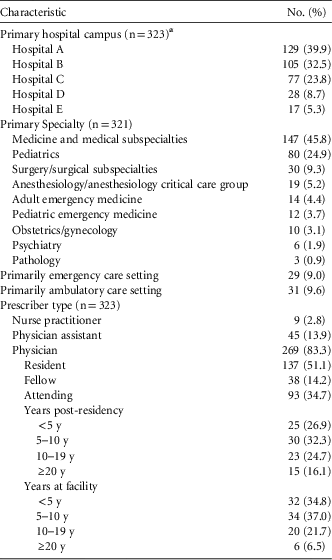
A total of 402 antimicrobial prescribers participated in the survey (response rate, ~16%), and 323 respondents provided their professional characteristics (Table 1). Respondents included 269 physicians (83%), 45 PAs (14%), and 9 NPs (3%). Among physicians, approximately half were residents (51%) and nearly half (46%) of respondents were from medicine and medical subspecialties.
Characteristics of Survey Respondents

NOTE. Responses were not mandatory, and some respondents skipped questions. Thus, the number of respondents varied among questions.
a 33 respondents worked at >1 hospital.
Attitudes Toward Antimicrobial Resistance and Antimicrobial Stewardship
Nearly all (99%) respondents agreed that antimicrobial prescribing practices impact resistance. Most (90%) agreed that improving one’s own prescribing practices reduces resistance, and nearly all (99%) agreed that subtherapeutic doses of antimicrobials can lead to antimicrobial resistance. Most respondents (92%) disagreed that new antibiotics in development will reduce the problem of antimicrobial resistance in the future.
Most respondents (89%) agreed that antimicrobial resistance is an important problem at their hospital and more than three-quarters of respondents (77%) believed that antibiotics are overused at their hospital. When asked questions about ASPs in general, most agreed that ASPs can decrease antimicrobial resistance (96%) and improve patient care and safety (94%). When asked specifically about their own hospital’s ASP, most respondents agreed that their ASP improves patient care and safety (90%) and optimizes treatment choices (87%). However, 32% felt that their hospital’s ASP delayed care, and 22% believed that it restricted their ability to prescribe their choice of antimicrobial therapy. Nearly half (45%) felt that they had not received adequate training regarding antimicrobial prescribing.
Confidence and Knowledge Related to Antimicrobial Prescribing
While 95% of respondents felt confident they know when to start antimicrobial therapy, 21% were not confident that they could choose the correct dose and interval, especially in patients with renal and/or hepatic dysfunction (38% lacked confidence). Additionally, respondents lacked confidence in selecting empiric therapy using the hospital antibiogram (30%), de-escalating therapy (17%), interpreting susceptibility testing results (24%), and determining duration of therapy (31%). Some respondents (14%) agreed that it is hard to deny antibacterial therapy to outpatients with presumptive respiratory viral infection.
Several knowledge gaps were identified. When presented a case of asymptomatic bacteriuria, respondents would sometimes prescribe antibiotics if the patient was immunocompromised (63%), had an indwelling urinary catheter (16%), or the organism was multidrug resistant (11%). For treatment of E. coli urinary tract infection (UTI) with provided susceptibilities, 29% chose an unnecessarily broad-spectrum antibiotic. Knowledge gaps related to the spectrum of activity of commonly prescribed antibiotics were identified. For example, 35% of respondents failed to correctly identify all agents with anaerobic activity from a list of 5 agents; 40% of respondents did not identify meropenem as having anaerobic activity; and 19% thought aztreonam had anaerobic activity. Similarly, 38% incorrectly selected cephalosporins as having activity against enterococci. Knowledge gaps related to oral bioavailability were also identified. Approximately half of respondents did not know that fluconazole (56%) and linezolid (45%) have equivalent oral and intravenous bioavailability. Overall, only 5 of 303 respondents (2%) that answered all knowledge questions answered all 7 of these questions correctly.
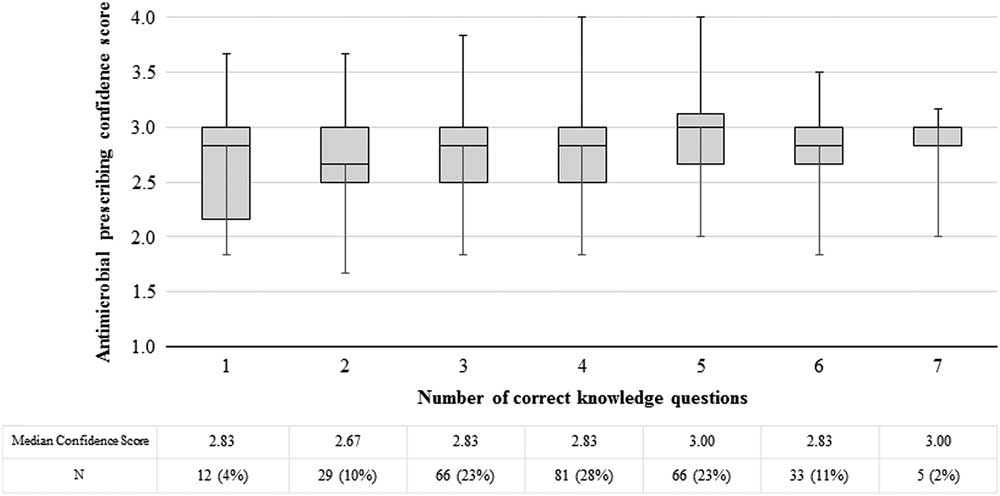
Prescriber confidence did not appear to be correlated with knowledge (Figure 1). Of respondents who answered all confidence and knowledge questions, respondents who correctly answered all 7 knowledge questions (5 of 292, 2%) had a median confidence score of 3.00 on a 1 to 4 Likert scale, while respondents who correctly answered only 1 knowledge question (12 of 292, 4%) had a median confidence score of 2.83.
Antimicrobial prescribing confidence versus knowledge of antimicrobial prescriber survey respondents. Antimicrobial prescribing confidence and knowledge were compared. A “confidence score” and a “knowledge score” were calculated for each respondent based on 6 confidence questions and 7 knowledge questions. Scores were based on the question’s Likert scale: scores ranged from 1 (least confident) to 4 (most confident). Only respondents that completed all 13 questions were included in this comparison (N=292).

Practices Associated With Selection, De-escalation, and Discontinuation of Antibiotic Therapy
For empiric selection of antibiotics, 32% ‘usually’ or ‘always’ liked to use the most broad-spectrum antibiotics possible. In a multiple-choice question regarding considerations when selecting an empiric antibiotic regimen, respondents most frequently considered covering all potential pathogens (92%), toxicity (70%), tolerability/side effects (47%), and emergence of resistance (42%). Nearly all respondents (99%) reported ‘sometimes,’ ‘often,’ or ‘always’ reviewing antibiotic appropriateness within 48–72 hours of initiation; but only 54% reported that they ‘always’ did so.
Attitudes About Antimicrobial Prescribing Resources and Education
Most respondents (74%) felt that discussion with ASP ID pharmacists was valuable. To guide antimicrobial management, respondents primarily use ID consultations (82%), web-based resources such as UpToDate (74%), and local web-based resources such as the hospital formulary and empiric treatment guidelines (73%). However, 23% of respondents were unaware of the treatment guidelines and 36% were aware of, but not familiar with, the guidelines. Respondents thought that the ASP interventions most likely to improve patient care were PPRF of antibiotic therapy within 48–72 hours of initiation (79%), consultations to assist with selecting an appropriate agent (69%), and an intravenous-to-oral conversion protocol (52%). At all 5 hospitals, the preferred methods to receive additional education about antimicrobial prescribing were computer-based training (52%), lectures (51%), and case-based discussions (43%).
Subgroup Analysis
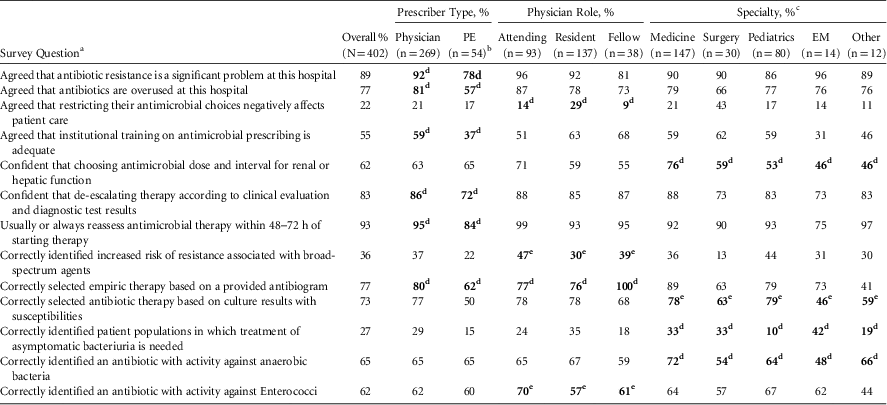
Table 2 shows the results of Likert-scale survey questions for which significant between-group differences were identified. “Physician extenders” included 45 PAs and 9 NPs. Physician extenders were less likely to believe that antibiotic resistance is a significant problem at their hospital (P=.04), that antibiotics are overused at their hospital (P=.01), and that institutional training on antimicrobial prescribing is adequate (P=.04). Physician extenders were also less confident de-escalating therapy according to clinical evaluation and diagnostic test results (P=.048) and less frequently re-assessed antimicrobial therapy within 48–72 hours of starting therapy (P=.04). In addition, in a case-based knowledge question, physician extenders were less likely than physicians to select correct empiric therapy using an antibiogram (P=.04).
Knowledge, Attitudes, and Practices of Antimicrobial Prescribers Related to Antimicrobial Stewardship for Likert Scale Questions

NOTE. PE, physician extender; EM, emergency medicine.
a Percentages in this table reflect the percent of respondents that agreed with the statement (“strongly agree” or “agree”) or that selected “usually” or “always” for frequency questions. Responses were not mandatory and some respondents skipped questions; Thus, the number of respondents varied among questions. Only those questions for which significant between-group differences were identified are included.
b Physician extenders included 45 physician assistants and 9 nurse practitioners.
c Medicine and surgery specialties include subspecialties. ‘Other’ includes anesthesia, obstetrics/gynecology, pathology, and psychiatry.
d Statistically significant difference within subgroups of P<.05.
e Statistically significant difference within subgroups of P<.001.
Residents were more likely than attending physicians and fellows to agree that restricting their antimicrobial choices negatively affects patient care (P=.03); they were also less likely to correctly identify the increased risk of resistance associated with use of broad-spectrum agents (P<.001). Fellows were more likely than attending physicians and residents to correctly select empiric therapy using an antibiogram (P=.02), while attending physicians were more likely than fellows and residents to correctly identify an antimicrobial agent with activity against enterococci (P<.001).
Respondents from medicine and medical subspecialties were more confident choosing antimicrobial dose and interval for renal or hepatic function than were respondents from other specialties (P=.003). Medicine and medical subspecialties and pediatrics respondents were more likely to select appropriate antibiotic therapy based on culture results with susceptibilities (P<.001). Respondents from pediatrics and ‘other’ specialties (including anesthesia, obstetrics/gynecology, pathology, and psychiatry) were less likely to correctly identify patient populations in which treatment of asymptomatic bacteruria is appropriate (P=.01). The ability to correctly identify an antimicrobial agent with activity against anaerobic bacteria also varied by specialty (P=.01).
General perspectives on antimicrobial resistance and stewardship were similar across hospitals (data not shown). However, there were variances in confidence choosing antimicrobial dose and interval for renal or hepatic function (P=.01), confidence de-escalating therapy (P=.01), ability to identify patient populations in which treatment of asymptomatic bacteruria is needed (P=.03), and ability to identify antimicrobial agents with similar intravenous and oral bioavailability (P=.01).
DISCUSSION
To our knowledge, this is one of the largest studies of the knowledge, attitudes, and practices (KAP) of physicians regarding antimicrobial stewardship and prescribing and the first to include PAs and NPs. This survey of 402 front-line prescribers also included various training levels and disciplines, which expanded our insights and helped us identify opportunities to enhance knowledge and improve prescribing practices in a large multihospital system. As described in similar studies, respondents generally recognized antibiotic misuse and antimicrobial stewardship as important issues,Reference Abbo, Sinkowitz-Cochran and Smith 14 , Reference Venugopalan, Trustman, Manning, Hashem, Berkowitz and Hidayat 16 , Reference Chaves, Cheng, Runnegar, Kirschner, Lee and Buising 17 and most had positive attitudes toward ASPs, both in their ability to increase appropriateness of antimicrobial prescribing and to improve patient care.Reference Venugopalan, Trustman, Manning, Hashem, Berkowitz and Hidayat 16 , Reference Stach, Hedican, Herigon, Jackson and Newland 19 However, some respondents, particularly residents, had negative attitudes toward ASPs because they thought ASPs delayed care and restricted autonomy. The survey also identified several specific and actionable deficiencies related to knowledge, prescribing practices, and awareness of available resources that can be addressed to improve antimicrobial prescribing at the study hospitals. Many of these deficiencies have also been identified in other studies.Reference Hermsen, Shull, Puumala and Rupp 12 – Reference Abbo, Sinkowitz-Cochran and Smith 14 , Reference Venugopalan, Trustman, Manning, Hashem, Berkowitz and Hidayat 16 – Reference Dyar, Pulcini, Howard and Nathwani 18
Awareness and use of existing resources were suboptimal, and some knowledge gaps were related to their interpretation and implementation. Opportunities to improve foundational knowledge were also identified. Overall, respondents were aware of these knowledge gaps; nearly half of prescribers indicated they had not been adequately trained in antimicrobial prescribing. However, comparison of confidence questions and case-based knowledge questions revealed that there was not a correlation between confidence and knowledge (Figure 1). Several significant differences were found in our subgroup analyses, suggesting that assessing KAP locally is needed to address specific educational needs and resource gaps, even within the same healthcare network.
In our survey, respondents desired education and expert assistance for optimal antimicrobial selection, dosing, and appropriate treatment duration. Drug selection and development of an intravenous-to-oral antibiotic conversion protocol, were perceived as helpful interventions. As in other studies, respondents indicated that PPRF would be a useful resource.Reference Venugopalan, Trustman, Manning, Hashem, Berkowitz and Hidayat 16 , Reference Stach, Hedican, Herigon, Jackson and Newland 19 For education, most respondents preferred computer-based training and lectures.
The strengths of this study include a relatively large sample size and the inclusion of a wide variety of prescriber types, experiences, and hospital settings, which increases the generalizability of the findings. The survey used in this study is included as Supplementary Material and may be used by other hospitals to identify local strengths and opportunities related to prescribers’ knowledge and use of antimicrobial agents. In addition, to our knowledge, this is the first study to examine KAP among PAs and NPs regarding antimicrobial prescribing in an acute-care setting. The results of this study, combined with those of another recent study that examined NP and PA antibiotic prescribing practices in an outpatient settingReference Sanchez, Hersh, Shapiro, Cawley and Hicks 20 and the expected growth of this prescriber group by 30% over the next decade,Reference Moote, Krsek, Kleinpell and Todd 21 , 22 suggests the need for education among this group of providers and additional research in this area.
This study has several limitations. Volunteer bias is possible because participation was voluntary and response rates were relatively low; however, the number of respondents was relatively large. Some specialties had lower response rates, and few responses were received from NPs, which limited the analysis of differences between certain subgroups. Many of the questions asked about self-perceived confidence, which can be challenging to assess and interpret. However, whenever possible, the confidence questions were checked for internal consistency against knowledge and practice questions. Some questions addressed clinical issues in adults rather than children and were therefore outside the clinical experiences of pediatric prescribers. Despite survey development by a multidisciplinary team, it is possible that some potential barriers were not assessed. In addition, unique outpatient antibiotic prescribing issues were not addressed. Although prescribers at 5 hospitals of various sizes and patient populations were included, the generalizability of the findings may be limited by the inclusion of hospitals from a single hospital system in a single geographic region and the predominance of responses from prescribers at large, tertiary-care hospitals.
As the problem of antimicrobial resistance continues to grow and to gain attention,Reference Kaki, Elligsen, Walker, Simor, Palmay and Daneman 23 – 25 the role that inappropriate use of antimicrobial agents plays in this public health crisis is being increasingly recognized. New requirements, standards, and recommendations related to antibiotic prescribing and ASPs are being developed appropriately. The results of this survey demonstrate that prescriber education is an important role of the ASP team and that there is no “one size fits all” approach to education. Understanding the facilitators of and barriers to appropriate antimicrobial prescribing within a healthcare facility and among prescribers is critical to the successful implementation of ASPs.
ACKNOWLEDGMENTS
Financial support: This study was funded by the New York State Department of Health (NYSDOH grant no. C028680) as a part of the Healthcare-Associated Infection Prevention Project. The NYSDOH provided research support but was not involved in study design, conduct, analysis, nor reporting.
Potential conflicts of interest: All authors report no conflicts of interest relevant to this article.
The data and conclusions reported here do not necessarily represent the opinions, interpretations, or policy of the State of New York.
SUPPLEMENTARY MATERIAL
To view supplementary material for this article, please visit https://doi.org/10.1017/ice.2017.317