Introduction
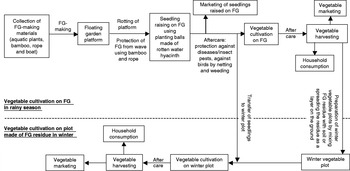
Floating gardening is an ancient practice of crop cultivation in the floodplains of the southern parts of Bangladesh (e.g. Gopalganj, Barisal and Pirojpur Districts)1. This form of hydroponics, or soil-less culture is comparable with cultivation techniques practiced in several parts of the world, e.g. by the Aztecs in Central America, in Kashmir in India and in southern Myanmar. In Bangladesh, plants, mostly aquatic, are used to construct thick, floating platforms on which seedlings are raised, and vegetables and other crops are cultivated in the monsoon (Fig. 1). In addition, the platform residue is used for winter vegetable gardening in preparation of beds or as bio-fertilizer. Floating gardening is known as baira, boor, gathua, geto, daap and gatoni in different parts of Bangladesh. Water hyacinth (Eichhornia crassipes) is the major component of floating garden platforms since it is one of the most common aquatic plants of the wetlands of Bangladesh1, Reference Haq, Ashaduzzaman and Ghosal2.
Flow-chart showing floating gardening and winter vegetable gardening traditionally practiced in Bangladesh (FG, floating garden).

Bangladesh is a land of water and wetlands. The wetland ecosystems are very important to the economy and lives of the people of the country, as their livelihoods and subsistence are very much linked with the productivity of wetlands. One important type of wetland in Bangladesh is haor, which is a large back swamp or bowl-shaped depression located between the natural levees of rivers, and usually consisting of a number of saucer-shaped depressions that retain water all year around. The haor areas of north-east Bangladesh are characterized by prolonged flooding, for about seven or eight months each year. The lack of cultivable land restricts agricultural activities to just the few dry months of winter. Lack of employment, and migration to other areas during the rainy season are common practices in the haor area. If a cultivation technique could be introduced to overcome the want of agricultural space in the rainy season, it would be likely to have an important beneficial influence on livelihoods.
Against this background, floating gardening could be considered as an important tool for poverty alleviation and food security for the people living in haor areas. This environment-friendly agriculture system can create local jobs in the wet season when job opportunities are limited, and it provides a use for the stagnant water that would otherwise remain unused during the monsoon. The technique can also increase the land-holding capacity of poor, landless people, who will be able to grow vegetables in the monsoon without substantial costs. Beside these, many other social, economic, agricultural and ecological benefits are associated with the practice of floating gardening1.
Despite long use in the southern floodplains, floating gardening was a completely new concept for the haor areas. The World Conservation Union (IUCN), Bangladesh Country Office therefore implemented a small-scale pilot project with CARE Bangladesh in 2005–2006 to introduce floating gardening and associated winter vegetable gardening in selected haor areas. The project was designed to contribute to the food security of targeted marginalized communities, and also to test the feasibility of floating gardening as an option for alternative livelihoods in vulnerable communities.
This paper documents the challenges faced in introducing this new agro-technique in the north-eastern wetlands of Bangladesh and the approaches taken to overcome challenges by increasing awareness and knowledge in the community. We also describe necessary adaptation of the technique specifically for the haor wetlands.
Project Area and the Target Community
Three villages (Adarshagram, Biddabhushan Para and Ghagrakona) of Baniachang 2 No. Uttar Paschim Union (longitude 91°22′ and latitude 24°33′) under Baniachang Upazilla of Habiganj District of Bangladesh were selected from the haor region of the north-east of Bangladesh. Out of a total of 388 households of the villages, 76% were identified as vulnerable, where selection criteria mainly included ownership of property such as land, a house, a boat, a fishing net, etc. A total of 21 vulnerable families (seven from each village) with 150 family members were selected for introduction and promotion of floating gardening and associated winter vegetable gardening.
The entire target population was landless, and almost all were illiterate. The population density (average 7 persons per family) and growth rate (average 5 children below the age of 15 per family) were very high3. The number of wage-earning members was between one and three per family. Wage-labor and fishing were the two most common jobs in the monsoon period (83%). In winter, the main jobs were wage-labor in agricultural fields followed by carpentry and fishing. The household daily income ranged from US$0.8 to 4.0 with an average of about US$2.0 per day, both in the monsoon and winter. Therefore, the annual per capita income was calculated as US$104; very low compared with the national per capita income of Bangladesh (e.g. US$482 in 2005–20064).
The society in general was conservative, and women were mostly engaged in housework. Potato (Solanum tuberosum) was considered as the staple vegetable, but leafy and fruit vegetables were obtained seasonally from local markets. Despite being wetland dwellers, people frequently had to buy fish from these markets. Although people knew that buying vegetables was much more expensive than growing them at home, homestead vegetable gardening was very limited.
Challenges
The pilot project focused on the livelihood and nutritional support of the marginalized populations. A number of challenges were identified at the beginning. These were:
1. Convincing the target community to take up floating gardening—an entirely new agricultural technique to them.
2. Assessing the availability of plant materials (e.g. water hyacinth) for construction of the floating platforms or, alternatively, identifying suitable materials to build the platforms.
3. Suggesting an appropriate floating platform size for the haor, keeping in mind the hydrology, social conditions and natural resources of the area.
4. Protecting the floating gardens from wave-action, using locally available materials.
5. Selecting appropriate crops and husbandry for maximum benefit from the initiative.
6. Promoting appropriate, low-cost techniques for balancing costs and benefits.
Methods
Rapid rural appraisal (RRA) was used for scoping floating gardening in haor. A questionnaire survey was carried out at the beginning of the project using a tested format mainly to establish the baseline of existing vegetable consumption and gardening in the monsoon and winter. Group and one-to-one discussions were conducted to encourage communication among the target communities about floating gardening, and training programs were organized. The project team monitored the activities of the floating gardeners at the field level on a regular basis. Fortnightly and per-visit reports by the project staff were useful in tracking the tangible and intangible changes taking place in the field. The impacts of the initiative were assessed at the end of the project with three separate questionnaires that collected input–output data and information on community dynamics, along with other issues.
Pre-project Vegetable Consumption and Gardening Scenario
A total of 30 different types of vegetable were consumed, cultivated and bought by the targeted families. Potato, eggplant (Solanum melongena), snake gourd (Trichosanthes anguina), ridged luffa (Luffa acutangula) and bottle gourd (Lagerneria siceraria) were the top five vegetables consumed by the villagers in the monsoon period, whereas potato, eggplant, tomato (Lycopersicon esculentum), hyacinth bean (Lablab purpureus) and amaranth (Amaranthus tricolor) were used in winter. Cauliflower (Brassica oleracea var. botrytis) and cabbage (Brassica oleracea var. capitata) were the other two major vegetables bought in the cold season. On average about US$0.30 was spent by each household per day to buy vegetables from the market.
Almost all surveyed households cultivated one or more vegetables in both seasons in the limited space in their homesteads and had been doing so on a limited scale, on average, for more than 10 years. The most common cultivated species in the monsoon were snake gourd, ridged luffa and amaranth, and in winter tomato, eggplant, hyacinth bean, potato and amaranth. Scarcity of land, lack of knowledge and infertile soil were identified as the main reasons for not undertaking extensive homestead vegetable gardening.
Most of the people grew vegetables only to meet their own needs, without any intention to sell but, when sold, most vegetables were bought by others living in their villages or by traders coming to the villages to buy their products. The respondents of the survey identified long distance of transportation, high transport costs and shortage of labor as the major constraints in marketing of vegetables.
Preparing the Communities
A number of measures were taken to prepare the communities for the project.
1. A total of 20 awareness meetings were organized at the project site to discuss floating gardening cultivation. Each meeting was attended by 10–25 villagers, of whom 70–100% were women.
2. The communities with enhanced awareness were organized into three Floating Garden Groups, each consisting of seven members (average male:female ratio=3:4) who met regularly.
3. One formal training session on floating gardening and associated winter vegetable gardening was organized for all 21 participants. Topics included collection of platform-making materials, preparation of the floating garden and its protection from wave-action. Appropriate species for cultivation were suggested, and guidance was given for raising of seedlings and their transfer to the floating platforms, after-care, protection against birds and other pests and crop harvesting. A training manual was prepared in the national Bangla language, and all Floating Garden Group members were provided with individual on-site training during preparation of their floating platforms in the monsoon of 2006.
4. To gain further experience, 20 participants visited the southern Bangladesh districts (Pirojpur, Madaripur and Gopalganj) where floating gardening has been traditionally practiced.
Floating Gardening in the Monsoon
Floating platform preparation
A total of 28 floating garden platforms were prepared in the monsoon of 2006, of which 25 were prepared by the Floating Garden Group members and three by non-target villagers who had been inspired by the activity of the project. Most of the families (c. 70%) prepared one platform; but two to four platforms were made by some members. The average length of the freshly prepared platforms was 4.6 m, width 1.4 m and height 1.1 m. The height decreased significantly to about 0.5 m after 2–3 weeks, when the platform had rotted and was ready to cultivate. The area of the platforms ranged from 3 to 33 m2 with an average of 7 m2. Generally, gathering of water hyacinth began 4.5 weeks before platform preparation.
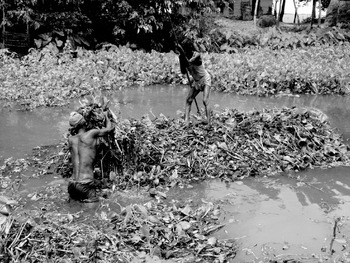
The time taken to construct a platform varied from 0.5 to 6 person days (1 person day=8 h), with a mean of 2.5 person days. In almost all cases, construction was intermittent, often being spread over a period of 7–10 days. While making the platforms, the gardeners were assisted by family members, relatives, neighbors or laborers (Fig. 2). Mostly (66% of cases), sons and husbands helped their parents and wives, respectively, in the construction.
A neighbor (in water) is helping a floating gardener to prepare a garden in Ghagrakona, Habiganj. (Photo: Haseeb Md Irfanullah, IUCN Bangladesh.) (Figure can be viewed in color in the Supplementary Materials for the online version of the paper)

The floating platforms were always sited near the gardener's house in shallow water (maximum depth 2 m). All sites were inundated during the monsoon and dried out in winter, when vegetables were cultivated in areas potentially suitable for winter gardening. In terms of the availability of water hyacinth, 21 floating platforms were prepared at sites where the plant was easily available, but in seven cases, people had to collect water hyacinth by manually operated country-boat from further away, taking about 20 min.
Vegetable cultivation
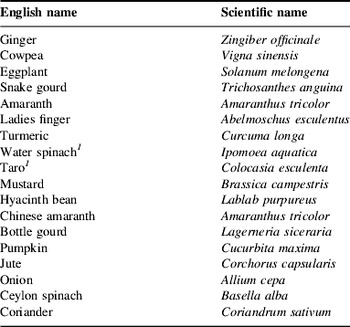
A total of 18 different kinds of vegetable or spice were cultivated on the floating platforms (Table 1). Bottle gourd, amaranth and pumpkin were the three most common species, being cultivated on more than 70% of the platforms. The seeds used were either bought from local markets (50%) or came from personal supplies, however, seeds of the top three cultivated vegetables were mostly (approx. 65%) bought from the market.
Vegetables and spices cultivated on floating gardens in the monsoon of 2006 in Habiganj.

1 Saplings collected from nature.
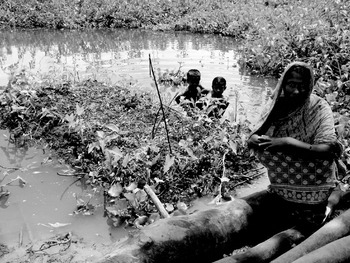
In the case of vegetables with large seeds, like bottle gourd, pumpkin and bean, one seed was first inserted in a small, semi-moist ball made of rotten water hyacinth. These balls were then placed in shade on the ground and kept moist. Once the seedlings were about 7 days old, the balls containing seedlings were transferred to the floating platform and placed about 30 cm apart. Small seeds, such as amaranth and jute, were spread directly on the platform. Taro and water spinach were collect from the wild and planted on the edge of the platform. On most floating gardens, one to five vegetable varieties were cultivated, but the maximum number was eight (Fig. 3).
A female floating gardener by her floating platform, Adarshagram, Habiganj. (Photo: Haseeb Md. Irfanullah, IUCN Bangladesh.) (Figure can be viewed in color in the Supplementary Materials for the online version of the paper)

Certain vegetables, e.g., amaranth were harvested 3 weeks after sowing. Taro and water spinach were harvested after a few weeks. Other vegetables required months before harvest of the first fruits. The monsoon of 2006 was not typical, and the water receded very quickly (see below). Hence, winter gardening methods became necessary even in October.
Protecting the floating platforms
Physical damage
A number of options were tested for protecting the platforms from physical damage due to wave-action or drifting. All were found suitable, depending upon the intensity of wave-action. Four common methods were:
1. Erecting bamboo sticks in the mud at regular intervals around the platform.
2. Inserting a bamboo pole in the middle of the platform. Sometimes rope or string was used to tie the pole to the bank.
3. Aligning the platform parallel with the bank, then restraining it on the open side with a floating banana trunk or thick bamboo pole, loosely tied to a tree on the bank.
4. Planting taro along the edge of the platform so that the dense taro root system bound and strengthened the platform.
Damage caused by biological agents
Birds (chickens and ducks), cows, rats, monitor lizards, insect pests and diseases can all cause damage to the crops grown on floating gardens. However, most of the participants did not consider it necessary to take any measures to protect their crops. Several farmers erected fences made of bush morning glory (Ipomoea fistulosa) stems around the platform edges, or used netting to protect the produce from bird-attack. Planting of taro densely around the edges also served the same purpose. When the water receded, cattle could reach the crops, necessitating the erection of fences. No measures were specific for protection from rats or monitor lizards, but fencing or netting could offer some protection against these species. The farmers were encouraged to use integrated pest management techniques. Ash was used by some farmers to protect seedlings and plants from pests, and only one member used chemical pesticides.
Winter Gardening with Floating Garden Residues
When the water receded, the farmers broke up the semi-moist floating platforms and mixed the residue with the soil for winter vegetable gardening. During the trials, seven plots were made by seven farmers using floating platform residues. The average area was 120 m2 per plot. Common species of vegetables cultivated on the plots were tomato, spinach, potato, sweet potato and chillies. Harvests in February 2007 were good.
Input–output Analysis
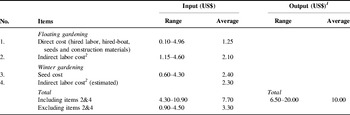
Direct monetary investments in floating gardening were for seed purchase, hire of labor and boats, and the purchase of construction materials like bamboo and rope (Table 2). However, there were a number of additional indirect costs, such as for labor by the Floating Garden Group members and their families, and for bamboo or seeds taken from their own stocks. These costs should be considered when analyzing budgets. It should be noted that, in most cases, the family members worked on the floating or winter vegetable gardens in their spare time, and women engaged in platform-making had not been otherwise involved in income generating activities. Therefore, in almost all cases the farmers did not have to give up their regular jobs for floating gardening. Most of the floating gardens required low labor inputs (Table 2).
Input–output matrix for a single floating garden (surface area 7 m2) and associated winter garden plot (120 m2), 2006–2007. Cost as in February 2007 (US$1=70 Taka).

1 Harvest over 150 days.
2 Includes the cost of labor provided by the ‘Floating Garden Group’ members and their family members.
The monetary value of the vegetables or seedlings produced on the floating garden platforms was calculated. If indirect labor expenses were excluded, the average income (estimated from produce) over 5 months (floating gardening and winter gardening) was about three times that of the total expense.
Impacts of Floating Gardening in Haor
On social dynamics
One of the important successes of the floating gardening and associated winter gardening initiative was its positive impact on social dynamics. The communities of the project site as a whole were optimistic about the floating gardening initiative from its inception. Those who learned about floating gardening through the awareness and capacity building programs were enthusiastic in sharing the technique and the benefits with others. People's perception improved greatly over time. Neighbors helped each other in preparation of platforms when help from family members was not available. People also gave their garden produce to their relatives and neighbors, thus improving social linkages among families.
Community dynamics in terms of gender balance was also noteworthy. In the pilot study, about 60% of the Floating Garden Group members were women, and a good number of the family members, relatives or neighbors who helped in platform preparation were women. Gender balance was also ensured in the training and awareness programs, and for the visits to the southern floating gardens (40–50% women). In all the villages, husbands were very positive towards their wives' participation in the gardening and associated project activities. Moreover, when female members could not attend training events or visits for personal reasons, their spouses came forward to represent the families.
On nutritional security
The project increased food availability at the household level, as envisaged by the project. Most of the products (70%) were consumed by the families, with 14% given to relatives and neighbors and 16% sold to local buyers. Although not assessed, the increased vegetable consumption, in turn, is likely to have had a positive effect on the health of targeted households.
On livelihoods
In the first year, from a floating garden of 7 m2 and a 120 m2 winter garden plot, US$10 was added to household income during the 150 days of the project (Table 2). Floating gardening and associated winter gardening has therefore demonstrated its potential to be a good supplementary income option for haor, year round.
On land-holding capacity
Through floating gardening, people of the project area made productive use of the stagnant waters adjacent to their homes, which would otherwise remain unutilized in the rainy season. The floating platforms increased their land-holding capacity without significant cost. For the poor, marginal, landless people of the project site, enhanced land-ownership, although for a short period of time in monsoon only, meant a lot to them and created significant social impacts. Depending upon the size of the homestead, floating gardens with a total area of 20 m2 can increase land ownership by 2–10% during the monsoon.
Limitations of Floating Gardening in Haor
Despite the encouraging impacts on livelihoods and food availability, a few constraints were encountered in some haor villages. The farmers were encouraged to share their problems, and most of them mentioned loss of seeds and seedlings owing to torrential rain. Collection of water hyacinth was an important problem for some farmers if there were not enough plants nearby, since they had to hire or borrow boats from neighbors in order to gather enough plant material. Other constraints cited were a lack of help to prepare the floating platforms, damage to the platforms by waves and problems with weeds. Just one or two respondents mentioned problems with hot weather, high labor costs, monitor lizards and collecting seed.
Furthermore, it was found that the time required for platform preparation ranged widely and was often longer than expected primarily because of variations in water hyacinth availability, the number of people involved and the size of the platform.
There was only one rainy season during the pilot project (2006) and it was unexpectedly rainless, causing a rapid decrease in water level in the haor. This caused difficulties for the farmers who made their platforms in July in shallow waters next to their houses in the expectation of an increase of water depth to 1 or 2 m. In a few cases, the water receded by early September and, as a result, it was not possible to conduct reliable tests of the protective measures against wave-action.
At the beginning of the project it was envisaged that disputes might arise over land or water tenure issues, but as the pilot study was on a limited scale, with mostly one or two platforms per family, there was little scope for conflicts over land or water.
Only one–third of the gardeners made winter vegetable gardens using floating garden residues in 2006–2007. There were two main reasons: lack of sufficient land in and around the homestead and failure to take out a lease on land elsewhere, individually or collectively.
Comparison Between Floating Gardening in Southern Bangladesh and in Haor
The size of platform promoted in haor by the present initiative was much smaller than that traditionally practiced in the southern floodplains of Bangladesh, where platforms are 15–55 m long and 2 m wide. There were several reasons for using smaller platforms in the haor area, which is very different from the stagnant, calmer floodplains of the south, where water hyacinth is abundant.
• Shorter, thicker floating platforms were expected to be more resistant to wave-action and drifting.
• Narrower platforms were suggested so that they could be maintained from a boat or from the bank of the water body. This reduced the need for a farmer to stand on the platform, thus making it weaker and prone to wave-damage.
• Availability of water hyacinth was not equal in all the villages.
Nevertheless, those who made floating platforms in late July made larger platforms using bigger water hyacinths in relatively calm water.
Demand for seedlings is different in the two areas. In southern Bangladesh (e.g. Pirojpur District), there is large-scale seedling production and marketing, and returns are good and rapid but in the haor area, demand for seedlings is low.
Areas to Explore
The main target of this small-scale, pilot study was to meet household demands for vegetables, and thus the scope for marketing of produce was limited. Some gardeners, however, sold floating garden and winter garden produce, which comprised about one-sixth of total production up to February 2007. Large-scale vegetable seedling production, a profitable practice in southern Bangladesh, would not be feasible in the haor without detailed market assessment. On the other hand, there is good scope for selling vegetables in the local markets, as well as in nearby niche markets in the towns. Vegetables like amaranth during the monsoon, and potato, sweet potato and tomato in winter could easily be sold in the local markets. In the study, most of the bottle gourd and pumpkin seedlings raised on the floating platforms did not survive because of the unusual monsoon, but the potential should be explored for cultivation of these varieties as winter vegetables, along with cabbage and cauliflower.
Floating gardening is not suitable for all the haor villages in Bangladesh, but it could be promoted in those haor areas where water hyacinth is easily available on the sheltered sides of the villages. Stagnant, polluted water with water hyacinth should, however, be avoided because of the potential risk of infectious diseases.
The visits to working floating garden systems in the south of the country were found to be very effective in teaching this novel technique, and could be included in any similar pilot study or future extension of the idea.
The involvement of existing community-based organizations (CBOs) could be explored in relation to the longevity of similar pilot initiatives. In the present project, CBOs of the SHOUHARDO (Strengthening Household Ability to Respond to Development Opportunities) Program of CARE Bangladesh were considered. A good relationship with the local government office (Union Parishad Office) was found to be very useful in introducing the novel agricultural technique to local marginalized people.
The project has indicated considerable potential to introduce floating gardening to other haor areas of Bangladesh, and promises to continue improving the food security and livelihoods of people living in haors.
Floating Gardening for Aquatic Weed Management
In many countries of the world, water hyacinth is a major invasive alien species causing serious problems in the water systemsReference Howard and Matindi5. Over the past two decades or so, severe environmental, social and economic impacts of water hyacinth infestation have been estimated for many Asian and African countriesReference Mukhopadhyay and Hossain6–Reference Williams, Duthie and Hecky11. The management of water hyacinth has included mechanical, chemical and biological measures. Of these, biological control using weevils and moths has been practiced successfully in many African countries as an environment-friendly measureReference De Groote, Ajuonu, Attignon, Djessou and Neuenschwander8, Reference Hill and Cilliers12–Reference Wilson, Rees and Ajuonu14. Biological control, however, might not always be successful in controlling water hyacinthReference Williams, Duthie and Hecky11, Reference Ogwang and Molo15, and the risk of resurgence is always on the horizon.
In addition to environmental concerns from their use, physical and chemical control methods are expensive and have to be repeated every year, hence developing countries often cannot afford to support such measuresReference Woomer, Muzira, Bwamiki, Mutetikka, Amoding and Bekunda16, Reference Ingole and Bhole17. Another way to potentially control invasive aquatic plants like water hyacinth, water lettuce (Pistia stratiotes) and salvinia (Salvinia molesta) could be utilization of the weeds for financial gainReference Ingole and Bhole17, Reference Sinkala, Mwase and Mwala18. This could involve energy productionReference Gunnarsson and Petersen19, use in agriculture as biofertilizer, or as a nutritious growing medium for mushroomsReference Sinkala, Mwase and Mwala18–Reference Murugesan, Vijayalakshmi, Sukumaran and Mariappan20, however, this type of use in local communities has been uncommonReference Sinkala, Mwase and Mwala18. As shown in Bangladesh, participatory approaches through CBOs such as the Village Development Committee could be a good option for management of natural resources, including aquatic weeds1, Reference Uchida and Ando21, 22.
Floating gardening using aquatic weeds could be a useful method of managing aquatic weeds while improving the local food supply and economy, and improving the environment as a whole. It holds particular promise for the African large water bodies (e.g. Lake VictoriaReference Opande, Onyango and Wagai10) where water hyacinth is a serious nuisance, and could contribute to a better nutritional balance for people whose diet often depends on just fish. Floating gardening is a simple means of vegetable gardening on water, however, pilot studies are essential in order to develop country- and ecosystem-specific gardening systems that include evaluation of platform-making materials, measures for protection of platforms and crops against physical and biological stresses, the marketing of produce and overall sustainability of the initiative.
Acknowledgements
The paper documents an action research pilot project jointly implemented by IUCN Bangladesh and CARE Bangladesh funded by USAID under the SHOUHARDO Program. We thank Ainun Nishat and Raquibul Amin of IUCN Bangladesh, and Faheem Y. Khan of CARE Bangladesh for their advice during the implementation of the project. Shukla Tagore of CARE Bangladesh and Saifur Rahman Chowdhury of IUCN Bangladesh were extremely helpful in the field. Thanks also due to Tom Barker of the University of Liverpool, UK for his useful suggestions on the manuscript.