Introduction
Music festivals, including electronic dance music events (EDMEs), are increasingly common. Since the 1980s, with breakthroughs in the technologies supporting electronically engineered music, the growth of EDMEs has been exponential internationally. Part of a US $4.5 billion industry annually, the target audience is youth and young adults aged 15-25 years.Reference Carmichael 1 - Reference Weir 5
Raves, the origin of the EDME movement, are all night dance parties featuring electronic music, typically held in venues not intended for that purpose.Reference Weir 5 Raves occurred “underground” in venues not intended for large crowds or purpose built for events; admission charges were often low (eg, US $5).Reference Madert 6 Electronic dance music events were created as the rave music scene moved out of the underground and into licensed establishments.Reference Johnson, Voas and Miller 7 - Reference Chinet, Stephan, Zobel and Halfon 9 At the present time, with special event infrastructure including alcohol sales, security, toilets, catering, and health services, admission charges can run to over US $100 per day.Reference Furr-Holden, Voas, Kelley-Baker and Miller 8
Documented risks of EDMEs include: alcohol overuse;Reference Johnson, Voas and Miller 7 drug use;Reference Furr-Holden, Voas, Kelley-Baker and Miller 8 , Reference Johnson, Voas, Miller and Holder 10 , Reference Van Havere, Vanderpalasschen, Lammertyn, Broekaert and Bellis 11 drug overdoses related to the use of 3,4-methylenedioxy-N-methylamphetamine and related compounds, gamma-hydroxybutyric acid,Reference Box, Prescott and Freestone 12 as well as other drugs;Reference Britt and McCance-Katz 13 driving accidents;Reference Furr-Holden, Voas, Kelley-Baker and Miller 8 and mass-casualty incidents.Reference Soomaroo and Murray 14 Music festivals may be higher risk than other types of events that involve young people gathering in large numbers. Over the last 15 years, mainstream media sources have reported at least 68 deaths attributed to drug overdoses/poisonings in the context of music festival attendance (Table 1).Reference Romero 15 - Reference Boles 48 The true extent of the mortality burden is currently unknown. Non-substance related deaths (ie, homicides, drowning, and trauma) were excluded from analysis.
Overdose/Poisoning-related Fatalities at Music Festivals

Accordingly, emergency physicians are becoming increasingly familiar with the type of patient presentations associated with large EDMEs. Health care professionals involved in the provision of on-site care at large music festivals and EDMEs experience first-hand the range of clinical presentations at these events, and researchers are just beginning to document the illness/injury burden and case-mix associated with this category of event.Reference Ter Bogt and Engels 3 , Reference Weir 5 , Reference Johnson, Voas and Miller 7 , Reference Furr-Holden, Voas, Kelley-Baker and Miller 8 , Reference Johnson, Voas, Miller and Holder 10 - Reference Box, Prescott and Freestone 12 , Reference Dutch and Austin 49 , Reference Molloy, Brady and Maleady 50 Because of risk profile of EDMEs, on-site medical care is sometimes provided and various authors have argued that health services should be on site;Reference Scott 51 however, little is known about the impact of different models of on-site care, ranging from first aid (FA) only to higher level of care (HLC) multidisciplinary teams, which may include advanced care paramedics, nurses, psychiatric nurses, drug counselors, nurse practitioners, physicians, and others.
Given substantial acute care costs, an international problem with emergency department (ED) overcrowding,Reference Bond, Ospina and Blitz 52 - Reference Lund, Turris and Bowles 56 ambulance offload delay, and ever increasing numbers of ED visits, the authors of this study wondered about the degree to which mass gatherings in general, and EDMEs in particular, impact the health care system. Lund, Turris, and Bowles recently published on the consumptive and disruptive effects of mass gatherings on baseline health care services.Reference Lund, Turris and Bowles 56 The present report is an extension of that work.
The authors hypothesized that the on-site presence of a team of HLC providers (including emergency physicians) would mitigate the impact on local EDs since appropriate patients could be assessed, treated, and monitored on site while they recovered from the effects of mild to moderate overuse of alcohol or recreational drugs.
Research Question(s)
In the present study, the authors investigated the following questions:
-
1. On site, what are the case mix (including acuity) and patient presentation rates (PPRs) per 1,000 attendees?
-
2. What are the ambulance transfer rates (ATRs) per 1,000 attendees for both a FA model and a HLC model (ie, clinical monitoring, diagnostic decision making, and critical care experience)?
Methods
Outcomes of interest for this study included: PPRs, case mix, medical interventions required, and ATRs.
Case Mix and Patient Presentation Data
Data for this study were drawn from the University of British Columbia (UBC) Event and Patient Registry, out of the Department of Emergency Medicine at UBC. 57 Ethics approval was obtained through the UBC Research Ethics Board.
During the event, documentation (ie, patient encounter form [PEF]) was reviewed by researchers on site (ST and AL) in a timely fashion. As each form was completed (ie, upon discharge or transfer of the patient), it was reviewed, missing fields (if applicable) were identified, and the form was returned immediately to the provider for completion.
Registry data were extracted from PEFs on an ongoing basis throughout the event. Data were entered by volunteer medical students who received a standardized orientation to data entry and were overseen directly by a research program manager (KL) familiar with the architecture and unique fields of the Registry.
Inclusion and Exclusion Criteria
Cases were included if an individual presented for medical care to the main medical tent on site at the event. Cases were excluded if individuals presented to the main medical tent for reasons other than health care issues (ie, directions or looking for a friend).
Ambulance and Transfer to Hospital Avoidance
Determination regarding disposition (ie, hospital transfer or treat and release) was made on a case-by-case basis and data about the disposition were recorded as described below:
-
1. First aid attendants (FAA), first contact on all patients at the event, assessed each patient and determined whether s/he was “first aid only” or required HLC.
-
2. All patients beyond FA “treat and release” were vetted through an on-site HLC team, which was co-located with standby ambulance resources.
-
3. The most responsible health care provider for each patient (ie, FAA, nurse, nurse practitioner, or physician) indicated in a data field on the PEF whether or not the care provided at the event prevented transfer to the hospital for additional care.
-
4. All transports were coordinated through the HLC team and on-site ambulance command.
Results
Event-related Variables
Ticket costs (regular/VIP) were US $125/$190 for a single day or US $220/$270 for both days. On the first day, attendees were in line for up to four hours prior to entering the venue due to security screening procedures. The temperature outside was 4.6°/4.9° Celsius (40.3°/40.8° F), the weather was overcast, and attendees were “in costume” (ie, many were underdressed for the ambient temperatures). 58
The venue for the 2-night EDME was covered and bounded and took place in a large Canadian city. For the present event, the floor of the 50,000+ person venue was overlaid with interlocking, plastic, flexible flooring. The event took place primarily on a 15,000 square foot floor and there were four half-sections of seating open to the spectators (just under 3,000 seats). Spectators on the floor were standing or dancing; no seating was available on the floor.
The lighting was low, with the exception of stage show lighting in the blue and green color spectrum and intermittent strobe lighting, which made the preservation of night vision impossible. Sound regularly registered at 95-100 decibels on the floor. Fog was present intermittently throughout the event, generated by the event special effects team.
Alcohol was available on an “open carry” basis (ie, one drink at a time sold to individuals 19 years of age or older and exhibiting no evidence of intoxication). Food was available for purchase on site, and potable water was available from venders roaming the floor, in vending machines, and from bathroom taps.
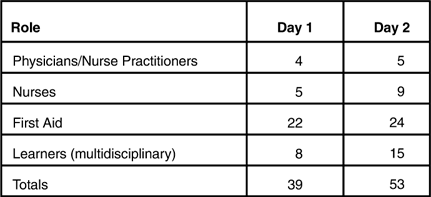
In terms of venue health and safety services, certified FA services were on site, consisting of providers operating out of a permanent purpose-built FA room located within the building in the outer ring of the venue, adjacent to the event. An additional contracted team of HLC providers (Table 2) was on site in a temporary clinic setting on a loading dock within the venue, adjacent to the event floor. Contracted stand-by paramedics staffed the event with three stand-by ambulances (including one non-transport equipped ambulance geared for event communications and logistical support). Additional police were on site, as were venue and additional contracted security services.
On-site Health Care ProvidersFootnote a

a Excludes operations/logistics/communications staff.
Patient-related Variables
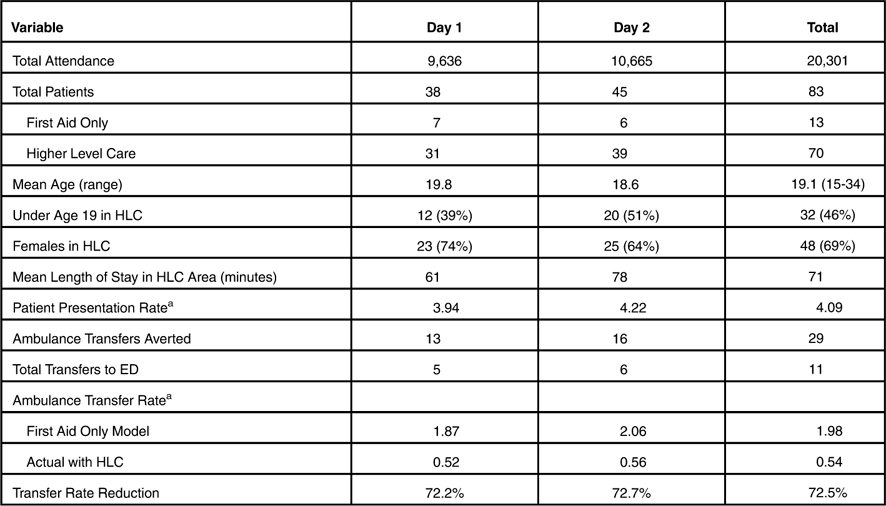
The 2-day event drew thousands of attendees on both nights. The demographics of patient groups on Day 1 and Day 2 were similar, as were the PPRs and the ATRs. Females presented more commonly than males. The number of under-aged patients (ie, less than 19 years of age) was slightly higher on the second night. Patient demographics, PPRs, and ATRs are reported in Table 3.
Demographics, Case Mix, PPR, ATR, and Ambulance Transfers Avoided

Abbreviations: ATR, ambulance transfer rate; ED, emergency department; HLC, higher level of care; PPR, patient presentation rate.
a Per 1,000 attendees at event.
For the HLC team, the majority of patient encounters (n=55/70; 79%) involved assessment and treatment for drug and alcohol overuse. Dimenhydrinate (n=14) was the most common medication administered (Day 1, four doses given by injection, one dose intravenously; Day 2, three doses orally, two doses by injection, and four doses intravenously). Acetaminophen (n=1), lorazepam by injection (n=1), and ibuprofen (n=1) were also given. A total of nine intravenous starts for volume or parenteral access were required (Day 1, n=3; Day 2, n=6).
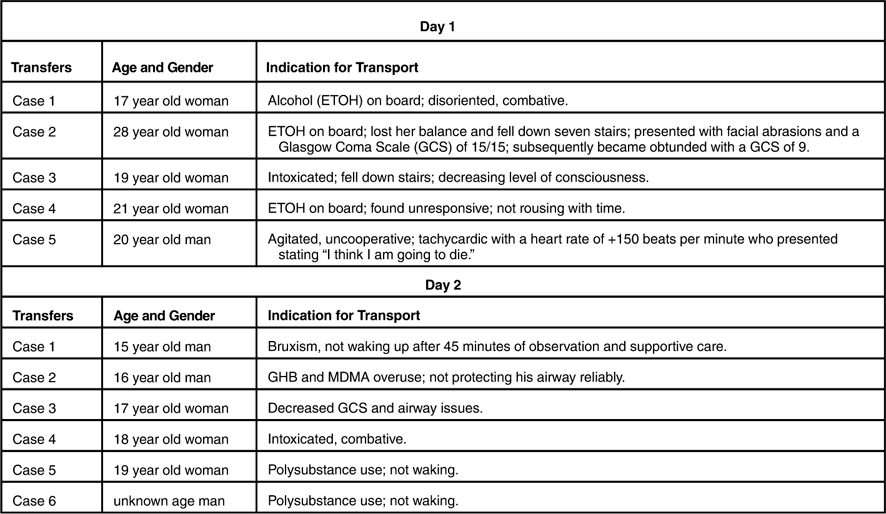
Ambulance transfer and ED avoidance were determined when a patient who would have been transferred in a FA only model was transferred to the HLC team, and the HLC team was able to provide the required level of care on site, most commonly, pending patients’ recovery from the acute effects of alcohol and/or substance use. Of note, the last two transfers each night occurred because less than an hour of on-site medical coverage remained and the patients were judged to need more than an hour to recover from the effects of alcohol and substance overuse (Table 4). For each transfer to the hospital, a phone report was called to the receiving ED and a copy of patient documentation was sent with the patient, accompanied by paramedics.
Details of Transfer to Hospital Cases

Abbreviations: ETOH, alcohol; GCS, Glasgow Coma Scale; GHB, gamma-hydroxybutyric acid; MDMA, 3,4-methylenedioxy-N-methylamphetamine.
Venue FA staff called no ambulances due to the on-site presence of the HLC team. Venue FA staff reported they would not have the capacity or mandate (eg, space, personnel, or policies) to “watch and wait” for the resolution of symptoms in a large number of patients with decreased levels of consciousness. Therefore, in the absence of the HLC team, they would have called emergency services (eg, 911 or equivalent service) for patients who were not “treat and release.” The presence of an on-site HLC team had a significant positive effect on avoiding ambulance transfers.
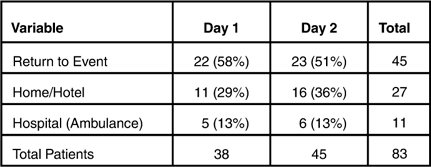
The majority of patients seen were able to return to the event after being assessed, treated, and observed (Table 5). Those who returned to the event were discharged in the care of a responsible (ie, non-intoxicated) friend or parent; patients who returned to the event were encouraged to come back to the medical clinic on an as-needed basis. No patients seen returned for a second encounter with the HLC team.
Patient Disposition

Discussion
Patient Presentation Rates, Case Mix, and Health Services Utilization
Mass gatherings in general, and EDMEs in particular, can have a substantial impact on the local health care system. There are scant reports in the medical literature regarding EDMEs, yet deaths and adverse outcomes are published repeatedly in the media.Reference Romero 15 - Reference Boles 48 In the context of an EDME, Molloy and colleagues documented 39 ED visits in a 24-hour period, requiring nine admissions, two readmissions, and 25 interventions, including intravenous fluids, suturing, joint reductions, and casting. Violence at this event also resulted in eight stabbings, four of which required chest tubes. There were two deaths associated with this event.Reference Molloy, Brady and Maleady 50
Drug and Alcohol Use
Recreational drug and/or alcohol use was a factor in 79% of cases (55/70) in the present study. Similarly, a retrospective review of ED visits related to a large summer music festival in Ireland documented a 94% incidence of alcohol and/or drug use as a co-factor for patients transferred to the ED from a music festival. In contrast, Krul collected data prospectively, over a 4-year period, from a series of indoor and outdoor EDMEs in the Netherlands.Reference Krul, Sanou, Swart and Girbes 59 He reported just over one-quarter of patient presentations were related to recreational drug use.
The difference in reported rates of drug and alcohol use is stark. It is possible that attendees in the Netherlands did not disclose drug or alcohol use, or it was not captured as an independent variable in the charting. Further, as the present study occurred at an indoor venue, it is possible that there were fewer “simple first aid” presentations (ie, heat exposure, sunburns, wounds, and insect envenomations) that are common in outdoor, multi-day festival environments.
More likely, the difference may have been due to the practice of “preloading” with alcohol (ie, drinking before entering the event grounds).Reference Hutton and Cusack 60 Similarly, Merlo and colleagues described “tail gating,” which involves drinking in the parking lot before attending a dry college football game.Reference Merlo, Ahmedani, Barondness, Bohnert and Gold 61 Preloading and tailgating may be a risk for under-agers who would have a more difficult time obtaining alcohol within the venue.
Ambulance Transfer and ED Visit Avoidance
There is increasing support for mandating on-site medical teams at events.Reference Hutton and Cusack 60 , Reference Merlo, Ahmedani, Barondness, Bohnert and Gold 61 In the present study, hospital referrals occurred at a rate of 13.3% of patients presenting to the HLC medical team. In terms of reducing ATRs, a single study was identified. Dutch and Austin described the deployment of a HLC team for a series of EDMEs in Australia. They reported on 61 cases of gamma-hydroxybutyric acid intoxication and found a 64% reduction in ambulance transfers to hospital due to the HLC team, which is similar to the 72.5% rate reported in the present study.Reference Dutch and Austin 49
Recommendations
Based on the results of this study, the authors recommend:
-
1. Replication Using a Control Group:
-
The present study provides a “snap shot” of a single EDME. Examination of a series of similar events, employing a cohort or control group design, would allow researchers to explore prediction models vis a vis clinical presentations and health care burden.
-
-
2. On-site Medical Teams:
-
Electronic dance music events can have an impact on the Emergency Medical Services and EDs in the host community. On-site support with safe monitoring capacity for mild to moderately intoxicated individuals may reduce the rate of transport and the number of ED visits. Further research is required to confirm the optimum mix of providers to meet the need, while remaining cost effective. Medico-legal risk and responsibility for non-transport decisions requires further exploration and discussion. Prospective trials of “event observation medicine” protocols with clear inclusion and exclusion criteria for mild to moderately intoxicated patients would improve the evidence base for this practice.
-
-
3. Measurement of Health Care Burden:
-
Outcomes for patients who were transferred to a hospital were not explored in the present study. A robust model for quantifying the cost of an ED visit in this context, as well as an analysis of the costs of mounting a medical response on site during events, is a next logical step in understanding and describing the full scope of the impact on local health services.
-
-
4. Institute Consistent Harm Reduction Strategies:
-
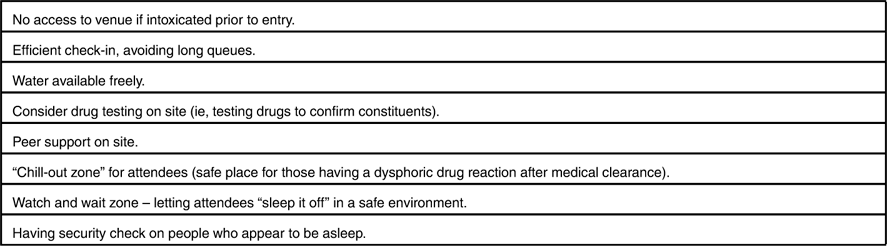
Emergency physicians who provide care at EDMEs and are keen to reduce the number of hospital referrals (with the resulting cost savings to the system) could consider integrating harm reduction suggestions reported in the literature (Table 6). Of note, these are suggestions; to the authors’ knowledge, none of the interventions have been tested prospectively for efficacy.
-
-
5. Reduce ED Visits by Designing Safer Events:
-
Various researchers, with an interest in harm reduction, are exploring the culture of particular types of mass gatherings, as well as the behavior of audience members at specific types of planned events.Reference Hutton, Ranse, Verdonk, Ullah and Arbon 62 “Crowd resiliency” is discussed increasingly in the literature as one way of focusing attention on supporting those attending and participating in events to stay safe (eg, advocating for friends to “stay together,” “never put down your drink,” and even selling kits to test drugs to confirm content prior to ingestion). 63 - Reference Posadzki 66
-
Harm Reduction StrategiesReference Chinet, Stephan, Zobel and Halfon 9 , Reference Krul, Sanou, Swart and Girbes 59 , 63 - Reference Posadzki 66

Limitations
The current study presents descriptive data from a single event. Decisions regarding transport were made according to the professional judgment of the physician at the bedside, in consultation with an on-site emergency physician. Patient and transport data from events with a FA only model would be valuable to understand the transfer rates without the presence of a HLC team. Prospective replication, including the use of a control group, is required to confirm (or refute) and further clarify the effects of a HLC team on patient transport rates. Other impacts, such as dispatch delay, ambulance response times, crew on-scene times, off-load delay in hospital, and ED data, are not addressed in this study.
Conclusions
Electronic dance music events have a predictable need for on-site medical services, including the ability to care for patients with altered levels of consciousness, intoxication, and potential airway compromise. In the present study, the introduction of clinical monitoring by a HLC team reduced the need to transfer patients with altered levels of consciousness. Investment by event producers in robust, on-site FA and HLC medical response decreased the impact of this category of mass gathering on its host community by reducing the number of ambulance transfers.
Acknowledgements
The authors would like to acknowledge Ms. Kerrie Lewis, Mr. Jordan Myers of Warehaus Productions, Ltd, Dr. Samuel J. Gutman of Rockdoc Consulting, Inc, and Masoud Yousefi, Senior Statistical Analyst, Vancouver Coastal Health Research Institute.