A robust and growing literature indicates that conduct problems (CPs) and problem behavior starting in early childhood are linked to CP in later childhood and adolescence (Aguilar, Sroufe, Egeland, & Carlson, Reference Aguilar, Sroufe, Egeland and Carlson2000; Campbell, Pierce, Moore, & Marakovitz, Reference Campbell, Pierce, Moore and Marakovitz1996; Shaw, Gilliom, Ingoldsby, & Nagin, Reference Shaw, Gilliom, Ingoldsby and Nagin2003), as well as negative outcomes in adulthood, such as diagnoses of antisocial personality disorder, criminality, and drug use (Caspi, Moffitt, Newman, & Silva, Reference Caspi, Moffitt, Newman and Silva1996; Moffitt, Caspi, Harrington, & Milne, Reference Moffitt, Caspi, Harrington and Milne2002; Shaw & Gross, Reference Shaw, Gross and Lieberman2008). Youth antisocial behavior is very costly for society due to its effects on the individual, youth's families, victims of crime, and society as a whole (Frick & Dickens, Reference Frick and Dickens1996; Romeo, Knapp, & Scott, Reference Romeo, Knapp and Scott2006; Scott, Knapp, Henderson, & Maughan, Reference Scott, Knapp, Henderson and Maughan2001). A small group of early starting youth represent approximately 6%–7% of the population yet are responsible for almost 50% of adolescent crime and 75% of violent crimes (Offord, Boyle, & Racine, Reference Offord, Boyle and Racine1991), emphasizing the importance of early starting CP on the impact of later crime.
Although there is a recognized need for greater understanding of factors related to the development of early starting CP and effective prevention and intervention methods, such efforts must also account for the degree of heterogeneity among individuals displaying CP and more serious forms of antisocial behavior (McMahon & Frick, Reference McMahon and Frick2005). Several methods for identifying more homogenous groups of youth have been proposed (Frick & White, Reference Frick and White2008; Loeber & Stouthamer-Loeber, Reference Loeber and Stouthamer-Loeber1998; Moffitt, Reference Moffitt1993), with age of onset and the presence of callous–unemotional (CU) traits being two of the most prominently studied. Based on the robust literature indicating the importance of early starting CP (Shaw & Gross, Reference Shaw, Gross and Lieberman2008) and the increasing use of CU traits in subgrouping school-age children and adolescents with CP (www.dsm5.org), research on CU behaviors in young children is critical in furthering our ability to identify more homogenous subgroups of children at risk for early-starting patterns of CP. This research holds the promise of developing preventative and intervention methods tailored to specific subgroups of children at risk for persistent patterns of CP (Dadds & Rhodes, Reference Dadds and Rhodes2008; Frick, Reference Frick2001). However, to date, little research has examined CU behaviors in early childhood or examined CU behaviors as a moderator of intervention effectiveness in the context of a randomized trial of an empirically supported intervention.
Because few studies have examined callousness and related behaviors in very early childhood, we know relatively little about the early behavioral manifestations of what may become CU “traits.” Research is needed to see if it is possible to identify behaviors in very early childhood that show similar characteristics to older children with CU traits and also place such children at risk for persistent CP over time. Moreover, since CU traits have been shown to predict behavior change following treatment for CP (Hawes & Dadds, Reference Hawes and Dadds2005) and early intervention may be key to preventing early starting CP, research is needed that addresses whether early personalized preventative interventions can be effective for those high and low on early callous behaviors. Therefore, the central goals of this study were to examine (a) whether a factor of CU-like behavior could be identified in early childhood; (b) if such a factor could be identified, whether it would predict future CP over and above current symptoms of CP; and (c) whether high levels of CU-like behavior would attenuate children's response to a family-focused intervention aimed at preventing early starting CP.
CU Traits
CU traits are defined by lack of empathy, callousness, and shallow affect (Frick, Cornell, Barry, Bodin, & Dane, Reference Frick, Cornell, Barry, Bodin and Dane2003; Frick & Hare, Reference Frick and Hare2001) and can be seen as a downward extension of the interpersonal and affective components of the psychopathy construct (Frick & White, Reference Frick and White2008; Harpur, Hare, & Hakstian, Reference Harpur, Hare and Hakstian1989). Much of the early work on CU traits focused on school-age and early adolescent samples (Frick, Cornell, Bodin, et al., Reference Frick, Cornell, Bodin, Dane, Barry and Loney2003; Frick, O'Brien, Wootton, & McBurnett, Reference Frick, O'Brien, Wootton and McBurnett1994), and while more recent studies have extended this work to later adolescence (ages 13–18; Essau, Sasagawa, & Frick, Reference Essau, Sasagawa and Frick2006) and earlier childhood (ages 4–8; Hawes & Dadds, Reference Hawes and Dadds2007), most studies have examined samples of children across a relatively wide age range (e.g., at least 3 or 4 years). CU traits in youth ranging in age from 6 to 18 (Christian, Frick, Hill, Tyler, & Frazer, Reference Christian, Frick, Hill, Tyler and Frazer1997; Frick, Cornell, Barry, et al., 2003; Frick & White, Reference Frick and White2008) and perhaps as early as age 3 (Kimonis et al., Reference Kimonis, Frick, Boris, Smyke, Cornell and Farrell2006) have been linked to particularly severe and chronic antisocial behavior both concurrently and longitudinally (Enebrink, Andershed, & Långström, Reference Enebrink, Andershed and Långström2005). Moreover, these associations have been replicated in both clinic-referred (Gretton, Hare, & Catchpole, Reference Gretton, Hare and Catchpole2004) and community samples (Pardini, Obradovic, & Loeber, Reference Pardini, Obradovic and Loeber2006), suggesting the robust and generalizable nature of this association across different types of samples and age periods.
Beyond links to CP, several studies support the theory that CU traits are “trait-like” through evidence of stability of the construct (across 1-, 4-, and 9-year periods, ages 4–13; Dadds, Fraser, Frost, & Hawes, Reference Dadds, Fraser, Frost and Hawes2005; Frick, Kimonis, Dandreaux, & Farell, Reference Frick, Kimonis, Dandreaux and Farell2003; Muñoz & Frick, Reference Muñoz and Frick2007; Obradovic, Pardini, Long, & Loeber, Reference Obradovic, Pardini, Long and Loeber2007), high heritability (in 7- and 9-year-olds; Viding, Blair, Moffitt, & Plomin, Reference Viding, Blair, Moffitt and Plomin2005; Viding, Jones, Paul, Moffitt, & Plomin, Reference Viding, Jones, Paul, Moffitt and Plomin2008), links to differences in neural reactivity in adolescence (Jones, Laurens, Herba, Gareth, & Viding, Reference Jones, Laurens, Herba, Gareth and Viding2009; Marsh et al., Reference Marsh, Finger, Mitchell, Reid, Sims and Kosson2008), and links to adult personality and psychopathy (Burke, Loeber, & Lahey, Reference Burke, Loeber and Lahey2007). Based on the preliminary evidence and theory that CU may be a trait, researchers have suggested that these traits should emerge very early in life and thus be an important factor among youth with early starting CP (Frick & Ellis, Reference Frick and Ellis1999). Although some research has shown that boys with early starting CP display higher levels of CU traits in adolescence (Silverthorn, Frick, & Reynolds, Reference Silverthorn, Frick and Reynolds2001), with a few exceptions noted below, little work has examined CU traits or behaviors within the context of early starting CP. Note that we are consistent with the literature in referring to CU traits as “traits” in late childhood and adolescence when there is more evidence of this construct's stability. However, given the little research on callousness in early childhood, we refer to these as CU behaviors during early childhood.
The few studies that have examined CU behaviors earlier in childhood have demonstrated that, while correlated with CP, CU behaviors appear to be an independent and moderately stable attribute beginning in the late preschool period (ages 4–9; Dadds et al., Reference Dadds, Fraser, Frost and Hawes2005; Pardini et al., Reference Pardini, Obradovic and Loeber2006). CU behaviors assessed during the preschool and middle childhood periods have been associated with increases in CP at 6-month and 1-year follow-ups in some studies (Dadds et al., Reference Dadds, Fraser, Frost and Hawes2005; Hawes & Dadds, Reference Hawes and Dadds2005), albeit not in all (Pardini et al., Reference Pardini, Obradovic and Loeber2006). Although a few of these studies have examined CU behaviors beginning prior to school entry, only two studies (Kimonis et al., Reference Kimonis, Frick, Boris, Smyke, Cornell and Farrell2006; Willoughby, Waschbusch, Moore, & Propper, Reference Willoughby, Waschbusch, Moore and Propper2011) have examined CU or similar behaviors before the age of 4, when both child and ecological markers of early starting CP have initially been identified (Shaw et al., Reference Shaw, Gilliom, Ingoldsby and Nagin2003; Shaw, Keenan, & Vondra, Reference Shaw, Keenan and Vondra1994) and when preventative efforts may be more effective than at later ages (Dishion et al., Reference Dishion, Shaw, Connell, Gardner, Weaver and Wilson2008).
In some ways, the lack of research on CU behaviors in early childhood is not surprising based on the theoretical and practical problems of measuring CU behaviors during the toddler and early preschool periods. While it seems theoretically and practically important to be able to identify toddlers and young preschoolers at risk for particularly severe CP, concerns over the ability to measure CU-type behaviors so early based on developmental constraints of young children's cognitive abilities and concerns that, if successful, the implications for identifying such young children as being CU (or even worse, having “psychopathic traits”) are legitimate reasons for being cautious in pursuing this line of research (Seagrave & Grisso, Reference Seagrave and Grisso2002). However, based on the potential for informing early prevention and intervention studies (Dishion et al., Reference Dishion, Shaw, Connell, Gardner, Weaver and Wilson2008; Olds et al., Reference Olds, Kitzman, Cole, Robinson, Sidora and Luckey2004) and the further need to identify subgroups of children at risk for showing persistent patterns of CP, it would behoove researchers to identify CU-like behaviors in early childhood (Dadds & Rhodes, Reference Dadds and Rhodes2008). In theory, developmentally salient behaviors that may be observed among toddlers and early preschoolers may predict more extreme and chronic early starting CP, which could include early deceitfulness and lying (Loeber & Dishion, Reference Loeber and Dishion1983), lack of conscience development and lack of guilt (Fowles & Kochanska, Reference Fowles and Kochanska2000), and, perhaps, lack of early affect and connection to others (Jones, Happé, Gilbert, Burnett, & Viding, Reference Jones, Happé, Gilbert, Burnett and Viding2010).
Measurement of CU Traits
Whereas there are a variety of measures of child and adolescent psychopathy (Kotler & McMahon, Reference Kotler and McMahon2005), much of the literature in this area, particularly in earlier childhood, has focused specifically on affective and interpersonal components associated with psychopathy, especially callousness and unemotionality (Frick & White, Reference Frick and White2008). CU traits have been measured primarily by the Antisocial Process Screening Device (APSD; Frick & Hare, Reference Frick and Hare2001); however, based on the modest number of items in the factor (n = 6) and the debate over the scale's factor structure and item content (Vitacco, Rogers, & Neumann, Reference Vitacco, Rogers and Neumann2003), a more thorough measure of CU, the Inventory of Callous–Unemotional Traits (ICU), has been receiving increased attention in the literature (Essau et al., Reference Essau, Sasagawa and Frick2006; Kimonis et al., Reference Kimonis, Frick, Skeem, Marsee, Cruise and Munoz2008). Beyond these specific measures of CU, investigators have generated measures of callousness by using items from behavior rating scales and creating specific psychopathy scales for younger children (e.g., Dadds et al., Reference Dadds, Fraser, Frost and Hawes2005; Obradovic et al., Reference Obradovic, Pardini, Long and Loeber2007; Willoughby et al., Reference Willoughby, Waschbusch, Moore and Propper2011). These emerging measures of callousness have been supported by factor analysis as separate constructs from CP, have shown incremental predictive validity of CP, and contain items that overlap with the Antisocial Process Screening Device and other measures of child and adult psychopathy (Dadds et al., Reference Dadds, Fraser, Frost and Hawes2005; Obradovic et al., Reference Obradovic, Pardini, Long and Loeber2007). Based on the convergence of these more “home-grown” CU scales with traditional measures of CU traits, it remains an empirical question whether CU-like behaviors measured in early childhood using items from broader problem behavior scales (e.g., the Achenbach Child Behavior Checklist [CBCL]) would form a coherent factor resembling CU and inform prediction of concurrent or later CP (McMahon & Frick, Reference McMahon and Frick2005). Moreover, the benefit of being able to identify items tapping this construct in broader measures of problem behavior would be that studies that have longitudinal data on child problem behavior but were not originally designed to examine CU traits could examine this construct and its association with later problem behavior.
Moderation of the Link Between Parenting and CPs
Based on the success of measures of CU and child psychopathy in identifying a more homogenous and severe group of youth among school-age children and adolescents, several studies have examined whether CU traits moderate the negative effect of poor parenting and the role CU traits play in behavior change in response to parenting-focused interventions for CP. In several cross-sectional studies, the potential moderating effects of CU have been examined in exploring associations between parenting dimensions and CP. For example, in a cross-sectional study of clinic and volunteer youth (ages 6–13; boys and girls), global ineffective parenting (i.e., a combination of parenting constructs including discipline, involvement, and monitoring) was associated with CP only in children low on CU traits, whereas those high on CU traits displayed high levels of CP regardless of their parenting (Wootton, Frick, Shelton, & Silverthorn, Reference Wootton, Frick, Shelton and Silverthorn1997). This pattern of cross-sectional findings has been replicated with a focus on harsh parenting in a high-risk community sample of second and third graders (Oxford, Cavell, & Hughes, Reference Oxford, Cavell and Hughes2003), in a sample of adolescent juvenile offenders (Edens, Skopp, & Cahill, Reference Edens, Skopp and Cahill2008), and in a representative sample of seventh- and eighth-grade girls (Hipwell et al., Reference Hipwell, Pardini, Loeber, Sembower, Keenan and Stouthamer-Loeber2007). While most of the research in this area has been cross-sectional, a 5-year longitudinal study of girls from a community sample (ages 7–8 at the start) demonstrated that low levels of parental warmth were more strongly associated with high levels of CP for girls elevated on CU (but not those low on CU), while exposure to harsh parenting was associated with higher levels of CP regardless of CU level (Kroneman, Hipwell, Loeber, Koot, & Pardini, Reference Kroneman, Hipwell, Loeber, Koot and Pardini2011). Moreover, the interaction between parental warmth and CU appeared to be greatest when girls were younger, suggesting that both age and type of parenting examined may affect this parenting–CU traits interaction. Although these studies in later childhood and adolescence have supported the notion that CU behaviors moderate the parenting–CP link, a study of 49 high-risk preschoolers in Head Start suggested no interaction: CU behaviors and parenting independently predicted concurrent teacher ratings of aggressiveness, but no interaction between parenting and CU was evident (Kimonis et al., Reference Kimonis, Frick, Boris, Smyke, Cornell and Farrell2006).
Outside of these observational designs, only two studies have examined parenting and CU behaviors as predictors of intervention success within a parent-training intervention context (for studies focusing on CU moderation of non-parenting-focused interventions, see Haas et al., Reference Haas, Waschbusch, Pelham, King, Andrade and Carrey2011; Waschbusch, Carrey, Willoughby, King, & Andrade, Reference Waschbusch, Carrey, Willoughby, King and Andrade2007). In a study of 49 clinic-referred boys ages 4 to 8 (M age = 6 years), CU behaviors were found to be associated with greater CP at pretreatment and worse outcomes at 6 months following intervention (Hawes & Dadds, Reference Hawes and Dadds2005). Parents with children high on CU behaviors reported them to be less responsive to discipline with time-out than boys lower on CU behaviors. While this study could be interpreted as showing that those youth high on CU behaviors do not benefit from treatment, especially parenting-focused interventions, a few caveats are worthy of consideration. First, although boys with the highest and most stable levels of CU behaviors had the worst outcome, a substantial portion of children showed a reduction in CU and CP scores across treatment. These findings suggest that treatment, in this case parent management training, may have had an impact on some boys' CP and CU. Second, because the treatment was not carried out within the context of a randomized controlled trial (RCT) and therefore is not, strictly speaking, a study of treatment moderators but rather of predictors of treatment outcome (Hinshaw, Reference Hinshaw2002), it is unclear how CU behaviors would affect the trajectory of CP in the control group (e.g., those high on CU behaviors in the control group would be predicted to have the largest increase in CP over time, and this effect cannot be modeled without a control group). Third and finally, the most significant limitation of this treatment study was its small sample size.
Several challenges remain on intervention research examining the potential moderating contribution of CU. First, designs are needed to address the mechanisms underlying the results: Is it more challenging to modify parenting when child CU is elevated, or is it that parents are able to change their behavior but not successfully modify their child's behavior because high-CU children are less influenced by parenting than other children with CP? Second, to examine moderators of intervention success, randomized trials are needed to incorporate an untreated group as a comparison to determine trajectory of CP with CU behaviors if untreated. Third, studies that use interventions more tailored to individual children's and families' needs would be helpful based on evidence that more personalized studies may be most effective for those high on CU traits. For example, some studies suggest that psychopathic traits among residential adolescent offenders may not always moderate treatment outcomes, especially when treatment is personalized (Caldwell, Reference Caldwell2011; Caldwell, McCormick, Umstead, & Van Rybroek, Reference Caldwell, McCormick, Umstead and Van Rybroek2007). A recent study suggests that CU traits did not moderate the effectiveness of an assessment-driven, personalized treatment for children with CP ages 6–11 that contained targeted options such as a parenting intervention as well as individual and pharmacological therapy (Kolko & Pardini, Reference Kolko and Pardini2010).
Prevention of Early Starting Conduct Disorders
Based on the need to prevent and treat CP in early childhood, RCTs are needed to identify prevention and intervention methods that can be effective for at-risk children, including those high on CU. As highlighted in the literature, interventions that are initiated in early childhood before behavior is deeply entrenched and that are tailored to the individual needs of a child and his or her family may be more effective. One example of a preventive intervention that has shown effectiveness at preventing and treating CP in early childhood is the Family Check-Up (FCU; Dishion et al., Reference Dishion, Shaw, Connell, Gardner, Weaver and Wilson2008). The FCU is family centered and tailored to each family's specific array of risk factors through an initial assessment of child, parenting, and extrafamilial risk factors. The FCU addresses CP by using motivational interviewing to increase parents' awareness of the seriousness of the child's problem behavior and family management techniques to increase parents' skills in addressing child problem behavior (Gill, Hyde, Shaw, Dishion, & Wilson, Reference Gill, Hyde, Shaw, Dishion and Wilson2008). The FCU is targeted to support families during developmental transitions when problem behaviors may be mostly likely to emerge. Thus, the FCU was initially designed to be used during adolescence (Dishion & Kavanaugh, Reference Dishion and Kavanagh2003) and was subsequently adapted for families facing the challenges associated with toddlerhood and the emergence of the “terrible twos” (Dishion et al., Reference Dishion, Shaw, Connell, Gardner, Weaver and Wilson2008; Shaw, Dishion, Supplee, Gardner, & Arnds, Reference Shaw, Dishion, Supplee, Gardner and Arnds2006). The FCU has been shown to reduce and prevent problem behavior and early substance use among adolescents (Dishion & Kavanagh, Reference Dishion and Kavanagh2003) and, more recently, among two independent samples of toddlers at high risk for emerging CP (Dishion et al., Reference Dishion, Shaw, Connell, Gardner, Weaver and Wilson2008; Shaw et al., Reference Shaw, Dishion, Supplee, Gardner and Arnds2006). Intervention effects of the FCU on early child CP were shown to be mediated by both improvements in parenting (Dishion et al., Reference Dishion, Shaw, Connell, Gardner, Weaver and Wilson2008) and decreases in maternal depression (Shaw, Connell, Dishion, Wilson, & Gardner, Reference Shaw, Connell, Dishion, Wilson and Gardner2009), suggesting that a tailored approach may change multiple risk factors in the child's environment. Moreover, such a tailored approach to intervention may be particularly important for children high on CU behaviors, since research has suggested that different parent management techniques may be especially important for youth high versus low on CU (Dadds & Rhodes, Reference Dadds and Rhodes2008; Hawes & Dadds, Reference Hawes and Dadds2005). Although the FCU has been found to be a promising intervention for early starting CP, no research has examined the role of early CU behaviors on its effectiveness. Moreover, because the FCU has been tested within a RCT, it is an ideal intervention for examining the possible moderating effects of CU on its effectiveness in preventing early CP and the potential moderating role of CU between effecting changes in parenting and child CP.
The Present Study
The central goal of the current study was to examine early manifestations of callous and unemotional behaviors in a sample of 731 high-risk boys and girls and their families during early childhood (ages 2–4) by asking the following questions: first, can early behavioral dimensions of callousness (e.g., deceitfulness, callousness, and lack of affect) be identified in very early childhood using common behavior ratings scales, and do these items factor together to form a coherent scale? Second, do these CU-like behaviors predict CP prospectively over and above current levels of CP? Third, do these CU-like behaviors moderate the effectiveness of the FCU in preventing early CP, and do these behaviors make it more challenging for parents to change their behavior or for parenting techniques to change child behavior? The large sample size and the nature of the preventive intervention RCT offered sufficient power to detect interactions and allowed us to examine more specific mechanisms through which early deceitful and callous behaviors might moderate the course of early interventions longitudinally. Because the study examines high-risk families, we were able to examine these questions in those children at elevated risk for early starting CP and within an intervention that targets multiple family risk factors. Fourth and finally, since this study has focused on using observational methods and reports of child behavior from multiple informants, we were able to test these questions using multiple informants of child CP and with observed measures of parenting.
Method
Participants
Participants initially included 731 children and families. Families were recruited between 2002 and 2003 from Women–Infant Children (WIC) nutritional supplement programs in the metropolitan areas of Pittsburgh, Pennsylvania, and Eugene, Oregon, and within and outside the town of Charlottesville, Virginia (see Dishion et al., Reference Dishion, Shaw, Connell, Gardner, Weaver and Wilson2008). Parents were contacted at WIC sites and invited to participate if they had a son or daughter between 2 years, 0 months and 2 years, 11 months of age. Screening procedures were developed to recruit families at especially high risk for CPs. Risk criteria for recruitment were defined as at or above one standard deviation above normative averages on several screening measures in the following three domains: child behavior (i.e., CPs or high-conflict relationships with adults), family problems (i.e., maternal depressive symptoms, daily parenting challenges, substance use problems, or teen parent status), and sociodemographic risk (i.e., low education achievement and low family income based on WIC criterion). Risk factors across two or more of the three domains were required for inclusion in the sample. In cases where the criterion for child behavior was not met, children needed to be above the sample mean for child CPs to increase the probability that those assigned to the intervention team would be motivated to engage in the intervention. The research protocol was approved by the institutional review boards at the respective universities, and participating primary caregivers (PCs) provided informed consent.
Recruitment
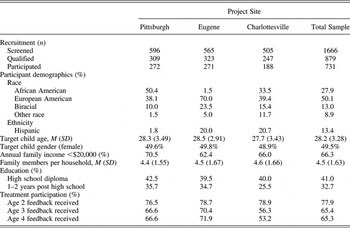
Of the 1,666 families who had children in the appropriate age range and who were contacted at WIC sites across the three study sites, 879 met the eligibility requirements (52% in Pittsburgh, 57% in Eugene, and 49% in Charlottesville) and 731 (83.2%) agreed to participate (88% in Pittsburgh, 84% in Eugene, and 76% in Charlottesville; see Table 1 for summary of recruitment). The children in the sample had a mean age of 29.9 months (SD = 3.2) at the time of the age 2 assessment. Of the 731 families (49% female children), 272 (37%) were recruited in Pittsburgh, 271 (37%) in Eugene, and 188 (26%) in Charlottesville. Across sites, PCs self-identified as belonging to the following ethnic groups: 28% African American, 50% European American, 13% biracial, and 9% other groups (e.g., American Indian and Native Hawaiian). Thirteen percent of the sample reported being Hispanic American. During the 2002–2003 screening period, more than two-thirds of those families enrolled in the project had an annual income of less than $20,000, and the average number of family members per household was 4.5 (SD = 1.63). Forty-one percent of the population had a high school diploma or GED, and an additional 32% had 1–2 years of post high school training.
Recruitment descriptives by project site

Retention
Of the 731 families who initially participated, 659 (90%) were available at the age 3 follow-up and 620 (85%) participated at the age 4 follow-up. At ages 3 and 4, selective attrition analyses revealed no significant differences in project site; children's race, ethnicity, or gender; levels of maternal depression; or children's externalizing behaviors (parent reports). Furthermore, no differences were found in the number of participants who were not retained in the control versus the intervention groups at both age 3 (n = 40, 32) and age 4 (n = 58, 53, respectively; Dishion et al., Reference Dishion, Shaw, Connell, Gardner, Weaver and Wilson2008).
Procedure
Assessment protocol
Procedures and protocol for the current study are explained in more detail elsewhere (Dishion et al., Reference Dishion, Shaw, Connell, Gardner, Weaver and Wilson2008; Lunkenheimer et al., Reference Lunkenheimer, Dishion, Shaw, Connell, Gardner and Wilson2008). Parents (i.e., typically mothers and, if available, alternate caregivers [ACs] such as fathers or grandmothers) who agreed to participate in the study and went through informed consent procedures were scheduled for annual home assessments at child ages 2–4. Assessments were identical for control and intervention group participants and involved structured and unstructured play activities for the target child with PCs, ACs, and siblings. Parenting and child observational data derived from the current study included the following sequence of tasks administered at ages 2, 3, and 4 with only minor deviations in task selection in accord with the child's developmental status: a 15-min free play session, a 5-min cleanup session, a 5-min delay of gratification task, four 3-min teaching tasks, a second free play session for 4 min, a second 4-min cleanup task, 2 min each of two inhibition-inducing toys, and a 20-min meal preparation task. Families received $100, $120, and $140 for participating in the age 2, 3, and 4 assessments, respectively, each of which lasted 2.5–3 hr.
Intervention protocol: The FCU
The FCU is a brief intervention generally consisting of three sessions, and it is based on motivational interviewing techniques and modeled after the Drinker's Check-Up (Miller & Rollnick, Reference Miller and Rollnick2002). Families who were randomly assigned to the intervention condition were scheduled to meet with a parent consultant for two or more sessions, depending on the family's preference. The three meetings in which families were typically involved included an initial contact meeting, an assessment meeting, and a feedback session (Dishion & Kavanagh, Reference Dishion and Kavanagh2003). To optimize the internal validity of the study by preventing differential dropout rates in the intervention and control groups, the age 2 assessments (visits described previously) were completed before random assignment results were known to either the research staff or the family. For research purposes, the sequence of contacts was assessment, randomization, initial interview, and feedback session, with the option for follow-up sessions. Families in the feedback session received a $25 gift certificate for completing the FCU and the feedback session (for more details about the FCU, see Dishion et al., Reference Dishion, Shaw, Connell, Gardner, Weaver and Wilson2008; Gill et al., Reference Gill, Hyde, Shaw, Dishion and Wilson2008; Lunkenheimer et al., Reference Lunkenheimer, Dishion, Shaw, Connell, Gardner and Wilson2008).
After the first meeting (the assessment described previously), the second visit, called the “get to know you” meeting, consisted of the parent consultant meeting, with the parent(s) discussing their concerns with a focus on current family issues that were most critical to their child's and family's functioning. For the third meeting, the feedback session, parent consultants utilized motivational interviewing to summarize the results of the assessment and highlight areas of strength and areas in need of attention. One objective of the feedback session was to assess the parent's willingness to change problematic parenting practices, to support existing parenting strengths, and to identify services appropriate to the family's needs. The parent was given the choice to participate in additional follow-up sessions that were focused on parenting practices (using Parent Management Training techniques) as well as other family management and contextual issues (e.g., coparenting, child care resources, and housing). Parent consultants were also able to recommend community service organizations that could be of assistance to the family. Parents in the intervention group received the FCU after each year's assessment.
Parent consultants were a combination of doctoral- and master's-level service workers, all with previous experience in carrying out family-based interventions. Training in the FCU occurred over a period of 2.5–3 months (see Dishion et al., Reference Dishion, Shaw, Connell, Gardner, Weaver and Wilson2008). Of the families assigned to the intervention condition, 73.8% participated in the “get to know you” and feedback sessions at child age 2, and 62.7% participated at child age 3.Footnote 1 At the baseline assessment, there were no significant differences between families in the intervention condition who engaged in the FCU (73.8%) and families who did not (26.2%) on sociodemographic covariates of interest (child age, gender, ethnicity, geographical location, baseline level of child distress, parental education, and family income).
Measures
Demographics questionnaire
A demographics questionnaire was administered to PCs during each visit. This measure included questions about family structure, parental education and income, parental criminal history, and areas of familial stress. For the purposes of this study, income was assessed as total household income per month, and race/ethnicity was dichotomized into European American and non-European American (e.g., African American or biracial).
CBCL 1.5–5
The CBCL for ages 1.5–5 (Achenbach & Rescorla, Reference Achenbach and Rescorla2000) is a 99-item questionnaire that assesses behavioral problems in young children, which was administered to PCs at child ages 2, 3, and 4. Individual items from the CBCL were combined with items from the Eyberg Child Behavior Inventory (ECBI; Robinson, Eyberg, & Ross, Reference Robinson, Eyberg and Ross1980) and the Adult–Child Relationship Scale (ACRS) to create the deceitful–callous (DC) behavior measure (described below). Based on the overlap in content between DC items and the CBCL (i.e., 3 items were used from the CBCL to create the DC scale), we chose to focus on the ECBI as our primary measure of problem behavior from ages 2 to 4.
ECBI
The ECBI is a 36-item parent-report behavior checklist that was also administered at the ages 2, 3, and 4 assessments (Robinson et al., Reference Robinson, Eyberg and Ross1980). The ECBI assesses CPs in children between 2 and 16 years of age via two factors, one that focuses on the perceived intensity of behavior similar to the CBCL and another that identifies the degree to which the behavior is a problem for caregivers. One item was used as part of the DC behavior measure (“lies”) and was therefore removed from the Eyberg factor scores to avoid content overlap between problem behavior outcomes and the DC factor. Both Eyberg factors demonstrated acceptable internal consistency from ages 2 to 4 (intensity factor α = 0.86–0.94; problem behavior factor α = 0.84–0.94).
ACRS
The ACRS was adapted for use with parents and children based on the Student–Teacher Relationship Scale (Pianta, Reference Pianta2001). The Student–Teacher Relationship Scale and the ACRS tap the adult's feelings about the child and attachment-related behavior, and was designed to assess multiple distinct characteristics of their relationship (see Ingoldsby, Shaw, & Garcia, Reference Ingoldsby, Shaw and Garcia2001). One item was used from this scale for the DC factor (“the child is sneaky or tries to get around me”).
DC Behavior Factor
Items were drawn from the CBCL, the ECBI and the ACRS that appeared to reflect aspects of early deceitfulness, lack of guilt, and lack of affective behavior as they could be related to later CU traits and the broader CU construct. In particular, we focused on items that were similar to those on the CU scale of the APSD (Frick, Bodin, & Barry, Reference Frick, Bodin and Barry2000) or the ICU (Essau et al., Reference Essau, Sasagawa and Frick2006) and items that had minimal overlap with actual externalizing problem behavior. Initially eight items were chosen from these scales (see Table 1) and subjected to factor analyses to create a final factor (see Results). Based on the final content and factor loadings of these scales and as noted in the introductory section, we have termed this factor DC behavior. Moreover, it is important to note that the items mostly focus on observed behaviors and thus we emphasize the term “behaviors” rather than “traits,” particularly in this early age period.
Parental positive behavior support (PBS)
PBS encompasses both the anticipation of children's needs and active involvement in their welfare. This construct was assessed from the home visitor's ratings (see description below) and from coding videotaped interactions between caregivers and children in the home setting from the ages 2 (preintervention) and 3 (postintervention) assessments using a composite variable as described in Dishion et al. (Reference Dishion, Shaw, Connell, Gardner, Weaver and Wilson2008) and Lunkenheimer et al. (Reference Lunkenheimer, Dishion, Shaw, Connell, Gardner and Wilson2008). A team of undergraduates coded the videotaped family interaction tasks at ages 2 and 3 using the Relationship Process Code (RPC; Jabson, Dishion, Gardner, & Burton, Reference Jabson, Dishion, Gardner and Burton2004) with an acceptable agreement (average team RPC percentage agreement = 0.87, κ = 0.86). The RPC is a third-generation code derived from the Family Process Code (Dishion, Gardner, Patterson, Reid, & Thibodeaux, Reference Dishion, Gardner, Patterson, Reid and Thibodeaux1983) used extensively in previous research. After coding each family interaction, coders completed an impressions inventory regarding proactive and positive parenting practices.
The following items were entered into the PBS scores: (a) Parent involvement: This measure is based on the home visitor's rating of the parents' involvement using the following items from the Home Observation for Measurement of the Environment Inventory (Bradley, Corwyn, McAdoo, & García Coll, Reference Bradley, Corwyn, McAdoo and García Coll2001): “Parent keeps child in visual range, looks at often”; “Parent talks to child while doing household work”; “Parent structures child's play periods.” (b) Positive reinforcement: This measure is based on caregivers prompting and reinforcing young children's positive behavior from videotape coding as described in the following RPC codes: positive reinforcement (verbal and physical), prompts and suggestions of positive activities, and positive structure (e.g., providing choices in a request for behavior change). (c) Engaged parent–child interaction time: This score reflects the average length of parent–child sequences involving talking or physical interactions, such as turn taking or playing a game. The average duration of episodes that included consecutive parent–child exchanges involving RPC codes, such as talk and neutral physical contact, were used to define these episodes. (d) Proactive parenting: Videotape coders rated each parent on his or her tendency to anticipate potential problems and to provide prompts or other structural changes to avoid young children becoming upset and/or involved in problem behavior on the following six items: parent gives child choices for behavior change whenever possible; parent communicates to the child in calm, simple, and clear terms; parent gives understandable, age-appropriate reasons for behavior change; parent adjusts/defines the situation to ensure the child's interest, success, and comfort; parent redirects the child to more appropriate behavior if the child is off task or misbehaves; and parent uses verbal structuring to make the task manageable (α = 0.84). Previous research using this sample has supported combining these four variables as indicators of PBS (Dishion et al., Reference Dishion, Shaw, Connell, Gardner, Weaver and Wilson2008). Separate latent factors were created for age 2 and age 3.
Overview of analysis
To address our research questions, a variety of statistical techniques were used. For Hypothesis 1, the sample was randomly divided into halves using the Statistical Package for the Social Sciences (SPSS v. 18). An exploratory factor analysis (EFA) was conducted on the half of the sample using principal components analysis extraction and an oblique rotation (direct oblimin; δ = 0) within SPSS. Items that loaded highly together on one factor of interest (Table 1) were then used in a confirmatory factor analysis (CFA) in Mplus 6.0 (Muthen & Muthen, Reference Muthen and Muthen2010) within the other half of the sample. This same CFA was also tested using all AC reports of child behavior. For Hypothesis 2, correlations and regressions were computed within SPSS in which extracted factor scores of DC behaviors were regressed onto later problem behavior while controlling for concurrent problem behavior. Note that for both Hypotheses 1 and 2, listwise deletion was used because of the small number of variables used in each analysis and the difficulty in estimating parameters when there is missingness in one of only three variables. Tables are provided that detail the sample size for each analysis.
For Hypothesis 3, analyses were carried out within Mplus 6.0 with a full information maximum likelihood approach, which can efficiently accommodate missing data. The amount of missing data was small for each individual measure (n = 620–731 for PC reported measures, 444–730 for observer ratings, and 377–421 for AC reported measures), but listwise deletion would have limited the power to detect significant interactions. Using full information maximum likelihood procedures, our analyses included using all participants except when they were missing data on a grouping variable (moderator in multigroup models) or an independent predictor that cannot be estimated with missingness (e.g., a control variable such as income) with a final n = 726 for most analyses. The use of Mplus also permitted evaluation of multiple indices of model fit including the chi-square, the root mean square error of approximation (RMSEA), and the comparative fit index (CFI), as well as the statistical significance of individual paths. Note that for interaction analyses, fit statistics are not provided, because Mplus employs numerical integration in this situation and thus cannot compute these same meaningful fit statistics.
Results
Hypothesis 1: Construction of an early measure of callousness
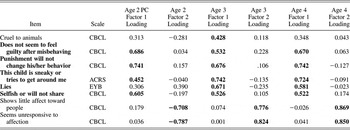
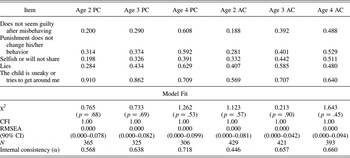
The results from EFAs at ages 2, 3, and 4 are presented in Table 2. Two main factors emerged: one that contained items indexing lack of guilt and deceitfulness, and another focused on lack of affection. Moreover, scree plots at each age also were consistent with a two-factor structure in that at all ages two factors had eigenvalues greater than 1 (and all other factors ≤1). Based on our primary interest on callousness and deceitfulness and findings from the EFA, the items from the first factor were used in a series of CFAs. These analyses confirmed that these items fit the data well and that individual items loaded onto this single factor at each age (see Table 3). Internal consistency was also tested using Cronbach α for all items within these subsamples. The five-item scale demonstrated poor to moderate internal consistency at age 2 with improved and acceptable internal consistency at ages 3 and 4 (see Table 3). Finally, factor scores for the DC latent factor were estimated and extracted for each child in Mplus and used in the analyses below.
Factor loadings (beta weights) from an exploratory factor analysis of possible callousness items

Note: Loadings in bold represent items that load >0.4 on one factor and <0.25 on the other factor. Item labels in bold represent the final items identified for further examination for a measure of deceitful–callous behaviors. The effective total number with listwise deletion for each age is age 2 = 361, age 3 = 328, and age 4 = 316. CBCL, Child Behavior Checklist; ACRS, Adult–Child Relationship Scale; ECBI, Eyberg Child Behavior Inventory.
Standardized factor loadings and fit statistics from confirmatory factor analyses of callousness item

Note: All factor loadings are significant at p < .001. PC, primary caregiver; AC, alternate caregiver; CFI, comparative fit index; RMSEA, root mean square error of approximation; CI, confidence interval.
Consistent with other studies examining post hoc measures of callousness (e.g., Hawes & Dadds, Reference Hawes and Dadds2005; Willoughby et al., Reference Willoughby, Waschbusch, Moore and Propper2011) and Hare's two-factor model of psychopathy (Hare, Reference Hare1991), we wanted to confirm that our measure of DC behaviors tapped a distinctly different construct than a broader measure of externalizing behaviors during this age period. Therefore, a series of CFAs were conducted in which the five items from the DC behavior scale and the six items from the CBCL oppositional–defiant disorder (ODD) scale were loaded onto one “externalizing” factor or two separate factors (DC behaviors, ODD symptoms) and their fits were compared. The two-factor model fit the data significantly better at age 3 (χ 2 diff = 13.75, df = 1, p < .05) and at age 4 (χ2 diff = 27.32, df = 1, p < .05), confirming that the items in the model are tapping two distinct constructs (e.g., DC behaviors vs. ODD symptoms).
Hypothesis 2: Prediction of later problem behavior
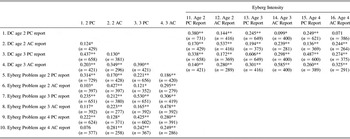
Table 4 presents zero-order correlations between DC behaviors at each age and problem behavior at these same ages. As can be seen in these correlations, PC and AC reports of DC behaviors were moderately correlated across time (r = .35–.43), with some correlation across reporter (r = .12–.39), and DC behaviors were correlated with problem behavior both concurrently and longitudinally (and within and between informant).Footnote 2
Bivariate correlations of DC behaviors and problem behavior

Note: Correlations on the right-top half of the table focus on Eyberg Intensity factor scores, and correlations on the left-bottom half focus on Eyberg Problem factor scores. Although not presented, within age and informant, Eyberg Intensity and Problem factors were moderately to highly correlated (r = .55–.75). DC, deceitful–callous; PC, primary caregiver; AC, alternate caregiver.
*p < .05. **p < .01.
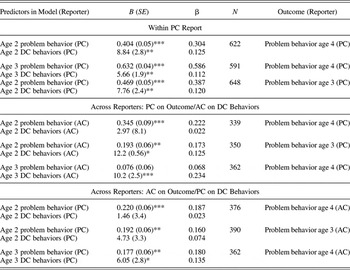
Tables 5 presents regressions predicting ages 3 and 4 problem behavior using the problem behavior factor of the ECBI, while controlling for concurrent behavior on these scales (e.g., age 3 DC behaviors predicted age 4 problem behavior while controlling for age 3 problem behavior). DC behaviors were related to later problem behaviors at ages 3 and 4 after accounting for concurrent Eyberg factor scores within informant. Results cross-informant were not as robust when using reports of age 2 DC behaviors. However, age 3 DC behaviors were generally associated with problem behavior at age 4 across informant. Note that results were almost identical using the intensity factor of the ECBI (table available on request).
Regressions longitudinally predicting Eyberg problem factor from earlier DC behaviors

Note: DC, deceitful–callous; PC, primary caregiver; AC, alternate caregiver.
*p < .05. **p < .01. ***p < .001.
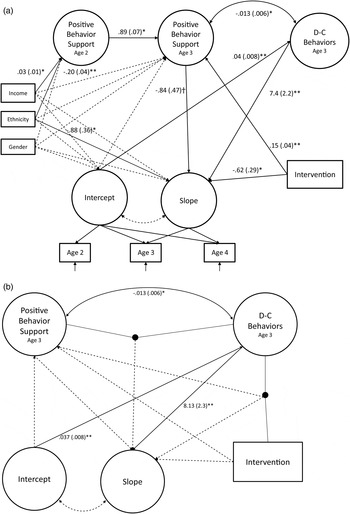
To examine the independent contribution of DC behaviors in relation to longitudinal growth in early CP, we estimated a structural equation model (SEM) similar to Dishion et al. (Reference Dishion, Shaw, Connell, Gardner, Weaver and Wilson2008) that contained latent growth curves of problem behavior (using the Eyberg problem scale) with a latent variable of age 3 DC behaviors as a predictor of behavior slope (see Figure 1a). We chose to use age 3 DC behaviors as the primary predictor variable because age 2 DC behaviors had inadequate internal consistency. When age 3 DC behaviors were entered into the model, the model fit was acceptable (χ2 = 310.5, p < .05, CFI = 0.92, RMSEA = 0.039) and this latent factor significantly predicted the slope of problem behavior (β = 7.44, SE = 2.2, p < .01).
Direct and interactional model of deceitful–callous (DC) behaviors and intervention effects on the Eyberg Child Behavior Inventory problem scale. (a) The direct effects of DC behaviors on the slope of problem behavior. (b) An abbreviated figure detailing the two interactions tested in a subsequent interaction model. Significant paths are marked by a solid line, and nonsignificant paths are marked by a dashed line. For further details of the measurement model, see Dishion et al. (Reference Dishion, Shaw, Connell, Gardner, Weaver and Wilson2008; positive behavior support) and Table 3 (DC behaviors). All paths and variables were modeled in both (a) and (b), with N = 726. †p < .10. *p < .05. **p < .01.

In addition, since DC behaviors may be more meaningful at the extreme, we examined a model containing only latent growth curves of Eyberg problem scores in a multigroup SEM approach across high and low DC behavior groups based on the age 3 PC report of DC behavior (high > 1 SD above the sample mean, n = 126; low ≤ 1 SD above the sample mean, n = 532). When comparing the mean slope of the growth curves, those in the group lower on DC behaviors had a nonsignificant, negative slope (M = –0.134, SE = 0.196, ns) for problem behavior from ages 2 to 4, indicating little change across this age period. However, for those in the high DC behavior group, the mean slope was positive and statistically significant (M = 1.312, SE = 0.39, p < .001), indicating an increase in problem behavior across this age period. Moreover, the difference between these groups was statistically significant (χ2 diff = 9.58, df =1, p < .05). The variance of the intercepts for both low and high DC behavior groups was significant (s 2 = 16.9, SE = 3.1, p < .001; s 2 = 21.9, SE = 5.1, p < .001, respectively). Whereas the variance in the slope of problem behavior was significant for the low group (s 2 = 11.82, SE = 3.1, p < .001), the variance of the slope of problem behavior was not in the high group (s 2 = 1.07, SE = 2.6, ns), indicating that the high DC group displayed little significant interindividual variability on problem behavior over time.
Hypothesis 3: Moderation of intervention and parenting effects on problem behavior
To test the hypothesis that DC behaviors would moderate the link from intervention to age 3 PBS and slope of problem behavior slope, and from age 3 PBS to slope of problem behavior, three continuous interactions were modeled that predicted the growth curve of problem behavior from ages 2 to 4 while accounting for the interaction between intervention and DC behavior and the interaction between parenting and DC behaviors (see Figure 1b). As seen in Figure 1b, although DC behaviors continued to predict problem behavior slope, the interaction of DC behaviors and intervention status was not a significant predictor of slope (interaction term = –0.86, SE = 1.3, p > .05) or age 3 PBS (interaction term = 0.003, SE = 0.17, p > .05), nor was the interaction of DC behaviors and PBS a significant predictor of problem behavior slope (interaction term = 0.18, SE = 1.8, p > .05).
Again, since DC behaviors may be more meaningful when examined at the extreme, we examined these same two interactions using multigroup SEM. Similar to previous analyses, we split the sample into two groups comparing those high on age 3 DC (≥1 SD above the mean; n = 125) and those below this threshold (<1 SD above the mean; n = 524). Next, we tested a SEM similar to the one in Figure 1a (without the DC behavior latent factor and with extracted rather than estimated PBS factors due to problems in estimating latent factors in the smaller subgroup). The initial multigroup model in which parameters were allowed to vary across group fit the data reasonably well (χ2 = 50.7, p < .05, CFI = 0.985, RMSEA = 0.061), with the caveat noted in Hypothesis 2 that the slope of problem behavior in the group high on DC behavior did not have significant variance. When each of the relations involved in the mediation pathway were fixed to be equal across groups, these paths were not statistically different across groups (intervention to PBS: χ2 diff = 1.86, df = 1, p > .05; PBS to behavior slope: χ2 diff = 0.06, df = 1, p > .05; intervention to slope: χ2 diff = 2.19, df = 1, p > .05), indicating no differences in these paths across groups. We also tested the multigroup moderation model with other grouping variables: The three paths of interest continued to be largely equivalent between groups using a mean split on PC-reported age 3 DC behaviors, using PC-reported age 2 DC behaviors, and using AC reports of DC behaviors.
Discussion
The findings demonstrate the ability to measure DC behaviors from face valid items contained in common behavior ratings scales in very early childhood and the utility of these behaviors in predicting later externalizing behavior. Moreover, the results suggest that these DC behaviors, in this developmental period, do not moderate the positive effects of a tailored, family-centered preventative intervention. These findings add to the relatively large literature on CU traits in later childhood and adolescence, and to a relatively small literature that has examined CU or related behaviors in very early childhood, especially as they may relate to intervention outcomes and relations between CU and parenting. Moreover, these results were found in the context of a relatively large randomized trial of a parenting intervention that contained an ethnically diverse sample of boys and girls at risk for early starting CP followed longitudinally using multiple parent and caregiver reports as well as observations methods.
Consistent with other studies that have used more “homegrown” measures of CU traits, we were able to identify eight items within common ratings scales that were similar to items from the APSD or the ICU and represented deceitful, callous, or unemotional behaviors. It is interesting that the five items that indexed more deceitful and callous behaviors loaded onto a separate factor than those that represent more unemotional behaviors. It is possible that these unemotional items may not load together with the DC behavior, particularly during early childhood, since these items appear to be included in the CBCL to measure symptoms of autism and related pervasive developmental disorders. Thus, these items may have a different meaning than the “unemotional” qualities tapped by items in the APSD CU scale (see Jones et al., Reference Jones, Happé, Gilbert, Burnett and Viding2010).
The DC behaviors factor loaded together well and demonstrated reasonable internal consistency at ages 3 and 4, indicating that these items do measure a coherent construct. However, internal consistency was somewhat lower at age 2; the lower consistency at age 2 suggests that callous and deceitful symptoms (e.g., “lies” or “the child is sneaky or tried to get around me”) might be less related to one another at this early age, perhaps reflecting the relative developmental immaturity of toddlers that increases rapidly from ages 2.5 to 3.5 (i.e., most “age 2” assessments were conducted around age 2.5, and most “age 3” assessments were conducted around age 3.5). Many of the behaviors tapped by measures of CU and our specific measure of DC behaviors (e.g., guilt, lying, and being sneaky) require advanced cognitive skills, and thus asking parents about these behaviors very early (e.g., age 2) may be assessing skills and behaviors that are still developing. For example, studies of empathy (Knafo, Zahn-Waxler, Van Hulle, Robinson, & Rhee, Reference Knafo, Zahn-Waxler, Van Hulle, Robinson and Rhee2008; Zahn-Waxler & Radke-Yarrow, Reference Zahn-Waxler and Radke-Yarrow1990), prosocial behavior (Svetlova, Nichols, & Brownell, Reference Svetlova, Nichols and Brownell2011), guilt (Kochanska, Gross, Lin, & Nichols, Reference Kochanska, Gross, Lin and Nichols2002), lying (Evans, Xu, & Lee, Reference Evans, Xu and Lee2011), conscience development and inhibitory control (Kochanska, Reference Kochanska1997; Kochanska, Murray, & Coy, Reference Kochanska, Murray and Coy1997), and theory of mind (Wellman, Cross, & Watson, Reference Wellman, Cross and Watson2001) suggest that all of these important skills are underdeveloped in the first 2 years of life but mature rapidly from ages 2 to 5. Thus, many important aspects of DC behaviors and CU traits may be insufficiently developed to assess before age 3 when these cognitive skills begin to come online, which would then allow parents to make more reliable and meaningful assessments of these behaviors. Moreover, since these skills and behaviors are still developing through age 5 and beyond (e.g., empathy), measures of CU behaviors during the toddler years may need to tap slightly different behaviors to measure the same underlying construct measured during school age.
Although from the perspective of face validity, the items included in the DC scale are consistent with measures of CU and child psychopathy developed for older children, it remains an empirical question as to whether this measure of DC behaviors indexes the same construct and/or an early manifestation of CU “traits” as scales developed for older youth. For example, two of the five items in the DC scale represent lying and deceitfulness, and thus it is possible that the measure represents early covert antisocial behavior (Loeber & Stouthamer-Loeber, Reference Loeber and Stouthamer-Loeber1998; Patterson & Yoerger, Reference Patterson and Yoerger1999). It is interesting that a very recent study examining CU-like behaviors in early childhood using the preschool version of the CBCL identified many of the same items used in this study (e.g., doesn't seem guilty after misbehaving, punishment doesn't change behavior, and seems unresponsive to affection; Willoughby et al., Reference Willoughby, Waschbusch, Moore and Propper2011). Moreover, these items factored separately from ODD symptoms and predicted temperament profiles consistent with CU traits in later childhood, suggesting converging evidence across studies for use of this type of early measure of CU-like behavior. However, future studies are still needed that use the current measure of DC behaviors in early childhood with more standard measures of CU in middle childhood, because the lack of a more established measure of CU in this sample at this age period is less than ideal. These studies could address the degree of concurrent overlap between these two related measures (DC behaviors and CU traits) and whether early DC behaviors are stable over longer periods of time and predict the later development of CU traits. Studies of this type would also address possible heterotypic continuity between DC behaviors and CU traits.
Beyond the interpretation of the meaning of DC behavior, these results emphasize that the current measure of DC behaviors is robust in predicting concurrent and future CP after controlling for concurrent CP. While the relationship between DC behaviors and later CP was weaker when measured across informant, most of the nonsignificant findings were evident using age 2 reports of DC behaviors when internal consistency of DC was low. Age 3 reports of DC behaviors appeared to be a relatively consistent predictor of age 4 problem behavior across PC and AC reports. This finding is consistent with a previous report (Kimonis et al., Reference Kimonis, Frick, Boris, Smyke, Cornell and Farrell2006) in this age period suggesting that DC behaviors predict increases in problem behavior over time. Moreover, since much of the literature linking CU traits to CP and later antisocial behavior has been cross-sectional and used only one informant, the current study adds to the few studies that have examined these relationships longitudinally and/or with multiple informants. Results from the multigroup latent growth curve approach were also consistent with regressions using continuous measures of DC: Children in the high DC behavior group demonstrated increasing problem behavior over time, while their peers demonstrated a flat or even negative trajectory of these behaviors. The high DC group also showed little interindividual variability in their behavior trajectory, as reflected by a lack of significant variance in the growth slope, indicating that this group of children is relatively homogenous with respect to their trajectory of early problem behavior (both high and persistent). Thus, the use of DC behaviors in this early age period may be helpful in identifying a homogenous subgroup of young children at risk for a persistent pattern of early starting CP.
Contrary to our prediction, although DC behaviors identified more severe and homogenous patterns of CP, individual differences in DC did not moderate intervention effects. Moreover, since we tested this hypothesis in several complimentary ways in a relatively large sample, our null finding is less likely to be an artifact of our methodological approach. Interaction analyses indicated that DC behaviors at age 3 did not lessen the effectiveness of the FCU on changes in parenting or the effectiveness of changes in parenting on trajectory of problem behavior. This null finding could be explained several ways. First, it may be that the FCU was more effective in the face of DC behaviors because it is more personalized, is initiated earlier than other interventions, and targets multiple components of risk (e.g., parenting but also maternal depression; see Shaw et al., Reference Shaw, Connell, Dishion, Wilson and Gardner2009). The FCU is a flexible intervention (see Gill et al., Reference Gill, Hyde, Shaw, Dishion and Wilson2008), and thus parents of children with DC behaviors may choose very different options for intervention, thus creating an intervention tailored to suit the needs of individual children and families (Dadds & Rhodes, Reference Dadds and Rhodes2008). In this way, the current study may be more similar to studies of Alternatives for Families: Cognitive Behavioral Therapy (Kolko et al., Reference Kolko, Dorn, Bukstein, Pardini, Holden and Hart2009; Kolko & Pardini, Reference Kolko and Pardini2010), that have demonstrated no effect of CU on intervention outcomes for children with CP, than studies of nonpersonalized parent training (Hawes & Dadds, Reference Hawes and Dadds2005). In terms of the personalization of the FCU, it is also important to note that the average number of sessions that parents took part in at age 2 was 3.32 (see Dishion et al., Reference Dishion, Shaw, Connell, Gardner, Weaver and Wilson2008), emphasizing how brief this intervention was at each age period (age 2 and age 3). Given the current findings, it would be extremely helpful to examine if or how intervention may have been personalized for children higher or lower on DC behaviors. While data about the focus of individual sessions has been collected at these age periods, it is still being coded, and thus future studies are needed to address the important issue. Second, since this study is part of a prevention trial for very young children at high risk for early starting CP, the malleability of CP at this age may be higher than that of previous intervention trials conducted on slightly older children (Hawes & Dadds, Reference Hawes and Dadds2005). Hawes and Dadds (Reference Hawes and Dadds2005) have shown that parent training can reduce CU behaviors in some children, and perhaps this point is even truer at earlier ages and within a broader prevention trial. Albeit beyond the scope of this paper, future analyses could focus on the effect of parenting on DC behaviors longitudinally, because changing DC behaviors could be a potential target for intervention. Research is needed to address the long-term stability of this construct. Moreover, as this cohort continues to be followed longitudinally, it would be possible to test if DC behaviors or later CU traits interfere with intervention at later developmental periods and if there are sensitive periods for intervention for those high on CU traits and behaviors.
Two other points are also important to consider when comparing this study to others examining potential moderation of intervention effects by CU traits and behaviors. First, this study utilized a community sample of young at-risk children rather than a clinical sample. Identifying and intervening with at-risk children prior to school entry, before they would typically be referred for clinical services by parents or teachers, may be important in preventing early CPs (Dishion & Patterson, Reference Dishion and Patterson1992), especially in the presence of CU behaviors. Second, it is worth noting that in two of the previous intervention studies that found CU traits to not be associated with poor child outcomes, clinical protocols included the possibility for youth to receive pharmacotherapy (Kolko & Pardini, Reference Kolko and Pardini2010; Waschbusch et al., Reference Waschbusch, Carrey, Willoughby, King and Andrade2007). Although these studies suggest that pharmacotherapy may be an important component of intervention for youth high on CU traits, our current findings suggest that early behaviorally oriented intervention may also be effective for these children.
Limitations
The present findings are limited by several characteristics of the current study. First, as noted above, no formal measures of CU traits were measured, and thus the link between early DC behaviors and later CU traits is based only on the item content of the DC behaviors measure. Second, the study is focused on high-risk children and their families during the toddler and preschool years. Therefore, the results may not generalize to more affluent samples, to treatment-referred samples, or to later age periods. Nonetheless, based on research demonstrating the importance of early childhood in the trajectory of CP and later antisocial behavior (Shaw et al., Reference Shaw, Gilliom, Ingoldsby and Nagin2003), the current sample targets an important group of families at high risk for later child CP. Third, it would have been helpful to have objective diagnostic measures of problem behavior. Although many parents reported clinically meaningful levels of CPs (e.g., 49% of the sample at age 2 and 24 % of the sample at age 4 reported externalizing behavior in the clinical range on the CBCL; see Dishion et al., Reference Dishion, Shaw, Connell, Gardner, Weaver and Wilson2008), the use of formal diagnostic instruments, albeit limited in utility between the ages of 2 and 4, would have increased our ability to make comparisons with older children in other studies (e.g., Hawes & Dadds, Reference Hawes and Dadds2005; Kolko & Pardini, Reference Kolko and Pardini2010). Data collection on the current sample at age 10 includes diagnostic interviews and is currently under way. Thus, future studies with this sample can address this issue at later age periods. Fourth, as noted above, the intervention used in this study is focused primarily on parenting and is personalized for each family. Therefore, the results cannot generalize to other preventive intervention studies, even parenting-focused interventions. Future studies are needed with different interventions in this age period to determine if there is something unique about the FCU during the toddler years in terms of its effectiveness in modifying behaviors of children demonstrating high levels of DC. Fifth and finally, although a strength of this study is the inclusion of girls and a large proportion of ethnic minorities, given the complexity of the analyses conducted, we did not address any three-way interactions (e.g., such as whether gender or ethnicity might moderate the current results) and thus cannot conclude that these results generalize equally across gender and ethnicity.
Conclusions and implications
The present findings suggest that DC behaviors can begin to be reliably measured at age 3 and that these behaviors delineate children with a more severe and homogenous trajectory of CP during very early childhood. In addition, the findings demonstrate that DC behaviors during this age period do not attenuate efficacy of a parenting-focused intervention previously shown in the same sample and during the same age period to reduce the slope of early CP (Dishion et al., Reference Dishion, Shaw, Connell, Gardner, Weaver and Wilson2008). This study emphasizes that DC behaviors may be an important factor in understanding early starting CP, but clinically DC behaviors may not interfere if the intervention is personalized. These results also suggest that the FCU during the toddler years is equally effective for children regardless of their DC behaviors. This finding is consistent with another study on the FCU (Gardner et al., Reference Gardner, Connell, Trentacosta, Shaw, Dishion and Wilson2009), which demonstrated few moderating effects of many other common moderators of intervention effectiveness (e.g., income, maternal depression, and substance use). Finally, these results highlight the importance of early intervention for CP while behavior may be less stable and more malleable than at older ages.