Introduction
Macrocytosis is a general term denoting increased red blood cell size; it is commonly defined as a mean corpuscular volume of more than 100 fl. This haematological abnormality has a vast aetiology, but is generally considered to be a marker, rather than a cause, of disease.Reference Davidson and Hamilton1 However, in 2009 Freeman et al. reported a link between macrocytosis and bilateral sudden or rapidly progressive profound sensorineural hearing loss (SNHL) in patients with a history of excessive codeine use.Reference Freeman, Bray, Amos and Gibson2
We report a similar case of bilateral rapidly progressive profound SNHL in a patient with significant macrocytosis. However, in this instance, there was no history of previous codeine use or any other identifiable cause. This supports the argument that macrocytosis may have a deleterious effect on cochlear function.
Case report
A 47-year-old woman presented in January 2014 with sudden SNHL in the right ear, closely followed by sudden SNHL on the left. At the initial assessment, no hearing threshold could be detected in the right ear and a 90 dB hearing loss was documented in the left ear (Figure 1).
Pure tone audiogram showing thresholds in the (a) right and (b) left ears at initial presentation. × = air conduction left ear; ○ = air conduction right ear; < = bone conduction left ear

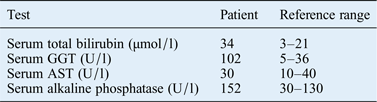
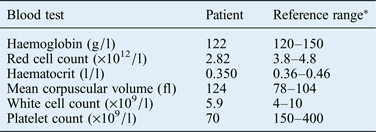
The patient had a history of previous alcohol misuse, although she had been in recovery since January 2013. Despite this, the patient had chronically deranged liver function test results (Table I). A full blood count analysis demonstrated a marked elevation in mean corpuscular volume (to 124 fl) at presentation (Table II). Serum vitamin B12 and folate levels were within normal limits.
Liver function test results at presentation
GGT = gamma-glutamyl transpeptidase; AST = alanine transaminase
Full count results at presentation
*From our laboratory.
An autoantibody screen was negative and a trial of high-dose oral steroids (40 mg/day prednisolone for 14 days) was ineffective. At the patient's next review in March 2014, repeat audiometry showed no improvement in hearing level in the right ear and deterioration to profound hearing loss in the left ear (Figure 2). Magnetic resonance imaging of the internal auditory meati was normal and the patient was referred for assessment by the cochlear implantation team. She underwent successful right-sided cochlear implantation in October 2014.
Pure tone audiogram showing thresholds in the (a) right and (b) left ears at review. × = air conduction left ear; ○ = air conduction right ear; < = bone conduction left ear; < = bone conduction right ear
Discussion
Freeman and colleagues’ report of 10 patients with significant macrocytosis at the time of presentation with sudden SNHL was the first report to link these conditions.Reference Freeman, Bray, Amos and Gibson2 They recorded the maximal mean corpuscular volume at the time of sudden SNHL presentation for each patient, which supported the connection. Yet the underlying cause of the macrocytosis itself was uncertain. Ultimately the authors attribute the raised mean corpuscular volume to codeine phosphate overuse, citing an animal toxicology study,3 despite there being only two such reported cases of macrocytosis potentially linked to codeine or codeine containing medications in the UK since 1963.4 A more credible alternative theory is that confounding factors such as alcohol and paracetamol misuse led to liver dysfunction and abnormal red blood cell production.
Therefore, in the case presented here, macrocytosis was a possible aetiological factor for sudden SNHL in its own right. Other blood abnormalities including iron deficiency anaemia and myelodysplastic syndrome are known to cause sudden SNHL.Reference Chung, Chen, Lin and Hung5, Reference Lee and Yoon6 It is also notable that the rare autosomal recessive disorder thiamine-responsive megaloblastic anaemia is characterised by a mean corpuscular volume greater than 100 fl and progressive bilateral sensorineural deafness in childhood.Reference Bay, Keskin, Hizli, Uygun, Dai and Gumruk7 However, it is important to recognise that these children have megaloblastic macrocytic anaemia which is responsive to thiamine treatment, unlike in the case presented here. If macrocytosis were considered a cause of sudden SNHL, then these children could develop hearing loss by a similar mechanism.
One possible aetiological mechanism for macrocytosis in hearing loss concerns the cochlear blood supply. It is established that a cerebrovascular incident may disrupt the cochlea's supply of glucose and oxygen, producing dysfunction of the sensory neuroepithelium that presents as sudden SNHL. In a similar way, the large red blood cell size in a macrocytosis patient may also disrupt the cochlea's microvascular supply. Macrocytic red blood cells have an increased surface area to volume ratio and are more easily deformed than normal cells (mean corpuscular volume < 100 fl).Reference Vaya, Bonet, Romagnoli, Nunez and Todoli8 Pathological red blood cell deformability has been linked with sudden SNHL,Reference Garcia-Callejo, Marco-Algarra, Pla-Gil, Monzo-Gandia, Juantegui-Azpilicueta and Martinez-Beneyto9 although the current understanding is that a reduction in red blood cell deformability leads to deterioration of blood flow through the labyrinthine branch of the posterior inferior cerebellar artery which supplies the cochlea. However, it is possible that very high red blood cell deformability, as seen in macrocytosis, may have a similar effect.
A further link between macrocytosis and bilateral sudden SNHL specifically, as presented in this case report, is shown by the range of disorders for which both conditions indicate a poor prognosis. For example, macrocytosis is reported to be an independent predictor of mortality in decompensated heart failure, in patients requiring haemodialysis and after percutaneous coronary intervention for ischaemic heart disease.Reference Ueda, Kawakami, Horii, Sugawara, Matsumoto and Okada10–Reference Myojo, Iwata, Kohro, Sato, Kiyosue and Ando12 Bilateral sudden SNHL is more closely associated with serious systemic disease compared with unilateral sudden SNHL, and a recent review noted an overall mortality of 15.5 per cent in 103 cases of bilateral sudden SNHL.Reference Sara, The and Friedland13
• Macrocytosis is linked to sudden sensorineural hearing loss in codeine misuse
• Other blood dyscrasias are also risk factors for sudden sensorineural hearing loss
• In a case of bilateral sequential sudden sensorineural hearing loss, the only abnormality was significant macrocytosis
• This patient's hearing loss might have been prevented by correction of this haematological abnormality
Despite reporting a possible link between macrocytosis and sudden SNHL, we recognise that this patient's bilateral sudden SNHL may have been a consequence of the toxic effects of alcohol misuse. Toxicity is the most common aetiology, accounting for 29.1 per cent of such bilateral sudden SNHL cases.Reference Sara, The and Friedland13 However, in the case presented, the patient had not misused alcohol for a full year before developing hearing loss, although she had a maximum mean corpuscular volume of 124 fl at presentation. Therefore, we consider this case to represent a possible further example of macrocytosis-induced bilateral sudden SNHL.
Conclusion
Despite the uncertain connection between macrocytosis and sudden SNHL, we recommend that patients should have a full blood count at presentation to identify this possible causative factor. Further investigation of this link is warranted because it may represent a modifiable factor to prevent further hearing loss.
Acknowledgements
The authors acknowledge the assistance of the Audiology Team at Ulster Hospital in preparing this case report.