




Introduction
The global obesity crisis is predicted to cost economies $4.3 trillion annually by 2035(Reference Sweis1) and more than US$18 trillion by 2060 worldwide(Reference Okunogbe, Nugent and Spencer2). The real cost, however, is the toll it takes on individuals living with uncontrolled obesity. In 2022, approximately 890 million adults worldwide were living with the disease of obesity, and approximately 2.5 billion had an elevated BMI putting them at risk of developing obesity(Reference Okunogbe, Nugent and Spencer2).
Incretin-based therapies, such as GLP-1 receptor agonists (GLP-1RA; liraglutide, semaglutide) and dual GLP-1/GIP agonists (tirzepatide), belong to the class of nutrient-stimulated hormone therapies (NuSH), a key class within obesity management medications. These hormones are secreted by enteroendocrine cells and have wide-ranging physiological effects, notably on eating behaviour(Reference Cristancho, Kim and Apovian3). Over the past decade, NuSH therapies have been evaluated in dozens of large-scale clinical trials, enrolling tens of thousands of participants. These studies consistently demonstrate clinically meaningful weight loss, improved glycaemic control and reductions in cardiometabolic risk factors. Landmark cardiovascular outcome trials such as LEADER (liraglutide)(Reference Marso, Daniels and Brown-Frandsen4), SUSTAIN-6(Reference Marso, Bain and Consoli5,Reference Bain, Belmar and Hoff6) , SELECT (both semaglutide)(Reference Lincoff, Brown-Frandsen and Colhoun7) and REWIND (dulaglutide)(Reference Branch, Dagenais and Avezum8) confirm benefits beyond weight loss, including reduced major adverse cardiovascular events and renal protection(Reference Mann, Rossing and Bakris9). Evidence is further strengthened by recent systematic reviews and meta-analyses(Reference Yao, Zhang, Li and Wu10), which included 76 clinical trials across 39,246 participants, covering 15 different NuSH therapies, and examined outcomes including glycaemic control, weight loss and lipid profile. Another 2025 systematic review encompassed 41 trials with 15,135 participants, all reporting significant weight reduction across the NuSH class(Reference Patel and Niazi11). Additionally, a model-based meta-analysis of placebo-controlled trials included 55 studies involving 16,269 participants and assessed dose-response and safety across 12 NuSH therapies(Reference Guo, Yang and Huang12). NuSH therapies are redefining obesity care, delivering durable control of the disease of obesity and cardiometabolic and renal benefits that shift treatment from short-term management to long-term, disease-modifying therapy. However, systematic evidence on dietary quality, micronutrient adequacy and eating behaviours during NuSH therapies remains limited, with little understanding of impacts on cravings, protein and fibre intake, lean mass preservation(Reference Almandoz, Wadden and Tewksbury13).
While recent evidence suggests that the effects of NuSH therapies on cravings, hedonic eating and broader reward-driven, emotional and compensatory eating behaviours are emerging, they remain limited, inconsistent and not yet fully understood, particularly in humans(Reference Almohaileb, le Roux and Crotty14,Reference Lassen, Johansen and Modin15) . For example, a recent systematic review suggests that GLP-1RAs may help address reward-related dysfunction in humans associated with food stimuli, obesity and type 2 diabetes, potentially through modulation of dopaminergic signalling, improvements in insulin sensitivity and reductions in craving-related behaviours(Reference Almohaileb, le Roux and Crotty14). Moreover, a multicentre prospective observational study in adults with type 2 diabetes showed that therapeutic response to GLP-1RAs varies according to baseline eating behaviour phenotype, with sustained reductions in external eating (i.e. eating in response to external food cues such as sight or smell), but only transient improvements in emotional (eating in response to negative emotions) and restrained eating (conscious restriction of food intake to control weight), that attenuated during weight maintenance(Reference Lassen, Johansen and Modin15).
Most notably, while GLP-1RA deliver substantial benefits for obesity and diabetes, their effectiveness depends heavily on long-term adherence(Reference Almohaileb, le Roux and Crotty14). The discontinuation of GLP-1RA therapy leads to clinically significant weight regain for many, reinforcing the chronic disease model of care. Side effects, treatment fatigue, cost and supply challenges can all undermine persistence, with many patients discontinuing therapy and experiencing weight regain(Reference Lassen, Johansen and Modin15). Most individuals who discontinue GLP-1RA therapy regain the majority of the weight they have lost within 10–20 months, averaging nearly 10 kg in the first year(Reference West, Koutoukidis and Scragg16). Oral formulations and other innovations may ease some of these barriers in the future, but supportive care remains essential. Adjunctive nutritional strategies, psychological counselling and patient-centred communication may help manage expectations, mitigate cravings and stress-eating and build sustainable habits alongside pharmacotherapy(Reference Almandoz, Wadden and Tewksbury13,Reference Mozaffarian, Agarwal and Aggarwal17,Reference Sharma, Ramos Salas and Campbell-Scherer18) .
Interestingly, emerging microbiota-targeted approaches, including probiotics, postbiotics and prebiotic dietary modulation, may further support appetite regulation and metabolic outcomes when combined with GLP-1 therapy, reflecting emerging evidence of bidirectional interactions between incretin-based therapies and the gut microbiota(Reference Everard and Cani19–Reference Trapanese, Dagostino and Natale21). By tailoring treatment and providing structured support, healthcare providers could improve adherence and ensure patients fully realise the benefits of GLP-1 therapies.
Finally, evidence supporting integrated approaches that combine structured nutritional support with NuSH therapies remains limited, particularly in paediatric populations. Most data are derived from adults, and while metabolic–bariatric surgery (MBS) has been studied as an adjunct or comparator to NuSH therapies, such procedures, including sleeve gastrectomy (SG) and Roux-en-Y gastric bypass (RYGB), have struggled to become scalable solutions to the many patients who are eligible for these treatments. Consequently, paediatric clinical practice must rely largely on extrapolation from adult studies, adapted to the unique developmental, nutritional and psychosocial needs of younger patients.
This review synthesises current evidence on how NuSH, with a focus on GLP-1RA and emerging incretin-based therapies, interact with nutrition, eating behaviour, stress biology and the gut microbiome across age groups. For clarity, we use NuSH as an umbrella term encompassing GLP-1RA and other incretin-based therapies, acknowledging the varied terminology currently used in the literature. We integrate findings from behavioural science, dietetics, microbiota research and MBS to identify strategies that optimise adherence, tolerability and long-term clinical outcomes and to outline key research priorities for personalised, multidisciplinary obesity care.
Incretin-based pharmacotherapy to complement surgical approaches
Surgical MBS approaches, such as SG and RYGB, remain the most durable intervention for substantial and sustained weight loss(Reference Barberá-Carbonell, Dayer-Jankechova and Gaspar-Figueiredo22), while modern NuSH therapies (GLP-1, GIP/GLP-1 and emerging duals) deliver significant, clinically meaningful losses with cardiometabolic benefits(Reference Marso, Bain and Consoli5–Reference Branch, Dagenais and Avezum8).
However, framing the solution to the chronic disease of obesity as ‘either surgery or medication’ appears to be inappropriate; the task is to right-size treatment and sequence therapies over time for each person(Reference Papamargaritis, le Roux and Holst23).
NuSH may have a role both before and after surgery, including optimisation of high-risk candidates pre-operatively and management of insufficient weight loss or weight regain post-operatively(Reference Cohen, Park and Prager24). Indeed, emerging evidence also supports the use of GLP-1RAs in the later post-operative period following bariatric surgery, particularly for patients experiencing insufficient weight loss or weight regain. For example, GLP-1 receptor agonist can reverse approximately two-thirds of regained weight after surgery, highlighting their therapeutic potential in this setting.(Reference Mok, Adeleke and Brown25) Similarly, a recent systematic review further reported encouraging evidence for the use of GLP-1RAs in managing post-surgical weight regain and insufficient weight loss, while also highlighting potential concerns regarding lean mass and bone health(Reference Dutta, Nagendra and Joshi26). More recent systematic reviews and meta-analyses, further indicate that GLP-1RAs are increasingly used as adjunct therapies after bariatric surgery, demonstrating improvements in weight and metabolic outcomes in patients with suboptimal response(Reference Tan, Shang and Davis27), although the evidence base remains largely observational and heterogeneous, with limited long-term outcome data. Moreover, some analyses report neutral or even less early post-operative weight loss in specific subgroups; therefore, their use should be individualised(Reference Cohen, Park and Prager24,Reference Mathur, Wasden and Shin28) .
Key reasons why patients with obesity discontinue GLP-1RA therapy include gastrointestinal side effects, treatment fatigue, cost, access issues, non-response and unrealistic expectations as major barriers to long-term adherence(Reference Sharma, Ramos Salas and Campbell-Scherer18,Reference Vallis, Boyland and Caroli29) . Patients should be counselled that obesity is a chronic disease: surgery and medicines can control the disease but cannot cure the disease. This might set expectations for long-term pharmacotherapy, adherence and relapse prevention. The current therapies may work best when embedded in sustained, multidisciplinary care (nutrition, psychology, primary care)(Reference Sievenpiper, Ard and Blüher30).
With next-generation NuSH(Reference Drucker and Holst31), increasing real-world evidence(Reference Shalitin, Phillip and Yackobovitch-Gavan32–Reference Samuels, Ye and Irlmeier34), treatment algorithms will mix surgery and pharmacology with personalisation by phenotype and patient preference.
Eating behaviour and nutritional considerations under NuSH therapy across age groups
The regulation of appetite and food reward is tightly governed by gut–brain communication, involving neural, hormonal and immune signals that relay information from the gastrointestinal tract to the central nervous system. NuSH therapies primarily enhance satiety signalling and slow gastric emptying, leading to earlier fullness and reduced energy intake. However, NuSH therapies may also alter appetite physiology and eating behaviour by engaging complementary hedonic pathways, including central hypothalamic and mesolimbic signalling which may dampen cue-reactivity and craving(Reference Badman and Flier35–Reference Müller, Finan and Bloom41). In adults, semaglutide, in the initial dynamic weight loss phase, increases satiety, reduces prospective consumption and lowers ad libitum energy intake by ∼35% in standardised settings(Reference Friedrichsen, Breitschaft and Tadayon42).
A recent systematic review of both preclinical and human studies reports that GLP-1RAs consistently reduce energy intake and modulate reward-related responses to food, including decreased neurocortical activation to high-calorie food cues, alongside reductions in hunger and caloric intake; these effects may be mediated by improvements in insulin sensitivity and modulation of dopaminergic signalling(Reference Almohaileb, le Roux and Crotty14). In addition, an observational study evaluated the association between eating behaviour patterns and the therapeutic efficacy of GLP-1RA in individuals with type 2 diabetes and reported reductions in external eating but found that emotional eating and restrained eating improved only transiently, with no sustained effects over time when patients transits from the dynamic weight reduction phase to the stable weight maintenance phase(Reference Koide, Kato and Hayashi43). Overall, broader aspects of appetite regulation and treatment response remain incompletely understood(Reference Purnell and le Roux44,Reference Purnell and Le Roux45) .
Adolescent trials show robust weight loss(Reference Kelly, Auerbach and Barrientos-Perez46,Reference Weghuber, Barrett and Barrientos-Pérez47) , yet systematic evidence on dietary quality and eating patterns remains limited. Clinically, patients report earlier fullness, smaller portions and fewer snacks; some note reduced preference for sweets or ultra-processed, nutrient-dense foods(Reference Almandoz, Wadden and Tewksbury13,Reference Mozaffarian, Agarwal and Aggarwal17,Reference Friedrichsen, Breitschaft and Tadayon42,Reference Cardel48–Reference Srivastava, Campbell and Hill52) .
These findings highlight that the influence of NuSH therapies on cravings, emotional and reward-driven eating and broader compensatory behaviours is still incompletely characterised, underscoring an important gap in the current evidence base.
Finally, gastrointestinal side effects and intended substantial and sustained weight loss may also increase the risk of inadequate nutrient intake (e.g. low protein and fibre). Thus, pharmacotherapy should be accompanied by structured nutrition and behavioural support to prevent malnutrition, muscle loss and adverse effects(Reference Almandoz, Wadden and Tewksbury13,Reference Mozaffarian, Agarwal and Aggarwal17,Reference Srivastava, Campbell and Hill52–Reference Locatelli, Costa and Haynes54) . Meal sequencing (protein first, followed by high-fibre carbohydrates and fats) may mitigate gastrointestinal symptoms while improving diet quality, and resistance exercise can help preserve lean mass(Reference Almandoz, Wadden and Tewksbury13,Reference Mozaffarian, Agarwal and Aggarwal17,Reference Karakasis, Patoulias and Fragakis53,Reference Locatelli, Costa and Haynes54) .
Tailored supports for adolescents vs. adults
The American Academy of Pediatrics (AAP) recommends early, intensive health behaviour and lifestyle treatment for all youth with obesity and offers NuSHs, including NuSH therapies, from age ≥12 years, within multidisciplinary, family-centred care(Reference Hampl, Hassink and Skinner55). Obesity Canada’s guideline, was in agreement with these recommendations and underlined focusing on outcomes beyond weight alone(Reference Ball, Merdad and Birken56).
Paediatric care must safeguard growth and puberty by regularly monitoring anthropometry and development and ensuring adequate energy intake, nutrition quality; integrate caregivers, promote a healthy, active lifestyle and screen for disordered eating and mood disturbances(Reference Hampl, Hassink and Skinner55–Reference Grossman, Bibbins-Domingo and Curry57). Adults often prioritise obesity complication reduction and functional goals; clinicians can lean more on higher-protein strategies, structured resistance exercise and obesity complication-specific patterns while still monitoring and adequate diet and eating behaviour(Reference Almandoz, Wadden and Tewksbury13,Reference Mozaffarian, Agarwal and Aggarwal17,Reference Sharma, Ramos Salas and Campbell-Scherer18,Reference Srivastava, Campbell and Hill52) .
Dietary counselling should focus on structured meal patterns despite blunted hunger, ensure a diverse, high-quality diet rather than simply ‘less of the same’ to ensure adequate nutrient supply(Reference Almandoz, Wadden and Tewksbury13,Reference Mozaffarian, Agarwal and Aggarwal17,Reference Sharma, Ramos Salas and Campbell-Scherer18,Reference Srivastava, Campbell and Hill52) . In adolescents, guarding nutritional adequacy and micronutrient intake is a priority and may need individual care, especially during rapid growth(Reference Kwok, Lister and House58). Fibre-rich, minimally processed diets that ensure adequate protein and micronutrient intake may support the effects of NuSH therapies and mitigate side effects, with dietitians playing a key role in translating these principles into practice(Reference Almandoz, Wadden and Tewksbury13,Reference Mozaffarian, Agarwal and Aggarwal17,Reference Srivastava, Campbell and Hill52) .
Behavioural programmes, including family-based, multimodal therapy, remain the backbone that improves adherence, quality of life and metabolic health, with or without medication(Reference Hampl, Hassink and Skinner55,Reference Ball, Merdad and Birken56) . Of note, the US Preventive Services Task Force (USPSTF) recommended comprehensive, intensive behavioural interventions with a total of at least 26 contact hours over a period of 2–12 months in youth with the disease of obesity, with ≥52 contact hours leading to even greater weight loss and improvements in some cardiometabolic risk factors(Reference O’Connor, Evans and Burda59). Real-world feasibility and the unique physiological and psychosocial features of severe obesity in adolescence do not seem to align well with the degree of intensity of behavioural interventions shown to be effective by the USPSTF. Therefore, a critical appraisal of the feasibility, effectiveness and sustainability of the USPSTF recommendations among adolescents with severe obesity is warranted, and studies are ongoing(Reference Kelly60).
GLP-1, stress biology and eating behaviour
Stress is a major driver of emotional and reward-based eating, and growing evidence suggests that GLP-1 signalling influences key components of the stress response. Preclinical studies show that GLP-1 receptor activation in the brainstem, amygdala and hypothalamus reduces stress-induced feeding, attenuates anxiety-like behaviour and modulates hypothalamic–pituitary–adrenal (HPA) axis activity, including reductions in corticosterone responses(Reference Hayes and Schmidt61). In humans, early neuroimaging studies suggest that GLP-1 receptor activation can reduce neural reactivity to food cues and enhance cognitive control overeating, which may indirectly blunt stress-related or emotional eating, although these findings remain preliminary and inconsistently demonstrated in clinical settings(Reference van Bloemendaal, Ijzerman and Ten Kulve40). For example, in a randomised, placebo-controlled crossover trial involving adults with type 2 diabetes, liraglutide reduced neural activation in the parietal cortex, insula and putamen in response to highly desirable food cues and decreased food intake, supporting a central mechanism by which NuSH therapies may modulate appetite and reward processing(Reference Farr, Sofopoulos and Tsoukas62).
Interestingly, a systematic review by Nishida et al., based on pharmacovigilance data from the WHO VigiBase database encompassing several thousand individual case safety reports, found that while GLP-1 receptor agonits were not associated with a significant increase in overall psychiatric adverse events, there was a signal for elevated reporting of eating disorders and depression/suicidal ideation. These findings suggest that emotional and stress-related eating behaviours may persist or be unmasked during therapy, underscoring the need for adjunctive psychological and behavioural support(Reference Nishida, Chrétien and Dolladille63). Notably, some preclinical studies also report that central GLP-1 signalling can acutely activate stress-related pathways(Reference Kelly60), suggesting a context-dependent or temporally distinct effect on stress responses that warrants further investigation.
These seemingly contradicting effects may contribute to individual variability in emotional eating and adherence during NuSH therapies. Importantly, although NuSH therapies may attenuate stress-related increases in appetite and reduce some aspects of emotional eating, they do not reliably modulate the broader psychobiological effects of stress. Stress continues to drive dysregulated eating, reduced dietary quality, sleep disruption and impaired executive control, factors that directly undermine adherence and long-term weight trajectories(Reference Tomiyama, Mann and Vinas64–Reference Adam and Epel66). Specifically, chronic psychosocial stress, which activates the HPA axis, elevates cortisol and strengthens reward-driven eating circuits(Reference Tuluhong and Han67), none of which are consistently normalised by NuSH therapies. Although high stress and emotional dysregulation are known to impair treatment adherence in obesity care, these factors have not yet been directly studied in relation to NuSH therapy tolerability or persistence.
Given that gastrointestinal side effects are a leading cause of NuSH therapy discontinuation and that stress amplifies gut–brain sensitivity, stress-prone individuals may be at greater risk of early dropout due to increased gastrointestinal discomfort and also subsequently higher weight regain, an important hypothesis that warrants targeted investigation(Reference Vallis, Boyland and Caroli29,Reference Mayer, Labus and Tillisch68) . In line with this, a potential modulatory role for the gut microbiota in stress-related responses to NuSH therapies has also been proposed (see paragraph below). Indeed, stress can disrupt gut–brain signalling, including reward-related signalling and microbial composition(Reference Ribeiro, Schellekens and Cuesta-Marti69,Reference García-Cabrerizo, Carbia and O´Riordan70) . Overall, well-controlled clinical studies examining stress physiology, cortisol dynamics and stress-related eating outcomes during NuSH therapy are needed, taking into account gut microbiota shifts also.
The gut–brain axis, the microbiome and NuSH therapies
Growing evidence indicates that the gut microbiota and its metabolites influence appetite control, food reward and stress reactivity through microbial metabolites, vagal pathways and immune–neuroendocrine signalling(Reference García-Cabrerizo, Carbia and O´Riordan70–Reference van de Wouw, Schellekens and Dinan73). Microbial composition and metabolites, such as SCFA, may therefore contribute to inter-individual variability in response to NuSH therapies and represent a potential target to complement their effects on appetite and behaviour.
Interestingly, early preclinical findings suggest that GLP-1RA treatment can alter gut microbial profiles(Reference Gofron, Wasilewski and Małgorzewicz20), raising the possibility of bidirectional interactions. Human studies similarly indicate that GLP-1RA therapy may interact with the gut microbiome, with baseline microbial composition and treatment-related shifts variably associated with metabolic outcomes, although the evidence remains heterogeneous and limited by small sample sizes and short follow-up.(Reference Gofron, Wasilewski and Małgorzewicz20).
Notably, recent translational studies suggest that targeted modulation of the microbiota may attenuate both diet-induced obesity and stress-related physiology. In a randomised, placebo-controlled trial in approximately 100 adults with overweight/obesity, a microbiota-based intervention using a specific Bifidobacterium longum strain (APC1472) improved metabolic parameters, including reductions in fasting glucose and normalisation of postprandial ghrelin profiles, and reduced the cortisol awakening response(Reference Trapanese, Dagostino and Natale21). These hormone-level changes are closely linked to appetite regulation and stress pathways, suggesting a plausible mechanism through which microbiome-directed strategies could complement NuSH therapies.
Furthermore, evidence from a human study using a different Bifidobacterium longum APC1714 strain supports a role in modulating stress-related physiology and brain function(Reference Allen, Hutch and Borre74). In this randomised, placebo-controlled, repeated-measures study in 22 healthy volunteers, 4 weeks of Bifidobacterium longum 1714 attenuated increases in cortisol output and subjective anxiety in response to the socially evaluated cold pressor test(Reference Allen, Hutch and Borre74). In addition, in a randomised, placebo-controlled trial in 44 patients with irritable bowel syndrome, administration of Bifidobacterium longum NCC3001 for 6 weeks reduced depression scores and altered brain activity in emotion-processing regions, including the amygdala, further supporting an influence of probiotics on neural processing of emotions(Reference Pinto-Sanchez, Hall and Ghajar75). While emerging evidence supports effects on stress-related physiology and behaviour (e.g. anxiety and mood), direct evidence for effects on stress-related or emotional eating remains limited. Nevertheless, these findings suggest a biologically plausible pathway through which microbiome-targeted strategies may complement NuSH therapies, particularly in individuals where stress and metabolic dysregulation contribute to eating patterns.
Together, these approaches, including probiotics and postbiotics, may help address dimensions of stress and eating behaviour that NuSH therapies do not reliably normalise, with potential to improve tolerability, adherence and long-term outcomes. Such strategies may be especially relevant in adolescents and adults with high emotional or environmental stress burdens and represent an important direction for future research.
Interactions between obesity treatments and the gut microbiome: Mechanistic and clinical perspectives
The relationship between NuSH therapies and the microbiome is bidirectional but incompletely understood(Reference Everard and Cani19,Reference Trapanese, Dagostino and Natale21) . A recent systematic review including 29 animal and 9 human studies, reported that NuSH therapies, most consistently liraglutide, may lead to a shift in the microbiome composition towards ‘lean-associated’ profiles, although findings vary by species and study design(Reference Gofron, Wasilewski and Małgorzewicz20,Reference Zhao, Chen and Xia76,Reference Wang, Li and Tang77) . In the 2018 study by Zhao and colleagues, liraglutide produced consistent alterations in gut microbiota in both diet-induced obese and diabetic obese rat models(Reference Zhao, Chen and Xia76). Treatment significantly increased the relative abundance of Bacteroidetes, including increases in Bacteroidia and Bacteroidales, while Firmicutes and the class Clostridia showed a general decreasing trend, resulting in a markedly higher Bacteroidetes-to-Firmicutes ratio. Genera within Bacteroidetes were enriched, whereas Firmicutes-associated genera were reduced, with additional decreases in Tenericutes, Cyanobacteria and Acidobacteria observed in diabetic rats. Correlation analyses indicated that Firmicutes-associated genera such as Romboutsia and Ruminiclostridium were positively associated with adiposity-related and glycaemic parameters, whereas the Bacteroidetes genus Prevotella showed metabolically favourable inverse associations. Overall, liraglutide shifted the microbial community towards a composition linked to more favourable metabolic profiles(Reference Zhao, Chen and Xia76). In a complementary 2022 study in high-fat-diet-fed mice, Zhao and colleagues demonstrated that liraglutide improved body weight, total cholesterol, LDL-cholesterol and HDL-cholesterol, alongside pronounced changes in microbiota composition(Reference Zhao, Qiu and Zhang78). Treatment increased genera regarded as metabolically beneficial, including Akkermansia (the most substantially increased), Lactobacillus, Parabacteroides and Oscillospira, and reduced taxa associated with dysbiosis and lipid abnormalities. Lipid-related parameters were positively correlated with harmful taxa and inversely correlated with beneficial genera, supporting a microbiota-mediated contribution to liraglutide’s lipid-lowering effects(Reference Zhao, Qiu and Zhang78). Acute liraglutide administration has been shown to increase caecal levels of Escherichia coli–derived caseinolytic protease B (ClpB), a microbial peptide that mimics α-melanocyte-stimulating hormone and can modulate appetite signalling, via sympathetic activation, an effect benign in healthy mice but promoting bacterial translocation under colitic conditions, thereby highlighting a mechanistic link between GLP-1R signalling and microbiota dynamics(Reference Kato, Sato and Fujita79). Semaglutide improved weight, glucose homeostasis and metabolic gene expression in high-fat-diet mice, and these benefits were partially transferable via faecal microbiota transplantation, with recipient mice showing similar metabolic improvements. Both semaglutide and the transplanted microbiota reshaped gut microbial composition and altered metabolic pathways, indicating that microbiota shifts contribute to semaglutide’s metabolic effects(Reference Sun, Shang and Lv80).
Human studies, though limited, also suggest that baseline microbiota composition may influence metabolic responses to NuSH therapies(Reference Tsai, Lu and Chou81). In a pilot study of adults with type 2 diabetes, Tsai and colleagues identified distinct microbial signatures that differentiated glycaemic responders from non-responders, with responders characterised by higher abundance of several metabolically favourable taxa (including Bacteroides dorei and Roseburia inulinivorans) and non-responders showing enrichment of species linked to insulin resistance and metabolic dysfunction (including Prevotella copri and members of the Ruminococcaceae family)(Reference Tsai, Lu and Chou81). After adjustment for clinical confounders, microbial predictors remained significant, supporting the concept that the gut microbiome contributes to inter-individual variability in treatment response. Complementing this, a 2023 systematic review by Bica et al., including 5 studies, two on sodium-glucose cotransporter 2 inhibitors (SGLT-2i) and 3 on GLP-1RA, found that antidiabetic therapies with cardiometabolic benefits, including NuSH therapies, were often associated with shifts in gut microbiota composition, although human findings were heterogeneous and frequently limited by small sample sizes, short follow-up and inconsistent sequencing methods(Reference Bica, Pietroșel and Salmen82). In contrast, a 12-week randomised trial in type 2 diabetes patients found no detectable changes in faecal microbiota with liraglutide compared to placebo(Reference Smits, Fluitman and Herrema83), underscoring heterogeneity and the need for better-powered, standardised phenotyping. More recently, a 2024 analysis published by Zeng and colleagues described the reciprocal ‘crosstalk’ between glucagon-like peptide-1 signalling and the gut microbiota in metabolic disease, highlighting that gut microbiota metabolites affect glucagon-like peptide-1 secretion and action, and that GLP-1RA may modulate microbiota structure and function(Reference Liang, Su and Guan84). Together, these studies highlight that microbiome composition may contribute to inter-individual variability in treatment response, but robust human data remain sparse.
Moreover, MBS reshapes the gut microbiome, which in turn influences gut hormones and brain reward pathways. Emerging evidence shows that these microbiota-driven changes may potentially enhance satiety, reduce hedonic eating and contribute to sustained metabolic benefits of surgery beyond mechanical restriction(Reference Chapela, Alvarez-Córdova and Martinuzzi85,Reference Hamamah, Hajnal and Covasa86) . Mechanistically, this may point towards a broader crosstalk wherein incretins and microbial metabolites mutually influence energy homeostasis that may help explain inter-individual variability in treatment outcomes(Reference Gofron, Wasilewski and Małgorzewicz20,Reference Trapanese, Dagostino and Natale21,Reference Srivastava, Campbell and Hill52,Reference Zhao, Chen and Xia76,Reference Wang, Li and Tang77,Reference Chapela, Alvarez-Córdova and Martinuzzi85) .
These mechanistic overlaps may carry clinical relevance. Sequencing and combination strategies are emerging, as NuSH therapies are increasingly used after MBS to address insufficient weight loss or weight regain(Reference Mok, Adeleke and Brown25,Reference Jensen, Renström and Aczél87–Reference Alabduljabbar and le Roux89) . Pharmacological treatment could potentially contribute to the effects of MBS while adding additional central effects on reward and appetite regulation(Reference Almandoz, Wadden and Tewksbury13,Reference Mok, Adeleke and Brown25,Reference Jensen, Renström and Aczél87,Reference Sundbom, Järvholm and Sjögren90) . Long-term data is still limited, and more research is needed to determine the durability of the effects, safety and optimal treatment combinations.
Integrative supportive strategies and future directions
Across age groups, biological changes induced by NuSH therapies make structured nutrition and behavioural counselling essential to ensure adequate nutrient intake, manage side effects and sustain healthy habits alongside pharmacotherapy while at the same time strengthening adherence(Reference Almandoz, Wadden and Tewksbury13,Reference Sharma, Ramos Salas and Campbell-Scherer18,Reference Vallis, Boyland and Caroli29) . Emerging evidence also shows that NuSH therapies induce characteristic shifts in gut microbiota, generally increasing Bacteroidetes and other metabolically favourable taxa while reducing Firmicutes-dominant, obesity-associated genera.(Reference Gofron, Wasilewski and Małgorzewicz20,Reference Zhao, Chen and Xia76) . Human studies further suggest that baseline microbial profiles may help distinguish responders from non-responders, contributing to inter-individual variability in treatment outcomes(Reference Tsai, Lu and Chou81).
Moreover, NuSH therapies may optimise outcomes in MBS, either pre-surgery or after surgery to enhance treatment effect(Reference Mok, Adeleke and Brown25,Reference Jensen, Renström and Aczél87–Reference Alabduljabbar and le Roux89) , although clear recommendations are lacking due to a lack of evidence. Pharmacological and surgical treatments should be framed as complementary rather than mutually exclusive. Future shared-care models with nutritional and behavioural support, appropriate sequencing and blending of therapies over time are needed in adult and paediatric cohorts alike(Reference Sundbom, Järvholm and Sjögren90–Reference Michalsky, Fox and Pratt95). Ongoing surveillance for side effects, nutrient adequacy and adherence is essential(Reference Almandoz, Wadden and Tewksbury13,Reference Sharma, Ramos Salas and Campbell-Scherer18,Reference Vallis, Boyland and Caroli29) . Research priorities include developing scalable and equitable care models, integrating e-health strategies and standardising reporting of nutrition and lifestyle interventions(Reference Mozaffarian, Agarwal and Aggarwal17,Reference Srivastava, Campbell and Hill52,Reference Torbahn, Lischka and Brown96–Reference Frattolillo, Massa and Capone101) , with digital tools, behavioural nudges and precision nutrition offering opportunities to enhance personalisation and adherence.
Finally, this integrative perspective identifies clear research priorities. Further evidence is needed to determine whether microbiota signatures play a role in tolerability, adherence and weight trajectories with NuSH therapies or after MBS; how targeted dietary strategies influence treatment outcomes and gut microbiota alongside obesity treatment, and how best to integrate pharmacological and surgical approaches(Reference Sundbom, Järvholm and Sjögren90–Reference Järvholm, Janson and Henfridsson93). Advancing this field will also require harmonised methodology for dietary and lifestyle assessment, as well as the establishment of structured, standardised documentation systems, including international registries(Reference Torbahn, Lischka and Brown96–Reference Czernichow, Rassy and Carette98,Reference Kelly102) . At the systems level, expanding behavioural services that integrate dietitians and psychologists across paediatric and adult care is essential(Reference Hampl, Hassink and Skinner55,Reference Ball, Merdad and Birken56) , but it should be done in such a way as to facilitate the scalability of treating the disease of obesity.
Taken together, these developments suggest that obesity management may be more effective when nutrition, medications and surgery are considered not in isolation, but as potentially complementary components of a shared gut–brain axis.
Optimising outcomes with NuSH therapies requires personalising care according to age, sex, metabolic phenotype and the alongside addressing treatment fatigue, adherence and relapse prevention to ensure long-term success.
Long-term safety and the potential for metabolic adaptation to NuSH therapies remain critical questions, particularly as their use expands across age groups. Opportunities are also arising to complement pharmacotherapy with microbiome- and gut–brain axis–targeted strategies, which may reinforce appetite regulation and metabolic health. Finally, robust longitudinal data in youth populations are urgently needed to clarify the developmental, nutritional and psychosocial implications of these therapies.
Conclusion
NuSH therapies, including GLP-1RAs, have reshaped obesity and type 2 diabetes management, yet their long-term effectiveness depends on comprehensive chronic disease management that extends beyond pharmacology. Structured nutritional guidance, psychological support and continued monitoring are essential to safeguard nutrient adequacy, preserve lean mass, minimise side effects and maintain adherence across age groups. As clinical practice in obesity increasingly blends pharmacological and MBS approaches (primarily SG and RYGB), NuSHs are best positioned within coordinated, multidisciplinary care pathways or within primary care chronic disease management rather than used as isolated interventions.
Despite rapid clinical integration, substantial knowledge gaps remain. The effects of NuSH therapies on reward-driven, emotional and compensatory eating behaviours are still poorly defined, particularly in paediatric populations, where evidence for nutritional and behavioural impacts is sparse. Likewise, while preclinical studies consistently show that NuSH therapies modulate the gut microbiota, human findings remain limited, heterogeneous and methodologically inconsistent. Whether microbial signatures contribute or even predict treatment tolerability, adherence or weight-loss trajectories is an important unanswered question.
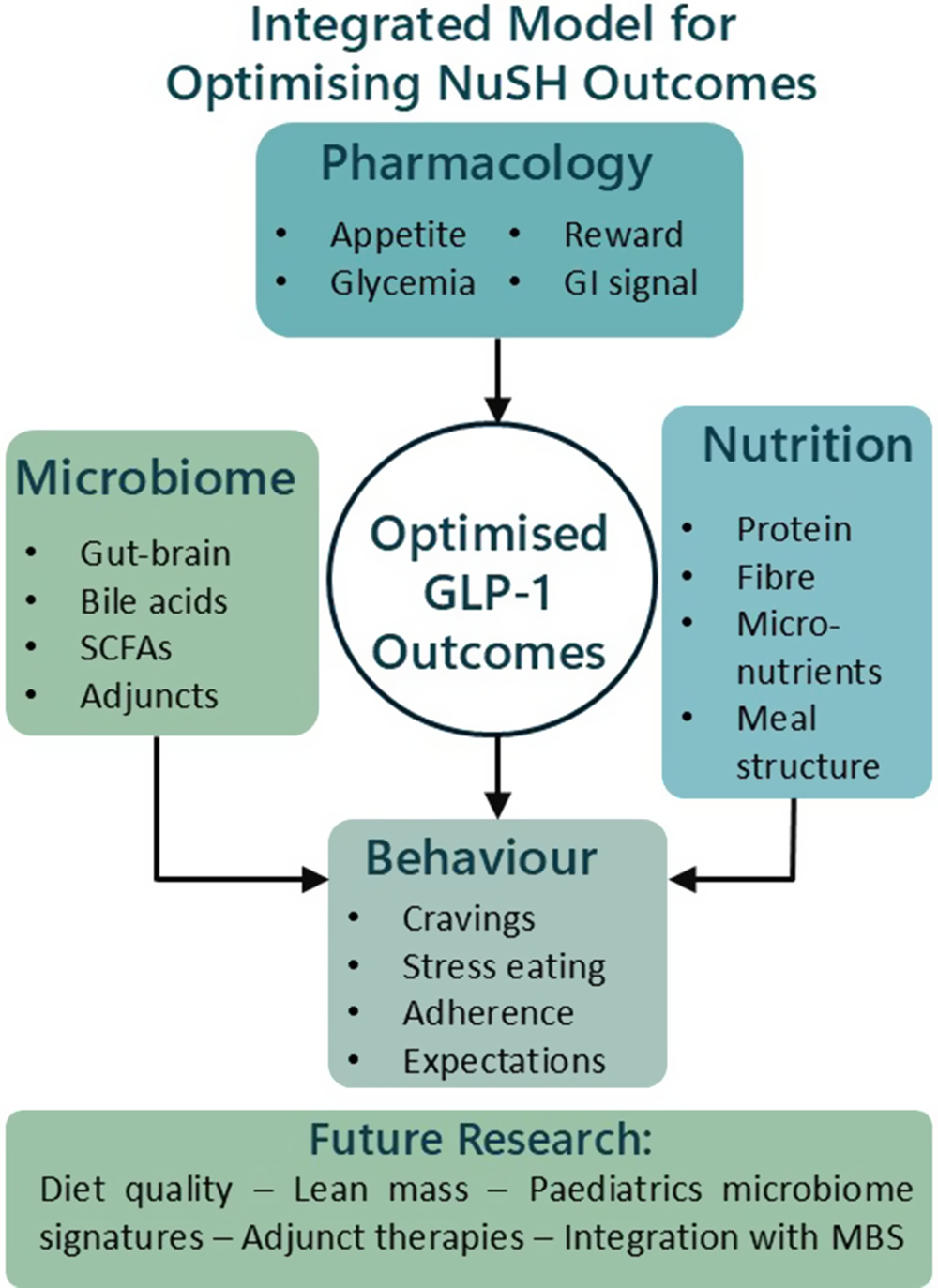
Future progress will depend on clarifying behavioural and microbial determinants of response, developing and testing targeted nutritional and microbiota-focused adjuncts, and determining how best to sequence or combine NuSHs with MBS. Equally critical is the creation of scalable care models, supported by harmonised dietary and behavioural assessment methods and long-term registries, that can deliver equitable, personalised treatment across diverse populations. Strengthening these areas of evidence will enable a more precise and durable integration of NuSHs into obesity care, ultimately ensuring better outcomes for both adults and young people living with the disease of obesity (see Fig. 1).
Integrated model for optimising outcomes with Nutrient-stimulated hormone therapies (NuSH) therapies.

Figure 1. Long description
The diagram illustrates an integrated model for optimizing outcomes with nutrient-stimulated hormone therapies (NuSH). It features three main components: Pharmacology, Nutrition, and Microbiome, each contributing to optimized GLP-1 outcomes. Pharmacology influences appetite, glycemia, reward, and gastrointestinal signals. Nutrition focuses on protein, fiber, micronutrients, and meal structure. The Microbiome affects gut-brain communication, bile acids, short-chain fatty acids, and adjuncts. These components collectively influence behavior, impacting cravings, stress eating, adherence, and expectations. Future research areas include diet quality, lean mass, pediatric microbiome signatures, adjunct therapies, and integration with metabolic and bariatric surgery.
Acknowledgements
The authors gratefully acknowledge institutional support from APC Microbiome Ireland.
Author contributions
H.S. conceived the overall concept for the manuscript. J.L., D.W. and H.S. wrote the manuscript. T.G.D. and C.W.LeR critically reviewed the manuscript and provided domain expertise.
Financial support
The research was conducted and primarily funded by APC Microbiome Ireland, a research centre funded by Research Ireland [Grant Number 12/RC/2273_P2] (formerly Science Foundation Ireland). H.S. received funding from the Biostime Institute for Nutrition & Care – BINC Foundation, which also contributed to the research directly, and Food for Health Ireland through the EI Technology Centre award (TC20180025).
Competing interests
The authors declare no conflict of interest. H.S. an inventor on a patent EP17187989.3 ‘Bifidobacterium longum APC1472 for treating obesity and weight management’. H.S. has obtained research funding from Pharmavite, Cremo, Tate & Lyle PLC, Pepsico and Fonterra. D.W. has received consulting and lecture fees from Novo Nordisk A/S, Rhythm Pharmaceuticals and Eli Lilly and Company. The funding sources did not influence or constrain the writing of the manuscript.

 Open access

