In the prevailing histories of American film music, the first three notes of Max Steiner's score for King Kong (1933) bear much weight. As the film's block-lettered title surges from background to foreground, low brass intone a chromatic descent—B, B-flat, A—each slab of sound foreshadowing the approach of an oversized ape and, ostensibly, an era of original, symphonic underscoring in Hollywood sound film. The cinematic gesture is assured and emphatic, but the conceit that Steiner's Kong marked a breakthrough sits at odds with the historical record. At RKO, Max Steiner had already composed musical accompaniments for isolated scenes in films like Cimarron (1930), Roar of the Dragon (1932), The Conquerors (1932); he had composed lengthier scores for Symphony of Six Million (1932), Bird of Paradise (1932), and The Most Dangerous Game (1932). By March of 1933, the month of Kong's premiere, most studios incorporated—at least occasionally—background scores into their films. Many of these scores received acknowledgement in newspapers, yet Kong's music went almost completely unnoticed by critics during its initial release, its presence not as noteworthy as the film's hokey-yet-novel special effects.Footnote 1
These circumstances have prompted scholars to qualify Kong's achievements. Recent film music histories, for example, assert that the music of Kong signaled a “coming-of-age of nondiegetic film music” and “model for scoring practice,” but they also draw attention to earlier Steiner scores that had received notice in the press.Footnote 2 Other studies have parsed specific pre-Kong scores to illuminate sophisticated musical accompaniments that clearly informed Steiner's work on Kong.Footnote 3 This article builds upon this work by directing scrutiny at the Kong myth itself. How did Kong become such a compelling cornerstone for early Hollywood underscore, and how does its canonization continue to shape expectations of what film music was, is, or should be? Possible responses to these questions are many, and this study offers one by comparing Steiner's pre-Kong career trajectory alongside another film music practitioner of the early sound era: Paramount music director Nathaniel Finston.
Although Finston is little known today, his widely aired views on film music reflected his experiences as a silent cinema music director and clashed markedly with Steiner’s. Finston endorsed the compartmentalized, assembly-line methods of Hollywood music departments, including the pragmatic recycling of preexistent music. In contrast, Steiner—and those writing about Steiner—described his contributions as evoking the musical spirit of silent cinema but framed his methods as those of an art composer working alone on original work. Close examination of compositional trends, press accounts, and critical reception of select films from the 1930s, reveals that both Steiner's and Finston's conflicting methods proved resilient in subsequent years, but growing critical acclaim for Steiner's Kong marginalized collaboratively produced film scores and threatens to misdirect appraisals of Steiner's other work. The musical contents of Kong are therefore not of prime importance here. Instead, this investigation of film music discourse addresses the emergence of biases and expectations that would later be used by critics to leverage Steiner's Kong to the position of Hollywood's model underscore—years after the film's initial release. Considering Finston's practices at Paramount alongside Steiner's pre-Kong scores at RKO illuminates the limitations of using only Kong as a model, and shows that Finston's perspective on film scoring in the early 1930s offers a corrective balance for assessing film musicians’ work before and after Kong.
Roads to Hollywood
Finston and Steiner had tellingly different résumés when they arrived in Hollywood; not surprisingly, these experiences informed their approaches to film scoring. Raised in fin-de-siècle Vienna, Steiner (1888–1971) was the son of theater scion Gabor Steiner, whose accomplishments included the building of the Riesenrad, the city's largest Ferris wheel.Footnote 4 Max took to musical theater at an early age and spent the pre-war years composing and conducting operettas across Europe, from Moscow to London. With the outbreak of World War I, Steiner came to Broadway, where he continued to conduct, compose, and arrange music for various shows, including the Gershwins’ Lady Be Good, and productions by Victor Herbert. After working on Harry Tierney's Rio Rita, Steiner received an invitation to Hollywood in 1929 to assist with a film version of the Broadway production at RKO.
It was an inauspicious arrival, and Steiner almost returned to the East Coast when work proved scarce. Production of film musicals declined sharply in 1931 and many musicians were removed from studio payrolls.Footnote 5 Instead of letting Steiner go, RKO executives appointed him head administrator of the studio's reduced music department. The position initially involved little composition, but in the early thirties Steiner began fielding requests from producers—notably David O. Selznick—for original music for main titles and dramatic sequences. From these efforts the career of Hollywood's most prolific composer was born. Steiner continued to shoulder administrative duties through the early 1930s at RKO and later Selznick International Pictures, but Steiner's rise to prominence in the press came through his efforts as a composer, not administrator. By the late 1930s he had shifted his efforts entirely to composition. Steiner continued writing film music through 1965; tallies of his filmography vary but extend well beyond two hundred.Footnote 6
Nathaniel W. Finston (1890–1979)Footnote 7 had much more experience in film than Steiner when he arrived in Hollywood in 1928.Footnote 8 Born in New York and trained as a violinist, Finston began working in his teens with the Fifth Avenue Hotel orchestra, an experience that exposed him to a wide variety of light classical fair. He soon graduated to more prestigious ensembles, including the Russian Symphony Orchestra, the orchestra of the Boston Opera, New York Symphony, and New York Philharmonic. While serving as concertmaster in one of Samuel “Roxy” Rothapfel's moving picture palaces in the late 1910s, Finston accepted conductor Hugo Riesenfeld's invitation to take up conducting. Finston served under Riesenfeld as associate conductor at the Rialto (1917–19) and also music director at the Capitol (1919–21), where he oversaw an orchestra of 74 pieces and helped compose and compile scores. A job overseeing music operations in the Chicago-based Balaban and Katz theaters, led to an even higher administrative position as music director for the entire Publix Theatre chain, operated by Paramount studios (1925–28).Footnote 9
In an undated publicity bio written for Publix ca. late 1920s, Finston divulged his enjoyment of the business side of music:
I was not inclined towards a musical career for possibly the first 20 years of my life. It was only the necessity for succeeding as a player to improve my income and living which interested me in music. I was rather inclined towards a commercial or law course of training. However my mother had a different opinion about this, and I guess my closing chapter will be the death of a musician not a businessman. Some of my friends insist that as a musician, I am a good businessman. My business associates are positive that as a businessman, I am a fine musician.Footnote 10
Finston's tongue-in-cheek admission suggests he enjoyed deflating romantic ideals attached to his profession. He was, after all, that rare creature whose entry to the arts came through parental pressure and the lure of monetary reward. Hardly a suffering artist, Finston's pragmatic coordination of business and music interests made him well suited for the rapidly growing film industry, where success depended upon savvy negotiation of budget and craft.
In 1928 Finston moved to Hollywood, where he aggressively promoted music's contributions to the film industry generally and Paramount's films in particular. In terms of influence, these were Finston's critical years, a crest made evident by his increased presence in mainstream and trade press publications. Indeed, Finston's evident availability to journalists was likely strategic: a step that brought greater public awareness to Paramount's music department and Finston's expert managing of it. Multiple reporters from the Los Angeles Times marveled at his encyclopedic grasp of film music facts. In 1929 Speed Kendall lauded Finston's ability to identify the “melody, title, composer, and publisher” of any of the Paramount music library's holdings, often having to “produce a piece from a few faulty bars of it, whistled or hummed in his delicate ear.”Footnote 11 The same year Edwin Schallert noted Finston's advocacy for collective scoring methods, in which each composer specializes in one scene type and then composes only that type. “There are many composers who are individualists,” acknowledged Finston, “but there is a great difference in screen work. It is a difference often times better understood by the industrialist than the artist. He knows that in a factory each man can specialize in doing something exceedingly well and will confine his efforts chiefly to that thing.”Footnote 12 Finston's factory friendly analogies and anti-artistic rhetoric appear, much like Finston's earlier comments on music and business, intentionally provocative: sly jabs at the romantic ideal of the isolated composer. In an article titled “Commerce and Art United in Talkie Business” for the Los Angeles Daily News, Harry Mines detailed the rationale behind Finston's views:
Art and big business have never agreed in the past. But necessity makes even miracles possible. . . . Take the music department of Paramount studio, for instance. Here, Nathaniel Finston . . . is attempting to form tin-pan alley into an organized department that turns out songs and music as you order them. In other words, Finston is making a business of composing music. Inspiration is out. To go about this successfully, he had and still has to battle temperament. He has a staff of musicians working constantly under him. Each man specializes in a particular phase of music.
Mines surveys some of these phases by following film songs and music cues as they pass among composers, lyricists, arrangers, conductors, and musical advisers. He concludes:
His idea to apply big business efficiency methods to song composing and the music department came to Finston when he once visited the Armour Meat factory in Chicago and watched their methods of slaughtering and preparing livestock. Each man at Armour’s, he explained, had his own particular piece of work and knew it so well, that the job was finished speedily and neatly and saved many hours of labor a single man would have had to go through. Now he is trying this time saving system on the department of music at Paramount and so far everything has worked well.Footnote 13
Although the journalist does not specify when this music-as-meatpacking revelation visited Finston, the Chicago setting suggests 1921–25, when Finston was overseeing musical operations in that city's Balaban and Katz theatrical circuit. With new silent films arriving weekly, perpetual time shortages meant that musical directors needed a system that worked “speedily and neatly.” Hence music directors typically worked collaboratively with their staffs and drew liberally from preexistent music to compile accompaniments. None of these practices was unique to Finston, but whereas some musicians expressed public dismay at what they perceived to be hasty and irreverent methods (contemporary Max Winkler likened these accompaniments to butchery in the non-complimentary senseFootnote 14), Finston embraced collaborative techniques in both silent and sound eras. Rather than arguing for greater artistic originality and autonomy for film musicians, Finston emphasized music's important service to silent film and its capacity to render similar enhancements in the sound cinema. In 1931, Philip Scheuer related:
Music, points out Nathaniel Finston . . . is too much a part of our lives to be ignored in our cinema. He recalls that in those halcyon days when he, along with Hugo Riesenfeld, Erno Rapee, David Mendoza, William Axt, and the late Josia Zuro were arranging scores for New York's Capitols and Rialtos, these musical accompaniments were regarded as a good 50 percent of the success of any picture. He asks who can deny the enhancing power of the scores for such spectacles as “Way Down East,” “The Birth of a Nation,” “The Big Parade,” and the rest; and adds that all this was forgotten over night with the astounding discovery that voices could be made to come out of the mouths of babes. On that day, he says, the work of twenty years went for naught. Recovery is only now beginning.Footnote 15
Finston's gripe was a familiar one among orchestral film music practitioners. Steiner later outlined a similar problem in his essay “Scoring the Film,” from 1937. Looking back on the early sound era, he noted a combination of factors both technical (it was not easy to record music on the set and rerecording sacrificed audio clarity) and aesthetic (would audiences grappling with the heightened realism of sound film find music distracting?) that prompted the disruption of orchestral scoring techniques associated with the silent era.Footnote 16 Whereas theater orchestras had played more or less continuously for silent films, studio orchestras had comparatively less to do. For the most part, orchestral music continued to be used only in parts lacking synchronized dialogue, including title sequences and montages, and scenes in which music could be justified through genre (i.e., musicals) or narrative circumstance (i.e., diegetic music). This summary is admittedly tidy, and recent scholarship by Michael Slowik has shown that select filmmakers deployed multiple strategies to incorporate background scoring into early sound films like Lights of New York (1928) and The Big Trail (1930).Footnote 17 The extent to which these exceptional films proved—or disproved—the rule described by practitioners, however, has only begun to be addressed in the scholarship.Footnote 18 At Paramount, Finston viewed his efforts as music administrator as key to effecting a more deliberate and calculated “recovery” for music in the industry.
In the same article in which Finston recalls silent era accompaniments he also singles out Fighting Caravans of 1931, a western starring Gary Cooper in which music plays under dialogue and action for the entire film. The sustained use of symphonic underscore beneath synchronized sound was unusual for the time, but it went largely ignored by critics and remains understudied.Footnote 19 The reasons are telling. First, no composer is listed in the credits and a team of nine actually worked on the film.Footnote 20 Familiar melodies like “Oh! Susannah,” and “Arkansas Traveller” comprise the most prominent melodic materials of the score. Thus, not only is its authorship both hidden and collective, but the music's “originality” is diminished by reliance on preexisting melodies. Finally, the music plays at a very low volume for most of the film. Although the entrances of several recurring themes and textural changes occasionally correspond to narrative events, the music's ubiquitous presence and imprecise correlation to onscreen action makes it easy to ignore, which is precisely what most critics did. Finston himself expressed reservations about the film's music, admitting that he “is not altogether positive that a complete musical underscore is advisable for a talkie, certain episodes lending themselves better so silence; but he is convinced that no music at all is infinitely worse.”Footnote 21
Steiner's Symphony and Island Adventure Trilogy
As Finston toiled at Paramount, Steiner assisted with musicals at RKO. Although he penned a few minutes of symphonic underscore for Cimarron (1930), his orchestral compositions for film did not otherwise extend beyond main and closing title sequences. When producer David O. Selznick arrived at RKO in 1932, he requested that Steiner provide more for their second film together, the aptly titled Symphony of Six Million (1932). Unlike the music for Fighting Caravans, which had been assembled by a team, the single name of Max Steiner in Symphony's credits helped clarify and elevate authorship in mainstream publications like the Los Angeles Times:
An “operatic underscoring” is the technical designation of the musical complement composed by Max Steiner for RKO Radio Pictures’ “Symphony of Six Million.” . . .[Steiner] credits the original idea for this treatment to David O. Selznick, executive vice-president in charge of RKO production.Footnote 22
Even though Symphony was not as “original” as Selznick and Steiner let on, it did mark an important step in film music accompaniment. In Fighting Caravans Finston's crew had essentially slipped a continuous, silent-era film score behind dialogue and effects. Part of Symphony's success rested on a more judicious and bold implementation of music. By having music enter and leave the film's soundtrack, audiences would be more aware of music's presence and—just as importantly—absence.
Despite its title and musical facets, Symphony's central story has little to do with music. The title refers to the inhabitants of the film's setting—New York City—and is explained through a foreword following the opening titles:
The film, based on a story by Fannie Hurst, follows the life of Felix Klauber, a boy who dreams of becoming a great doctor for his neighbors in the Lower East Side. Plans go awry when his brother convinces him to leave the low-paying neighborhood clinic and work privately for wealthy uptown clients. Although his boosted salary allows his family to enjoy greater creature comforts, Felix (Ricardo Cortez) gradually becomes estranged from his family, his childhood friend Jessica (Irene Dunne), and his community. After losing his father (Gregory Ratoff) in an unsuccessful operation, Felix resolves to return to the clinic, where he saves Jessica through surgery and rededicates his life to serving the Jewish community of his youth.
Throughout Symphony, music's presence characterizes narrative space, contrasting the poor, Jewish home of Felix's family with the uptown office that he eventually opens. Throughout the first part of the film, Steiner's underscore accompanies scenes of the aspiring doctor at home with his family, at the local clinic, and at the Braille institute where Jessica, his love interest, works. The music emphasizes Felix's cultural milieu through the inclusion of Jewish melodies, such as “Auf’n Pripotchok” (Warshawski, 1913), “Hatikvah” (Imber and Cohen, 1888), “Eli, Eli,” and the Kol Nidre, which become associative motives linked to characters and ideas.Footnote 23 The music's “Hebrew idiom”—as noted by critics—is also reinforced through klezmer-inspired passages and original themes set in the harmonic minor mode.Footnote 24 When Felix moves from ghetto to uptown office, the music stops. Scenes in which Felix serves rich women while ignoring his father unfold without musical comment. The silence expresses audible disapproval, exemplifying Mark Slobin's concept of erasure: “Who gets soundspace [in film] and who gets silence carries major cultural meaning.”Footnote 25 More important, however, is when the musical division between ghetto and uptown dissolves. When a preoccupied Felix forgets to operate on a boy at the local clinic and the boy dies, Jessica makes an unprecedented visit to confront him in his uptown office. Music anticipates her entrance, and Steiner marks her arrival with the melody of “Hatikvah.” The unsung lyrics echo her own plea that Felix return to his community:
In contrast to Fighting Caravans, in which continuous music was ignored by critics, Symphony's intermittent underscoring received more comment as well as comparisons to silent-era practices:
The [RKO] people who are responsible for underlaying Symphony throughout with a splendid musical score have pointed the way which may be followed with profit by others. It was composed by Max Steiner, and as an example of thematic music is worthy of study. In the silent days we had music throughout the picture. . . . With the coming of ‘talkies’. . . dialogue and the rasping of mechanical contrivances all but eliminated music. . . . Here in ‘Symphony of Six Million’ it is used . . . for the very deliberate purpose of building and sustaining emotional values of both the dialogue, the incidental background noises, and the picture itself.Footnote 26
There is some irony here, in that Finston's more accurate replication of silent-era music-making within a continuous synchronized soundtrack received no mention while Steiner's more selective cues prompted critics to recall an era in which music had invigorated quiet images. Perhaps it was that Symphony had granted space for the musical score to blossom apart from sound effects and dialogue, allowing audiences to contemplate its contribution in real time. When Felix's father dies in surgery, Steiner's cue enters after two nearly silent minutes of the surgery itself. During the operation sound is limited to the clink of surgical instruments and a few words of dialogue. The visual editing, which darts with increasing speed among static shots of the operating room is simple and riveting. When Felix cries overs his father, murmuring low strings begin the Kol nidre. As the staff wheels the body from the room, “Auf’n Pripotchok” plays slowly on piano, with accompanimental chords on organ (see Example 1). The odd instrumental pairing specified in Steiner's short score simultaneously invokes memory—the piece has been performed previously by Felix's sister on piano—and the hereafter, with sustained organ chords sounding ghostly and funereal.Footnote 27 The son is left alone in the room. “Auf’n Pripotchok” fades away, its final phrase played doloroso on bassoon. Such deliberately wrought musical restraint packs considerable power, especially within the sentimental context of an early 1930s melodrama. The effect, however, is not achieved through breathtaking musical originality: melodic content is almost entirely borrowed and the cue is carried by a handful of instrumentalists, not a straining full orchestra.Footnote 28 Even so the filmic context encourages close listening, with recognizable melodies unwinding alongside footage that is otherwise silent.
Opening page of Max Steiner's short score for Reel 9 (death scene), featuring the “Kol Nidre” (mm. 1–3) and “Auf’n Pripotchok” (mm. 9–12). Annotations and timing marks are transcribed from the original document. Max Steiner Collection. L. Tom Perry Special Collections Library. Harold B. Lee Library. Brigham Young University. Provo, Utah.

In story and usage of music, Symphony may seem as far removed from King Kong as Finston's Fighting Caravans, but Symphony establishes many important precedents that Steiner would carry through to Kong, including the reliance upon associative themes, the deliberate withholding of music to contrast one narrative space with another, and even mickey-mousing (Steiner's music matches Felix's footfalls in a hospital scene). Like Kong, Symphony also includes scenes that creatively intertwine diegetic music-making and nondiegetic accompaniment. Far from being a modest predecessor to Kong, Symphony of Six Million demonstrates elegant integration of visuals, narrative, and music. The only thing missing, it would seem, is complete independence from preexistent music and a denser, more harmonically complex orchestral texture. Both of these facets emerge in Bird of Paradise and Most Dangerous Game.
Watching Bird of Paradise, Most Dangerous Game, and King Kong in succession reveals immediate parallels. All three films center on an exotic encounter mediated by music: white adventurers find an island populated by exotic others. Their arrival at the island cues both narrative conflict and orchestral underscore. The similarities in plot are heightened by other parallels, including shared castingFootnote 29, shared sets, shared footage (identical shark footage used in Bird and Game prompted Steiner to write in the margins of his score “We’ve got a shark in every picture, by Jesus!”Footnote 30), shared studio, and shared personnel: Merian C. Cooper directed both Game and Kong while David O. Selznick and Max Steiner served on all three productions. Finally, all three films were deemed by critics to be throwbacks to the silent era, a conclusion abetted by musical accompaniment.
In both Bird of Paradise and Most Dangerous Game, music delineates narrative space. In the opening scene of Bird of Paradise, a boat crew attempts to navigate through a narrow and shallow island reef. Although dialogue is heard, synchronized sound effects are spare. Crashing waves are depicted aurally through Steiner's evocative ocean music: brass crescendos, closely miked harp glissandi, and a carefully timed cymbal crash evoke a large wave's crest and hide the fact that not a drop of actual water can be heard even though visually it sloshes over the camera lens. Yet the replacement of aural realism with sprays of orchestral color performs an important purpose. Just as the boat rides the wave crest into a strange, beautiful land, so the gentle dissociation of visual and aural realism eases the spectator over the barrier of disbelief, with music compelling the audience to at least consider a land where “native” Dolores Del Rio pursues amorous entanglements with an impressively clueless Joel McCrea. The effect anticipates the much celebrated island-approach scene in King Kong that Claudia Gorbman argues “initiates us into the fantasy world, the world where giant apes are conceivable. . . . [Steiner's music] helps to hypnotize the spectator, bring down defenses that could be erected against this realm of monsters. . . .”Footnote 31
Steiner's music for Bird of Paradise plays for almost the entire film. Even with this near-continuous score, however, Steiner withholds music for an important scene when the sailors are back at the boat, marveling at Joel McCrea's easy susceptibility to natives’ charms. It is the film's one allowance for real world disenchantment and is fittingly confined to sailors crammed inside their ship. When the camera cuts to McCrea enjoying the night air above board, the shimmering texture of the film's opening returns, marked in Steiner's pencil draft as “very traümerisch.”Footnote 32 For the rest of the film, Steiner generously unfurls theme after theme, with eleven full melodies supplemented by shorter motivic fragments. Mark Slobin observes that “Steiner mixed an orchestral score with depictions of indigenous music-making, tossing in generalized colorful music that drew on the Hawaiian music craze . . . [thereby creating] quite the ethnomusicology of an imaginary community.”Footnote 33 Contemporary critics were similarly charmed by Bird: “Significant in ‘Bird of Paradise’ [is] the musical background that actually helps to tell the story, enhancing dramatic effects and building up climaxes just as symphony orchestras used to do with big silent films.”Footnote 34
Most Dangerous Game covered what was becoming increasingly familiar ground: underscore is withheld until the adventurers are shipwrecked, melodic gestures ape onscreen movement (in this case, the footsteps of the film's protagonist), diegetic and nondiegetic music share motivic material, and critics lauded once again Steiner's inspired touch.Footnote 35 Steiner did not compose as much music for Game, partly because he was writing a replacement score—an initial attempt by W. Franke Harling had been rejected by director Cooper. With Harling's score cut for being too light, Steiner and orchestrators Bernhard Kaun and Emil Gerstenberger erred on the hefty side, with textures so thick and busy for the film's extended chase sequence that the thirty-two member orchestra had trouble recording it. “There were a great many individual mistakes in the orchestra,” wrote sound engineer Murray Spivack in the recording log, “which were not due to lack of rehearsal. These should be considered unavoidable, inasmuch as the musicians were working from 10:00 A.M. to 6:00 A.M., and the music was extremely difficult.”Footnote 36 Steiner's strain as lone composer aided only by orchestrators is also more evident: “Bernard!” Steiner scribbled in one margin to orchestrator Bernhard Kaun, “Help this if you can! It's now 4 a.m. and I can't think anymore. Worked since 8 this morning.” In order to generate more music with less effort, Steiner also ordered that more passages be repeated, albeit with different orchestration. For one such passage near the end of the picture, fatigue forced bad puns: “cue the other instruments. Should be very forte. (maybe 80) HA! HA! (4 a.m.).”Footnote 37 Exhausted and already looking ahead to Kong, Steiner had just enough energy to pun at the end of the score: “Grandioso a la Kaun. . . Bernard: Make this as nice as you can its 5:30 and I am dying! Dein [Your] Max.”Footnote 38
Notes like these remind us that Steiner controlled more of the compositional details, whereas Finston oversaw the collaborative efforts of others. Viewed in relation to Finston's team-approach, some of Steiner's stylistic decisions also become more understandable. Mickey-mousing, a device often dismissed as overly obvious, served to emphasize the customized contours of Steiner's music. If a melodic line perfectly matches the erratic footsteps of an onscreen character, as it does in The Most Dangerous Game, then it is clear the music has not been recycled from a studio library, as at Paramount. Similarly, the shift away from Symphony of Six Million's Jewish melodies to the original music of Bird of Paradise and Most Dangerous Game raised the cachet of the original, individualist composer. Nowhere is this more explicitly celebrated than in an article titled “Classical Composers Banished from Films”:
To be unceremoniously ejected from the RKO lot was the fate of Ludwig van Beethoven, Peter Ilyitch Tschaikowsky and other dead composers! One living man will supplant them! Original music, never played or heard before, is being fitted to such cinema plays . . . and it is being composed by one man! That man is Max Steiner, musical director for Radio Pictures. Not one note, not one bar of music, will come from any other brain.Footnote 39
This statement was likely provided by a studio publicist. Even Steiner depended on orchestrators and assistants to realize his drafted short scores. Nevertheless, the copy reveals a myth in the making. The idea that a critic might focus attention on the efforts of one composer stands in strong distinction to Finston's openly collaborative and derivative models. These models withheld from journalists a strong personality, other than Finston’s, on which to lavish attention.
The consequences of these different strategies can be seen in the press. Finston coached Scheuer, for example, to give heed to the music in Dishonored, a film starring Marlene Dietrich about a female spy who encodes secrets into music: “In this picture we have made a piano an integral part of the plot, so that the music played on it becomes important to the actors involved; and as the result of this piano-playing is made visually apparent, a full symphony orchestra develops the original themes to terrific proportions.”Footnote 40 (The role of the piano is intimated in the main titles, which present an orchestral fantasia on the opening of Beethoven's Piano Sonata, No. 8 “Pathétique.”) But when Scheuer reviewed Dishonored, his description of the music—“tremendously effective, especially in its orchestral finale”—left out Karl Hajos and Herman Hand, the musicians responsible for the original material and arrangements.Footnote 41
In contrast to this anonymity, Steiner received increasing attention, with critics beginning to note patterns in his most recent RKO production, The Most Dangerous Game. One Los Angeles Times critic even echoed Finston's words on music in the silent cinema:
A thing that should be noted, and more than just in passing, is the work that this musician, Max Steiner, is doing in bringing out atmospheric possibilities in pictures. He contributes measurably to “The Bird,” and even more to “The Most Dangerous Game,” which is soon to show.
In silent pictures music supplied much of the emotional sweep of a production when it was exhibited on the screen. In fact, I would be inclined to say that 50 per cent of this sweep was due to the influence of the theater orchestra, when there was an orchestra, and 25 per cent when the organ had to be depended on for accompaniment, provided both the orchestral leader and the organist were equal to the occasion.
For portions of “The Bird of Paradise,” and also for fully half of “The Most Dangerous Game,” music does its old share in providing the stimulus.Footnote 42
Ironically, praise for Steiner's ability to revitalize silent-era sonic grandeur breaks sharply at King Kong. As stated above, the music of received little comment during its initial release. By itself, this is not terribly surprising; background music in films was regularly ignored by critics in the 1930s. But Symphony, Bird, and Game all received significant notice. Why not King Kong? As James D’Arc and Wierzbicki have noted, part of the reason was likely the film's special effects and novel story—both of which preoccupied critics at length.Footnote 43 It is also likely, however, that by King Kong's release in March 1933, background orchestral music was no longer the novelty it had been eleven months earlier with Symphony of Six Million. Rather than breaking new ground, King Kong followed a well-trod path blazed by the earlier films. Indeed, the very fact that RKO's executive producer, David O. Selznick, approved the larger orchestraFootnote 44 and $30,603.48 bill for Kong's music—a cost that nearly matched the collective salary of the cast ($35,956)—speaks to the studio's prioritization of Steiner's contribution.Footnote 45 Without the demonstrated success of music in the earlier films, it is difficult to conceive of any studio spending so much on music.
Crowning Kong, Forgetting Finston
If the very traits that Steiner's music for Kong purportedly introduced into the cinema were already well established in earlier films, why then is Kong still depicted as a historic achievement? Renewed attention from journalists helped. One commentator in Variety returned to the film months after its release to ruminate on its music:
Going back over recent months, and keeping away from the straight musicals for the moment, the picture which seems to be a shining example for its musical score is King Kong orchestrated [sic] by Max Steiner. Memory and physical restrictions necessarily limit a summary on every picture which has come out of Hollywood in the past six or eight months, but it is logical to presume that no regular release has contained a more expert emotional buildup via music than ‘Kong’ did for the introduction of the giant gorilla. This was truly a fine piece of work, both as to scoring and staging, and undoubtedly was responsible to a definite degree for that picture's box office success, although many were seemingly unconscious of it.Footnote 46
Bruno David Ussher, a musicologist and music critic who wrote regularly about film music at a time when most music critics ignored it, also contributed. In 1937 Ussher wrote:
A good deal of music is used that suggests the smell and the surge of the sea. As far as I can recall, no one in or out of Hollywood, as far as films are concerned, has ever surpassed Mr. Steiner as a tonal distiller of the watery elements. He waxed most subtle in that Frankensteiniade, King Kong. To me a stupid adventure tale, Steiner compensated with music at once exotic and convincing, direct of atmospheric effect while employing technical means as modern harmonically as ever went into a picture.Footnote 47
In 1940, Ussher would assert that Steiner:
made film history with a background score for a picture in which a mechanical gorilla was the villainous central figure of that amazing (and unintentionally funny) fantasy.
Max Steiner's music for the boatride scene over the waters surrounding the isle of lost men still stands out in my mind as an exceptionally artistic piece of atmospheric composition in all the enormous quantity of film music written in Hollywood since then.Footnote 48
In his own writings Steiner argued that his music helped Kong succeed in theaters, but Kong's resilience as a pop culture icon sustained Steiner's music in cultural memory—especially at a time before commercial soundtracks, VHS, DVD, and internet formats facilitated the study of films outside theaters.Footnote 49 Other factors helped as well. Months after King Kong, RKO released Son of Kong (1933) a half-hearted sequel that parodied the original but gave Steiner opportunity to reuse thematic material.Footnote 50 King Kong's popularity prompted numerous theatrical rereleases of the film from 1938 onward, which may well have assisted the memory of critics like Ussher.Footnote 51 When King Kong was remade in 1976 and 2005, Steiner's music resonated implicitly and explicitly in each production.Footnote 52 Journalist Tom Shales even set John Barry's score for the 1976 version alongside a newly recorded album of Steiner's score, declaring: “it's hardly a challenge to pick the superior score. It's Steiner by a mile. . .. [Steiner’s] principal theme is three descending notes that have in fact become nothing less than a musical icon, like the first four notes of Beethoven's Fifth.”Footnote 53 In contrast to Kong's accumulation of films, soundtracks, studies, and assurances of canonic status, Fighting Caravans, Dishonored, Symphony of Six Million, Bird of Paradise, and Most Dangerous Game survive at best as minor classics.Footnote 54
Kong also satisfies musicological preoccupations. It was composed (albeit not orchestrated) by an individual; it features original content; its textures are frequently dissonant and denseFootnote 55; and it is musically organized around a melodic cell, an idée fixe that undergoes thematic transformation.Footnote 56 In addition, it is more self-consciously operatic than its predecessors. The spirit of Wagner is appropriately invoked in discussions of Kong and Steiner himself cites Verdi in his short score. As Kong bids farewell to Ann before falling from the Empire State Building, Steiner writes a halting descending line in the violins, accompanied by a note reading, “This should sound about like the ‘Miserere’ from Trovatore,”Footnote 57 an unexpected connection that links Kong to Leonora. Aside from the melodic resemblance, the passage does not sound at all like Verdi, but the annotation suggests that Steiner was drawing—likely with tongue in cheek—musico-dramatic parallels between Verdi's task and his own. All of these characteristics might be mustered to argue that Kong does represent an early pinnacle in Hollywood film scoring. Whether it served as a model for subsequent efforts, however, remains debatable. Steiner's later scores, for example, did not build directly upon these ideas. Instead, many of the scores historians favor—The Informer (1935), Gone with the Wind (1939), Casablanca (1942), Since You Went Away (1944), The Searchers (1955)—foreground preexistent music and less dense orchestration. Collectively, they have more in common with Symphony of Six Million than King Kong. In other words, Kong is indeed exceptional, but not because it provided a particularly useful compositional model.Footnote 58
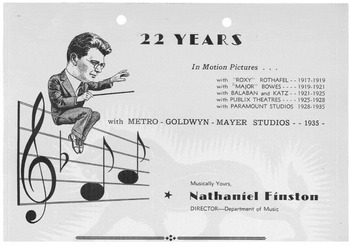
If overemphasis on Kong threatens to skew perception of Steiner's other work, it also pushes figures like Nathaniel Finston to an ahistorical periphery. As a music administrator, Finston's contributions do not fit easily into a critical framework built—however misleadingly—around individual composers furnishing complete scores. Yet despite neglect at the hands of critics and scholars, Finston and the methods he endorsed figured critically in Hollywood before and after King Kong. In 1933, Finston topped Los Angeles Times critic Edwin Schallert's list of individuals leading Hollywood's musical “renaissance”; Steiner followed second.Footnote 59 In 1935 Finston became head of MGM's music department, a prestigious post that he held for the next nine years.Footnote 60 In the early 1940s, Finston also served as chairman of the music branch of the Academy of Motion Picture Arts and Sciences. During Finston's time at MGM, publicists sought to depict his musical authority in accessible terms that nonetheless stopped short of composition. Images show Finston with baton in hand, iconography that acknowledged his skills as a conductorFootnote 61 and also suggested that his directorial command extended well beyond any podium (see Figures 1 and 2).
Nathaniel Finston poses with MGM studio musicians, ca. 1941–44. Nat Finston Collection. American Heritage Center. University of Wyoming. Laramie, Wyoming.

This advertisement appeared in various trade presses after Nathaniel Finston moved to MGM. It continued to be reprinted throughout the 1940s. Nat Finston Collection. American Heritage Center. University of Wyoming. Laramie, Wyoming.

Although historical distance makes it more difficult to assess Finston's influence within individual productions, glimpses of his efforts can be caught through the eyes of contemporaries. Observing Finston at Paramount, Dorothea Cartwright described his blending of compositional talents in nearly culinary terms:
Finston first determines the type of music necessary, then assigns the composers and lyricists best suited to produce it. If, for example, an operatic type is desired, the assignment is turned over to W. Franke Harling. Karl Hajos . . . handles a rather serious type of composition written in the Viennese style. Sam Coslow does the modern Gershwin sort. . . . In order to get an ‘all-around result,’ Finston combines several individuals. . . . On Monte Carlo [1930], Harling gave an esthetic quality to the music, while [Leo] Robin and [Newell] Chase sprinkled it with spice.Footnote 62
A full-page, single-spaced studio document from December of 1944 also offers a fascinating window onto Finston's accomplishments, which included recruiting almost the entire MGM music staff, from orchestral musicians to orchestrators, from conductors to composers. In addition, Finston was praised for his most recent contributions to musicals and music-laden films including Bathing Beauty (1944), As Thousands Cheer (1943), Song of Russia (1944), Meet Me In St. Louis (1944), and Anchors Aweigh (completed in 1944, released in 1945), “all made possible by Finston's selection and knowledge of fine—in fact, the finest of—musical craftsman.”Footnote 63 The author also acknowledged Finston's work at the podium, where he had recently conducted a handful of scores by Bronislau Kaper.Footnote 64 In December 1944 Finston resigned from his post at MGM, citing “disharmony in the music department.”Footnote 65 Although his old methods of managing musicians across diverse productions had ended, Finston found occasional work arranging film scores around preexistent selections. Both Song of My Heart (1948) and The Second Woman (1950) featured Finston's own arrangements of Tchaikovsky's music. Writing in 1948 for Music and Dance in California and the West, Finston looked back to his time as a music administrator. Twenty years ago it had been his “good fortune to be then an executive and the musical head of this major film company, and to convert and install the music requirements, at the transitional point, from silent to sound pictures.”Footnote 66 By the late 1940s, Finston may have already sensed that his status in the profession was fading swiftly from public consciousness. When Finston died thirty years later, the headline of his Los Angeles Times obituary confirmed this disconnect: “Conductor Brought Melody to Silent Films.”Footnote 67
While Finston was still at MGM, pianist-composer-actor Oscar Levant found him poring over charts and allocating studio musical responsibilities in a “commodious office.” Levant's memorable sketch shows Finston flourishing in a music machine of his own making:
As Commissar of Music for the MGM enterprises, Finston was as closely in touch with the activities of his vassals as the tovarisch in charge of a salt mine in the Ukraine.
He then launched into a long exposition of his career at the studio, detailing the chaos in which he found the music department and the perfection of organization that now prevailed. “I’ll tell you,” he said, “it's running like a well-oiled machine.” The phrase appealed to him, and he repeated it, “Like a well-oiled machine. Every man a cog in the wheel.” . . .“Mr. Finston,” I answered, “My greatest desire in life at this moment is to a be a cog in the wheel.”Footnote 68
Taken from the unabashedly self-indulgent A Smattering of Ignorance, Levant's stories are pitched for dramatic effect, but his point is accurate. Finston's administrative approach continued to thrive in Hollywood throughout the studio era. David Raksin and Henry Mancini, for example, developed their craft through years of anonymously writing isolated music cues and arranging library selections for productions at Universal and Warner Bros. in the 1940s and 1950s.Footnote 69
Studio music departments’ regular reliance upon teams of composers and assistants to tackle individual films is not news. In a foreword to Clifford McCarty's 1953 Film Composers in America, a vast index of film composer credits, Lawrence Morton acknowledged that McCarty's resource favored one concept of film composition at the expense of others:
The anonymous score might escape attention because it must be observed, so far as this book is concerned, in abstentia. . . . Many of these scores, especially those of the early ’thirties, were created not by individual composers but by a music staff working under the supervision of a music director. They collaborated in a practical way by using common thematic material and employing one or another of the currently fashionable styles. . . . In many of these scores, collaboration was a very successful procedure from the standpoint of music-department operation and theatrical effectiveness, whatever the strictly musical results may have been. Screen credit, if it was given at all, usually went to the music director, though there were exceptions, as in Stagecoach and Union Pacific, where plural authorship was acknowledged on the screen.Footnote 70
Sixty years after Morton's observation, these collaborative methods remain understudied in part because the rise of Steiner's Kong and the forgetting of Finston are interrelated phenomena, reflections of value placed on credited composers that is often withheld from others, whether administrators like Finston or orchestrators like Bernhard Kaun, who assisted Steiner at RKO. It is not the point of this study to argue equivalency across Steiner's and Finston's skills and work. Rather, examining Steiner's pre-Kong work alongside Finston reveals a widening rift in practice and discourse that had consequences on how film music was (and largely is) critiqued. Finston's memorable lampooning of concert music ideals during Hollywood's early sound years offers a helpful jolt today: rather than disavowing Hollywood's semi-industrial models and the perpetuation of silent-era methods, Finston touted them. Critics may object on aesthetic grounds to these methods, but as even Morton himself conceded, these preferences should not obscure historic practices.Footnote 71
The example of Stagecoach (1939), a film that followed Finston's methods and provoked Steiner's ire, offers a case in point. For this production Walter Wanger hired Boris Morros, Finston's successor at Paramount, to direct the film's score. By Kathryn Kalinak's count, a seven-member team incorporated fifteen traditional and popular melodies into the underscore, an approach that echoed the tactics used by Finston's team on Fighting Caravans (John Leipold even contributed music to both films).Footnote 72 Whereas Fighting Caravan's music went largely unnoticed by critics, Stagecoach's music received an Academy Award, an unusual recognition for a team effortFootnote 73 that annoyed Max Steiner. “They had nine composers [sic] on that,” Steiner griped in an interview, “They did all the western tunes. No one will ever understand what happened [with the Academy Award] there.”Footnote 74 Steiner resented Stagecoach in large part because his music for Gone With the Wind (1939) did not win similar recognition the night of the ceremony.Footnote 75 But Steiner's objections left unmentioned that substantial swaths of Gone With the Wind's score had been composed and arranged by assistants who, along with Steiner, had interwoven period appropriate melodies.Footnote 76 Unlike Stagecoach, the “plural authorship” was not recognized on screen; only Steiner and music director Lou Forbes receive screen credit.
Examining the role of music administrators like Finston and the collaborative model he employed illuminates the prevalent contradiction embedded in Steiner's dismissal of Stagecoach's music. More importantly, it enriches our understanding of film scoring in early 1930s Hollywood and reveals the formation of certain critical prejudices that persist today. Although orchestrators and other collaborators frequently receive screen credit in current films, the habit of attributing a film score's creative content to a single composer remains strong. Music supervisors charged with selecting preexistent music for a film also receive less credit for their efforts than composers. As noted in a 2013 New York Times article, music supervisors “don't exactly create anything,” and acknowledgement of their contributions remains contested among industry powerbrokers, including the Academy of Motion Picture Arts and Sciences.Footnote 77 Increased critical scrutiny of figures like Finston—past and present—and the collaborative scoring methods practiced at Paramount and other Hollywood studios may help realign this historically skewed emphasis on lone composers and increase awareness of film music's profound yet complicated relationship to collaborative creativity.
In the end, the methods Finston advocated also prompt a reevaluation of the principles that quietly uphold Kong's subsequent sway over film music historiography. Steiner's Kong is an important, distinctive effort, but sustaining its prominence in historical narratives threatens to overshadow the more diverse and collaborative situations in which Hollywood underscore was typically assembled, with individual circumstances changing across productions and studios. Placed within this historical context, Kong's music did not just draw upon earlier models; it pointedly eschewed others, including the preexistent music of Symphony of Six Million and the collaboratively constructed, loosely-synchronized accompaniment in Fighting Caravans. Once Kong's relationship to these productions and its ex post facto elevation to Hollywood masterpiece is better understood, King Kong appears less like a new standard to which subsequent films hewed and more a remarkable oddity. In the spirit of its gigantic namesake, Steiner's music remains impressive but infrequently imitated.