The MacArthur-Bates Communicative Development Inventory (CDI) has now been adapted into more than thirty languages. This proliferation in a little over a decade indicates that parent report instruments have become a major source of information about the transition to language and early language development. Since the adaptations adhere to the core template developed by Fenson et al. (Reference Fenson, Dale, Reznick, Thal, Bates, Hartung, Pethick and Reilly1993), while reflecting linguistic and cultural differences in the population they target, they facilitate meaningful cross-linguistic comparisons of children's language development from 0 ; 8 to 2 ; 6. Although they are not direct measures of children's language and may indeed underestimate children's overall vocabularies (de Houwer, Bornstein & Leach, Reference de Houwer, Bornstein and Leach2005), particularly for some parts of speech (Pine, Lieven & Rowland, Reference Pine, Lieven and Rowland1996; Tardif, Gelman & Xu, Reference Tardif, Gelman and Xu1999) or some caregivers (de Houwer et al., Reference de Houwer, Bornstein and Leach2005), their ease of administration and scoring allows them to be used with much larger samples than are usually feasible with naturalistic speech sampling or other direct measures of child language. This allows us to explore and account for variability in development in a way that is not usually possible for spontaneous speech data (Fenson, Dale, Reznick, Bates, Thal & Pethick, Reference Fenson, Dale, Reznick, Bates, Thal and Pethick1994). In this report we provide the first detailed comparison of results from two closely related languages for which parent report data has recently become available, Cantonese and Mandarin (or ‘Putonghua’ as it is officially called in mainland China). Information on the language development of Mandarin-speaking children aged 0 ; 8–2 ; 6 was collected in Beijing, to establish the Chinese Communicative Development Inventory – Putonghua version (CCDI-P). Caregivers of children of the same age in Hong Kong provided the data for the Chinese Communicative Development Inventory – Cantonese version (CCDI-C). These data augment the body of knowledge on early lexical and grammatical development available via parent report in languages other than English, as reported for example in Jackson-Maldonado, Thal, Marchman, Bates & Gutierrez-Clellen (Reference Jackson-Maldonado, Thal, Marchman, Bates and Gutierrez-Clellen1993) for Spanish, Caselli et al. (Reference Caselli, Bates, Casadio, Fenson, Fenson, Sanderl and Weir1995) for Italian, Thordardottir & Weismer (Reference Thordardottir and Weismer1996) for Icelandic and Maital, Dromi, Sagi & Bornstein (Reference Maital, Dromi, Sagi and Bornstein2000) for Hebrew.
Putonghua, the ‘common language’, is the term used for Mandarin Chinese in mainland China, and was adopted as the official language of the People's Republic of China (PRC) in 1955. We use the term Putonghua, rather than ‘Mandarin’, the term more commonly used in English-speaking circles, in the name of the form to emphasize that we are reporting on the results of a vocabulary instrument that was designed by and with a particular set of users in mind – those who consider themselves to be ‘Putonghua’ speakers. Although there are many similarities between the multiple Mandarin dialects, including various northern and southern variants (see Li & Thompson, Reference Li and Thompson1981; Ramsey, Reference Ramsey1987) used within mainland China, variants of Mandarin labelled ‘Kuoyu’ or ‘Huayu’ in Taiwan, and variants labelled ‘Huayu’ in Malaysia and Singapore, the form was designed for, and we are presenting results on, the ‘Putonghua’ spoken by residents of Beijing, China. Nonetheless, the grammar of Putonghua is that of northern Mandarin and the vast majority of words on the instrument are appropriate for speakers of other Mandarin dialects.
In contrast, Cantonese belongs to the Yue set of Chinese dialects (Matthews & Yip, Reference Matthews and Yip1994: 2), spoken primarily in the southern provinces of Guangdong and Guangxi, and in the Hong Kong and Macao Special Administrative Regions of China. Cantonese and Mandarin are from the same language group – they are strongly isolating tonal languages of the Sino-Tibetan family. They are, however, mutually unintelligible, with distinct phonological inventories and lexical differences. According to some estimates, vocabulary differences range from 10–50% depending on the source and style of material (Snow, Reference Snow2004). Their grammatical structures are very similar, but with variations in obligatoriness of marking and the specific ways in which aspect, number and negatives are marked, as well as word order differences in some syntactic constructions. The Chinese language grouping can be compared to the Romance languages. As with French and Spanish, spoken Cantonese and Mandarin are typologically similar and have many phonological and grammatical characteristics in common, but a monolingual speaker of one language cannot communicate with a speaker of the other. This means that distinct adaptations of the CDI were required for Mandarin and Cantonese. Cultural variation that is reflected in language, especially in vocabulary, also had to be accommodated. Although Beijing and Hong Kong are both major Chinese cities, one is geographically and politically at the heart of the PRC, and, at the time of our study, essentially monolingual and monocultural. The other, located on the southern coast, has a majority (95%) Cantonese-speaking population, but because of long contact with the West and the presence of a significant minority of speakers of English and other languages, was more open to influences from other cultures, and this is reflected in the vocabulary that children are exposed to.
We used the data from the Chinese CDIs to address two questions: first, the role of both linguistic and socio-cultural factors (including structural differences in family demographics) in the growth of expressive vocabulary in Chinese children; and second, the part played by linguistic and pragmatic factors in the development of one grammatical category – noun classifiers – common to Mandarin and Cantonese (see Erbaugh, Reference Erbaugh, Li, Tan, Bates and Tzeng2006).
Expressive vocabulary
Although children in Beijing and Hong Kong are exposed to languages which are structurally closely related, they grow up in distinct environments, with different institutions, educational systems, family structures and linguistic influences. For our purposes, in relation to the early stages of development, it is the latter two that are of most relevance. The vast majority of children in Beijing are only children, in keeping with the one-child policy strictly enforced by the PRC government since 1979 (see Jing, Wan & Over, Reference Jing, Wan and Over1984). By contrast, there are no such restrictions in Hong Kong, and our sample contains families of from 1 to 5 children with a mean of 1·63 (SD=0·74) children per family. While there is increasing exposure to English in Beijing, this comes mainly at school age, and neither English nor any other language is a common feature of the home environment. In Hong Kong, by contrast, despite the relatively small number of resident non-Chinese, a significant minority of young children are exposed to English via their own parents' emphasis on learning English and/or through contact with live-in domestic helpers, typically, well-educated Filipinas, for whom English is the lingua franca in communication with the Chinese families they work for.
In keeping with general patterns of vocabulary growth (Fenson et al., Reference Fenson, Dale, Reznick, Thal, Bates, Hartung, Pethick and Reilly1993; Huttenlocher, Haight & Bryk, Reference Huttenlocher, Haight and Bryk1991), we would expect caregivers to report, for the period from 0 ; 8–2 ; 6 in Mandarin and Cantonese, a slow start for children in both languages from their first birthday on, succeeded by a rapidly increasing acceleration after six months. There seems no obvious a priori reason from the structure of the languages to expect dramatic differences in the average rate at which children in Beijing and Hong Kong learn words, overall, or learn members of a particular category of grammatical function words such as noun classifiers, as these are well represented in represented in both languages. However, we do expect higher average scores for girls than boys, in keeping with findings from English and other languages (Huttenlocher et al., Reference Huttenlocher, Haight and Bryk1991; van Hulle, Goldsmith & Lemery, Reference van Hulle, Goldsmith and Lemery2004). In addition, it is entirely possible that the different familial and linguistic contexts of Beijing and Hong Kong will have an effect on early vocabulary development. The single-child status of the vast majority of the Beijing sample, and their monolingual language experience, contrasts with the larger families and more varied linguistic environment of the Hong Kong children. The differences seem likely to favour the Beijing children, with more intensive linguistic input leading to output advantages (Hart & Risley, Reference Hart and Risley1995). The two groups of children will be compared in terms of age-based norms, both in terms of the absolute number of vocabulary terms reported on the CDI as well as in terms of ‘word opportunity’ scores reported in previous comparisons of CDI data across languages (e.g. Bornstein et al., Reference Bornstein, Cote, Maital, Painter, Park, Pascual, Pecheux, Ruel, Venuti and Vyt2004; Caselli et al., Reference Caselli, Bates, Casadio, Fenson, Fenson, Sanderl and Weir1995; Maital et al., Reference Maital, Dromi, Sagi and Bornstein2000).
Noun classifiers
Both Mandarin and Cantonese have a category of grammatical function word, noun classifier, that is common across many genetically unrelated East Asian languages (Erbaugh, Reference Erbaugh, Li, Tan, Bates and Tzeng2006; Li & Thompson, Reference Li and Thompson1981: 105; Matthews & Yip, Reference Matthews and Yip1994: 92), as well as many other non-Asian languages. There are five different types of classifiers in Chinese, with sortal classifiers, based on features of nouns such as shape, natural kind and function, the most distinctive of these (Erbaugh, Reference Erbaugh, Li, Tan, Bates and Tzeng2006; Matthews & Yip, Reference Matthews and Yip1994: 92). Chinese noun phrases (NPs) are grammatical without classifiers. However, classifiers in both Mandarin and Cantonese are obligatory in NPs after numerals, quantifiers and demonstratives, and they may be used in other contexts as well (see Erbaugh, Reference Erbaugh, Li, Tan, Bates and Tzeng2006). The syntactic location of classifiers is the same in both languages – they occur immediately before head nouns (see examples below). In addition to the specific sortal classifiers, each language has a ‘default’ or ‘general’ classifier – ge in Mandarin, go3 in Cantonese, which can be used across a wide variety of different nouns. Classifiers emerge early in development and their use is gradually refined in both languages (Chien, Lust & Chiang, Reference Chien, Lust and Chiang2003; Erbaugh, Reference Erbaugh, Li, Tan, Bates and Tzeng2006). The examples below of classifier use with a numeral in the two languages indicate the syntactic location of a pair of cognate sortal classifiers, tiao2/tiu4, in the two languages. They also show how they link nouns which share a common semantic feature, in this case that they are all elongated objects:Footnote 1
(1) Mandarin yi4 tiao2 she2 yi4 tiao2 yu2 yi4 tiao2 lu4 one CL snake one CL fish one CL road
(2) Cantonese yat1 tiu4 se4 yat1 tiu4 yu2 yat1 tiu4 lou6 one CL snake one CL fish one CL road
Other classifiers are different across the two languages. For instance, Mandarin marks ‘piles’ of things (e.g. hay, sand) with the arrangement classifier dui1 ( ), whereas Cantonese uses a sortal classifier (gau6,
 ) for some clump-like piles, and also extends its use to amorphous blobs like modelling clay. These syntactic and semantic features would suggest that the development of classifiers would correlate with the trajectory of vocabulary development overall in each group of children. However, differences in the functions of these forms across the two languages might lead us to predict an advantage in classifier development for Cantonese-speaking children. Specifically, Cantonese speakers are more likely than Mandarin speakers to include sortal classifiers in NPs to mark definiteness, to make anaphoric reference in a narrative and to mark possession (Erbaugh, Reference Erbaugh, Li, Tan, Bates and Tzeng2006; Matthews & Yip, Reference Matthews and Yip1994: 107). If we also bear in mind the observation (Erbaugh, Reference Erbaugh, Li, Tan, Bates and Tzeng2006) that in a narrative Mandarin speakers are far more likely to use the general classifier than Cantonese speakers, we can anticipate that Cantonese-speaking children will be exposed to both more classifier types and classifier tokens, and they will hear them in more varied contexts.
On this basis we would predict an advantage in classifier use for Cantonese-speaking children. In order to address this issue, we use vocabulary size in addition to age and ‘word opportunity scores’ as a metric for comparison across the two languages. Although this strategy has often been used to compare children with language disorders or other developmental delays to normally developing children (e.g. Klee, Stokes, Wong, Fletcher & Gavin, Reference Klee, Stokes, Wong, Fletcher and Gavin2004; Rice & Oetting, Reference Rice and Oetting1993), this method has rarely been used in cross-linguistic research (but see Caselli, Casadio & Bates, Reference Caselli, Casadio and Bates1999). Further, we propose a novel approach, using logistic regression as a tool, to estimate the vocabulary size at which particular linguistic features may emerge for 50% of children, and thus provide a parallel to the more commonly used ‘acquisition age’ measure in which 50% of children are said to acquire a particular word or particular feature (Dale & Fenson, Reference Dale and Fenson1996).
METHOD
Participants
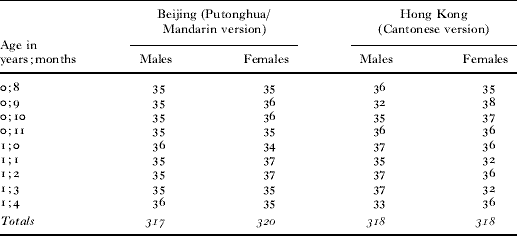
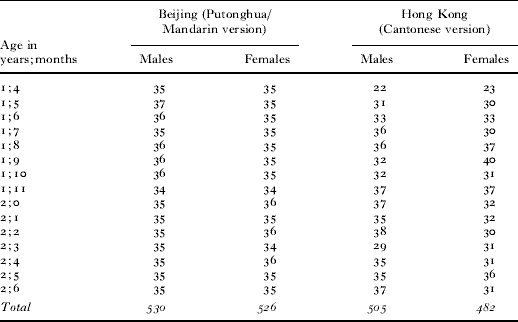
Both the Beijing and Hong Kong norming studies were intended as representative samples of their respective locations. As with the English CDI, each form was normed with a cross-sectional sample of approximately 70 children, half female, at each monthly age group, sampled within fifteen days (before or after) of their month-birthday, from 0 ; 8 to 1 ; 4 for the Words and Gestures (W&G) form and 1 ; 4 to 2 ; 6 for the Words and Sentences (W&S) form. Mean ages for each age group did not differ across the two samples. See Tables 1a and 1b for a breakdown of the actual number of children in each age and gender group and below for further details on each sample.
Number of children at each monthly age group by gender and location for CCDI-P and CCDI-C Words and Gestures norming Studies in Beijing and Hong Kong

Number of children at each monthly age group by gender and location for CCDI-P and CCDI-C Words and Sentences norming studies in Beijing and Hong Kong

Beijing had a population, based on the 2000 census, of 13·82 million (National Bureau of Statistics, People's Republic of China, 2001), almost all of whom are ‘Putonghua’ (Mandarin) speakers, and 30% of whom who claim to speak ‘Putonghua’ as a second language with other dialects of Mandarin, other Chinese dialects and non-Chinese languages (e.g. Korean, Mongolian) as first languages. In order to ensure population sampling, we collaborated with the Department of Pediatrics, Peking University Medical School First Hospital and local Mother–Child Clinics to obtain a list of potential participants of the right age from two main districts of Beijing (Xuanwu, Western).
The final sample in Beijing consisted of 637 children aged 0 ; 8–1 ; 4 tested on the Words and Gestures, and 1056 children aged 1 ; 4–2 ; 6 tested on the Words and Sentences form (Tables 1a and 1b). The people who were identified as ‘primary caregivers’ and with whom we conducted the interviews were primarily mothers (58%), although a significant number of fathers (13%), mothers and fathers together (4%), and both maternal (9%) and paternal grandparents (12%), as well as other relatives (2%) or combinations of parental and other caregivers (2%), also participated. Overall, the Beijing parents had a modal education at the upper secondary level (ten–twelve years of schooling), and the grandparents and other caregivers had a modal education at the lower secondary level (seven–nine years of schooling), with a range in both groups from little or no formal schooling (zero–three years, but only two of the parents because of our selection criteria) all the way to university and postgraduate training. All children included in the final sample were of normal birth weight (>2,500 grams), full-term (at least thirty-six weeks and no more than forty weeks gestational age at birth), had no record of oxygen deprivation during birth, and had no congenital malformations, including cleft palate, or family history of deafness. In addition, children were rated as ‘normal’ on six- and/or twelve-month developmental Screening tests, and appeared to be otherwise free of developmental delays, severe feeding problems or long hospitalization histories, or had parents who were not native speakers of Mandarin.
Hong Kong has a population of 6·8 million, a total area of just 420 square miles and now two official languages – English and Chinese (Hong Kong government, Civil Service bureau website: www.csb.gov.hk/english/aboutus/org/scsd/1470.html). Despite the linguistic complexity of the territory, over 95% of Hong Kong residents consider themselves to be native speakers of Cantonese, with high concentrations of English and Mandarin speakers living on Hong Kong Island and in the northern New Territories, respectively. To obtain a representative population of native Cantonese speakers, we collaborated with the Department of Health's Family Division and statisticians on their staff and chose to sample at random from healthy infants and toddlers at five Maternal and Child Health Clinics in Hong Kong Island (1), Kowloon (2) and the New Territories (2).
The final Hong Kong sample consisted of 636 infants aged 0 ; 8–1 ; 4, and 989 toddlers aged 1 ; 4–2 ; 6, roughly half male and female. Aside from an N of 45 in the 16-month Words and Sentences sample, all groups had Ns of greater than 60. Medical exclusion criteria similar to those of the Beijing sample were applied. The people who were identified as ‘primary caregivers’ and with whom we conducted the interviews were primarily mothers (75%), although a significant number of fathers (12% total) and other relatives (9%) also participated. As with the Beijing parents, the Hong Kong caregivers varied considerably in their levels of education. Overall, the Hong Kong caregivers had a modal education that was slightly lower than the Beijing parents (and this is in keeping with demographic trends for both cities) at the lower secondary level (seven–nine years of schooling, or Forms 3 to 5), and the grandparents and other caregivers had a modal education at the upper primary level (four–six years of schooling) with a range in both groups from little or no formal schooling (zero–three years) all the way to university and postgraduate training.
Exposure to a second language
One of the selection criteria for our Beijing study was that the child be exposed to ‘Putonghua’ (Mandarin) as a native language in the home. Thus, it is not surprising that although 145 (8·6%) of the mothers did not list Mandarin as their native language, all but one of the mothers spoke Mandarin as the only language to their child and the one mother who reported speaking another language to her child spoke both Mandarin and Mongolian, her native language, to the child. Similarly, a total of 99·2% of the fathers spoke Mandarin to their child even though a full 10·9% of them spoke languages other than Mandarin as their native language. Of the non-Mandarin speakers, most spoke other dialects of Chinese (including other dialects of Mandarin), although three of the fathers spoke Mongolian and one spoke Japanese as their native languages. In total, roughly 94% of the children were exposed only to Mandarin, whereas eleven children (0·7%) were also exposed to English and ninety-four children (5·6%) were exposed to other languages, including Mongolian, Japanese and other dialects of Chinese in the home.
Although we applied the same selection criteria to our Hong Kong sample (the child must be exposed to Cantonese as a native language in the home), a more linguistically diverse picture emerged. In all, 252 mothers (15·5%) did not list Cantonese as their native language and 154 (9·5%) of the fathers were not native speakers of Cantonese. However, only 99 mothers (6·1%) and 69 fathers (4·3%) reported that they did not speak Cantonese to their child. In all, 103 children lived in households where neither parent spoke Cantonese as a native language, although all families included at least one Cantonese-speaking caregiver who spoke Cantonese to the child, and because our interviews were conducted in Cantonese, this is the caregiver we interviewed in any of the multilingual households. Of the total sample, 971 children (61%) were exposed only to Cantonese, 343 (21%) were exposed to both Cantonese and English, 78 children (5%) had Mandarin, as well as Cantonese, spoken at home, and there were 196 children (12%) who were exposed to languages other than Cantonese, English or Mandarin in the home (all percentages rounded).
Procedure
The original MacArthur-Bates CDI (Fenson et al., Reference Fenson, Dale, Reznick, Thal, Bates, Hartung, Pethick and Reilly1993) used a mail-in data collection procedure. Jackson-Maldonado et al. (Reference Jackson-Maldonado, Thal, Marchman, Bates and Gutierrez-Clellen1993) compared mail-in and interview procedures, in an adaptation of the CDI for Spanish-speaking children, and found that the two methods produced comparable results. Although this may be true for some samples, we were wary of whether this would also be true for the population samples that we drew in our study because of a generally lower level of education (at least 10% of our interviewees were not functionally literate and this is representative of the populations for which we were creating the norms) and a general lack of familiarity and attention to children's early language behaviours. This was confirmed in our pilot studies both in Beijing and Hong Kong when, despite standardized instructions similar to those on the English CDI forms, when asked about comprehension, several caregivers responded affirmatively if the child was familiar with an object, action or concept in question, regardless of whether or not the word was ever spoken in the child's presence. For production, caregivers had a tendency to ask the child to immediately repeat words listed on the form and if the children were able to do it, regardless of whether they had heard the word before, they were scored as ‘can say’. Yet other caregivers simply drew lines down the entire CDI pages, reporting that the child could either understand/say ‘everything’ (shen2me dou1 hui4 shuo1!) or ‘nothing at all’ (shen2me dou1 bu2 hui4”), but on further interviewing, a range of scores was found for individual words. Taken together, these issues, as well as issues with the interpretation of some of the characters used to represent dialect-specific words (some words, especially loan words such as ‘BB’ [baby], do not have characters in Cantonese, and yet others, especially Cantonese colloquialisms, have non-standard forms), face-to-face interviews were conducted with all participants in our norming studies. In both Beijing and Hong Kong we trained research assistants with a common three-day training protocol, introducing them to the purpose of the study (to produce population norms for language development), measurement issues and information about language development. In addition, we spent an entire day in each location introducing the assistants to each section of the form and going over standard prompts for checking to make sure that the child really ‘understood’ or ‘can say’ the words, and for determining if a caregiver appeared to be confusing words with concepts. Other prompts involved checking that the particular words examined were understood in different contexts (e.g. for da3 qui2/da2 bo1 ‘hit ball’ – does the child understand what ‘ball’, qiu2/bo1, is outside of contexts in which the ball is hit/played with, or for da3/da2, are there other contexts in which the word is understood). Further prompts were designed to help a caregiver recall situations in which the child might have showed understanding (e.g. if a child had both a spoon and bowl in front of him/her and was asked to give mom the bowl would he/she look at or pick up the bowl as distinct from the spoon). All assistants also coded and engaged in practice interviews with each other and finally with real caregivers together as a team. Only research assistants who reliably coded answers in the practice interviews were asked to join the data collection team.
In general, it took longer to conduct interviews for children who were reported to have more words than those with fewer words. Thus, interviews with caregivers who had children at the youngest age ranges (0 ; 8 for W&G, 1 ; 4 for W&S) for each form were typically the shortest, whereas interviews with caregivers who had children at the oldest age ranges (1 ; 4 for W&G, 2 ; 6 for W&S) for each form took the longest. For the Words and Gestures form, interviews lasted from approximately 15 minutes to one hour, including all sections (first signs of understanding, understanding phrases, starting to talk, words and gestures). For the Words and Sentences form, interviews lasted from approximately 20 minutes to 90 minutes, including all sections (words, how children use words, sentences and phrases, and complexity). Fuller details of this and other aspects of the norming study procedures can be found in Tardif, Fletcher, Zhang & Liang (Reference Tardif, Fletcher, Zhang and Liang2008).
Adaptation
Adaptations of the words on the CCDI-P and CCDI-C involved several different types of processes. The most straightforward was a simple translation and organization of everyday words into the basic categories of ‘Sounds’, ‘People’, ‘Action Words’ and so on into Mandarin or Cantonese. In the final version of the forms, all but one of the categories (Quantifiers and Articles) in the MacArthur-Bates CDI were preserved, and this category was changed to ‘Classifiers’, which was more appropriate for the grammar of Chinese languages. Overall, the total number of categories in the English and Mandarin Words and Gestures (Infant) and Words and Sentences (Toddler) CDIs are identical. The second type of process involved substitution of words that were appropriate for one culture, but not for the other. This was particularly true for food items (e.g. cha2  ‘tea’, instead of coffee; zhou1
 ‘congee’, instead of sandwich), kinship terms (which are more specific and thus more numerous in Chinese) and action words (which are also more specific and more numerous in Chinese, as reported by Tardif (Reference Tardif1996) and Tardif, Shatz & Naigles (Reference Tardif, Shatz and Naigles1997) and by Ma, Golinkoff, Hirsh-Pasek, McDonough & Tardif (in press)).
In addition, we both added and deleted words that were appropriate for one culture but not for the other, based on the availability of words and concepts and also the results from the preliminary pilot studies. Additions included commonly appearing words from existing databases: (1) of ten Mandarin-speaking children aged 1 ; 8–2 ; 2; and (2) two databases of seventy-eight Cantonese-speaking children in Hong Kong who ranged from 1 ; 0 to 5 ; 6 (see the Beijing transcripts in the Mandarin corpus and the two Cantonese corpora on the CHILDES database: Tardif, Reference Tardif1996; Lee et al., Reference Lee, Wong, Leung, Man, Cheung, Szeto and Wong1994; Fletcher, Leung, Stokes & Weizman, Reference Fletcher, Leung, Stokes and Weizman2000; MacWhinney, Reference MacWhinney2000). And, based on results from our pilot studies (described in more detail in Tardif et al., Reference Tardif, Fletcher, Zhang and Liang2008; Tardif, Gelman & Xu, Reference Tardif, Gelman and Xu1999), we also modified the order of presentation of categories and items on the CCDI-P and CCDI-C from the English version of the CDI. For categories, we followed the same general principle as that used on the English CDI by presenting the ‘easiest’ categories (sounds, object nouns) early on the form, with ‘harder’ categories (verbs, adjectives, function words) appearing later on the form. Our form differs, then, just in the specifics of which categories were ‘easier’ (achieved highest means by youngest ages) and ‘harder’ for our samples – and this varied somewhat across the two locations (see Tables 2a and 2b). For the order of items within each category, English orders items alphabetically. However, since neither of these Chinese languages uses an alphabetic script as a primary script for writing the spoken language, and feedback from the pilot study parents suggested that they had difficulty going from word to word when the items seemed to be ordered randomly (we actually ordered the pilot form items on an alphabetic basis using the romanized transcriptions for the words), we clustered the words thematically (e.g. for body parts, started at the top with ‘head’ and ‘hair’ and went down to ‘feet’ and ‘toes’) and/or used the frequency results from our pilot studies to guide presentation so that the ‘easier’ words generally came before the ‘harder’ words in a category.
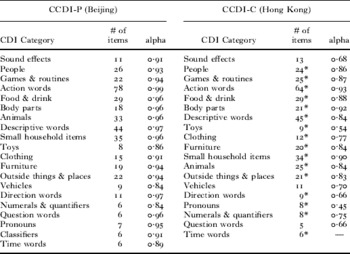
Summary of number of items and scale reliabilities for each of the subscales in order of appearance on the vocabulary portion of the Words and Gestures forms for Mandarin (CCDI-P), and Cantonese (CCDI-C)

* Subscales for which one or more items received a mean of 0·00 for ‘can say’ are marked with an asterisk. Such items were removed from the scale for purposes of determining Cronbach's alpha reliability statistics.
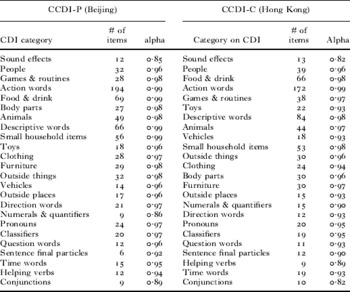
Summary of number of items and scale reliabilities for each of the subscales in order of appearance on the vocabulary portion of the Words and Sentences forms for Mandarin (CCDI-P) and Cantonese (CCDI-C)

Structure of forms
The Words and Gestures form provides a list of words (CCDI-P 411 words; CCDI-C 388 words) divided into semantic or syntactic categories (CCDI-P has 20; CCDI-C has 19). Ten of these categories consist of nouns (people, food and drink, body parts, animals, household items, toys, clothes, furniture, outside things and places to go, and vehicles). The other categories include sound imitations and exclamations, games and routines, verbs, adjectives, locative terms, quantifiers, question words, pronouns, classifiers (CCDI-P only because pilot testing of the CCDI-C revealed no classifers to be produced or comprehended by the children aged 0 ; 8 to 1 ; 4 in our pilot studies and, indeed, very limited production before 2 ; 0 in the present study) and time words. On the Words and Sentences form the vocabulary list on the CCDI-P has 801 words and the CCDI-C has a total of 800 words, both organized into twenty-four semantic or syntactic categories. As with English, eleven of these categories are nouns (people, food and drink, body parts, animals, household items, toys, clothes, furniture, outside things, vehicles and places to go). Additional categories include games and routines, a long list of verbs (194 items on the CCDI-P and 172 on the CCDI-C), as well as adjectives, locatives, quantifiers, pronouns, classifiers, question words, sentence final particles, time words, auxiliary verbs and conjunctions.
As mentioned above, words in some categories are simply more frequent and more highly lexicalized in different languages. In Mandarin and Cantonese, verbs and kinship terms are both more highly lexicalized and more frequent in adult-to-child speech than they are in English (Tardif, Reference Tardif1996; Tardif et al., Reference Tardif, Gelman and Xu1999). Given that this results in different numbers of words for each category, when comparing across languages, several authors (e.g. Caselli et al., Reference Caselli, Bates, Casadio, Fenson, Fenson, Sanderl and Weir1995) have argued that it is important to not only consider the total number of words that a child can produce within each category, but to also consider the child's score as a function of the total number of words available in that category and on the form as a whole (i.e. the ‘word opportunity’ score). Thus, the results we present below will consider both raw and ‘word opportunity’ scores.
In addition, for the purposes of the norming study, because Cantonese includes a large number of loan words, some that are used interchangeably with standard written Chinese (e.g. bo1 vs. kau6 for ‘ball’), and because of the large amounts of English exposure in daily life, we included an additional column in the CCDI-C for ‘can say in English’. For the Cantonese children only, therefore, children were scored as ‘can say’ if they were reported to say the word in either Chinese (Cantonese) or English. Although this way of scoring added significantly to the average scores at each age group (F(1, 972)=100·67, p<0·001, η2=0·09), the difference was minimal (e.g. a mean of 31·20 words for Chinese ‘can say’ vs. 32·53 words for ‘can say’ in English or Chinese at 1 ; 4 and 521·22 vs. 533·45 at 2 ; 5), adding no more than two to three percent to the total for each age group. Nonetheless, because it could have a more pronounced effect on children who grow up in multilingual households, we recommend that this practice of including ‘can say’ in either English or Chinese (Cantonese) is used for Hong Kong children, and report the total vocabulary data for the present study based on the combined numbers. This practice does not and should not apply to the consideration of Classifiers, however, which are function words belonging to a Chinese grammatical category and do not have appropriate English substitutions.
Tables 2a and 2b present the number of items in each word type category in the order in which the categories appeared, by language, on the forms for the Words and Gestures and Words and Sentences, respectively. In the following analyses, we will report on total expressive vocabulary in Mandarin and Cantonese for each of the age groups tested, aggregating information from Words and Gestures and Words and Sentences forms, as well as on the number of classifiers produced (twenty items for Beijing, nineteen items for the Hong Kong form) from the Words and Sentences form only. Again, since it makes the most sense to create forms of the greatest relevance for speakers of the language for which the forms are intended, when comparing across languages it is important to consider a number of metrics, including raw scores, ‘word-opportunity’ scores and the vocabulary size at which children might be expected to produce a particular word or word class.
Reliability
As with the English versions of the forms, internal consistency was extremely high, both overall and within each lexical category. Internal consistency was calculated by computing Cronbach's alpha for individual items within every subsection of the Words and Gestures and Words and Sentences forms, as well as for subscales of the vocabulary and other sections of the forms. Tables 2a and 2b also list the alpha values for each word type category. Category means are not listed given the developmental nature of the sample, where means begin at zero with the youngest ages sampled and approach ceiling for the oldest ages sampled in most of the categories.
For the CCDI-P, individual item reliabilities for the Words and Gestures and Words and Sentences Vocabulary Production categories ranged from 0·84 (Words and Gestures ‘Can Say’ for Vehicles) to 0·99 (Words and Gestures ‘Can Say’ Verbs; Words and Sentences ‘Can Say’ Verbs, Things to Eat/Drink, Adjectives and Household Items). In addition, each of the vocabulary categories was then treated as an ‘item’ to examine the consistency of the vocabulary scale across the twenty Words and Gestures categories and twenty-four Words and Sentences categories of words. For both the Words and Gestures and Words and Sentences CCDI-P forms, the alpha values were 0·93 for items that caregivers reported the infants ‘can say’, suggesting extremely high reliability across the categories and across the entire age range for which the instrument was normed.
For the CCDI-C, reliabilities in general were also quite high, although there were two scales on the Words and Gestures form that received relatively lower reliabilities – Toys (alpha=0·54) and Pronouns (alpha=0·45). For both of these categories, there were only nine and eight items, respectively, and several of these were dropped due to zero variances and zero scores, as was the case with the entire Time Words scale on the Words and Gestures form. Nonetheless, several scales on this form also received reliabilities above 0·90 and the scale as a whole achieved a reliability of 0·92 when categories, rather than items, were considered. On the CCDI-C Words and Sentences form, reliabilities were much higher, ranging from 0·82 (sounds, conjunctions) to 0·99 (verbs), with an overall reliability of 0·93 when categories, rather than items, were considered. Thus, the CCDI-C, as the CCDI-P and the English CDI, appear to be extremely reliable measures of children's early vocabulary learning and useful for examining vocabulary development in normally developing infants and toddlers aged 0 ; 8–2 ; 6.
RESULTS
Total vocabulary
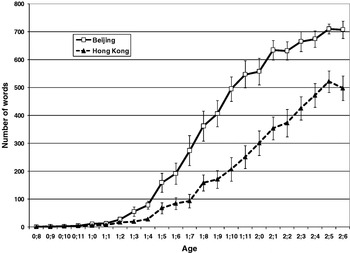
As can be seen in Figure 1, for both Cantonese and Mandarin, as expected, a slow beginning is evident for the accumulation of words in the child's spoken vocabulary, with a gradual increase from around 1 ; 4 and a more rapid acceleration thereafter. This is in accord with information available from English and other languages, from both spontaneous speech data and from parental report (e.g. Fenson et al., Reference Fenson, Dale, Reznick, Bates, Thal and Pethick1994; Huttenlocher et al., Reference Huttenlocher, Haight and Bryk1991; Maital et al., Reference Maital, Dromi, Sagi and Bornstein2000).
Mean vocabulary size by age (with standard error bars) from 0 ; 8–2 ; 6 for children from Beijing (CCDI-P) and Hong Kong (CCDI-C), reported as number of words that child ‘can say’ on the Words and Gestures and Words and Sentences forms.

However, an obvious feature of the graph is the divergence in rate of growth of the curves for Hong Kong and Beijing children, with a considerable advantage for Mandarin speakers from around 1 ; 3. To explore possible reasons for this difference, we first ran a three way ANOVA with location, child sex and child's age in months as independent variables, and number of reported words as the dependent variable.Footnote 2 There were main effects for location (F(1, 3221)=942·53, η2=0·23), gender (F(1, 3221)=61·87, η2=0·02), and child age (F(22, 3221)=470·06, η2=0·76; all p's<0·001). In addition, there was a location by age interaction (F(22, 3221)=28·23, η2=0·16, p<0·001), confirming the differences we observed in Figure 1, and a gender by age interaction (F(1, 3221)=61·87, η2=0·02, p<0·005), with girls outperforming boys from the onset of vocabulary production around 1 ; 0–1 ; 2 and with a larger difference for older children than younger across the entire age range of our samples.
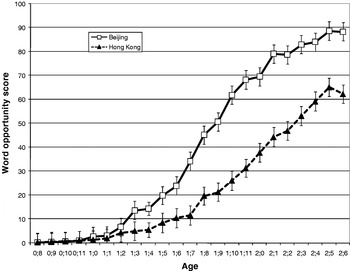
As with other comparisons across CDI vocabulary in different languages (see, for example, Caselli et al., Reference Caselli, Bates, Casadio, Fenson, Fenson, Sanderl and Weir1995; Maital et al., Reference Maital, Dromi, Sagi and Bornstein2000), we also computed a ‘word opportunity score’, which comprises the number of words a child is reported to produce divided by the total number of words on the form. These scores are generally considered to be a more stable indicator of cross-linguistic differences than the total number of words per se since they also account for differences in the total number of words that could be scored. For example, children aged 1 ; 4 in both Beijing and Hong Kong could have received either the Words and Gestures or the Words and Sentences form. Since the Words and Sentences have more words on the form, it is possible that the children at 1 ; 4 who received that form score higher than those who received the Words and Gestures form, simply because there were more words for the parents to choose from. In fact, the Beijing children at 1 ; 4 receiving the Words and Gestures form had a mean of 77·7 words, whereas those receiving the Words and Sentences form had a mean of 79·4 words. Translated into ‘word-opportunity’ scores, these same children were reported to say 18·9% of the words on the Words and Gestures form, but only 9·9% of the words on the Words and Sentences form. Similarly, the Hong Kong children aged 1 ; 4 whose caregivers were administered the Words and Gestures forms were reported to say a mean of 25·7 words, whereas those given the Words and Sentences forms were reported to say a mean of 31·2 words, translating into 6·6% and 3·9% of the words on the form, respectively. In this case, the ‘word-opportunity’ scores but not the total vocabulary scores show significant differences according to the form that the children were given at this age. However, it is equally likely that the cross-linguistic differences we observed could have appeared for total vocabulary, but not for ‘word opportunity’ scores. As can be seen in Figure 2, this was not the case – the location differences remained even when word-opportunity scores were taken into effect. A follow-up ANOVA with location, child sex and child's age as independent variables, and the word opportunity score as the dependent variable, also showed the exact same pattern of effects as the total vocabulary scores. Again, there were main effects for location (F(1, 3221)=915·57, η2=0·22), gender (F(1, 3221)=66·52, η2=0·02) and child age (F(22, 3221)=419·83, η2=0·74; all p's<0·001), as well as the same location by age (F(22, 3221)=24·95, η2=0·15, p<0·001) and gender by age interactions (F(1, 3221)=1·95, η2=0·01, p<0·005).
Mean ‘word opportunity’ scores by age from 0 ; 8–2 ; 6 for words reported as ‘can say’ on the Beijing (CCDI-P) and Hong Kong (CCDI-C) Words and Gestures and Words and Sentences Forms.

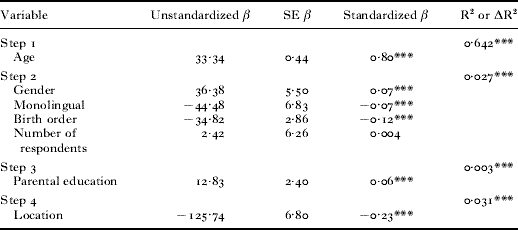
Because there are differences in the linguistic and social environments in which children were raised across the two locations, we next conducted a hierarchical regression analysis to determine which factors contributed to the differences that we found. Specifically, we first controlled for age of child, and then entered gender, parity (first-/only- vs. later-borns), monolingual status (mono- vs. multilingual) and number of respondents as a second step, then added parental education at the third step, and finally, location as a final step. As can be seen in Table 3, although almost all of these factors were significantly related to the number of words children were reported to produce, location continued to contribute a significant proportion of the variance, accounting for 3% of the variation in vocabulary production, even after controlling for each of these factors. Although 3% may not seem to be a large proportion of the variance, it is important to consider that number of respondents did not account for any variance whatsoever in our sample (in contrast to recent reports by de Houwer, Bornstein & Leach, Reference de Houwer, Bornstein and Leach2005) and, taken together, gender, monolingual status and birth order also did not account for any more of the variance than location alone.
Hierarchical regression analysis for total number of words reported as ‘can say’ on CCDI-P and CCDI-C (n=3270)

*** p<0·001.
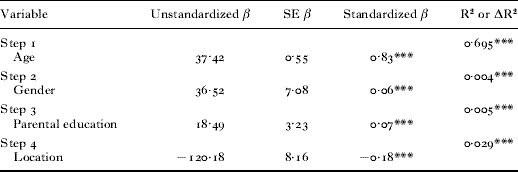
Nonetheless, it is also possible that the large differences in demographic characteristics of our sample could have skewed our results. Thus, we also ran the same model on only the Beijing and Hong Kong children who were ‘only-children’ from monolingual Mandarin- (for Beijing) or Cantonese- (for Hong Kong) speaking families. We know from previous studies (e.g. Hoff-Ginsberg, Reference Hoff-Ginsberg1998; Rescorla & Achenbach, Reference Rescorla and Achenbach2002) that the presence of siblings and multiple language backgrounds can have significant negative effects on vocabulary development (but see Patterson, Reference Patterson2004). Accordingly, it is important that these factors be controlled for in any comparisons across the Beijing and Hong Kong samples. As is clear from Table 4, however, this did not change the overall pattern of results. Instead, location continued to exert its effect, with the Beijing children reported to produce relatively more words, both in terms of actual numbers and ‘word opportunity’ scores, than Hong Kong children tested in our norming samples.
Hierarchical regression analysis for total number of words reported as ‘can say’ on CCDI-P and CCDI-C for monolingual ‘Only’ children in Beijing and Hong Kong samples (n=2038)

*** p<0·001.
Classifiers
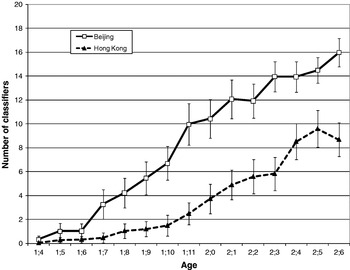
In keeping with the overall differences in vocabulary size for same-aged Beijing and Hong Kong children, the Mandarin-speaking children in Beijing were ahead of their Cantonese-speaking Hong Kong counterparts in classifier acquisition at any given age from 1 ; 4 to 2 ; 6. This can be seen clearly in Figure 3 and was confirmed by an ANOVA with total number of classifiers as the dependent variable. Specifically, there were main effects for age (F(14, 1984)=103·44, η2=0·42), gender (F(1, 1984)=18·54, η2=0·01) and location (F(1, 1984)=466·75, η2=0·19), and a 2-way interaction between age and location (F(14, 1984)=9·32, η2=0·06; all p's<0·001), with minimal differences in classifier acquisition at the earliest ages (when both groups were at floor), but differences becoming large and salient from about 1 ; 7 onwards. Word opportunity scores are not presented here, but the pattern is the same and instead, we present the following classifier acquisition by vocabulary size analyses, which we feel are a more informative way to compare the acquisition of particular categories of words across samples.
Mean number of classifiers reported as ‘can say’ as a function of age for Beijing (CCDI-P) and Hong Kong (CCDI-C) Words and Sentences Forms.

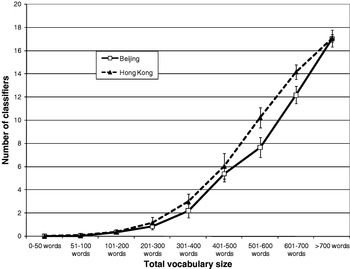
In the following analyses, we replaced age with vocabulary size as the standard by which we compared Beijing and Hong Kong children and, as would be expected from the previous discussion about the differential use of classifiers in adult Mandarin and Cantonese (see also Erbaugh, Reference Erbaugh, Li, Tan, Bates and Tzeng2006), the location effect was not only diminished, but reversed. As can be seen from Figure 4, for children with equal vocabulary sizes, the Beijing and Hong Kong curves are mostly overlapping, and when they do not overlap, it is the Hong Kong children who had more classifiers than the Beijing children. In this analysis we treated children's total vocabulary as a categorical variable with nine separate groups (0–50, 51–100, 101–200, 201–300, 301–400, 401–500, 501–600, 601–700 and >700 words) and examined the effects of vocabulary size, gender and location. As with the previous analysis, a main effect remained for location (F(1, 2005)=23·27, η2=0·011), but it was accompanied by a very strong effect of vocabulary size (F(8, 2005)=722·04, η2=0·74) and an interaction between location and vocabulary size (F(8, 2005)=4·99, η2=0·02), with the greatest differences for children with intermediate vocabulary sizes and ceiling and floor effects for children at both tails. Unlike the age-based analyses, however, there were no main effects of gender and it failed to interact with either location or vocabulary size, suggesting that the gender effects seen in the previous analysis may simply have been a result of the overall differences in vocabulary for boys and girls. These data clearly demonstrate that when the acquisition of a particular word class is of interest, estimates based on age versus vocabulary size can not only change the strength of an effect, they can also change its direction.
Mean number of classifiers reported as ‘can say’ as a function of vocabulary size for Beijing (CCDI-P) and Hong Kong (CCDI-C) Words and Sentences Forms.

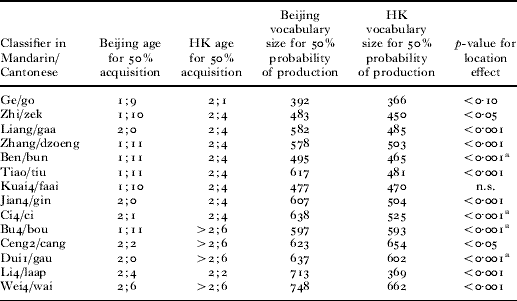
The importance of using vocabulary size in addition to just age as a metric for comparison across groups becomes more evident when we examine the emergence of individual classifiers which have the same or similar usage in the two languages (i.e. characterize the same or a similar set of nouns). These classifiers have distinct pronunciations in the two languages but are written with the same character. Table 5 lists for each language: the age by which half the children in the sample were reported to have used each form; and the vocabulary size at which 50% of children were likely to acquire the classifier, by location. This latter measure was derived by using logistic regression methods to first estimate the Beta weights for location and vocabulary size associated with the ability to ‘say’ (scored as 1 vs. 0 for ‘cannot say’) each of the specific classifier words. With these two parameters and the specification of a ‘cut-off’ value at 0·50 (representing the 50% probability for children to ‘say’ the word) the constant generated by the logistic regression equation could be used to compute the total number of words for which a child would have a 50% probability of producing each classifier. To do this, we divided the constant generated in the logistic regression by the β for vocabulary size and adjusted for location. Thus, for Beijing (considered the ‘zero’ location), the mathematical formula was βconstant/βvocabulary size and for Hong Kong it was (βconstant+βlocation)/βvocabulary size.
Specific classifiers and acquisition information for CCDI-P (Mandarin) and CCDI-C (Cantonese)

a Indicates a significant interaction between vocabulary size and location.
In general, the effects for specific classifiers mirror the overall vocabulary profile. Specifically, comparing the second and third columns in Table 5, we see that the age by which half the children in the Beijing sample are reported to have used a particular classifier is generally earlier than the age by which half the Hong Kong sample have used the form. However, when we compare classifier use in the two groups in relation to vocabulary size, as derived above, we find that, with a couple of exceptions, Hong Kong children use the forms when they are reported to produce fewer total vocabulary words than Beijing children. Again, this underscores the importance of using a metric such as total vocabulary size, in addition to age, when looking at the acquisition of a particular aspect of language, particularly when overall vocabulary norms may differ across the samples.
DISCUSSION
Expressive vocabulary size
The difference in rate of acquisition of vocabulary between children in Beijing and those in Hong Kong is striking, especially when we consider their typological relatedness and the fact that we allowed for Hong Kong caregivers to report words that their children could say in either Chinese or English. The total number of words reported for two-year-olds in the two cities illustrates the magnitude of the difference: the median for Hong Kong boys at 2 ; 0 is 297, and for Hong Kong girls, 322. For boys in Beijing it is 588, and for girls 657. As discussed above, possible explanations for these discrepancies are unlikely to lie simply with data collection or sampling procedures. In both locations the data were obtained via interviews with the caregiver who spent most time with the child and were conducted with trained interviewers who all went through the same rigorous three-day training protocol. Stratified random sampling was applied in both cities. Thus, reasons other than methodology are likely causes of the divergence in vocabulary scores apparent in Figure 1 from around 1 ; 4 onwards. The hierarchical regression analysis goes some way towards isolating factors which are relevant, but still leaves open a number of hypotheses.
It is clear from the regression analyses in Tables 3 and 4 that a monolingual linguistic environment, being the first or only child in a family and the educational standing of caregivers, confer advantages in first-language vocabulary development, and in this sense our data confirm previous findings (e.g. Hart & Risley, Reference Hart and Risley1995; Hoff-Ginsberg, Reference Hoff-Ginsberg1998; Rescorla & Achenbach, Reference Rescorla and Achenbach2002). Recall that the vast majority of parents in Beijing spoke ‘Putonghua’ (Mandarin) to their child. By contrast, in Hong Kong around 25% of the children were exposed to languages other than English. These ambient language differences play a small but significant role in depressing vocabulary scores of the children in Hong Kong. Birth order is also a factor. Mandarin-speaking children, in common with first-born children in Hong Kong, appear to gain a linguistic benefit from their permanent or temporary status as the only child in a household. Taken together, all of these issues suggest that differences in input quantity and quality affect children's early vocabularies, and this echoes work by many others, including Hart & Risley (Reference Hart and Risley1995), who also document the long-term effects of these differences.
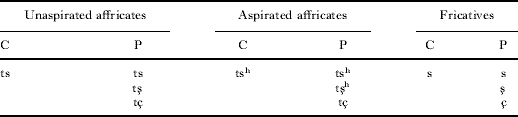
Nonetheless, although input factors go a long way to explaining individual differences in vocabulary, and may also have an impact on the cross-sample differences between Beijing and Hong Kong, we propose there may also be some structural factors at play as well. Consider first that there was still a significant role for location in the final step of the regression analysis, even after all these factors, as well as age and gender, were controlled. And, when we ran a separate regression analysis with just the monolingual ‘only’ children entered, the location effect was not diminished. Although it is possible that we simply did not capture the relevant factors that differed across samples, one hypothesis worthy of future investigation is how the languages themselves differ. Cantonese and Mandarin are closely related languages. Phonotactically they allow a very similar set of syllable shapes, with no initial consonant clusters. Each syllable has a distinct tone. This, and an asymmetry between syllable-initial and syllable-final consonant inventories (see below and Duanmu, Reference Duanmu2000) should make segmentation straightforward in both languages. There are, however, phonological differences which may play a role in the observed rate of overall vocabulary development in Mandarin. Initial-consonant inventories are distinct, especially in respect of dental–alveolar and palatal fricatives and affricates. Cantonese has one dental–alveolar fricative, and two alveolar affricates, one aspirated and one unaspirated. Mandarin has a complex series of fricatives and affricates: dental–alveolar, retroflex and palatal fricatives, and a corresponding set of aspirated and unaspirated affricates. Table 6 compares the two part-systems.
Cantonese (C) and Mandarin (P) initial consonant systems: dental–alveolar and palatal contrasts

Further, Mandarin has a smaller number of contrastive tones than Cantonese (four rather than six) and a more limited set of syllable finals, or rhymes – vowel or vowel+final consonant. Not considering tones, Cantonese has fifty-six different rhymes (Bauer & Benedict, Reference Bauer and Benedict1997: 49), whereas Mandarin has thirty-seven (Li & Thompson, Reference Li and Thompson1981: 6). This comes about because Cantonese has a less restricted set of final consonants (all nasals plus unreleased /p/, /t/ and /k/), whereas Mandarin only allows the nasals /ŋ/ and /n/ as final consonants. Overall, then, these phonological properties conspire to limit the number of distinct syllable shapes in lexical use in the two languages, but particularly so in Mandarin. According to Duanmu (Reference Duanmu2000: 51), there are ‘about 400’ distinct syllables in Mandarin, with estimates varying from 710 to 1800 in Cantonese (Bauer & Benedict, Reference Bauer and Benedict1997: 409; Duanmu, Reference Duanmu2000). One effect of this is that for the Mandarin-speaking child, there will be fewer syllables to master and thus more dense phonological neighbourhoods (for monosyllabic or reduplicated words, which form the bulk of the early-acquired words in Mandarin, Cantonese and English) than for the Cantonese-speaking child. Mandarin, then, may allow children to gain entry into the lexical system faster by limiting the complexity and number of syllables to be mastered and, in doing so, force children to make finer phonetic distinctions at an earlier age than Cantonese. Although this is merely a hypothesis at this point, there is evidence from English that, controlling for individual word-frequency effects, words from dense neighbourhoods are acquired more quickly than words from sparse neighbourhoods. Studies have demonstrated this under controlled conditions (Storkel, Reference Storkel2001). And in a study designed to replicate these findings from naturalistic data, where the English CDI was one of the data sources, Storkel (Reference Storkel2004) found that early produced words were higher in density (i.e. were made up of sounds that were very similar, but with minimal contrasts, to those appearing in many other words) than later produced words. Clearly, however, further follow-up of this hypothesis is warranted, including examination of individual word acquisition in both production and comprehension data to see if dense neighbourhoods have the same types of effects for these two languages as those found in Storkel (Reference Storkel2004) for English.
Classifiers
Moving from total vocabulary size to a specific category of words – classifiers – included in the CCDI forms, if we plot the development of these against not age, but against vocabulary size, we see a different picture. In contrast to the superior performance of the Mandarin-speaking children on total vocabulary, here it is the Cantonese children who appear to have the advantage, when compared with Mandarin-speaking children with equivalent vocabulary sizes. This is the case both for number of classifiers overall, and, as can be seen from Table 5, for the majority of individual classifiers. The Cantonese children appear to be sensitive to the greater range of functions fulfilled by classifiers in their language, and to the type diversity which appears to be a feature of the input they hear. The degree of sensitivity to the input of both groups of children is perhaps best demonstrated by the results for individual classifiers in the table. In most cases we find that the vocabulary size required for Beijing children to have a 50% probability of acquisition of the classifier is significantly higher, in accord with the overall finding. In one case the difference is dramatic. The pair laap1/li4 can be applied to small objects, such as a kernel of rice, in both languages. However the extension of laap4 is broader in Cantonese, where it can be used for any number of small, round objects that can be picked up between thumb and forefinger. This is not true of li4 in Mandarin, which is restricted to seeds, pills and grains of rice. This difference is clearly reflected in the table, where Cantonese-speaking children acquire laap1 as one of the earliest classifiers (after the default classifier go3) and Mandarin-speaking children acquire li4 as one of the latest on the CCDI-P list. A further quite precise reflection of differences in use comes with one of two examples in Table 5 of terms that are acquired ‘earlier’ (in vocabulary size) for Mandarin-speaking children. The pair ceng2/cang2 can be used in both languages with ‘floor’. However, whereas in Beijing (but not necessarily other dialects of Mandarin) ceng2 is used virtually obligatorily with this noun, Cantonese (and many other dialects of Mandarin) uses cang4 interchangeably with lau5 (lou2 in Mandarin).
GENERAL DISCUSSION
This exploration via parent report, of expressive vocabulary development in Chinese children between 0 ; 8 and 2 ; 6 months, reveals much that is familiar to us. There is a relatively slow start to the children's word production from 1 ; 0 on, followed by a gradually accelerating trajectory. By the middle of their third year, on average, children are reported to be using the majority of words on the checklist. This fits well with data from English and other languages, and attests once again to the efficiency of lexical learning procedures in typically developing infants. A cross-linguistic comparison within Chinese takes us further, however. Contrasting developmental profiles for two closely related languages in two culturally distinct Chinese cities extends our understanding of both linguistic and socio-cultural factors which play a role in the rate at which vocabulary develops, and in the expansion of a specific grammatical class within the child's lexicon.
At any particular age between 0 ; 8 and 2 ; 6 at which we want to compare, Mandarin-speaking children are reported to outperform Cantonese-speaking children in the size of their vocabulary. The facilitating factors for the children in Beijing can be argued to be the linguistic consistency of the input, and the effect of their single-child status on the amount of input they receive, but these do not appear to be the only factors that account for the differences. Location effects remain even when these factors are controlled, leaving us to speculate about other possible differences including the role of the reduced number of syllables and phonological density for Mandarin- vs. Cantonese-speaking children. Further comparisons of CDI data with languages that have a relatively small syllable inventory (e.g. Japanese) vs. those with relatively large inventories (e.g. English, Cantonese) would be informative for this hypothesis, as would explorations of the role of phonological neighbourhoods in facilitating vs. inhibiting lexical acquisition in languages with smaller syllabic inventories.
Finally, when we examined the control of a specific grammatical category, classifiers, we found differences across samples that demonstrate a Cantonese advantage. Specifically, Cantonese-speaking children acquired classifiers as a category and tended to acquire individual classifiers at relatively smaller vocabulary sizes than their Mandarin-speaking counterparts. Earlier studies on English have argued for a close relationship between vocabulary size and various aspects of grammar (e.g. Brown, Reference Brown1973), including word combinations, grammatical complexity and past tense morphology. Our data suggest that this relationship extends to grammatical categories. Most importantly, it makes clear how attentive very young children are to subtle features of the ambient language. In Cantonese, classifiers are obligatory in more situations than Mandarin and more specific classifiers (vs. the general classifier) tend to be used in adult speech. Thus, if children are truly paying close attention to the input, it is not surprising that Cantonese-speaking children, relative to Mandarin-speaking children, are earlier to tune into the precise functions and extensions which classifiers enjoy. We hope that future cross-linguistic comparisons in child language will also be attentive to both input and socio-cultural differences across languages and samples and that the use of vocabulary size as well as age will become a common metric for examining cross-linguistic differences in the acquisition of particular forms and form class categories.