


Introduction
Multiple Sclerosis (MS) is a neurological disease involving selective destruction of the myelin sheath that insulates the nerve fibres of the body. These changes can lead to disruption of neural transmission resulting in symptoms such as loss of limb control, weakness, fatigue, eye problems, dysarthria, incontinence and cognitive impairment. Perhaps unsurprisingly, depression among persons with Multiple Sclerosis (MS) is common. One account of depression, which may have application to people with MS, is the hopelessness theory (Abramson, Metalsky and Alloy, Reference Abramson, Metalsky and Alloy1989). This proposes that exposure to negative life events in the context of a negative attributional style (a stable, global style) can create a vulnerability to depression. An “attribution” refers to the causal explanations people give when trying to explain the reason why a certain event has taken place. The term “attributional style” refers to an individual's tendency to repeat the same pattern of thinking when attempting to explain the occurrence of differing events. A stable style is one in which negative events are interpreted as due to factors that are long lived or recurrent, rather than those that are short lived or intermittent; a global style is one in which negative events are interpreted as due to something that affects a broad range of situations, rather than being confined to a narrow range of circumstances.
Kneebone and Dunmore (Reference Kneebone and Dunmore2004) identified a significant association between attributional style and depressive symptoms among persons with MS. The more negative (stable and global) an individual's attributional style, the greater the level of depression. Furthermore, recent negative life events and a global attributional style significantly interacted to explain significant additional variance in depression.
A review of studies of attributional intervention in people not known to have MS concluded that attributional retraining successfully changed cognitions and behaviour, with little work having considered emotional change (Forsterling, Reference Forsterling1985). One study, however, that has examined cognitive behavioural and emotional change concluded that individuals who had undertaken attributional retraining had more adaptive attributions and less depressive mood compared to a control group (Green-Emrich and Altmaier, Reference Green-Emrich and Altmaier1991). The group intervention involved education about classifying attributions and the difference between “adaptive” and “non-adaptive” attributions. This was then applied to personal negative experiences within the group and practised as homework over the following week. Further evidence that changing attributional style can alter depressive symptoms is provided by studies of cognitive behaviour therapy (CBT). Cognitive behavioural therapies designed to target more than explanatory style have been identified to alter attributional style, which in turn has successfully predicted changes in depression (DeRubeis and Hollon, Reference DeRubeis, Hollon, Buchanan and Seligman1995). Pertinent to our interest, such CBT appears particularly effective in reducing depression in people who have MS, including when administered by phone (Mohr et al., Reference Mohr, Likosky, Bertagnolli, Goodkin, Van Der Wende, Dwyer and Dick2000). Considering this evidence alongside Kneebone and Dunmore's (Reference Kneebone and Dunmore2004) work suggests an intervention to change attributional style in people who have MS and are depressed is warranted. This has the potential to inform on the causal role of attributions in the depressive symptoms that occur in this population, with implications for treatment.
The current study involved a structured, manual based, attributional intervention, administered by telephone, for people who had MS and significant depressive symptoms. It was hypothesized that changes in negative attributional style through the intervention would be accompanied by changes in participants' depressive symptoms.
Method
Design
A brief telephone-based attributional intervention for depression in persons with MS was evaluated through an ABA design. Baseline measurement of depressive symptoms was weekly, for 4 weeks (A) followed by the Attributional Intervention for 5 weeks (B). Post-treatment baseline measurement was weekly for a further 4 weeks, with subsequent 3 and 6-month follow-ups (A).
Measures
The Centre for Epidemiological Studies Depression scale (CESD) is a 20-item instrument designed to assess depressive symptoms in community samples. Scores of 16 or above on this instrument are considered significant.
The Profile of Mood States Depression-Dejection scale (POMS D-D) measures the experience of depression over the past week. Scores of 15 or more are considered significant for depression on this scale when it is used with people who have MS.
The Structured Clinical Interview for DSM-IV Axis 1 Disorders (SCID) is a semi-structured interview schedule to support the identication of major DSM-IV Axis 1 diagnoses.
The Attributional Style Questionnaire-Survey (ASQ-S) provides participants with descriptions of 12 negative events and asks them to write down one principle cause for each, and rate each cause on a 7-point scale for its degree of stability and globality. A score for stability (ASQSS) and globality (ASQSG) can be calculated. The ASQ-S was administered pre and post-intervention and at 3 and 6-month follow-up, in order to assess the impact of the intervention on attributional style.
Recent Life Changes Questionnaire (RLCQ) provides a list of 74 events. Participants indicate which they have experienced. Each event is weighted for degree of stress. Within the present study, events within the last 3 months were assessed to allow the same time frame at each assessment without an overlap of events. The RLCQ was used to investigate the contribution of life events to depressive symptoms.
The MS Stress Scale (MS SS) includes 17 statements reflecting experiences of daily life stressors that may occur as a result of MS. Participants rate these according to their severity of stress. This was also used to assess the influence of life stressors on depressive symptoms.
The CES-D and the POMS D-D were the main measures of the impact of the intervention. They were administered weekly for 4 weeks prior to the intervention, weekly for 4 weeks post the intervention then at 3 and 6-month follow-up. The SCID was administered 3 weeks before and 3 weeks post-intervention. All of these measures were administered by telephone, the latter by a qualified clinical psychologist.
The RLCQ and the MS SS were administered via mail pre and post-treatment and at 3 and 6-month follow-up in order to consider findings in respect to the stressors faced by participants.
Procedure
Participants were recruited through research flyers circulated within a local health community and a local branch of the MS Society. Eight potential participants came forward. Inclusion criteria included age between 18 and 65, a diagnosis of MS, as confirmed by GP, and the presence of significant depressive symptoms as measured by the CES-D and the POMS D-D. As it was necessary for the participants to be able to fully engage with the intervention, those participants with impaired cognitive functioning (as measured by a brief cognitive screen) were excluded. Using these criteria two participants were obtained. The participants were provided with a copy of the client manual prior to the first treatment session.
Attributional intervention
The attributional intervention was a psycho-educational, manualized, cognitive-behavioural intervention, designed to provide individuals with the information and skills necessary to help them alleviate their depressive symptoms by changing attributional style. It involved 5 weekly sessions conducted on a one-to-one basis between the client and therapist, via the telephone.
An honours degree psychology graduate, who had undertaken introductory training in CBT and was specifically trained in the attributional intervention program, administered the intervention. A consultant clinical psychologist provided weekly supervision.
Results
Characteristics of participants
Participant 1 was a 63-year-old white British female, who lived in her own home with her husband. She had two grown-up children and was a retired professional. Her GP listed her diagnosis as chronic progressive MS; her first symptoms appeared and she was diagnosed 6 years prior to the study.
Participant 2 was a 49-year-old white British female who lived in her own home with her husband. She had no children. She was a retired professional, who had been forced to give up employment as her symptoms advanced. She had a diagnosis of chronic-progressive transitional MS. Her first symptoms appeared 13 years prior to the study, with diagnosis 11 years prior.
Participant 1
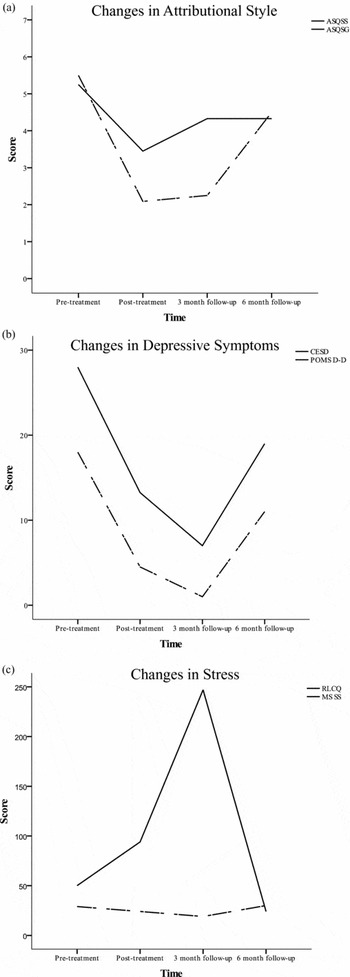
A reduction in scores on the ASQ-S (Stable and Global) from pre to post-treatment indicated an improved attributional style (see Figure 1a). Although scores increased post-treatment they were still below pre-treatment levels at the 3 and 6-month post-treatment assessment. As attributional style for negative events became less global and stable, improvements in depressive symptoms were evident (see Figure 1b). Scores on the CES-D and the POMS D-D fell to a level considered non-significant for depression from pre to post-treatment and continued to decline at the 3-month post-treatment assessment. At the 6-month post-treatment assessment these scores had increased, although not to pre-treatment levels. SCID diagnoses for Participant 1 supported the impact of the intervention: they went from “minor depression” to “no diagnosis”. Life stressors over the period of the study were monitored and are displayed in Figure 1c. The RLCQ identified fluctuating events with a particularly stressful period recorded at the 3-month post-treatment assessment. The MS SS was relatively stable over the period of the study.
Score changes for Participant 1. In Figure 1b pre and post-treatment depressive symptoms scores are the mean of 4 weekly assessments
Note: ASQSS = Attributional Style Questionnaire-Survey Stability scale, ASQSG = Attributional Style Questionnaire-Survey Globality scale, CESD = Centre for Epidemiological Studies Depression scale, POMS D-D = Profile of Mood States Depression-Dejection scale, RLCQ = Recent Life Changes Questionnaire, MS SS = MS Stress Scale.

Participant 2
Participant 2 chose to discontinue the intervention after 3 sessions, but completed all assessment measures for the remainder of the study. Attributional style increased slightly over the study period, for both global and stable attributions. Depressive symptoms remained within the significant range. There was no change in SCID diagnosis: this remained “major depressive disorder, recurrent, partial remission”.
Discussion
Overall, the results suggest that assessment of and intervention with respect to attributional style may be useful for treating depression in people with MS and offers, albeit guarded, support for the hopeless theory of depression in this population. The attributional intervention appeared effective in changing attributional style and reducing depressive symptoms in one person with MS, but not another. The SCID assessment provided clinician judgement that supported the self-report data.
For Participant 1, where the intervention was effective, gains were evident post-treatment and at the 3-month post-treatment assessment, but were not fully sustained at the 6-month post-treatment assessment. One factor that may have influenced the treatment response is the occurrence of life stressors. The increase in negative attributional style and depressive symptoms at the 6-month post-treatment assessment was preceded by an increase in life stress at 3-months, as measured by the RLCQ.
A limitation of this study is that the participants involved may not be typical of people with MS and depressive symptoms. The cognitive functioning criteria excluded 75% of the potential sample. The high exclusion rate within the current study may be due to the length of time participants had MS and/or the severity of the condition. This screening criteria needs to be reconsidered for future research, particularly as those people with MS and cognitive impairment may have higher levels of depression as their work life, activities of daily living and social support are more likely to be reduced.
Due to the small number of participants, and as the study design did not include a control group for non-specific therapy effects, conclusions about the intervention are limited. The findings, however, do suggest further investigation utilizing a randomized controlled group design is warranted.




Comments
No Comments have been published for this article.