Introduction
When Jeffrey Isaac approached us to review some recent works in American politics from a comparative perspective, we gladly accepted the task, believing it important to help overcome what some see as the “splendid isolation” of American politics. Indeed, the invitation arrived at a propitious time because, after completing our most recent book, we critically reflected on the fact that we had unfortunately written almost nothing on the oldest, and one of the most diverse, democracies in the world, the United States. We thus agreed to contribute some thoughts on the matter, recognizing the limits of our knowledge of the entire field of American politics, but acknowledging, too, our belief that the current distancing of the study of America from the analysis of other democracies impoverishes modern political science.
Such distancing was not always present. European scholars, from the eve of the French Revolution to World War II, looked at the United States as a new world that would serve as a model of political development. Important European social theorists such as Alexis de Tocqueville, James Bryce, M. Ostrogorski, Max Weber, Werner Sombart, and Harold Laski all incorporated the United States within more broadly comparative accounts of modernization. Yet following World War II, the growing scholarly study of US institutions by Americans, and of European institutions by Europeans, led to more particular views of Europe or America and fewer comparative integrative works.
Now is the time for a new look at the United States, taking into account the wealth of new data and research currently available. Such studies should fully incorporate the fact that the United States, by many of the standard indicators of inequality, is now the most unequal long-standing democracy in a developed country in the world, as tables we will present in this review will make abundantly clear. And yet the preoccupation of many Americanists with America's distinctive governmental institutions—Congress, the presidency, the Supreme Court—obscures this inequality and what it means for the US political system. It thus seems to us that Americanists' ability to analyze American politics would be enhanced by locating these problems in a larger, comparative context. Such a reconceptualization of American politics could help to broaden our discipline and enhance the quality of its generalizing theories. It might also have beneficial political consequences, for the political will to overcome inequality-inducing features of the US political system might be increased if more American politicians, citizens, and analysts were to understand just how equality inhibiting many US political structures and political practices actually are.
Yet such a reenvisioning also would require surmounting some powerful barriers that have arisen between subfields in US political science. Why this mutual distancing, especially of the American politics field and the comparative politics field? While this should not serve as an excuse for the situation, for many comparativists, the American field's growing combination of a vast amount of published material, intense subspecializations, and increasing methodological, especially quantitative, sophistication has raised conscious, or unconscious, barriers of entry to the incorporation of America in their studies. For Americanists—even those concerned with American political development (APD), whose founding mission statements commit them to comparative and international approaches—the sheer pull of the concentration on America is revealing.
Titles of academic books and articles do not of course tell the full story, but they normally indicate major concerns. Ira Katznelson and Theda Skocpol, who famously combine comparative and American interests in their own respective work, helped create a series that has become the flagship for pioneering APD books. The full title of the series is “Princeton Studies in American Politics: Historical, International and Comparative Perspectives.” Yet only seven of the 47 books in the series employ a comparative perspective to explore American political institutions and policies, even if a few other books use international statistics to identify the exceptionalism of the United States or to place it into its own international context.Footnote 1 The editors of the flagship journal of APD, Studies in American Political Development, stated in their initial statement of purpose that the journal would “publish theoretical and empirical research on political development and institutional change in the United States.” Notably, the editors extended their invitation for submissions to scholars of “comparative or international studies that illuminate the American case.” Yet since the journal's founding in 1986, fewer then two dozen articles of nearly 300 articles or exchanges—just 7% of the total—take a comparative perspective.Footnote 2
There are two new trends emerging in American political science Ph.D. programs, even among scholars of APD, that may intensify the distancing of Americanists from comparative politics, and which may indeed incapacitate most new Americanists from doing serious, comparatively informed research on the United States. First, while two generations ago all of the best Ph.D. programs in political science required the demonstration of at least a reading ability in one (or two) foreign languages, now most programs allow Ph.D. candidates to substitute quantitative or formal modeling skills for such language skills. Of the top 25 Ph.D. programs, as determined by the National Research Council's “regression-based” rankings, only New York University's program retains an explicit language requirement for all of its Ph.D. candidates. Representative of the transition away from formal language training is the recent introduction of a “Research Tools Plan” for Harvard University's Ph.D. in government. Prior to Fall 2010, every entering Ph.D. candidate was required to demonstrate competency in a language other than English—as well as completing one quantitative methods class. Students entering the program in 2010 or thereafter, however, now have greater flexibility in proposing a methodological and research sequence that may or may not include a language. Second, less than a generation ago, all Ph.D. candidates had to pass qualifying examinations in two core subfields of political science, and many Americanists took comparative politics as their second subfield. Recently, many departments have created a fifth subfield, methodology. Largely due to job-search pressures and the direction of their subdiscipline, the strong majority of Americanists at Columbia, for example, have elected the nonsubstantive subfield of quantitative methodology as their minor or secondary field.
If many Americanists get their doctorates with no language skills, and virtually no non-US substantive courses (and, in an increasing number of departments, little to no political theory instruction), will they be able to pursue sufficiently broad questions about the United States informed by minimal levels of information about other advanced democracies? Will we have solid successors to those scholars who profitably combined Americanist and comparative research, to the enrichment of both subfields, from Robert Dahl and Seymour Martin Lipset to Paul Pierson, Skocpol, and Katznelson?
Inequality in the United States in Comparative Perspective
Our ideas on this subject have been stimulated by two excellent, recent edited volumes coming from the APD tradition. Democratization in America is the first book of which we are aware that analyzes the US political process from the perspective of the comparative democratization literature that has emerged since the late 1960s. Laurence Whitehead, one of the editors, argues that one source of the analytic isolation of American studies was the view, held by many observers, that America was an “Immanent Democracy”—“a regime so confident of its inherent democratic status that external comparison can be treated as superfluous” (p. 36). By rejecting this view, scholars can explore de-democratization and democratization within American politics. Most cases of de-democratization in world history involve the overthrow of a democratic regime by a military coup or by antidemocratic movements. What is distinctive about the United States is that movements of great de-democratization occur without democratic regime change and within the democratic regime.
Stephen Tuck's “The Reversal of Black Voting Rights after Reconstruction” deftly analyzes such a de-democratization process, documenting that black voter turnout in the eleven southern states declined from 58% in 1880, to 36% in 1892, to 17% in 1900, to 2% in 1912 (p. 139). This massive disenfranchisement of citizens was accomplished through an incongruous manner that “is unique to the United States. Procedural means (elections and the democratic process) were used to produce an undemocratic result (loss of franchise, a basic constitutional right). Across the South, African American voters were disenfranchised through state constitutional amendments that were adopted by referenda or constitutional conventions” (p. 134). Tuck asserts that “federal government inaction was an important precondition for the success of southern disenfranchisement” (p. 142). Robert C. Lieberman employs the democratization literature well to show that the re-democratizing Civil Rights movements in the 1960s were successful only because they reversed such inaction by mobilizing civil society, not only by opposing racists but also by pressuring the federal state to protect rights and to use state coercive capacity to do so.
In general, the chapters in this volume show, as Guillermo O'Donnell first did for South America, that there are still numerous comparable “brown areas” in the United States where the democratic state and rule of law (“green areas”) do not yet flourish. We note with some irony that on the heels of the successful Civil Rights movement of the 1950s and 1960s, US incarceration rates have undergone a sevenfold increase since the 1970s. Because of this, 2.4 million American citizens are now disenfranchised. In a separate manuscript, we have documented that American disenfranchisement occurs at a rate 60 times higher than the average for our comparison set.Footnote 3
The Unsustainable American State deepens the debate on inequality by focusing attention on what it is about American politics that has become unsustainable, particularly from the perspective of necessary, and overdue, social reforms. The general argument of this edited volume is that the reform process is increasingly frozen, and that the American political system has been captured by groups associated with increasing, rather than decreasing, inequality. In important articles that we will discuss later, Benjamin I. Page and Lawrence R. Jacobs show that public opinion is not responsible for this state of affairs, while Larry M. Bartels documents that senators are virtually completely unresponsive to the policy preferences of the poorest of their constituents.
Suzanne Mettler's chapter in this volume, “Promoting Inequality: The Politics of Higher Education in an Era of Conservative Government,” is a deft analysis of how the use of the rhetoric of equality, linked to very focused lobbying, can help produce inequality-enhancing outcomes that are against public opinion, but which make senators' unresponsiveness to the poor almost invisible. Mettler shows how banks, by promoting a discourse of increasing opportunities for the poor to complete a college education, have, since the 1970s, greatly multiplied loans available to students. Given the availability of these student loans, political support for government-paid Pell grants declined proportionally, and the value of the average grant declined from 80% of the costs of attendance at public four-year institutions in the mid-1970s to about 40% now (p. 203). For banks, new student loans became the third largest source of revenue. Such policies, in Mettler's judgment, allowed “students who would have attended college regardless to attend more expensive institutions,” and the percentage of students coming from the third quartile of family income who completed their baccalaureate degrees from 1970 to 2000 (26.8%) almost doubled. In sharp contrast, students from the bottom quartile who received baccalaureates in the same period decreased slightly to only 6%. Given this stagnation, the United States has fallen from being the country with the highest levels of education for population aged 25–35, to the tenth highest (pp. 201–2).
Where does the United States stand when compared with a large set of other modern democratic states in terms of basic questions of quality of democracy, especially inequality? In 2004, Theda Skocpol, as president of the American Political Science Association, created the Task Force on Inequality in the USA, which documented the nation's growing inequality. The task force, which included many of the pioneering figures working on inequality in the United States—such as Jacob Hacker, Larry Bartels, Lawrence Jacobs, and Skocpol herself—went out of its way (pp. 15–16) to stress that the United States was not an across-the-board welfare laggard:
The USA pioneered schooling for all, spending as much or more than many advanced economies…. In higher education, the G. I. Bill extended generous assistance to universities, community colleges and vocational schools for millions of veterans of World War II and the Korean War…. [S]ocial security, which provides protection against low income in retirement to employees who contribute to the system…. America can boast then of a distinguished track record that not only enhanced opportunity and security for the many but promoted democracy by expanding political voice.
Certainly there were many important welfare improvements in the United States from the 1930s to the late 1960s, linked to Franklin Roosevelt's New Deal, the Civil Rights movements, and Lyndon Johnson's Great Society. In fact, by 1968, equality had improved greatly, with the Gini index of inequality falling to .388, the best Gini ever recorded in the United States.Footnote 4 Even so, looked at comparatively, at its best where did the United States rank? Unfortunately, we do not have systematic comparative data for many countries in this period. But we do have some telling data. Two leading scholars of inequality have comparable data for the United States and at least seven other long-standing democracies in advanced economies for the period 1975–77. During this two-year period, four of the seven countries (France, the UK, Sweden, and Finland) had Gini indices that fell between .200 to .250; two of the seven (Germany and the Netherlands) were between .270 to .300; and only one (Canada) was over .300 at. 360.Footnote 5 Thus, during the heyday of income equality in the United States, no other country in the set was as unequal as America, and most were substantially more equal.
Since the early 1970s, moreover, inequality in the United States has only gotten worse. From an all-time best measure on the Gini index of .388 in 1968, by 2009 the US Census Bureau had put the US, Gini at .469, America's worst Gini index in many decades.Footnote 6
In order to compare the United States, let us use the 2010 data of the United Nations Development Programme (UNDP). Comparisons, to be analytically effective, should be within a set of countries that share some important common dimensions within which we can explore variation about a similar problem, such as inequality. We think that one important set of countries to compare the United States with are other long-standing democracies in advanced economies.Footnote 7 In this set, there are 22 other countries in addition to the United States.Footnote 8 Throughout this essay, we will call this our comparison set. Even with a UNDP-assessed Gini for the United States of .408 (which, due to slightly different coding, is a much better figure than the US Census Bureau's estimate of .469), the United States is the most unequal country in the entire set, as Table 3 and other tables we produce in this essay will make clear.
Electorally Generated Veto Players and US Inequality
Social inequality has many determinants. And, as institutionalists “historical” and “new” have emphasized, a key determinant of inequality is the institutional structure of a society. A question thus arises, one both simple and surprisingly understudied by scholars of American politics: From a comparative perspective, does the United States have more “majority constraining” and “inequality inducing” political structures and veto players than other democracies?
In addition to the volumes under review, valuable work on the majority-constraining capacity of “veto players” that may enrich the study of the United States has been done by comparativists such as Ellen M. Immergut, George Tsebelis, and Evelyn Huber and John Stephens, specifically concerning those vetoes involving an “individual or collective actor whose agreement is required for a policy decision.”Footnote 9 For example, in the United States, the Senate and the House of Representatives are veto players because without their consent, no bill can become a law. Using spatial modeling and empirical arguments, Tsebelis makes a convincing case that the more veto players there are in a political system, the more difficult it is to construct a win-set to alter the political status quo. We will concentrate on electorally generated, constitutionally embedded veto points and players. In this piece, we will use the phrases “veto points” and “veto players” interchangeably. We will use “veto players” more often because it connotes agency more than does “veto points.” However, methodologically, a veto player cannot be said to exist unless it has the potential to control a constitutionally embedded, electorally generated veto point.
How many veto players are there in each country in our comparison set of long-standing democracies? Is the United States, on these grounds, an outlier, and if so, does this fact take us some way to explaining the high degree of social inequality in the United States as documented in the volumes under review?
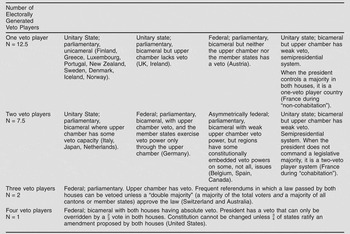
When we examine our set of 23 long-standing democracies in advanced economies, we find that slightly more than half of these countries (12.5) actually have only one electorally generated veto player. This is so because, with the exception of France, they are all unicameral (or if bicameral, the upper house does not have a veto) and parliamentary; thus, the only veto player whose consent is needed is the prime minister's majority in the lower house. There are 7.5 countries with two veto players, two countries (Switzerland and Australia) with three veto players, and only one country, the United States of America, with four electorally generated veto players.Footnote 10 Thus, the United States is politically exceptional in the high number of electorally based veto players who potentially can block social change, by blocking key bills or amendments. See Table 1.
Electorally Generated Veto Players in the Set of 23 Long-Standing Democracies in Advanced Economies

Sources: Arend Lijphart, Patterns of Democracy: Government Forms and Performance in Thirty-six Countries (New Haven: Yale University Press, Reference Lijphart1999), pp. 189, 202; George Tsebelis and J. Money, Bicameralism (New York: Cambridge University Press, Reference Tsebelis and Money1997); and our assessment. Denmark until 1953 and Sweden until 1970 had bicameral systems. Norway until 2009 had a modified unicameral system in which the parliament (Storting) separated itself into two chambers: the Lagting and the Odelsting.
Other Majority-Constraining Features of the US Political System
In addition to having the highest number of veto players, there are four more constitutionally embedded features of the US political system that, taken together, make that system even more majority constraining and, we believe, inequality inducing, than any other democracy in our set (and more than Table 1 indicates).
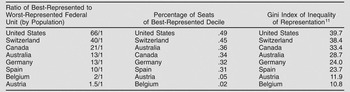
First, the principle that every state in the Union has an equal vote in the Senate (two senators) generates by far the greatest violation of the classic majority principal of “one person, one vote” of any of the eight federal democracies in our set. Indeed, on three different measures, the US Senate is the most malapportioned of all such upper houses. For example, Wyoming has a population of 450,000 and California a population of more than 32 million; thus, we can say that the value of a vote in California has 66 times less weight in producing a senator than a vote in Wyoming. See Table 2.
Degree of Overrepresentation in the Upper Houses in the set of Eight Long-Standing Federal Democracies in Advanced Economies

Source: Data come from Whitaker's Almanack (London: I. Whitaker, Reference Whitaker1997); The Europa World Year Book 1995 (London: Europa Publications, 1995); and Daniel Elazar et al., Federal Systems of the World (Harlow, UK: Longman, Reference Elazar1994). For the constitutional provisions on second chambers, see S. E. Finer, Vernon Bogdanor, and Bernard Rudden, Comparing Constitutions (Oxford: Oxford University Press, Reference Finer, Bogdanor and Rudden1995); and A. P. Blaustein and G. H. Flanz, eds., Constitutions of the Countries of the World (Dobbs Ferry, NY: Oceana Publications, Reference Blaustein and Flanz1991).
The malapportionment indicated in Table 2 is virtually unamendable, because Article 5 of the US Constitution stipulates that “no State, without its Consent, shall be deprived of its equal Suffrage in the Senate.” Article 5 is thus not merely the normal constitutional requirement of an exceptional majority for a constitutional amendment but a unanimity requirement. In Robert Dahl's judgment, with which we concur, the two-senators-per-state rule would require a new US constitution, and given the exceptional blocking power of electoral minorities (and the pride of Americans in their constitution), he does not see this ever happening.Footnote 12
Second, to compound the significance of the comparative inequality of representation of the US Senate, this most malapportioned chamber in our set has the most comparative power in our set. The Senate has vastly more influence on federal appointments than the “one person, one vote” House of Representatives, and more prerogatives than any other democratically elected upper house in our set. The veto power of the US Senate to defeat reforms backed by a majority in the House has been demonstrated again and again. For example, as Dahl has written, “between 1800 and 1860 eight anti-slavery measures passed the House but all were killed in the Senate.”Footnote 13 More recently, 83% of the House voted to abolish the Electoral College but the proposed amendment was defeated in the Senate. Dahl calls the Senate “the graveyard of constitutional amendments altering the Electoral College.”Footnote 14
Third, no constitution can foresee everything that the majority of the demos of the polity might eventually believe should become an equality-enhancing feature of their polis, such as the creation of a welfare state. When such a felt need emerges from the political system, most democracies can accommodate it because their constitutions allocate “residual powers” to make such decisions to the center, or in the case of some federal states such as Germany, to the center and the states acting jointly. Due to other features of the German constitution, such as Article 31, which stipulates that “Federal law shall take precedence over Land Law,” or especially Article 106, which mandates “uniformity of living conditions in the federal territory,” the German federal state is not constrained in its efforts to produce equality. However, the Tenth Amendment of the US Constitution creates the strong presumption that residual powers do not pass to the center, but rather to the states: “The powers not delegated to the United States by the Constitution, nor prohibited by it to the states, are reserved to the States respectively, or to the people.”
Fourth, all of these majority-constraining features are constitutionally embedded and could, in theory, be changed by amendments supported by exceptional majorities of citizens. However, the US constitutional system enables minorities to block such amendments with comparative ease. Indeed, Donald Lutz, in his excellent American Political Science Review article “Toward a Theory of Constitutional Amendment,” demonstrates that the US Constitution is by far the most difficult constitution to amend in our set.Footnote 15
What is the effect of these features of the US constitutional system, taken together, on the comparative quality of democracy and comparative inequality of the US political system? Because of the exceptional number of veto players, and the additional four majority-limiting features we have just discussed, we would expect the United States, even in its best period, to have more difficulties in reducing its inequality than countries with one or two veto players.
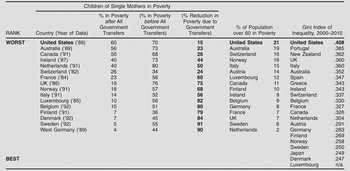
Let us take a look at some of the evidence starting, again, with the most commonly used indicator of inequality, the Gini index. Additionally, we will use two other important measures of poverty and inequality, measures developed by the invaluable Luxembourg Income Study: the percentage of the total population over age 60 living in poverty after all government transfers, and the percentage of children of single mothers who are living in poverty after all government transfers. What is particularly revealing about the meticulous Luxembourg study is that it graphically illustrates how all US government transfers together move only 15% of children of single mothers from the “in poverty” category to the “out of poverty” category. This US government-induced poverty-reduction percentage for such children is much less than for any other country in the set; indeed, comparable poverty reduction is between 60% to 91% in France, the UK, Norway, Luxembourg, Belgium, Finland, Denmark, Sweden, and Germany. See Table 3.
Comparative Inequality among Long-Standing Democracies in Advanced Economies

Sources: For Gini index data, see (exact year of data not provided for individual nations) United Nations Development Programme, “Human Development Report, 2010,” Statistical Annex, pp. 152–55; for “single mother households,” see Lee Rainwater, “Inequality and Poverty in Comparative Perspective,” Estudio/Working Paper 110, Institute Juan March, Madrid, Reference Rainwater1997, especially Table 7 on p. 16; for “population over 60 in poverty” data, see Anthony Atkinson, Lee Rainwater, and Timothy Smeeding, Income Distribution in OECD Countries: Evidence from the Luxembourg Income Study (Paris: OECD, Reference Atkinson, Rainwater and Smeeding1995) on p. 104.
There is a positive correlation between a high number of electorally sanctioned veto players and high inequality, as Table 4 shows clearly. Correlation does not necessarily imply causation. However, we can demonstrate how veto players can produce a causally powerful mechanism (such as the Swiss or Australian constitutional provision for national referendums) that can block reform measures supported by the majority of parliament. As Table 1 shows, Switzerland's three-veto-player classification is due to its having a national referendum. Minorities as small as 100,000 citizens, representing approximately 2.5% of the electorate, have the right to force a referendum to challenge, and often defeat, a bill already passed by the lower house and by the collective executive. The referendum requires a double majority—a majority of all voters but, most critically, a majority of all the cantons (which, due to the malapportionment documented in Table 1, are often actually only a minority of all voters)—to approve the bill or the bill fails.
Relationship Between Inequality and Number of Veto Players: In the Set of Long-Standing Democracies in Advanced Economies

A careful study of four basic social welfare reforms in Switzerland that could have reduced inequalities in the areas of health, accident insurance, old age, and maternity leave shows how all four of these reforms were passed by strong majorities in the lower house and the government. Eventually, all four measures were passed and funded. However, the time lag due to referendum defeats was 14 years for health reform, 18 years for accidents, 17 years for old age, and 18 years for maternity leave.Footnote 16 In Australia, the world's first major welfare state was advocated by the Labor government in 1912 and approved by the lower house. However, a minority of overall voters, from the overrepresented agricultural states, were able to force, and win, a referendum on the matter. Australia's welfare state was thus delayed for almost three decades. For the correlation between veto players and inequality produced by concrete mechanisms such as we have just discussed, see Table 4.
What do the constitutionally embedded anti-majoritarian structures mean, and not mean, for possible inequality reducing measures?
Political Transcendence of Four Veto Players: Brazil
Four veto players clearly provide more concrete mechanisms to block democratic majorities than do one or two veto players. However, this does not mean that inequality-reducing changes are impossible, even with four potential veto players.
Indeed, recent history shows that a country with four veto players, Brazil, under the last two democratic presidents, Fernando Henrique Cardoso and Luís Inácio Lula da Silva (“Lula”), carried out major inequality-reducing reforms over the last 16 years. Its Gini index of inequality, in the past even much worse than that of the United States, has improved in virtually every one of these 16 years. Part of the explanation for this success is that, though they emerged from different political parties, both presidents were political leaders who made a great effort to turn Brazilian public opinion, and ultimately even the Brazilian legislatures, in favor of the idea that social inequality was a major human and developmental problem in the country. Given their ability to sell this fundamental point, political polarization on this issue almost disappeared. Lula's 70% approval rating when he left office was not due primarily to his style but to the fact that he deepened Cardoso's reforms in several critical areas, such as basic family maintenance programs (Bolsa Familia), primary and secondary education, and the creation of a universal right to health services and a national, publicly funded coordinated system (the Sistema Unica de Saúde, or SUS) to deliver health services to citizens.Footnote 17
Obama's United States: Transcending the Filibuster and Reducing Four Potential Veto Points to One Actual Veto Player?
From the comparative perspective of advanced European democracies, it seems difficult to comprehend that the only long-standing democracy in an advanced economy with four electorally sanctioned veto players and the most malapportioned and most powerful upper house (Senate)—the United States—should in essence allow this vastly overrepresented body to acquire even more power than it already has via the filibuster. A filibuster facilitates the blocking of win-sets by minorities. Instead of only 51 votes needed for a bill to pass, a credible threat of a filibuster now creates the necessity of a supermajority of 60 votes. Worse, in the last few decades, anonymous “secret holds” by a single senator have produced gridlock, which holds up discussions and votes on major appointments or legislation. No other democratic upper house in the world allows such “unconstitutionally entrenched,” minority-induced vetos. The common argument is that the recent “polarization” of the Senate contributes to this problem. Polarization has indeed gotten worse, but a disciplined majority, absent a filibuster, could still pass major reforms.Footnote 18
Despite four potential veto players in the United States, on the day of Barack Obama's inauguration in January 2009, he had the majorities that in theory (and certainly in practice in West European democracies) could have allowed him to control three of the four veto players (the lower house, the Senate, and the presidency). Also, since none of the major reforms that he said he would implement if elected required constitutional amendments, the fourth veto player (the three-quarters of the states whose assent is needed) did not come into play. It thus makes analytic and political sense to argue that Obama, if he could have sold his party, and the American people, on the correctness and urgency of reducing inequality in the United States and fighting for the reform proposals for which he was elected, might have politically created a situation with one true veto player. How?
Bruce Ackerman's article in the American Prospect makes a convincing case that the filibuster could have been eliminated at the first session of a new Congress.Footnote 19 Senator Tom Udall (NM)—a major leader and cosponsor with Democratic Senators Tom Harkin (IA), Jeff Merkley (OR), and Mark Udall (CO) of several Senate resolutions to eliminate, or greatly reduce, the blocking power of filibusters—concurs with Ackerman. In Tom Udall's forthcoming article in the Harvard Law and Policy Review (and in a detailed discussion with Stepan), he argues for what he calls the “Constitutional Option.” As he writes: “The Constitutional Option is based on a simple premise: at the beginning of each new Congress, the Senate is not bound by the rules of any previous Congress. In accordance with the Constitution, the Senate is free to end debate with a simple majority vote and move to a final vote at the beginning of each new Congress.”Footnote 20 For Ackerman, this means that Vice President Joseph Biden, in his constitutional role as president of the Senate, could have opened the Congress with a request for a simple majority vote over cloture rules, which if carried, would have eliminated the filibuster for the 2009–10 Congress.
The entrenched (though not constitutionally mandated) argument is that the Senate, unlike the House, is a “continuing body” (because two-thirds of every new Senate are continuing members) and, in a Catch-22 situation, is thus bound by existing precedent. There are many other reasons why even Democrats might not have favored the Ackerman-Udall proposal. For example, some day they might be in the minority and want to use the blocking power of filibusters; also, eliminating the filibuster would mean giving up a great source of the personal power of individual senators who, by themselves, can threaten a filibuster and, until recently, put anonymous “holds” on appointments. Some senators argue that the American public wants a divided government, and for a variety of reasons internalizes the costs of gridlock in relation to reforms it may have voted for and desire.Footnote 21
We believe that parties in Europe, if they had the majority the Democrats had in January 2009, would not have been checked by the threat of polarization because they would have had sufficient party discipline to deliver a majority for their reforms. As far as we can tell, President Obama chose not to launch a major fight to get the 59 Democratic senators to support the elimination of the existing filibuster procedure, nor did he try to persuade the American public to support his efforts in this regard. Neither he, nor Biden, personally lobbied hard and persistently to get 51 votes from the 59 democratic Senators, or to create supportive public opinion to break filibusters. Rather, he chose to negotiate with an ideological Republican minority of the sort that did not exist, as Fiorina shows, in the 1960s but that absolutely existed in 2010. From a European perspective, Obama's choice is very hard to comprehend. With the threat of a filibuster credibly still in place, the ideologically committed Republican minority made few compromises to the proposals of the Senate majority or to the president.
If Obama had chosen to commit his political resources to fighting for the elimination of the extreme majority-constraining filibuster rules, and had been successful, then his reforms could has been passed more quickly, and in less watered-down form, thus giving him a more powerful platform to take into what turned out to be the great midterm election defeat of 2010.
Is US Public Opinion the Fundamental Obstacle?
Many observers, both Americanists and comparativists alike, believe that US public opinion is much more opposed to inequality-reducing reforms than is European public opinion. They point to the belief in the “American Dream” of the sort presented in Jennifer Hochschild's classic book What's Fair? and to the American public's hostility to government, to taxes, and especially to welfare entitlements for the “undeserving poor.”Footnote 22 There is something to all of this. But two of America's most authoritative survey designers and analysts, Benjamin Page and Lawrence Jacobs, in their chapter “No Class War: Economic Inequality and Political Representation” in The Unsustainable American State, offer evidence that Americans support many more inequality-reducing measures than is commonly thought. For example, despite Americans' comparative “philosophical conservatism” in such matters as the state and the individual, which the authors document, on the issues of most relevance to Obama's inequality-reducing programs concerning health provision, or basic support for the elderly, or help for children in poverty, the American public, two years before Obama's election, favored positive federal government action in all of these areas.
For their specially designed Inequality Survey, Page and Jacobs give data for three categories of respondents: “All Americans,” “Republicans,” and “High Income People.”Footnote 23 In response to the statement “It is the responsibility of the federal government to make sure all Americans have health care coverage,” 73% of all Americans, 56% of Republicans, and 66% of high-income people agreed. But 40 million Americans, 16% of the total population, have no public or private health coverage (p. 148). Their survey also shows that 73% of all Americans believe that health care should be “expanded,” and only 8% believe it should be “cut back” (p. 149). Even when asked the tricky question about taxes, a solid majority (58%) say they would be willing to pay more taxes in order to provide health coverage for everyone (p. 150).
Table 3 shows that the United States has the highest percentage of children of single mothers living in poverty in any country in our comparison set, after all government transfers. But Page and Jacobs assert that “a large majority of Americans (66%) even say they favor their tax dollars being used to help pay for welfare benefits for the children of single teenage mothers. Still more remarkably, this view is shared by large majorities of Republicans and of the affluent” (pp. 145–46).
Table 3 also shows that the United States has the highest percentage of people over 60 living in poverty of any country in the comparison set. However, Page and Jacobs created a question that specifically asked Americans if they supported “government provision of minimum income in retirement.” The results were that 66% of all Americans, 56% of Republicans, and 63% of high-income people approved the following statement: “The Social Security system should ensure a minimum standard of living to all contributors even if some receive benefits exceeding the value of their contributions” (p. 135). They conclude their revisionist piece with the statement that “the responsibility for the pinched US welfare state rests with public officials and the political system, not with ordinary citizens” (p. 162).Footnote 24
The argument that American public opinion, per se, has not contributed to the great increase in inequality is supported by Morris Fiorina's newest book, Disconnect, where he argues that “the plurality that prefers the moderate label is about 5 percentage points higher in the 2000s than in the 1970s.”Footnote 25 Further evidence that the lack of support for inequality-reducing programs is not a function of Congress's being responsive to American opinion is found in the article “Economic Inequality and Political Representation” by Larry Bartels, in The Unsustainable American State. Bartels reports that his study of senators' votes in relationship to constituency demands showed that both Democrats and Republican senators are overwhelmingly more responsive to high-income groups than to middle-income groups and, most shockingly, that “there is no evidence of any responsiveness to the views of constituents in the bottom third of the income distribution, even from Democrats” (See Figure 7.3 on p. 181).
If we are looking for an explanation, a much stronger candidate for this deterioration, in our judgment, comes from Jacob Hacker and Paul Pierson and their agenda-setting analysis of how public policies are made, and not made, in the United States. They dismiss what they say is the dominant economic explanation for rising inequality, which emphasizes “skill-biased technological change—a shift toward greater emphasis on specialized skills, knowledge and education—that has fueled a growing divide between the highly educated and the rest of American workers,” a shift which some people see as related to universal causal processes, such as globalization.Footnote 26 The authors demonstrate the utility of a comparative frame of reference for testing this hypothesis when they produce data on the share of national income of the top 1% of the population between the mid-1970s to 2000 in 11 countries from our comparison set. Of these 11 countries, France, Germany, Japan, the Netherlands, Sweden, and Switzerland experienced little or no increase. Indeed, the only countries in our comparison set that have greatly increased the percentage of national income controlled by the top 1% of the population are English-speaking countries, whose top business and financial executives could be seen, to some extent, as potential defectors to the United States unless they are compensated at equally exorbitant levels.Footnote 27
In terms of political process, the devastating table by Bartels on the inattention of senators to the bottom one-third of their constituents is put into context by Hacker and Pierson's discussion of the “organizational transformation of American politics.”Footnote 28 They show that “in 1971, only 175 firms had registered lobbyists in Washington while, by 1982, 2,445 did.”Footnote 29 In contrast, the group that they consider historically the most politically significant advocate of working-class demands, labor unions, has had an organizational decline. After World War II, more than a third of wage and salary workers were in unions, but by 2009, “the share had dropped to 12.3% and just 7.2% in the private sector.”Footnote 30 Because many of the public policies that affect the superrich and the poor have to do with complicated tax issues, the fact that well over a thousand registered lobbyists in Washington identify taxes as one of their areas of activity, with the vast majority of them representing businesses and with labor now virtually absent, has a direct effect on what the authors see as “the politics of organized combat”: “During recent fights over the estate tax—a policy issue with large and obvious distributional consequences—organized labor could supply only one union lobbyist to address the issue.”Footnote 31 Universalist explanations alone, like globalization, do not adequately explain the decline of labor. Between 1960 and 2005, the union share of wage and salary workers in the United States went from 30.4% to 12.5%, whereas in Canada, union share remained virtually the same, shifting only from 32.3% to 32.0%.Footnote 32 Hacker and Pierson make a very convincing argument that the “winner take all” aspects of the American economy are political outcomes more than they are market ones.
Dangerous Myths and Metaphors about American Politics
Widely repeated myths, or even metaphors, can be crucial in normalizing inequality and making it more difficult for inequality-reducing politics to be organized. In our judgment, the United States has a particularly diverse and damaging set of such myths and metaphors. Here are several.
“US Federalism as 50 ‘Laboratories’ of Experimentation”
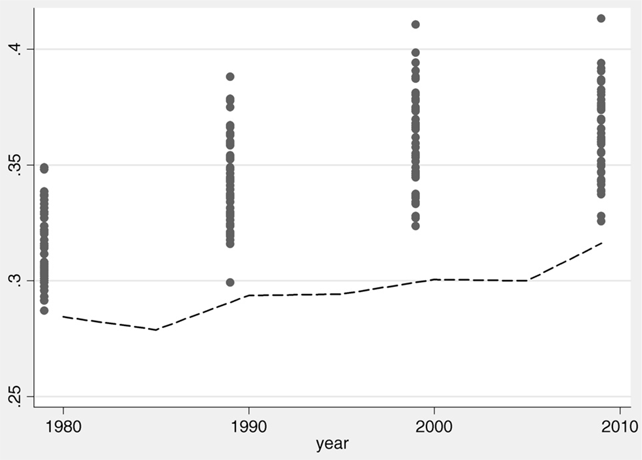
All analysts understand that some practices, such as the “race to the bottom” in tax policies among states, have drawbacks. However, the supposedly trumping metaphor is that US federalism should best be seen as 50 different laboratories, all experimenting to find the best policies. The US Census Bureau has published the Gini index scores for every state in the union for every decade since 1980. Therefore, we have 200 “observations” with which we can see how these experiments are doing: Not a single US “laboratory” in the last 30 years has had a Gini index score better than the average for our comparison set. See Figure 1.Footnote 33
None of the 50 US laboratories of experimentation has produced a Gini better than the comparison set average: 1980–2010.
Sources: US Census Table S4, “Gini Ratios by State: 1969, 1979, 1989, 1999,” at http://www.census.gov/hhes/www/income/data/historical/state/state4.html; 2009 data created from American Community Survey from 2009. World data from OECD, some countries missing in early years. Data from 2009 from UNDP, as listed earlier in this essay, at http://stats.oecd.org/Index.aspx?DatasetCode=INEQUALITY.
The line at the bottom of the table is our comparison set average Gini for available countries and years. The vertical lines depict the range of Gini index scores, from least unequal to most unequal American state, for each of the 50 observations in years 1980, 1990, 2000, and 2010.

Despite the famous saying by Aaron Wildavsky that “Federalism Means Inequality,” the five federal democracies in our comparison set (Australia, Belgium, Canada, Germany, and Switzerland) have Gini scores between .28 to .34, substantially better than that of the federal United States (see Table 3). As we have argued elsewhere, it is the extreme localism and number of prerogatives of American states, the result of their “coming together” type of federalism, that facilitates inequality-producing state policies, such as the famous “race to the bottom” competitive tax policies among states.Footnote 34
“Inequality Is the Price We Pay for Our Diversity”
One often hears assertions among political activists and analysts alike that the reason for America's great inequality, when measured against other advanced–economy, long-standing democracies, is America's exceptionally high number of foreign-born residents. From a comparative perspective, this is simply a myth. The percentage of total foreign-born residents in the US population, compared to the percentage in our comparison set, is very similar, 12.4% to 11.8%, respectively.Footnote 35 A more graphic demonstration of the mythlike quality of this statement is that six of the countries in our comparison set—Germany, Sweden, Austria, the Netherlands, France, and Belgium—have similar or higher levels of foreign-born residents but substantially better Gini indexes than the United States. See Figure 2.
At all levels of foreign-born residents, American states are more unequal than comparison set democracies.
Sources: Data for the US states are drawn from US Census Bureau American Community Survey 2009 and adjusted for cross-national comparability (see source note in Table 5). Data for comparison set countries are from UNDP 2010 (Gini) and OECD 2009 (percent foreign-born).
The dotted line and faint initials represent the United States. The solid line and bold initials represent the comparison set.

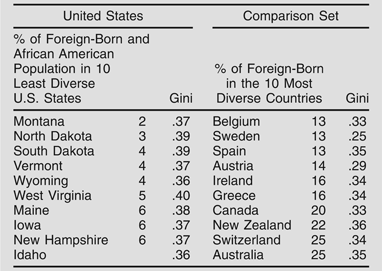
Some analysts might think that American diversity is best understated by focusing solely on foreign-born residents and that much of America's inequality is driven by the combination of immigrants and minority groups, especially African Americans. Even this hypothesis-saving reformulation is easily refutable. Table 5 compares the 10 American states with the lowest combined percentage of foreign-born residents and African-Americans and contrasts them with the 10 countries in our comparison set with the greatest diversity. None of the American states with the lowest levels of foreign-born and African American populations (2%–6%) has a better Gini than any of the countries in our set with the highest levels of foreign-born residents, (13%–25%). See Table 5.
America's Ten Least Diverse States Are Far More Unequal Than Comparison Set's 10 Most Diverse Countries
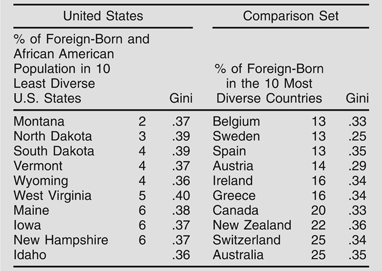
Sources: All state-level measures are drawn from 2009 American Community Survey. ACS data calculate US national Gini coefficient to be .46, much higher than the figure used in UNDP, LIS (formerly the Luxembourg Income Study), or OECD. State-level figures reported here are adjusted downwards according to a proportional factor. This represents an analytically conservative approach for the sake of comparison. The actual difference between US and comparable democracies' income distribution may be higher. Gini coefficients for these groups were calculated using individual-level Census data from the Integrated Public Use Microdata Series (IPUMS). IPUMS data yield higher Gini estimates across the board; so these figures are based on an adjustment that reduces the observed Gini by a factor equal to the ratio between the Census Bureau's aggregate Gini coefficient measure for the state and the state-level Gini coefficient from IPUMS.
“Americans Like and Have Limited Government”: Public Spending on Health Care
Despite this oft-stated assertion, in many areas, including government-funded health care, limited government is a myth that needs to be reexamined.
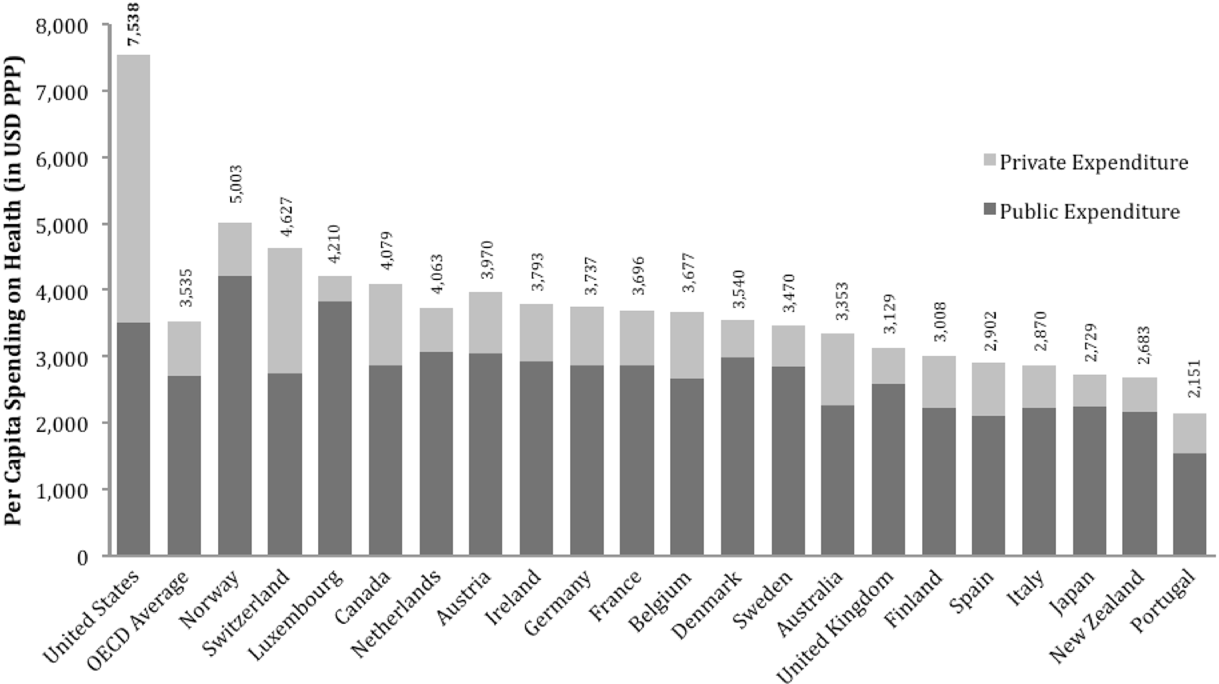
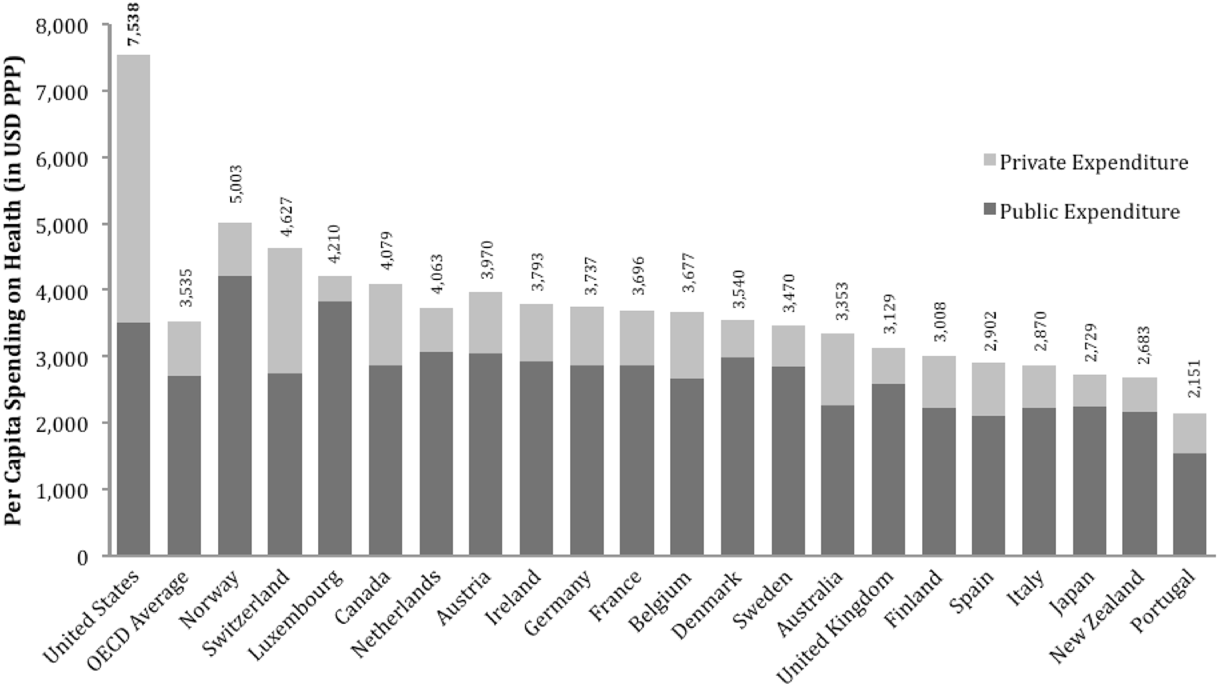
Let us look at health care comparatively. The first thing we have to note is that if we combine total federal and state expenditures on health care, the United States has a higher per capita public expenditure than any of the countries in our comparison set except Norway and Luxembourg. Moreover, the combined total of private and public expenditures on health care shows that the United States spends more than twice as much on health care than the comparison set average, and indeed, has per capita costs 30% higher than any single country in our set. See Figure 3.
The United States spends more public money on health care than any country in the comparison set, except for Norway and Luxembourg.
Source: OECD Health Data 2010.
Despite spending so much public and private money on health care, in comparative terms the United States stands out for its low quality of health care in two critical respects: scope of coverage and health results. As Page and Jacobs assert in The Unsustainable American State, the United States has 47 million citizens (16% of the population) who have no health insurance, almost certainly a higher figure than for any of our comparison set (p. 148). Most shockingly, the maternal mortality rate in the United States is nearly 3 times higher than the average for our set. Infant mortality is 40% higher than the average for our set, and only one country in our comparison set has a lower life expectancy for women at 65 years of age. Finally, because of the high costs of American medicine and the high number of people not covered by insurance, Americans have the second lowest doctor consultation rates, per capita, of any country in our set.Footnote 36
The previous structure of health care-costs and outcomes, no doubt, has something to do with the intense lobbying of the sort that Hacker and Pierson discuss in Winner-Take-All Politics. However, lobbying is by no means the entire explanation. An important work in comparative historical analysis of health-care policy is Antonia Maioni's Parting at the Crossroads: The Emergence of Health Insurance in the United States and Canada. She documents that the lobbyists for the American Medical Association (AMA) and the Canadian Medical Association (CMA) had virtually identical positions on national health insurance and they were equally well organized and well financed. However, once the Canadian political parties took a position in favor of comprehensive health care, the ability of the CMA to lobby effectively to block such coverage was greatly reduced because of the discipline of Canadian political parties. In contrast, the AMA was able to effectively lobby individual congressmen and senators to defect from their party's positions and accept much less comprehensive health insurance coverage. The absence of strong party discipline, and the self-financing of many candidates, magnify the importance of money in American politics.Footnote 37
“The American Dream”
In The Unsustainable American State, Page and Jacobs assert that their results confirm that “most Americans still believe deeply in the American dream, in material incentives, and in unlimited opportunity” (pp. 136–37). Should they?
Fortunately, in the last decade a focused body of research results has been published that allows us to evaluate the American Dream in comparative perspective. Some British scholars argue that such research “is seen by many as a measure of the extent of equality of economic and social opportunity. It captures the degree of equality in life chances—the extent to which a person's circumstances during childhood are reflected in their success in later life, or the flip-side, the extent to which individuals can make it by virtue of their own talents, motivation and luck”.Footnote 38
In comparative terms, if belief in the American Dream were still warranted, the United States should manifest levels of comparatively great upward mobility and comparatively little intergenerational persistence of disadvantage. This new body of research demonstrates that the opposite is true. We have data for the United States and nine countries in our comparison set: the UK, Germany, France, Italy, Canada, Norway, Denmark, Sweden, and Finland. In tests of intergenerational mobility, the higher the correlation between one generation's family income and education and the next generation's, the lower the mobility. In all of the studies, the United States emerges as having the lowest levels of intergenerational upward mobility, with the possible exception of the UK. In a study by Markus Jäntti, a research director at the Luxembourg Income Study, the least mobile country is the United States, with a persistence of advantage of .45, while the least persistence of advantage is in Denmark with a .12, and “most other countries are quite close to .25.”Footnote 39 In a study of nine countries from our comparison set produced by the Centre for Economic Performance in London, the United States is the least mobile, with a score of .289, and America's federal, high-immigration neighbor, Canada, scores much better with a .143.Footnote 40 A leader of intergenerational mobility studies, Miles Corak, summarized this research by asserting that at the extreme pole of immobility, the United States, about 50% of educational and wealth disadvantage is passed on by the parents. In contrast, in Canada and Sweden, at the more mobile pole, only 20% of disadvantage is passed on.Footnote 41
While not producing comparative data, we have an excellent longitudinal survey of 6,000 Americans for whom “we know both family income in adolescence (1978–80) and family income as adults (1997–2003).”Footnote 42 The author of the study concurs with the results of low intergenerational mobility we have presented so far. He writes that in the United States “there is much less intergenerational mobility than many people might have imagined.”Footnote 43 One study asserts that “the chances of ending up rich if you were born to a low income family are on the order of just one percent.”Footnote 44
The comparative study of inequality in the United States suggests, then, that not only is there runaway wealth at the top of the income pyramid, as Hacker and Pierson have documented, but also exceptionally low comparative mobility at the bottom. The American Dream has now become a dangerous myth.
Conclusion
The absence of a breakthrough in American politics that offers alternatives to growing inequality, and the continued “policy drift,” lead to the question: Why? This is a question with serious implications for US society and democratic theory, to which there are not yet any certain answers. Building upon the two books in this review essay, however, future Americanists would do well to take a comparative perspective and pay more attention to how and why other advanced democracies have avoided many of the problems these books document so convincingly.
A further reality that merits study in comparative perspective is that many of the advanced democracies, when faced with crises of the magnitude that the United States now confronts, were able to reimagine, and reconfigure, many of their basic institutions and to deepen democracy. The time is long past for unthinking acceptance of America's founding political institutions not only by citizens but also by academics.
We take no delight in having illustrated in this review that, by many standard measures of equality, the United States is now the world's most unequal long-standing democracy in the developed world. However, we do so with the hope that the results presented here will contribute to more politically focused, comparative research in which scholars both here and abroad alike reexamine the reasons for such persistent inequality and explore new ways to transcend this pattern.