Introduction
In Mississippi, corn is typically planted between March 24 and April 27, which often coincides with preplant herbicide applications in soybean [Glycine max (L.) Merr.] and cotton (Gossypium hirsutum L.) production systems (USDA 2010). Historically, preplant and at-planting PRE herbicide applications have consisted of a residual herbicide for extended weed control plus a nonselective, broad-spectrum herbicide such as paraquat or glyphosate for control of emerged weeds (Givens et al. Reference Givens, Shaw, Johnson, Weller, Young, Wilson, Owen and Jordan2009; Shaw Reference Shaw1996). However, due to widespread glyphosate resistance in troublesome weed species such as Palmer amaranth (Amaranthus palmeri S. Watson), preplant herbicide applications in soybean and cotton now primarily rely on paraquat for control of emerged weeds (Crow et al. Reference Crow, Steckel, Hayes and Mueller2015; Norsworthy et al. Reference Norsworthy, Griffith, Scott, Smith and Oliver2008; Owen et al. Reference Owen, Steckel, Koger, Main and Mueller2009). In addition, fomesafen is commonly used for residual control in cotton applied PRE and for POST control in soybean (Bond et al. Reference Bond, Oliver and Stephenson2006a; Everman et al. Reference Everman, Clewis, York and Wilcut2009; Norsworthy et al. Reference Norsworthy, Griffith, Scott, Smith and Oliver2008; Owen et al. Reference Owen, Steckel, Koger, Main and Mueller2009; Whitaker et al. Reference Whitaker, York, Jordan and Culpepper2010).
Paraquat and fomesafen exhibit contact foliar activity and require greater spray coverage than systemic herbicides for adequate control of target weeds (Buehring et al. Reference Buehring, Roth and Santelmann1973; Etheridge et al. Reference Etheridge, Hart, Hayes and Mueller2001; Knoche Reference Knoche1994; Ramsdale and Messersmith Reference Ramsdale and Messersmith2001a,b; Reichard and Triplett Reference Reichard and Triplett1983). Increased spray coverage is achieved through increasing spray volume, by nozzle selection, or both (Buehring et al. Reference Buehring, Roth and Santelmann1973). However, smaller spray-droplet qualities such as fine (106 to 235 µm) and medium (236 to 340 µm), which are commonly used for contact herbicides, exhibit exponentially higher particle drift than larger spray-droplet qualities, such as very coarse (404 to 603 µm) and ultra-coarse (>665 µm) (ASABE 2009; Foster et al. Reference Foster, Sperry, Reynolds, Kruger and Claussen2018). Consequently, the higher spray-coverage requirement with fomesafen and paraquat applications coupled with close proximity of sensitive row-crop production has resulted in increased incidents of off-target paraquat and fomesafen in Mississippi in recent years.
Off-target movement of glyphosate from preplant applications in cotton and soybean onto non-glyphosate–resistant corn hybrids has been described as an area of concern (Brown et al. Reference Brown, Robinson, Young, Loux, Johnson, Nurse, Swanton and Sikkema2009; Ellis et al. Reference Ellis, Griffin and Jones2002, Reference Ellis, Griffin, Linscombe and Webster2003; Henry et al. Reference Henry, Shaw, Reddy, Bruce and Tamhankar2004; Reddy et al. Reference Reddy, King, Zablotowicz, Thomson, Huang and Krutz2010). In addition, low rates of herbicides applied to simulate off-target movement have repeatedly been shown to injure sensitive crops, including rice (Oryza sativa L.), corn, grain sorghum [Sorghum halepense (L.) Pers.], cotton, peanut (Arachis hypogaea L.), and soybean (Bond et al. Reference Bond, Griffin, Ellis, Linscombe and Williams2006b; Ellis et al. Reference Ellis, Griffin, Linscombe and Webster2003; Johnson et al. Reference Johnson, Fisher, Jordan, Edmisten, Stewart and York2012). Glyphosate applied at 10% of the labeled rate injured grain sorghum up to 60% (Al-Khatib et al. Reference Al-Khatib, Claassen, Stahlman, Geier, Regehr, Duncan and Heer2003). Glufosinate at 6.3% and 12.5% of the labeled rate, applied at boot stage, reduced rice yield 90% (Webster et al. Reference Webster, Hensley, Blouin, Harrell and Bond2015). Corn yields were reduced 78%, 43%, and 22% when glyphosate was applied at 12.5%, 6.3%, and 3.2%, respectively, of the labeled rate at V6 (Ellis et al. Reference Ellis, Griffin, Linscombe and Webster2003). Henry et al. (Reference Henry, Shaw, Reddy, Bruce and Tamhankar2004) reported corn response to paraquat under greenhouse conditions; however, plants were only treated at one growth stage, and neither plant height nor yield parameters were evaluated.
Crop growth stage at time of herbicide exposure also can cause differential sensitivity to herbicides (Bunting et al. Reference Bunting, Sprague and Riechers2004; Johnson et al. Reference Johnson, Young and Matthews2002; Swanton et al. Reference Swanton, Chandler, Elmes, Murphy and Anderson1996). Johnson et al. (Reference Johnson, Young and Matthews2002) reported that mesotrione caused 4% and 11% greater corn injury when applied at V5 compared with V3 or V4 growth stages, respectively. Corn exhibits 16% to 32% greater injury from foramsulfuron applied at V6 or V8 than at V2 or V4 (Bunting et al. Reference Bunting, Sprague and Riechers2004). Likewise, applications of nicosulfuron plus rimsulfuron caused 13% lower yield when applied at V6 than at V3 (Swanton et al. Reference Swanton, Chandler, Elmes, Murphy and Anderson1996). Furthermore, corn injury from nicosulfuron plus bromoxynil was 25% greater when applied at V3 compared with V5 (Carey and Kells Reference Carey and Kells1995).
Currently, to our knowledge, no peer-reviewed literature is published on corn response to paraquat or fomesafen under field conditions. Furthermore, little is known of the effect of corn growth stage on response to paraquat or fomesafen. On the basis of corn sensitivity to other herbicides in the literature, it was hypothesized that corn sensitivity to paraquat or fomesafen would be higher at later vegetative growth stages. Therefore, the objective of these experiments was to evaluate corn agronomic performance and yield after exposure to sublethal rates of paraquat or fomesafen at vegetative growth stages.
Materials and Methods
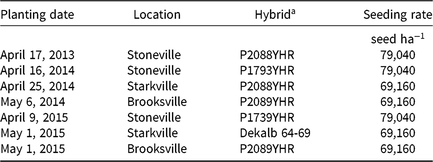
Two separate but concurrent studies were conducted from 2013 to 2015 at the Delta Research and Extension Center (33°44’00.9”N, 90°88’59.9”W) in Stoneville, MS; in 2014 and 2015 at the R.R. Foil Plant Science Research Center (33°47’60.9”N, 88°77’38.1”W) in Starkville, MS; and in 2014 and 2015 at the Black Belt Experiment Station (33°15’24.5”N, 88°33’24.4”W) near Brooksville, MS, to evaluate corn response to sublethal rates of fomesafen and paraquat. Soil series were Catalpa silty clay (fine, smectic, thermic Fluvaquentic Hapludolls) with 1.3% organic matter (OM) and pH of 7.2; Dundee silty loam (fine-silty, mixed, active, thermic Typic Endoaqualfs) with 1.2% OM and pH of 6.1; and Brooksville silty clay (fine, smectitic, thermic Aquic Hapluderts) with 2.2% OM and pH of 6.1 at Starkville, Stoneville, and Brooksville, MS, respectively. Planting dates, corn hybrids, and seeding rates are listed in Table 1. All studies were conducted under conventional tillage and maintained weed free with PRE applications of glyphosate (Roundup PowerMAX, Monsanto Company, 800 N. Lindbergh Blvd., St. Louis, MO 63167) and S-metolachlor plus atrazine plus mesotrione (Lexar EZ, Syngenta Crop Protection, P.O. Box 18300, Greensboro, NC 27409) applied at 1,169, 976, 976, and 126 g ae or ai ha−1, respectively. Where needed, weeds escaping PRE control warranted a broadcast POST application of atrazine (Aatrex, Syngenta) and S-metolachlor plus glyphosate plus mesotrione (Halex GT, Syngenta) 1,682, 1,055, 1,055, and 106 g ha−1, respectively, to the entire experimental area. Plot sizes in Starkville and Brooksville were four rows spaced 97-cm apart and 12-m long. In Stoneville, plots were four rows 102-cm apart and 9-m long. Corn at all sites received 32% urea-ammonium nitrate at 523 L ha−1 21 to 35 d after planting (DAT).
Planting dates, locations, corn hybrids, and seeding rates for experiments evaluating corn agronomic performance after exposure to sublethal rates of fomesafen or paraquat at PRE, V1, V3, V5, V7, or V9 in Brooksville, Starkville, and Stoneville, MS, from 2013 to 2015.

a P2088YHR, P1793YHR, P2088YHR, P2089YHR, and P1739YHR (Dupont Pioneer, Johnston IA); Dekalb 64-69 (Monsanto Company, St. Louis, MO).
Paraquat and fomesafen were tested individually in separate experiments; however, methods for both experiments were identical. Both experiments were conducted as randomized complete block designs with four replications. In similar studies, researchers have used sublethal herbicide rates that ranged from 1% to 13% of the labeled use rate (Al-Khatib et al. Reference Al-Khatib, Claassen, Stahlman, Geier, Regehr, Duncan and Heer2003; Johnson et al. Reference Johnson, Fisher, Jordan, Edmisten, Stewart and York2012; Maybank et al. Reference Maybank, Yoshida and Grover1978; Webster et al. Reference Webster, Hensley, Blouin, Harrell and Bond2015). Consequently, a preliminary field test was conducted to evaluate several rates of paraquat and fomesafen on corn to identify an appropriate sublethal rate for each herbicide before initiating the current studies. On the basis of findings of the pilot study, paraquat (Gramoxone SL 2.0, Syngenta) or fomesafen (Reflex 2L, Syngenta) were applied at 105 and 35 g ai ha−1, respectively, representing 12.5% of the labeled preplant rate for soybean and cotton. Herbicide treatments in each experiment were applied to the center two rows of each plot at planting (PRE) or when corn reached V1, V3, V5, V7, or V9 (Hanway Reference Hanway1963). Application timings were chosen to represent a range of plausible exposure timings based on typical corn planting dates and PRE herbicide applications for cotton and soybean systems. In addition, a nontreated control (NTC) was included in each experiment for comparison.
In both experiments, herbicide treatments were applied with nonionic surfactant (Activator 90, Loveland Products, 3005 Rocky Mountain Ave., Loveland, CO 80538) and ammonium sulfate (Class Act NG, Winfield Solutions, P.O. Box 64589, St. Paul, MN 55164) at 0.5% and 2.5% vol/vol, respectively. Herbicide treatments at Stoneville were applied with either a tractor-mounted sprayer equipped with XR 11002 nozzles (TeeJet Technologies, Spraying Systems Co., P.O. Box 7900, Wheaton, IL 60187) calibrated to deliver 140 L ha−1 at 303 kPa or a CO2-pressurized backpack sprayer equipped with AIRMIX 11002 nozzles (Greenleaf Technologies, P.O. Box 1767, Covington, LA 70434) calibrated to deliver 140 L ha−1 at 248 kPa. At Starkville and Brooksville, all herbicide treatments were applied with a CO2-pressurized backpack sprayer equipped with AIXR 110015 nozzles (TeeJet Technologies, Spraying Systems Co., P.O. Box 7900, Wheaton, IL 60187) calibrated to deliver 140 L ha−1 at 290 kPa.
Estimates of corn injury were visually evaluated 3, 7, 14, 21, and 28 DAT on a scale of 0% (no symptoms) to 100% (plant death). Heights of five randomly selected plants were measured from the soil surface to the uppermost extended leaf tip 14 DAT. Corn height subsamples were averaged for each plot and then converted to a percentage of the NTC. This transformation accounted for differential heights due to maturity rather than herbicide treatment, because herbicide treatments occurred across a wide range of growth stages. At physiological maturity, ears from five random plants per plot were collected to determine average ear length and number of kernel rows. The center two rows of each plot were then harvested with a small-plot combine and yields were adjusted to 15% moisture.
All data were subjected to mixed model ANOVA using PROC GLIMMIX and means were separated with the LSMEANS function at α = 0.05 (SAS, version 9.4, SAS Institute Inc., Cary, NC). In the ANOVA model, growth stage at application was considered a fixed effect, whereas site-year and block (nested within site-years) were considered random effects to allow for inferences across multiple environments (Blouin et al. Reference Blouin, Webster and Bond2011).
Results and Discussion
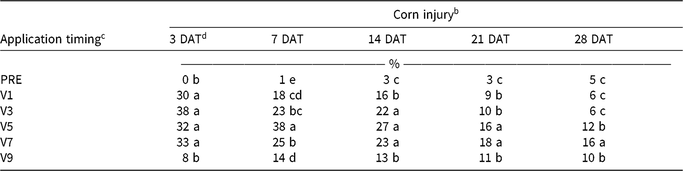
No differences in injury were observed 3 DAT when corn was exposed to fomesafen from V1 to V7; injury ranged from 30% to 38% (Table 2). However, corn exposure to fomesafen PRE and at V9 resulted in 0% and 8% injury 3 DAT, respectively. At 7 DAT, corn exposure to fomesafen at V5 resulted in 38% injury, whereas exposure at V3 and V7 resulted in 23% and 25% injury, respectively. Fomesafen exposure at V1 or V9 resulted in 18% and 14% injury 7 DAT, respectively. Similarly, corn has been shown to be more sensitive to mesotrione at V5 than V3 or V4 (Johnson et al. Reference Johnson, Young and Matthews2002). By 14 DAT, corn injury from fomesafen exposure at V3, V5, or V7 ranged from 22% to 27%. At 21 DAT, the greatest levels of corn injury resulted from fomesafen at V5 (16%) or V7 (18%). Likewise, corn injury at 21 DAT from fomesafen exposure at V1, V3, or V9 ranged from 9% to 11%. By 28 DAT, only exposure at V5, V7, or V9 resulted in injury greater than 10%. Overall, fomesafen exposure at V5 or V7 consistently caused the greatest levels of corn injury across all evaluations. At approximately the V6 growth stage is when the growing point of corn is first at or slightly above the soil surface (Hanway Reference Hanway1963). This suggests that the higher injury levels and relative lack in recovery from fomesafen exposure at V5 or V7 could be due to damage to the growing point.
Corn injury after exposure to fomesafen (35 g ha−1) at PRE, V1, V3, V5, V7, or V9 in Brooksville, Starkville, and Stoneville, MS, from 2013 to 2015.a

a Data are pooled across 7 site-years.
b Means within a column followed by the same letter are not different according to Fisher protected LSD test (P = 0.05).
c Growth stages as described by Hanway (Reference Hanway1963).
d Abbreviation: DAT, days after treatment.
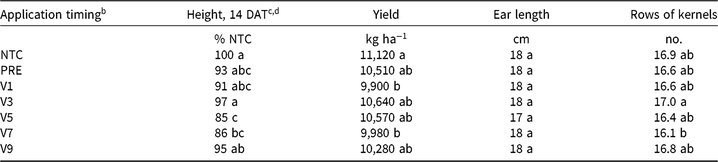
Corn height 14 DAT was reduced 15% and 14% from the NTC when fomesafen exposure occurred at V5 or V7, respectively (Table 3). Similarly, corn exposure to glufosinate at 53 g ai ha−1 at V5 or V6 reduces plant heights up to 21% (Ellis et al. Reference Ellis, Griffin, Linscombe and Webster2003). In the current experiment, yield losses were only observed from fomesafen exposure at V1 or V7, which were 1,215 and 1,133 kg ha−1 losses, respectively. No differences in ear length were observed, indicating that yield loss was not a function of ear length. In addition, the number of rows of kernels from all treatments were similar to that of the NTC; however, fomesafen exposure at V7 (the approximate stage at which ear girth is determined) resulted in 0.9 fewer kernel rows than V3 (Hanway Reference Hanway1963). Although yield loss from fomesafen at V7 was somewhat expected, based on earlier injury and height reduction, yield loss from exposure at V1 was peculiar, because the V1 exposure time did not result in height reduction. Also, fomesafen at V5, which resulted in the greatest levels of injury and height reductions among growth stages, did not result in yield loss. Ellis et al. (Reference Ellis, Griffin, Linscombe and Webster2003) reported glufosinate at 53 g ai ha−1 applied to V6 to V9 corn caused 13% and 11% yield reductions, respectively. In addition, corn yield loss is greater after later applications of foramsulfuron and nicosulfuron plus rimsulfuron at V8 and V12 (Bunting et al. Reference Bunting, Sprague and Riechers2004; Swanton et al. Reference Swanton, Chandler, Elmes, Murphy and Anderson1996). Hanway (Reference Hanway1963) reported that frost or hail damage at V3 to V5 growth stages or earlier that causes defoliation only results in minimal yield loss because the growing point is still protected underground. This somewhat explains the slight yield loss observed from fomesafen exposure at V1. However, further reduction in yield from fomesafen exposure at growth stages later than V5 was not observed. This could be due simply to a high tolerance level at the dose tested.
Corn characteristics after exposure to fomesafen (35 g ha−1) at PRE, V1, V3, V5, V7, or V9 in Brooksville, Starkville, and Stoneville, MS, from 2013 to 2015.a

a Data are pooled across 7 site-years.
b Growth stages as described by Hanway (Reference Hanway1963).
c Abbreviations: DAT, days after treatment; NTC, nontreated control.
d Means within a column followed by the same letter are not different according to Fisher protected LSD test (P = 0.05).
Injury to corn when fomesafen was applied PRE did not exceed 5% at any evaluation interval, and plant height and yield were similar to that of the NTC (Tables 2 and 3). This was surprising, considering the product label requires a 10-mo plant-back interval after application of the full labeled rate (Anonymous 2016). However, the rate used (35 g ha−1) coupled with soil OM of at least 1.2% may have resulted in conditions favorable for herbicide adsorption and reduced herbicide availability (Cobucci et al. Reference Cobucci, Prates, Falcao and Rezende1998; Guo et al. Reference Guo, Zhu, Shi and Sun2003; Mueller et al. Reference Mueller, Boswell, Mueller and Steckel2014; Rauch et al. Reference Rauch, Bellinder, Brainard, Lane and Thies2007; Weber Reference Weber1993).
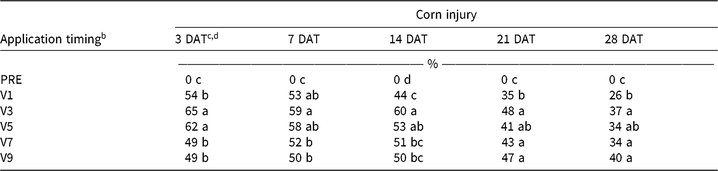
Corn exposure to paraquat at V3 or V5 resulted in 65% and 62% injury 3 DAT, respectively (Table 4). Although paraquat exposure at V1, V7, or V9 resulted in lower injury rates than exposure at V3 or V5, injury was still 49% to 54%. Corn injury was similar across all exposure times 7 DAT, ranging from 50% to 59%. The paraquat injury rate in corn was 44% after exposure at V1 (14 DAT), whereas exposure at V3 resulted in 60% injury. Likewise, among POST timings, paraquat exposure at V1 resulted in the lowest injury of 35% and 26% at the 21 and 28 DAT evaluations, respectively. However, no differences in injury were observed from paraquat exposure at V3 to V9, 21 and 28 DAT. Corn injury from paraquat applied PRE was not observed at any evaluation interval.
Corn injury after exposure to paraquat (105 g ha−1) at PRE, V1, V3, V5, V7, or V9 in Brooksville, Starkville, and Stoneville, MS, from 2013 to 2015.a

a All data are pooled across 7 site-years.
b Growth stages as described by Hanway (Reference Hanway1963).
c Means within a column followed by the same letter are not different according to Fisher protected LSD test (P = 0.05).
d Abbreviation: DAT, days after treatment.
Paraquat present in soil irreversibly binds to colloids, resulting in almost complete unavailability for absorption by emerging corn seedlings (Tucker et al. Reference Tucker, Pack, Ospenson, Omid and Thomas1969). Henry et al. (Reference Henry, Shaw, Reddy, Bruce and Tamhankar2004) reported corn injury from paraquat applied at 56 or 225 g ha−1 to V5 to V7 corn was between 71% and 94% at 4 to 10 DAT. Corn injury from paraquat in the current study applied at 105 g ha−1 to V5 or V7 corn was 49% to 62% at 3 to 14 DAT (Table 4). The large differences in corn injury from paraquat in the current study compared to the findings of Henry et al. (Reference Henry, Shaw, Reddy, Bruce and Tamhankar2004) likely were due to the difference in rates used and growing conditions. Henry et al. (Reference Henry, Shaw, Reddy, Bruce and Tamhankar2004) conducted their experiment under greenhouse conditions, which can be more favorable for increased herbicide absorption, due to lack of leaf cuticle growth (Hatterman-Valenti et al. Reference Hatterman-Valenti, Pitty and Owen2006; Schonherr and Baur Reference Schonherr and Baur1994).
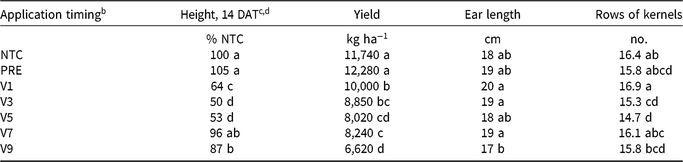
Corn height 14 DAT in response to paraquat exposure was highly dependent on growth stage (Table 5). The greatest levels of height reduction resulting from paraquat were observed when exposure occurred at V3 (50%) or V5 (47%). Paraquat exposure at V1 or V9 resulted in 36% and 13% height reductions, respectively. However, paraquat exposure at V7 did not result in corn height reduction. The V7 corn growth stage is the start of rapid internode elongation (Hanway Reference Hanway1963), which could possibly explain the lack of corn height response after V7 paraquat exposure. However, exposure at V9 resulted in 13% height reduction, most likely due to the slowing of internode elongation and beginning of tassel and ear formation that occurs at this growth stage (Hanway Reference Hanway1963). Yield losses were observed from all paraquat exposure times except PRE, indicating that paraquat exposure is never safe on emerged corn. Yield loss of 5,120 kg ha−1 resulted from paraquat exposure at V9 and was possibly due to damage of ear shoot formation (Hanway Reference Hanway1963). Similarly, Hanway (Reference Hanway1963) indicated that corn was more susceptible to yield loss from hail damaged at V9 to V10 than at all earlier stages. Paraquat exposure at either V3, V5, or V7 caused the second greatest yield losses of 2,890 to 3,720 kg ha−1. Paraquat exposure at V1 resulted a yield loss of 1,740 kg ha−1, which was the least amount of yield loss among POST treatments, because plants most likely had more time to recover before reproductive growth. No reductions in ear length compared to the NTC were observed; however, paraquat exposure at V9 caused 2- to 3.2-cm shorter ears than exposure at V1, V3, or V7. Paraquat exposure at V3 or V5 resulted respectively in 1.1 and 1.7 fewer kernel rows than in the NTC. Likewise, Bunting et al. (Reference Bunting, Sprague and Riechers2004) reported corn yield loss from foramsulfuron applied at V8 and V12 was due to ear malformations.
Corn characteristics after exposure to paraquat (105 g ha−1) at PRE, V1, V3, V5, V7, or V9 in Brooksville, Starkville, and Stoneville, MS, from 2013 to 2015.a

a All data are pooled across 7 site-years.
b Growth stages as described by Hanway (Reference Hanway1963).
c Abbreviations: DAT, days after treatment; NTC, nontreated control.
d Means within a column followed by the same letter are not different according to Fisher protected LSD test (P = 0.05).
In summary, growth stage at exposure was very influential on the level of corn response to paraquat or fomesafen. In particular, paraquat was extremely injurious to corn. This is concerning because protoporphyrinogen oxidase–inhibitor resistance has been documented in Palmer amaranth, and paraquat will be relied upon more extensively than fomesafen for preplant applications in soybean and cotton (Giacomini et al. Reference Giacomini, Umphres, Nie, Mueller, Steckel, Young, Scott and Tranel2017; Salas et al. Reference Salas, Burgos, Tranel, Singh, Glasgow, Scott and Nichols2016; Varanasi et al. Reference Varanasi, Brabham, Norsworthy, Nie, Young, Houston, Barber and Scott2018). With the exception of fomesafen exposure at V9, corn yield was generally more affected by paraquat or fomesafen exposure at later growth stages. This is particularly concerning in scenarios when corn is planted in the early portion of the planting window or when preplant herbicide applications are delayed for soybean or cotton and emerged corn would be in later vegetative growth stages. Based on these data, any POST paraquat exposure or fomesafen exposure at V1 or V7 could be considered a failed corn stand warranting termination of the injured crop. However, yield potential of late-planted corn is less than that of corn planted at optimal dates, and dicot crops can be sensitive to carryover of PRE corn herbicides such as atrazine (Brecke et al. Reference Brecke, Currey and Teem1980; Soltani et al. Reference Soltani, Mashhadi, Mesgaran, Cowbrough, Tardiff, Chandler, Nurse, Swanton and Sikkema2011; Van Roekel and Coulter Reference Van Roekel and Coulter2011). In addition, effects of paraquat or fomesafen on corn potentially could be exacerbated by labeled herbicides applied after paraquat or fomesafen exposure, as occurs with glyphosate on non-glyphosate–resistant corn (Brown et al. Reference Brown, Robinson, Young, Loux, Johnson, Nurse, Swanton and Sikkema2009). We acknowledge that the levels of corn injury from true off-target movement events can be more intense depending on herbicide rate, droplet size, and droplet concentration (Banks and Schroeder Reference Banks and Schroeder2002; Ellis et al. Reference Ellis, Griffin and Jones2002; McKinlay et al. Reference McKinlay, Ashford and Ford1974; Smith et al. Reference Smith, Ferrell, Webster and Fernandez2017). However, these data indicate that pesticide applicators should exercise extreme caution or avoid applications of paraquat or fomesafen near emerged corn if conditions are conducive for off-target herbicide movement.
Author ORCiDs
Benjamin P. Sperry https://orcid.org/0000-0002-2471-2163; Daniel B. Reynolds https://orcid.org/0000-0002-2607-277X
Acknowledgements
This publication is a contribution of the Mississippi Agricultural and Forestry Experiment Station. Material is based on work supported by the National Institute of Food and Agriculture, U.S. Department of Agriculture, Hatch project under accession number 153190. The authors would like to thank the Mississippi Corn Promotion Board for partially funding this research. We thank personnel at Mississippi Agricultural and Forestry Experiment Station facilities for their assistance. No conflicts of interest have been declared.