Introduction
Mood disorders, including major depressive disorder (MDD) and bipolar disorder (BD), are prevalent, heritable psychiatric disorders (Mullins et al., Reference Mullins, Forstner, O'Connell, Coombes, Coleman, Qiao and Bryois2021; Wray et al., Reference Wray, Ripke, Mattheisen, Trzaskowski, Byrne, Abdellaoui and Andlauer2018). Findings from genome-wide association studies have demonstrated that genetic risk variants may be shared between the disorders (e.g. Amare et al. Reference Amare, Vaez, Hsu, Direk, Kamali, Howard and Snieder2020; Liu et al. Reference Liu, Blackwood, Caesar, de Geus, Farmer, Ferreira and Green2011). Yet, there has been limited success in identifying the genetic basis for mood disorders and the pathophysiology remains poorly understood. A more promising avenue may be the identification of endophenotypes. Endophenotypes are illness-related traits that are highly heritable and found in unaffected family members at a greater rate than in the general population (Gottesman & Gould, Reference Gottesman and Gould2003; Leboyer et al., Reference Leboyer, Leboyer, Bellivier, Jouvent, Nosten-Bertrand, Mallet and Pauls1998). For mood disorders, aberrant emotional cognition could be a putative endophenotype (Elliott, Zahn, Deakin, & Anderson, Reference Elliott, Zahn, Deakin and Anderson2011; Miskowiak et al., Reference Miskowiak, Glerup, Vestbo, Harmer, Reinecke, Macoveanu and Vinberg2015, Reference Miskowiak, Kjærstad, Meluken, Petersen, Maciel, Köhler and Carvalho2017). Emotional cognition abnormalities often persist in periods of remission and present in the early stages of the disorder as well as in unaffected relatives of patients with mood disorders (Bora & Ozerdem, Reference Bora and Ozerdem2017; Miskowiak et al., Reference Miskowiak, Seeberg, Kjaerstad, Burdick, Martinez-Aran, del Mar Bonnin and Hasler2019; Samame, Martino, & Strejilevich, Reference Samame, Martino and Strejilevich2012). However, studies of emotional cognition in unaffected relatives are scarce and the evidence is mixed, with some studies reporting aberrant facial expression recognition, emotional reactivity and emotional regulation (Bora & Ozerdem, Reference Bora and Ozerdem2017; Le Masurier, Cowen, & Harmer, Reference Le Masurier, Cowen and Harmer2007; Miskowiak et al., Reference Miskowiak, Glerup, Vestbo, Harmer, Reinecke, Macoveanu and Vinberg2015), while other studies show no differences (de Brito Ferreira Fernandes et al., Reference de Brito Ferreira Fernandes, Gigante, Berutti, Amaral, de Almeida, de Almeida Rocca and Nery2016; McCormack et al., Reference McCormack, Green, Rowland, Roberts, Frankland, Hadzi-Pavlovic and Mitchell2016; Meluken et al., Reference Meluken, Ottesen, Harmer, Scheike, Kessing, Vinberg and Miskowiak2019). This inconsistency may partly be due to small samples of unaffected relatives, different inclusion criteria (i.e. the definition of ‘unaffected’, limiting samples to relatives of patients with BD type-I, etc.) and different experimental paradigms across studies. However, the conflicting evidence may also reflect true heterogeneity within emotional cognition among unaffected relatives.
In patients with mood disorders, studies using data-driven approaches have identified discrete subgroups with differing levels of performance within both non-emotional cognition (Cotrena, Branco, Ponsoni, Shansis, & Fonseca, Reference Cotrena, Branco, Ponsoni, Shansis and Fonseca2017; Jensen, Knorr, Vinberg, Kessing, & Miskowiak, Reference Jensen, Knorr, Vinberg, Kessing and Miskowiak2016; Kjærstad, Eikeseth, Vinberg, Kessing, & Miskowiak, Reference Kjærstad, Eikeseth, Vinberg, Kessing and Miskowiak2019; Lima et al., Reference Lima, Rabelo-da-Ponte, Bücker, Czepielewski, Hasse-Sousa, Telesca and Rosa2019; Pu, Noda, Setoyama, & Nakagome, Reference Pu, Noda, Setoyama and Nakagome2018; Solé et al., Reference Solé, Bonnin, Jiménez, Torrent, Torres, Varo and Tomioka2018) and, more recently, social – and emotional cognition (Szmulewicz, Millett, Shanahan, Gunning, & Burdick, Reference Szmulewicz, Millett, Shanahan, Gunning and Burdick2020; Varo et al., Reference Varo, Solé, Jiménez, Bonnín, Torrent, Valls and Miskowiak2020, Reference Varo, Kjærstad, Poulsen, Meluken, Vieta, Kessing and Miskowiak2021). Specifically, cluster analyses revealed distinct emotional cognitive profiles among patients with mood disorders: one with intact emotional cognition performance (57–71%) and one or two clusters indicating impairments in emotional cognition (29–43%) with mild-to-moderate difficulties within the domains of emotion recognition (Szmulewicz et al., Reference Szmulewicz, Millett, Shanahan, Gunning and Burdick2020; Varo et al., Reference Varo, Solé, Jiménez, Bonnín, Torrent, Valls and Miskowiak2020), emotional intelligence (Szmulewicz et al., Reference Szmulewicz, Millett, Shanahan, Gunning and Burdick2020; Varo et al., Reference Varo, Solé, Jiménez, Bonnín, Torrent, Valls and Miskowiak2020) and facial expression recognition and emotion processing and -regulation (Varo et al., Reference Varo, Kjærstad, Poulsen, Meluken, Vieta, Kessing and Miskowiak2021). Furthermore, subgroups with impaired emotional cognition were characterised by poorer psychosocial functioning and neurocognitive performance (Szmulewicz et al., Reference Szmulewicz, Millett, Shanahan, Gunning and Burdick2020; Varo et al., Reference Varo, Jimenez, Sole, Bonnin, Torrent, Valls and Reinares2017). However, no study has investigated the heterogeneity of emotional cognition in unaffected relatives of patients with mood disorders. The identification of subgroups of relatives with a particularly disruptive pattern of emotional cognition could represent specific risk endophenotypes that may be important for understanding the aetiology of mood disorders and help obtain useful biomarkers for future illness risk and resilience. This dimensional transdiagnostic approach across unaffected relatives of patients with BD and MDD might provide new insights into common emotional cognition mechanisms and would therefore be useful for precision medicine across mood disorders. Thus, this could potentially be used to evaluate the risk of future mood episodes and thereby provide a platform for personalised early prophylactics.
The current study, therefore, aimed to investigate (i) whether emotional cognition in unaffected first-degree relatives of patients with mood disorders is characterised by heterogeneity using a data-driven approach and (ii) whether any distinct emotional cognition profiles would be associated with differences in demographic, clinical, non-emotional cognition and functioning. We hypothesised that (i) different profiles of emotional cognition would exist among unaffected relatives of patients with mood disorders and that (ii) impaired emotional cognition subgroups would be characterised by poorer non-emotional cognition, impaired functioning and greater illness chronicity in their affected proband.
Methods
Study design
This study is a cross-sectional investigation of baseline data pooled from two large studies from our research group, comprising Neurocognition and Emotion in Affective Disorders (NEAD) study (Meluken et al., Reference Meluken, Ottesen, Harmer, Scheike, Kessing, Vinberg and Miskowiak2019) and baseline data from our ongoing longitudinal Bipolar Illness Onset (BIO) study (Kessing et al., Reference Kessing, Munkholm, Faurholt-Jepsen, Miskowiak, Nielsen, Frikke-Schmidt and Poulsen2017). Our pooled sample included a total of 297 individuals, comprising 94 unaffected relatives and 203 healthy control (HC) individuals. We deemed the pooling of the data from these two studies appropriate given the similar recruitment criteria of unaffected first-degree relatives and HCs, and the large overlap between the applied paradigms of emotional cognition and measures of non-emotional cognition and functioning. Moreover, both studies were conducted at the same research site, the Copenhagen Affective Disorder Research Centre (CADIC), during overlapping times.
Recruitment and screening
Unaffected relatives in the studies were included if they were between the ages of 15 and 40 years old and were first-degree relatives (siblings or offspring) of patients with BD (BIO study) or monozygotic twins discordant for MDD or BD (NEAD study). Patients from the BIO study were recruited from the Copenhagen Affective Disorder Clinic, Psychiatric Centre Copenhagen (Kessing et al., Reference Kessing, Munkholm, Faurholt-Jepsen, Miskowiak, Nielsen, Frikke-Schmidt and Poulsen2017) (for clustering of affected probands, see Varo et al., Reference Varo, Kjærstad, Poulsen, Meluken, Vieta, Kessing and Miskowiak2021). Affected and unaffected twins from discordant monozygotic twin pairs in the NEAD study were recruited from the Danish Twin Registry, the Danish Psychiatric Central Research Register and the Danish Civil Registration System (Meluken et al., Reference Meluken, Ottesen, Harmer, Scheike, Kessing, Vinberg and Miskowiak2019). Patients with BD comprised both BD type I and II. Relatives were excluded if they met the criteria for a history of mood disorder or schizophrenia spectrum disorder, confirmed with the SCAN interview. Relatives in the BIO study were invited to participate in the study upon consent from their affected proband, whereas relatives in the NEAD study were recruited through the aforementioned registries and were contacted and invited to participate along with their affected co-twin.
Age and sex-matched HCs (BIO) were recruited from the blood bank at Copenhagen University Hospital, Rigshospitalet and healthy monozygotic twins (NEAD) were recruited through the Danish Twin Registry as described above. Exclusion criteria for HCs in both studies was having a personal or first-degree relative with treatment-required psychiatric illness or substance abuse disorder.
In relation to the cognitive part of both studies, exclusion criteria for all participants included current mood episodes (> 14 on the Hamilton Depression Rating Scale 17-item [HDRS-17] (Hamilton, Reference Hamilton1960) or Young Mania Rating Scale [YMRS] (Young, Biggs, Ziegler, & Meyer, Reference Young, Biggs, Ziegler and Meyer1978), organic mental disorder, pregnancy, history of brain injury, current substance abuse and severe somatic illness. Additionally, in the NEAD study, participants were excluded due to low birth weight <1.3 kg and dizygosity. Both studies were approved by the Regional Ethics Committee (protocol numbers: H-7-2014-007 and H-3-2014-003) and the data protection agency in the Capital Region of Copenhagen (RHP-2015–023 and 2014-331-0751, respectively). The authors assert that all procedures contributing to this work comply with the ethical standards of the relevant national and institutional committees on human experimentation and with the Helsinki Declaration of 1975, as revised in 2008. All participants provided informed consent prior to inclusion in the study.
Measures
Measures of emotional cognition
The Social Scenarios Task assessed emotion reactivity and regulation to social scenarios (Kjærstad et al., Reference Kjærstad, Vinberg, Goldin, Køster, Støttrup, Knorr and Miskowiak2016). Short written descriptions of negative or positive social situations and associated self-belief statements were presented on a computer screen. Participants were instructed to either naturally react to, or dampen, their emotional response to the described social scenarios. The first scenario was neutral followed by two scenarios of the same valence with alternate react/dampen conditions. Each scenario consisted of 11 sentences describing the situation (3s each), 10 self-beliefs (3s each) and 10 emotion ratings. The emotion rating required participants to evaluate their discomfort or pleasure, respectively, on a 100-point visual analogue scale. Two social scenarios involved the attraction to, or rejection by, men or women, according to the respective sexual orientation of the participant.
The Facial Expression Recognition Task assessed the ability to identify six basic facial emotional expressions: anger, disgust, fear, happiness, sadness and surprise morphed at 10% intensity levels between a neutral face (0%) and a full emotional face (100%) (Harmer, Shelley, Cowen, & Goodwin, Reference Harmer, Shelley, Cowen and Goodwin2004). After each face presentation, participants had to indicate which facial expression was shown by pressing the corresponding key on a keypad. Four examples of each emotion at each intensity were presented (ten individuals) yielding a total of 250 facial stimuli. The face stimuli were presented on a computer screen in a random order for 500 ms after which it was replaced by a blank screen. Accuracy and reaction times were registered.
The Faces Dot-Probe Task assessed attentional vigilance towards emotional faces (Murphy, Downham, Cowen, & Harmer, Reference Murphy, Downham, Cowen and Harmer2008). Stimuli were pairs of happy-neutral, fearful-neutral or neutral-neutral faces were displayed horizontally, above and below the centre, on a computer screen. Faces were displayed either unmasked (supraliminal attention to emotional information) or masked (subliminal attention to emotional information). In the unmasked condition face pairs were shown for 100 ms, and then, a probe appeared in the location of one of the preceding faces. The probe was two dots presented either vertically (:) or horizontally (⋅⋅). Participants were instructed to indicate the orientation of the dots by pressing the corresponding key as quickly and accurately as possible. The sequence of events was the same in the masked condition, except the face pair was displayed faster than unmasked conditions, for 17 ms and followed by a neutral mask which was displayed for 84 ms. The task comprised eight masked and eight unmasked blocks presented in an alternating order, with each block consisting of 12 trials.
Measures of non-emotional cognition
Overlapping non-emotional cognition measures for both studies included the Trail Making Test parts A and B (TMT A/B) (Reitan, Reference Reitan1958) and the Danish Adult Reading Task (DART), which was used to estimate IQ (Nelson & O'Connell, Reference Nelson and O'Connell1978). In the NEAD study, non-emotional cognition was assessed using the Screen of Cognitive Impairment in Psychiatry (SCIP-D) (Purdon & Psych, Reference Purdon and Psych2005). The SCIP is brief screening of neurocognitive dysfunction, which assesses verbal learning and memory, delayed memory, working memory, verbal fluency and processing speed. The subtests of the SCIP has previously been validated against the established neurocognitive tests used in the BIO-study (Jensen et al., Reference Jensen, Støttrup, Nayberg, Knorr, Ullum, Purdon and Miskowiak2015). In the BIO study non-emotional cognition was assessed using a larger neuropsychological test battery including the Rey Auditory Verbal Learning Test (RAVLT) (Corwin, Reference Corwin1994; Rey, Reference Rey1958), the Letter-Number-Sequencing subtest from Wechsler's Adult Intelligence Scale 3rd edition (WAIS-III) (Wechsler, Reference Wechsler1997), verbal fluency with letters S and D (Borkowski, Benton, & Spreen, Reference Borkowski, Benton and Spreen1967), Coding and Digit Span Forward from the Repeatable Battery for the Assessment of Neuropsychological Status (RBANS) (Randolph, Tierney, Mohr, & Chase, Reference Randolph, Tierney, Mohr and Chase1998), the Spatial Working Memory (SWM) test and the Rapid Visual Information Processing (RVP) test from the Cambridge Neuropsychological Test Automated Battery [CANTAB® (Cognitive assessment software). Cambridge Cognition (2020). All rights reserved. www.cantab.com].
Measure of functioning
Participants completed the Functional Assessment Short Test (FAST), which is an interviewer-administered interview developed to assess the main difficulties in daily life that patients with BD may experience. It comprises 24 items which assess six specific functioning domains: autonomy, occupational functioning, cognitive functioning, financial issues, interpersonal relationships and leisure time. The FAST-total score ranges from 0 to 72, and higher scores indicate greater disability, the cut-off score indicating functional impairment was established in 11 or higher scores in the original validation study (Rosa et al., Reference Rosa, Sánchez-Moreno, Martínez-Aran, Salamero, Torrent, Reinares and Ayuso-Mateos2007). This scale has been extensively used in patients with BD (Bonnin et al., Reference Bonnin, Valls, Rosa, Reinares, Jimenez, Solé and Colom2019), MDD (Castellano et al., Reference Castellano, Torrent, Petralia, Godos, Cantarella, Ventimiglia and Pirrone2020) and healthy subjects (Riegler et al., Reference Riegler, Wiedmann, Rücker, Teismann, Berger, Störk and Heuschmann2020).
Statistical analysis
Pre-processing
For the Social Scenarios Task, emotion ratings were arcsine transformed for normality, and a measure of ‘emotion reactivity’ was obtained by subtracting the ‘neutral view’ from the ‘negative view’/‘positive view’ conditions, whereas ‘emotion down-regulation’ was calculated by subtracting the ‘negative dampen’/‘positive dampen’ conditions from the ‘negative view’/‘positive view’ conditions (Kjærstad et al., Reference Kjærstad, Vinberg, Goldin, Køster, Støttrup, Knorr and Miskowiak2016). For the Facial Expression Recognition task, reaction times were log-transformed, and a measure of discrimination accuracy of facial expressions (d′) was calculated for each facial expression using the formula [(number of hits + 0.5)/(number of targets + 1)] − [(number of false alarms + 0.5)/(number of distractors + 1)] (Corwin, Reference Corwin1994). We collapsed facial expressions of positive (happy, surprise) and negative (anger, disgust, fear, sadness) valence. For the Faces Dot-Probe Task, we calculated vigilance scores by subtracting median RT in congruent trials from incongruent trials. Positive values reflect vigilance (i.e. attention towards the emotional face), and negative values reflect avoidance (i.e. attention away from the emotional face).
Unaffected relatives' raw scores on emotional and non-emotional cognition tests were standardised to z-scale scores based on controls' means (M) and standard deviations (s.d.) using the formula: (test score − HCM)/HCSD. Outlying z-scores of ± 4 s.d. mean were truncated to z = − 4.0 or 4.0, respectively, to minimise the effects of extreme scores. The scores for CANTAB SWM (‘between errors’ and ‘strategy’) and RVP (‘mean latency’) and Trail-Making Test (A and B) and were inverted so that lower scores reflected poorer performance. The z-scores for the various neurocognitive tests and SCIP were combined to create four non-emotional domains: Attention and psychomotor speed (TMT-A, RBANS digit-symbol coding, RBANS digit-span-forward, RVP accuracy and mean latency / the Processing Speed Test of the SCIP); Verbal learning [RAVLT immediate (trial I-V correct), trial VI correct, delayed recall, recognition/the immediate and delayed recall scores of the SCIP]; Working memory and executive function [WAIS letter-number sequencing, TMT-B, SWM (between errors and strategy)/the Working Memory Test of the SCIP]; and Verbal fluency (Verbal fluency S and D/the Verbal Fluency Test of the SCIP) (see online Supplementary Table S2 for an overview of established neurocognitive tests and matched SCIP subtests that make up the calculated composite domains). A measure of Global cognition was calculated by averaging the z-scores of the neurocognitive domains. This grouping of the neuropsychological tests into cognitive domains was based on some consistency in the literature (Lezak, Howieson, Loring, & Fischer, Reference Lezak, Howieson, Loring and Fischer2004; Purdon et al., Reference Purdon, Jones, Stip, Labelle, Addington, David and Tollefson2000). Moreover, the SCIP has been validated and correlated with the established tests used in the BIO study (Jensen et al., Reference Jensen, Støttrup, Nayberg, Knorr, Ullum, Purdon and Miskowiak2015). Finally, estimated full-scale IQ was calculated using the formula 128-0.83*DART error score (Nelson & Willison, Reference Nelson and Willison1991).
Hierarchical cluster analysis
To investigate homogeneous subgroups of unaffected relatives based on emotional cognition performance, we conducted a hierarchical cluster analysis (HCA) with squared Euclidian distance and Ward's linkage based on relatives' emotional cognition task scores: (i) emotional reactivity and down-regulation of emotions in aversive and pleasant social scenarios; (ii) recognition accuracy (d′) and RT during facial expression recognition of positive and negative faces; and (iii) attentional vigilance scores to masked and unmasked fearful and happy faces. The dendrogram and agglomeration schedule (scree plot of coefficients) were visually inspected to establish the appropriate number of clusters to be retained (Yim & Ramdeen, Reference Yim and Ramdeen2015). A discriminant function analysis (DFA) was also conducted in order to test the validity of the clusters.
The emotional cognition profiles of the resulting clusters of relatives and controls were compared in emotional cognition tasks, demographic, clinical and functional variables and non-emotional cognition tasks, respectively, using a series of analysis of variance (ANOVAs) with least-significant difference (LSD) correction and chi-square, as appropriate. We adjusted for the original studies (BIO/NEAD) for the non-emotional cognition tests given the differences in the neurocognitive tests applied in the two studies. Further, significant group differences in emotional and non-emotional cognition were followed up with post hoc generalised linear mixed models with the dummy-coded genetic relationship between unaffected and affected proband as a random factor to account for the differences in the genetic relationship between siblings/offspring and monozygotic twins, respectively. Analyses were two-tailed and significance levels set to α = 0.05. Effect sizes are reported in partial eta-squared (η p2). All analyses were performed with the IBM Statistical Package for Social Sciences version 22 (IBM Corp, NY, USA).
Results
Emotional cognition clustering
Results obtained from the HCA and data provided by visual inspection of the dendrogram indicated that 94 unaffected relatives assessed were optimally clustered, based on their emotional cognition performance, into two HCA different clusters: 55% (n = 52; 40% relatives of MDD proband) were relatively ‘emotionally preserved’ and 45% (n = 42; 29% relatives of MDD proband) ‘emotionally blunted’ (see online Supplementary Figs S1 and S2 for dendrogram and agglomeration schedule in online Supplemental material). Results from the DFA revealed one discriminant function explaining 64.2% of the variance (Wilks' λ = 0.43, χ2 (12) = 73.31, p < 0.001). Emotional reactivity to aversive social scenarios (r = 0.52) contributed most to clustering. The classification results revealed high sensitivity with 89.4% of original grouped cases being correctly classified.
Comparisons of emotional cognition profiles between the identified clusters
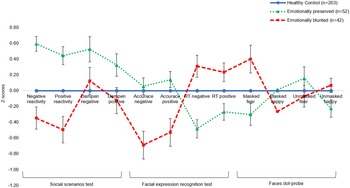
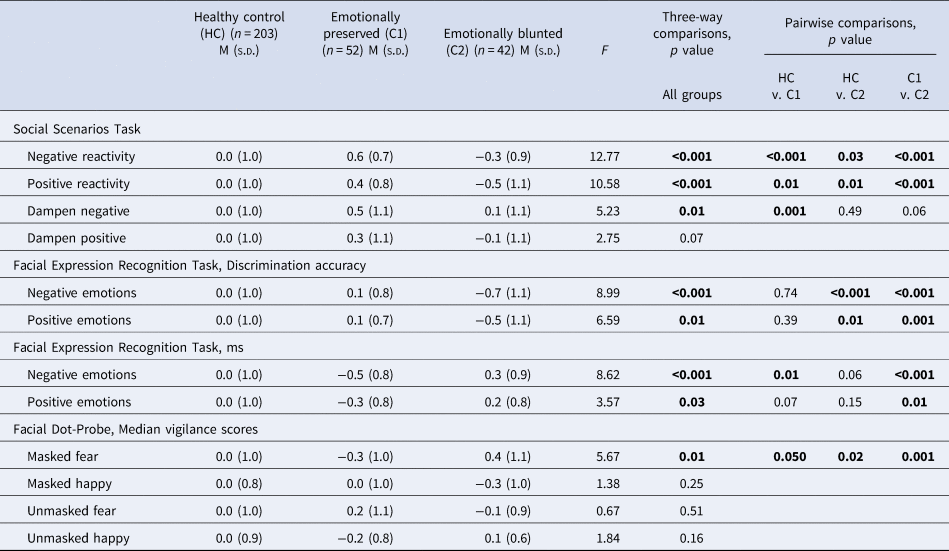
There was a significant difference between the two emotional cognition clusters of unaffected relatives and HCs in reactivity to both aversive (F (2,299) = 12.77, p < 0.001, η p2 = 0.08) and pleasant (F(2,288) = 10.58, p < 0.001, η p2 = .07) social scenarios and in the ability to down-regulate their emotional response to aversive scenarios (F(2,288) = 5.23, p = 0.006, η p2 = 0.04) (Table 1, Fig. 1). There was also a statistically significant effect of group for discrimination accuracy of negative (F(2,235) = 8.99, p < 0.001, η p2 = 0.07) and positive (F (2,235) = 6.59, p = 0.002, η p2 = 0.05) emotion expression as well as speed during recognition of both negative (F(2,235) = 8.62, p < 0.001, η p2 = 0.07) and positive (F (2,235) = 3.57, p = 0.03, η p2 = 0.03) facial expressions and vigilance towards masked fearful faces (F (2,292) = 5.67, p = 0.004, η p2 = 0.04). However, the unaffected relative clusters and HCs were comparable in their ability to down-regulate emotional responses to positive social scenarios and in their vigilance towards masked happy faces or unmasked happy and fear faces (ps ⩾ 0.07).
Mean z-scores for each emotional cognition domain in two clusters of unaffected relatives of patients with mood disorders – a relatively ‘emotionally preserved’ (n = 52) and an ‘emotionally blunted’ (n = 42) cluster – and HC individuals (n = 203). Error bars represent standard error of the mean.

Emotional cognition according to the two emotional clusters in unaffected relatives and HC individuals

Bold text in the table indicates significant values.
These effects of the group were driven by the ‘emotionally preserved’ unaffected relatives cluster exhibiting higher emotional reactivity in aversive and pleasant social scenarios compared to both controls (ps⩽0.004) and ‘emotionally blunted’ relatives (ps < 0.001) (Table 1, Fig. 1). They were also more successful at dampening emotions in aversive social scenarios than controls (p = 0.001), with no significant difference between the two groups of unaffected relatives (p = 0.06). ‘Emotionally preserved’ relatives were also faster at recognising negative facial expressions (ps ⩽ 0.002) and showed more avoidance of subliminally presented fearful faces (ps ⩽ 0.050) than controls and ‘emotionally blunted’ relatives.
Relatives in the ‘emotionally blunted’ cluster displayed lower emotional reactivity across both aversive (ps ⩽ 0.03) and pleasant social scenarios (ps ⩽ 0.003) as well as poorer recognition of positive (ps ⩽ 0.002) and negative (ps ⩽ 0.001) facial expressions compared to HCs and relatives categorised as ‘emotionally preserved’ (Table 1, Fig. 1). They also presented with longer latencies during recognition of both positive (p = 0.009) and negative (p < 0.001) facial expressions compared to ‘emotionally preserved’ relatives (but not controls; ps ⩾ 0.06). Finally, ‘emotionally blunted’ relatives exhibited more attention vigilance towards subliminally presented fearful faces (ps ⩽ 0.02) than both HCs and ‘emotionally preserved’ relatives.
Post hoc analyses were repeated as a linear mixed model with a genetic relationship as a random factor. Results revealed that these group differences prevailed (ps ⩽ 0.005), with the exception of discrimination accuracy of positive faces, which was reduced to a trend (p = 0.052), and ability to down-regulate emotional responses to aversive social situations, which rendered non-significant (p = 0.13).
Demographic and clinical variables
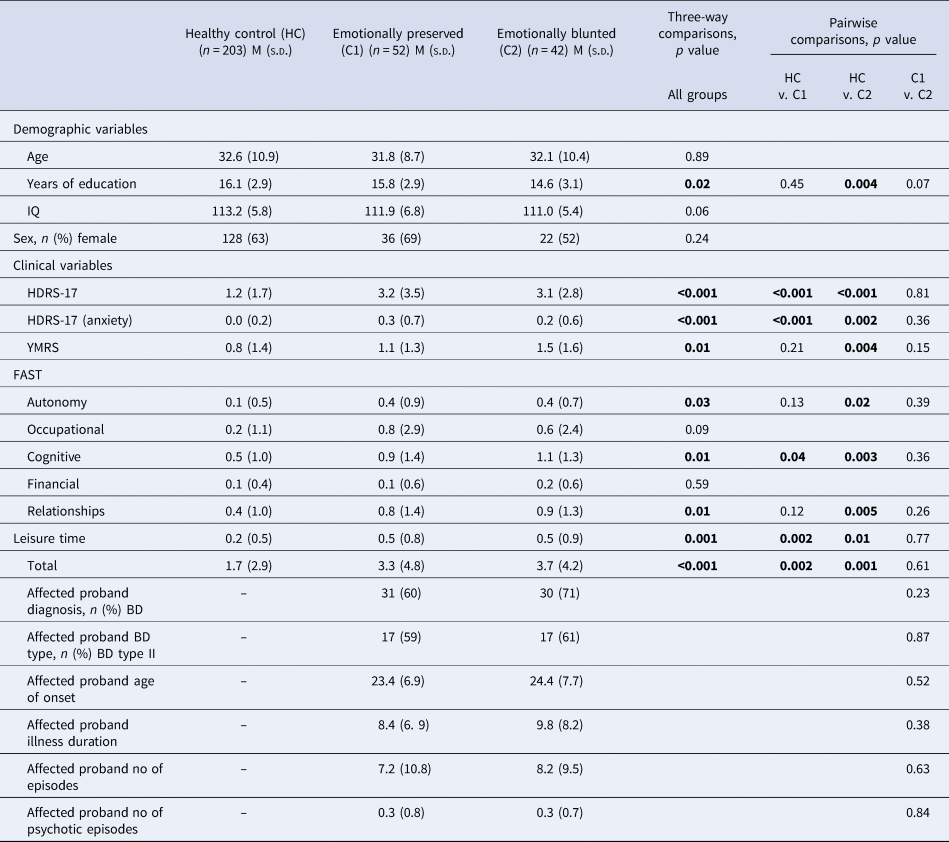
The sample of unaffected first-degree relatives comprised 46 siblings of patients with BD, five offspring of patients with BD, 10 unaffected monozygotic twins with a co-twin with BD, and 33 unaffected monozygotic twins with a co-twin with MDD. The emotional cognition clusters were comparable to controls in age, gender and IQ. However, there was a statistically significant difference between emotional cognition clusters of unaffected relatives and controls in years of education (F (2,294) = 4.27, p = 0.02, η p2 = 0.03), subsyndromal depression (F (2,294) = 24.22, p < 0.001, η p2 = 0.14), mania (F (2,294) = 4.56, p = 0.01, η p2 = 0.03) and anxiety (F (2,284) = 13.15, p < 0.001, η p2 = 0.09) symptoms. Specifically, the ‘emotionally preserved’ and ‘emotionally blunted’ clusters presented with more subsyndromal depression and psychic and somatic anxiety symptoms than controls (ps < 0.001 and ps ⩽ 0.002, respectively). The ‘emotionally blunted’ cluster also exhibited more subsyndromal mania symptoms (p = 0.004) and had undergone fewer years of education (p = 0.004) compared to controls, whereas relatives categorised as ‘emotionally preserved’ did not significantly differ from controls (ps ⩾ 0.21) (Table 2). There were no differences between emotional cognition clusters in any clinical or demographic variables (ps ⩾ 0.07). There were also no differences between emotional cognition clusters in their affected probands' diagnosis distribution (i.e. MDD v. BD: p = 0.23; or BD type I v. type II: p = 0.88) or illness chronicity (i.e. illness duration, number of mood episodes, number of psychotic episodes: ps ⩾ 0.23).
Demographic and clinical variables according to the two emotional clusters in unaffected relatives and HC persons

Abbreviations: M, mean; s.d., standard deviation; IQ, intelligence quotient; BD, Bipolar disorder; BD-I, Bipolar disorder type I; BD-II, Bipolar disorder type II; HDRS-17, Hamilton Depression Rating Scale; YMRS, Young Mania Rating Scale; FAST, Functioning Assessment Short Test. * Anxiety symptoms were determined based on mean scores from items 10 and 11 using the HDRS-17. Bold text in the table indicates significant values.
Non-emotional cognition according to the two emotional clusters in unaffected relatives and HC

Bold text in the table indicates significant values.
Non-emotional cognition
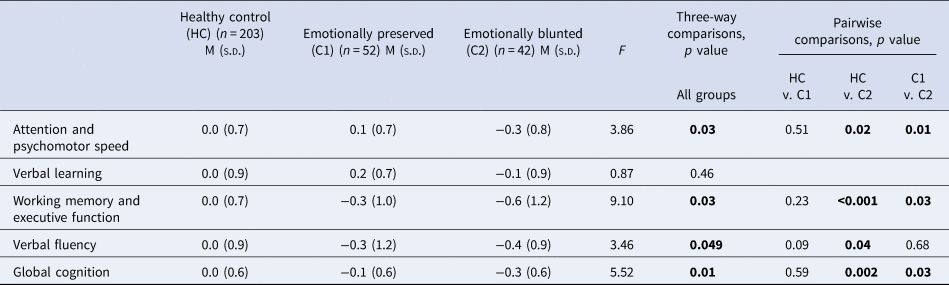
There was a significant difference between the emotional cognition subgroups of unaffected relatives and controls in global neurocognitive functioning (F (2,293) = 4.78, p = 0.009, η p2 = 0.03), as well as within all the individual cognitive subdomains of attention and psychomotor speed (F (2,293) = 3.75, p = 0.03, η p2 = 0.03), working memory and executive function (F (2,293) = 6.86, p = 0.001, η p2 = 0.05) and verbal fluency (F (2,293) = 3.04, p = 0.049, η p2 = 0.02) (Table 3). In contrast, the clusters were comparable to controls in verbal learning (p = 0.46). The group differences were driven by the ‘emotionally blunted’ unaffected relatives performing significantly worse in global neurocognitive functioning (ps ⩽ 0.03), attention and psychomotor speed (ps ⩽ 0.02) and working memory and executive function (ps ⩽ 0.03) compared to both controls and the ‘emotionally preserved’ unaffected relatives. Further, ‘emotionally blunted’ relatives performed poorer than controls (but not ‘emotionally preserved’ relatives: p = 0.68) in verbal fluency (p = 0.04). The ‘emotionally preserved’ cluster showed no difference from HCs in any aspect of non-emotional cognition (ps ⩾ 0.09). Post hoc analyses, repeated as a linear mixed model with a genetic relationship as a random factor, revealed that all group differences prevailed (ps ⩽ 0.03).
Functioning
Comparisons between the two unaffected relatives clusters and HCs revealed a significant difference between groups on FAST total score (F (2,290) = 9.36, p < 0.001, η p2 = 0.06) and in the individual functional domains of autonomy (F (2,290) = 3.57, p = 0.03, η p2 = 0.02), cognitive functioning (F (2,290) = 5.67, p = 0.004, η p2 = 0.04), interpersonal relationships (F (2,290) = 4.55, p = 0.01, η p2 = 0.03) and leisure time (F (2,290) = 7.22, p = 0.001, η p2 = 0.05), whereas no group differences were found for occupational or financial functioning (ps ⩾ 0.09) (Table 2). Both the ‘emotionally preserved’ and ‘emotionally blunted’ unaffected relatives clusters presented with significantly poorer general functioning (i.e. FAST total scores p = 0.002 and p = 0.001, respectively), cognitive functioning (p = 0.04 and p = 0.003, respectively) and leisure time (p = 0.002 and p = 0.01, respectively) compared to controls. The ‘emotionally blunted’ cluster of relatives additionally displayed more difficulties in the autonomy (p = 0.02) and interpersonal relationships (p = 0.005) domains compared to controls. There were no differences between the two clusters of relatives in functioning (ps ⩾ 0.39). Although relatives presented with statistically significantly poorer than controls, their FAST scores were still within the normal range (relatives' FAST total mean ± s.d.: 3.48 ± 4.52; i.e. < cut-off 12) suggesting no clinically significant functional impairment (Bonnín et al., Reference Bonnín, Martínez-Arán, Reinares, Valentí, Solé, Jiménez and Rosa2018).
Discussion
This is the first study to examine emotional cognition subgroups in a large sample of unaffected relatives (n = 94) of patients with mood disorders. Two distinct emotional cognition clusters emerged: a relatively ‘emotionally preserved’ (n = 52; 55%) and an ‘emotionally blunted’ (n = 42; 45%) cluster. Relatives categorised as relatively ‘emotionally preserved’ presented with generally heightened reactivity in social scenarios, but also with superior ability to dampen emotions in pleasant social scenarios relative to HCs. They also exhibited faster recognition of overt negative faces but less attentional vigilance to subliminally presented fearful faces compared to controls. The second cluster of relatives presented with an ‘emotionally blunted’ profile, as reflected by generally lower emotional reactivity in social scenarios, poorer recognition of positive and negative faces and more vigilance to subliminal fearful faces compared to controls. Moreover, relatives – regardless of cluster assignment – presented with more subsyndromal depression and anxiety symptoms and functioning difficulties than controls. Relatives categorised as ‘emotionally blunted’ also presented with more global neurocognitive difficulties, subsyndromal mania symptoms, lower years of education and difficulties with interpersonal functioning than controls, whereas ‘emotionally preserved’ relatives were comparable to controls on these measures. Surprisingly, the two clusters of unaffected relatives did not differ with respect to demographic and clinical characteristics.
Previous studies investigating emotional cognition in unaffected relatives of patients with mood disorders have yielded evidence of abnormalities in emotion reactivity and regulation. Specifically, relatives of patients with MDD typically present with negative biases exhibited by increased attention to negative facial expressions and susceptibility to distraction by negative information (Miskowiak & Carvalho, Reference Miskowiak and Carvalho2014). Relatives of patients with BD exhibit impairments in the recognition of facial expressions (although whether these are general or specific differ between studies) as well as difficulties down-regulating emotional responses to positively valanced emotional information (Kessing & Miskowiak, Reference Kessing and Miskowiak2018; Miskowiak et al., Reference Miskowiak, Kjærstad, Meluken, Petersen, Maciel, Köhler and Carvalho2017). In a recent study comparing monozygotic twins at risk of BD v. MDD, we found that twins at risk of BD show increased sensitivity to positive stimuli; heightened sensitivity to happy faces and greater positive emotional reactivity in social scenarios compared to twins at risk of MDD and controls, whereas twins at risk of MDD show no negative face processing bias (Kærsgaard, Meluken, Kessing, Vinberg, & Miskowiak, Reference Kærsgaard, Meluken, Kessing, Vinberg and Miskowiak2018). The lack of consistent evidence of cognitive risk endophenotypes in previous studies may be due to the heterogeneity in emotional cognition demonstrated in our study. Neglecting to consider the heterogeneity of emotional cognition may result in erroneously concluding that familial risk of mood disorders does not contribute to the emotional cognitive impairments seen in mood disorders and that these impairments are solely illness-related deficits or products of scarring. Indeed, the two, relatively opposing, emotional cognition profiles in unaffected relatives displayed in our study would likely cancel each other out making it appear that unaffected relatives overall perform similarly to controls.
While no previous study has investigated emotional cognition heterogeneity in unaffected relatives, we previously grouped relatives according to their affected probands' neurocognitive and emotional cognitive cluster assignment, respectively (Kjærstad et al., Reference Kjærstad, Eikeseth, Vinberg, Kessing and Miskowiak2019; Varo et al., Reference Varo, Kjærstad, Poulsen, Meluken, Vieta, Kessing and Miskowiak2021). This revealed that relatives of neurocognitively impaired BD patients exhibited poorer facial expression recognition and functioning (Kjærstad et al., Reference Kjærstad, Eikeseth, Vinberg, Kessing and Miskowiak2019), while relatives of emotionally preserved patients with mood disorders were more successful at dampening their emotions in aversive social situations (Varo et al., Reference Varo, Kjærstad, Poulsen, Meluken, Vieta, Kessing and Miskowiak2021). Based on this, we suggest that the emotional and non-emotional cognition cognitive impairments in these BD subgroups may be partially attributed to familial risk (Kjærstad et al., Reference Kjærstad, Eikeseth, Vinberg, Kessing and Miskowiak2019). However, although unaffected relatives generally exhibit the same pattern of emotional cognitive heterogeneity as their affected probands, it is not necessarily the case that the unaffected relatives and patients from the same family belong to the same cluster assignment. In fact, about half (53%) of ‘emotionally blunted’ relatives had an affected proband who also presented with impairments in emotional cognition (see online Supplement for further information).
Together, these findings suggest distinct emotional cognition profiles across unaffected relatives of mood disorders that may reflect subgroups of relatives with distinct risk profiles with some being more resilient while others are at greater risk of adverse outcomes. Importantly, these abnormalities in emotional cognition appear to be transdiagnostic, as they do not differ between unaffected relatives of patients with BD and MDD. Indeed, mood disorders present with substantial familial aggregation whereby relatives of patients with BD also have an increased risk of developing MDD (Kessing, Ziersen, Andersen, & Vinberg, Reference Kessing, Ziersen, Andersen and Vinberg2021; McGuffin & Katz, Reference McGuffin and Katz1989). A recent meta-analysis identified a shared neural network underlying impaired emotion processing that is common across major psychiatric disorders (McTeague et al., Reference McTeague, Rosenberg, Lopez, Carreon, Huemer, Jiang and Etkin2020). Also, mood instability has been found to present as a risk factor for the development of mood disorders and is associated with the illness course, thus reflecting a putative transdiagnostic marker (Panchal, Kaltenboeck, & Harmer, Reference Panchal, Kaltenboeck and Harmer2019; Stanislaus et al., Reference Stanislaus, Faurholt-Jepsen, Vinberg, Coello, Kjærstad, Melbye and Bardram2020). Taken together, these findings support the Research Domain Criteria (RDoC) framework, including positive and negative valence systems and systems for social processes (Insel et al., Reference Insel, Cuthbert, Garvey, Heinssen, Pine, Quinn and Wang2010), whereby emotional cognition profiles in individuals at familial risk of mood disorders reflect transdiagnostic neurobehavioural phenotypes, as opposed to risk-markers of distinct clinical diagnostic classifications.
A mechanistic explanation for the two unaffected relatives emotional cognition profiles cannot be properly assessed given the cross-sectional design. However, it is possible that the use of different patterns of responses across the emotional cognition tasks may be conceptualised in terms of compensatory mechanisms or responses related to genetic liability. ‘Emotionally preserved’ relatives may react more strongly in social scenarios but compensate for this by possessing a superior ability to dampen their emotions. This may have protected against the amplification of affect into a full-blown mood episode and thus reflect an adaptive compensatory mechanism against illness onset. Conversely, it is plausible that the more ‘blunted’ emotional profile of the second cluster of relatives, as evidenced by the lower emotional reactivity in social scenarios, requires the lesser need to down-regulate emotions to compensate for excessive emotional reactivity as seen in the ‘emotionally preserved’ relatives. ‘Emotionally blunted’ relatives showed greater attention towards subliminal fearful faces, indicating a subtle, implicit negative bias. The general facial expression recognition difficulties in ‘emotionally blunted’ relatives are of clinical and functional importance as the correct identification of facial emotion is fundamental for the ability to comprehend and respond appropriately to others' thoughts and feelings (González-Ortega et al., Reference González-Ortega, González-Pinto, Alberich, Echeburúa, Bernardo, Cabrera and Corripio2020; Miskowiak et al., Reference Miskowiak, Seeberg, Kjaerstad, Burdick, Martinez-Aran, del Mar Bonnin and Hasler2019; Weightman, Knight, & Baune, Reference Weightman, Knight and Baune2019). These relatives may be less vigilant towards social cues, which leads to more interpersonal difficulties. The interpersonal difficulties might be translated into less social networks, support in their stressful situations, social rewards which all together likely leads to an increased risk of mood disorders given the association between aberrant emotion processing skills and mood instability (Bilderbeck et al., Reference Bilderbeck, Reed, McMahon, Atkinson, Price, Geddes and Harmer2016; Miskowiak et al., Reference Miskowiak, Burdick, Martinez-Aran, Bonnin, Bowie, Carvalho and Sumiyoshi2018; Varo et al., Reference Varo, Jiménez, Solé, Bonnín, Torrent, Lahera and Martínez-Arán2019). Whether the greater than normal skill to dampen emotions in ‘emotionally preserved’ relatives and less emotional reactivity coupled with impaired and biased facial expression recognition in ‘emotionally blunted’ unaffected relatives reflect markers of resilience and risk, respectively, will be investigated in the ongoing longitudinal part of the studies. Nevertheless, it is surprising that the two groups of relatives did not differ with regards to demographic and clinical characteristics, suggesting that these variables – such as prodromal or subsyndromal mood symptoms − do not underlie the observed differences in emotional cognition.
Our findings provide new insights into the putative interplay between non-emotional and emotional cognition. Relatives who exhibit better non-emotional cognitive abilities may adapt in more complex ways – as reflected by relatives in the ‘emotionally preserved’ cluster having greater ability to dampen emotions and intact recognition of facial expressions. The superior non-emotional cognitive abilities in the ‘emotionally preserved’ relatives may enable them to adapt better in emotional situations. Conversely, it could be that their intact emotional cognition requires little effort to preserve thereby resulting in the recruitment of greater attentional resources allocated towards non-emotional cognition task performance. In line with this, ‘emotionally blunted’ relatives also present with more interpersonal and neurocognitive difficulties than controls. Performance in the working memory and executive function domain might be particularly important for intact emotional cognition. Indeed, the association between non-emotional and emotional performance suggests that pharmacological or psychological pro-cognitive treatments may indirectly improve difficulties with emotional cognition.
Strengths of the study include a large, well-defined sample of unaffected relatives of patients with mood disorders and a comprehensive battery of emotional and non-emotional cognitive tests, functioning and mood ratings. It was a limitation that the two studies from which data were pooled included different batteries of non-emotional cognition (i.e. a large battery of non-emotional cognition in the BIO-study v. the SCIP in the NEAD-study). However, these non-emotional test scores were standardised based on HCs' means and s.d. and calculated into composite scores, and the original study (BIO/NEAD) was controlled for in the analyses. Also, behavioural tasks assessing emotional cognition were limited to the social scenarios task, the facial expression recognition task and the faces dot-probe task. Nevertheless, these tasks target broad domains of emotional cognition, including emotional processing and regulation and attention vigilance to emotional faces. Further, other environmental factors (e.g. childhood maltreatment, psychological stressors, etc.) were not assessed and could theoretically have contributed to the differences between the two clusters of relatives. Moreover, group comparisons were conducted using LSD to aid comparability with results in previous studies of cognitive heterogeneity in mood disorders that used this approach (e.g. Burdick et al., Reference Burdick, Russo, Frangou, Mahon, Braga, Shanahan and Malhotra2014; Jensen et al., Reference Jensen, Knorr, Vinberg, Kessing and Miskowiak2016; Kjærstad et al., Reference Kjærstad, Eikeseth, Vinberg, Kessing and Miskowiak2019; Russo et al., Reference Russo, Van Rheenen, Shanahan, Mahon, Perez-Rodriguez, Cuesta-Diaz and Burdick2017). Due to the fact that our study was an exploratory analysis we have not conducted any statistic procedure to control for multiple comparisons when analysing emotional and non-emotional cognition. However, the lack of correction for multiple comparisons may have increased the risk of type I error. Finally, data were cross-sectional, which prevented analyses of the cognitive trajectory within the two clusters of unaffected relatives.
In conclusion, this study reveals for the first time two discrete emotional cognition subtypes in unaffected relatives of patients with mood disorders: a cluster of relatives with a relatively ‘emotionally preserved’ profile (55%) and a cluster with a ‘emotionally blunted’ profile (45%). The ‘emotionally preserved’ relatives generally showed no or only subtle differences from controls in emotional and non-emotional cognition and were even superior in emotion regulation. In contrast, the ‘emotionally blunted’ relatives exhibited lower emotional reactivity in social scenarios, generally poorer recognition of faces and more vigilance to subliminal fearful faces, as well as lower performance in non-emotional cognition and lower interpersonal functioning compared with HCs and relatives who were ‘emotionally preserved’. ‘Emotionally blunted’ relatives presented with poorer neurocognitive performance, heightened subsyndromal mania symptoms, lower years of education and difficulties with interpersonal functioning compared with controls, whereas ‘emotionally preserved’ relatives were comparable to controls on these measures. These distinct emotional cognition profiles might indicate a difference in the familial predisposition for mood disorders. In an ongoing longitudinal study of unaffected relatives, we will clarify whether the emotional cognition profiles reflect risk or resilience to the onset of psychiatric illness.
Supplementary material
The supplementary material for this article can be found at https://doi.org/10.1017/S0033291721004165
Acknowledgements
KWM holds a five-year Lundbeck Foundation Fellowship (grant no. R215-2015-4121). EV thanks the support of the Spanish Ministry of Science and Innovation (PI15/00283, PI18/00805) integrated into the Plan Nacional de I + D + I and co-financed by the ISCIII-Subdirección General de Evaluación and the Fondo Europeo de Desarrollo Regional (FEDER); the Instituto de Salud Carlos III; the CIBER of Mental Health (CIBERSAM); the Secretaria d'Universitats i Recerca del Departament d'Economia i Coneixement (2017 SGR 1365), the CERCA Programme, and the Departament de Salut de la Generalitat de Catalunya for the PERIS grant SLT006/17/00357. MV acknowledges the Danish Twin Registry for cooperation in the study, especially thanks the support, data work and technical help of Inge Petersen and Axel Skytthe from the Danish Twin Registry.
Financial support
The BIO study is funded by grants from the Mental Health Services, Capital Region of Denmark, The Danish Council for Independent Research, Medical Sciences (DFF-4183- 00570), Weimans Fund, Markedsmodningsfonden (the Market Development Fund 2015-310), Gangstedfonden (A 29594), Helsefonden (16-B-0063), Innovation Fund Denmark (the Innovation Fund, Denmark, 5164- 00001B), Copenhagen Center for Health Technology (CACHET), EU H2020 ITN (EU project 722561), Augustinusfonden (16-0083), Lundbeck Foundation (R215-2015-4121). The NEAD study was supported by The Capital Region of Denmark, the Augustinus Foundation, the Axel Thomsen's Foundation, the Lundbeck Foundation (R108-A10015), the Hoerslev Foundation, and Fonden til Lægevidensskabens Fremme. The sponsors had no role in the planning or conduct of the study or in the interpretation of the results.
Conflict of interest
KWM has received consultancy fees from Lundbeck and Janssen-Cilag in the past three years. EV has received grants and served as consultant, advisor or CME speaker for the following entities: AB-Biotics, Abbott, Allergan, Angelini, AstraZeneca, Bristol-Myers Squibb, Dainippon Sumitomo Pharma, Farmindustria, Ferrer, Forest Research Institute, Galenica, Gedeon Richter, Glaxo-Smith-Kline, Janssen, Lundbeck, Otsuka, Pfizer, Roche, Sage, Sanofi-Aventis, Servier, Shire, Sunovion and Takeda, unrelated to this study. LVK has within recent three years been a consultant for Lundbeck and Teva. MV has within the last three years received a consultancy fee from Lundbeck, Janssen-Cilag and Sunovion. The remaining authors declare that the research was conducted in the absence of any commercial or financial relationships that could be construed as a potential conflict of interest.