Positron emission tomography (PET) is an example of a costly, popular, and potentially beneficial diagnostic imaging test that has been introduced rapidly into health care often without definitive evidence of clinical or cost-effectiveness. As healthcare systems struggle to manage the introduction and use of diagnostic imaging modalities in clinical care, many use health technology assessment (HTA) to help define the clinical benefits of these technologies and direct policy for clinical use and research within the context of improved health outcomes, limited healthcare resources, and patient focus.
Several HTA agencies within the International Network of Agencies for Health Technology Assessment (INAHTA) have assessed the scientific evidence of PET's clinical utility for the purpose of informing purchasing and reimbursement decisions, research policy, and clinical utilization within an evidence-based framework. INAHTA established a Joint Project on PET scanning in 1997 to synthesize information on the diffusion, evaluation, and policy implementation of PET in healthcare systems represented by its members. INAHTA Joint Projects are collaborations among member agencies to evaluate medical technologies of mutual interest. The first Joint Project report on PET was produced in 1999 (1).
Since then, both INAHTA's membership and interest in PET have continued to expand along with the need to carefully manage the technology's diffusion into clinical care with increasingly scarce healthcare resources. As a result, INAHTA sought to update its first Joint Project report by again surveying membership on diffusion, assessment, and policy for clinical use of PET. To supplement the survey results, INAHTA sponsored a pre-conference workshop at the first scientific meeting of Health Technology Assessment International in Krakow, Poland, in June 2004 entitled: Strategies for Managing the Diffusion of High Cost Diagnostic Technology—the Case of PET Scanning (2). The objectives of the workshop were to expand discussion on the role of HTA in and present a range of policy implementation strategies for managing the diffusion of PET.
Part 1 of the INAHTA Joint Project on PET presents the survey results. Part 2 presents and summarizes the proceedings of the workshop, emphasizing the use of HTA to guide policy strategies for managing the diffusion of PET in clinical care within local contexts (unpublished data, 2005).
METHODS
In June 2002, the INAHTA Executive Board, represented by Elizabeth Adams of the Veterans Health Administration Technology Assessment Program (VATAP) in the United States (US), sought expressions of interest from member agencies in updating its 1999 INAHTA Joint Project on PET (1). Officers from the Australian Department of Health and Ageing (DHA) volunteered to coordinate a new survey looking at PET utilization and HTA within INAHTA member countries.
DHA's involvement in a new survey was seen as a useful adjunct to its existing PET program. Since 1999, DHA has been actively engaged in developing public funding policy for PET, informed by PET HTA conducted by Australia's Medical Services Advisory Committee (MSAC), the body that advises the Federal Minister for Health and Ageing on evidence relating to new medical technologies and procedures.
DHA Officers, Ms. Adams, and representatives of the Centers for Medicare and Medicaid Services (CMS) in the United States and the Canadian Coordinating Office for Heath Technology Assessment (CCOHTA) jointly developed the survey instrument. All INAHTA agencies were surveyed in January 2003 using INAHTA's electronic listserv. Follow-up requests were made in April 2003, September 2003, and March 2004 to nonrespondents.
RESULTS
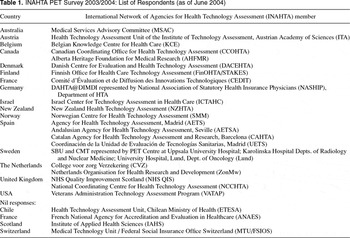
Twenty-seven INAHTA agencies in nineteen countries responded to the survey, representing a 69 percent response rate, including four agencies who replied with no involvement in PET scanning (“nil”) (Table 1). The National Association of Statutory Health Insurance Physicians Department of HTA (NASHIP) provided data for Germany on behalf of the German INAHTA agency DAHTA@DIMDI. Responses from the Swedish HTA agencies (SBU and CMT) were addressed by the PET Centre at Uppsala University Hospital, the Karolinska Hospital Departments of Radiology and Nuclear Medicine, and University Hospital Department of Oncology in Lund. Responses for Canada were provided by CCOHTA and AHFMR.

The wide timeframe over which responses were received, along with the lack of detail in some responses, made it difficult to construct a definitive “snapshot” of the situation at a single point in time. The survey information, therefore, provides a general overview of PET diffusion and evaluation of the period from early 2003 to early 2004 based on a range of anecdotal responses. Tables 2 through 4 summarize the key survey results.


Diffusion of PET
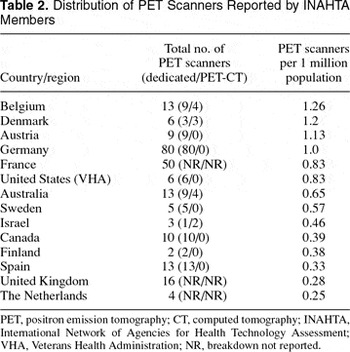
Members reported the number and type of PET scanners in clinical use in their country, region, or local health system; the survey considered dedicated PET scanners, PET–computerized tomography (PET-CT) hybrid scanners, and gamma cameras modified for coincidence detection (Table 2). The majority of models in use were dedicated scanners, and most were situated in the public sector. Use of mobile scanners and modified gamma cameras as a lower cost alternative to traditional PET scanning was reported anecdotally.
INAHTA members reported an average of 16.4 dedicated PET scanners (range, 2–80 scanners; median, 9.5 scanners) per country, region, or health system and 0.65 scanners per 1 million people (equals 1.5 million people per scanner). Respondentsconveyed a shifting interest toward PET-CT hybrid systems. Five countries or regions reported planned expansion of PET services, including installation of PET-CT hybrids:
- Ontario, Canada: At least three hospitals plan to install PET or PET-CT hybrid in the near future.
- Denmark: A third PET scanner/cyclotron facility is planned for Odense in 2005.
- France: Total dedicated PET scanners are expected to increase from approximately fifty scanners to approximately sixty-five in the future.
- Israel: Ten scanners are to be installed in the near future to meet their regulatory requirement of one scanner per 600,000 population.
- The Netherlands: Eight scanners are to become operational in the near future (including at least one PET-CT hybrid scanner).
Responders provided data on clinical throughput; however, incomplete reporting and variability with respect to time period of data collection, definition of utilization, types of scanners represented, and the number of PET sites reported by each respective country or region hindered interpretation of the data. Countries with the highest annual throughputs included Belgium (10,273 scans in 2002), Australia (8,146 scans in 2003), Canada (4,700 scans in 2002), and the United States (VHA) (3,721 scans in Fiscal Year 2001). The most popular indications for PET use were in oncology. Lung cancer, colorectal cancer, lymphoma, and melanoma were among the most common indications for which scan were performed, whereas some of the less common indications included myeloma, testicular cancer, chronic skeletal infection, and tumors of the liver, pancreas, and spleen.
Assessment of PET
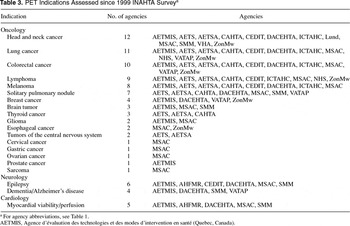
The number of agencies involved in assessing PET and the list of indications assessed since the 1999 INAHTA survey are expanding, particularly in oncology (Table 3). HTA approaches included new systematic reviews of primary studies, syntheses of existing systematic reviews, and primary data collection. Reasons for assessment centered on determining PET's clinical and cost-effectiveness for the purposes of improving quality of care and maximizing public resources with respect to the appropriate number of PET centers and their use within a local context.
The clinical applications most often assessed by INAHTA agencies were the following cancer forms: head and neck, lung, colorectal, lymphoma, and melanoma. Assessments were restricted to studies using dedicated PET models, but some respondents expressed a need for evaluating the clinical utility of alternatives to dedicated PET systems and their impact on service provision.
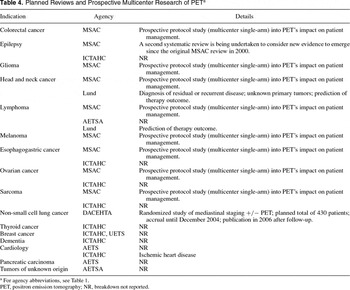
Seven agencies reported planned assessments of PET typically as part of a research protocol (Table 4). All but one agency (Coordinación de la Unidad de Evaluación de Tecnologías Sanitarias, Madrid, UETS) are evaluating multiple indications for use. MSAC in Australia is assessing a range of indications as part of a multicenter single-arm study of PET's impact on patient management.
Policy Implementation of PET
All respondents commented on having some form of public funding for clinical PET scans, usually in the form of a prescribed list of indications, on a “case-by-case” basis, or within a research protocol. Clinical use and funding for PET were determined initially by external or in-house review of the clinical evidence, at times supplemented with expert input. Strategies for implementing clinical policy of PET usually included linking funding to continuous data gathering for the purposes of refining clinical use and optimizing resource allocation toward indications that maximize patient outcomes. Such strategies included monitoring utilization, monitoring published evidence to define PET's diagnostic performance in selected indications, and examining PET's impact on patient management and health outcomes within a local context.
CONCLUSIONS
Experiences of INAHTA members show an increasing use of HTA to direct appropriate use of PET services in clinical care, taking into account clinical and cost-effectiveness, patient needs, and local resources. INAHTA members have reported integrating continuous quality improvement (CQI) approaches into clinical policy for PET, in which initial use is defined through systematic review, modeling, and expert opinion, and subsequent use is refined through continuous literature review, research protocol, and monitoring of utilization and outcomes. A CQI framework can assist policy makers in optimizing scarce resources for both evaluation and clinical use of high cost and potential beneficial diagnostic technologies such as PET, particularly in areas where potential clinical or cost-effectiveness is considerable but conclusive evidence is lacking.
CONTACT INFORMATION
John Hastings, BA (john.hastings@health.gov.au), Australian Department of Health and Ageing, Diagnostics and Technology Branch, GPO Box 9848, Canberra, Australian Capital Territory, Australia 2601
Elizabeth J. Adams, MPH (Elizabeth.adams@med.va. gov), Research Analyst, Veterans Administration Technology Assessment Program, VA Boston Healthcare System (11T), Boston, Massachusetts 02130
INAHTA gratefully acknowledges the voluntary efforts of the Officers from the Australian Department of Health and Ageing (DHA) who agreed to coordinate the survey and compile the results. INAHTA also wishes to thank all of its members who participated in the project.