INTRODUCTION
Many authors consider the introduction of non-indigenous species to different ecosystems an ecological problem affecting biodiversity (Ribera & Boudouresque, Reference Ribera and Boudouresque1995; Okolodkov et al., Reference Okolodkov, Bastida-Zavala, Ibañez, Chapman, Suárez-Morales, Pedroche and Gutiérrez-Mendieta2007). Non-indigenous algal species have been reported in Mexican coasts such as: Sargassum muticum (Yendo) Fensholt (Aguilar-Rosas & Aguilar-Rosas, Reference Aguilar-Rosas and Aguilar-Rosas1985), Undaria pinnatifida (Harvey) Suringar (Aguilar-Rosas et al., Reference Aguilar-Rosas, Aguilar-Rosas, Ávila-Serrano and Marcos-Ramírez2004), Sargassum filicinum Harvey (Aguilar-Rosas et al., Reference Aguilar-Rosas, Aguilar-Rosas, Hawai, Uwai and Valenzuela-Espinoza2007), and Cladostephus spongiosus (Hudson) C. Agardh (Mazariegos-Villareal et al., Reference Mazariegos-Villareal, Riosmena-Rodríguez, Rivera-Camacho and Zerviere-Zaragoza2010), among others. There is no current plan to regulate or even control the introduction and dispersion of alien algae. A government plan is lacking for monitoring ecologically key (Okolodkov et al., Reference Okolodkov, Bastida-Zavala, Ibañez, Chapman, Suárez-Morales, Pedroche and Gutiérrez-Mendieta2007) and commercial species.
As part of recent extensive floristic studies on the benthic macroalgae of the Baja California Peninsula and its island territories (Mexico), on 14 June and 14 September 2010, we found and collected a new entity at Cedros Island, an unusual brown alga which was identified as Dictyopteris prolifera (Okamura) Okamura, a species native to the temperate coasts of Japan.
In this paper we present the first record of Dictyopteris prolifera for the eastern Pacific coast. Details on the morphological characters of the thallus, as well as habitat and geographical location are provided.
MATERIALS AND METHODS
Description of the study area
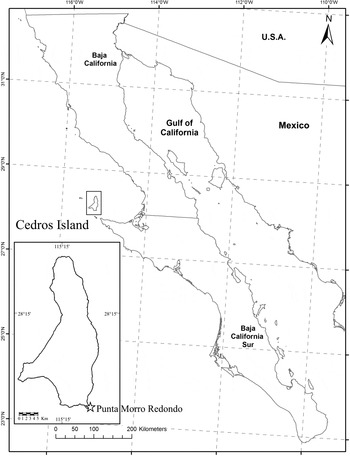
Cedros Island is the largest island of the Mexican Pacific (34,820 ha). It is located off the central coast of the Baja California Peninsula, between 28°02′20″–28°22′55″N and 115°09′20″–115°21′30″W (Figure 1).
Dictyopteris prolifera: study area and collection site.

Cedros Island is characterized by high rocky cliffs, some long sandy beaches on its western coast, and some rocky intertidal areas with large pools. Its location is very important for ecological studies provided it is in the transition area between the Californian (warm-temperate) and Cortez (subtropical) biogeographical provinces, where several representative species from each zone concur (Correa-Sandoval & Rodríguez-Cortés, Reference Correa-Sandoval and Rodríguez-Cortés1998). Samples were collected at Punta Morro Redondo, located at 28°1′53.86″N and 115°11′17.50″W, at the southern tip of Cedros Island, Baja California, Mexico.
Sampling
Specimens were found and collected in the intertidal zone on 14 June and 14 September 2010, growing attached to rocks in the intertidal zone at Punta Morro Redondo, Cedros Island, Baja California (BC), Mexico. Specimens were put in Ziploc™ bags and preserved in 4% formalin seawater until further analysis in the laboratory at the Universidad Autónoma de Baja California (UABC), in Ensenada, Mexico. To identify the thallus of D. prolifera, we compared our samples with the Korean specimens from the Chungnam National University and followed the descriptions and illustrations by Tseng (Reference Tseng1984), Kajimura (Reference Kajimura1994), Lee & Kang (Reference Lee and Kang2001) and Lee & Hwang (Reference Lee, Hwang, Boo, Lee, Hwang, Keum, Oak and Cho2010) and with the Japanese specimens housed at the University of California herbarium in Berkeley, California (UC 794091, UC555185, UC688751, UC 315282, UC 279984, UC 90785, UC 200362 and UC 1717800). The collected specimens are housed at the UABC herbarium (CMMEX 10116 and 10117), which is included in the World Herbaria Index (Holmgren et al., Reference Holmgren, Holmgren and Barnett1990).
RESULTS AND DISCUSSION
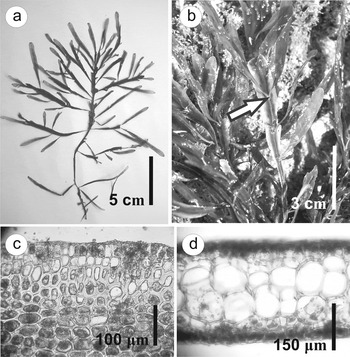
Dictyopteris prolifera (Figure 2) was found growing on rocks in the intertidal zone. The discovery of this population in the protected coast at Punta Morro Redondo, on Cedros Island, represents the first record of this exotic species, not only for the Mexican Pacific coast, but throughout eastern Pacific region. This species is distributed from the Asian coasts of Japan (Okamura, Reference Okamura1930; Yoshida, Reference Yoshida1998), China (Tseng, Reference Tseng1984) and Korea (Lee & Kang, Reference Lee and Kang2001; Lee, Reference Lee2008), to Cape Verde Islands (Cabo Verde Archipelago), in the eastern Atlantic Ocean between 570 km and 835 km off the western coast of Africa (Price et al., Reference Price, John and Lawson1978), and now to the Mexican Pacific (Figure 2). The rocky substrate in the study area is crucial for the development of marine flora typical of the Mexican Pacific coast. Other marine algae that commonly occur in the area are Dictyopteris undulata E.M. Holmes, Padina durvillaei Bory Saint-Vincent, Eisenia arborea J.E. Areschoug, Macrocystis pyrifera (Linnaeus) C. Agardh, Codium fragile (Suringar) Hariot, and Pterocladiella capillacea (S.G. Gmelin) B. Santelices and M.H. Hommersand.
Dictyopteris prolifera. (A) Specimen collected at Cedros Island, Baja California, Mexico, on 14 September 2010; (B) proliferations developed from the conspicuous midrib; (C) cross-section from middle portion of proliferation; (D) cross-section showing medullary cells irregularly arranged.

The new population of Dictyopteris prolifera at Cedros Island consists of young and mature individuals with a mean high of ~25 cm (up to 30 cm).
Some distinctive characters are: a bushy, coriaceus, polistichous, complanate, brown to dark brown thallus, subdichotomously branched, which is attached by stupose conical discs of rhizoidal holdfast from which a complanate axis usually arises, densely and copiously branched with proliferations developed from the conspicuous midrib on both surfaces, with coriaceo-membranous, narrow wings. The proliferated branches are narrow, elongated, linear–oblanceolate, attenuated at the base, with smoothly rounded apices around 3–11 cm long and 3–6 mm wide. The lower portion of the thallus becomes apparently stipitate. Cortex is composed of 5–6 layers of coloured cells, medullar cells are rounded in shape, not pigmented and irregularly arranged. Groups of phaeophycean hairs are commonly scattered, deriving from cortical cells on both sides of the branches. Sporangial sori are closely set in linear series along both sides of the midrib. The tetrasporangia are spherical to ovoid.
The genus Dictypteris J.V. Lamouroux includes 35 species, widespread in tropical and temperate waters, of which only five species are distributed on the Mexican Pacific coast and currently accepted taxonomically (Guiry & Guiry, Reference Guiry and Guiry2011). Compared with other local species such as D. undulata Holmes, which is fairly common in Cedros Island, its midrib is evident but shows much wider axes mainly in the mid-terminal portion of the thallus and these are appically broad–obtuse, in addition to its evidently undulated and proliferation-free margins. Dictyopteris prolifera is easily recognized by the conspicuous midrib on both surfaces and especially by the proliferations developed from the midrib on both surfaces of the branches. Other species occasionally found in the Mexican North Pacific coast such as D. delicatula J.V. Lamourox and D. repens (Okamura) Børgesen are very small species widely distributed in tropical to temperate seas.
From June to September 2010 we observed that the population of D. prolifera grew rapidly. During the June survey we found few specimens in a small area at the intertidal zone (100 m2), while in September we found more than 40 specimens in the same area. Our preliminary observations suggest that D. prolifera can be invasive on the Cedros Island coast, possibly occurring seasonally as other brown algae species occur on the Baja Californian coast (Aguilar-Rosas et al., Reference Aguilar-Rosas, Aguilar-Rosas, Ávila-Serrano and Marcos-Ramírez2004; Pedroche et al., Reference Pedroche, Silva, Aguilar-Rosas, Dreckmann and Aguilar-Rosas2008). Although Japanese populations occur throughout the year (Lee & Hwang, Reference Lee, Hwang, Boo, Lee, Hwang, Keum, Oak and Cho2010), it will take more collections at different times of the year to determine the species phenology on the Mexican Pacific coast.
Of note, this finding is the second record of this species outside its Asian water range (Lee & Hwang, Reference Lee, Hwang, Boo, Lee, Hwang, Keum, Oak and Cho2010), after being recorded in Cape Verde Islands (Cape Verde Archipelago), in the eastern Atlantic Ocean off the western coast of Africa (Price et al., Reference Price, John and Lawson1978). We hypothesized that D. prolifera could have been introduced as a result of fouling on commercial ship hulls. Japanese ships arrive periodically to Cedros Island to haul the production of the ESSA's (Exportadora de Sal S.A.) industrial salt producing complex. This species is slowly dispersing along the Pacific coast of Baja California since it has no morphological characteristics, like pneumatocysts shown by other species that allow quick transportation by local ocean currents, such as Sargassum on the Mexican coasts (Aguilar-Rosas & Aguilar-Rosas, Reference Aguilar-Rosas and Aguilar-Rosas1985; Aguilar-Rosas et al., Reference Aguilar-Rosas, Aguilar-Rosas, Hawai, Uwai and Valenzuela-Espinoza2007). Seawater temperature will surely limit its success for settlement and dispersion, just as Silva et al. (Reference Silva, Woodfield, Cohen, Harris and Goddard2002) suggest that seawater temperature is one of the main limiting factors for the survival and establishment of Asian brown algae species that have been found along the American Pacific coast. This new record is ecologically very important because it occurs in the transition area between the Californian and the Cortez biogeographical provinces while the original distribution of this species is characterized by warm-temperate water.
Other recent cases of non-indigenous macroalgae species to the coast of Baja California have been reported by Aguilar-Rosas et al. (Reference Aguilar-Rosas, Aguilar-Rosas and Shimada2008) and Mazariegos-Villareal et al. (Reference Mazariegos-Villareal, Riosmena-Rodríguez, Rivera-Camacho and Zerviere-Zaragoza2010) who indicate that species introduction to the Pacific coast of Mexico, though unintentional, could have been related to commercial vessel traffic, including large Asian cargo and cruise ships coming to Mexico from other countries. In particular Sebastian Vizcaíno Bay, including Cedros Island, is under the influence of deep-sea vessel traffic (ships loading at ESSA), so this finding of D. prolifera is also probably related to the traffic of commercial barges bound to the Guerrero Negro harbour, in Baja California Sur, from the Cedros Island harbour.
The record of D. prolifera adds to the list of species of macroalgae introduced to the Pacific coast of Mexico. Other cases recently documented are: Cutleria cylindrica Okamura (Aguilar-Rosas, Reference Aguilar-Rosas1994), Porphyra suborbiculata Kjellman (Broom et al., Reference Broom, Nelson, Yarish, Jones, Aguilar-Rosas and Aguilar-Rosas2002), Undaria pinnatifida (Aguilar-Rosas et al., Reference Aguilar-Rosas, Aguilar-Rosas, Ávila-Serrano and Marcos-Ramírez2004), Scytosiphon gracilis Kogame (Aguilar-Rosas et al., Reference Aguilar-Rosas, Aguilar-Rosas, Choo and Boo2006) and Ulva pertusa Kjellman (Aguilar-Rosas et al., Reference Aguilar-Rosas, Aguilar-Rosas and Shimada2008). Findings of introduced macroalgal species in the Mexican Pacific Ocean have been documented in recent decades as part of a permanent programme of the Universidad Autónoma de Baja California for monitoring species introduced along the coast of Baja California.
ACKNOWLEDGEMENTS
This work was supported by the Institute of Oceanographic Research of the Autonomous University of Baja California, under the 14a UABC Research programme, no. CA 403/1/C/50/14, CONABIO research programme no. GN007, and the monitoring programme of Herbarium CMMEX. We thank Filiberto Núñez Cebrero for assistance in the laboratory and sample preservation. Special thanks to Manuel Gardea Ojeda for the English translation and editing.