

The importance of working to improve the rates of employment of Aboriginal people in Australia is underpinned by the level of disadvantage they experience. This disadvantage is measurable across the whole pathway from education to employment, with Aboriginal people having lower educational engagement and outcomes, lower rates of employment, and lower levels of income than comparable groups in the Australian community (Steering Committee for the Review of Government Service Provision (SCRGSP, 2009, 2011). Additionally, disadvantage is also evidenced in areas such as health, longevity, rates of incarceration, living conditions, and family and community violence. Worse still, on a majority of indicators, levels of disadvantage have not lessened during the past decade (ABC News, 2009) and have actually deteriorated on some measures (SCRGSP, Reference Gooda, Priday, Gargett and Kiss2011, pp. iii, 31).
Local Government in South Australia
One important way to potentially improve the situation for the Aboriginal peoples of Australia is through the actions of local governments since, in principle, local governments are directly involved in communities and can make the necessary changes and advances (Paradies et al., Reference Paradies, Chandrakumar, Klocker, Frere, Webster, Burrell and McLean2009). Given that local governments’ community responsibilities include representation, provision of services, development, welfare, and regulation (Local Government Association of South Australia, 2006), the level of local government engagement in Aboriginal issues is an important question in a nation with stated ambitions of true reconciliation with its Aboriginal peoples (e.g., Sorry Speech; Rudd, Reference Rudd2008).
In recent years, local governments in South Australia have embraced an increasingly visible awareness of Aboriginal and Torres Strait Islander cultures, echoing efforts at broader levels of the government to be more inclusive (Rerden, Reference Rerden2009). What is less clear at the local government level is how this visible awareness is translating into specific outcomes around employment, reduction of disadvantage, and appropriate service provision. The aim of this research was to clarify these outcomes, if any, and to do so by talking directly to those people involved. The present research, therefore, focused on local government bodies in South Australia and what they are doing to improve any disadvantages through encouraging Aboriginal employment.
Employment and Other Issues in Local Government
One of the key strategies to redress Aboriginal issues used by many organisations, particularly in state and federal government, is the development and adoption of Aboriginal Employment Policies (e.g., Australian Public Service Commission, 2005; Department of Education and Children's Services, n.d.; Department of Employment and Workplace Relations, 2007; Office for the Commissioner of Public Employment, 2003; RMIT, 2007; South Australia Department for Families and Communities, 2008; South Australian Health Commission, n.d.; University of South Australia, 1997; University of Technology Sydney, 2008). Application of effective employment policies was one of the recommendations to come out of the Don Dunstan Federation reports into Aboriginal involvement in the South Australian State Government (Barnett, Spoehr, & Parnis, Reference Barnett, Spoehr and Parnis2007). These policies typically include setting goals for increasing Aboriginal employment levels, ensuring fairness in recruitment processes, and improving access to training and career development for Aboriginal people. Improved awareness of Aboriginal culture through appropriate training was also a key recommendation to come out of a survey of Aboriginal workers in the South Australian Public Service (Barnett, Reference Barnett2007), although such training does need to be understood in the context of its limitations, such as ‘traps’ around thinking all members of a group behave in the same way and value the same things (Egan & Bendick, Reference Egan and Bendick2008; Rerden, Reference Rerden2009).
A range of programs are in place to build increased levels of Aboriginal employment and reconciliation into mainstream workplaces in Australia, including Reconciliation Australia's ‘Reconciliation Action Plan’ (RAP) program (Reconciliation Australia, 2009), and the Australian Employment Covenant, a private initiative with government backing, which seeks to find work for 50,000 Aboriginal people (Department of Education, Employment and Workplace Relations, 2009a). These and other programs, such as government programs aimed at increasing work-related training and cadetships for Aboriginal people (e.g., Department of Education, Employment and Workplace Relations, 2009b), demonstrate a range of approaches that may offer ways to increase levels of Aboriginal employment in local government, and indeed, which may already be being employed in local government.
As mentioned above, despite these employment ideas and initiatives, it is still not clear to what extent they are being applied. A key aim of this research was to investigate a range employment issues for Aboriginal workers within the local government sector.
There are many other contextual issues likely to affect the experiences of Aboriginal people in dealing with local government (Rerden, Reference Rerden2009). These include: racism in the broader community (Mellor, Reference Mellor2003); stereotypes, such as the way Aboriginal people are depicted in the media, with an emphasis on offending (Simmons & Lecouteur, Reference Simmons and Lecouteur2008); and a lack of visible Aboriginal people in the institutions of the community such as retail outlets and service providers. Key among the likely issues is white privilege, the implicit way in which it is regarded as ‘normal’ to be white (Ngarritjan Kessaris, Reference Ngarritjan Kessaris2006). Critical race theory asserts that ‘White dominance is so ingrained in societal structures and practices, that it is normalized, and therefore difficult to recognize’ (Ngarritjan Kessaris, Reference Ngarritjan Kessaris2006, p. 349). The key problem is the power difference this engenders.
Other issues include a lack of recognition of non-educationally acquired competencies (Reid & Melrose, Reference Reid and Melrose2004), and workplace cultures that tolerate discriminatory behaviours (Paradies et al., Reference Paradies, Chandrakumar, Klocker, Frere, Webster, Burrell and McLean2009). Collectively, these issues represent a formidable set of obstacles to Aboriginal people who want to be fully involved in their community, and also to organisations — such as local government — that may be in a position to employ them in roles that cement that involvement. It was therefore considered important to ask directly those interviewed in this research about the nature of the issues they might have experienced, including issues specific to their workplace and its culture.
Research Questions
The research behind the present study has identified a number of key issues that might be relevant in local government in South Australia (Rerden, Reference Rerden2009). These include:
• assessing the perceived efficacy and appropriateness of Aboriginal employment policies, especially around setting targets, and implementing cultural awareness training; and how to get the most out of these policies;
• determining the actual benefits of involving Aboriginal people in local government as employees;
• identifying issues that have been, or might be, raised by efforts to employ Aboriginal people in local government, including barriers to recruitment;
• asking about ways toward solutions concerning issues for Aboriginal people in local government and in the community more generally.
The present study aimed to shed some light on these topics and to do so using, as far as possible, the actual words of the people involved.
Method
Participants
Participant inclusion criteria for the present study were that participants work, or have worked, for a local government council in South Australia or in a related body that provides services to the local community on behalf of local government, and that they either work in a role that is related to the employment of, or service provision to, Aboriginal peoples; or that they identify as being Aboriginal.
Recruitment was primarily through an open invitation distributed via an email network for Aboriginal employees. Of those who expressed initial interest in the study, only about half proceeded all the way to interview. The most common reason given for not proceeding further was the perception that their involvement would not be relevant. The process was confidential for anyone who responded to the open invitation by returning an email.
The final participants for the present study were 10 people (P1 to P10) either working in local government in South Australia, or who have worked in local government in South Australia, or who are working in closely affiliated roles delivering services on behalf of local government. Of those participating, six identified as Aboriginal Australians, and four as non-Aboriginal Australians but working in Aboriginal-related roles; eight were male and two were female. Five could be described as holding managerial level roles, two had been in their role for 10 years or more and all had been in their role more than 1 year. Six of the participants were engaged full time in their role, and four were part time while holding other roles outside local government. Collectively, participants represented four different councils within South Australia, all of which were located within the greater Adelaide region.
Procedure
The research in all aspects was approved by the University of South Australia Human Ethics Committee. Interviews were conducted over a 3-month period from mid-2009 to 2010. In all cases, the participant was at their place of work, although in the case of part-time or former employees, this was not necessarily a local government place of work. Each participant was interviewed alone on one occasion. Participants were given the option to be interviewed at a time and place of their choosing so that if they felt uncomfortable meeting at their workplace they could specify another location. All 10 participants agreed to have the interview recorded, so in all cases the interviewer took minimal notes during the interview to maximise rapport. Nine of the 10 interviews were conducted in person using a room at the participant's place of work; the other interview was conducted by telephone.
The recorded portions of the interviews ranged in length from 19 to 81 minutes. Two of the interviews exceeded the time allocated by the participant who, as a result, made the decision to delay subsequent meetings in order to continue the interview.
Formal procedural discussion, including informed consent and informal general discussion, took place before and after the recorded portion of the interviews. It was clear from the nature of this informal talk that many of the participants were glad to be given the opportunity to express their views and keen that something should come from this process. Presumably, persons not keen to participate simply did not self-select to be involved.
Open-ended interviews were conducted covering relevant topics about the use, benefits and challenges of Aboriginal employment policies; benefits of Aboriginal roles in local government; issues around Aboriginal roles in local government; the participant's own role; ways forward for Aboriginal people, specific to local government; ways forward for Aboriginal people, more generally; the political landscape and current issues for Aboriginal people in Australia today; and anything else the participant wanted to discuss. Within these broad topics, however, the participant could discuss whatever aspects were most important to them. Recordings and transcripts have been retained and are stored securely and will be kept in accordance with ethical guidelines.
Results and Discussion
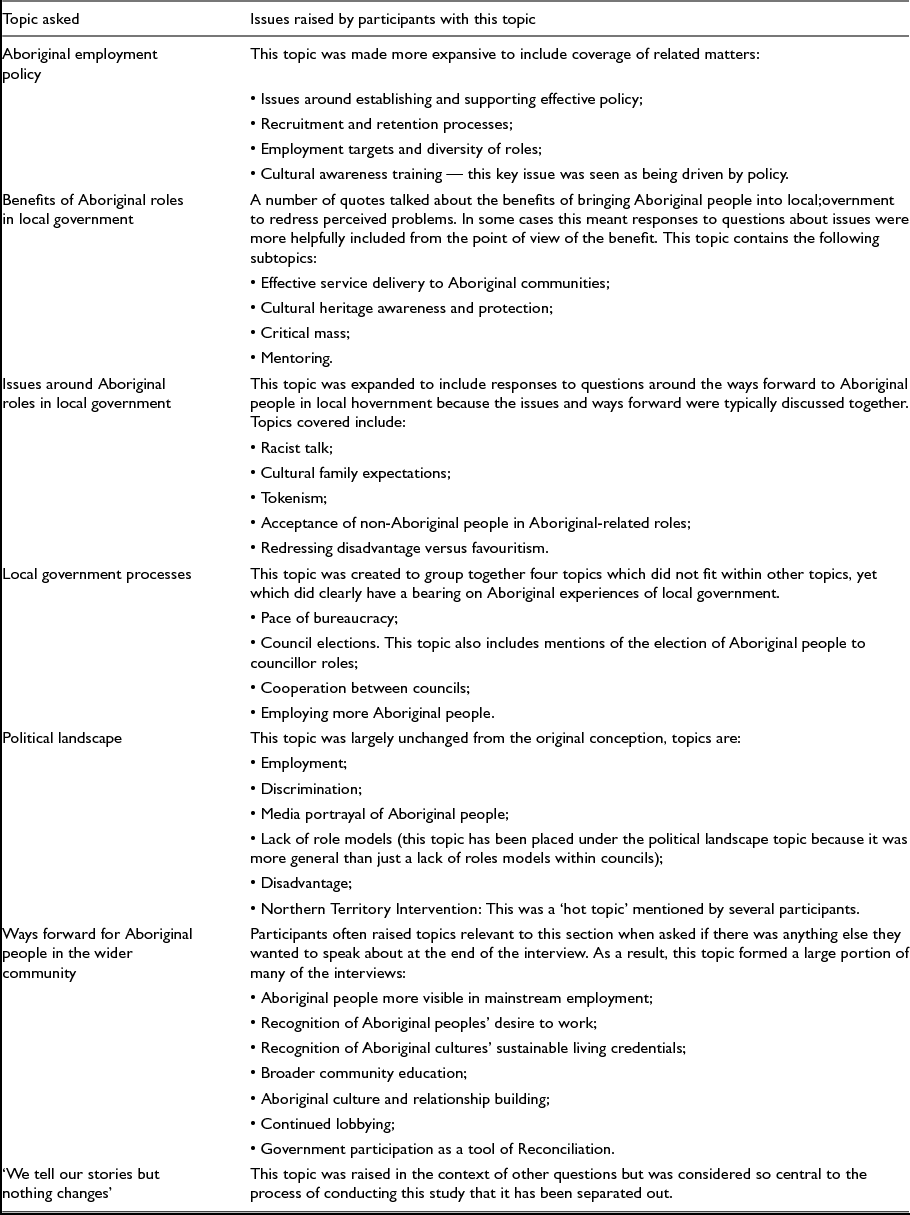
For the present study, the data sampling method was to record the entirety of each interview for transcription and analysis by the researchers. Topics discussed were identified and grouped according to the original topics list. The topics list was then adjusted with input from a key participant to better reflect the content of the interviews; in particular, topics that consistently overlapped were combined, and those centred on a specific topic slightly different to the preconceived topic were renamed accordingly. Table 1 shows a summary of the main issues from the interviews grouped by the question asked.
Topic List Adjusted to Reflect Actual Content of the Interviews

Following is a discussion of the interviews according to the broad topics outlined in Table 1. A short discussion of overall patterns in the data is provided. Throughout the discussion, any differences between the responses of different segments of the sample — for example, between Aboriginal and non-Aboriginal participants — are noted.
Aboriginal Employment Policies
Those interviewed for the present study were all supportive of the use of formal Aboriginal employment policies as tools to improve the employment rates and conditions for Aboriginal people in local government. The participants’ understanding of what such policies should aim to achieve was expansive, including recruitment and retention, training and development opportunities, the diversity of roles available to Aboriginal people, anti-discrimination, and cultural awareness training.
Establishing and supporting policies
Participants coming from one of the councils involved in the present study, one with a strong Aboriginal employment policy, attributed a great deal of that organisation's progress on Aboriginal employment to the implementation and resourcing of that policy. One participant commented that the history of Aboriginal employment had been ‘chequered’ (P9), with a lack of proper support structures prior to adoption of an effective policy.
There were some issues in terms of that first intake [of Aboriginal trainees] in that the majority of them were . . . in [street cleaning] or [gardening], . . . that there were no support structures in place, there was no cultural awareness training. (P9)
The single most important issue identified for the successful implementation of an Aboriginal Employment Policy was stakeholder buy-in, that is, stakeholders — managers, staff, both Aboriginal and non-Aboriginal, among others — having a sense of having had a say in the shape of the policy, and something to gain from its implementation. This is consistent with the literature, such as Stevens (Reference Stevens2008), which states that in order to be effective, codes and policies that attempt to modify behaviour should be embedded, embraced by management, and communicated effectively. Other issues discussed include integration of the policy into day-to-day work processes so that decisions can actually be made that are purposefully consistent with the policy:
. . . it's really how you roll it out and get it down to people who need to have it and how you build that into their day-to-day work. (P9)
Having a formal policy was described as providing an important tool with which to argue on issues as they arose; for example, in gaining support to roll out cultural awareness training to support an Aboriginal employment program:
. . . it certainly gives me a little bit of backing and support, and let's face it, I need all the support I can get . . . in the workplace people forget where they are, they let their opinions get the better of them, they probably say things that they shouldn't, so it's good to have [a policy] in the way of support. (P3)
Recruitment and retention processes
Not surprisingly, making recruitment processes equitable for Aboriginal people was described as a critical feature of any effective Aboriginal employment policy. A number of anecdotes concerning adverse recruitment process experiences in organisations lacking an effective policy were reported:
I went for a job, went there, ‘ah, sorry mate the position's been fulfilled’. . . I went to the pub later on that afternoon and my [non-Aboriginal] mate come in, he was over the moon, ‘yeah, I got a job, I start Monday’. . . [I said] ‘I went for that position there! What time did you go?’ . . . I went at 11 o'clock [in the morning] and the position was already fulfilled, he went at 3 o'clock he got the position, so I thought, ‘shit, that's pretty weird’. . . (P2)
A key issue raised around recruitment concerned how information about vacancies should be communicated to the Aboriginal communities, with the literature noting that traditional methods may be less effective due to the patterns of media consumption in some Aboriginal communities (Barnett et al., Reference Barnett, Spoehr and Parnis2007; Employment and Training Outcomes Pty Ltd., 2008, Nicholas & Sammartino, Reference Nicholas and Sammartino2002):
Recruitment, I think, comes down to word of mouth a lot more within the Aboriginal community compared to non-Aboriginal people because everybody knows somebody and everyone always talks to everyone else in the Aboriginal community so you've always got that tight networking . . . (P3)
Another topic concerned the common strategy of targeting Aboriginal recruitment activities at traineeship programs (Barnett, Reference Barnett2007), including those supported by government programs such as the National Indigenous Cadetship Program (NICP; Department of Education, Employment and Workplace Relations, 2009b). The key issue here is ensuring that positions are available upon completion of the training:
. . . if there's not a position available at the end of their traineeship. . . we lose that person. Then are we doing more damage . . . (P3)
According to those interviewed, one of the most basic but fundamental challenges concerning Aboriginal recruitment is the small size of the Aboriginal population, which is 1.2% of the population as a whole in South Australia (Gould, Reference Gould2000):
I guess it's a small community of one kind of people but they live like every other kind of people, so they don't all want to be admin officers, they want to go on to university, or they want to go on to a trade or they might want to go and do farming or whatever . . . (P5)
One of the more contentious issues raised around recruitment, with some openly expressed emotion, is the increasing use by councils of labour hire firms to source employees. This was seen to create an ‘us-and-them’ divide as well as a lack of job security, and was seen as something particularly relevant in lower level positions, such as those in which Aboriginal employees are commonly overrepresented:
. . . although we've been working here such a long time . . . [we're] actually being employed through [a staffing agency] . . . there's still that little bit of ‘us-and-them’. (P8)
Given the word-of-mouth, close-knit nature of many Aboriginal communities, an organisation seeking to recruit Aboriginal employees must be very mindful of its reputation in that community. To this end, actions are seen as being more influential than marketing material, and racist behaviour is a key issue that should properly be targeted in an inclusive employment policy:
. . . it's about doing, about being seen to believe in what you're doing and to take action when things like that [racism] happen and so it's word of mouth. (P9)
A workplace environment respectful of Aboriginal employees was also seen as a key plank in any strategy to retain Aboriginal people once they have been hired. As well, awareness of Aboriginal culture on behalf of the ‘machinery’ of the organisation was seen as key, given some of the cultural issues, such as familial obligation and shaming, more common to Aboriginal people:
Retention I guess comes around to cultural awareness. . . . Certainly if . . . [an Aboriginal support person] wasn't there at a specific time to help the person through a situation they definitely wouldn't have been at work on the Monday. (P3)
Employment targets and diversity of roles
The setting of numerical targets regarding the number of Aboriginal people employed in local government as a part of an employment policy was consistently thought of as not very useful, and perhaps counterproductive and limiting. On the face of it, this appears to be contrary to the recommendations of the Don Dunstan Foundation Report (Barnett et al., Reference Barnett, Spoehr and Parnis2007), but a closer reading of that report and of the comments made here shows that both are concerned with gaining Aboriginal representation in a broad range of roles across local government, and not just an overall tally:
People want to set a target, a percentage rate, of employees that will be Aboriginal . . . Which makes me then question, if we set a target like State Government does and we hit that target, then what do we do? Do we rest on our laurels? (P3)
I think Port Adelaide's [Football Club] got more than the 1.2% [Aboriginal players], so has the Crows [Adelaide Football Club], you know, they don't just say we've got 1.2% players now, we don't need any more Aboriginal players; they're taken on merit. (P4)
Another concern around the setting of targets was that they should apply to each of the diversity of roles across the council, avoiding over-representation of Aboriginal people in low-level roles:
I'd like to see 1% in every section not as a whole so, a Nunga gardener, a Nunga administrator, a Nunga manager . . . in the whole structure . . . one percent in each section. (P4)
Related then to concerns around targets across the organisation was the diversity of roles that are accessible to Aboriginal people:
I am trying to break away from those stereotypical areas and the perceptions that all Nungas are good with their hands so all want to be a diesel mechanic or work in the dirt. (P3)
Cultural awareness training
Awareness of Aboriginal culture has already been mentioned in the context of retention. While the literature is quick to point out the traps of cultural awareness training, such as stereotyping, awareness training was clearly an important issue for participants who value it highly for the visible support it offers them, even while suggesting there are drawbacks and issues. When asked how best to build awareness of Aboriginal culture and of the issues impacting Aboriginal people, there were a number of suggestions raised:
One of the things is that we often see cultural awareness as this very structured thing . . . a three-hour session and someone comes along and talks to us about, ‘these are Aboriginal people and this is their culture’, . . . and people go, ‘oh, very nice’ . . . and off they go . . . and I think there's a number of ways that you can provide cultural awareness training on a day-to-day basis and some of those simple ways are introducing an acknowledgement of the traditional owners in staff meetings . . . as a part of everyday business. (P9)
A highly effective form of cultural awareness ‘training’, supported by the Australian Psychological Society position paper on reducing racism and prejudice (Sanson et al., Reference Sanson, Augoustinos, Grindley, Kyrios, Reser and Turner1998), is exposure to positive images of Aboriginal people that disconfirm negative stereotypes. Simply by working alongside Aboriginal people there may be a breaking down of negative perceptions, so recruiting Aboriginal people may in and of itself have a positive effect on cultural awareness:
Maybe having more Aboriginal people here at work as well to [show that] Aboriginal people can work, they're hard workers, they're dedicated to their jobs, they live good lives . . . (P7)
Responsibility for compliance with policy
It was noted that compliance with most policies throughout local government organisations, such as policies around harassment and safety, are made the responsibility of each individual section within the organisation to ensure accountability at the level where action needs to be taken. In contrast, Aboriginal policies are often, perhaps because of their relative newness, made the responsibility of human resources (HR), which must work across the entire organisation.
I think divisions maybe should be responsible for what they're [participant's emphasis] doing for the policy, they're responsible for the OH&S Policy, they're responsible for every other policy, so why does the policy of Aboriginal Employment [for the whole of Council] come back to one person [in HR]? (P3)
Benefits of Aboriginal Roles in Local Government
There were numerous benefits to be derived by the inclusion of Aboriginal people in local government according to those interviewed, including: improved ability to deliver services to the Aboriginal communities served by council, improved culture within council, and improved environmental and development credentials for council.
Effective service delivery to Aboriginal communities
On the subject to being able to interface effectively with Aboriginal communities, it was noted that having Aboriginal employees within council was of substantial benefit:
. . . Aboriginal people employed who would be acting as a conduit to the broader Aboriginal community. . . . To ensure that there was a fair and appropriate and effective service delivery to Aboriginal people and an effective voice for Aboriginal people back into the policy development process. (P1)
A possible issue around Aboriginal involvement with local government is what is perceived to be reluctance on behalf of some Aboriginal people to engage with it because of a sense that nothing changes. Having Aboriginal people properly represented inside local government may go some way to overcoming this issue.
I would say there's a kind of reluctance, reticence, on the part of at least some Aboriginal people to engage with the, what might be seen as a kind of hierarchy I guess [of the Council] . . . the machinery, . . . the protocol, ‘why bother’. (P1)
Cultural heritage awareness and protection
Another benefit of having Aboriginal people on staff was perceived to be improved awareness of issues of Aboriginal culture and heritage by the organisation.
The positives [of engaging with the Aboriginal community] are that there's recognition of traditional owners . . . The benefits for Council are increased knowledge and understanding of Aboriginal culture . . . (P9)
Related to this is greater understanding at times where there was a conflict between development versus preservation goals:
There was, and there probably still is, this question of heritage versus development . . . it's been well established that there are strong connections between Aboriginal people and various parts of the [locale]. (P1)
Initiatives by local government such as dual naming — the use of Aboriginal names for locations in addition to non-Aboriginal names — is one high profile example of an attempt to give more recognition to Aboriginal heritage. Kaurna language naming, such as the dual naming of Victoria Square/Tarndanyangga in the centre of Adelaide (Adelaide City Council, 2006), has been, and continues to be, embraced by councils on the traditional Kaurna lands that cover the Adelaide Plains area. While this has received wide community support it has been noted:
Some Kaurna people hate it [dual naming], but most like it though. There's always a few vocal people and that's their choice. (P9)
Critical mass
One issue experienced by Aboriginal people who work in many organisations is the sense of isolation brought about by a lack of critical mass, that is, a lack of many, or even any, Aboriginal co-workers due to the low numbers in the organisation. This issue has also been raised in literature on Aboriginal employment, given the comparatively low numbers of Aboriginal employees in most organisations (Barnett, Reference Barnett2007; Barnett et al., Reference Barnett, Spoehr and Parnis2007):
I go to meetings all the time . . . I look around and I am the only Aboriginal person there. (P2)
A major positive benefit of engaging sufficient Aboriginal people so that Aboriginal employees see others like themselves in the workplace is the mutual support they are able to offer each other.
I spoke to one girl [at an Aboriginal employees’ networking event], . . . she's [young], single mum, and she gets up every morning about 4 o'clock to make sure she gets in here . . . for her 7 o'clock start. And I am just blown away by her enthusiasm, I just thought, ‘You go girl!’ . . . I just admire her so much to have that strength and that courage, so I came away from that [Aboriginal networking event] just going, ‘Wow, this is great’. (P 7)
Mentoring
At the outset it was envisioned that a significant number of those interviewed for this research would come from roles directly supporting Aboriginal people in employment. While several of the interviewees did act in supportive roles, only one participant had this as a primary role. In talking generally about the need for mentoring roles such as this one, that participant noted that only some councils, and a minority of those they work with, engage an officer in a comparable role:
Some do, some call it cultural diversity officers, certainly some councils don't, and I think it's needed, I think the minute they have one Aboriginal person on board that role is needed. (P3)
When talking about the key duties within the role:
. . . it's really creating a rapport and relationship with all Aboriginal employees at [Council], to the point where we have got a mutual trust, where they can come to me with any issues, work-related or not . . . Aboriginal family issues have an impact on work so I encourage . . . [them to] come to me about anything. (P3)
When asked about the challenges of the mentoring role, the interviewee said being properly supported by the organisation was the key issue. As the conversation progressed, it became evident that it was a very broad definition of support the interviewee had in mind, including financial, logistical, policy, management, resource, as well as personal types of support:
In my position description it doesn't say what you do and what you don't do, but as an Aboriginal person I know that I feel obliged to help as much as I can, you've got to really straddle these two cultural borderlands where you've, at the same time I'm a representative of [Council], I'm here to do a job, but then on the other side of the coin I'm representing the Aboriginal community in my job as well, so I really need to try and strike a balance between the two.
These roles aren't a 9-to-5 role, we can't switch off once we walk out that door, because I will walk out that door and straight into the community and within that community is the Aboriginal community, and within that Aboriginal community are people that are going to come up to me and say hey, get me a job here, or, my cousin is doing this, or I've heard that [Council] is doing this or that, or aren't doing this . . .
In talking about how Aboriginal employees can be successfully deployed and retained in local government, the participant described how there is a key need for someone to be there in a role that provides a mentoring and support structure for them. Through this role, the task is to help assure positive employment experiences for Aboriginal employees, despite challenges such as racism, misunderstanding, and isolation. The participant talked about needing support to deal with the ongoing challenges, the stress of the variable hours, and the emotional labour inherent in the role.
Issues Around Aboriginal Roles in Local Government
In reviewing how to work effectively with Aboriginal people, it was often described as being important to understand some of the issues that are either unique to, or are more commonly experienced by, Aboriginal people (Rerden, Reference Rerden2009). Issues raised in the interviews ranged from racist talk in the workplace, cultural obligation, the problems of tokenistic roles, and challenges around redressing inequity without being seen as discriminating against non-Aboriginal employees.
Racist talk
A recurrent issue raised by most of the Aboriginal participants was racist talk, particularly around perceptions of Aboriginality versus skin colour. This is a particular issue for fair-skinned Aboriginal people who report not being seen as Aboriginal, or ‘Aboriginal enough’. Most of these participants recounted one or more stories of hearing racist jokes or comments made by people, including close friends and colleagues, who either did not see them as Aboriginal, or just did not think before going along with the crowd.
Racism still is rife in the workplace. Covert and overt racism. Certainly people making comments that they just don't realise can be offensive, . . . ‘you don't look black enough to do this role’. . . or people say that you're a ‘half-caste’ unaware that that is a derogatory comment and certainly that it offends me. (P3)
I've experienced . . . incidents . . . one was a [racist] joke that was said which I took offence to and it was in an open forum so there was all these people who laughed at this joke and then there was me, so I felt very alone in that sense. . . . I think also, because I'm also quite white, like a lot of people might not even consider me to be Aboriginal unless they get to know me. (P7)
Cultural and family expectations
An issue often raised in the literature (e.g., Barnett et al., Reference Barnett, Spoehr and Parnis2007; Williams & Chapman, Reference Williams and Chapman2005; Williams & Thorpe, Reference Williams and Thorpe2003) is that of extended familial expectations and obligations on Aboriginal people and how, in some cases, these present challenges in a non-Aboriginal oriented workplace:
One of the most common things is when you've got a family member that's working, come pay day people know, you've got Aboriginal family members, community members come to that person's place, they say, ‘right, you've been paid today let's have a drink’, and of course that person is feeling pressured that he or she may have to supply them with alcohol and have a drink knowing that they've got to get up, be at work at 4 am in the morning. (P3)
Recognising these obligations and engaging in open discussion as to how they can be accommodated equitably in the workplace can be a major step in enabling Aboriginal employees to feel more accepted in the workplace.
Tokenism
One participant who was involved in a service delivery role associated with, but not directly a part of, a local council noted the frustration around ‘tokenistic’ Aboriginal roles. These are roles where an Aboriginal person was engaged essentially to welcome Aboriginal clients without being given any substantial authority outside of directing them to an appropriate non-Aboriginal person to handle their enquiry. His experience placed him in a unique position to comment on this issue:
When some of these departments have Aboriginal workers . . . their authority and what they can actually do is [minimal] . . . they may see a client and it looks great, yeah, Aboriginal person there, he's greeting the person and everything, ‘Oh yeah, deadly [good] bro, how you going, yeah’, they just greet them and find out what they actually need and put them on to someone else. Sometimes it's ok but they've got no authority to do anything else, they're just there as a token. (P2)
In thinking about how to better handle this situation, this participant nominated improved training for, and giving more responsibility to, Aboriginal workers, and avoiding simple ‘meet and greet’ roles except as an entry-level strategy.
Acceptance of non-Aboriginal people in Aboriginal-related roles
All but one of the participants in the present study worked in Aboriginal-related roles, but only 60% identified as an Aboriginal person. One of the non-Aboriginal workers in an Aboriginal role recounted considerable resistance to her occupation of the role by small segments of the Aboriginal community:
The challenges, especially when I first started, were getting the community to accept me because they believed that my role should have been filled by an Aboriginal person. . . . There were lots of racist comments about me when I first started, coming from the Aboriginal community . . . I'm sure they put up with it throughout their lives so, God, if I have to put up with a little bit of it really, what's the big deal. But, the majority of the community are great, they're really great. (P5)
Related to this issue is the concept of lateral violence, loosely defined as intra-racial conflict arising within disadvantaged or oppressed groups and often manifesting as bullying, gossiping, shaming, organisational conflict, and family feuding (Gooda, Priday, Gargett, & Kiss, Reference Gooda, Priday, Gargett and Kiss2011). As has been clearly illustrated by this participant, an important part of the Reconciliation process is to recognise the hurt suffered by many Aboriginal people and to take a wider view when that hurt occasionally manifests in behaviour that could be seen as an invitation to retreat to destructive, non-conciliatory modes of action. The Australian Human Rights Commission concluded ‘the first step to tackling lateral violence is naming it and exposing the ways it impacts our communities’ (Gooda et al., Reference Gooda, Priday, Gargett and Kiss2011, p. 98).
Redressing disadvantage versus favouritism
A participant who occupied a role to support Aboriginal employees noted that often there was a perception by a small segment of the council workforce that programs in place to redress disadvantages experienced by Aboriginal employees — such as networking meeting to help overcome critical mass issues — represent unfair favouritism toward Aboriginal people:
It's the comment that you hear when other staff members are made aware of our . . . [Aboriginal networking] meeting, ‘oh, the blacks are getting something again for nothing!’ (P3)
Cultural awareness training, aimed particularly at pointing out the pervasive nature of the discrimination and disadvantage experienced by Aboriginal people even today, may go some way to at least build an appreciation in the workplace of the need to take steps to redressing some of the disadvantages (Gould, Heylen, & Graham, Reference Gould, Heylen and Graham2000). Another task for cultural awareness training is to increase awareness of ignorance about cultural practices (Bussema & Nemec, Reference Bussema and Nemec2006) so that people are better able to appreciate that, unless they ask, they do not know why diverse groups do some of the things they do.
Local Government Processes
Processes within local government itself, such as the slow pace of bureaucracy, the periodic changes of leadership and policy brought about through the election cycle, and the arbitrary demarcation of land between councils, were raised as potential issues in the interface between local government and Aboriginal people.
Slow pace of bureaucracy
When talking about the development of Aboriginal employment policies and working with and engaging Aboriginal communities, a theme raised by more than one participant was the slow pace of bureaucracy in local government. Speaking generally on the issue of developing Aboriginal employment policy it was noted:
I got the employment of Aboriginal people from something that we did on an ad hoc basis to a policy. . . . It has been in many ways a frustrating and long process, . . . things are slow in Council, from conception through to delivery things can take many years. (P9)
When talking about this issue in relation to a specific Aboriginal project, which had originally had a 2- to 3-year timeframe to get from launch to completion, it was said:
Bureaucratic wheels turn slowly . . . that time has passed and there's been a lot of politics . . . a couple of elections . . . it's been a bit of a rocky road and I guess one of the things that does frustrate me is the ability to create more infrastructure for the long term. (P4)
By long-term infrastructure, the participant was referring to a desire to work toward building capacity over time with a consistent set of goals not frustrated by the need to renegotiate funding and policy with each passing election.
Council elections
An issue raised by several participants was the subtle and not-so-subtle changes in emphasis and direction that occur at each council election. This process is compounded by similar, and in some cases even more dramatic, changes with federal and state elections:
It's not a perfect world, we have ups and downs of course. The only thing that kind of affects it is council elections every four years, the mayor's got a different view on things, councillors change. (P8)
An issue closely related to council elections is the election of Aboriginal people to local government. To date, there have been very few Aboriginal people elected to local government in South Australia, despite information packages encouraging Aboriginal people to run for council being available through the LGA (2003). When asked about how to engage more Aboriginal people to become involved and seek election to local government, one participant commented:
I'd love to broadcast it if I can! . . . I want to get in and talk with the unions to say ‘Let's get an advertising campaign going’ to go in the Koori Mail to say, ‘Let's do this’, get more Aboriginal people involved . . . I'd love to see more Aboriginal people running for Council ‘cos that's the best level [of government]. (P10)
On the subject of Aboriginal councillors serving in South Australia:
It's great to . . . have an Aboriginal councillor . . . [but] . . . because he's seen as Aboriginal . . . he's probably between a rock and a hard place because he doesn't want to be seen to be saying ‘yes’ just because he's an Aboriginal, so it's probably a bit hard for him. Another . . . thing . . . just because he's Aboriginal, [Aboriginal people might] . . . automatically expect him to see what [they are]. . . seeing . . . and he may well not see it like that. (P8)
Cooperation between councils
Several of the participants lamented a relative lack of cooperation between councils on matters of Aboriginal employment and culture. Some of the benefits of increasing cooperation include more integrated approaches to culturally significant issues and sites, which often straddle council boundaries, as well as cost savings for smaller councils that might not have the scale to engage an Aboriginal Employment Officer, or Aboriginal Cultural Officer, on their own.
Certainly, that is tricky about Kaurna being across 28 councils because what councils try and do is say, ‘Yep, we're going to do this, it's going to be here’, and then the Kaurna people say, ‘Yeah, but it might be there for you but for us it goes from here over to here and down to there’. (P9)
Another participant (P8) went on to note that this issue is easily overcome through communication and collaboration between Councils. It had also been noted by another (P6) that a Council of Elders is being discussed as a means by which the Aboriginal community can engage in a more coordinated way with other bodies, including local councils and groups thereof.
Employing more Aboriginal people
When asked about how a local government body not yet fully embracing Aboriginal employment might progress toward a more inclusive employment proposition, there were some clear insights borne of experience in achieving these aims in more progressive councils:
[A Council] would engage with their local Aboriginal community, they would undertake some research into the other councils that have done it before to see the pros and cons, to learn from their experience basically . . . engaging with any existing Aboriginal staff . . . but it's important there to maintain the distinction that Aboriginal staff in the organisation may not represent the views of all Aboriginal people in the community; that's a mistake that can be made often . . . (P9)
Political Landscape
When talking more generally about the political landscape in Australia for Aboriginal people, there were some impassioned views. These were driven by similar issues to those raised when talking about the closely related issue of ways forward for Aboriginal people in the wider community, which follows.
Employment
Employment was quoted as being a key factor in addressing poverty, and poverty a key factor in beginning to redress disadvantage:
Employment, for any group, is particularly important in terms of dealing with poverty. Certainly, the kinds of issues that many Aboriginal people face, one of the key factors is the poverty that is associated with some elements of the communities. The more that can be done to overcome the barriers to employment in local government, all the good. (P1)
Discrimination
Not surprisingly, given the issues raised in the literature on Aboriginal people in Australia (Rerden, Reference Rerden2009), discrimination featured strongly when participants were asked about the political climate in Australia generally:
My first challenge was being Aboriginal, you know, the colour of my skin was my toughest challenge. A disease I had, was my colour of my skin . . . I walk in there with a shirt, it's government logos on it, our little design on it, they can see I am a government worker, I'm flashing a badge and ‘bang’, it's direct help, support straight away; why couldn't [they provide this help to another Aboriginal person] straight away? (P2)
The depth of some of the negative perceptions of Aboriginal people in some segments of the Australian community is remarkable when an Aboriginal man, speaking about friends he has known for decades, can say this:
. . . a newsflash comes on, [when] . . . you're sitting there with your mates and there's an Aboriginal person that's been arrested for stealing a car — they all know I'm Aboriginal — but the comments still come out, ‘ah, typical black bastard, ah typical, had to be a coon’ . . . and then they realise that I'm sitting there . . . these are close friends of 20 plus years! (P3)
Media portrayals of Aboriginal people
A key issue raised by many of the participants was the way Aboriginal people are depicted in the media. This issue was picked up across almost all participants regardless of their own cultural identification:
The only time you read about Aborigines in the paper is when they're leaving the scene of a crime . . . [but] when you look at the crime statistics Aboriginal people are probably, again, 1.2% of the crime statistics. The concept is that we create 95% of the crime . . . the media have really stopped Aboriginal people from going forward, they've limited our progress. . . . People focus on . . . [drunk people in the parklands] but while they're looking at them they don't see the black nurse walking past, or a manager, or other people that are working in the community that are contributors to Australian society as a whole. (P4)
A lot of people's experience of Aboriginal people is what they see on the media, the media . . . is very negative . . . what people don't realise is that that is a small part of Aboriginal community, that the majority of Aboriginal people live their lives very much like everyone else, want to make a living, want to get by, be happy. (P9)
Lack of role models
Another issue mentioned was that, outside perhaps of the sporting arena where there are a number of high profile Aboriginal success stories such as AFL football players and Olympic gold medallist Cathy Freeman, there are few role models for Aboriginal people in daily life. One participant spoke of a feeling among some of her peers of not being good enough to go to university or pursue certain career paths:
There's no one in their families that have been educated in tertiary education so then they have no family [models] and no role models. . . . And then you look at Council at the moment, there's no role models in upper management for young Aboriginal people or new Aboriginal people as aspire to. (P7)
Disadvantage
The disadvantage experienced by Aboriginal people on the whole was also a topic mentioned by many of the participants. Key issues are the same as those identified through the literature; life expectancy, poverty, health, employment:
I can only speak for Kaurna, I don't know what it's like for other Aboriginal people, but if we looked at some of the stats we certainly haven't [improved] . . . we've increased some of the kids getting matriculation, going to Year 12 which is fantastic, but in other terms of health we haven't increased it we've kind of come to a bit of a plateau I suppose. We're not dying any younger but we're not dying any older. (P8)
Northern Territory Intervention
Most participants, Aboriginal and non-Aboriginal, mentioned the Northern Territory Intervention (Parliament of Australia, 2007), typically experiencing it as a terrible backward step which may well turn out to be this generation's ‘Stolen Generation’:
I think the ideal situation would be to consult more with Aboriginal people, one only has to look at the intervention into the Northern Territory where they just basically went in, we had that years ago with the Stolen Generation and we can see that that didn't work. More consultation with Aboriginal people that would be the best thing. I'd hate for consultation to happen just for lip service . . . so the government can say ‘we consulted’ but they didn't really consult . . . so real [participant's emphasis] consultation, go out to communities and physically sit down on the ground with mobs and talk about issues. (P10)
It is interesting that in the context of talking about local government in Adelaide, four of the six Aboriginal participants raised the issue of the Northern Territory Intervention. This illustrates the level of impact this intervention has had on Aboriginal communities throughout Australia.
Ways Forward for Aboriginal People in the Wider Community
Discussion of possible pathways toward improved acceptance of Aboriginal people in the wider community was a ‘hot button’ topic for many participants, evoking some of the most emotive comments. This was not limited to the Aboriginal participants, though it was certainly strongly felt in that group, with similar levels of passion reported by non-Aboriginal workers in Aboriginal-related roles. A point noted by this researcher during the interview processes was that three of the four non-Aboriginal participants frequently used self-inclusive collective terms such as ‘we’, ‘us’ and ‘our’ when referring to Aboriginal people. The fourth and only other non-Aboriginal participant was a former council employee who, in contrast to the others, was no longer in an active local government role.
Aboriginal people more visible in mainstream employment
A point of particular note was the perception that Aboriginal people are simply not visible in the mainstream employment sector:
I always think that one day I am going to throw a party when I see the first Aboriginal person working in the [major local retail centre] . . . when I see the first Nunga person working in the [tourist] precinct, when I see the first Aboriginal person working in [the major central shopping area]. (P4)
What was particularly alarming in this for participants was the lack of everyday positive role models for young Aboriginal people, many of whom may therefore not see themselves reflected in the South Australian community at large.
Recognition of Aboriginal peoples’ desire to work
Despite the lack of everyday role modelling, most Aboriginal people share as strong a desire to participate in the full gamut of community life as any other group:
Once you get employment, I feel, you're more likely to think . . . money's good, I like this, it beats being on the dole, I can get deadly [really good] shoes and help my mum and dad too, help them buy food, buy my little brother stuff. (P2)
Recognition of Aboriginal cultures’ sustainable living credentials
In this climate of strong and growing concern over environmentally sustainable living, combating global warming, and the South-Eastern Australian water crisis, recognition of Aboriginal people's successful stewardship of the Australian landscape for 55,000 years is something for which there is a growing appreciation:
We're moving in the right direction I guess. When we talk about ‘sustainability’, I reckon that the Indigenous people, they invented that word, I'm telling you, so it is their word, ‘ingenuity’ as well is another word that's their word. (P6)
We're all Australians at the end of the day . . . once we've established that I think we'll have a longer journey together . . . it's all about stewardship because Council are the stewards of the land . . . looking after the country, we've both [Aboriginal people and local government] got an interest in that and I think we could certainly build on that. (P8)
Broader community education
Education of the broader community about Aboriginal culture was an issue raised with some passion by a number of the participants interviewed:
[Let's] . . . work on the Johnny Appleseed principle, plant the seeds in all those little fertile minds [school children] . . . and hope something comes later on . . . hope they recognise that there's something here, a good strong positive contact to help negate all those negative comments they're going to hear in the backyard barbecues from their redneck uncles. (P4)
A particularly specific and detailed comment on broader community education came from one participant:
I think cultural awareness training needs to become more prevalent, and to have a bit more market value. I think governments should play a really proactive role in that area, if I can extend on that . . . I always draw the correlation between governments’ policies in the past in relation to health. In the ’70s we formed the ‘Life Be In It’ campaign, Norm and Libby, and health was really big on the agenda, and it still is I might add, but nevertheless it was a concerted effort by government to create a health [and] wellness type message. . . . I'd beg the question, has government really attempted to create an awareness and a sense of appreciation and love of Aboriginal culture? Is it government's responsibility to really pick on an item such as the Indigenous issue? (P6)
Aboriginal culture and relationship building
The pace and style of Aboriginal culture, it was noted by a number of participants, is more laid back, and more focused on relationship-building than is non-Aboriginal culture in Australia. In what is sometimes referred to as yarning, some Aboriginal people choose to adopt a traditional mode of relationship building through informal and relaxed discussion or story telling:
One thing I have learned about the culture is that it's very relaxed and they would rather go and sit [outside] . . . and have a cup of coffee and chat about what's coming up in the next month or what they did last week rather than what they might have to do. . . . At first I found that a little bit frustrating ’cos I was a bit like, ‘Come on, timelines, deadlines, come on!’ . . . I think having that time out during the day, during every day, is good, it's good for relationship building, which is really what the culture is all about, it's all about relationship building, not just within their family groups or their community groups, but the greater community, and in us as a workgroup. (P5)
. . . anybody who walks in the door, we welcome them, invite them to have a look around, I think the best tool we have here is that kettle over there. (P4)
Continued lobbying
The importance of ongoing political advocacy by and for Aboriginal people was mentioned as a key ongoing need, supported by observations about regression to ‘the bad old days’ with the likes of the Northern Territory Intervention if Aboriginal people as a group do not continue to fight for equity:
We live in a political environment, whether we like it or not. Aboriginal people are in a minority group, and my God, if you're not lobbying . . . if it wasn't for their vocalness and their determination and dedicating their life . . . then we wouldn't be here today. . . . We're still vulnerable though, I think, if we take our foot off the pedal, because . . . there are still bigots out there and they tend to speak loud as well. (P6)
Government participation as a tool of reconciliation
One participant observed the lack of any Aboriginal MPs in the South Australian State Parliament:
This state was founded in 1836, we still haven't had an MP of Aboriginal descent in Parliament . . . I can see a lot of benefit for an Aboriginal person to get into Parliament, to make decisions, that to me is reconciliation right there. Non-Aboriginal and Aboriginal people making decisions for the wider community . . . that would be just fantastic. (P10)
Overall Patterns in the Interview Data
As previously mentioned, there were six Aboriginal and four non-Aboriginal people interviewed for this research. While recognising that these numbers are very small, and any conclusions therefore tentative, there was a difference observed in the patterns of themes raised between Aboriginal and non-Aboriginal interviewees. Issues that were predominantly or solely the preserve of Aboriginal interviewees included: workplace discrimination and racist talk, the election of Aboriginal people to government, critical mass, and workplace relationships. For some of these topics, it seems reasonable to suggest these differences arose because of Aboriginal interviewees’ ability to speak of the situations from first-hand experience, such as experiencing discrimination or racist talk. For other topics, however, such as the election of Aboriginal people to government, the difference is harder to explain — especially given that the interviews were overtly about Aboriginal roles in local government. The fact that most topics, such as cultural awareness training and employment policies, were discussed equally by both groups, also makes this difference more noteworthy.
We Tell Our Stories But Nothing Changes
This Results section could not be completed without commenting on an issue of which this research is undeniably a part — that of Aboriginal peoples’ frustration with being constantly the subject of research, enquiries, committees, and taskforces, and yet still experiencing appalling levels of inequality and disadvantage in modern Australia:
The more people that know what's happening [the better] . . . you know . . . Aboriginal people are the most studied people in the world, and the most . . . we've had the most recordings, interviews like this. . . . Aboriginal people are the most documented people in the world, we've been documented that many times . . . some of the people get sick of it . . . I know our Elders are . . . they're frustrated and so they should be . . . she told them five years ago what's happening . . . [but still things are] not getting any better. (P2)
Conclusions
While limited to 10 knowledgeable and well-placed people, the research conversations present a great deal of information across a wide range of topics, both related to Aboriginal roles in local government and to Aboriginal issues more broadly. Those interviewed for this research agreed remarkably closely with the existing literature on Aboriginal issues, suggesting that the participants involved here did not differ in any consistent way with samples employed in other research. In summary, the issues they raised included:
• a general lack of visibility of Aboriginal people in the community, especially in everyday work roles. This was seen as resulting in a lack of role models for young Aboriginal people;
• Aboriginal disadvantage, consistent with literature on the subject;
• negative media portrayals of Aboriginal people;
• discrimination;
• mass, sustained community education about Aboriginal people, similar to past programs such as the health-focused messages of ‘Life Be In It’, was advocated by one participant, pointing out that state and federal government have roles to play in this;
• that a number of participants noted that relationship building is one of the key strengths of Aboriginal culture, and one that can be leveraged to advantage in the workplace in building better working environments, as well as better client relationships.
Implications for Local Government
Local government in South Australia is developing a proud tradition of providing leadership on Aboriginal issues through activities as diverse as the pro-active employment strategies at District Council Ceduna (2006), which aims to employ more Aboriginal people, to cultural recognition in forms such as the establishment of the Living Kaurna Cultural Centre in the City of Marion (2009) and Adelaide City Council's (2006) dual naming program and the flying of the Aboriginal flag in Victoria Square/Tarndanyangga. The present research shows that this is having an impact both at the statistical level (Gould, Reference Gould2000) and also in terms of what has been said on the subject by participants in this research. Not surprisingly, however, it remains important to continue to work with Aboriginal communities, to not lose impetus, and to realise there is more to be done.
Some of the implications for local government described by participants, and consistent with existing literature, include:
• The continued development of Aboriginal employment policies is widely supported, with cautions that they require supporting resources, stakeholder involvement, and integration into day-to-day work practices.
• Recruitment processes must be, and be seen to be, culturally neutral. Being seen to be culturally neutral can be as simple as being transparent and open to feedback.
• Employment targets for Aboriginal people should be applied with care, ensuring that Aboriginal people are employed in a balance of roles across the organisation.
• Traineeships and cadetship programs offered to Aboriginal employees are an excellent way of engaging people at the entry level, but there needs to be ongoing work available after the training period. When running these programs, it is also important not to lose sight of the benefits of recruiting Aboriginal people at higher levels.
• When seeking to recruit Aboriginal employees, word of mouth through the relatively tight-knit Aboriginal communities can be a powerful tool. But that same tool can become a powerful disincentive to work at a place that becomes known for standing by when racist remarks or actions take place.
• One way to overcome the sense of isolation that may result from a local council having only a small number of Aboriginal employees who may also work in a range of areas, is to set up an Aboriginal employees’ network. Such networks can cross council boundaries to leverage and benefit larger numbers of Aboriginal people.
• One of the most powerful forms of cultural awareness training is working day to day beside Aboriginal people.
• Ways should be found to avoid the ‘us-and-them’ mentality that may arise when filling blocks of roles through external personnel companies; this is an issue for all employees, not only Aboriginal employees.
• Delivery of services to Aboriginal people and communities can be facilitated by having the presence, advice and assistance of Aboriginal members of staff.
There were a range of other implications for local government to come out of these interviews that may extend what has already been described in the literature, or offer a slightly shifted perspective on it:
• Aboriginal employees in local government need a mentor, someone they can speak to about issues they face, especially when numbers are low so critical mass has not been achieved. Also, that mentor needs support from the organisation to ensure they can address issues that arise on a timely basis — even if that is outside normal hours.
• Tokenistic roles where an Aboriginal person is employed to ‘meet and greet’ Aboriginal clients without having any substantial authority should be seen as a transitionary arrangement only while Aboriginal staff are trained with a view to gaining their own authority.
• When special programs are put in place to assist Aboriginal employees, it is important that training is provided to other employees about the disadvantages being addressed by those programs. This should reduce perceptions of favouritism.
• Showing an understanding and respect of Aboriginal family obligations can be an effective way of improving an organisation's ‘brand’ in Aboriginal communities.
• With issues around environment, climate change, and water shortages coming more and more to the fore, the sustainable living credentials of traditional Aboriginal peoples are something local government is well placed to take advantage of; for example, in caring for public land reserves by returning native flora and fauna, and using traditional stewardship techniques.
• Extending the cooperation that already exists between the councils located on traditional Kaurna land should help to better roll out culture and heritage programs in mutual cooperation with Kaurna communities. Similar cooperation would presumably be of benefit on other Aboriginal lands throughout Australia.
• An Aboriginal employment and cultural awareness policy should be made the responsibility of each section within council, as is typically the case for occupational health and safety policy, so it can be enacted at the ‘coalface’.
The preceding list of implications is not exhaustive, and is not intended to imply local government is not already doing many of these things — because they are — but rather to serve as a reminder to keep doing those things, and to engage with Aboriginal people to look for ways to do them better. Of particular note here is that policies of inclusion, cultural awareness, and employment of Aboriginal people should not be left to HR or some other administrative process to apply across an entire organisation, but rather made the responsibility of each section. In this way, responsibility is taken by the people concerned at the location where action is needed, and is not seen as something imposed from the outside, thereby bringing it into line with the literature concerning effective implementation of policy (e.g., Stevens, Reference Stevens2008).
Limitations and Future Directions
The present research has a number of limitations, including its small sample size, the small number of local government bodies involved, and the fact that all of them are located in metropolitan Adelaide. These limitations can be attributed in part to the finite resources available to the study, and also to what turned out to be an overly lengthy recruitment process. However, with the sample gained here there was both a breadth of material and many consistencies, suggesting the main issues are likely to have been covered. We also hope this spurs others to conduct similar research in other areas of Australia.
The outcomes here highlight a number of specific recommendations for local councils to address, and we have passed these recommendations onto the councils involved here. There is also much scope for future research, including the need to better understand perceptions of cultural awareness training, and also the perceptions of favouritism generated when special programs are run for Aboriginal people. It was observed in this research that cultural awareness training is regarded as valuable and important in its present form, perhaps for what it says about organisational values, yet the same people also expressed the view that you cannot change people's prejudice in a short training session — which is exactly the type of training that prevails. An important question then is: What drives these contrary perceptions, and how can training be best delivered to increase efficacy without losing any of the perceived benefits that already exist?
Ways to address perceptions of favouritism and the resultant resentment when groups are singled out for special programs to redress workplace disadvantage — such as networking meetings for Aboriginal employees — would also seem to be an important area for attention. It has been suggested here that providing training around the need for the programs might be a way forward, but given the likely ongoing need for these interventions for the foreseeable future, and the strong desire of organisations to be seen to be fair, a more rigorous, empirically validated, approach is called for. These are not the only issues raised here, but they are perhaps the ones needing to be addressed first to begin the process of working toward mutually beneficial working relationships based on cultural understanding and respect between Aboriginal and non-Aboriginal employees.
Future research might also look to testing, with a larger sample, the tentative finding here that the issue of the election of Aboriginal people to government is more ‘visible’ to Aboriginal people than to non-Aboriginal people in local government — even when those non-Aboriginal people are working in Aboriginal-related roles. If this can be replicated then gaining a better understanding of the factors supporting this difference may shed light on issues and benefits around the election of Aboriginal people to local government.
Moving forward, ‘Participatory Action Research’ (e.g., Woodward & Hetley, Reference Woodward and Hetley2007), approached with a keen awareness of the challenges, opportunities and obligations of working in the cultural borderlands between Aboriginal and mainstream Australia, would seem a logical way of transitioning this and similar research toward outcomes for both Aboriginal people and for Australia more generally. The work to be done is difficult, and any research will necessarily contribute only a small piece, but through working toward real action together, Australia can move slowly forward, redressing the almost two and a half centuries of colonialism that have been a feature of its interaction with Aboriginal people to date.
Acknowledgments
The authors wishes to acknowledge the contribution of the participants for their time and enthusiasm in helping to bring this project to fruition. Although confidentiality prevents me from naming him, without the support of one particular person, an Aboriginal man in an Aboriginal specific role in a local government body, the possibility of this body of work would never have come to our attention.
In this article we use the word Aboriginal most of the time. This word has been used to describe people who, through heritage and culture, self-identify as having a long association with the Australian land prior to European settlement. Terms such as Indigenous, Koori, and Nunga are also often seen in the literature but, to avoid confusion and repetition, this paper used the term Aboriginal. Further, the term should be read as being inclusive of Torres Strait Islander people but is shortened for journal space. While Aboriginal people in some parts of Australia are comfortable with the term Indigenous, the authors understand that the term Aboriginal is preferred by peoples living in the South Australian region and so will use that term. The term Kaurna, which also appears in the literature, refers to traditional inhabitants of the Adelaide Plains.