In the years following the publication of Jane Eyre, Charlotte Brontë's social circle expanded rapidly, extending far beyond the narrow circumference of Haworth Parsonage. The later letters attest to personal acquaintance with many prominent literary contemporaries, including Elizabeth Gaskell, Harriet Martineau, George Henry Lewes, and William Thackeray. Yet, second perhaps only to Thackeray, the writer that Brontë credits as most influential to her thinking about art and narrative is one that she never did meet: John Ruskin. Brontë's initial exposure to Ruskin's work came through the channel of their shared publisher, George Smith, who in 1848 sent her a copy of the first two volumes of Modern Painters. She voices her delight with the book in a subsequent letter to W. S. Williams (Smith's partner), but it is a delight predicated on a degree of self-criticism:
[Modern Painters] made me feel how ignorant I had been on the subject which it treats. Hitherto I have only had instinct to guide me in judging of art; I feel now as if I had been walking blindfold – this book seems to give me eyes – I do wish I had pictures within reach by which to test the new sense. (94)
So as not to dismiss Brontë's account as too transformational to be believed, it is worth remembering that the effect she attributes Modern Painters depends on her own affective responsiveness to its message, which is partly registered by the striking locution “walking blindfold” and partly by her purported eagerness to put Ruskin to an immediate test. Acknowledging that she might have been ignorant of art criticism as a proper subject of study, she claims for herself what in the nineteenth century was typically invoked as the hallmark of the truly aesthetic sensibility: an innate responsiveness to art. Thus, Ruskin's work is eye-opening to her precisely because it gives her a means of looking critically at her earlier instinctual responses to art, and this insight has an impact on par with the discovery of a “new sense,” rendering her own acts of viewing more deliberate and self-conscious while making her former, innocent mode of perception seem in itself a sort of blindness.
Of course, in voicing these opinions, Brontë is in part taking her cue from Ruskin himself. The first volume of Modern Painters – which is largely devoted to outlining the major “ideas” conveyable by great art – is also where Ruskin begins to draw the distinction between two different states of aesthetic perception that he fully articulates in the second volume as the distinction between aesthesis and theoria. As he defines it, “the mere animal consciousness of pleasantness [of aesthetic impressions] I call aesthesis; but the exulting, reverent, and grateful perception of it I call theoria” (15). Peter Fuller, in his study of Ruskin, helpfully reframes the distinction: “[t]he former he described as ‘mere sensual perception of the outward qualities and necessary effects of bodies’. . . the latter as a response to beauty of one's moral being” (45). Ruskin's formulation of this opposition is structured in terms of surface and depth, aesthesis being a largely superficial sensory pleasure inspired by beautiful objects and theoria the “grateful” perception of this pleasure, a conscious awareness of one's aesthetic faculties while one is in the throes of appreciation. This second level of perception, which operates simultaneously and in tandem with “mere sensual perception” in the viewer has a self-reflexive component, as Ruskin himself obliquely acknowledges in Modern Painters when he makes the claim that even the “sensual impressions themselves” might be considered aesthetic “ideas” insofar as they can also be “things which the mind occupies itself about in thinking” (83). The “mere animal” pleasure of aesthesis, it seems, has itself a potentially aesthetic aspect that can be appreciated by the “theoretic” faculty. Thus, Ruskin allows for the possibility that the viewer can turn this higher level of perception towards his or her own sensory perceptions – aiming theoria at aesthesis – and scrutinize them with the same critical gaze that is typically directed at the art object.
In his use of “theoretic” in lieu of the more familiar term “aesthetic” to signify an elevated and conscious form of visual appreciation, Ruskin also refines the model of experience typically understood to elicit this kind of perception, limiting it to scenarios in which viewership is an intended, rather than accidental, function of the moment. Ruskin was certainly aware of the etymology of “theoria,” the Latin derivation of the Greek θεωρία, which is itself derived from the word θεωρός, meaning “spectator,” or literally “one looking at a show.” Moreover, though θεωρία [theoria] does mean “contemplation” or “speculation” – Ruskin's official interpretation of the term in Modern Painters – it can also be translated as “spectacle” and the state of “being a spectator.” Implicit in Ruskin's term is a sort of perspectival indeterminacy. While theoria refers to the act or faculty of aesthetic appreciation, it also gestures towards the spectacle itself and to the spectator's awareness of him- or herself in the act of viewing. As opposed to aesthesis, which is limited to the perceptual act, theoria is a viewership that depends on an object being displayed and a space created specifically for its display. It is a reciprocally-defining relation: to be a spectator requires a spectacle, and a spectacle is something created with the expectation of spectators. As an aesthetic experience, it is to be distinguished from the typically Romantic epiphanic awakening to natural, unintended, and unexpected beauty; instead, it is a moment that has been, in a sense, prearranged, even scripted. The viewer comes to it with eyes wide open (as it were), in anticipation of a visually-arresting created sight and with certain preconceived notions as to what qualifies as a spectacle and what it means to be a spectator.
The changing conception of aesthetic experience figured in Ruskin's valorization of theoria parallels the shift from the Kantian privileging of nature as the primary object of perceptual appreciation to the Hegelian privileging of the work of art, but neither the shift from Kant to Hegel nor Ruskin's theoria can be fully appreciated apart from the historical context in which the museum was institutionalized. Though Modern Painters, for example, is an explicitly pedagogical text, intended to educate the masses on the subject of aesthetic appreciation, Ruskin remains largely silent on the matter of where the public should go to practice the theoria his book is intended to cultivate, where one could find, to use Brontë's words, “pictures within reach by which to test this new sense.”Footnote 1 Similarly, when Hegel, in Gerard Genette's words, pronounces “artistic beauty, as a production of the spirit, superior to natural beauty,” the work of art is disembedded from its context, unfettered from the material realities of its composition (199–201).Footnote 2 Aesthetic philosophy focuses its attention on the hypothetical relation between the viewing subject and the object of the gaze, which creates two significant blind spots that I would like to argue Brontë recognizes and attempts to address in her final novel, Villette. First, Villette, through its narrativizing of aesthetic experience as it occurs within the museum, calls attention to the shaping influence of the scene on the relation between viewer and art object. Second, by illustrating how the mental solitude that Ruskin assumes for his subject is, in reality, constantly interrupted and intruded upon by other viewers, Brontë shows how powerfully being watched and watching others conditions the totality of aesthetic experience, revealing a social dimension to what is typically theorized as a private encounter. In these ways, the gallery scene in Villette both anticipates and may be productively read in conjunction with recent developments in contemporary museology and museography, particularly those claims concerning the dynamic relations between the museum, its objects, and its visitors and what is at stake – individually, culturally, politically – in the formation of those relations.Footnote 3 Before turning to Villette, however, I would like to more thoroughly explore the ramifications of Brontë's reading of Ruskin, to illustrate that her analysis of the strengths and limitations of Ruskin's theories provides a viable and convincing context for an interpretation of Villette. Specifically, I wish to show that Brontë's analysis ultimately guides her towards a narrative rendering of aesthetic experience based on a social psychology of character that seeks to critique and redress the essentialist resistance to particularity in Ruskin's theoretical aesthetics as well as in nineteenth-century museum space.
“That State of Cultivation”: Charlotte Brontë on Ruskin's Critical Disposition
Perhaps because she did not know him personally, scholarly inquiry into Brontë's relationship to Ruskin has been limited, but as her letters evidence, her study of Ruskin continued far beyond a perusal of Modern Painters. Her correspondence, including at least two letters to fellow Ruskin-admirer Elizabeth Gaskell, is punctuated with references to The Seven Lamps of Architecture, The Stones of Venice, and even to his children's book The King of the Golden River. It is clear from these references that she respects Ruskin's ideas, but because she insists on treating them in their larger textual environments, they never appear as sacrosanct rules to her. In that first letter to Williams, Brontë follows her appreciation of Modern Painter's treatment of its subject with praise of the “energy and beauty” of Ruskin's style, concluding that she likes “himself too, because he is such a hearty admirer . . .. One can sympathize with that sort of devout, serious admiration (for he is no rhapsodist) one can respect it; and yet possibly many people would laugh at it” (94). The progression of Brontë's assessment has the noticeable effect of turning the tools of the aesthete back onto himself, an effect underscored by her slippage from the first into the third person. As compelling as are Ruskin's theories, she suggests, these theories are inseparable from the particular rhetorical style, taste, and temperament of the man himself. Moreover, the “devout, serious admiration” that Ruskin displays in his defense of the artistic reputation of J. M. W. Turner can be made an amusing spectacle in the eyes of unsympathetic readers.
Although in the Williams letter Brontë carefully distances herself from readers who would have the audacity to laugh at Ruskin, she returns to this same topic three years later in a letter to George Smith, where she again celebrates Ruskin's “deep serious passion” “for his Art and his Work,” but admits that “[w]e smile sometimes at Ruskin's intense earnestness of feeling towards things that can feel nothing for him in return – for instance – when he breaks out in an apostrophe to a sepulchre ‘O pure and lovely Monument – My most beloved in Italy – that land of Mourning!’” (615). Brontë's gentle amusement at Ruskin's expense, in both of these letters, centers on the illusion of privacy on which his authorial persona depends. Though admiring the scrutiny that he devotes to his “Art” and the seriousness of purpose with which he approaches his “Work,” she nevertheless feels obliged to note the irony of his determinedly detached perspective: he is performing for an inanimate object that cannot appreciate his appreciation, while he will not deign to notice the only audience that is listening to him, i.e., his reader. Of course, this tunnel vision is not unique to Ruskin but rather conventional to the generic form of the aesthetic treatise. While the aesthetic treatise may announce its intention of educating its readership, its message depends on the fiction that the critic is merely conveying the objective value of those art objects with which it is concerned. To acknowledge an audience in moments when the critic is rapt in contemplation is to acknowledge that aesthetic experience might have a performative element, and that the critic is aware not just of himself in such moments but also of the public space in which his arguments will be received and evaluated.
Jane Kromm has argued that Brontë's letters regarding Ruskin make “clear that she chafes at the notion of being explicitly instructed what to think about art without being able to test the critical evaluations for herself in the presence of the paintings themselves” (389). While Brontë's avowal of her desire to “test” the new sense awakened by reading Modern Painters certainly suggests an independence of perspective that is also on display in her novels, I see Brontë's remark as having less to do with any doubt about the truth of his assessments than with her own desire to put Ruskin's model of theoretic viewership into practice in order to see what this experiment might reveal about her own faculties and, ultimately, her own character. For it is with the “character . . . that pervades every page” of Ruskin's writing that Brontë seems most fascinated; her evaluations of Ruskin frequently return to the idea that what is most visible and valuable in his criticism is the “marked individuality” that informs it (696). Far from a misplacement of emphasis, Brontë's attentiveness to Ruskin's critical persona demonstrates an awareness of how Ruskin's opinions regarding art are part of a larger effort to articulate a moral philosophy of taste. For Ruskin, it is “a duty, more or less imperative . . . to bring every sense into that state of cultivation, in which it shall both form the truest conclusions respecting all that is submitted to it, and to procure [the viewer] the greatest amount of pleasure consistent with its due relation to other senses and functions” (21). Ruskin reframes the common distinction between “good taste” and “bad taste” into a distinction between “pure taste” and “impure taste,” purity being measured by the degree to which viewers have freed themselves from all preferences deemed “shallow, false, or peculiar to times and temperaments” (22). In this schema, a continual refinement of character leads inexorably to an extinction of character; all that is unique to the individual, “peculiar” to personality and situation, must be sacrificed if the viewer is to attain “true perception of [the] universal laws” that facilitate “accurate assessments regarding the essence of the beautiful” (24, 22). Similarly, if theoria originates in a self-conscious attitude towards one's sensory faculties, Ruskin sees its end goal as being a kind of ecstatic self-forgetfulness on par with Emerson's “transparent eyeball,” aesthetic contemplation as a ritual burning off of the dross of individuality in order to merge with the universal and infinite.
Brontë's insistence on the “marked individuality” that Ruskin displays throughout his writing might be read as a refusal to accept the broader implications of his philosophy of taste. Though receptive to his ideas and admiring of his intellect – poetically described to Gaskell in relation to The Stones of Venice as “all the Foundations of Marble and of Granite together with the mighty Quarry out of which they were hewn” – she does not accept the implicit assertion that his judgments are authorized by his attainment of a universality of perspective unhinged from local, social, and psychological determinants. In the midst of his abstract theorizing, she sees at work “a small” but significant “assortment of crotchets and dicta – the private property of one John Ruskin Esqr” (593). Brontë's discussions of Ruskin from 1848 through 1851 chronicle her development of an increasingly confident and sophisticated grasp of aesthetic theory, but they also show a growing resistance to the notion that aesthetic impressions are merely reflective of the viewer's place on a morally-inflected sliding scale of refinement. Whereas Ruskin might be said to hold what social theorists call a dispositionist understanding of taste – founded on the belief that all aesthetic responses can be evaluated within a common taxonomy – Brontë's refusal to overlook the idiosyncratic and performative elements of Ruskin's own taste suggest that she is more of a situationist. By situationist, I mean that Brontë's conception of aesthetic experience attempts to account for the ways in which personality and environment (and the dynamic relation between the two) impact the shape of those experiences. While she still believes one's character to be perceivable in judgments of taste, “character” is conceptualized as an unstable, unique, and temporary manifestation of subjective perceptions, values, and predilections coming into contact with a specific set of outside stimuli.
If Brontë's study of Ruskin might be said to have facilitated her development of a situationist understanding of character, it is in her novel Villette that the broader implications of this understanding are put on display through the determinedly performative mode of viewership practiced by its narrator, Lucy Snowe. Critics have long been fascinated by what George Eliot called Villette's “preternatural power,” an effect created by its narrator's strategic omissions, persistent misinterpretations, and imaginative flights-of-fancy, all of which serve, as Cristina Crosby has argued, to “displace identities and compromise the founding differences on which notions of consciousness and interiority depend” (703).Footnote 4 Though she is recognizably the relative of earlier characters like Jane Eyre, Lucy Snowe's narrational peculiarities speak to her creator's newfound skepticism regarding the possibility of possessing a coherent, inviolable identity that expresses some combination of abstract qualities or values. Instead, Lucy Snowe's slippery narrative persona shows how perception, especially aesthetic perception, is itself a kind of social performance, one that always tells less than the individual intends and more than she knows, both about herself and the world where she exists as an actor and member of the larger audience.
It is at this juncture that the museum comes into play. Though there are many representations of perception in Villette that bear the imprint of Brontë's engagement with Ruskin, the chapter devoted to Lucy Snowe's aforementioned visit to a Belgian art gallery expressly narrativizes that engagement. The scene of Lucy in the gallery provides Brontë with the occasion to evidence the impact of situation upon aesthetic experience by depicting how Lucy's spectatorial efforts are forged out of the confrontation between her unique subject position and the ideological and institutional forces that are concretized within the space of the museum. That said, if the museum plays an (often productively) adversarial role in this scene, it also provides the necessary context that allows this confrontation to be made narratable. As museum theorists like Donald Preziosi have long argued, exhibitionary space is textual in nature; it works by “render[ing] the visible legible” (50). Soliciting acts of viewership, interpretation, and judgment, the museum encourages its visitors to read into the objects on display, and through the selection and arrangement of those objects, it strives to communicate a particular narrative of culture. Yet, if presented to the viewer as merely informative, the museum's communiqués – its exhibitions – are, in reality, also performative.Footnote 5 “The act of display,” Rhiannon Mason has observed, “is always simultaneously one of definition and attribution of value; it says ‘this is art’ or ‘this is culture’” (18). These spatialized statements are themselves performative utterances, and thus, to focus exclusively on what the museum does, or on how it narrates, is to risk perpetuating one of its foundational myths: that the museum's soliloquy of cultural valuation exists independent of its audience and of external conditions and conventions. It is precisely this myth – which is the institutional analogue of Ruskin's authoritarian posture in Modern Painters – that constitutes the point of departure for Brontë's novel. On one level, the gallery scene in Villette affords Brontë the opportunity to challenge the notion that the viewer is and should be the passive recipient of the knowledge that the museum bestows. In the same way that Brontë dispels Ruskin's oratory glamour by smiling at his consciously unselfconscious apostrophes to Italian sepulchers, Lucy Snowe's skeptical narrative perspective denaturalizes the gallery's performative monologue, thereby revealing the relation between the viewer and the art object to be a dynamic encounter. On another level, Brontë also might be seen as using the textual aspect of gallery space – its ability to make the visual legible – as a template for her own narrative experiments in representing sociality throughout Villette.
As Gordon Fyfe has observed, one of the things that made museums and galleries “novel places of public social intercourse” in the nineteenth century was that they were “space[s] of crowds who were invited to think of themselves as spectacle to each other and as self-regulating civilized individuals for whose benefit the museum's exposition was presented” (35). Fyfe's description of the Victorian mindset regarding the “social aspect” of museum space is pertinent to this reading of Villette in two ways. First, the idea that the nineteenth-century museum, in addition to facilitating aesthetic encounters with art, also promoted the viewing of social encounters from an aesthetic perspective provides a means of understanding the unique value and function of the art gallery as a setting in Brontë's novel. Unlike the theater, in which spatial and temporal boundaries separate viewer from stage and reality from performance, the museum situates its visitors in the midst of a spectacle that unfolds from the moment of the viewer's ritualized application of attention to its objects. For the museum to “speak,” the viewer must first activate the exhibit's narrative by deliberately adopting the attitude of a visual listener, which means looking at the objects on display with an eye to their significatory potential and with the expectation that, taken together, they will disclose to the viewer a truth about the world beyond the museum proper. Put simply, while theatrical performance may make a truth claim about the world, the museum must make such a claim and its viewers will, ideally, respect that truth claim. The sense of authority implicit in the museum's assertion of its right to communicate this truth works to reinforce existing power structures, validating the superiority of the viewer whose perspective and situation it reflects and enforcing the subjugation of alternative cultural narratives and viewpoints. In Brontë's novel, the series of interactions that take place in the gallery between the heroine and her fellow viewers illuminate the ways in which even the most spontaneous and fleeting of interpersonal engagements are directed by the flow of social currents in which all are caught up. The substance of these interactions being (ostensibly, at least) wholly about the viewing of the art on display, Villette's museum scene does not further the plot in any traditional sense. Lucy's relations with the other characters do not change on account of her visit nor is she made privy to any information about their lives that she did not already know. However, the ritualizing force of the gallery – the way that it structures space, guides movement through it, and enforces certain physical and psychic attitudes – does present dynamics of the plot from a uniquely revealing angle, as the viewing methods exhibited by the characters show their conformity to patterns of behavior constitutive of their positions in society. In this way, the museum is a social space and a simulacrum of social space, which, glimpsed through Lucy's focalizing consciousness, transforms ordinary interactions into ceremonial spectacles for the participants themselves.
As Fyfe reminds us, though, the Victorian museum worked on its visitors’ conception of social identity in another way as well – by reminding them that they were “self-regulating civilized individuals for whose benefit the museum's exposition was presented.” This aspect of the museum – its civilizing function – was often the primary justification offered in nineteenth-century arguments in favor of creating public institutions for the viewing of art and natural history. Even Ruskin, in a late article on the subject, designates the museum's “first function” to be its ability “to give example of perfect elegance, in the true sense of that test word, to the disorderly and rude populace” (247). Again, Ruskin represents the process of acculturation from a dispositionist standpoint; the populace, by nature “disorderly and rude,” must be civilized through an exposure to and internalization of the museum's elegant example. Brontë's novel, not surprisingly, indirectly takes issue with this interpretation, as is evidenced by her narrator's resistance to the “object-lessons” (to use Preziosi's term) that the museum and its agents provide. Yet, the form of this resistance is an argument not against the museum but rather one in favor of another way of relating to its socializing influence. The gallery in Villette presents Lucy Snowe with a situation through which she comes to recognize herself as an interested party in a protracted negotiation with the narrative of culture that the museum embodies and communicates. Eschewing a passive model of viewership, she becomes a careful reader of the fine print, and in the process, finds pleasure and edification “not always in admiring, but in examining, questioning, and forming conclusions” (274). Ultimately, the textuality of museum space facilitates the recognition that aesthetic experience is at root a social contract, which requires the viewer to voluntarily abdicate a degree of perspectival autonomy so that she might be included within the cultural system the art object synecdochally represents.
This aspect of the museum offers a model that helps to explain some of Villette's narrative idiosyncrasies, specifically the artful framing devices that Lucy Snowe uses in telling her own story. As Jessica Brent has pointed out, one of the things that has long frustrated readers of the novel is the series of “gaps in Lucy Snowe's narrative that arise at the very moments the reader most expects information or expressive interiority” (90). Dramatic moments in her life, moments of anxiety, strife, surprise, and recognition, oftentimes are merely glancingly referenced or otherwise only recalled in retrospect. Brent reads this narrational tendency as indicative of Brontë's ambivalence towards the visual realm and its ability to disturb and overwhelm rational thought and experiential articulability, an argument that provides a vital counterpoint to a critical tradition that has largely focused on how Lucy's omissions signify “exertions of narrative power, control, and even a kind of subversive emancipation” (93). My only caveat to Brent's persuasive reading of the novel lies in her use of the word “elision” to describe these narrative disruptions. To elide something is to omit it, to take it out and then to smooth over what remains so as to leave no trace of the extraction. Lucy Snowe's narration, however, is defined by her obstinate refusal to perform such cosmetic operations; the omission is there, but the smoothing-over is not. When deviating from the straightforward relaying of events, Brontë's narrator provides all kinds of obvious and subtle signpostings to mark her manipulation of the text. A prime example of her denaturalization of her own narrative control can be found in an early chapter in which she gestures towards an eight-year gap in her life story, the period of her transition from adolescence to adulthood during which time her family's fortunes undergo a massive upheaval.Footnote 6 First asserting that the reader might expect that she was only too happy to return from the home of family friends (a visit that had been the subject of the novel's introductory chapters) “to the bosom of her kindred,” she assures her readers that she has no intention of disabusing them of that “amiable conjecture,” and then proceeds to do just that:
Far from saying nay, indeed, I will permit the reader to picture me, for the next eight years, as a bark slumbering through halcyon weather, in a harbour still as glass. . . . A great many women and girls are supposed to pass their lives something in that fashion; why not I with the rest? Picture me then idle, basking, plump, and happy, stretched on a cushioned deck, warmed with constant sunshine, rocked by breezes indolently soft. However, it cannot be concealed that, in that case, I must somehow have fallen over-board, or that there must have been wreck at last. (94)
In this passage, what we see is not an elision but rather an excision, a surgical removal of readerly expectations and narrative backstory that, significantly, leaves a scar behind, marring the smoothness of the façade and gesturing towards an abundance of information now missing from the text. But with this excision, what is to be made of the extended metaphor that Lucy uses to stitch the narrative back together? The metaphor itself is fairly conventional, but its framing is not, in that what is usually implicit in the use of metaphors – that they require their readers to conjure up the associated image – is made manifest through its translation into the language of the museum.
Here, the extended metaphor is broken down into its component parts, which are presented as a series of pictures, an organized exhibition whose narrative can be grasped only by “reading” the images in a particular order. The reader is initially permitted and subsequently ordered to “picture” Lucy, first as a harbored boat and secondly as a pampered passenger. Both of these images are bound up in what Lucy understands to be normative destinies for middle-class women, and by offering them up to her readers as visual analogues to what they might imagine to be her experience, she stresses the pressures on individual narrative to reify cultural myths.Footnote 7 At the same time, this passage also puts on display the distance between Lucy as narrator and Lucy as character, a distance that autobiographical narrative often strives to obscure. In objectifying her younger self for the reader, using images already in circulation, Brontë's narrator acknowledges how the “real” material of her life is being molded, edited, and aestheticized in order to produce a story that resonates in the social context within which it is situated and which gives it meaning.
Villette's exposition of its own narrative excisions I read as a gambit on Brontë's part to demystify the processes by which perceptual autonomy is wrested from the individual by cultural ideologies and institutions. The origins of this gambit can be traced back to her interrogation of Ruskin, in particular to her belief that any conceptualization of aesthetic experience must also consider what Mieke Bal in Double Exposures called “the discursive situation” of the scene of the encounter. In that work, Bal also notes the significance of the contemporaneous emergence of the public museum and “the tradition of the great realist fiction of the nineteenth century.” One fundamental similarity between the two, she argues, is that they employ similar “gestures of exposing,” “gestures that point to things and seem to say: ‘Look!’ – often implying: ‘That's how it is’” (2). Although noted more or less in passing, Bal seems to mean that in both cases, the “first-person” agent of that speech act (author or institution) is hidden behind the “third-person” object (narrative or visual representation), in a bid to connect “the object to an epistemology” and to convince the “second-person” audience (reader or viewer) that what they see before them is unquestionably “real, true, present, or otherwise reliable” (5). Part of Bal's stated objective in her own critical approach to the museum is to make the first-person visible, an objective that I would argue Villette shares and accomplishes through its narrator's impersonation of the museum's exhortatory mode of address at critical junctures in the plot. There is an important difference, though, between the imperatives “look” and “picture,” one that gets to the heart of Brontë's objections to visual and narrative “realism.” The former hijacks vision in service of the spectacle; the latter engages the interpretive faculties, implying that the spectacle is also dependent upon the viewer's ability to imaginatively engage with the object and to aid in its symbolic transformation into something worth looking at. Thus, Lucy Snowe's invitation to picture her younger self signals the novel's awareness of its audience and its larger project of fostering a similar degree of self-consciousness on the part of that audience, highlighting the aforementioned social contract that binds reader to narrative and viewer to spectacle.
If the museum's staging of the scene of aesthetic encounter makes the visible legible, Brontë's experiments in narrativizing this process in Villette conversely might be said to make the legible visible. By this, I mean that the novel calls attention to the stylistic maneuvers and narrative conventions that it employs to organize the endless minutiae of subjective experience into a coherent, intelligible, and ultimately readable story. In other words, Lucy Snowe treats her past life as a potential exhibition of which she is curator, tasked with excising, adding, and manipulating materials with an eye towards the expectations, abilities, and desires of her hypothetical audience. As the bafflement of many of Brontë's contemporaries attests, this narrative stance is profoundly unsettling, lending to Lucy Snowe's recitation of events an uncanny aspect – still recognizable in form but somehow affectively unfamiliar.Footnote 8 Perhaps most estranging, though, is the novel's not infrequent demand that its readers invoke their own powers of visualization, of picturing, in order to decipher the carefully-wrought images that its speaker provides in lieu of straightforward exposition. Given the degree to which Brontë's reading of Ruskin appears to have impacted her conceptualization of the social politics of vision in Villette – in ways that the critical tools of modern museum theory help us to see – a more sustained look at this problem requires that we turn to the novel itself. Since, as I have argued, the museum provides the template for other social relations in Brontë's novel, it makes most sense to consider the novel's nineteenth chapter, “The Cleopatra,” so named for the preeminent picture on display in the Belgian gallery visited by Lucy Snowe. Brontë, in this chapter, through Lucy's narration of her aesthetic encounters, brings to the fore what Bal has labeled the ideological, institutional, psychological, and material “interferences” that are “always part and parcel of the experience of art” (“Exposing the Public” 525). In the process, Villette removes theoria from the realm of the philosophically theoretical and puts it into narrative practice, recuperating the lost spectacle at the heart of θεωρία and demonstrating through the situated and performative perceptions of Lucy Snowe “a mind occupying itself in thinking.”
“Open! Sesame”: Social Scripts and Cultural Codes in the Museum
When Lucy Snowe arrives at the Belgian gallery, exactly what kind of space is she entering into? This is a question that can only be answered by attending to both theory and praxis. Theoretically, by entering into the museum “proper to western culture of the nineteenth century,” Lucy is – in Foucault's words – stepping into a “heterotopia of indefinitely accumulating time,” a spatial manifestation of “the will to enclose in one place all times, all epochs, all forms, all tastes, the idea constituting a place of all times that is itself out of time and inaccessible to its ravages” (22). One of the principles that govern heterotopias, he adds, is that they
always presuppose a system of opening and closing that both isolates them and makes them penetrable. In general, the heterotopic site is not freely accessible like a public place. Either the entry is compulsory, as in the case of entering a barracks or a prison, or else the individual has to submit to rites and purifications. To get in one must have a certain permission and make certain gestures. (25)
In the case of the museum, the suggestion that it is not a truly public place is seemingly contradictory to its stated mission, its civilizing function. Yet, as Bourdieu has pointed out, if the museum advertises the “pure possibility of taking advantage of the works on display,” the real possibility of doing so is a dauntingly difficult endeavor, requiring in advance that the prospective visitor have a “cultural need” to visit the museum and the interpretive tools to make that visit satisfying (37). And as “the aspiration to cultural practice” is engendered through an education in the instruments of personal cultivation, and that education is the endowment of economic and social privilege, real access to the museum requires prior authorization in the form of a certain perspective and attitude that makes the museum's hidden benefits visible and barriers circumnavigable. In Villette, Lucy Snowe alludes to the secret rites through which one is initiated into the mysteries of museum-going directly prior to her own trip to the museum, when she comments on the “perfect knowledge” of Villette possessed by her self-appointed “cicerone,” Dr. John Bretton (Lucy's countryman, as the name suggests):
I often felt amazed at his perfect knowledge of Villette; a knowledge not merely confined to its open streets, but penetrating to all its galleries, salles, and cabinets: of every door which shut in an object worth seeing, of every museum, every hall, sacred to art or science, he seemed to possess the ‘Open! Sesame.’ (273)
In likening the museums, galleries, and all other places “sacred to art or science” to the thieves’ cave in The Book of One Thousand and One Nights, full of stolen gold and protected by a secret, magical password, Lucy draws attention to the private nature of these supposedly public institutions. The mark of the cultural insider is that one knows the “open streets” to be ultimately “confin[ing],” that one is capable of seeing not simply laterally – along the surface of things – but also vertically – “penetrating” the depths to what is “worth seeing,” which, the allusion implies, is nothing less than the hidden world of capital, a horde of treasure jealously guarded by robbers. That Lucy attributes this “perfect knowledge” of Villette to John Bretton is fitting, as his job as a physician grants him a level of access to the homes and society of the cultural elite that he otherwise, as a foreigner and as a member of the middle-class, would be denied. Yet, even as Lucy compares John Bretton to the poor but wily woodcutter Ali Baba, this chapter of Villette invites the reader to carry the analogy even further and to compare Lucy herself to the narrator of One Thousand and One Nights, Scheherazade. With its elaborate introduction, the Cleopatra chapter reads like a story within a story, with Lucy's general reflections on the invisible social networks operating within the town finding elaboration and concretization in the narrative of her own experience in the gallery. Brontë signals this structural stratification by an abrupt switch in the narrative register – after speaking generally about those cultural inner sanctums normally obscured from outsiders such as herself and the sorts of experiences that take place there, the story suddenly shifts into the temporally and spatially unsituated, universalizing language of the fairytale, as Lucy begins to her account of what happened “[o]ne day, at a quiet early hour, [when she] found herself nearly alone in a certain gallery” (275). Read in relation to the latter tale, Lucy's opening remarks operate as a frame, providing the reader with insight into the social reality that determines the possibilities and prohibitions governing her specific relation to the heterotopic space of the museum and inflects the experience that she will have there.
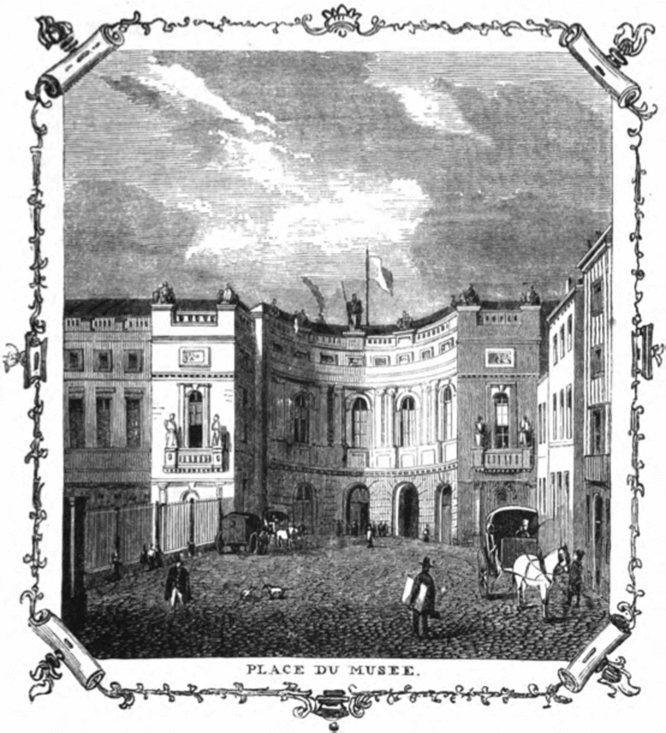
If Foucault's concept of heterotopia helps us to understand the theoretical dimension of Lucy's remarks, Brontë's experiences in Belgium ground them in material history. Charlotte lived, studied French, and taught English at the Pensionnat Heger in Brussels for the majority of 1842 and 1843, in the company of her sister Emily for the first half of her stay and then alone. As Gustave Charlier and Eric Ruijssenaars have noted, many of the characters, places, and events described in Villette have analogues to those Brontë would have encountered during her time abroad, many of which would have been identifiable to those with a knowledge of Belgium. Thus, when Lucy rather coyly refers to her visit to “a certain gallery” in Brussels, her more cosmopolitan readers would likely have recognized the place to which she was obliquely referring: what was at the time the only real art museum of note in Brussels, the Palais des Beaux-Arts (See Figure 5).Footnote 9 Located within the Palais de Charles de Lorraine – commonly known as “l'Ancienne Cour” – the art museum shared the space with three other collections: a library, a museum of natural history, and the Palais de l'Industrie, the last of which was dismissively described in an 1859 guidebook as “a curious collection of models of engines, sluice-gates, machinery, etc.” (Weale 51). The Palais des Beaux-Arts, often referred to in Belgian and English publications simply as “le Musée” or “the museum,” was situated on the second floor of the building, where it occupied a series of interconnected rooms and galleries, the largest of which was constructed in 1826 after a fire destroyed part of the museum.Footnote 10 The permanent collection during the years of Charlotte's stay was comprised largely of native or “national” art – a designation that was stretched to include everything from the early Flemish school to contemporary Belgian neo-classicism and romanticism – with a smattering of works by foreign artists. Widely considered inferior to the collection in Antwerp, the Brussels Musée was often spoken of slightingly in English travel literature of the periodFootnote 11; for example, Charlotte's beloved Thackeray, who visited Belgium in 1840 and 1843, was demonstrably unimpressed, calling the Palais des Beaux-Arts “an absurd little gallery, absurdly imitating the Louvre, with just such compartments and pillars as you see in the noble Paris gallery; only here the pillars and capitals are stucco and white in place of marble and gold, and the plaster-of-Paris busts of great Belgians are placed between the pillars” (Thackeray 346).Footnote 12
“Place du Musee.” Illustration from Alphonse Wauters, Bruxelles et ses Environs. (Bruxelles: Chez C. Muquardt, 1845–46): 101.

Regardless of its disputed merits, the Musée would have presented Charlotte Brontë with an unprecedented degree of access to the fine arts, and moreover, her stay coincided with an event that would have transformed the galleries in the l'Ancienne Cour into an even greater attraction. In 1842, it was Brussels’ turn to host the Exposition Nationale des Beaux-Arts, an exhibition held triennially in Antwerp, Ghent, or Brussels, featuring new artworks by mostly Belgian artists (See Figure 6).Footnote 13 From the 22nd of August through the 9th of October, the 686 art objects on display at the Salon de 1842 were open to the scrutiny of the public most days from 10 a.m. to 3 p.m., these hours being dependent on the fact that windows in the roof lighted the major gallery of the Musée.Footnote 14 Contemporary newspaper accounts of the Musée during the exhibition paint a picture of a space filled beyond capacity with all manner and quality of art objects, where works evocative of “calm and happiness, suffering and despair, wealth and poverty, beauty and ugliness, all very nearly touch” (Robin 31, trans. mine). The reviewer for L'Artiste provides one of the most detailed depictions of the Salon's layout:
Now, let us go to the opening of the Brussels Salon, and enter with the crowd into the many rooms of the exhibition. The first room to the right upon entering plays a role akin to that of the Salon Carré at the Louvre. It offers to the immediate notice of the visitor artworks either widely favored or judged in advance as very remarkable. The large gallery that follows it is a little less aristocratic. There are a large number of paintings which clash with each other and which meet side by side; the profane is close to the sacred, the terrible close by the graceful or the severe. It is a kind of pandemonium, but ultimately the day there is still passable. As for the fifteen or twenty rooms after the large gallery, in which are exhibited haphazardly paintings of every genre, often incorrectly placed and out of the light, we cannot but compare them to a petty gallery of wood which one has suddenly become aware is hanging off of the side of the Louvre, just like a vast nest of swallows. The paintings there have, in effect, neither enough distance nor enough light. It is the purgatory of pictures. (311, trans. mine)
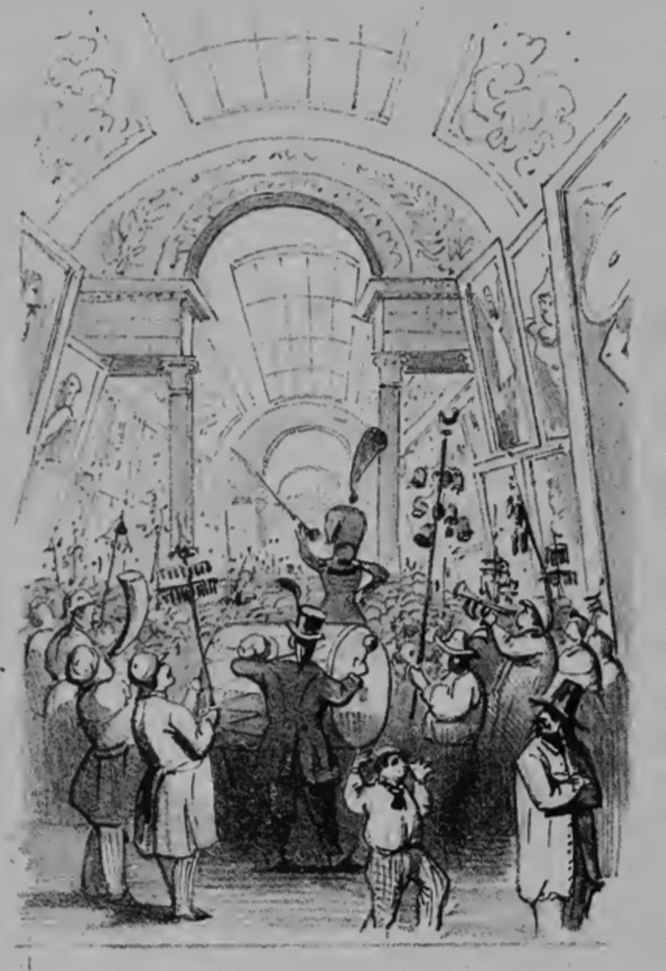
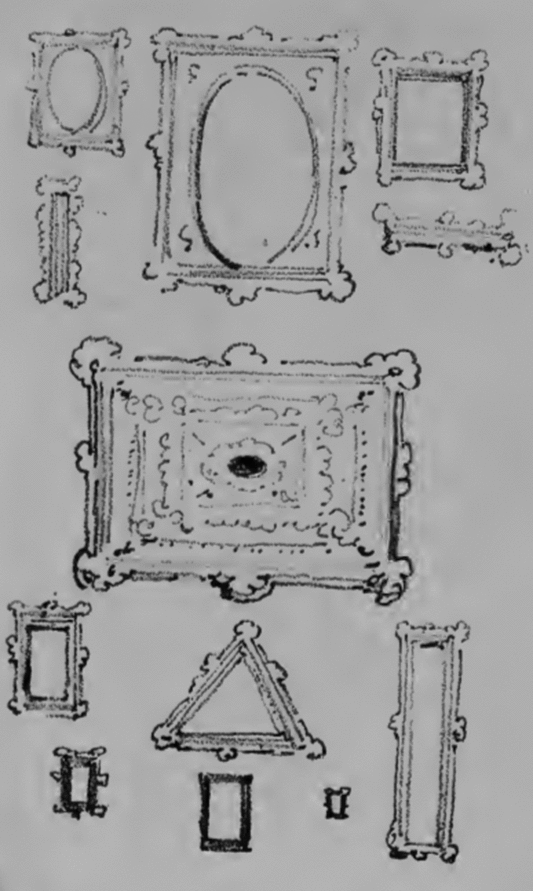
L'Artiste was not the only periodical to insinuate the influence of coterie politics on the arrangements of the accepted artworks at the Salon; for instance, it is likely not a coincidence that a large work by Belgian neo-classical painter François-Joseph Navez – the current director of the Académie Royale des Beaux-Arts in Brussels and member of the Salon's Executive Committee – was given “la place d'honneur” in the first gallery of the Salon, where it would catch the eye of every incoming visitor (“Salon National de 1842” 81). Other works, by less distinguished artists, were left to languish in the overcrowded wings, hung one above another, almost up to the ceiling of the gallery (See Figure 7).
Illustration from Promenade Charivarique au Salon de Bruxelles, 1845. (Bruxelles: Chez tous les Libraires, 1845): 4.
Illustration from Promenade Charivarique au Salon de Bruxelles, 1845. (Bruxelles: Chez tous les Libraires, 1845): 68.
If this somewhat structured chaos of the Musèe during the Salon served as Brontë's primary model of the museum in Villette, one can better understand why she chose to have Lucy preface her narration of her trip to the gallery with an allusion to Ruskin's aesthetic credo, as his insistence on the strict standards by which one deduces the intrinsic merit of an art object provided a means of separating the wheat from a voluminous amount of chaff. Ruskin's famous injunction to the young artist to “go to Nature in all singleness of heart . . . having no other thoughts but how best to penetrate her meaning and to remember her instruction . . . rejoicing always in the truth” is echoed in Lucy's comments on what distinguishes a good painting from a bad one (210). For Lucy, even “chef d'oeuvres bearing great names” might be dismissed if what they represent is “not a whit like nature”; those worthy of her praise are ones that display
fragments of truth here and there which satisfied the conscience, and gleams of light that cheered the vision. Nature's power here broke through in a mountain snow-storm; and there her glory in a sunny southern day. An expression in this portrait provided clear insight into character. . . . These exceptions I loved: they grew dear as friends. (275)
Performing Ruskin's command for the artist to “penetrate” Nature's hidden meaning, Lucy's ideal conception of aesthetic experience imagines the viewer seeing through the painting's surface and catching a glimpse of an underlying elemental power or universal truth. However, Lucy's position differs from Ruskin's in that she can only conceive of this process as occurring in a piecemeal fashion. Only in “fragments” and “gleams” can a particular representation pierce through the layer of convention and communicate anything of significance. Moreover, Ruskin's formulation never considers what Lucy's opening and the anecdote that follows take great pains to establish: that the space of the museum works against the epiphanic moment, intruding into the hypothetically pure encounter between subject and object and disrupting the ecstatic transcendence through aesthetic sensibility into the noumenal realm of Nature's “truth.” One such obstacle of the museum, Lucy observes in terms very similar to the critic in L'Artiste, is the sheer volume and inconsistent quality of the art on display. Before lighting upon one of the brilliant exceptions capable of instructing and elevating the viewer, the eye must first wade through a flood of unnatural images – nature scenes in which “Nature's daylight never had that colour,” mythological tableaus full of figures “by no means the goddesses they appeared to consider themselves,” and “many scores of marvellously-finished little Flemish pictures . . . [which] gave evidence of laudable industry whimsically applied” (274–75). The “wonderful sense of fatigue” resulting from this visual labor, from sorting through the mixed bounty the museum provides, depletes the viewer's mental resources, making communion with the truly superior object a more muted, less all-encompassing experience (274).Footnote 15
Another aspect of the gallery that Brontë identifies as presenting an obstacle to the practical implementation of Ruskin's model of aesthetic experience is the “prescriptive museological stagecraft and dramaturgy” that intervenes in and complicates the viewer's relation to the individual art object (Preziosi 52). In Villette, the museum's artificial and anticipatory staging of the aesthetic encounter is itself put on display through Lucy's recounting of her experience with the chapter's titular artwork – a much-lauded painting of Cleopatra. Lucy describes the arrangement of the gallery in a way that strives to expose its constructedness, its contrivedness:
One day, at a quiet early hour, I found myself nearly alone in a certain gallery, wherein one particular picture of pretentious size, set up in the best light, having a cordon of protection stretched before it, and a cushioned bench duly set in front for the accommodation of worshipping connoisseurs, who, having gazed themselves off their feet, might be fain to complete the business sitting: this picture, I say, seemed to consider itself the queen of the collection. (275)
In this long and elaborate sentence, a paragraph unto itself and an anacoluthon to boot, Lucy gives the most ironical of answers to a question often asked by museum visitors: How does one know which art object is “the queen of the collection”? The answer: Look for the one sitting on the throne. Refusing at this moment to give the reader any clue as to the picture itself (except a brief note about how its size indicates a pretension to grandeur on the part of the artist), Lucy instead focuses on how the arrangement of the space surrounding the painting – what Tony Bennett has called its “layout” – is designed to underscore its importance and to reinforce the gallery's “theory” – “a particular set of explanatory categories and principles of categorization” that promote the Cleopatra to its prominent position (165). Using a series of buried clauses, one piled upon the next, her grammar serves as a textual analogy for this spatial structuring; not only is this painting placed front and center, but it is placed in the best light, is sectioned off from the rest of the gallery by a protective barrier, and has a bench set in front of it in order to herd onlookers into an appreciative group before it. Indeed, the only way to describe the scene is to embed descriptive phrase within descriptive phrase, repeatedly deferring the reader's encounter with the painting itself. Thus, the experience of reading this passage mimics the experience of viewing the painting; Brontë prepares the reader for what is about to be described in much the same way that the museum prepares the viewer for the encounter with the celebrated picture. Yet, as the conclusion of this sentence implies, no amount of scenic pageantry can change the intrinsic worth of the art object. The painting is “the queen of the collection” not because there is anything about it essentially powerful and worthy of worship. Rather, like her living counterparts, the Cleopatra's status as monarch is largely a function of the arbitrary organization of things, royalty and other positions of power being themselves bestowed by cultural customs, biological accidents, political arrangements. Thus, in spite of the pomp and circumstance heralding its presence, the painting's appearance of value is mostly the product of its situation within the artificial, coded space of the gallery.
Lucy Snowe's description of the gallery housing the Cleopatra indicates a recognition of and resistance to a form of aesthetic experience in which one's response to an art object is manipulated by external circumstances. While she makes a point of noticing the physical boundary separating the picture from the viewer, her highly figurative language also collapses (or at least complicates) the distinction between the imaginary space of the painting and the “real” space of the museum. The non-verbal signifiers used by museum curators to confer distinction on a particular painting – ornate frames, prohibitive cordons, light sources, chairs and benches (all of which, in truth, work to position the viewer) – are read parodically as indicators of the homage to which the painting feels that it is entitled as “the queen” of this particular collection. By pretending to ignore the role of the museum in establishing a painting's value and instead ironically attributing that evaluative capacity to the picture itself (anthropomorphizing it only to deride its conscious self-satisfaction with its own beauty), Lucy underscores the strange and ultimately groundless abdication of authority practiced by viewers when they allow their judgment to be manipulated by the literal arrangement and figurative ranking of art objects in a space designed for aesthetic contemplation and consumption. Moreover, as her derision of the painting's supposed feeling of entitlement suggests, the viewer is encouraged to relinquish her own evaluative agency through the implication that artistic value is an intrinsic feature of the art object itself. To appreciate a painting because it is placed in such a way that it demands notice, Lucy suggests, makes as little sense as crowning a woman a queen simply because she sees herself as royalty.
Tony Tanner has argued that the art gallery and the theatre in Villette are “framed spaces” in which “[t]he frame separates the audience from the spectacle and thus the framed space is discontinuous with the social space containing it.” “One effect of this,” he adds, “is to allow extremes of representation or action, (which are only latent or totally suppressed in the social space,) to be projected in a way which allows for contemplation without actual involvement” (21–22). What Tanner might have considered, though, is that the museum – unlike the theater – is a social space designed to create relations not only between the viewer and the art object but also between the viewer and other viewers.Footnote 16 Without such clear lines of division, the theatricality of museum space is capable of transforming viewership itself into a performance, a point that Lucy herself acknowledges when she describes her dislike of visiting such places with others:
In company, a wretched idiosyncrasy forbade me to see much or to feel anything. In unfamiliar company, where it was necessary to maintain a flow of talk on the subjects in presence, half an hour would knock me up. . . . I never yet saw the well-reared child, much less the educated adult, who could not put me to shame, by the sustained intelligence of its demeanour under the ordeal of a conversable sociable visitation of pictures. (274)
The problem with visiting a museum in a group is complex. On the one hand, the consciousness of others’ presences makes the subjective experience of aesthetic reflection nearly impossible, preventing Lucy from “see[ing] much or . . . feel[ing] anything.” On the other, to be “in company” at the museum is to submit to being on display to and as a part of that company. At the theatre, one might attend as part of a group and yet, for at least the duration of the play, hide in the darkness of the auditorium, allowing for the “contemplation without involvement” that Tanner describes. The well-lighted, open space of the museum, however, does not offer its visitors the same security against scrutiny. Instead, it creates an environment in which private perceptual acts can have a public aspect and potentially a social function. In the “conversable sociable visitation of pictures” that Lucy finds so arduous, contemplation is no longer an end in itself but rather a means to an end; one looks at pictures in order to speak on them, in the process demonstrating a certain level of aesthetic proficiency as well as politely contributing to the social “flow of talk on the subjects in presence.” Even when one is not speaking, Lucy laments, one must be conscious enough of oneself to sustain an “intelligence of demeanour” that signals a certain level of engagement with others. Tellingly, Lucy sees the social necessity as an “intelligence of demeanour” rather than, say, an intelligence of expression. A “demeanour” (etymologically and otherwise) has little to do with real feelings; it refers to a “conduct, way of acting,” a “manner of comporting oneself outwardly or towards others” [OED]. A public persona that is constructed out of internalized social codes, “demeanour” is self-discipline intended for an audience. Thus, when Lucy states that both an “educated adult” and a “well-reared child” are her superiors in this regard, it is not true aesthetic engagement that she is speaking of but rather the look of engagement, not the disinterested, detached perspective valorized by aesthetic theorists but an active mode of viewership that the museum encourages or requires.
Indeed, what Lucy's subsequent narration of her Belgian gallery visit makes clear is that no one is truly outside the shaping influence of those cultural scripts that structure the space of the museum. While Brontë invests her heroine with a critical awareness of the social dynamics that complicate idealized conceptions of aesthetic experience, this awareness only serves to heighten and, in different ways, to ironize the intrinsically dramatic nature of her encounter with the Cleopatra. It is Lucy's very attentiveness to the ways in which outside circumstances can manipulate her aesthetic responses that renders the Cleopatra an object of such importance, and her description of the painting, for this reason, is an exercise in resistance:
It represented a woman, considerably larger, I thought, than the life. I calculated that this lady, put into a scale of magnitude suitable for the reception of a commodity of bulk, would infallibly turn from fourteen to sixteen stone. She was, indeed, extremely well fed: very much butcher's meat – to say nothing of bread, vegetables, and liquids – must she have consumed to attain that breadth and height, that wealth of muscle, that affluence of flesh. She lay half-reclined on a couch: why, it would be difficult to say; broad daylight blazed round her; she appeared in hearty health, strong enough to do the work of two plain cooks; she could not claim a weak spine; she ought to have been standing, or at least sitting bolt upright. She had no business to lounge away the noon on a sofa. She ought likewise to have worn decent garments; a gown covering her properly, which was not the case: out of abundance of material – seven-and-twenty yards, I should say, of drapery – she managed to make inefficient raiment. Then, for the wretched untidiness surrounding her, there could be no excuse. Pots and pans – perhaps I ought to say vases and goblets – were rolled here and there on the foreground; a perfect rubbish of flowers was mixed amongst them, and an absurd and disorderly mass of curtain upholstery smothered the couch and cumbered the floor. On referring to the catalogue, I found that this notable production bore name ‘Cleopatra.’ (276)
Lucy's spirited and combative engagement with the painting is a direct response to her reading into its subject, style, size and spatial arrangement an institutionalized insistence on its value. Of course, by making the Cleopatra the battlefield on which she stakes her opposition to the collective standards of judgment that would praise it, she tacitly acknowledges the painting's social – if not aesthetic – significance. This acknowledgment, though, is necessary to the larger agenda that informs this chapter of Villette. In order for Brontë to illustrate the process by which certain spaces transform aesthetic experience itself into a self-conscious spectacle, her heroine must engage with a painting that, if we take her earlier professions at face-value, is beneath her notice. Yet the Cleopatra, epitomizing a mode of artistic representation that is focused solely on technical mastery, on surface detail that is “beautiful” rather than “true,” complements the performative mode of aesthetic valuation that Lucy ironically mimics and, through mimicry, seeks to unsettle.
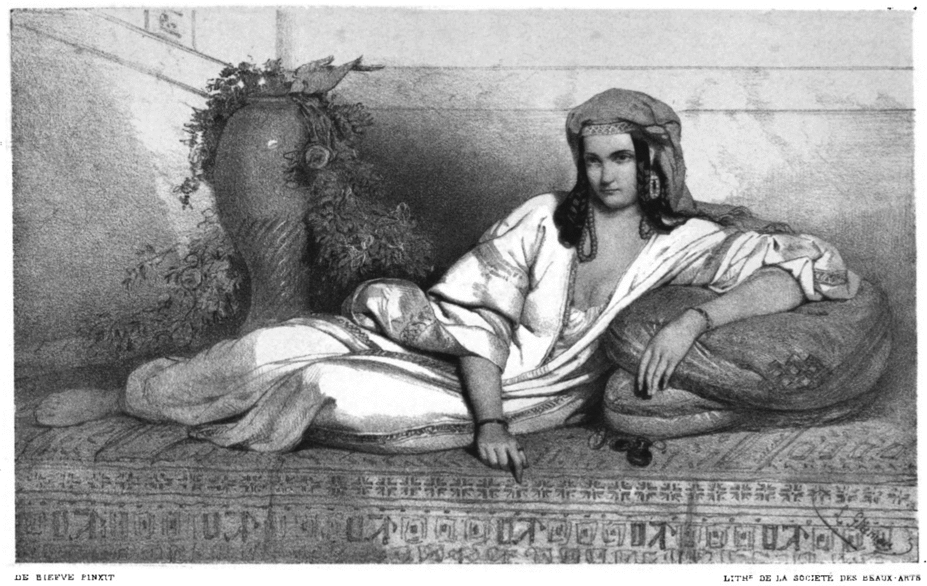
That Brontë made the subject of this painting Cleopatra is no less important to the scene than its style. As other critics have noted, Brontë probably based the picture on one of the more notorious submissions to the 1842 Salon, a painting by prominent Belgian artist Edouard de Biefve titled Une Almé (A Dancing-Girl) (Charlier 387) (See Figure 8). Identified and discussed in many newspaper and periodical reviews of the exhibition, de Biefve's canvas presented an image of (in the words of the Revue Belge) “a young woman, dark and beautiful, dressed in a transparent tunic, softly lying on a rich ottoman” (113, trans. mine).Footnote 17 By reimagining de Biefve's unnamed odalisque as a representation of the infamous Egyptian queen, Brontë situates the image more broadly within what Jill Matus has called “the burgeoning nineteenth-century fascination with the East and interest in Oriental exoticism” (347). More specifically, Cleopatra was of particular interest to artists and writers of the period as a femme fatale, embodying “a passion [that] springs out of the habitual craving of a licentious nature, and that . . . is supported and reinforced by voluntary stimulus and sought-for associations, instead of blossoming out of spontaneous emotion” (Coleridge 77). It is not simply Cleopatra's supposed carnality that constitutes her dangerous allure but also the assumption that this carnality is itself deliberately cultivated. Her incitement of her own “licentious nature” is seen to give her “passion” a dramatic aspect, rendering it a provocative display directed towards a susceptible viewer. Coleridge's representation of Shakespeare's character closely aligns with Brontë's imaginary ekphrasis in their shared insistence on the unnatural quality of Cleopatra's posturing. In both cases, the figure of Cleopatra symbolizes the art object's power to seduce and, in the seduction of the viewer, to “deny things their truth and turn it into a game, a pure play of appearances” (Baudrillard 8).
Edouard de Biefve, “Une Almé.” Engraving, from La Renaissance. Tome Troisième. (Bruxelles: Imprimerie de la Société des Beaux-Arts, 1841–42).
The play of seduction depends on the willing complicity of the seduced with the seducer, an implicit agreement to keep everything on the surface level, with signs rather than referents. In the case of the art object, the image seduces the viewer by holding the attention to its formal features and diverting all attempts to see below that beautiful surface, to the network of social and economic factors that determine its meaning. Yet, in Villette, though the picture of Cleopatra is described as every bit the temptress as the real woman it is meant to represent, Lucy Snowe's aesthetic encounter with the painting is as great a failure of a seduction as anything in the fiction of Samuel Richardson. Lucy is unlike those earlier heroines in most respects; however, in her decided rejection of the solicitations of the spectacular image – in her refusal, as it were, to be charmed – she too turns in a virtuoso performance of personal virtue. What makes Lucy's engagement with the painting a performance of virtue is that she puts herself in a position where the painting could potentially work its spell on her. Rather than virtuously avoiding the painting altogether (which is what, it is later suggested to her, propriety obliges her to do), she instead faces the temptation and withstands its solicitations. Looking at the painting with a critical eye, dwelling at length on its stratagems and flaws, she refuses to admire it in the way that the space of the gallery and the painting itself demand. As she rather acerbically tells the reader, she will sit on the seat thoughtfully provided for her viewing pleasure for no other reason than “the bench was there” and she “might as well take advantage of its accommodation,” not because, like the connoisseurs before her, she has any intention of being swept off her feet (276).
Her description of the painting further demystifies its allure by humorously translating its aesthetic effects into alternate frames of value, where the odalisque does not fare nearly so well. The picture is first assessed using the language of the market-place and economic theory: imagining the figure of the Cleopatra as a “commodity of bulk,” Lucy wonders whether her “Junoesque” form is worth the amount of “butcher's meat . . . bread, vegetables, and liquids” required for the attainment of “that wealth of muscle, that affluence of flesh” (275, italics mine). Lucy then speaks from a medical standpoint: “she appeared in hearty health . . . she could not plead a weak spine; she ought to have been standing, or at least sitting bolt upright” (275). Finally, she surveys the scene from the joint perspectives of social and domestic propriety, Mrs. Grundy and Mrs. Beeton combined, and, on this front, chastises Cleopatra both for her indifferent and indecent toilette (“she ought . . . to have worn decent garments, a gown covering her properly”) as well as for the state of her abode (“for the wretched untidiness surrounding her, there could be no excuse”) (275). Voicing resistance to the Cleopatra-as-painting through a sarcastic, scathing critique of the Cleopatra-as-woman, Lucy invokes the authority of different evaluative discourses and, in the process, demonstrates how that authority is attained through a performance of judgment that, in each instance, reifies social norms and results in the controlling objectification of the “feminine.” By using the language of the market, medicine, and domestic morality in her assessment of the picture, Lucy brings into the realm of the aesthetic the more prosaic concerns of the outside world and insists on their interrelatedness. The Cleopatra is not merely an enigmatic image, impervious to penetration; recontextualized (however satirically), she is the product of a complex and contradictory set of cultural scripts on which subjective judgments of taste depend.
A spectacle exists primarily to be seen, its dazzling surface constantly threatening to overwhelm conscious thought through visual over-stimulation. Lucy's deliberate misreading of the painting is only one of the strategies she employs to avoid succumbing to the spectacle. She simply refuses to view it as such. Avoiding confronting the picture directly (as an image in its totality), she focuses instead on the details of its arrangement, stressing particularly its affectedness. Even her sole compliment to the painting – that “some of the details – as roses, gold cups, jewels, &c. – were very prettily painted” – undermines the Cleopatra's potential aesthetic effect by limiting its success to the competently pretty representation of various feminine trifles, so unimportant as to merit an “&c.” Lucy further undercuts the painting's claim to attention by contrasting those small details of roses, gold cups, and jewels, with details from a number of adjacently situated “exquisite little pictures of still life: wild-flowers, wild-fruit, mossy wood-nests, casketing eggs that looked like pearls seen through clear green sea-water” (276). The comparison is an intricate one, working on a number of levels. Considered broadly, the artificiality of the Cleopatra, metonymically evoked through the list of cultivated and crafted objects, is set against the quasi-natural authenticity of the still lifes. Narrowing the focus still further, one sees that each detail in the first list has a counterpart in the second: for the carefully-tended roses we have wild-flowers and fruit; for golden goblets we have more rustic receptacles, birds’ nests; and for precious gemstones we have glossy-shelled eggs, poor mens’ pearls. The indirect comparison of these two sets of objects works to demystify and devalue the allure of the Cleopatra, mostly by drawing attention to the obviously provocative function of even the minutiae of the “coarse and preposterous canvas” (276).Footnote 18 All luxury items, the roses, gold cups, and jewels that clutter the foreground of the painting are evocative of wealth, sensuousness, and, more crudely, female genitalia; within the context of the painting, they reinforce the erotic promise of the odalisque.Footnote 19 When offset by more natural symbolic equivalents – equivalents that suggest not feminine sexuality so much as fertility – they become little more than stage props, objects that have the appearance of value but are barren of any real meaning.
In this passage, Lucy strives to dispel the magic of the spectacular image in the same way that she reveals the contrivances of museum space: by exposing the technical machinery behind the effects. Her final evaluation of the painting – that it is “on the whole an enormous piece of claptrap” (i.e., “a device or trick for catching applause” [OED]) – only makes explicit what has inspired her antagonism in the first place; it is the manipulative theatricality of the Cleopatra, a theatricality that extends beyond the frame to include the dandified connoisseur on his “cushioned bench” mirroring the Egyptian odalisque on her sofa. Though Lucy herself sits on this bench, her engagement with the Cleopatra ridicules the facile, sensuous obsession with beautiful surfaces and demands a new standard of valuation, one based on the “truth” of the image. Still, her means of engagement – the parody – has a performative element not wholly dissimilar to the behavior of the aesthetes from whom she is trying to distinguish herself. Thus, Lucy's surveillance of the spectacle (her skeptical, interrogative stance) involves her in what Joseph Litvak calls “the spectacle of surveillance,” in which the act of viewing implicates the viewer in “a widespread social network of vigilance and visibility” (x). Hardly the disinterested spectator, Lucy's performance of viewership exposes what the situation of the painting – its arrangement, its protective cordons, its frame – is always attempting to conceal: the lack of fixed boundaries in the ever-shifting relation between viewer and aesthetic object. The space of the museum is all about situating the viewer, positioning the viewer's body in such a way as to arrange a particular relation to the art object, one that encourages the viewer to adopt the cultural narrative which the space and its objects endorse. It is a fiction perpetuated by the museum, however, that viewers are interchangeable, that the individual does not bring to the viewing experience particularities that influence how the art object is apprehended. Moreover, this fiction requires the viewer's participation in the form of an espousal of appreciation that feigns ignorance of how that appreciation is itself conventional, both elicited and confirmed by the institution in which viewing takes place.
Early in the chapter, Lucy Snowe describes previous trips to the museum as characterized by an internal battle “between Will and Power”:
The former faculty exacted approbation of that which it was considered orthodox to admire; the latter groaned forth its utter inability to pay the tax; it was then self-sneered at, spurred up, and goaded on to refine its taste, and whet its zest. . . . Discovering gradually that a wonderful sense of fatigue resulted from these conscientious efforts, I began to reflect whether I might not dispense with that great labour, and concluded eventually that I might, and so sank supine into a luxury of calm before ninety-nine out of a hundred of the exhibited frames. (274)
One of many such instances in the novel where Lucy personifies her emotions to create a narrative of her inner life, here she transforms her conflicting feelings regarding matters of taste into an epic struggle between enemy combatants. The names that she gives to these feelings – Will and Power – have their precedent in the second volume of Modern Painters, in a chapter titled “Accuracy and Inaccuracy in Impressions of Taste.” In this chapter, Ruskin justifies his claim that there are objectively right and wrong sources for subjective “sensations of beauty” by arguing, first, that “an impression of sense may be deceptive” and, second, that “an impression of sense, or a preference of one, may be a subject of will, and therefore of moral duty or delinquency” (46–47). While he admits that man has no control over “immediate” impressions, he sees “ultimate” impressions as governable by man's moral faculties, and thus “it is the duty of men to prefer certain impressions of sense to others, because they have the power of doing so” (49). For Ruskin, Power (the aesthetic faculty) exists as a handmaiden to Will (the theoretic faculty), and it is the responsibility of the viewer to train and direct his taste toward those objects whose established reputations are seen to attest to their intrinsic merit.
Brontë's dramatization of this inner dynamic reframes Ruskin's formulation in a way that calls into question some of the comfortable assumptions on which it rests. In Lucy's narrative, Will is not the individual incarnation of a universal morality so much as an internalization of cultural hegemony, which tyrannizes over the individual's aesthetic responses by demanding tribute to objects that are generally admired but have left the viewer cold. Power, ironically the subaltern in this equation, can only resist by passively refusing to “pay the tax,” withholding its approval even at the expense of its own social legitimacy. That being said, it is clear that Lucy's “taste” – at least as it manifests itself in this chapter – tends towards the kinds of art objects that Ruskin had such a large role in raising to prominence, so why does Brontë feel it necessary to subvert what Modern Painters asserts to be the proper relation between these two aesthetic faculties? Also, why follow Lucy's declaration with her excitedly disdainful engagement with the Cleopatra, a painting that epitomizes the conventional art towards which she should be apathetic but in front of which she can hardly be said to “s[i]nk supine”? For one thing, by translating Ruskin's hierarchal relation between aesthesis and theoria into a narrative of internal conflict, Brontë gestures towards the potential pitfall of forcing one's wayward impulses to comply with morally-inflected standards of judgment: that the effort to discipline one's natural preferences might extinguish them all together, leaving the individual psyche a victim of Stockholm Syndrome, tricked into believing the conventional tastes of the broader culture are inseparable from one's own.
A desire to avoid this fate, though, does not fully account for Lucy's strong reaction against the Cleopatra. While she is able to quickly and confidently dismiss other celebrated artistic productions as not conforming to Ruskin's mimetic standards, this one painting provokes her ire to a disproportionate degree, suggesting that there is something more at work than a general fear of cultural indoctrination, something specific to her own character and situation. Considered objectively, the Cleopatra can be written off using the Ruskinian litmus test: it is “not a whit like nature.” Yet, as the embodiment of a highly sexualized but ultimately passive femininity, the Cleopatra is also not a whit like Lucy's nature, and herein might be the source of her peculiar animus. By granting the painting the praise that the museum suggests it is due, Lucy implicitly would be sanctioning her own marginalization in the social sphere on the basis of her deviation from the dominant model of femininity that it represents. In other words, Lucy does not have “the luxury of calm” at this moment; she must actively align herself against the Cleopatra, because, failing to do, she risks self-negation through the overwhelming presence of an idealized image of womanhood that represents everything she is not. Seen in this light, Lucy's Dickensian mockery of the painting can be read as a defensive strategy, a performance of aesthetic evaluation that seeks to contain the affective force of the Cleopatra by revealing its artificiality, resisting its dangerous allure by focusing instead on the institutional mechanisms on which the spectacle depends.
“A perfect crowd of spectators”: The Viewer Viewed and Other Specular Peculiarities
In Villette, Brontë's interest in how the coded space of the museum impacts the internal dynamics of viewership is matched by an equal degree of perspicacity regarding its influence on the external social relations between viewers. Though the museum is ostensibly constructed to encourage individual perceptual experiences, the fact that others are witness to those experiences complicates and compromises the viewer's claim to authority. Thus Lucy, in the aftermath of her masterful deconstruction of the Cleopatra, finds herself in the gaze of M. Paul Emanuel, her school's professor of literature. Directly following Lucy's observation that she need not heed the arrival of other spectators in the gallery, “as,” she asserts, “indeed, it did not matter to me,” M. Paul's intrusion throws her comment into a certain ironic relief:
Suddenly a light tap visited my shoulder. Starting, turning, I met a face bent to encounter mine; a frowning, almost a shocked face it was.
‘Que faites vous ici?’ said a voice. (276)
In a reversal of roles, Lucy finds herself sharply scrutinized by a sensibility as critical as her own. The abrupt visitation of this unidentified figure breaks in upon her reverie and reminds Lucy (and the reader) that she is not outside the evaluative space of the museum. Moreover, M. Paul's question (“What are you doing here?”) initially threatens to undermine Lucy's carefully constructed aesthetic persona by doubting her right to be there in the first place. Emanuel's objection to Lucy's situation, though, has less to do with her presence in the museum than with her choice of viewing material. A young, unmarried, and unaccompanied woman has decided for herself to sit before the Cleopatra. It is, as he tells her, a matter of propriety: “How dare you, a young person, sit coolly down, with the self-possession of a garçon, and look at that picture?” (277).
While Emanuel's critique is humorously rendered, his statements serve a larger purpose in Brontë's narrative anatomizing of the conventions of spectatorship. M. Paul recognizes in Lucy's self-possessed viewing of “that picture” the mark of a personality prone to insubordination. Aligning her quiet contemplation of the Cleopatra with something like the bold stare of a cheeky young man, Emanuel locates Lucy's aesthetic experience within a distinctly social register. Evincing no interest in her subjective impressions of the painting, he instead focuses on the objective fact of her looking at it. His scandalized overreaction serves to move Lucy's interior monologue, her private act of viewership, into the public sphere, where her gaze becomes a contested object in an implicit struggle for power that plays out between the two of them. His subsequent attempt to redirect her attention to subjects more proper for female contemplation – which he does by physically moving her from the scene of the Cleopatra and towards a quadtych titled “La vie d'une femme” – only further evidences the social dynamics at work in the space of the museum. “La vie d'une femme,” as Lucy notes, occupies not center stage like the Cleopatra but rather “a particularly dull corner,” which is not especially surprising given the subject matter:
The first [of the four panels] represented a ‘Jeune Fille,’ coming out of a church-door . . . her eyes cast down, her mouth pursed up – the image of a most villainous little precocious she-hypocrite. The second, a ‘Mariée’ with a long white veil, kneeling at a prie-dieu in her chamber . . . and showing the whites of her eyes in a most exasperating manner. The third, a ‘Jeune Mère,’ hanging disconsolate over a clayey and puffy baby . . . The fourth, a ‘Veuve,’ . . . holding by the hand a black little girl, and the twain studiously surveying an elegant French monument, set up in a corner of some Père la Chaise. All these four ‘Anges’ were grim and gray as burglars, and cold and vapid as ghosts. . . . insincere, ill-humoured, bloodless, brainless nonentities! As bad in their way as the indolent gipsy-giantess, the Cleopatra, in hers. (277–78)
This fictional image, like the Cleopatra, is based on a triptych that Brontë viewed at the Brussels Salon – La Vie d'une Femme: Piété, Amour, Douleur by Fanny Geefs (Charlier 384). Another standout of the exhibition according to the press, Geefs's painting was celebrated by numerous reviewers for its “charming naïveté and sincere sentiment” (“Salon National de 1842” 92). “Madame Geefs,” asserts the Revue de Bruxelles, “does honor to an art that few women have cultivated with as much success. Her Vie d'une Femme, in which she represents the various phases of piety, love, and pain, is a work that could not be more graceful” (343, trans. mine).Footnote 20 As Sally Shuttleworth has observed, Brontë's incorporation of Geefs's painting into Villette serves to provide, in clear contrast to the Cleopatra, an alternative construction of femininity that is more socially acceptable if every bit as androcentric (154). Characterizing the life of woman as defined by four stages – girlhood, married life, motherhood, and widowhood – Brontë's take on Geefs's La Vie d'un Femme exposes how the painting validates a palpably bourgeois gender ideology. Yet, the four panels are also united by a common feature, to which Lucy's description insistently draws attention. While all four women look as they are supposed to (insofar as all of the images offer cloyingly clichéd feminine ideals), they also look where they are supposed to. The gaze of each figure, as Lucy points out, is reverently – if disconsolately – directed towards an acceptable recipient of worship, be it God, infant, or dead husband. Yet, their concentration, it is intimated, is exaggerated to the point of artificiality, and ultimately, this posture of dutiful attention is seen to deprive them of vitality, rendering them as weirdly inhuman as excessive materiality does the Cleopatra.
When, subsequent to this description, Lucy declares that “it was impossible to keep one's attention long confined to these masterpieces,” she is arguably stating a psychological imperative more than an aesthetic opinion. To “confine” her attention to La Vie d'une Femme would be to replicate the conventional performance of viewership that turned those depicted female figures into “bloodless, brainless nonentities” and to senselessly reenact the social scripts that inform such images. For Lucy's gaze to remain fixed on the painting would also entail her opting out of the strange game of mutual surveillance in which she and M. Paul are engaged. When she defies his edict and turns to “survey the gallery,” her roving eye meets his controlling one: “I noticed, by the way, that he looked at [the Cleopatra] himself quite at his ease, and for a very long while: he did not, however, neglect to glance from time to time my way, in order, I suppose, to make sure that I was obeying orders, and not breaking bounds” (278). The interplay of their glances – an interplay that also includes the two paintings – creates a dynamic of authority and rebellion. M. Paul's gaze strives to police Lucy's by keeping it restricted to the safe boundaries of one particular image, while Lucy's gaze escapes its confines in order to secretly survey its would-be jailer and the world outside its jail.
In many ways, it is the coded space of the gallery itself that lends their interactions such a dramatic charge, since Lucy, in defying M. Paul, is also defying the social conventions that determine and differentiate aesthetic experiences. Lucy's refusal to obey his “orders” is part and parcel of her broader resolve to come to her own conclusions about the images in the gallery, regardless of the institutional theories implicit in the space's layout. When M. Paul, in the traditional position of the male pedagogue, again instructs her to “turn to the wall and study your four pictures of a woman's life,” his authority rests on the assumption that there is something morally elevating for women about the pictures (280). Lucy's response – that “they are too hideous” – appeals to a different standard of valuation. They deliberately talk at cross-purposes; he attends to the pictures’ meanings, while she focuses on their form. Similarly, when she asks him what he thinks of the Cleopatra, his answer is consciously evasive: “Une femme superbe . . . des formes de Junon, mais une personne dont je ne voudrais ni pour femme, ni pour fille, ni pour soeur” [a superb woman, the form of Juno, but not a person I would wish for a wife, or a daughter, or a sister] (280, trans. mine). That a half-naked Junoesque female form is typically intended to evoke for the viewer his mother, sister, or daughter seems incredible, as does Emanuel's omission of the most obvious role for the Cleopatra – that of paramour and general object of masculine desire. By eliding the sexual appeal of the Cleopatra, though, he remains consistent in his attempt to shield Lucy, as an unaccompanied “demoiselle,” from a corrupting erotic subtext of which she is supposed to be ignorant. Meanwhile, Lucy's pert declaration that, in spite of his efforts, she can “see her [the Cleopatra] quite well from this corner” shows the failure of his efforts as well as her determination to claim for herself an independent perspective.
Through Lucy Snowe and M. Paul Emanuel's spectatorial battle-of-wills, Brontë reveals the hierarchies of power that structure aesthetic experience. Lucy's taunting and disobedient gaze further denaturalizes those accepted practices of viewership by refusing to train itself on subjects proper to its class, gender, and station. In her final, half-teasing affront to M. Paul, she sets her sights on something even more objectionable to the schoolmaster than the Cleopatra: a group of male spectators that have gathered before the odalisque. Asking Emanuel to “move an inch to the side,” Lucy's clearly directed stare draws from him the shocked question, “How! At what are you gazing now? You are not recognizing an acquaintance amongst that group of jeunes gens?” (281). M. Paul's question is again less a request for information than a chastening of any inclination to openly “recognize” a young man in public, such an acknowledgement implying a suspect familiarity. Lucy does admit to knowing one of the men – a young Belgian dandy, Alfred de Hamal, who is courting Lucy's student and countrywoman, Ginevra Fanshawe – but her reaction is at once less public and more radical than the social gesture that Emanuel expects. Contemplating de Hamal as he in turn ogles the Cleopatra, Lucy commences a scathing – if wholly internal – parody of the gentleman-aesthete, a parody made all the more subversive for having another gentleman-aesthete as the object of the desiring gaze:
In fact, I had caught a glimpse of a head too pretty to belong to any other than the redoubted Colonel de Hamal. What a very finished, highly-polished little pate it was! What a figure, so trim and natty! What womanish feet and hands! How daintily he held a glass to one of his optics! with what admiration he gazed upon the Cleopatra! and then, how engagingly he tittered and whispered a friend at his elbow! Oh, the man of sense! Oh, the refined gentleman of superior taste and tact! I observed him for about ten minutes, and perceived that he was exceedingly taken with this dusk and portly Venus of the Nile. (281)
A series of trite exclamations redundantly studded with exclamation points, Lucy's sketch of de Hamal uses the conventions of polite viewership against one of its more skilled practitioners. Her language plays with the typical gendering of the aesthetic relation to throw into relief the “feminine” preoccupation with physical appearance that characterizes the fop. Her deliberately objectifying gaze carves him up into pieces; de Hamal's “finished” pate, his “womanish” appendages, his “natty” figure all mark him as artificial a creation as the Cleopatra. Moreover, his manner of observation – the “dainty” use of a monocle, while “titter[ing]” to a friend – is as affected as the way in which Lucy describes him. In the scene before her, Lucy is presented with the realization of the aesthetic encounter that she believes the situation of the Cleopatra to encourage. De Hamal is the epitome of the swooning connoisseur, posed in front of the canvas, caught up in an act of aesthetic- and self-admiration. That a “hamal” is an “Oriental porter” and a “palanquin-bearer” [OED] seems important in this context, as it is on de Hamal's shoulders that the Cleopatra's reputation figuratively rests. As the “refined gentleman of superior taste and tact,” he is representative of those cultural forces that govern the aesthetic standards and practices inscribed in the museum. As Lucy's depiction of de Hamal takes pains to point out, though, the emptily performative nature of this variety of aesthetic experience creates a closed circuit of mutually-reinforcing subjects and objects. It is a hollow kind of appreciation insofar as it simply reifies those social codes that determine the experience in the first place.
Yet, if Villette is unsparing in its critique of cultural ciphers like the Cleopatra and de Hamal (objects and subjects that only simulate, offering a parody that is vacant of meaning), it does not advocate a return to an earlier, less self-conscious mode of aesthetic engagement. Instead, in the gallery scene, Brontë imagines a variety of perspectives and scenarios through which she can explore the complexities of the aesthetic encounter as it occurs in spaces created for acts of viewership. For Brontë, the individual's responses to the prescriptive nature of such spaces provides the greatest insight into the intricacies of spectatorship, intricacies to which she was first introduced through her reading of Modern Painters. Near the chapter's conclusion, Brontë's indebtedness to Ruskin again shows itself in her attempt to create a character that in some aspects approximates his ideally theoretic viewer, a viewer who responds to beauty with not just the senses but with his “moral being.” This figure, though, significantly is not Lucy Snowe but rather Dr. John Graham Bretton, and again, Lucy bears witness as he too encounters the art object that has evoked such revealing responses from the other characters.
After Lucy's extensive observation of de Hamal – an observation so intense, perhaps purposely so, that it causes M. Paul “to withdraw voluntarily” – her “pursuant” eye lights upon a fitting contrast to the Belgian dandy in the form of Dr. John, the man who brought her to the gallery: “He approached de Hamal; he paused near him; I thought he had a pleasure in looking over his head; Dr. Bretton, too, gazed on the Cleopatra. I doubt if it were to his taste: he did not simper like the little Count; his mouth looked fastidious, his eye cool” (281). Choosing to remain herself unobserved, Lucy watches Bretton and de Hamal as they contemplate the Cleopatra in close proximity to each other. As Lucy knows, the two are bound in more ways than the shared object of their gaze. They are also rivals for the affections of Ginevra Fanshawe, and the moment, as Lucy reads it, is charged with that significance. The Cleopatra functions as a placeholder for the absent Ginevra, and Dr. John's reaction to the painting underscores the differences between the men. Whereas de Hamal is “taken” by the sensuality of the image, Dr. John is faintly repulsed by it. He is not an admirer but a judge, and in his “cool eye” and “fastidious” mouth, Lucy reads a different standard of valuation from de Hamal's and also from Emanuel's. His “taste” (as opposed to the others’) depends on his ethics, and thus the provocative beauty of the Cleopatra does not engage his aesthetic sensibilities because its subject and style is, for him, morally objectionable. When Lucy finally announces her presence to Dr. John and joins him, they discuss various artworks in the gallery, including the Cleopatra. Lucy admires his unpretentious manner of aesthetic discourse: “without pretending to be a connoisseur, he always spoke his thought, and that was sure to be fresh: very often it was also just and pithy” (282). Still, that Dr. John always speaks his mind but is only very often “just” in his evaluations leaves open the possibility that even the theoretic viewer has a blind spot, a particular point on which his judgments are compromised by certain prejudices. His evaluation of the Cleopatra hints at what that prejudice might be: “Pooh! . . . My mother is a better-looking woman. I heard some French fops, yonder, designating her as “le type du voluptueux;” I can only say, “le voluptueux” is little to my liking. Compare that mulatto with Ginevra!” (282) If Dr. John's insensibility to the Cleopatra is “fresh” – setting him apart from the other viewers in the museum – it nevertheless is underwritten by a rather frigid set of beliefs and principles. His last statement is also unconsciously ironic; Ginevra, in spite of her pale and slim English beauty, is a heartless flirt who has been relentlessly teasing Dr. John while encouraging the attentions of de Hamal, making her more akin to the Cleopatra than the “graceful angel” to which the doctor has previously compared her (222). Dr. John's inability to compare Ginevra and “that mulatto” (a descriptor freezing with ugly and racist contempt) demonstrates that he falls short of Lucy's perspicacity in at least one respect: he is blind to how this aesthetic encounter visually reproduces the love triangle in which he occupies one anguished corner.
In the strange spatial and perspectival triangulation of the Cleopatra, de Hamal, and Bretton, Lucy's (and Brontë’s) sympathies are clearly with Dr. John, but this radically relativistic narrative still reveals the limitations of even his perspective: it puts him, as it were, in a narrative frame. This narrative framing of Dr. John in the Cleopatra chapter is anticipated in Lucy's only other recorded study of an art object: a childhood encounter with a portrait of Bretton as a youth, when he was simply known to her as “Graham.” Coming across the picture a second time when she crosses paths with Dr. John in Villette, Lucy recalls her earlier impression of it:
‘Ah! that portrait used to hang in the breakfast-room, over the mantel-place: somewhat too high, as I thought. I well remember how I used to mount a music-stool for the purpose of unhooking it, holding it in my hand, and searching into those bonny wells of eyes, whose glance under their hazel lashes seemed like a penciled laugh; and well I liked to note the colouring of the cheek, and the expression of the mouth.’ I hardly believed fancy could improve on the curve of that mouth, or of the chin; even my ignorance knew that both were beautiful, and pondered, perplexed over this doubt: ‘How it was that what charmed so much, could at the same time so deeply pain?’ (243)
That Lucy finds in the “bonny wells” of the portrait's eyes a “glance” is yet another example of Brontë's beliefs that the viewing subject is never outside of the boundaries of surveillance and that every attempt to perceive something always also reveals something of oneself. The beauty of the mouth is also quite telling, as it seems to signify that “whatever sentiment met him in form too facile, his lips menaced, beautifully but surely, caprice and light esteem” (243). What is truly beautiful in Brontë's system of aesthetics, this description suggests, is also what is most menacing, menacing in that it stands in judgment of whatever “sentiment” or consciousness chooses to meet it. To engage in aesthetic contemplation is to commit oneself to a particular perspective, thereby situating oneself within a larger socio-ideological framework. Brontë's depiction of museum space attempts to manifest this framework through her heroine's performative anatomizing of the internal and external factors that inform aesthetic judgment. In the characters of M. Paul Emanuel, Colonel de Hamal, and Graham Bretton, Brontë showcases different incarnations of a largely Ruskinian conception of self-conscious spectatorship but also insists upon what these characters and Ruskin himself fail to acknowledge: the material and institutional forces that contextualize and, to some degree, determine what the viewer is capable of taking from aesthetic encounter.
In many ways, Lucy's question to herself regarding Graham's portrait – How it was that what charmed so much, could at the same time so deeply pain? – gets to the heart of what distinguishes Brontë from Ruskin and Brontë's heroine from the other viewers with whom she both openly and secretly interacts throughout her experience at the gallery. Lucy's appreciation of Graham's portrait is tempered by an unhappy semi-awareness of the circumstances surrounding and shaping that appreciation. As she acknowledges of the portrait, “[a]ny romantic little school-girl might almost have loved [it] in its frame” (242–43); she, at that time, is just one such romantic little school-girl, and to love it uncritically, without distance and without consciousness of one's circumstances, is to remain willfully blind to the shaping influences of the outside world. Even the most transcendent of aesthetic experiences emerges from the crucible of context, and by choosing a relativistic independence of gaze, Lucy is able to see outside the frame of the aesthetic system, consequently gaining for herself the painful knowledge of her own perceptual limitations that the Ruskinian aesthete has forgotten to remember.
For all of Charlotte Brontë's letters detailing her careful study of the works of John Ruskin, there is only one extant epistle on his side that mentions the novelist and, even then, in no very great detail. Addressed to a young girl who was to become one of the most recognizable illustrators of the fin de siècle, Kate Greenaway, the letter (written in 1883) is full of instruction regarding her artistic technique. He praises an image of a sunset that she has sent to him but suggests “some consistent attention to the facts of colour and cloud form” is still necessary. He next urges her to “make notes of groups of children, and of more full faces than you – face – usually,” lest “the profile become conventional.” And then, rather abruptly, he closes with an oblique mention of Brontë: “I have never told you about Villette, etc. They are full of cleverness, but were extremely harmful to you in their morbid excitement; and they are entirely third-rate as literature. You should read nothing but Shakespeare, at present” (Works 37: 459). A dismissal brutal in its studied carelessness, Ruskin's decision to make Villette representative of a whole class of fiction nevertheless suggests that the novel made more of an impact on him than he is perhaps willing to admit. Equally telling is that Ruskin knows or at least assumes that Greenaway is already familiar with the book and that its “morbid excitement” most probably had a deleterious effect upon her. That said, it is just possible that Ruskin was right to ascribe to Villette such influence, for through Lucy Snowe's narrative grapplings with social institutions like the museum, Brontë reveals to the reader the well-guarded secrets of the thieves’ cave, most dangerous among them being that of the reader's own choice to see or not to see for oneself the writing on the gallery wall. Nowhere is this choice more evident than at the novel's conclusion, at which point Lucy briefly details the period following Paul Emanuel's declaration of affection, when he leaves her to travel to the West Indies to manage an estate that will make possible their marriage. Using the past tense, she describes a time of distance leavened by the emotionally-sustaining exchange of letters, and then there is another excision, marked by an abrupt switch into the present:
And now the three years are past: M. Emanuel's return is fixed . . . . The sun passes the equinox; the days shorten, the leaves grow sere; but – he is coming. Frosts appear at night; November has sent his fogs in advance; the wind take its autumn moan; but – he is coming. The skies hang full and dark – a rack sails from the west; the clouds cast themselves into strange forms – arches and broad radiations; there rise resplendent mornings – glorious, royal, purple as monarch in his state; the heavens are one flame; so wild are they, they rival battle at its thickest – so bloody, they shame Victory in her pride. I know some signs of the sky; I have noted them ever since childhood. God, watch that sail! Oh! guard it! (595)
As the Turneresque stylings of this narrative tableau suggest, the “signs of the sky” that Lucy has noted since childhood are also known to Villette's readers, from that earlier moment when she encourages us to “picture” her as a boat on stormy seas. The implication of this allusion is that there is trouble ahead, threatening the reunion between Lucy and M. Paul, a version of the happy ending which Jane Eyre so satisfyingly delivered. Here, though, there is nothing so definitive as “Reader, I married him,” and in place of the expected closure, the narrative opens back up: “Here pause: pause at once. There is enough said. Trouble no quiet, kind heart; leave sunny imaginations hope . . . . Let them picture union and a happy succeeding life” (596). Lucy leaves the ending of her story in the hands of her readers, who, depending on their respective temperaments, must decide whether to make the visual legible – accepting the radical indeterminacy of the image she provides – or to fall back on an established narrative tradition of picturing “union and a happy succeeding life.” Ruskin, in turning away from the open vista that stretches forward in Villette and back to the familiar territory of Shakespeare, might be said to choose the latter option, offering further evidence that, thirty years later, his faith in a dispositionist understanding of aesthetic experience remains unshaken, regardless of the vast alterations in his own personal situation and in the social constitution of Victorian culture more generally. Of course, it was John Ruskin who declared in “Traffic,” “tell me what you like, and I'll tell you who you are” (The Crown 65), and one imagines that no one would have been more capable of finding sympathetic humor in his consistency in this regard than Charlotte Brontë.