Introduction
The Tasmanian devil (Sarcophilus harrisii (Boitard)) is the largest living carnivorous marsupial and is endemic to the island of Tasmania, Australia (Rose et al., Reference Rose, Pemberton, Mooney and Jones2017). Since the late 1990s, the Tasmanian devil populations have been decimated by a soft-tissue neoplasm – Devil Facial Tumour Disease – and are now considered a threatened species (Rose et al., Reference Rose, Pemberton, Mooney and Jones2017; Wait et al., Reference Wait, Peck, Fox and Power2017).
Recent research has highlighted the importance of parasites within the ‘normal’ biology of their host, at the level of the host individual, population and community (Wait et al., Reference Wait, Peck, Fox and Power2017; Thompson et al., Reference Thompson, Lymbery and Godfrey2018; Carlson et al., Reference Carlson, Hopkins and Bell2020). Investigations of threatened host animals should routinely involve determination of parasite faunas (Carlson et al., Reference Carlson, Hopkins and Bell2020), especially as our baseline knowledge of that fauna may be extremely poor (Thompson et al., Reference Thompson, Lymbery and Godfrey2018). As threatened animals are placed in captive breeding programs, the risk of their parasites being unable to continue their life cycle increases, which could be due to a combination of increased hygiene and reduction in contact with infective stages (for parasites with an indirect life cycle especially) (Thompson et al., Reference Thompson, Lymbery and Godfrey2018). Ironically, this loss of parasites may cause more harm to the host than their presence (Thompson et al., Reference Thompson, Lymbery and Godfrey2018; Carlson et al., Reference Carlson, Hopkins and Bell2020).
As with many species of Australian wildlife, the parasite fauna of the Tasmanian devil is not well known, with few systematic surveys having been undertaken (Spratt & Beveridge, Reference Spratt and Beveridge2016, 2018; Wait et al., Reference Wait, Peck, Fox and Power2017). Currently, seven nematode species have been described from Tasmanian devils (Wait et al., Reference Wait, Peck, Fox and Power2017). Of these, one species Woolleyella sarcophili (Cameron, 1931) Mawson, 1973 (Rhabditida) is known only from the Tasmanian devil (Spratt & Beveridge, Reference Spratt and Beveridge2016; Wait et al., Reference Wait, Peck, Fox and Power2017). Trichinella pseudospiralis Garkavi, 1972 (Trichocephalida) has only been reported from Tasmanian dasyurids and birds of prey (Spratt & Beveridge, Reference Spratt and Beveridge2016; Wait et al., Reference Wait, Peck, Fox and Power2017). Four species – Baylisascaris tasmaniensis Sprent, 1970 (Ascaridida), Physaloptera sarcophili Johnston & Mawson, 1940, Cercopithifilaria johnstoni (Mackerras, 1954) Bain, Baker & Chabaud, 1983 and Cyathospirura seurati Gibbs,1957 (Spirurida) – have also been reported from a variety of Australian marsupials (Spratt & Beveridge, Reference Spratt and Beveridge2016; Wait et al., Reference Wait, Peck, Fox and Power2017). Angiostrongylus cantonensis Chen, 1935 (Strongylida) was introduced to Australia with a wide range of hosts across a variety of mammals (Spratt & Beveridge, Reference Spratt and Beveridge2016; Wait et al., Reference Wait, Peck, Fox and Power2017). Wait et al. (Reference Wait, Peck, Fox and Power2017) also reported the presence of trichurid eggs of an unknown species in a number of Tasmanian devil faecal samples undertaken as part of the routine health management by the Save the Tasmanian Devil Program; this was potentially a species of the genus Eucoleus, species of which are known to infect other dasyurids.
Most of the parasites described from the Tasmanian devil have not been reported since their initial description (Wait et al., Reference Wait, Peck, Fox and Power2017), and their overall biology and ecology has not been studied (Spratt & Beveridge, Reference Spratt and Beveridge2018). Thus, the importance of parasites in the conservation management of the Tasmanian devil remains largely unknown (Wait et al., Reference Wait, Peck, Fox and Power2017; Thompson et al., Reference Thompson, Lymbery and Godfrey2018).
This study documents the nematodes of the Tasmanian devil found during a small survey of their parasites, providing data on prevalence of infection as a baseline for future ecological studies, and reports the presence of a new species of nematode.
Materials and methods
Road-killed Tasmanian devil carcasses had been opportunistically collected and donated to the Tasmanian Museum and Art Gallery, Hobart (TMAG) and the Queen Victoria Museum and Art Gallery, Launceston (QVMAG) from November 2014 to May 2019 (table 1). Carcasses were frozen whole until they were made available for dissection in October 2019.
Collection information and nematodes collected from the Tasmanian devil carcasses examined in this study.

a Devil was also infected with Facial Tumour Disease.
b Specimen not dissected due to degradation of carcass.
A longitudinal incision was made from the neck area to pubis, exposing the abdominal and thoracic cavities. All internal organs and the alimentary system were removed and separated. The lungs and liver were sliced into 5-mm-thick sections and examined for parasites under a dissecting microscope. The heart, kidneys and spleen were also dissected and placed into separate 500 ml jars of tap water and agitated for a minute; the tissue was removed and examined under a dissecting microscope for parasites. After at least 10 min, the supernatant was gently poured off from the jar and the sediment was examined in a petri dish under a dissecting microscope. The stomach and intestinal system were separated and opened. All stomach contents were removed and examined. The stomach wall and intestinal system were placed into separate 1 L jars of tap water and agitated for a minute; the tissues and liquid were examined as described above.
All parasites found were collected, individually counted and fixed in 70% ethanol. Parasite prevalence and mean intensity of infection were calculated as per Bush et al. (Reference Bush, Lafferty, Lotz and Shostak1997).
Based on morphological characters, two different types of nematodes were collected from the intestinal system of the Tasmanian devils examined in this study: B. tasmaniensis and an unknown oxyurid. A small piece of the mid-body of a number of the specimens was excised for molecular study, and the remaining nematodes and nematode pieces were prepared as temporary wet mounts for morphological examination. Specimens were cleared in lactophenol and studied using an Olympus BH2 microscope (Tokyo, Japan) with differential interference contrast optics. Measurements were taken using an eyepiece micrometre and are given in micrometres, unless otherwise stated, as the mean followed by the range in parentheses. Illustrations were made using a drawing tube. Photomicrographs of mounted specimens were taken using a 9-MP microscope digital camera (AmScope Model MU900, Irvine, California, USA). Specimens were identified based on the literature (Mawson, Reference Mawson1964, Reference Mawson1978; Sprent, Reference Sprent1970; Sprent et al., Reference Sprent, Lamina and McKeown1973; Petter & Quentin, Reference Petter, Quentin, Anderson, Chabaud and Willmott1976).
All specimens were returned to their home institution – either TMAG or QVMAG (see table 1). The authorities for the new genus and species are attributed to the first three authors (i.e. Barton, Smales & Lee) only.
Genomic DNA was isolated from samples using DNeasy Blood & Tissue Kits (Qiagen, Hilden, Germany). The nuclear internal transcribed spacer (ITS) region of B. tasmaniensis was amplified utilizing the primer sets SS1: 5′-GTTTCCGTAGGTGAACCTGCG-3′ (forward) and NC2: 5′-TTAGTTTCTTTTCCTCCGCT-3′ (reverse) (Shamsi & Suthar, Reference Shamsi and Suthar2016). Polymerase chain reaction (PCR) reactions were performed in 25 μl master mixes containing 1X buffer, 1.5 mm Magnesium chloride, 0.1 μM of each primer, 0.2 mm of each deoxynucleoside triphosphate (dNTP), 1.25 U of Taq DNA Polymerase and 2 μl of genomic DNA (Promega, Madison, USA). Thermocycling conditions for each run were set as initial denaturation at 95°C for 2′, then 95°C/30″, 58°C/30″, 72°C/45″ × 40 cycles. Run completed with final extension at 72°C for 10′. The nuclear ITS1 region of the oxyurid nematode was amplified with Pinworm_18S_F: 5′-TAGGTGAACCTGCGGAA-3′ and Pinworm_5.8 R: 5′-GCAGYTHRCTGCGTTCTT-3′ and ITS2 region was amplified with Pinworm_5.8_F: 5′-CGATGAAGAACGCAGYDARCTG-3′ and Pinworm_28S_R: 5′-TGCTTAARTTCAGCGGGTA-3′. The 18S ribosomal RNA region was amplified with two primer pairs targeting a portion of 1800 bp of the gene: 18s_110: 5′-CTAGAGCTAATACATGCACCAA-3′ paired with 18S_1016_R: 5′-AGAACTAGGGCGGTATCTGA-3′ and 18S_538_F: 5′-TCTGGTGCCAGCAGC-3′ and 18S_1906_R: 5′-TGTTACGACTTTTGCCCG-3′. All attempts at amplification for the oxyurid were not successful.
Successful PCR amplicons (visualized via a clear band on gel electrophoresis) were sent to the Australian Genome Research Facility (AGRF Ltd.) in Queensland for bidirectional sequencing using the same primers. The sequences from this study were subjected to phylogenetic analysis with other Baylisascaris spp. from GenBank (table 2). Ascaris suum (Goeze, 1782) (KY964444.) was used as outgroup to root the phylogenetic tree. The Bayesian method was utilized to infer phylogenetic relationships amongst species. The HKY + G model was selected for Bayesian analysis using Jmodeltest2 (Darriba et al., Reference Darriba, Taboada, Doallo and Posada2012). Bayesian analysis was undergone using the parameters: temp = 0.2, Ngen = 2,000,000 and burninfrac = 0.3. Remaining parameters were set as default. Figtree v1.4.3 (Rambaut, Reference Rambaut2014) was used to visualize the phylogenetic trees.
ITS sequences of Baylisascaris spp. used in this study.

Ascaris suum was used as the outgroup.
* Sequences obtained in this study. NA, not available.
Results
A total of ten Tasmanian devil carcasses were available for examination in this study: six were collected from the southern part of Tasmania (dissected at TMAG) and four were collected from the northern part of Tasmania (dissected at QVMAG) (table 1). Two of the four individuals being held at QVMAG could not be examined due to the level of internal decomposition of the specimen. Of the remaining eight individuals, two specimens were not infected with any nematode parasites.
Of the nematode specimens collected, the majority were determined to be B. tasmaniensis based on morphological and molecular analysis. Molecular sequences obtained in this study (GenBank sequences MW063459–MW063468) were a 100% match to a specimen of B. tasmaniensis (GenBank sequence MH030603; Camp et al., 2018) and clustered with B. tasmaniensis with 100% branch support (fig. 1; table 3). Overall, six of the eight devils (62.5%) were infected with B. tasmaniensis with a mean intensity of 3.2 (1–6). From the southern devils examined, four of the six (66.7%; mean intensity 4 (1–6)) were infected; both of the northern devils were infected (mean intensity 1.5 (1–2)).
Bayesian phylogenetic tree of Baylisascaris tasmaniensis specimens collected in this study (marked with *) in comparison to sequences available from GenBank based on ITS sequences. Scale bar shows the number of substitutions per site.

Pairwise genetic distance matrix of the ITS regions of sequences obtained from this study compared to closely related species in GenBank, shown as p-difference (below the diagonal) and number of differences (above the diagonal).

All sequences obtained from this study were identical and shown as one haplotype in the table (1. MW063459). Please refer to GenBank accession number in table 2 for details of sequences.
One of the northern devils was also infected with a nematode that was determined to belong to the family Oxyuridae. A total of four male nematodes were collected. This nematode was determined to be a new genus and species and is described below.
Oxyuridae Cobbold, 1864
Sarcophiloxyuris n. gen.
Diagnosis
Oxyuridae: males relatively large, cuticle with transverse annulations; body tapering. Buccal cavity with pharyngeal lobes of inter-radial blades between pharyngeal teeth; cervical and lateral alae present. Three pairs caudal papillae, two pairs peri-cloacal, one pair large pedunculated posterior to cloaca; tail tapering, elongated without caudal alae. Spicule single, stout; gubernaculum with accessory piece present. Females unknown. Parasites of Dasyuridae, marsupials from Australia.
Type species. Sarcophiloxyuris longus.
Sarcophiloxyuris longus n. sp.
Description
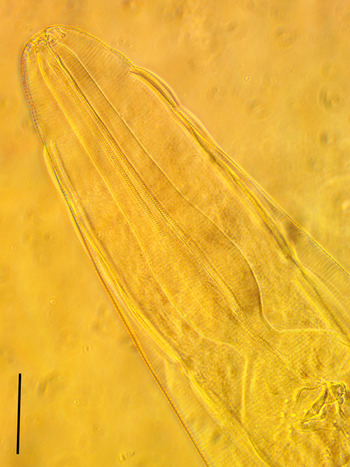
General (figs 2 and 3). Relatively large nematodes, cuticle with transverse cuticular striations. Cephalic end with four sub-median papillae, two lateral amphids; cervical alae present, lateral alae double crested, begin at posterior level of cervical alae and extend to level just posterior to cloaca. Buccal capsule wall lightly sclerotized, with inter-labial lamellae. Pharyngeal part of oesophagus lobed. Oesophagus with distinct isthmus, terminating in a sub-spherical bulb.
Sarcophiloxyuris longus n. gen., n. sp. male: (a) anterior-end lateral view; (b) cephalic-end dorso-ventral view, slightly flattened; (c) tail ventro-lateral view; (d) cephalic-end lateral view; (e) cloacal region lateral view, showing gubernaculum complex; (f) spicule tip. Abbreviations: i, inter-labial lamella; pl, pharyngeal lobe. Scale bars: (a, c) 100 μm; (b, d) 50 μm; (e, f) 25 μm.

Photomicrograph of anterior-end lateral view of Sarcophiloxyuris longus n. gen., n. sp. male. Scale bar: 50 μm.

Male (measurements from three worms). Body length 6 mm; maximum width 300–305. Cervical alae extend from 50 from anterior end to 180, 250 from anterior end. Oesophagus 589 (470–690) long; bulb 141 (125–167) long, 129 (99–167) wide. Nerve ring, excretory pore not seen. Tail elongated, tapering 487 (480–500) long. Spicule single, robust 147 (130–170) long, maximum width 20, spicule tip curved ventrally; gubernaculum 50 long, accessory piece 45 long. Caudal papillae three pairs; two pairs peri-cloacal; one pair, large pedunculated caudal, placed 140, 160 post-cloacal.
Female. Unknown.
Taxonomic summary
Type host. Sarcophilus harrisii (Boltard, 1841).
Site in host. Caecum.
Type locality. Weymouth/Lulworth turnoff (41.017°S, 147.103°E), northern Tasmania.
Type specimens. Holotype male (QVMAG registration number QVM:2019:18:0036), three paratype males (QVM:2019:18:0037-0039) collected by Vanessa Lee, 29 viii 2019.
Intensity of infection. Four.
Prevalence. One of eight Tasmanian devils examined.
Etymology. The genus is named after the host genus from which it was collected. The species is named after the much larger overall body size in comparison to the other oxyurids collected from Australian marsupials.
Remarks
Owing to the condition of the material (the specimens had been kept under a coverslip in lactophenol for an extended period of time) and the lack of female specimens, a complete characterization of the species was not possible. Features such as the buccal capsule and gubernaculum had been flattened and could only be visualized laterally and in two dimensions. Focussing through the specimens, however, provided sufficient information to prepare a limited delineation of the morphology of the specimens. For example, from the lateral view the gubernaculum appeared to be a simple rod shape with an unornamented accessory piece, similar to a less developed gubernaculum as described by Hugot (Reference Hugot1988), although the dorso-ventral shape could not be mapped. Therefore, it was possible to prepare a generic diagnosis and species description informed by the combination of those features of the cephalic and posterior ends that could be described. From the key to the Oxyurida of Petter & Quentin (Reference Petter, Quentin, Anderson, Chabaud and Willmott1976) these specimens can be placed in the Oxyuridae because they have non-pedunculate amphids. Further, the specimens can be placed with parasites of rodents, ruminants and hyracoids in having four or less pairs of well-separated genital papillae, of which only one pair is pedunculate, a gubernaculum and simple pharyngeal teeth. However, the specimens cannot be placed in any of the known genera comprising the family because of the differences in those characters that can be determined. In particular mamelons, typical of the genera, Syphacia (found in Australian murids) and Sypharista (found in Asian flying squirrels) are not present. Some characters of the posterior end of the new genus, including the three pairs of caudal papillae (two pairs peri-cloacal, one large pair post-cloacal) and a long tapering tail, are similar to those usually found in genera parasitizing rodents. Having a gubernaculum with accessory piece places Sarcophiloxyuris n. gen. closest to the genera Sypharista and Syphacia. In contrast to the filiform spicule of Sypharista and Syphacia, the spicule of S. longus is stout. The gubernaculum is neither hook-shaped nor ornamented, nor is the accessory piece ornamented. The only oxyurids that have been reported from Australian murids (Melomys, Pseudomys, Rattus and Zyzomys) are all representatives of the genus Syphacia. They comprise the cosmopolitan species, Sy. muris and seven endemic Syphacia spp., all of which have mamelons (Weaver & Smales, Reference Weaver and Smales2010). The available characters of the cephalic end of S. longus, a buccal cavity with inter-radial blades between three pharyngeal teeth without tubercules not protruding from the oral opening, show no similarities with the characters of the buccal capsules of the genera Syphacia and Sypharista, but, interestingly, some similarities with the buccal cavity of the genus Paraustroxyuris, a parasite of the Australian marsupial, Petauroides volans (see (Mawson, Reference Mawson1964). Sarcophiloxyuris longus are relatively large, males 6 mm long, compared with 1–2 mm for males of Syphacia spp. Representative comparative measurements for males are given in table 4. Studies of populations of species of Syphacia have shown that males are usually difficult to find because they disappear or die after copulation (Levine, Reference Levine1968). That only large males were found in the Tasmanian devil in this study suggests that S. longus may follow a different lifecycle strategy.
Measurements of Sarcophilus longus n. gen., n. sp. males compared to several oxyurids from Australian hosts as reported by Mawson (Reference Mawson1964), Hugot & Quentin (Reference Hugot and Quentin1985) and Weaver & Smales (Reference Weaver and Smales2010).

Alternatively, S. longus may be aligned with the family Pharyngodonidae, which are oxyurid parasites of reptiles and amphibians, although they do not appear to have the key character of pedunculate amphids. The pharyngodondid genera that have been reported from Australia (Parathelandros, Pharyngodon, Skryabinodon, Thelandros (syn. Parapharyngodon) and Veversia) have not been reported from Tasmanian reptiles (Pichelon et al., Reference Pichelin, Thomas and Hutchinson1999), although Pharyngodon sp. and Thelandros sp. (reported also as Parapharyngodon sp.) have been reported from Tasmanian amphibians (Munday & Green, Reference Munday and Green1972). The genus Sarcophiloxyuris differs from these genera as follows: from Parathelandros in having a robust, not poorly developed, spicule, narrow lateral alae that do not constrict sharply anterior to the cloaca and without a raised genital cone, post-cloacal spherical swelling or posterior directed process; from Pharyngodon in not having caudal alae supported by pedunculated papillae and in having a robust spicule; from Thelandros in having a gubernaculum and not having the posterior end truncate with a mid-dorsal process; from Skryabinodon in having a robust spicule, not having the cloacal region raised as a narrow elongate cone; from Veversia in not having thick lateral alae, a thick cuticle covered in dense hairs and an oesophageal bulb containing a masticatory apparatus (Baylis, Reference Baylis1930; Yorke & Maplestone, Reference Yorke and Maplestone1936; Inglis, Reference Inglis1968; Skryabin et al., Reference Skryabin, Shikhobalova and Mozgovoi1991).
The combination of biological and morphological characters, including the larger size and those of the cephalic and posterior ends, of S. longus support the erection of the new genus Sarcophiloxyuris. This is the first record of an oxyurid from a Tasmanian devil (Spratt & Beveridge, Reference Spratt and Beveridge2016). It is possible that these nematodes are actually parasites of prey items of the Tasmanian devil; however, their condition in an intestine that did not contain obvious digested prey suggests not. Further surveys are needed to either reveal alternative hosts or confirm S. harrisii as the definitive host and to complete the female component of the species description.
Discussion
This paper presents the first description of a species of oxyurid nematode from the Tasmanian devil. Oxyurids are considered rare in carnivorous dasyurid marsupials, as they are more commonly parasites of herbivores and invertebrates (Oakwood & Spratt, Reference Oakwood and Spratt2000). Oakwood & Spratt (Reference Oakwood and Spratt2000) reported a single specimen of an unknown species of oxyurid from the stomach of the northern quoll, Dasyurus hallucatus Gould, but suggested that it was more likely a parasite of a prey item, rather than a true parasite of the quoll. The four oxyurid specimens collected from the Tasmanian devil in this study were all in excellent condition at the time of collection, and did not appear to be degraded by digestion. Although it is possible that S. longus might be a parasite of a prey item, the condition of the worms, in an intestinal system also holding fully digested prey items, would suggest otherwise. Tasmanian devils are effective predators and specialized scavengers of medium to large prey such as macropods, possums and wombats (Jones, Reference Jones, Van Dyck and Strahan2008; Rose et al., Reference Rose, Pemberton, Mooney and Jones2017) and are unlikely to consume small mammals, such as rodents, reptiles or amphibians. However, it is possible that this parasite is not a true parasite of the Tasmanian devil, but of a prey item. Similar to the genus Sarcophiloxyuris, the other oxyurid genera reported from marsupials in Australia (see table 4), have also only been reported sporadically from hosts (Spratt & Beveridge, Reference Spratt and Beveridge2018). Thus, it is possible that this is a rare example of an oxyurid parasitizing a carnivorous marsupial. Given the sporadic nature of parasitological research on wildlife species in Australia (Spratt & Beveridge, Reference Spratt and Beveridge2018); however, much more research needs to be undertaken to assess their true relationship with this host group.
Baylisascaris tasmaniensis is one of the few parasites of the Tasmanian devil that has received attention from researchers (Sprent, Reference Sprent1970; Sprent et al., Reference Sprent, Lamina and McKeown1973; Munday & Gregory, Reference Munday and Gregory1974; Camp et al., Reference Camp, Radke, Shihabi, Pagan, Yang and Nadler2018). There are currently 11 recognized species of Baylisascaris (Camp et al., Reference Camp, Radke, Shihabi, Pagan, Yang and Nadler2018). Baylisascaris tasmaniensis, however, is a phylogenetic anomaly being the only species within the genus to utilize a marsupial carnivore as its definitive host. All other species utilize eutherian (placental) carnivores which do not naturally exist in Australia. Sprent (Reference Sprent1970) suggested the possibility of convergent evolution whereby parasites have infected hosts which occupy similar, though geographically separate, niches. The result is the development of morphologically similar, phylogenetically different species of parasites. Camp et al. (Reference Camp, Radke, Shihabi, Pagan, Yang and Nadler2018) reported on the molecular phylogenetics and species-level systematics of the genus Baylisascaris. The topology of the trees produced by Camp et al. (Reference Camp, Radke, Shihabi, Pagan, Yang and Nadler2018) and this study showed that B. tasmaniensis was distantly grouped from the other Baylisascaris species, as indicated by the long branches. If Camp et al. (Reference Camp, Radke, Shihabi, Pagan, Yang and Nadler2018) had been able to include more samples of B. tasmaniensis, they may well have also created an independent clade. The other two clades that were present – a clade of species collected from bears and pandas from China and the Americas, and a clade of species collected from skunks, racoons and a mustelid from the USA and Canada – were all highly supported by Camp et al. (Reference Camp, Radke, Shihabi, Pagan, Yang and Nadler2018). The placement of B. tasmaniensis differed between the studies in that B. tasmaniensis was basal to both clades in this study, but was only basal to the clade of species collected from bears and pandas in Camp et al. (Reference Camp, Radke, Shihabi, Pagan, Yang and Nadler2018). This difference could be due to the number of genes sequenced (one in this study vs. eight in Camp et al. (Reference Camp, Radke, Shihabi, Pagan, Yang and Nadler2018)), the species included (Baylisascaris venezuelensis from the spectacled bear in Venezuela was included in this study), the primers used and/or the type of tree presented (concatenated in Camp et al. (Reference Camp, Radke, Shihabi, Pagan, Yang and Nadler2018) vs. ITS only in this study). Importantly, however, the placement of B. tasmaniensis is always separate to these other clades, suggesting that B. tasmaniensis is not closely related to these species and that the origin of Baylisascaris in Tasmanian devils, as postulated by Sprent, still remains unresolved.
All species of Baylisascaris – excluding Baylisascaris laevis (Leidy, 1851) – are trophically transmitted, utilizing carnivores as their definitive hosts, and a vast variety of small mammals and herbivores as intermediate and paratenic hosts (Sapp et al., Reference Sapp, Gupta, Martin, Murray, Niedringhaus, Pfaff and Yabsley2017). Via the experimental inoculation of laboratory mice and the Tasmanian devil, Sprent et al. (Reference Sprent, Lamina and McKeown1973) were able to shed light on the full life cycle of B. tasmaniensis. Within the small intestine of marsupial carnivores, adult nematodes undergo maturation, with females releasing eggs which are subsequently shed in faeces. Provided conditions are optimal, zygotes undergo development into infective-stage larvae (Sapp et al., Reference Sapp, Gupta, Martin, Murray, Niedringhaus, Pfaff and Yabsley2017). After ingestion by intermediate hosts, larvae hatch and migrate to somatic tissues and undergo a second moult within one to two weeks post infection. Third-stage larvae then survive within the intermediate host for an indefinite period until ingestion by a definitive host (Sapp et al., Reference Sapp, Gupta, Martin, Murray, Niedringhaus, Pfaff and Yabsley2017). Though visceral, ocular and neural larva migrans syndrome has been extensively described in literature in relation to Baylisascaris procyonis, there has only been one study so far investigating the potential pathogenic effects of larval migration in B. tasmaniensis within wildlife. Munday & Gregory (Reference Munday and Gregory1974) found visceral granulomata within the mesentery, intestinal wall, liver, spleen, kidneys, heart and lungs of wombats from the north-eastern region of Tasmania; feeding of these larvae to captive Tasmanian devils resulted in infestation by B. tasmaniensis.
Wait et al. (Reference Wait, Peck, Fox and Power2017) reviewed the parasites of the Tasmanian devil and highlighted the importance of parasites for the biodiversity and conservation of their host species. Also, various researchers (Wait et al., Reference Wait, Peck, Fox and Power2017; Thompson et al., Reference Thompson, Lymbery and Godfrey2018; Carlson et al., Reference Carlson, Hopkins and Bell2020) have highlighted the importance of understanding the impact that conservation management measures can have on parasite prevalence and diversity. Although a number of Tasmanian devil parasites are not host-specific, at least six species (including S. longus) are, so there is a risk of extinction of these species with declining Tasmanian devil populations (Wait et al., Reference Wait, Peck, Fox and Power2017; Thompson et al., Reference Thompson, Lymbery and Godfrey2018). Indeed, Beveridge & Spratt (Reference Beveridge and Spratt2015) noted that no parasites had yet been included in the recovery program for the Tasmanian devil, even though the cestode Dasyurotaenia robusta Beddard, 1912 is an officially recognized endangered species.
Acknowledgments
The authors are indebted to Belinda Bauer (TMAG), Sarah Peck (Department of Primary Industries, Parks, Water and Environment, Tasmania), and David Maynard and Judy Rainbird (QVMAG) for access to Tasmanian devil specimens and facilities for dissection of specimens. The authors would also like to thank Ian Beveridge (University of Melbourne) for provision of literature and access to his knowledge of parasites of Tasmanian devils. This project was undertaken as part of an Honours project (V.L.).
Financial support
This project was partly funded by Charles Sturt University (S.S., grant number A512-828-xxx-66770).
Conflicts of interest
None.
Ethical standards
No approval of research ethics committees was required for this study as all specimens had been collected previously.