1 Introduction
Phonological learning involves discovering phoneme inventories, phonotactic patterns and alternations. Experimental and computational studies investigating how learners perform these learning tasks show discrepancies between the outcomes of learning and the statistical properties of the input. For example, learners apparently learn some phonological patterns in language data perfectly, while being unable to learn others, and they may undergeneralise or overgeneralise the statistical properties of some aspect of the data. One interpretation of such discrepancies between learning outcomes and input is that learners bring learning biases to the tasks of phonological learning (Wilson Reference Wilson2006, Moreton Reference Moreton2008).
The traditional optimality-theoretic framework (Prince & Smolensky Reference Prince and Smolensky1993) proposes a learning bias based on the following assumption: human learners are equipped with a set of universal constraints, and constraint ranking predicts the learnability of phonological patterns. A strong view of this thesis is that patterns not predicted by the interactions of the ranked constraints are simply unlearnable (Becker et al. Reference Becker, Ketrez and Nevins2011). However, other studies suggest a ‘soft bias’, proposing that some patterns may be harder to learn than others, or that learners are more likely to ignore certain patterns (Moreton Reference Moreton2008, Hayes et al. Reference Hayes, Zuraw, Siptár and Londe2009).
Work on phonological learning has mainly focused on two types of learning biases. First, it has found that learners more readily acquire simple or general patterns than complex or specific ones (Pater & Moreton Reference Pater and Moreton2012). Simplicity or generality is defined in terms of the number of features that participate in phonological processes; when an alternation involves more featural changes, learners have more difficulty acquiring the pattern (Peperkamp et al. Reference Peperkamp, Le Calvez, Nadal and Dupoux2006, Skoruppa et al. Reference Skoruppa, Lambrechts and Peperkamp2011). Likewise, when a phonological pattern requires more features to define it, learners have a harder time acquiring the pattern (Pycha et al. Reference Pycha, Nowak, Shin and Shosted2003, Saffran & Thiessen Reference Saffran and Thiessen2003, Cristià & Seidl Reference Cristià and Seidl2008). For instance, Saffran & Thiessen found that English-learning nine-month-olds learned a pattern in which [p t k] was distinguished from [b d g] better than one in which [p d k] was distinguished from [b t g], because the former pattern is more general and simple, in that the sets are distinguished by a single phonological feature. Second, it has been suggested that patterns that are phonetically motivated are easier to learn than those that are not. This type of bias is referred to as ‘substantive bias’ by Wilson (Reference Wilson2006). For instance, Wilson found that participants trained in velar palatalisation before [e] generalised the pattern to apply before [i] in a test session, while those trained in velar palatalisation before [i] did not generalise to [e]. This asymmetry can be accounted for by the fact that velars are more similar to palato-alveolars when they occur before [i] than when they occur before [e]. While systematic studies have found evidence supporting a simplicity bias, studies testing a bias related to phonetic motivation have had mixed results: some report supporting evidence (e.g. Wilson Reference Wilson2006, Hayes et al. Reference Hayes, Zuraw, Siptár and Londe2009, Carpenter Reference Carpenter2010, Skoruppa et al. Reference Skoruppa, Lambrechts and Peperkamp2011, Baer-Henney & van de Vijver Reference Baer-Henney and van de Vijver2012), and others report no difference in learnability between patterns with different degrees of phonetic support (e.g. Pycha et al. Reference Pycha, Nowak, Shin and Shosted2003, Wilson Reference Wilson2003, Skoruppa & Peperkamp Reference Skoruppa and Peperkamp2011). See Moreton & Pater (Reference Moreton and Pater2012) and Pater & Moreton (Reference Pater and Moreton2012) for overviews of the simplicity bias and the substantive bias.
This paper focuses on another learning bias, which is underexplored in the current literature: paradigm uniformity bias. The idea of paradigm uniformity has a long tradition in historical phonology, as does the interpretation of diachronic changes as involving a preference for uniform paradigms (Kiparsky Reference Kiparsky, Anderson and Jones1974, Reference Kiparsky1978). Within OT, the idea has been formalised in terms of output–output faithfulness constraints (Benua Reference Benua1997, Kenstowicz Reference Kenstowicz, Miglio and Morén1997, Burzio Reference Burzio1998, Steriade Reference Steriade, Broe and Pierrehumbert2000), which require phonological similarities between the surface forms of morphologically related words. Experiments in this study test natural phonological acquisition, and the results show that child learners expect non-alternating paradigms. On the basis of this finding, I argue that output–output faithfulness constraints are undominated in the initial learning state (McCarthy Reference McCarthy1998, Hayes Reference Hayes and Kager2004).
2 Background
2.1 Paradigm uniformity bias in Optimality Theory
This study focuses on the learning stage when learners start to understand morphological constraints and paradigms. McCarthy (Reference McCarthy1998) and Hayes (Reference Hayes and Kager2004) argue that learners prefer morphological paradigms without phonological alternations, or paradigm uniformity, at this stage. Within OT, this bias can be formalised in terms of faithfulness constraints. Forms exhibiting alternations violate two types of faithfulness constraints: input–output constraints, which require that surface forms match their corresponding underlying forms, and output–output constraints, which demand identity among morphologically related surface forms. In principle, prioritising either type of faithfulness constraint could bias a learner in favour of grammars that do not produce alternations. However, following work on the learnability of constraint-based grammars (Tesar & Smolensky Reference Tesar and Smolensky2000, Hayes Reference Hayes and Kager2004, Prince & Tesar Reference Prince, Tesar and Kager2004, Jesney & Tessier Reference Jesney and Tessier2011), this paper assumes that it is not input–output faithfulness constraints that are prioritised in order to favour uniform paradigms, because this would incorrectly predict unattested contrasts and raise subset issues in learning. (See Tessier Reference Tessier2012 for details of learnability issues when input–output constraints are prioritised.) Instead, output–output constraints are assumed to be prioritised, to favour paradigms with no alternations.
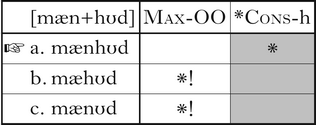
The high ranking of output–output constraints is needed for the learning of phonological patterns in derivational paradigms as well as in inflectional paradigms. McCarthy (Reference McCarthy1998) lays out the logic of how the high ranking of output–output constraints allows learning of some of the morpheme structure constraints (Halle Reference Halle1959, Stanley Reference Stanley1967) found in derivational morphology. For example, English in general lacks morpheme-internal consonant–[h] sequences, but such sequences can be derived through affixation, as in knighthood [th] and manhood [nh], and through compounding, as in alpenhorn [nh] and jackhammer [kh]. In order to learn that the realisation of the consonant–[h] sequence is possible in derived forms, learners need to assume a faithfulness constraint that requires the segments in each morpheme to have output correspondence in a derived word (Max-OO), and to rank it higher than *Cons-h, the relevant markedness constraint that bans such sequences. An example constraint ranking deriving the correct form of manhood is provided in (1).
(1)

Another argument for paradigm uniformity in learning derivational paradigms is discussed by Hayes (Reference Hayes and Kager2004). General phonotactic patterns can be overridden in some allophones in order to maintain paradigm uniformity. The learning of such allophones is possible when faithfulness constraints regulating the relation between the base and the derived words are assumed to be undominated. For instance, in some English dialects, the diphthong /aɪ/ is raised to [ʌɪ] before voiceless obstruents, as in write [ɹʌɪt], but is [aɪ] otherwise, as in time [tʰaɪm]. However, when a form is derived from a base whose corresponding vowel is [ʌɪ], the raised [ʌɪ] is retained in the derived form even before a voiced flap as in writer [ɹʌɪɾɹ̩], not [ɹaɪɾɹ̩]. In other words, writer is realised with a raised diphthong [ʌɪ] on the basis of the raised diphthong in the base form write [ɹʌɪt]. When children learn that writer is derived from write, they will assume that the diphthongs in the base write and the derived form writer are identical, and will thus pronounce writer as [ɹʌɪɾɹ̩]. In this case, faithfulness constraints regulating diphthong quality (e.g. Ident[low]-OO: any correspondent of a base segment specified as low must be low in the derived forms) should a priori outrank a relevant markedness constraint banning [ʌɪ], as in (2). (See Chomsky & Halle Reference Chomsky and Halle1968 for an alternative analysis.)
(2)
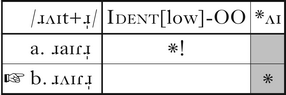
According to the paradigm uniformity bias hypothesis, learners initially (i.e. prior to receiving any data) assume a grammar as in (1) and (2), where output–output faithfulness constraints dominate markedness constraints. One prediction of this hypothesis is that even if alternations apply consistently in the target language, learners may initially produce non-alternating forms that are unlike what they have heard. In fact, this phenomenon has been observed both in L1 acquisition (Kazazis Reference Kazazis1969) and artificial grammar experiments (Wilson Reference Wilson2003, Reference Wilson2006, Tessier Reference Tessier2012, White Reference White2013). Kazazis (Reference Kazazis1969) reports one four-year-old child's production error during the course of learning inflectional paradigms of Modern Greek. The error consisted of generalising one form of the verbal stem throughout a verb's paradigm; the child incorrectly produced [ˈexete] ‘you (pl) have’ on the basis of [ˈexo] ‘I have’, while the correct 2nd person plural form of ‘have’ is [ˈeçete]. Hayes (Reference Hayes and Kager2004) points out that this data is striking, because the sequence [xe] found in the child's production form is not allowed in Modern Greek. Given that the child had no chance to hear the illegal [xe] sequence from adults, a markedness constraint banning [xe] should have been at the top of the constraint hierarchy. Yet the sequence was produced by the child. This outcome can be understood if we assume that the output–output faithfulness constraints regulating the [x]–[ç] distinction are a priori ranked even higher than the markedness constraint *[xe], which enforces a phonotactic restriction in Modern Greek. Bernhardt & Stemberger (Reference Bernhardt and Stemberger1998: 636) also suggest that ‘some faithfulness constraints [are] ranked higher than in the target adult language’. They specifically argue that faithfulness constraints ranked high in the child's language are responsible for regulating the match between morphologically related forms, supporting paradigm uniformity bias in child phonology.
Despite some evidence for paradigm uniformity bias, there has been no research which has provided systematic evidence from natural phonological acquisition. This study tests the predictions of the paradigm uniformity bias hypothesis by focusing on the learning of inflectional paradigms. Specifically, I investigate native Korean-speaking children's learning of inflected verb forms. I will show that children produce a variety of verb forms that deviate from the correct adult forms, and that a unified pattern across children's production can best be understood by assuming a ranking of constraints in the initial grammar that reflects paradigm uniformity bias, namely the undominated ranking of the output–output faithfulness constraints. Given the current lack of empirical evidence for paradigm uniformity bias, the main focus of this study is experimental investigation. Formal analysis and modelling of the trajectory of the demotion of output–output constraints will be left for future study.
2.2 Korean verbal inflection
Korean verbal inflection is a good test case for the exploration of the role of paradigm uniformity bias in phonological acquisition: the paradigms exhibit a variety of phonological alternations, both regular and irregular. If learners initially assume uniform paradigms, they will produce no alternating forms, regardless of the type of alternation. This paper first presents some of the major patterns of alternations that children learning Korean verb paradigms need to acquire. Based on the hypothesis adopted in this paper on the acquisition of alternations, the paradigm uniformity bias hypothesis, I then provide predictions for the expected production patterns of inflected verb forms in the initial stage of learning alternations.
2.2.1 Alternations in verb paradigms
A majority of the regular alternations found in the verb paradigms are governed by the phonotactic restrictions of Korean. Phonotactics relevant to the alternations of verbal stems will therefore be introduced first.Footnote 1
Korean has a three-way laryngeal contrast involving lenis, aspirated and tense obstruents, as in (3) (Jun Reference Jun2010).
(3)
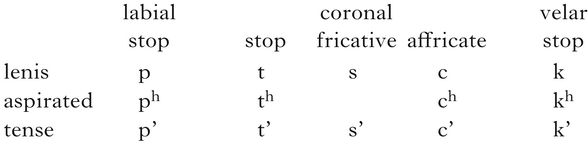
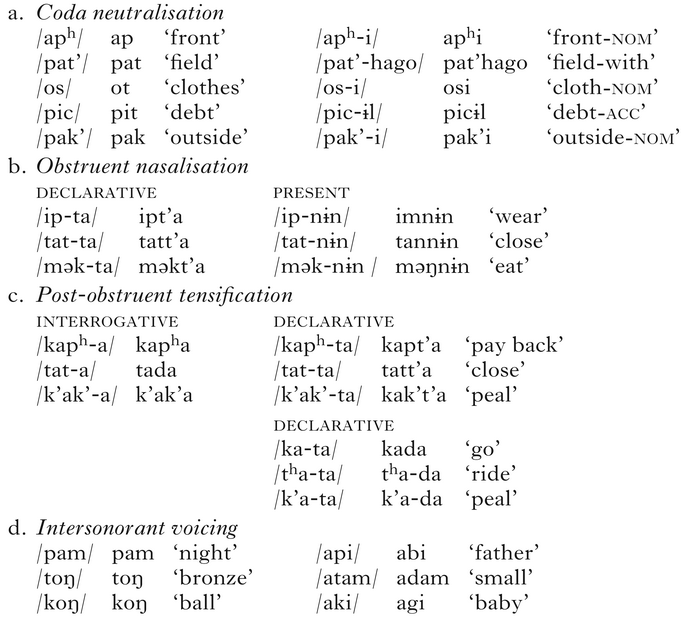
These obstruents undergo a range of phonological changes, four of which are relevant to the current study. First, /pʰ p’ tʰ t’ s s’ c cʰ c’ kʰ k’/ are neutralised to their homorganic lenis stop counterparts in coda position (i.e. coronal stops, affricates and fricatives neutralise to [t], labial stops to [p] and velar stops to [k]), while the basic variants [pʰ p’ tʰ t’ s s’ c cʰ c’ kʰ k’] occur in other positions. Second, the voiceless lenis stops, /p t k/, become nasal when a nasal (/n m ŋ/) follows, surfacing as [m n ŋ] respectively, whereas the basic variants [p t k] occur when the following consonants are non-nasal. Third, the lenis stops /p t k/ become their tense counterparts [p’ t’ k’] when preceded by a stop, and are realised as the basic variants [p t k] otherwise. Finally, the voiceless lenis stops /p t k/ are realised as [b d g] when flanked by sonorants. This is an allophonic pattern; i.e. the voiced and voiceless series are in complementary distribution. These four phonological processes are summarised in (4); the effects of allophonic intersonorant voicing are seen in (c) and (d).
(4)
Phonotactic restrictions related to laterals are also relevant to verbal alternations; phonemically intervocalic /l/ surfaces phonetically as [ɾ], as in (5).
(5)

The various phonological processes outlined in (4) and (5) give rise to regular alternations in the verb paradigms. To introduce the patterns of stem-final alternations, I first examine verbal suffixes, which are the triggers of the alternations.
2.2.2 Korean verbal morphology
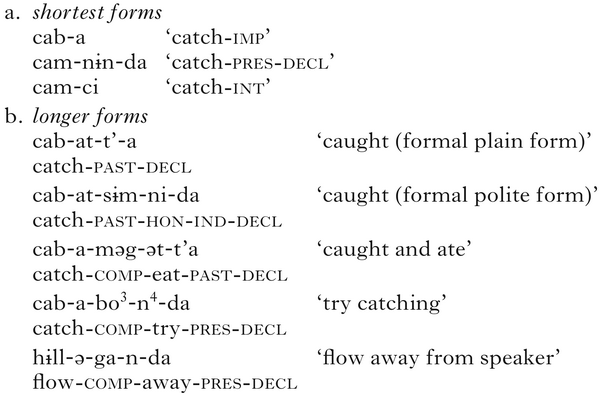
Korean verbs are conjugated (Martin Reference Martin1992, Sohn Reference Sohn1999): every verb form in Korean is composed of a verbal stem and a sequence of inflectional suffixes. Verb roots are bound; thus the shortest legal form is a verbal stem followed by an inflectional suffix, as in (6). If tense is not specified, the verb is present. In a declarative form, however, a present tense marker needs to be specified, as shown in (6); thus the shortest declarative form consists of a verbal stem, a tense marker and a mood morpheme. Verbs can be very long in Korean, due to the sequences of suffixes that mark grammatical contrasts, as in (6). There are over 400 verbal suffixes (Lee & Ramsey Reference Lee and Ramsey2000) and their orders are fixed (e.g. root–tense–mood). It is also possible to create longer verb forms with serial verb constructions, or by adding auxiliary verbs or directional morphemes. To incorporate an additional morpheme, a complementiser is required after the first verbal stem, as shown in (6).Footnote 2
(6)
The inflectional suffix that is adjacent to the verbal stem may trigger alternations in stem-final segments. Additional inflectional suffixes are irrelevant to stem-final alternations. Patterns of stem-final alternations rely on whether the suffix-initial segment is a vowel, an obstruent or a nasal. Examples of vowel-initial, obstruent-initial and nasal-initial suffixes are given in (7).Footnote 5
(7)
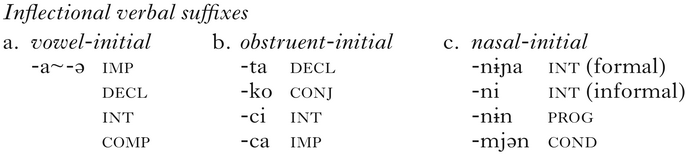
Some of the alternations triggered by the suffixes in (7) represent regular, predictable phonological processes of Korean. Obstruents are realised as homorganic lenis stop counterparts before a consonant-initial suffix. If that consonant is nasal, the stem-final obstruents are realised as nasal. If an obstruent-initial suffix follows an obstruent-final stem, it is realised as its tense counterpart. If a vowel-initial suffix follows a stem-final voiceless lenis stop, the stem-final segments become voiced. Alternations of stem-final obstruents are shown in (8a).
(8)
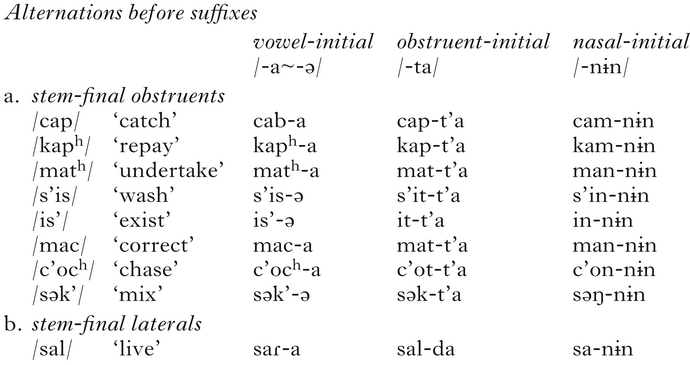
When a suffix triggers alternations to the stem-final obstruents, three types of stem allomorphs are realised, as shown in (8a). The first type, a ‘prevocalic allomorph’, appears when the verbal stem is followed by a vowel (e.g. [kapʰ-a] ‘repay-imp’). The second type is a ‘pre-obstruent allomorph’, which appears with neutralisation of the final obstruent to its homorganic lenis counterpart when the verbal stem is followed by an obstruent (e.g. [kap-t'a] ‘repay-decl’). The last type is a ‘pre-nasal allomorph’, which appears with a nasal consonant when the verbal stem is followed by a nasal (e.g. [kam-nɨn] ‘repay-pres’). Crucially, pre-obstruent and pre-nasal allomorphs are predictable from the prevocalic allomorph and the phonological environment, but not vice versa. This is because the final consonant of a prevocalic allomorph occurs in prevocalic position, which allows an aspirated vs. lenis laryngeal contrast, as well as fricative and affricate manners of articulation. For example, if the prevocalic allomorph ends in [pʰ], it is certain that the pre-obstruent allomorph will end in [p] and the pre-nasal allomorph in [m]. In contrast, if the pre-obstruent allomorph ends in [t] or the pre-nasal allomorph ends in [n], the prevocalic allomorph might end in any of [s s’ t t’ c cʰ]. Each of these possibilities is illustrated in (8a). This stem allomorphy is crucial to the experiments described later, where I will show that children tend to produce the prevocalic allomorph rather than the preconsonantal allomorphs.
Stem-final laterals show a regular alternation as well. A lateral alternates to a flap before a vowel-initial suffix, as in the prevocalic allomorph in (8b), since this is the allophone of /l/ that appears in this position. When a lateral is followed by an obstruent, the basic allomorph [l] occurs. However, a stem-final lateral is exceptionally deleted before nasal-initial suffixes in certain verbal paradigms, as in the pre-nasal allomorph in (8b). The regular outcome for /ln/ is [ll], due to lateralisation (e.g. /ilnjən/ [illjən] ‘one year’, /səlnal/ [səllal] ‘near year’, /kalnal/ [kallal] ‘edge of a knife’ and /culnəmki/ [culləmgi] ‘rope’). Exceptionally however, the lateral is deleted before a nasal only within verb paradigms, as in /sal-nɨn/ [sa-nɨn] ‘live-pres’, /sal-ni/ [sa-ni] ‘live-imp’ and /sal-na/ [sa-na] ‘live-int’ (see Kenstowicz & Sohn Reference Kenstowicz and Sohn2008 for an analysis of this exceptional alternation).
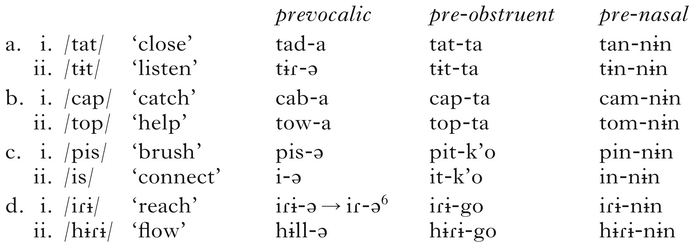
There are some verb stems that also display irregular alternations, as shown in (9). Stem-final /t/ is expected to be [d] in prevocalic forms, due to intersonorant voicing as in (9a.i), but in some lexically restricted environments, it becomes [ɾ] in prevocalic forms, as in (9a.ii). Stem-final /p/ normally appears as its intervocalic allophone [b] before a vowel-initial suffix, as in (9b.i), but in exceptional cases it is realised as [w], as in (9b.ii). Stem-final /s/, though normally retained, as in (9c.i), is sometimes deleted in intervocalic position, as in (9c.ii). Finally, stem-final /ɾɨ/, while normally retained, as in cases like (9d.i), appears instead as [ll] in prevocalic allomorphs for some verbs, as in (9d.ii). For these cases, it is not possible to predict the correct forms of the preconsonantal allomorphs from the prevocalic allomorph.
(9)
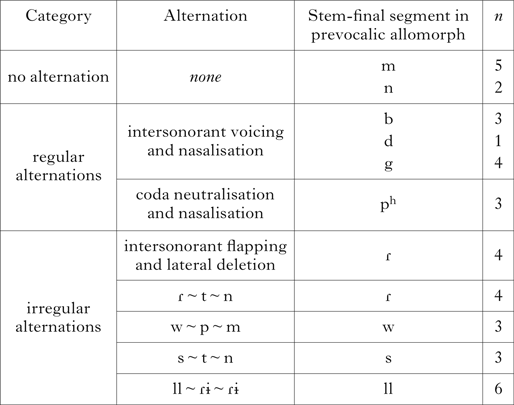
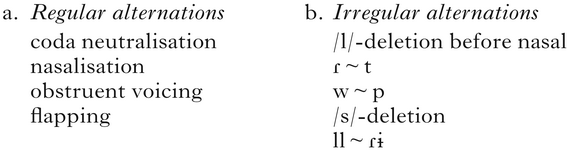
In sum, there are a variety of regular and irregular alternations in Korean verbal paradigms, as summarised in (10). In the case of regular alternations, preconsonantal allomorphs are predictable on the basis of prevocalic allomorphs, but not vice versa. With irregular alternations, however, preconsonantal allomorphs are not predictable from prevocalic allomorphs.
(10)
2.2.3 Predictions of the paradigm uniformity bias hypothesis
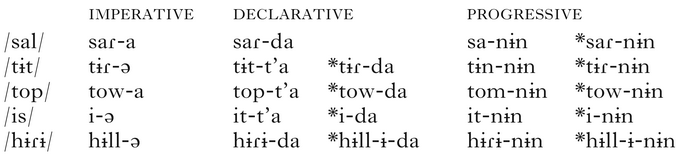
Learners in intermediate learning stages may reanalyse the verb forms if the output–output faithfulness constraints are ranked too high in these learners’ grammar. For example, if learners apply paradigm uniformity on the basis of a specific allomorph, the paradigm with the surface forms [tɨɾ-ə, tɨt-t'a, tɨn-nɨn] in (9a.ii) will be realised as [tɨɾ-ə, *tɨɾ-ta, *tɨɾ-nɨn], [*tɨt-ə, tɨt-t'a, *tɨt-nɨn] or [*tɨn-ə, *tɨn-t'a, tɨn-nɨn], with no alternation amongst the verbal stems.
Specifics of the reanalysis may differ, depending on how output–output constraints are evaluated. While it is mostly agreed that a paradigm uniformity bias will constrain derived forms to match their bases in the derivational paradigms (Benua Reference Benua1997), there are conflicting proposals regarding inflectional paradigms. Some researchers have assumed that the bias will lead to mutual correspondence among surface forms without reference to a base form (McCarthy Reference McCarthy, Downing, Hall and Raffelsiefen2005), while others have argued that inflectional paradigms may also have privileged bases that the remaining forms must be faithful to (Benua Reference Benua1997, Kenstowicz Reference Kenstowicz, Miglio and Morén1997, Albright Reference Albright2002, Reference Albright and Good2008). Even proposals assuming a base form in inflectional paradigms differ in how they suggest the base is determined (see Benua Reference Benua1997, Albright Reference Albright2002). In this paper I adopt Albright's (Reference Albright2002) ‘single-base hypothesis’ for the reanalysis of Korean verb paradigms discussed above. The experimental results of the current study will show that Korean verbal inflection is one of the cases that give strong empirical support to the single-base hypothesis.
According to Albright (Reference Albright2002), learners attempt to select one surface form in the inflectional paradigm as the base. For example, in the Korean example of the paradigm for the verb /tɨt/, a learner will select one of the surface forms in (9a.i). The selection of the base is guided by two main factors. First, the base form maximally preserves phonological contrasts among all surface forms. Second, it permits the most accurate generation of as many inflected forms of as many lexical items as possible. Crucially, the same paradigm cell must serve as the base within a language for all lexical items. For instance, if the learner selects the prevocalic form [tɨɾ-ə] as the base for the ‘listen’ paradigm, all other verbal inflectional paradigms should select the prevocalic form as the base. Once the base is selected, the learner projects the remaining surface forms, using stochastic morphological rules.
Albright & Kang (Reference Albright and Kang2008) tested the single-base hypothesis with a computational learning simulation of Korean verbs which showed that prevocalic forms are most informative, and that other members of the paradigms are best predicted from the prevocalic forms. Based on this evidence, they argue that adult learners will take the prevocalic forms as the base in Korean verbal paradigms. Do (Reference Do2013) replicated Albright & Kang's simulation, to see if the prevocalic forms are predicted to be the base in child Korean as well. Because there is no Korean corpus with a reliable amount of child-directed speech, the simulation was based on a set of hypothetical child-directed speech: the simulation used three databases, composed of the verbal roots with the highest 100-, 300- and 500-token frequencies, along with the ten verbal suffixes with the highest token frequencies from the Sejong corpus of written Korean (Kang & Kim Reference Kang and Hung-gyu2004), on the assumption that children are more likely to hear high-frequency verbs in frequently used inflected forms. Do's simulation predicts prevocalic forms to be the base forms, regardless of the size of the database. Based on this finding, Do argues that children acquiring Korean will take the prevocalic forms as base forms as well. Following Albright & Kang (Reference Albright and Kang2008) and Do (Reference Do2013), this study also assumes that the prevocalic forms are the base forms of Korean verbal paradigms.
Thus far, I have made two assumptions. First, the constraints regulating paradigm uniformity, i.e. output–output faithfulness constraints, are highly ranked in young learners’ phonological grammars, due to an initial bias in favour of paradigm uniformity. Second, the base form of Korean verbal paradigms is the prevocalic form. These two assumptions lead to the hypothesis in (11) regarding the initial stage of learning alternations.
(11)

If paradigm acquisition is not complete, or if learners have not yet mastered the correct surface forms, this hypothesis predicts that the reanalysis of surface forms will show incorrect uses of base forms in other morphologically related verbs. Recall that the alternations of obstruent-final stems are governed by the phonotactic principles of Korean, as shown in (8a). Even if a learner creates forms incorrectly using prevocalic stem allomorphs, the application of regular phonological processes will predict the correct surface forms of obstruent-final verbal stems. For example, if a learner incorrectly uses the prevocalic stem allomorph where a preconsonantal allomorphs is needed, such as *[kapʰ-t'a] and *[kapʰ-nɨn], the application of coda neutralisation and nasalisation will correct the forms to [kap-t'a] and [kam-nɨn].
The hypothesis in (11), however, predicts the production of incorrect forms in cases of irregular alternations such as (12): the starred forms predicted by the hypothesis have prevocalic stem allomorphs, although preconsonantal allomorphs are required.Footnote 7 The absence of a phonotactic constraint banning the sequences found in the incorrect forms allows the erroneous forms with the prevocalic allomorphs to be produced.
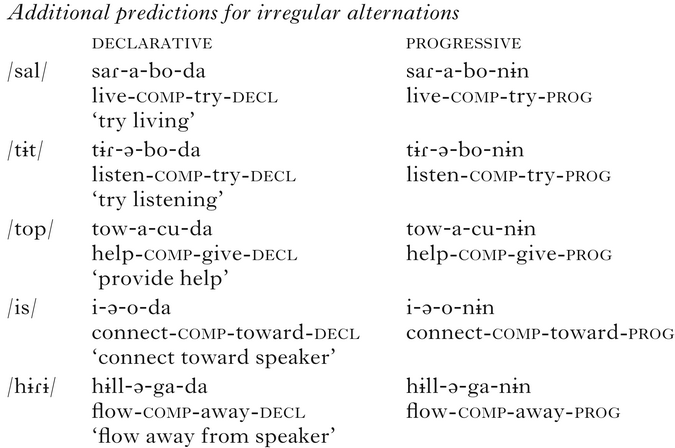
(12)
An alternative way to produce forms with prevocalic allomorphs is to employ morphologically longer forms, as in (13). As seen in (6b), longer forms may use prevocalic allomorphs, the stem allomorphs found in the base forms. The longer forms in (13) either have an auxiliary verb, such as /bo/ ‘try’, an additional verbal stem, such as /cu/ ‘give’, to create a serial verb construction, or a directional morpheme, such as /o/ ‘toward’ or /ga/ ‘away’. Crucially, all of the longer forms need the complementiser /a~ə/, which requires the use of the prevocalic stem allomorph.
(13)
This study tests the predictions of the paradigm uniformity bias hypothesis. The results of Experiment 1, to be discussed in §3.1, bear out the hypothesis in (11). While the specific ways by which paradigm uniformity is satisfied differ, depending on the ages of the child learners, a unified pattern across all production forms is found: four- to seven-year-old children deviate from adults’ production in various ways, all of which make paradigms more uniform. Specifically, child learners innovate forms that are faithful to the prevocalic base forms, supporting the hypothesis in (11).
The results of Experiment 2, discussed in §3.2, show further that six- to seven-year-old children produce non-alternating forms only when they are able to; otherwise, like adults, they successfully inflect verbs in alternating forms. Interestingly, the non-alternating forms are on occasion employed by children when the regular forms involve some sort of phonological alternation. I argue that children assign the alternating forms the highest probability when they are acquiring patterns of alternations, but their paradigm uniformity bias makes them search for alternatives that will enable them to produce non-alternating forms.
3 Empirical testing of paradigm uniformity bias
3.1 Experiment 1
3.1.1 Participants
Twenty-four native Korean-speaking children, 13 boys and 11 girls, aged from 4;1 to 7;2 (mean = 5.75) participated in Experiment 1.Footnote 8 In addition, eight adult native Korean speakers, four males and four females, participated for the purposes of comparison. All child participants attended public kindergartens in Korea, and all adult participants were standard Seoul Korean speakers.
3.1.2 Materials
A picture-description task was used to elicit the inflected forms of Korean verbs. Pictures were shown to participants, and a sentence in which the main verb was missing was given below each picture. (14) provides an example of the picture-description task used in the practice session.
(14)

No additional restriction was imposed for the picture-description task; participants were able to choose any verbal root and any inflectional structure. The intention behind this test design was to elicit production forms which would be similar to naturalistic data.
The purpose was to elicit inflected forms of verbs exhibiting (a) no alternation, (b) regular alternations and (c) irregular alternations, as in Table I. An additional two factors were considered in the selection of the verbs. First, the prevocalic form of the verb had to have a token frequency of at least 1000 in the Sejong corpus of written Korean (Kang & Kim Reference Kang and Hung-gyu2004), so that it would be likely to be familiar to young child learners. Second, the verbs saliently expressed motions (e.g. ‘walk’, ‘fly’, ‘dance’) or visible features of an object (e.g. ‘round’, ‘blue’, ‘long’), so the meaning of the predicates could be clearly presented in pictures. The list of specific target verbs is provided in Table II in the online supplementary materials.Footnote 9
Target verbs in Experiment 1.

Each picture was designed to elicit an inflected form of a single verb. The pictures were taken from Google images with permission, or if necessary, created as coloured illustrations especially for this experiment by a graduate student at the author's university. Seventy-six pictures were first designed to elicit the target verbs and three adults who did not participate in the experiment were asked to describe each picture in written form. Of the 76 pictures, the 38 that all three adults described using the same verbal roots were selected and used in the production test.
3.1.3 Procedure
Participants were shown 38 pictures one at a time on a computer screen, each with a corresponding sentence containing a blank space for the target verb. Parents of child participants attended the test session with their child. The parents read the sentences to the child participants, and were asked not to give response-contingent feedback. Adult participants completed the test by themselves. All participants were asked to give their answers orally, and the answers were tape-recorded and transcribed later.
Before the test session, both child and adult participants were given three examples of the picture-description task. The three examples showed situations that can be best described with non-alternating verbs, so the participants did not see any instance of the target of the study, stem-final segment alternations, before the task. The participants were then told that they would be looking at pictures. They were asked to fill in a blank for each picture in the most natural way, and, if they were not sure with which verb they should use, to make their best guess. The experimenter was present while the participants were shown the training examples, but not during the test session. All participants were asked to complete the full experiment in a single session, with no time limit.
3.1.4 Results
In total, 1216 answers were collected. Sixty-three answers (5.2%) were eliminated because the participants either did not answer the question (1.3%) or did not produce the intended target verb (3.9%).Footnote 10 The remaining recorded materials were digitised as .wav files, and then transcribed by the experimenter and, separately, by a Korean graduate student trained in phonetic transcription, who did not know the purpose of the experiment. There was 97% agreement between the two transcribers; tokens on which the transcribers disagreed were discarded. After this process, 1118 tokens remained for analysis: 818 tokens from the child participants and 300 tokens from the adult participants.
As we will see, the results of the child participants’ performance confirmed the hypothesis in (11): the children created innovative uniform paradigms in such a way that the verbs remained faithful to the prevocalic forms, the base of Korean verb paradigms.
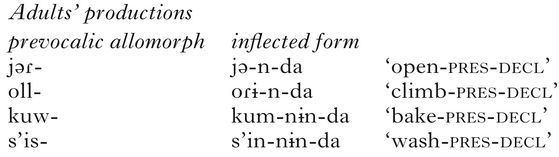
The adult participants inflected the verbs using the simplest morphological structures, a verbal stem followed by a present tense morpheme and a declarative morpheme, for most of their answers (98%). In the simplest structures, the correct stem allomorphs are the preconsonantal forms, which introduce stem-final alternations from the base forms. Adult participants always used the correct form of the preconsonantal allomorphs, as shown in (15).
(15)
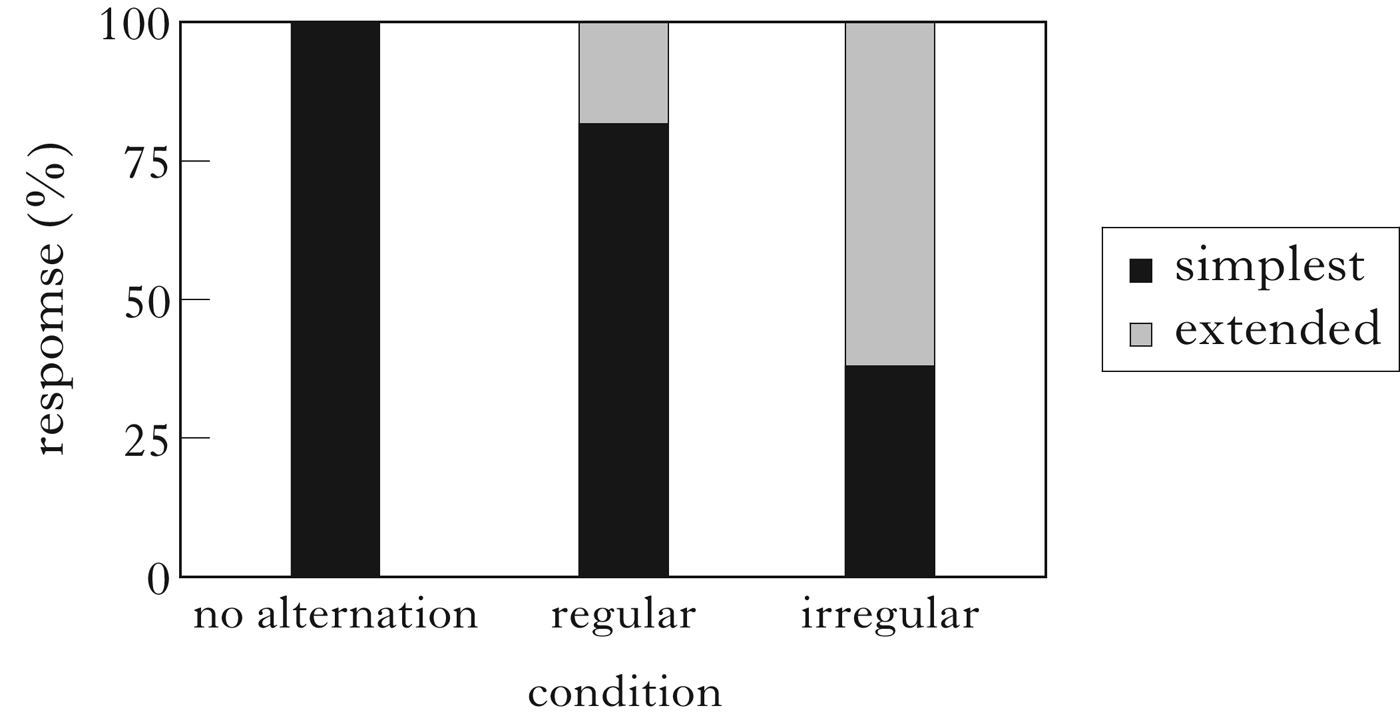
The morphological structures found in the children's verbal inflections differed, depending on the types of alternations involved in the target verbs. First, when the verbs did not involve any alternation, the children always used the simplest morphological structures (n = 145), e.g. /sin-nɨn-ta/ [sin-nɨn-da] ‘wear-pres-decl’, suggesting that they completely understood the task. Second, for verbs with only regular alternations, the child participants used not only the simplest structures, e.g. /cap-nɨn-ta/ [cam-nɨn-da] ‘catch-pres-decl’, but also the extended structures, e.g. /cap-a-po-n-ta/ [cab-a-bo-n-da] ‘catch-comp-try-pres-decl’; they predominantly used the simplest morphological structures (n = 189, 81.8%) rather than the extended structures (n = 42, 18.2%). Third, when the verbs underwent irregular alternations, extended morphological structures, e.g. /tɨɾ-ə-po-n-ta/ [tɨɾ-ə-bo-n-da] ‘listen to-comp-try-pres-decl’ were significantly preferred (n = 274, 61.9%) to the simplest structures, e.g. /tɨɾ-nɨn-da/ [tɨn-nɨn-da] ‘listen to-pres-decl’ (n = 168, 38.1%). The results are shown in Fig. 1.
The morphological structure of verbs by type of alternation.

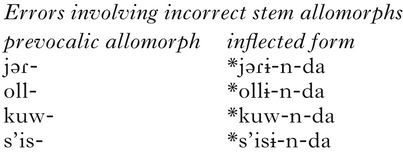
The child participants frequently produced erroneous forms when verbs with irregular alternations were inflected using the simplest morphological structure (58.9%, n = 99/168). Examples of these errors are shown in (16). No error was found in which verbs with no alternations or with regular alternations were inflected using the simplest structure.Footnote 11
(16)
When the verbs were inflected using extended morphological structures, they either involved an additional morpheme such as an auxiliary or were serial verb constructions. Examples are given in (17). No errors were observed in forms using extended morphological structures.
(17)
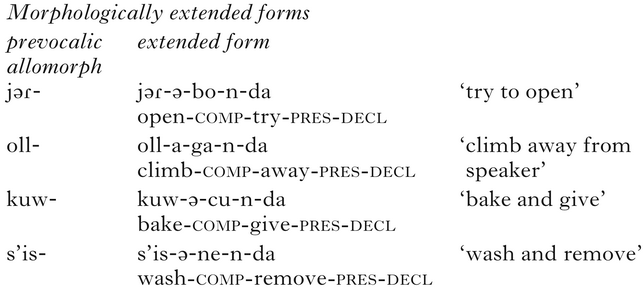
A unified pattern appeared in the erroneous forms involving incorrect stem allomorphs, as in (16), and the forms using extended morphological structures, as in (17): the inflected forms systematically showed the use of the prevocalic allomorph – the allomorph found in the bases of Korean verb paradigms. Specifically, the children incorrectly chose prevocalic forms where preconsonantal forms were required, but not vice versa. They also inflected verbs using morphologically extended structures that allowed the use of prevocalic stem allomorphs. In other words, the child participants employed two different ways of inflecting verbs using the prevocalic allomorphs.
Additionally, most of the erroneous forms were from four- to five-year-old children (n = 91/99), while most of the extended forms were produced by six- to seven-year-old children (n = 282/316).
To sum up, the results of Experiment 1 show that children inflected verbs differently from adults when the target verbs required alternations. The child participants sometimes chose the extended morphological structures when inflecting verbs involving regular alternations. The tendency to choose the extended structures was especially marked when they inflected verbs with irregular alternations. It was also found that they produced erroneous forms involving incorrect stem allomorphs when target verbs required alternations. Crucially, using erroneous forms involving incorrect stem allomorphs as well as morphologically extended forms enabled them to inflect the verbs using the prevocalic stem allomorphs.
3.1.5 Discussion
When the child participants’ production deviated from that of adults, they inflected verbs in such a way as to use the prevocalic stem allomorphs. The younger children preserved the prevocalic stem allomorphs in the base forms mainly by producing errors. The older children did so mainly by incorporating additional morphemes in the verbal conjugation.
This use of additional morphemes cannot be attributed to children's tendency to imitate adults’ usage of verbal inflections. Recall that the adult participants in the experiment almost always used the morphologically simplest structure. In addition, evidence from corpus data, including conversations between a Korean child and her mother in CHILDES (MacWhinney Reference MacWhinney2000) suggests that the morphologically simplest structure is the predominant form in child-directed speech.Footnote 12 The analysis of conversations in naturalistic settings between ten child–caregiver pairs in Do (Reference Do2013) also suggests that the morphologically simplest structure is the most frequent for all the verbs produced by the adult speakers. However, six- to seven-year-old children tended to use morphologically extended structures for the inflections of the verbs with irregular alternations.
It is also important to note that the six- to seven-year-old children produced many correct forms. This may indicate that children have a partial knowledge of adult-like inflection of verb forms. Why do six- to seven-year-old children sometimes incorporate additional morphemes into verbal inflections, while on other occasions successfully producing verb alternations in morphologically simpler ways? The hypothesis of this study is that the children are influenced by a paradigm uniformity bias, because producing morphologically extended forms allows them to use the base form prevocalic allomorphs. In other words, although children may assign the alternating forms the highest probability, just as adults do, their strong paradigm uniformity bias leads them to search for alternatives that will allow them not to produce the alternating forms. Alternatively, their behaviour could be simply due to the children's imperfect knowledge of phonological alternations: they might have learned the morphological system of verbal inflections, and are thus able to produce both the simplest and the extended structures, but have not yet fully mastered which stem allomorphs are required for each morphological structure.
A second experiment was conducted, in order to examine whether some of the six- to seven-year-olds’ inflection patterns observed in Experiment 1 were driven by a lack of knowledge of phonological alternations or by a preference for producing non-alternating forms. If children have good knowledge of verbal alternations, they will correctly produce preconsonantal allomorphs, as in the adult productions in (15), when the option of using prevocalic allomorphs is not available. Specifically, if the children are given a controlled condition in which they are prevented from employing the morphologically extended structures that enabled them to use prevocalic allomorphs in Experiment 1, they will produce forms with preconsonantal allomorphs. If the children are not yet able to produce the correct forms of preconsonantal allomorphs, a high rate of incorrect stem allomorphs will be observed in this controlled setting, as in (18).
(18)

The results of Experiment 2 show that six- to seven-year-old children correctly produce the preconsonantal allomorphs when they have to. This finding suggests that the non-alternating verb forms observed from children in the same age group in Experiment 1 are indeed a result of their phonological preference for paradigm uniformity, not to their ignorance of phonological alternations. The results of Experiment 2 further suggest that a paradigm uniformity bias does not necessarily prevent learners from acquiring alternations. Instead, even after learners assign the highest probability to the alternating forms, they still tend to search for morphological structures that allow them to avoid phonological alternations.
3.2 Experiment 2
3.2.1 Participants
Thirteen Korean children, six boys and seven girls, aged from 6;2 to 7;3 (mean = 6.5) participated in Experiment 2. None of them had participated in Experiment 1. The eight adults who participated in Experiment 1 also participated in Experiment 2.
3.2.2 Materials
A controlled experimental setting was designed in which participants were required to inflect verbs using specific morphological structures. In order to restrict the participants’ selection of morphological structures, a Korean syntactic constraint was employed. When two clauses are coordinated within a sentence, the order of suffixes is the same as in a single clause, but tense and mood morphemes are marked only in the final clause (Yoon Reference Yoon1997), as in (19). Within a coordinated sentence, the morphological structures of the two clauses must be identical. For instance, if one clause in a coordinated sentence is inflected without an auxiliary, the other clause must also be inflected without an auxiliary, as in (19a). If one clause in a coordinated sentence is inflected with a directional morpheme, the other clause must have a corresponding morpheme, as shown in (19b). It is unnatural for an additional morpheme to appear in only one clause within a coordinated sentence, as in (19c). Because this is a structural requirement, the specific meaning of corresponding morphemes in the two clauses need not be the same, as in (19b). I call this syntactic constraint the ‘structural parallelism constraint’.
(19)
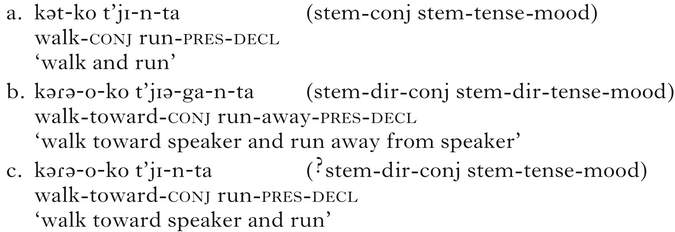
A paired-picture description test was designed to ensure that the participants’ production was controlled by the structural parallelism constraint. This design assumed that participants know the constraint, and that it is undominated in Korean speakers’ production grammars. If these assumptions hold, the morphological structure in one phrase should constrain the morphological structure in the other phrase. The prediction is that participants may produce forms as in (19a), without additional morphemes in both clauses, or (19b), with additional morphemes in both clauses. If participants correctly apply alternation patterns, verbal stems in the structures like both (19a) and (19b) will be correct.
The target verbs in Experiment 1 were employed, and organised into pairs. Transitive verbs were paired with other transitive verbs, and intransitive verbs with intransitives, so that the processing load, or syntactic structure, of the two clauses would be similar. Recall that in Experiment 1, verbs with no alternation or with regular alternations were predominantly inflected using the simplest morphological structure, and verbs with irregular alternations were predominantly inflected using morphologically extended structures. I call the two groups of verbs ‘regulars’ and ‘irregulars’ respectively. There were eleven regulars, which were paired with eleven irregulars. Among these eleven combinations, five pairs of pictures were designed to elicit a regular in the first clause, and six pairs of pictures were designed to elicit an irregular in the first clause. The remaining eight irregulars were paired with each other, and served as fillers. To balance the experimental conditions, eight new pictures expected to elicit descriptions using simplest-form preferring verbs were included, and paired into four stimuli. The pairs of pictures were randomly ordered, and the same condition was never presented twice in a row. The full list of pairs is given in Table III in the supplementary materials.
As in Experiment 1, only verbs were elicited. The same three adults who helped to design and select the pictures in Experiment 1 participated in confirming the appropriateness of the picture pairing for Experiment 2. An example of the paired pictures is given in (20).
(20)
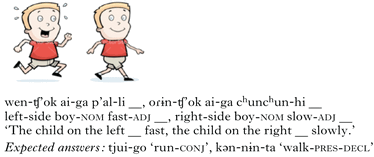
The expectation was that participants would use a connective suffix such as /-ko/ ‘and’, /-ciman/ ‘but’ or /-nɨnde/ or /-nɨnbanmjən/ ‘on the contrary’ at the end of the inflection of the first verb to indicate the coordination of the two clauses. Crucially, the morphological structure selected for one clause will constrain the morphological structure of the other coordinated clause; thus all four types of stimuli were expected to elicit either ‘simplest form simplest form’ or ‘extended form extended form’ answers.
3.2.3 Procedure
The test procedure and the methods used for data recording and transcription were identical to those in Experiment 1. In total, 248 tokens were collected from the children, and 151 from the adults, each of which were composed of two verbs. The between-transcriber agreement rate in Experiment 2 was 98%. Eight of the children's tokens that the two transcribers did not agree on were discarded.
3.2.4 Results
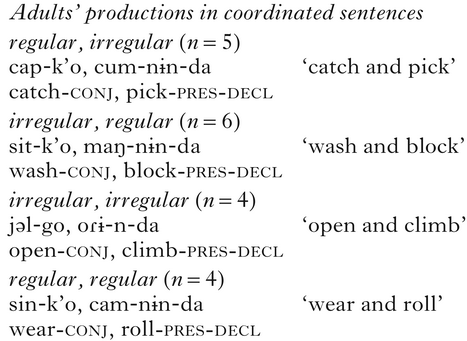
Experiment 2 shows that the structural parallelism constraint is undominated in Korean speakers’ production: all participants, both children and adults, inflected the two verbs within each coordinated sentence with identical morphological structures. Adults always employed the simplest morphological structure, as shown in (21), such as a verbal stem followed by a present tense morpheme and a declarative morpheme. The stem allomorphs were always correct; no erroneous forms were found.
(21)
The child participants produced two types of morphological structure: the simplest and the extended structures, as in (22).
(22)
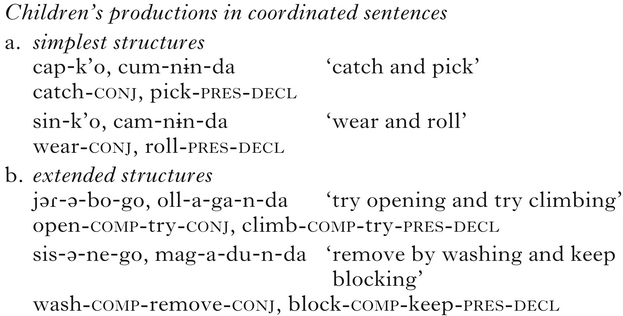
The simplest structures were identical to those produced by the adult participants: a verbal stem, a present tense morpheme and a declarative morpheme. As in Experiment 1, the extended structures included an auxiliary verb, a directional morpheme or an additional verbal stem to create serial verb constructions.
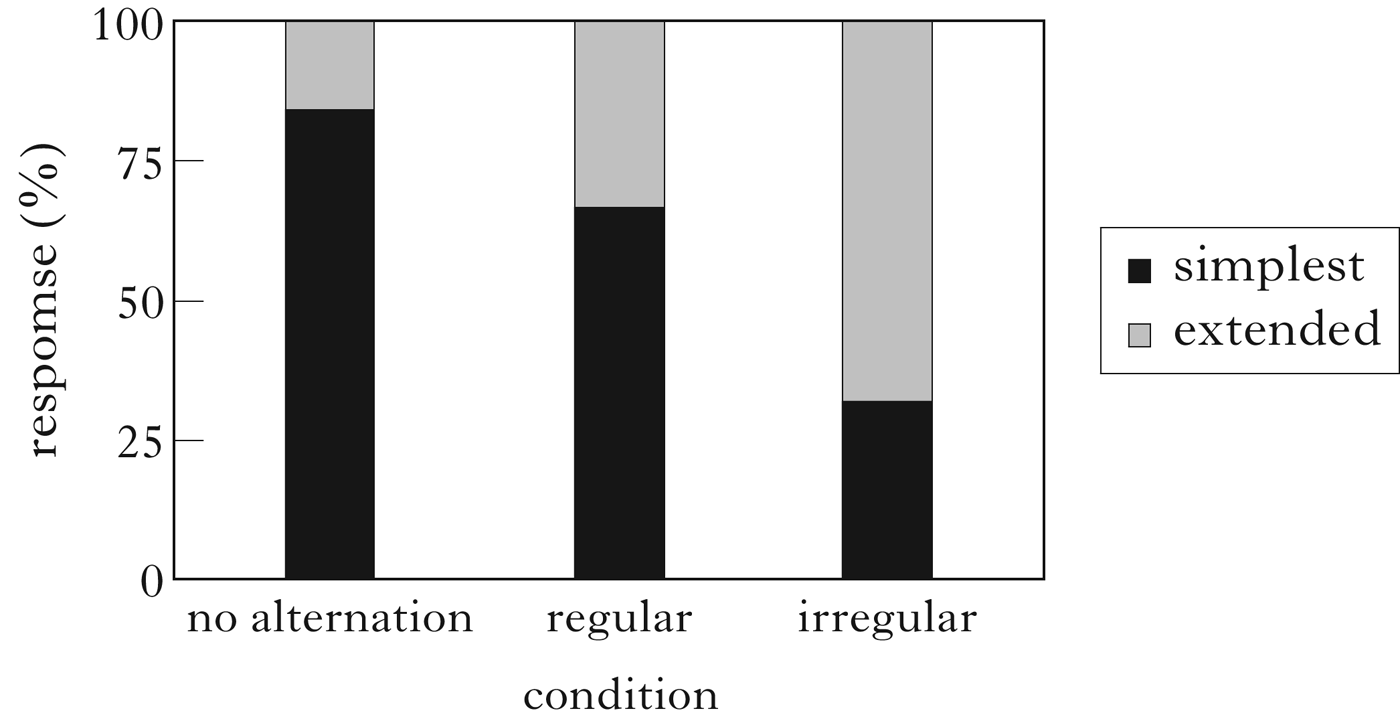
Importantly, the selection of one of the two types of morphological structures relied on the phonological properties of the verbs in the first clause of the coordinated sentence. Specifically, the types of alternations found in the first verbs determined the preferred morphological structure of the coordinated clauses. The simplest structures were predominantly selected when no alternation was involved in the first verb (n = 43, 84.3%), and were produced less frequently when the first verb involved a regular alternation (n = 42, 66.7%). Finally, extended morphological structures were selected most frequently when the first verb involved an irregular alternation (n = 85, 68.0%). Figure 2 shows the frequency of the simplest and the extended morphological structures, depending on the type of the first verb.
Simplest vs. extended morphological structures, depending on the type of alternation of the first verbs.

To test whether the participants’ response types (simplest structures vs. extended structures) are significantly different depending on the first verbs, a mixed-effects logistic regression model was fitted, using the R lme4 package (Bates et al. Reference Bates, Mächler, Bolker and Walker2015). As in the analysis of Experiment 1, the model included response type as a dependent variable (simplest structures vs. extended structures), with the simplest structures as the reference level. The condition of alternations of the first verb within a sentence was an independent variable, which had three levels (no alternation vs. regular alternations vs. irregular alternations), with regular alternations assumed to be the reference level. Random intercepts were included for participants and items, and a random slope for place by participants. The results show that choosing the simplest structures was significantly encouraged for the condition with no alternation compared to the condition with regular alternations (β = 2.4355, SE = 0.6848, z = ―3.557, p(z) = 0.000376), showing the effect of alternations. However, choosing the simplest structures was significantly discouraged when the target verbs involve irregular alternations rather than regular alternations (β = ―2.0914, SE = 0.5680, z = 3.682, p(z) = 0.000231), suggesting the effect of regularity. In sum, the results show the effect of alternations as well as the effect of regularity in the child participants’ choices of morphological structures. The findings of Experiment 2 are consistent with those of Experiment 1.
The majority of the children's answers were correct (92%), but five included errors, all of which were in the second verbs of the coordinated sentences in irregular pairs with a simplest form-preferring verb. These errors showed a systematic incorrect use of the prevocalic allomorph where a preconsonantal allomorph is required, as in (23). In no case did a child erroneously use a preconsonantal allomorph where a prevocalic allomorph was needed. The error pattern in Experiment 2 is consistent with the error pattern in Experiment 1.
(23)
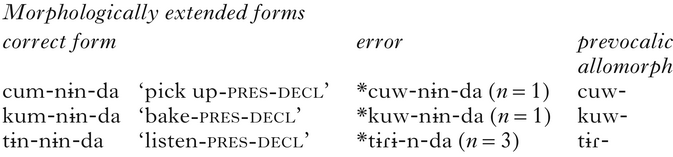
Except for the five error tokens, all other irregulars were correctly conjugated. Recall that in Experiment 1 the six- to seven-year-old children produced non-alternating verb forms by employing morphologically extended structures when they inflected the irregulars (i.e. the verbs with exceptional or lexically restricted alternations). But in Experiment 2 children in the same age range inflected alternating forms of the same verbs by correctly using the preconsonantal stem allomorphs in most cases. In other words, when the structural parallelism constraint was imposed, so that the children did not have the choice of incorporating additional morphemes, they showed they were able to use the stem allomorphs found in the base forms in Experiment 1. In this controlled condition in Experiment 2, the children obeyed the structural parallelism constraint, and therefore used the simplest morphological structure when inflecting irregulars. In particular, when the children inflected the verbs using the simplest morphological structure, they almost always made correct use of the prevocalic stem allomorphs. This result shows that children are able to correctly produce the alternating verb forms – not only regulars (verbs with no alternation or regular alternations), but also irregulars (verbs with irregular alternations).
3.2.5 Discussion
Why did children prefer not to produce alternating verb forms in Experiment 1, even though, as observed in Experiment 2, they are able to produce them? The additional structural constraint imposed in Experiment 2 requires the inflectional structure of the second verb to be identical to that of the first, and is apparently undominated, as it was not violated by any of the participants. This structural parallelism constraint requires that when the first verb is inflected in the simplest morphological structure, the second verb should be inflected using the same structure. Once children inflected a verb with no alternation or a regular alternation in the first clause by employing the simplest morphological structure, they could not inflect a verb with an irregular alternation in the second clause with a different morphological structure, such as a morphologically extended one. In other words, the only option remaining was to use the simplest structure in inflecting the second verb. Crucially, to create the simplest structure, they needed to use the preconsonantal allomorphs, i.e. allomorphs found in non-base forms. Experiment 2 found that, under this controlled condition, children successfully produced correct alternating verb forms.
These results suggest that the children's production patterns demonstrated in Experiment 1 are motivated by a paradigm uniformity bias, as well as the regularity effect, not by their ignorance of alternating verb forms: when children were free to choose a morphological structure of verbal inflection reflecting their own preferences as in Experiment 1, they preferred to produce non-alternating forms, thus providing support for the paradigm uniformity bias effect. They produced the forms with regular alternations just like the adults, but they did not produce forms involving irregular alternations, thus providing support for the regularity effect. In Experiment 2, where they were constrained to produce forms with irregular alternations, they correctly produced alternating forms. The results therefore suggest that children who successfully assign the alternating forms the highest probability, as adults do, still prefer alternative ways of inflecting verbs, in the interest of producing non-alternating verb forms, specifically when the inflection can potentially incur irregular alternations.
4 Discussion and conclusion
This paper has presented ways in which Korean children's productions of verbal inflections differ from those of adults, and has provided a unified account of the data obtained from two experiments. Four- to five-year-old children show an overall tendency to produce erroneous forms of irregular verbs by selecting incorrect stem allomorphs, while six- to seven-year-olds tend to employ extended morphological structures that are legal, but not preferred by adult participants. A unifying factor across all children's verbal inflection patterns is that, in comparison to adult forms, their verb forms are more faithful to the base forms of Korean verbal paradigms. These results support the claim that children prefer uniform paradigms, due to the high ranking of output–output faithfulness constraints in the early stages of learning alternations, when the patterns of alternations have not been mastered. It is worth noting that the children deploy morphologically longer verb forms to avoid alternation not only in irregular forms, but even in perfectly regular forms. Avoidance of alternation even in regular forms can provide a stronger support for paradigm uniformity bias among child learners.
To the best of my knowledge, the current study is the first to provide empirical evidence from natural L1 acquisition that supports the existence of an a priori paradigm uniformity bias. More research is needed to confirm paradigm uniformity bias in phonological acquisition and its role in the trajectory of learning alternations.
4.1 Demotion of output–output faithfulness constraints
If the output–output constraints are ranked too high in child learners’ grammars, they should be demoted during the course of acquisition, because the initial grammar does not predict the production of alternating forms. This study's findings provide evidence for a learning trajectory which can be accounted for by the demotion of output–output constraints: from an initial stage where no alternation is produced, through an intermediate stage where regular alternations are produced, to the final stage, where all types of alternations are produced. One approach to providing a theoretical explanation of the observed trajectory would be to combine a model in which constraint rankings depend on frequency in the data, such as the Gradual Learning Algorithm (Boersma Reference Boersma1997, Boersma & Hayes Reference Boersma and Hayes2001), with the paradigm uniformity hypothesis (McCarthy Reference McCarthy1998, Hayes Reference Hayes and Kager2004). A following study should provide a formal analysis or attempt to create a model to show how the demotion of output–output constraints accounts for the current findings.
Note, however, that it is also possible that learners rank a set of markedness constraints at the initial phonotactic learning stage at the bottom of the ranking, and promote these constraints as a result of patterns of alternations at the later stage of learning alternations. It is conceivable that the promotion of the markedness constraints, supported by phonotactically driven alternations, might facilitate the learning of alternations, even if the relevant output–output faithfulness constraints are not fully demoted.
Korean verb paradigms are not a good test case to investigate the extent to which the promotion of markedness constraints and the demotion of output–output faithfulness constraints contribute to the learning of alternations, because phonotactically predictable alternations are frequent as well (Albright & Kang Reference Albright and Kang2008, Do Reference Do2013). To better understand the specific role of the promotion of markedness constraints and the demotion of output–output faithfulness constraints in determining the acquisition of morphophonological alternations, evidence is needed from languages in which phonotactic predictability and frequency of alternations make different predictions about the order in which the various alternations will be learned.
4.2 The nature of paradigm uniformity bias
This study has shown that six- to seven-year-old Korean children are capable of producing a variety of alternating verbs. Their productions can be explained by changing constraint rankings in which output–output constraints are demoted below the relevant markedness constraint at an intermediate learning stage.
Although some output–output constraints are apparently demoted to their expected low rankings at some intermediate learning stage, as shown by the children's production of some of the alternating verb forms, the results of this study have also demonstrated that children tend to avoid alternating forms where possible. In the case of verbal inflections, they instead choose to produce extended morphological structures, thus retaining paradigm uniformity. If we consider only the constraint ranking that corresponds to children's production of alternating forms (markedness ⪼ output–output faithfulness), it is impossible to account for their observed tendency to avoid alternating verbs at the same learning stage; however, this can be accounted for by the opposite constraint ranking. This account of the study's results has interesting implications for biased phonological learning.
To the best of my knowledge, all previous proposals on learning biases in the literature have focused on the learnability of patterns, not on the role of bias in determining learners’ preferences at the stage of production. For example, it has been found that learning biases can result in learners being less likely to acquire certain patterns (Moreton Reference Moreton2008, Becker et al. Reference Becker, Ketrez and Nevins2011), or being able to learn only partial systems (Hayes et al. Reference Hayes, Zuraw, Siptár and Londe2009). An important finding of this study is that learners prefer to produce non-alternating verb forms that maintain paradigm uniformity even after they have acquired the correct alternating forms. This indicates that the role of learning biases in phonology is not limited to their power to determine a pattern's learnability. When learners have acquired an alternation pattern, and the markedness ⪼ output–output faithfulness ranking, they may still produce patterns that satisfy the initial constraint ranking, output–output faithfulness ⪼ markedness, which is preferred due to paradigm uniformity bias. The observed discrepancy between being able to produce alternating verb forms and preferring to produce non-alternating forms suggests that learning biases in phonology play a role not only in determining learnability, but also in shaping learners’ production preferences.