Cap-and-trade systems for greenhouse gas emissions are an important part of the climate change policies of the EU, Japan, New Zealand, among others, as well as China (soon) and Australia (potentially). However, concerns have been raised on a variety of ethical grounds about the use of markets to reduce emissions. For example, some people worry that emissions trading allows the wealthy to evade their responsibilities. Others are concerned that it puts a price on the natural environment. Concerns have also been raised about the distributional justice of emissions trading. Finally, some commentators have questioned the actual effectiveness of emissions trading in reducing emissions. This paper considers these three categories of objections – ethics, justice and effectiveness – through the lens of moral philosophy and economics. It is concluded that only the objections based on distributional justice can be sustained. This points to reform of the carbon market system, rather than its elimination.
1. Introduction
The design of climate-change policy involves underappreciated ethical dimensions. Greenhouse gas emissions might be reduced by several main approaches, each of which raise different considerations of ethics and justice. For instance, governments might provide information about the science and economics of climate change, price greenhouse gas emissions through a ‘carbon tax’, subsidise clean technology, establish a ‘cap-and-trade scheme’ in which a limit is placed on total emissions which declines over time (e.g. as per notions of ‘contraction and convergence’), and/or implement ‘command-and-control’ regulation requiring firms and individuals to take certain action, such using specific cleaner technologies. These approaches have various levels of effectiveness (that is, of successfully reducing emissions) and of efficiency (in terms of reducing emissions at least cost). They also have distributional implications (in that there will inevitably be losers and winners). Implementing climate-change policies is also likely to, and indeed will need to, change our relationship with the natural environment.
This paper focuses on cap-and-trade systems, which are argued by some to be a vital component of the attempt to prevent ‘dangerous anthropogenic forcing’Footnote 1 and dangerous temperature increases.Footnote 2 Indeed, greenhouse gas emissions trading was provided for by Article 17 of the Kyoto Protocol.Footnote 3 Many environmentalists support a cap-and-trade system because it is the only policy that places an absolute limit on the level of emissions. This allows emissions to fall over time consistent with the notion of ‘contraction and convergence’, for instance.Footnote 4 Other policies such as carbon taxes might, with luck, achieve the same effect of controlling and reducing emissions, but they do not provide the level of guarantee provided by a cap-and-trade system. Unless emissions are reduced, moreover, business-as-usual economic activity will increase the concentrations of greenhouse gases in the atmosphere, leading to temperature increases of perhaps four degrees Celsius by the end of the century, and serious risks of dangerous changes in precipitation and climate.
Several cap-and-trade systems for greenhouse gases have been implemented around the world. The most notable is the EU Emissions Trading Scheme (EU ETS), which came into effect on 1 January 2005 and is now in its second phase (2008–2012).Footnote 5 Other countries are establishing emissions trading, and some countries such as Australia are engaging in vigorous debates about the merits of emissions trading schemes compared with other approaches. The USA passed legislation in the House of Representatives which would cap emissions, with the cap reducing to 80% below 2005 levels by 2050, but passage of the legislation through the Senate was blocked. China has recently announced it will pilot carbon trading in five provinces and eight large cities in the coming years.Footnote 6 Long before the implementation of cap-and-trade systems for reducing greenhouse gas emissions, there were other kinds of environmental trading schemes. Perhaps the best known is the trading scheme for sulphur dioxide (SO2) in the USA under Title IV of the 1990 amendments to the Clean Air Act, which has successfully reduced acid rain at low cost.Footnote 7
As cap-and-trade systems to limit carbon dioxide pollution have actually been implemented, so too have criticisms emerged. The most aggressive criticisms of cap-and-trade emerge from climate-change sceptics, who would prefer to see no government response to climate change, and who consider cap-and-trade the most likely policy to succeed in passing through the relevant legislatures. More sober criticisms include arguments that emissions trading is inherently ethically objectionable. For instance, Michael Sandel argued that:
turning pollution into a commodity to be bought and sold removes the moral stigma that is properly associated with it…[and] may undermine the sense of shared responsibility that increased global cooperation requires.Footnote 8
The merit of such criticisms can depend upon the specific form of emissions trading under consideration. Trading within a cap-and-trade system could occur between countries (e.g. as occurs under the Kyoto Protocol), between firms (e.g. as occurs in the EU ETS), or potentially even between individuals. The implications for the sense of shared responsibility vary in each case. Furthermore, policy choices about the allocation of tradable allowances, whether given away to regulated entities for free or else sold, affect the justice of an emissions trading scheme.
This paper examines various ethical and moral objections to emissions trading. We examine these considerations in relation to a simple emissions trading scheme (ETS), rather than with respect to ‘add-on’ policies like carbon offsetting. While carbon offsets are beyond the ambit of this paper, we simply note here that offsets have two important moral virtues, – namely minimising waste and transferring climate finance to poorer countries to help them reduce emissions – but they also face challenges of ‘asymmetric information’ which opens the way to potential gaming and fraud. By considering its moral virtues, Section 2 examines why emissions trading might be thought to be a suitable policy response to climate change. Section 3 reviews and elaborates on a general taxonomy of ethical reasons for caution in the use of markets, engaging with the literature on the moral limits to markets. Section 4 employs this taxonomy to assess the view that carbon trading is unethical. Section 5 examines the notion that carbon trading may lead to unjust outcomes, and section 6 reviews arguments that carbon trading has not so far been effective at reducing emissions. Policy implications are suggested in the conclusion (section 7).
2. The moral virtues of cap-and-trade
2.1 Ensuring environmental protection
Cap-and-trade systems for pollution control can guarantee that pollution will be limited to the quantity specified by the ‘cap’, if it is suitably enforced.Footnote 9 The pollution cap is reduced from one period (often several years) to the next, thereby reducing total emissions over time. In the EU, for instance, the cap in the 2008–2012 period was set so that emissions would be reduced by 5% compared with 1990 levels, and the cap for the next period (2012–2020) has been set to reduce emissions by at least 20% compared with 1990 levels, although the EU commission is currently contemplating tightening the cap to a 30% reduction by 2020, a position which has the support of the United Kingdom, France and Germany, among others.
In this way, cap-and-trade systems provide policymakers and environmentalists with the certainty that a given emissions target will be met. Other policies, such as carbon taxes, subsidies or specific regulations, can make good progress towards reducing emissions, provided they are designed and enforced appropriately, but do not provide the same confidence as cap-and-trade systems. Cap-and-trade systems, like taxes, also provide a price signal. When the total level of emissions (and thus permits allocated) is fixed below business-as-usual levels, the permits become ‘scarce’ and trade with a positive price. Regulated entities can trade permits amongst themselves, establishing a ‘carbon price’. This price fluctuates with time, providing information about whether it is cheaper for companies to reduce emissions internally, or whether it is cheaper to purchase allowances from another firm which has reduced its emissions below its allocation.
2.2 Minimising waste
Cap-and-trade schemes therefore ensure that the cheapest short-run sources of abatement are undertaken first, because firms have an incentive to reduce their emissions whenever they can do this for less than the market price. There will be many different ways firms can economise on their emissions. The market price ensures that firms are rewarded if they do make reductions and penalised if they don't. Just as the ‘cap’ supports environmental integrity, the ‘trade’ supports minimum cost. This is true too of carbon taxes, which provides a similar economic incentive for firms to seek out abatement opportunities in a manner which minimises waste.
In contrast, government will rarely know where the cheapest sources of abatement are to be found, because opportunities to reduce emissions are often at the operational level of individual firms. Even if government had access to data on individual operational decisions (which it generally does not), it would be a mammoth task to attempt to specify the ‘optimal’ actions for each firm. If government does attempt to do this, it will doubtless make mistakes. If it doesn't, and instead applies a uniform regulatory standard, this is likely to be wasteful, because one firm can often comply more cheaply than another.
To take an example, suppose that firm A and B are both required to reduce emissions by 1 million tonnes of CO2. If firm A can reduce emissions for £10/tonne, while for Firm B it costs £20/tonne, then £10 million is wasted if trade between Firm A and Firm B is prevented. These wasted funds might have been used to develop new low-carbon technologies and products, increased staff wages, been passed onto shareholders or simply given to charity. Trade creates these benefits by minimising waste.
2.3 Maintaining liberty
A final moral virtue of economic instruments, including both carbon trading and taxes, is that these policies allow regulated entities (whether countries, firms or individuals) the liberty to reduce their emissions using the methods they see fit. In the (relatively unlikely) event that government actually knew more cost-effective ways to reduce emissions than individuals, there would still be value in allowing individuals to make their own choices, and indeed to make (and learn from) their own mistakes. Regulatory approaches which stipulate the specific actions to be taken deny people this liberty and deny them the creativity to arrive at different and original ways of cutting back on emissions or other ways which, even if they are more expensive, may be preferred by the individuals concerned.
There is a further benefit from allowing this liberty. If environmental groups take the view that the cap is not tight enough, they can purchase allowances and then retire them, thus preventing firms from using them to pollute. In this way, non-governmental organisations can voluntarily choose to tighten the cap. Indeed, in the EU ETS this is precisely what occurs, and there are various non-profit and indeed for-profit organisations that offer individuals the opportunity to force companies to reduce emissions by more than the government limits.
3. A general taxonomy
We have seen that moral virtues attach to carbon trading. This is one of the reasons why legislatures around the world have introduced such systems as a means of controlling emissions. Yet there are important moral arguments against emissions trading, and in order to give a comprehensive account of such arguments, we present in this section a taxonomy of the kinds of reasons that one might have for thinking that certain goods or services should not be traded. In section 4, we draw on this taxonomy to examine several different arguments against emissions trading. By doing so we hope to provide as systematic an account as possible of the different reasons one might have for rejecting emissions trading.
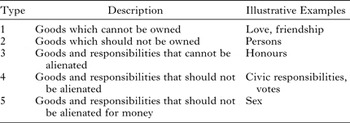
Our taxonomy draws on an account developed by Judith Andre in her instructive analysis of Michael Walzer's well known but rather unsystematic discussion of goods that should not be transferred for money.Footnote 10 Andre seeks to provide a more rigorous categorisation of the different kinds of reasons that can be given for thinking that certain burdens or benefits should not be bought and sold.Footnote 11 Drawing on her work, we distinguish between five types of case where trading a benefit or a burden is morally problematic.
First, there are goods which ‘by their nature cannot be owned’.Footnote 12 Well-known examples might include love, friendship, respect and admiration.
Second, there are some things that it is possible to own but which we think it would be wrong to own.Footnote 13 Again there are well-known examples. It is possible to own human beings but, of course, we now think that this is an indefensible practice, as this fails to respect the dignity and moral standing we attach to other human beings.
A third case where a trade in goods or services is problematic arises when it is impossible to alienate a good or a responsibility.Footnote 14 First, consider goods. There are goods which a person can possess but which he or she conceptually cannot transfer to others. An example would be an honour (such as the Nobel prize).Footnote 15 This honour belongs to the person awarded it and she cannot bestow it on someone else. It is not possible to alienate it. The same can be said of academic qualifications. People can only acquire these in a certain kind of way. For example, they must have been admitted onto the course in question, complied with the regulations, and passed the relevant examinations. The pedigree matters and this entails that it is not possible simply to transfer the good to others. Consider now responsibilities: there are some responsibilities which only the original duty bearer can honour and which it is not possible for others to honour. For a clear example of this kind of responsibility, suppose that a spouse has a duty of sexual fidelity to their partner. In such a case, this is a responsibility that they alone can honour. Compliance with that duty requires that particular person to personally discharge the duty. They cannot outsource that obligation to others in some way (though others can, of course, assist them in their performance of the duty).
In addition to the first three categories, there are also cases where it is possible to alienate a good or a responsibility but we might think that it is wrong to alienate such a benefit or a burden to other people.Footnote 16 Again we can distinguish between two cases here. The first is when someone alienates a responsibility to someone else but we think it is wrong for him or to do so. Machiavelli, for example, argued that it would be wrong for citizens to delegate the responsibility to protect their state or fight their wars to others, notably mercenaries. In his view, citizens should defend the state themselves.Footnote 17 Another example would be someone who seeks to alienate a civic responsibility (like doing jury service) to someone else. One might think that this is their job: they should do it and should not pass it on to others. We shall refer to these as ‘non-delegable duties’. These are duties one can alienate but should not. A second kind of case involves alienating a ‘benefit’. To take one example, some like John Stuart Mill, hold that people should not be allowed to alienate their own liberty.Footnote 18 They have inalienable rights. Another case is voting rights. It is widely held that it is wrong to transfer this benefit to others.Footnote 19
Let us turn finally to a fifth category. This fifth type of argument maintains that certain goods (or responsibilities) should not be alienated for money.Footnote 20 It does not object to someone exchanging a good or service but it does object to someone exchanging it for financial gain. Consider, for example, prostitution. Some, for example, would argue that whilst there is nothing wrong with having sex per se, and indeed sex as part of a loving relationship is normally considered to be good, it would be wrong to exchange sexual favours for money. Some argue along similar lines against commercial surrogate motherhood.
We can sum up the preceding discussion with the following table.Footnote 21
Arguments against trading certain burdens and benefits

4. Five ethical arguments against emissions trading
Having presented this taxonomy of the kinds of objections one might make to trading in general, we now turn to examine the case against trading allowances to emit greenhouse gases.Footnote 22 Not all of the categories outlined in the previous section lend themselves to a critique of emissions trading. In particular, we set aside the first and third type of argument. There do not seem to be any reasons why one cannot own an emissions allowance (so the first kind of argument does not apply) and one can easily transfer this good to others (so the third kind of argument does not apply).
We shall therefore focus on arguments 2, 4 and 5. More precisely, we shall consider one type 2 argument, two type 4 arguments, and two type 5 arguments.
Before beginning the normative analysis it is worth distinguishing between two separate questions. The first question is whether it is permissible for states and other political institutions to set up emissions trading schemes. Let us call this the institutional question. The second question is whether it is ethically appropriate for individuals to buy or sell emissions permits. Let us call this the individual question. These two questions are importantly different. One might, for example, argue that it is appropriate for the state to allow this kind of trading even if one thinks that such trading is immoral. On a liberal conception of the role of the state, the duty of the state is to treat people justly and respect their rights. This can include granting persons rights to do things which one believes to be immoral. For example, one might think – at the institutional level – that persons should be allowed to sell sexual services for money and yet also think – at the individual level – that persons ought not do so.
Our concern is primarily with the first type of question. The arguments from environmental outcomes, waste minimization and liberty give us prima facie reasons to endorse such a scheme. Our view is quite compatible with the view that persons are under a moral obligation to reduce their emissions, not to use energy wastefully and unnecessarily and, more generally to adopt an ethic of frugality of the sort advanced by David Wiggins in his paper.Footnote 23 Let us now consider five anti-market arguments to see whether the reasons in favour of emissions trading can be outweighed.
Argument A: Owning what should not be owned
One argument that might be made against emissions trading is that it involves owning a kind of good that, while it is possible to own it, should not be owned.Footnote 24 Emissions trading assumes that humans have property rights in the natural world. It might be argued that this is undesirable. The natural world (or perhaps, more plausibly, particular features of the natural world like the Earth's atmosphere) should not be treated as people's private property. Anti-commodification arguments are familiar, and in many cases, have force. For example, as noted above, we surely think that humans should not be owned. However, these types of arguments are unpersuasive in the context of emissions trading.
One central problem with the argument is that emissions trading does not rely on the assumption that persons own the atmosphere.Footnote 25 Emissions trading involves a right to use up some natural resource but a ‘use right’ is not the same as a ‘property right’.Footnote 26 An example might bring out the point. Consider someone who purchases a permit to camp on a certain plot of land. He or she does not, thereby, gain a private property right in the land. Rather they have a ‘use right’ – a right to use that piece of land for a fixed period of time. Emissions permits can be understood in a similar way. They entail a right to use, for a period of time, a certain proportion of the absorptive capacity of the atmosphere. After some time (maybe several hundred years in the case of greenhouse gases) the impact of the emission of greenhouse gases, like the impact of the camper, will effectively disappear.
Further evidence for the claim that emissions trading does not assume that persons own the atmosphere can be found once we note that emissions trading is quite compatible with the idea of stewardship. It is often said that humanity should act as ‘stewards’ or ‘trustees’ of the natural world rather than as private owners of it.Footnote 27 The concept of stewardship or trusteeship (we use the two interchangeably) might be said to include three components. First, those who are trustees of some particular designated natural resources may have a right to use that resource (use rights). Second, however, those who hold the natural resources in trust are not entitled to destroy the natural resources (no right to destroy). As Tony Honoré notes in his seminal analysis of ownership,Footnote 28 the right to destroy is one of the key eleven ‘incidents’ of private property, so this second feature distinguishes trusteeship from ownership. A third, and related, component can best be explicated by using a distinction coined by John Passmore in his seminal Man's Responsibility for Nature. Passmore distinguishes between ‘conservation’, which he defines as ‘the saving of natural resources for later consumption’,Footnote 29 and ‘preservation’, which he defines as ‘the attempt to maintain in their present condition such areas of the earth's surface as do not yet bear the obvious marks of man's handiwork and to protect from the risk of extinction those species of living beings which man has not yet destroyed’.Footnote 30 Utilising this distinction one might say that a third aspect of stewardship includes duties to conserve and/or preserve certain resources and features of the natural world for those who follow them (duty to conserve or preserve).
Now emissions trading is compatible with this ideal. Someone committed to the ideal of stewardship may think that we are stewards of Earth's climate and, therefore, may not destroy it and indeed must conserve or preserve it for future generations (thereby complying with the second and third features of ‘stewardship’). However, she may also quite consistently think that, within limits specified by the duty not to destroy, humans and non-human animals may use the absorptive capacity of the atmosphere (thereby conforming to the first feature of stewardship). This requires setting a budget specifying a safe level of emissions. With this in mind the proponent of a stewardship approach must then consider what policy instruments – including carbon taxes or emissions markets or regulations – would best protect this atmosphere. She might then quite consistently propose an emissions trading scheme for those permissible emissions. Emissions trading is, thus, not reliant on the private ownership of Earth's atmosphere and is fully compatible with a commitment to global stewardship.
Before we turn to consider a second argument against emissions trading we should, however, note an objection that might be levelled against our response to the first argument.Footnote 31 A critic might reply that though we are correct that emissions trading does not require the ‘ownership rights’ over the natural world, our appeal to ‘use rights’ over the natural world is not sufficient to exonerate emissions trading, for use rights can be morally problematic too. Consider, for example, a form of slavery in which persons do not have full ownership relations over others (and so may not destroy them) but they can ‘use’ those others as they see fit and without their consent. Suppose, for example, that they can (i) require them to work for no pay and control what they do and when they do it, and that they can (ii) sell or lend these persons to others for their use. (Let us term this slavery*.) Consider, similarly, a system of marriage in which men have ‘use rights’ over their wives (and so may have sex with their wives without their consent), and may (like Michael Henchard in Thomas Hardy's The Mayor of Casterbridge) sell their wife at an auction, but may not destroy them (and so strictly speaking does not own them in Honoré's sense). (Let us term this marriage*.) It follows from these examples that a system of ‘use rights’ can be deeply morally unacceptable too.Footnote 32
In reply: we agree that some kinds of use right are morally indefensible. Clearly slavery* and marriage* are objectionable. Two points, however, can be made. First, the problem with both of these institutions is that the ‘use rights’ involved in both slavery* and marriage* directly violate the fundamental and basic rights that all persons have over themselves. This explains why these kinds of use rights are morally unacceptable. By contrast, we see no reason to think that the natural world possesses an analogous right that would preclude human beings from having use rights over it. To challenge our position the critic would have to provide an argument that establishes both (i) that Nature can be a right-holder, and, moreover, (ii) that the rights that it possesses disallow persons from using it in anyway whatsoever without its consent (whatever that would mean). This seems to us a tall order and we are unaware of any argument that could establish this. Second, not only do we lack any reason to deny humans some use rights over the natural world, we also have positive reason to ascribe such use rights to persons. To withhold from persons any use rights over the natural world (unlike denying people use rights over other human beings without the latter's consent) would have catastrophic effects. It would deny people the land they need to live on, food to eat, water to drink, energy for heat and so on. It is, in effect, to call for the end of human life on earth. We, of course, place a limit on how much persons can use the natural world but see no reason to withhold from them any use rights at all, and plenty of reason to affirm such restricted use rights (including use rights over the atmosphere).
Argument B: Alienating responsibilities that one should perform oneself
Having considered a type 2 argument, and having argued that type 1 and type 3 arguments do not apply to the trading of permits to emit greenhouse gases, let us consider a type 4 argument. These, recall, maintain that certain goods (such as one's liberty or voting rights) and certain responsibilities (such as one's civic responsibilities) should not be alienated.
This kind of argument has been applied in a number of different ways to emissions trading. One common variant of this approach argues that creating a system with emissions trading is objectionable because it allows people to alienate responsibilities that it is inappropriate for them to alienate. This argument – what might be termed the Collective Sacrifice Argument – appeals to what we earlier termed ‘non-delegable duties’. If we focus on the distribution of emissions within a state, the claim is that each citizen should ‘do their bit’ and should not delegate their tasks to others. They themselves should constrain their own emissions and not pay for someone else to lower their emissions. At the international level, this argument would hold that each state should shoulder ‘its’ burden and that high-emitting countries should not pay others to discharge ‘their’ duty.Footnote 33
Note that this argument does not claim that those who purchase permits to emit greenhouse gases are not making a sacrifice. Clearly they are. The complaint is that they are not making the right kind of sacrifice. Paying a financial burden is not the way to discharge one's duty. One must discharge one's duty by keeping one's emissions within a pre-specified limit.
The idea of a shared sacrifice is a powerful one. However, this argument only has force against certain kinds of systems of emissions trading.Footnote 34 For example, if the government were to allocate permits to individuals and require them to control their own emissions as a matter of public duty, it would then be problematic to allow some people to pay to be exempted from this particular sacrifice. This would be akin to having a system of national military service and then allowing some to pay for others to substitute for them in discharging their public duty. However, it is crucial to note that emissions trading schemes do not necessarily have this character. An emissions trading scheme which allocates permits to firms, who either reduce their emissions or trade with other firms who have done so, can protect the environment without creating an individual civic responsibility to reduce emissions. Emissions trading need not involve the creation of civic duties, only to then allow individuals to escape their own duty by paying a sum of money. They can instead be a system which does not directly ascribe responsibilities to reduce emissions to its citizens, but which nevertheless achieves the collective environmental objective.
At this point a proponent of the Collective Sacrifice Argument may, of course, reply that we ought to address the challenge of reducing greenhouse gas emissions by creating a system of civic responsibilities. They might argue that we should adopt the same kind of approach that is normally adopted during in wartime – one in which there is rationing and a ban on trading. However, it is far from clear why this is the best way to deal with emissions reductions. In very many cases we allocate responsibilities to the state rather than to each individual citizen. For example, we often require government to remove household waste (rather than call for a system in which everyone takes their own waste to the rubbish tip) and we expect governments to provide an army to defend us (rather than have a military force entirely constituted by compulsory national service) and we then pay for the state to perform these tasks. Furthermore, in other cases, we might rely on other individuals to perform various tasks (e.g. look after our children). We discharge our responsibilities by paying the money that is required, rather than personally performing those responsibilities. But if we accept that kind of reasoning in these other cases, why should we insist that the task of emissions reduction must not be done in this kind of way? As Jeremy Waldron writes, ‘[w]artime conscription – together perhaps with jury service – is virtually the only example of the state's discharging its functions by exacting service rather than money from its citizens. Since the dawn of the modern era, states have relied for the most part on cash rather than in-kind contributions.’Footnote 35
At this point one final point might be made: a proponent of the Collective Sacrifice Argument might argue that our analysis of the Collective Sacrifice Argument overlooks an important distinction between two kinds of case.Footnote 36 They might reason as follows. Consider, first, a case where, say, two agents (A and B) are emitting greenhouse gases and it is much more expensive for A to reduce emissions than B. In such a case it seems reasonable to allow A to perform her duty by paying B to reduce emissions on A's behalf. Consider, however, a case where A and B both have exactly the same costs of reducing emissions. Suppose, however, that A does not feel like reducing her emissions and so would like to pay B instead. This, it might be argued, brings out the moral appeal of the Collective Sacrifice Argument. When applied to emissions trading, the thought might be that it is acceptable for a rich western country to pay China to reduce its emissions more cheaply by switching to more efficient technologies already in use in the west, but that it would be wrong for a rich western country, because it can't really be bothered, to pay the Chinese to reduce emissions by, for instance, not using a technology that westerners still continue to use.
Two points can be made in reply. First, it is not clear why it would be wrong for countries to express different attitudes to the way in which they bear their burden of reducing emissions, provided that all countries do indeed bear this burden. To give an analogy: consider two neighbours. Why would it be wrong for one to pay the other for the use of the other's front drive if the other consents to it and thinks the sum is a reasonable one? One neighbour no longer has the use of their front drive, and perhaps would find this inconvenient, but by foregoing the use of one resource (the front drive) but they simultaneously gain the use of another one (the money) in its stead.
Second, it is arguable that this kind of argument, and, moreover, the ‘West v China’ example given above, gains whatever intuitive appeal it has because it invokes separate extraneous factors – namely the respective wealth of the contracting parties and the fairness of the distribution of emission permits. That is, it might seem problematic for the wealthy to pay the poor to forego a good that the wealthy continue to enjoy. It is noticeable, for example, that the example that Sandel employs to illustrate the Collective Sacrifice Argument involves a rich family (‘[t]he family in the mansion on the hill’) paying its poorer neighbours to do some work for them.Footnote 37 This, however, cannot give us reason to reject emissions trading tout court. Rather it draws our attention rather to ensuring that there is a fair distribution of resources, including a fair share of emissions permits (an issue we discuss below in section 5).
Argument C: Emissions trading and the vulnerable
Consider now a third argument. Like the preceding argument it maintains that emissions trading involves alienating what should not be alienated (a type 4 argument). However, unlike the previous argument it focuses not on the person buying extra permits but on those who sell the permits. It maintains that to create a system in which permits to emit greenhouse gases were traded would allow trades which are disadvantageous to the most vulnerable and, as such, should not be allowed.
One can distinguish between two versions of this argument, what might be called the Paternalist Argument and the Unreliable Trustees Argument. The Paternalist Argument maintains that allowing persons to trade emissions may be undesirable because people will make poor judgements about their own interests and so they should be protected from themselves.Footnote 38 This argument is hard to sustain. Though there may be cases where a degree of paternalism is justified, it is not at all clear why: (a) we should assume that adults will make dire choices about their energy needs, and (b) even if they do it is not at all clear why the value of self-determination would be outweighed here. Furthermore, (c) the argument has no force against emissions trading between companies, as in the EU ETS. For paternalism to be justified there must be a case for protecting an actor (in this case, a company) from its own decisions. This can be plausible – in restrictive conditions – when that actor has an independent moral value and when protecting their well-being is of great importance and when they are likely to make errors in judgement. However, companies – unlike persons – do not have fundamental moral status; their importance stems from their contribution to consumers, owners, shareholders and employees. It is thus hard to see why we should prevent a company from making poor decisions about how many emissions permits to purchase or sell.Footnote 39
A more plausible argument is what we have termed the Unreliable Trustees Argument. This argument runs as follows: there are cases where it is either impossible or undesirable to allocate permits to emit greenhouse gases to certain groups of people, and we therefore have reason to create trustees to care for their interests. However, these trustees are sometimes unreliable (either because they are not motivated to care for those in their trust or because they are sometimes incompetent). Given this, rather than distribute money to these unreliable trustees to care for those in their charge (which they might spend inappropriately) there is a case for placing limits on how the trustees can use the resources allocated to them.
It may be helpful to give some concrete illustrations of this kind of reasoning. One example is provided by James Tobin who makes an Unreliable Trustees Argument when he defends allocating educational vouchers (rather than money) to parents.Footnote 40 This is a form of non-tradable good; it can only be used for one purpose and cannot be sold for profit. The case for vouchers is that these are the best way to ensure that children receive the goods we want them to receive. Now someone may argue on similar grounds that emissions trading may be morally problematic in cases where one has to use trustees, but cannot be sufficiently confident that they will use any permits allocated to them for the benefit of their charges. Henry Shue appears to endorse this kind of reasoning and argues that states should not be allowed to sell all of their emission rights because that would risk harming their citizens. Some emissions, he claims, should be regarded as ‘inalienable’.Footnote 41
Note, however, that Shue does not claim that this rules out all emissions trading.Footnote 42 At most, it would entail that emissions trading be impermissible where that would jeopardise vital energy and other needs. It thus does not give us any reason to condemn an emissions trading scheme in the European community or within states that one can assume will take a responsible approach to the emissions needs of their own population. It comes into play only in countries which distribute the emission rights (or the proceeds of selling emissions rights) in such an egregiously unjust way that interfering with sovereignty is unwarranted.Footnote 43 Thus it might, for example, apply in a regime that withholds emissions necessary for a decent standard of living from its citizens.Footnote 44
Argument D: Putting a price on the natural world?
Having considered two type-4 arguments, let us turn now to a type-5 argument. Some may object to emissions trading on the grounds that it puts a price on carbon dioxide emissions. They may argue that what is objectionable about emissions trading is not that it allows people to alienate their responsibilities or exchange benefits, but rather that emissions trading puts a monetary value on carbon dioxide (and other greenhouse gases). This, they may object, is an inappropriate attitude to take to the natural world, because its value simply cannot be captured in monetary terms.
A defender of emissions trading can, however, reply that emissions trading does not necessarily involve any expression of the value of the natural world. One might, for example, quite consistently adhere to both of the following tenets:
(a) the natural world is of intrinsic value and its value cannot be captured by monetary estimates, and
(b) the most efficacious way of protecting the natural world involves setting strict limits on the extent to which humans emit greenhouse gases and then allocating the remaining legitimate emissions through the operation of an emissions trading scheme.
To hold that market mechanisms are an effective way of protecting the natural world does not entail anything about why the natural world has value. Emissions trading here is simply a means to an end and is not in any way a statement about why the natural world has value.Footnote 45
This point might be put in another way: it is often said (and we endorse the claim) that political actors should ‘put a price on carbon’. Cap-and-Trade schemes are obviously one way (though not the only one) of putting a price on carbon. It is, however, crucially important to be clear on what this does and does not entail. On the one hand it clearly entails that to emit a certain quantity of greenhouse gases will cost a certain amount of money and hence these emissions permits have a price tag. However, putting a price on (a) emissions permits does not entail putting a price on (b) the protection of the earth's atmosphere. Emissions trading schemes, thus, put a price on the use of a certain amount of the absorptive capacity of the atmosphere; they do not thereby put a price on the maintenance of a climate that is hospitable to human and non-human life. To give an analogy one might think that some ancient ruins are of great intrinsic value and therefore must be protected. And one might think that the best and fairest way of achieving this is to regulate access to these vulnerable ruins and to charge people if they wish to visit them. In doing so the scheme will put a price on ‘visiting the ruins’. But by doing so it does not thereby put a price on ‘the protection of the ruins’. The same is true of emissions trading schemes. To put a price on one thing (the right to use the atmosphere) is not to put a price on another thing (the preservation of our climate system).
Argument E: Does emissions trading convert what ought to be a fine into a fee?
Let us turn now to a fifth argument against emissions trading. Like the preceding argument, this argument also makes a type 5 objection. It runs as follows: emissions trading grants people permission to pollute so long as they pay a financial fee but, so the argument runs, this is profoundly mistaken. Emitting greenhouse gases is a wrong that should be fined: it is not something that one should be allowed to do if one pays a fee. The core idea is nicely captured by Sandel in a short critique of emissions trading. Sandel writes:
The distinction between a fine and a fee for despoiling the environment is not one we should give up too easily. Suppose there were a $100 fine for throwing a beer can into the Grand Canyon, and a wealthy hiker decided to pay $100 for the convenience. Would there be nothing wrong in his treating the fine as if it were simply an expensive dumping charge?Footnote 46
Sandel's answer is ‘no’. It would be wrong in this case to treat the ‘fine’ as if it were a ‘fee’. Similarly it would be wrong for an able bodied person to park in a disabled car parking space with a view simply to paying the ensuing fine and treating the latter as a reasonable price to pay for the privilege.Footnote 47 Sandel then applies this kind of thinking to greenhouse gas emissions.Footnote 48 Persons should restrict themselves to a fixed quota and for any of them to exceed their individual quota is a crime that should be punished with a fine, not an option which they can pay for (as would be the case with a fee). Let us term this the Fines/Fee Argument.Footnote 49
Sandel's argument is, however, unpersuasive. It applies to cases where an individual act brings about a wrong (as it does in the hiker case and the car parking case), but it does not apply to cases where a wrong is only caused by a large number of individual actions when they hit a certain threshold. Sandel's claim that it would be wrong for the hiker to treat the $100 as a fee rather than a fine is plausible. But one cannot move from this example to conclude that emissions trading is similarly inappropriate. If one individual throws a single beer can, then she despoils the environment. However, if one individual purchases allowances so that she can emit more than her quota (however that is defined) then that in itself does not necessarily constitute a wrong if others, in line with the terms of the transaction, emit correspondingly less than their quota. A system of fees is not necessarily inappropriate.Footnote 50 Allowing people to exchange emissions permits for money is not therefore a case of wrongfully alienating responsibilities for money.
In sum, none of the five ethical arguments against climate change are seen to be compelling. First, emissions trading does not rely upon the private ownership of Earth's atmosphere and is compatible with a commitment to global stewardship. Second, the Collective Sacrifice Argument is unpersuasive because trading between firms and/or states can protect the environmental without creating civic duties; environmental goals and stewardship can be achieved by allocating the responsibility to states, rather than to individual citizens. The Paternalistic Argument is not applicable to emissions trading between firms, and there is no particular reason to think it would be persuasive even if trading took place between individuals. Third, the Unreliable Trustees Argument might entail that emissions trading be impermissible with corrupt states where this might jeopardize vital energy and other needs. However, it is not an argument against emissions trading per se and does not rule out emissions trading such as the EU ETS or systems in other well-governed countries. Fourth, while emissions trading puts a price on carbon dioxide emissions, this is not an expression of the value of the natural environment. Fifth, Sandels' Fines/Fee Argument is unpersuasive because each individual tonne of carbon dioxide emitted does not constitute a moral wrong — it is the aggregate damage that is problematic. An emissions trading or a system of taxes is able to prevent this damage, without the need to criminalise the activity of emitting and impose a system of fines.
5. The (distributive) justice of emissions trading
Section 4 considered the five strongest arguments for the claim that it would be intrinsically objectionable to create a system of emissions trading, and found them to be relatively weak. However, even if there is nothing intrinsically unethical about trading emissions permits, this does not necessarily imply that emissions trading will lead to just outcomes. In this section, we consider the impacts of emissions trading on distributive justice and the distribution of wealth. In focussing on this issue we are not assuming that distributive justice is the only relevant consideration in determining whether a policy is just. It is, however, an important consideration and it is the focus of this section.
We start from the assumption that, other things being equal, a more equal distribution of wealth is preferable to a less equal distribution. In general, market systems have a tendency at best to perpetuate existing distributions of wealth, and at worst to exacerbate wealth differences between rich and poor. Market economies involve greater uncertainty than planned economies, and the skilled and the fortunate are the beneficiaries, while the unskilled and the unlucky tend to suffer bad outcomes. While market economies tend to generate aggregate wealth and promote liberty, they can and do lead to highly unequal outcomes.
As with markets generally, environmental markets should not necessarily be expected to promote distributive justice or reduce inequality. Other things being equal, one might therefore expect the move to emissions trading to generate more unequal outcomes. However, the distributional consequences of an individual ETS are a function of the specific rules for allocating permits. Indeed, there is no reason in principle for an ETS to lead to more unequal distribution of wealth. It will depend on how the scheme is designed. The key point is this: whatever account of distributive justice one favours, the ETS can be designed to deliver a just outcome, either by specifying the allocation of permits in line with this favoured principle or by auctioning the permits and then distributing the revenues in line with this favoured principle.
In practice, two considerations will determine whether an ETS exacerbates or reduces inequality: first, the impact of increasing the cost of emitting pollution on different segments of the population and second, the transfers of wealth involved in the sale or free allocation of emissions allowances.
Controlling pollution directly or indirectly leads to an increase in the cost of pollution so that individuals and firms produce less of it. The evidence available strongly suggests that controlling carbon dioxide emissions is regressive, which is to say that the impacts are worse for low-income households (as a proportion of their income) than high-income households. This effect can be neutralised or reversed if the policy (whether emissions trading or taxes or otherwise) raises government revenue which is recycled to compensate poorer households.Footnote 51 In Australia, for instance, the Garnaut Review notes that roughly 10 per cent of income is spent on transport fuel, gas and electricity by low-income households, while high-income households spend only 5 per cent on these goods.Footnote 52 Pricing pollution thus hits poorer people relatively harder. Further, poorer households often rent, rather than own, their accommodation, which further constrains their ability to respond by adopting low-emissions substitutes, such as insulation, efficient space heating, hot water systems and cooking appliances. Similar effects are found in other countries.
For emissions trading to avoid regressive impacts, allowances must be sold to firms with a portion of the revenues directed to provide compensation to poorer households. This compensation could be a function of the costs required to adjust to a low-carbon economy, or could simply be given to low-income households through the tax system.
In addition to the fact that pollution control increases the price of pollution, a second consideration is that pollution policies transfer wealth from some individuals to other individuals, depending upon the particular policy and how it is implemented. For instance, carbon taxes on industrial firms normally transfer wealth from their shareholders back to the government. Carbon taxes need not have a regressive effect, provided the government doesn't give the funds back to the same firms, or earmark the funds for particular pet programmes (which often occurs in practice for political reasons). If funds are used to reform and reduce the burden of taxation on the poor, the impact of carbon taxes could be progressive. Similarly, auctioned permits under a cap-and-trade scheme transfer wealth from firms to governments, and again provided these funds are used sensibly, the effect need not be regressive and could be progressive.
However, for the most part – for the political reasons discussed above – governments have not auctioned off permits or used tax revenues for progressive reforms of the tax system. Rather, as in the EU ETS, the vast majority of ‘European allowances’, or EUAs, have been given to firms for free, rather than auctioned.Footnote 53 This has created windfall profits for firms, because (a) the emissions trading scheme creates a price which increases marginal costs of all units of production, which is often largely passed on to consumers in the form of higher goods prices, depending on the market structure; but (b) the firms are given most of the EUAs for free. In other words, marginal costs of production on all units increase, because firms need to retire a permit for every unit of production. However, firms (a) pass the cost increase onto consumers in the form of higher prices, and (b) they are compensated by government for the cost increase by being granted permits – which are a substantial financial asset – for free.Footnote 54 Thus, the EU ETS has created large-scale wealth transfers from taxpayers to firms, who have reaped substantial windfall profits. Rather than support suppliers, customers, or employees, these windfalls have largely been retained by shareholders, who are wealthier than the average taxpayer. The consequence is that it seems almost certain that the EU ETS has been significantly regressive. Similarly, in the USA, Parry argues that the free allocation of permits to industry would be regressive, redistributing income from poorer to richer households.Footnote 55
The conclusion is that climate-change policies are likely to create regressive impacts without other compensatory measures, and the EU ETS is certainly no exception so far. However, the design of the EU ETS has been improving as policymakers have learned from their mistakes. For instance, in the third phase of the system (2013–2020), the cap is much tighter (at least 20% and possibly 30% reductions from 1990 levels), and the proportion of EUAs sold at auction will increase substantially. However, even with these effects, it would seem that the EU ETS is likely to remain a regressive way of reducing emissions, at least until 2020. A policy that puts a price on emissions will only be progressive if it also raises significant amounts of government revenue to compensate low-income households. As this has apparently been too difficult for politicians to achieve so far, we conclude that emissions trading as currently implemented has had negative consequences for distributive justice.
6. The effectiveness of cap-and-trade
The effectiveness of any climate-change policy is also an ethical matter. If climate policies are not able to reduce emissions at the appropriate rate and scale, the risks imposed upon future generations would likely be considered to contravene intergenerational justice. Previous experience with cap-and-trade systems has shown that such systems can make significant contributions to environmental protection, provided that they are designed and implemented correctly.
6.1 Is cap-and-trade politically feasible?
One critically important question to ask of any proposed climate policy is whether it is actually politically feasible. Over the last 40 years, climate-change policies have proven extremely difficult to put in place. Because these policies provide a global public good, every country, particularly smaller countries, have an incentive to free-ride on others' efforts. Furthermore, achieving domestic political agreement on tackling climate change is challenging because there are many powerful losers and relatively few winners (unless other nations take similar action). Furthermore, the science continues to have important uncertainties, and the costs are incurred now while the benefits accrue decades and centuries into the future. Given these perspectives, instead of asking ‘why has so little been achieved?’Footnote 56 some sceptical economists often find it remarkable that any action has occurred at all, and consider the real puzzle to be why anything at all has been achieved.Footnote 57
Cap-and-trade systems have the virtue that they are almost the only deliberate climate-change policy to actually reduce emissions to any significant degree so far.Footnote 58 Half of the European economy is subject to the EU ETS, with a revealed price of around €10–20/tCO2, significantly higher than any other serious direct price signal elsewhere in the world. Other cap-and-trade schemes include the Regional Greenhouse Gas Initiative in the north-eastern USA, the Western Climate Initiative in several western USA states and Canadian provinces, and those adopted in the Australian state of New South Wales, Switzerland, Norway, Japan, New Zealand. As noted above, both China and India have also recently announced that they will be implementing cap-and-trade systems to reduce their absolute level of emissions.
The reason why some states and regions have been able to put a price on greenhouse gas emissions with emissions trading, whereas efforts to date with carbon taxes have not been as successful, is that cap-and-trade systems are able to garner political support from a wide spectrum of relevant actors. Environmentalists have supported cap-and-trade systems because the cap on emissions, which gets tighter over time, is the best method of securing a good environmental outcome. Industry has supported cap-and-trade ahead of direct regulation because it is cheaper and minimises the costs of compliance, and industry prefers cap-and-trade to taxes because, as discussed above, cap-and-trade allows a proportion of allowances to be given to firms for free. Finally, cap-and-trade systems have a natural constituency once they are up and running. The industrial firms which own the permits will see the value of that asset increase as the cap is tightened. Financial firms who trade the asset also have an interest in rising carbon prices. Unlike a carbon tax, where there is no strong constituent to support them, cap-and-trade systems have, rightly or wrongly, found support across a cross-section of environmentalists and business that make them more politically feasible.
6.2 Defining effectiveness
Only once a system has been implemented can its effectiveness be assessed. The effectiveness of emissions trading depends on the question which it is intended to answer. Is emissions trading intended to deliver global emission reductions of over 50% by 2050, without other policy interventions? Or is emissions trading intended to be part of a package of climate policies, so that its effectiveness is measured by whether it has made a sufficiently substantial contribution to reducing emissions?
In addition to measuring effectiveness of emissions trading according to the appropriate objective, effectiveness must also be measured by reference to a ‘counterfactual’, namely a baseline scenario describing what would have happened if the emissions trading scheme had not been introduced. Emissions trading can guarantee a specific limit on emissions, but it cannot guarantee a specific reduction in emissions compared to business-as-usual, because business-as-usual emissions are uncertain. For instance, a given emissions target might be achieved not because of emissions trading, but because of a severe economic recession which caused a fall in business-as-usual emissions. In a recession, economic activity falls and emissions fall, so the demand for permits could fall to the extent that the permit price could end up at zero. In such circumstances, it would be difficult to conclude that the ETS is working to reduce emissions. In contrast, if the price of emissions allowances is positive, then it follows that emissions trading is probably reducing emissions. The higher the allowance price, the greater the relative impact of the emissions trading scheme, and the lower the relative contribution of business-as-usual changes to reducing emissions.
6.3 Has cap-and-trade reduced emissions?
Cap-and-trade systems have been successfully used in the United States to phase out leaded gasoline in the 1980s,Footnote 59 reduce sulphur dioxide (SO2) and nitrogen oxides (NOx) emissions from power plants from 1995 onwards,Footnote 60 and the phase-out of chlorofluorocarbons (CFCs).Footnote 61 The leaded gasoline programme achieved environmental targets with an estimated cost saving of $250 million per annum.Footnote 62 The SO2 programme also achieved environmental targets, saving $1 billion per annum compared with the estimated costs of other regulatory approaches.Footnote 63
The fact that a particular policy intervention has worked for one environmental problem does not imply that it will necessarily work for others. Climate change is a particularly vexing environmental challenge because it is international, intergenerational, based on complex and uncertain science, and involves almost every aspect of production and consumption around the world. Many economists express the view that emissions trading (or some other form of emissions pricing, such as international carbon taxes) is a necessary but not sufficient component of overall climate-change policy. Other policies are needed because of the presence of multiple ‘market failures’.
The most significant experiment with cap-and-trade systems for greenhouse gases to date began with the launch of the EU ETS in 2005. In the first phase of the scheme, from 2005–2007, carbon prices rose to highs of above €30/tCO2 and then crashed to near zero for most of 2007. Zero prices arose when it became clear in the third and final year of the phase that that aggregate emissions were well below the number of allowances issued. This surplus of allowances implied that they were worthless. The period of zero prices in 2007 was problematic for several reasons; most importantly the incentive to continue reducing emissions was dramatically weakened.
The price collapse was caused by a combination of two things. First, firms actually reduced their emissions in the first two years of the phase, motivated by high prices in the 2005 and 2006 period, so that they didn't need as many allowances in 2007. Second, regulators handed out too many EUAs in the first place, as a result of uncertainty about business-as-usual emissions and sustained lobbying by individual firms and EU Member States for additional allowances. What is the overall balance between these two considerations? Ellerman and Buchner review the EU ETS over 2005 and 2006, when emissions were 60 million tonnes (or 3 per cent) below the allocation levels.Footnote 64 After a careful econometric analysis, they conclude that, although there is considerable uncertainty, emissions were probably reduced compared to business-as-usual by 50 to 100 million tCO2 in each of those two years by the EU ETS, amounting to several percent of total emissions in the scheme. This is a considerable achievement; by comparison, the entire UK economy (which is partially covered by the EU ETS) emits around 500 million tCO2 in any given year. This suggests that, even with the manifest design flaws in the first phase of the EU ETS, and in a system that had zero prices for a considerable period, significant reductions in emissions compared were achieved compared to business-as-usual.
More recent analysis supports this view. Anderson and di Maria (2010) find that over the three trading years of the pilot phase from 2005–2007, total abatement was 247 million tonnes, or just over 80 million tonnes per year.Footnote 65 Consistently, a separate study by Delarue et al. (2008) found reductions in the power sector alone of 30–60 million tonnes in 2005 and 20–35 million tonnes in 2006.Footnote 66
Indeed, even though the price in the first Phase (from 2005–2007) ultimately did fall to zero, Ellerman and Buchner (2008) point out that it is unsurprising that emissions were reduced given the following three observations:Footnote 67
1. The price of EUAs was positive and significant during the 2005–2006 period, providing firms with an incentive to reduce emissions;
2. Real output in the EU rose over those two years, and improvements in CO2 intensity had been declining which implies a baseline of increasing CO2 emissions prior to 2005; and
3. Historical emissions data indicate a reduction in absolute emissions over the relevant period, allowing for plausible bias.
6.4 Will cap-and-trade reduce emissions in future?
Even if the EU ETS has been successful at reducing emissions to date, it must do so at much greater scale in the future if it is to provide a policy response commensurate with the scale of the challenge. There have been several changes in the design of the EU ETS between Phase 1 and the current Phase 2 (from 2008–2012), with further improvements in place for Phase 3 (from 2013–2020). Current allowance prices are around €10–20/tCO2, significantly higher than any economy-wide carbon tax, and market participants who publish forecasts of future prices expect prices to increase substantially over the coming years. To some extent, companies take these future prices into account when making their investment decisions.
Some of the more significant changes since Phase 1 have been as follows:
– The EU commission has been more resistant to lobbying by firms, and has insisted on greater cuts in emissions than requested by EU Member States and their firms;
– A higher proportion of EU allowances (EUAs) are being auctioned to firms rather than given away for free;
– Banking of allowances is possible from Phase 2 to Phase 3. This promotes confidence that carbon market prices will not fall to zero. Indeed, prices were positive even during the recent financial crises and recession, which reduced output and baseline emissions. This is because the market price reflects the effort required by market participants to achieve the agreed emission reductions through to 2020.
These changes suggest that emission reductions created through the 2008–2012 phase are likely to be significantly greater than those in the so-called ‘learning’ phase from 2005–2007. Furthermore, emissions reductions in the 2013–2020 phase will take the European economy substantially below business-as-usual, and indeed 20–30% below emissions in 1990.
7. Conclusion
Cap-and-trade systems for greenhouse gas emissions have been put in place in several countries over the last decade. While the evidence so far suggests that they have been successful in reducing emissions, they have been subject to increasing criticism by climate-change sceptics. Over the course of 2010, they were also tarred with the same brush of dissatisfaction addressed towards the United Nations negotiations, which failed to deliver a binding agreement at the international conference in Copenhagen in December 2009, but which appears to have achieved greater progress at Cancún in December 2010. In this paper we hope to have identified key ethical criteria by which one can evaluate such schemes. More specifically, we have defended four conclusions.
First, we have noted in their favour that emissions trading schemes may minimize waste and recognize person' interest in liberty.
Second, we have provided a taxonomy of ethical objections to the market. Drawing on this we have examined five different attempts to show that emissions trading schemes are inherently unethical and have found each of these attempts wanting. Emissions trading schemes, so we have argued, are not committed to either ‘ownership’ rights or unacceptable ‘use rights’ over the atmosphere as a whole and are compatible with an ideal of environmental stewardship (Argument A). In addition to this, while the Collective Sacrifice Argument has force in some contexts, we have no reason to apply it to this particular context (Argument B). A third argument – that one may restrict emissions trading in order to protect the vulnerable – can take two forms, but neither rule out emissions trading entirely (Argument C). Such arguments (in particular what we termed the Unreliable Trustees Argument) draw our attention to the important issues of who should possess the legal rights to emit greenhouse gases and how one can best ensure that the permits (or the revenues of auctions) should reach the people entitled to them. Such concerns do not, however, undermine many emissions trading schemes (Argument D). Finally, we have argued that emissions trading schemes do not elide the distinction between a ‘fee’ and ‘fine’ (Argument E). Emissions trading schemes are, thus, not in principle objectionable.
Having considered these five root-and-branch critiques of emissions trading we then turned to two other criteria relevant to the evaluation of emissions trading schemes. The first critical issue is the effect of emissions trading schemes on the distribution of wealth. This takes us to our third conclusion which is that while cap-and-trade systems are not intrinsically unethical, they (like other policies that put a price on greenhouse gas emissions) are likely to hit poorer households harder than richer households, with unwelcome implications for distributional justice. The current EU ETS puts a price on pollution without providing adequate compensation for poor households and, as a result, it has had a greater impact on the poor relative to the rich. This is not a necessary outcome,Footnote 68 and in principle it is possible to design an ETS so that the revenues from auctioning permits are used to produce a progressive result. Indeed, companies in the EU ETS will have to pay for a greater proportion of their allowances over time, so there is some possibility that this problem will be resolved as the ETS matures. That said, it is unlikely that the EU ETS will be progressive for at least another decade.
This leaves the final crucial consideration, namely ‘are emissions trading schemes an effective means of mitigating climate change?’. Our conclusion here is that a careful analysis of cap-and-trade systems shows that they are more effective at reducing emissions than many of their critics appear to believe. As noted above, even in the 2005–2007 learning phase of the EU ETS, discredited as having ‘failed’ by some critics, it is estimated that 50–100 million tonnes of CO2 a year were reduced compared to business-as-usual. The current phase (2008–2012) of the EU ETS will deliver greater reductions, notwithstanding the recession, and the reductions delivered in the next phase (2013–2020) depend upon whether the EU commits to a 20% or a 30% target in the course of the next year or so.
Given the moral virtues of cap-and-trade systems and the absence of compelling moral objections relative to other policy possibilities, we conclude that emissions trading remains a valuable policy tool with which to address climate change. Carbon taxes have some advantages over cap-and-trade,Footnote 69 but in other ways are worse, not least in the fact that they provide no guarantee of environmental outcomes, and are significantly more difficult to establish politically. Indeed, carbon taxes are likely to continue to be politically difficult, especially in the USA, to implement and maintain at a level that will achieve reductions in emissions at the necessary rate to provide a just outcome for future generations. Direct regulation is inferior to an ETS or a carbon tax because it increases costs of compliance, increases wastage and reduces liberty of individuals and companies to adapt to a low-carbon economy in the manner most suitable to them. In an ETS, the possibility of trade minimises waste, the cap ensures environmental integrity over time, potentially according to a gradual ‘contraction and convergence’ pathway,Footnote 70 and the allocation of the permits determines the distributive justice (and political success). None of this is to suggest that a single cap-and-trade system would alone be an adequate response to climate change. Nevertheless, it is a morally valuable, rather than a morally suspect, contribution to moving at speed and at scale to the low-carbon economy required for humans to continue to flourish on Earth into the next century and beyond.