Introduction
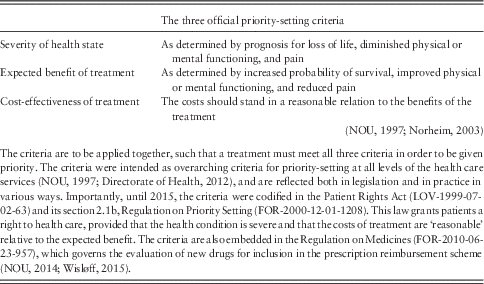
Priority setting in health care is a necessary, but difficult and complex task that can be tackled in different ways. Some countries have chosen to address this challenge by adopting a set of principles or criteria that are to be applied to a wide range of priority-setting decisions, often reflecting broader public debates about what values are relevant for rationing (see, e.g. Calltorp, Reference Calltorp1999; Berg and van der Grinten, Reference Berg and van der Grinten2003; Landwehr and Klinnert, Reference Landwehr and Klinnert2015; Rumbold et al., Reference Rumbold, Weale, Rid, Wilson and Littlejohnsforthcoming). Norway is one of the countries that has spearheaded this approach. Concerted efforts have been made from an early stage to take a systematic approach to priority setting, and through the work of several national commissions, a set of three official priority-setting criteria has been developed, in principle applicable to all kinds of priority-setting decisions (Norheim, Reference Norheim2003; Kapiriri et al., Reference Kapiriri, Norheim and Martin2007) (Table 1).
The three official priority-setting criteria

While the criteria themselves have been subject to extensive public debate and several revisions – most recently in the work of the third Priority Commission and its critics (NOU, 2014; Directorate of Health, 2015)Footnote 2 – questions concerning how the criteria are being applied in concrete priority-setting decisions have received less attention. The criteria were intended as overarching criteria for priority-setting at all levels of the health care services (NOU, 1997; Directorate of Health, 2012), and thus it is an important question how and to what extent they are being used in practice. In Norway, the National Council for Priority Setting in Health Care (‘the Council’) is one of several institutions involved in macro-level priority setting in the health care services.Footnote 3 In this paper, we look at how the Council has applied the official priority-setting criteria in deliberating and making decisions about the allocation of health care resources. We were interested in first, how the criteria were in fact being used by the Council, and second, whether the Council’s use of the priority-setting criteria could shed light on how priority setting happens in practice. For this purpose, we examine how the three criteria feature in the Council’s decisionsFootnote 4 and justifications. By means of a comprehensive document analysis of all cases processed by the Council from 2007 to 2014, we examined first, what decisions the Council had made, and second, what reasons they had provided to justify their decisions. In particular, how were the three criteria reflected in the justifications they gave, and what other reasons, if any, were offered?
The work of the Council is of interest for a number of reasons. The Council has been active since 2007 – and its predecessor since 2002 – but its work is not well known in the international debate, in contrast to the work of e.g. NICE (see, e.g. Devlin and Parker, Reference Devlin and Parker2004; Culyer, Reference Culyer2006; Rumbold et al., Reference Rumbold, Weale, Rid, Wilson and Littlejohnsforthcoming). Within Norway, naturally, the work of the Council has received much more attention (e.g. Johansson et al., Reference Johansson, Miljeteig and Norheim2009; Ringard et al., Reference Ringard, Mørland and Røttingen2010; Ringard et al., Reference Ringard, Larsen and Norheim2012; Ringard et al., Reference Ringard, Mørland and Larsen2012; NOU, 2014; Wang and Høymork, Reference Wang and Høymork2014; Agenda Kaupang, 2015). However, to date, no systematic analysis has been conducted of the Council’s justifications for their decisions, and our paper makes a novel contribution in this respect. Furthermore, the Council has made substantial efforts to promote transparency in their work. Their recommendations and justifications, as well as all case documents and summaries of their deliberations, have been made freely accessible to the public via the Council website, and all Council meetings are open for the public to attend. This offers a rare opportunity to gain some insight into how they make their decisions.
The Norwegian National Council for Priority Setting in Health Care
The Council was established in 2007 by the Norwegian Ministry of Health and Care Services, following the recommendations of the second Priority Commission (Norges Offentlige Utredning, 1997). The Council replaced the earlier National Priority Council, which was active from 2002 to 2006 (Mørland et al., Reference Mørland, Ringard and Røttingen2010). In the period from 2007 to 2014, the Council had 25 members, representing national and regional health management and administration, the health care professions, user and patient organisations and academia. The broad composition of the Council is intended to ensure that all important stakeholders and perspectives are represented. In addition, the Council has four ex officio members constituting its Secretariat, hosted by the Norwegian Knowledge Centre for the Health Services (until 2016).
The Council was intended as an arena for discussing governance and development in quality improvement and priority setting in the health services at a national level. Its mandate is to help ensure a comprehensive and consistent approach to quality improvement and priority setting, by clarifying the roles and responsibilities of different actors in the health care sector and improving coordination and interaction between the different levels, such as the primary care and specialist services (Mørland et al., Reference Mørland, Ringard and Røttingen2010; Ringard et al, Reference Ringard, Mørland and Larsen2012; National Health Plan, 2007–2010).Footnote 5 It is also part of the Council’s mandate to promote public debate on the specific cases it deals with as well as on priority setting in health care in general (the Council website).
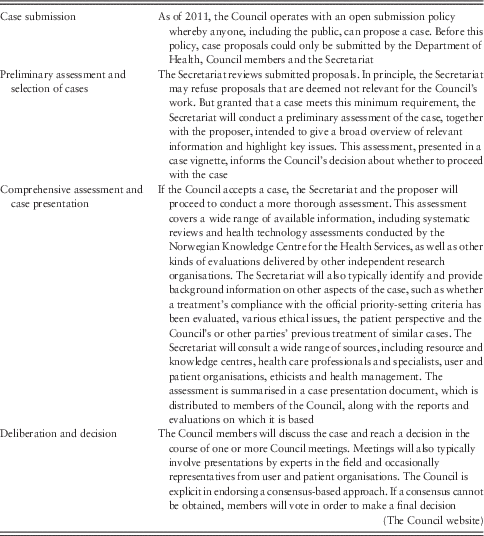
The Council’s primary role is to deliver assessments and recommendations concerning priority setting (and up until 2015, quality improvement) in the health care services to health management and authorities, policy makers and governing bodies (the Council website; Mørland et al., Reference Mørland, Ringard and Røttingen2010; Ringard et al, Reference Ringard, Mørland and Larsen2012). These recommendations, however, are not binding, but merely advisory (Table 2).
The Council’s case procedure

Materials and methods
Our analysis covers the Council’s activity between 2007 and 2014. We reviewed all cases processed within this period.
Materials
We reviewed the following documents, all available via the Council’s website:
-
∙ Case documents: case vignettes, case presentation documents and all supporting documents on which the vignette and presentation documents were based.
-
∙ Presentations at meetings (available as PowerPoint or PDF files).
-
∙ Meeting minutes, summarising the Council’s discussion.
-
∙ Final decisions: the Council’s final assessment, as communicated directly to the public on their website, which includes their recommendations and justifications.
Case selection
The Council website details a number of activities in addition to its recommendations in particular priority-setting cases. Such additional content includes, for example, information about past and upcoming public meetings and conferences as well as other events related to priority setting in the Norwegian health care services. We were only concerned with the Council’s actual decisions – thus, it was necessary, first, to identify the subset of cases where the Council had issued a recommendation on specific priority-setting questions. Subsequently, we completed a thorough review of the selected cases, acquiring detailed knowledge of each case and identifying the Council’s justifications for their recommendations. Both authors reviewed the cases independently, and subsequently we compared and discussed our findings. As discussed in further detail below, it was not always straightforward to identify the basis for the conclusion, or the conclusion itself. The independent review of the cases was helpful, as was the comparison and discussion of the lists each of us came up with. We were able to reach an agreement for each of the cases, but due to the nature of the documents and the ambiguity of some of the cases, we cannot guarantee that a third reviewer would have made the same assessment in all of the cases.
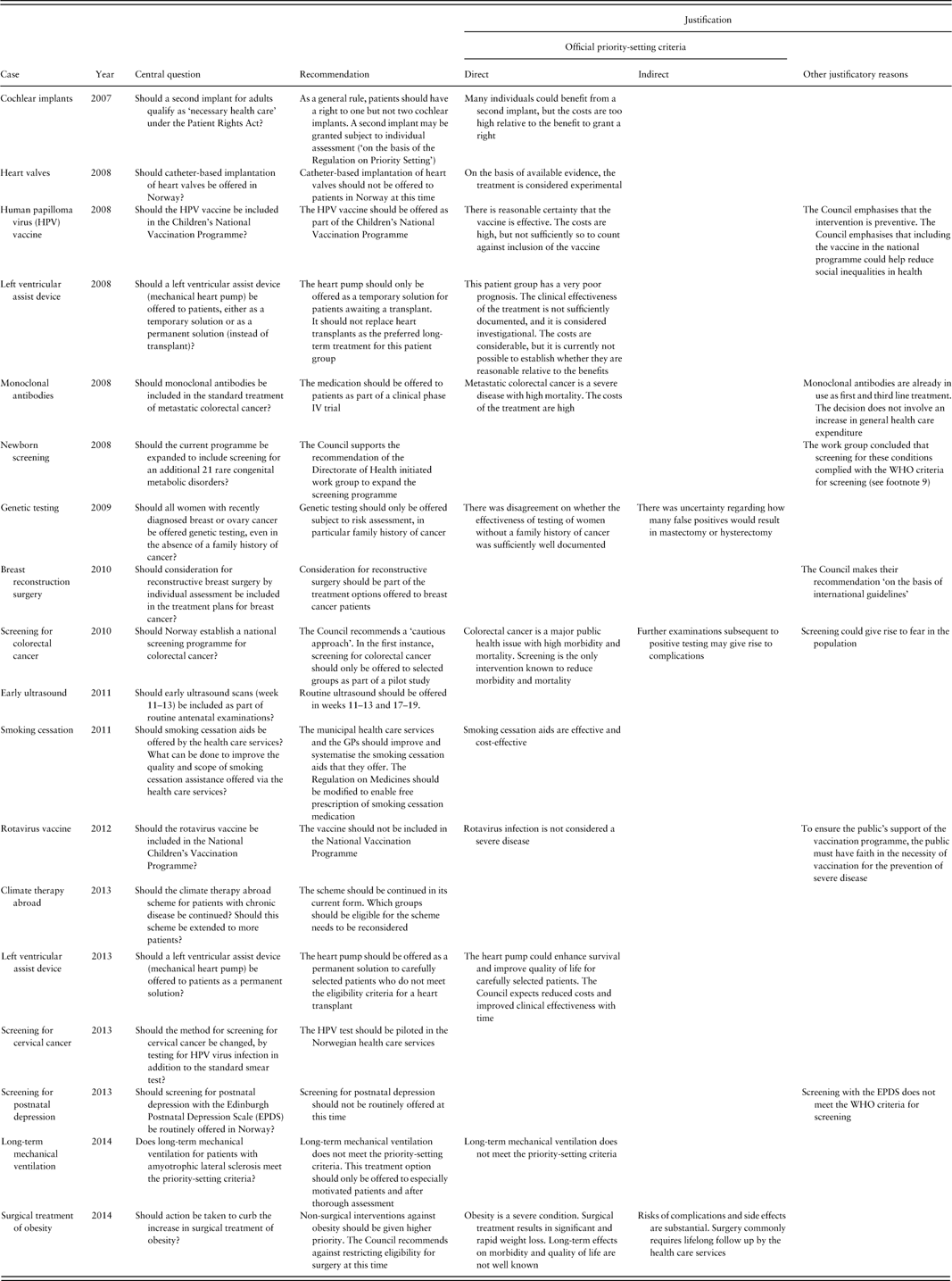
First, each reviewer identified all cases that concerned coverage of new and existing health care treatments and interventions. Second, we narrowed down this larger set of cases to cases where the Council’s final decision contained one or more concrete advisory statements regarding coverage of the treatment or intervention in question. For any given case, the Council had often issued a range of recommendations, including recommendations for further research and quality improvement, but we restricted our analysis to those recommendations that specifically concerned coverage. The Council’s engagement with a case tended to be fairly broad; thus, it was often not immediately clear whether the Council had set out to address specific questions or what these were. Although the case vignette would typically highlight key questions for consideration, the Council’s recommendations did not always correspond to these questions. The ‘central questions’ listed in Table 3 have been defined by ‘post-hoc’ reconstruction based on the case vignettes, the meeting minutes and the final decisions. Recommendations are put forward as part of the Council’s ‘final decision’, a more general assessment that sums up key issues and often covers a variety of aspects of the case. However, the recommendations themselves are not always clearly indicated within this broader piece of text. Thus, for some of the cases, identifying recommendations required some level of interpretation.
Case summaries and decisions

The wording of the recommendations and justifications has been kept as close as possible to the Council’s own, but are not direct citations unless otherwise indicated. The central question is reconstructed on the basis of case vignettes, meeting minutes and the final decision.
Analysis of the Council’s decisions and justifications
Subsequent to the selection of those cases in which the Council had issued one or more concrete recommendations, we sought to identify the reasons the Council had provided in support of their recommendation. Justifications, like the recommendations, are also to be found in the body of text that constitutes the Council’s final decision. Justifications tended not to be stated explicitly or spelled out in detail, and it was not always obvious whether a given consideration was specifically intended as a justificatory reason for the recommendation that was issued, or whether it was instead included merely as a general observation. Thus, there was a certain level of ambiguity with regards to what was intended by the Council as justificatory reasons. Some interpretation, therefore, was required for identifying the Council’s justifications.
We were primarily interested in the Council’s use of the official priority-setting criteria in their justifications, but also registered the use of other supporting reasons. The Council’s references to the three priority-setting criteria varied somewhat with respect to how direct or explicit they were, and we distinguish between ‘direct’ and ‘indirect’ references to each of the criteria. ‘Direct’ references include all explicit mentioning of a criterion, as well as quite specific references to the content of the criterion, but without specifically naming the criterion itself. For example, we considered a statement such as ‘The costs are high, but not sufficiently so to count against inclusion of the vaccine’ (Human papilloma virus vaccine) as a reference to the cost-effectiveness criterion, even if it is not specifically stated that the cost-effectiveness criterion is met. Similarly, we considered statements about poor prognosis and high morbidity and mortality (Left ventricular assist device) as direct references to the severity criterion. Statements about the level or quality of evidence of effectiveness were considered direct references to the expected benefit criterion. In three of the cases, the Council made reference to factors that would impact on whether the Expected benefit criterion is met, even if that factor is not directly contained in the criterion itself. For example, the possibility of false positives was offered as a justifying reason in Genetic testing, and risk of complications was mentioned in both Screening for colorectal cancer and Surgical treatment of obesity. We included these justifying reasons as ‘indirect’ references to the Expected benefit criterion. Finally, reasons offered in support of the Council’s decisions with no clear relation to the official priority-setting criteria were recorded as ‘other’ reasons. We included references to the WHO criteria for screening in this category. These criteria – 10 in total – include significance of the health problem, availability of effective treatment and costs (Wilson and Jungner, 1968), and as such one could say that there is some overlap between the WHO criteria and the official priority-setting criteria. However, as the Council did not specify which of the 10 WHO criteria they had in mind, we counted their references to the WHO criteria as a reference to ‘other’ justifications.
For each case, we also considered whether the Council’s decision and justification complied with the official priority-setting criteria. Here, we conducted an in depth analysis of the background information for the case and the Council’s deliberations as per the meeting minutes. Thus we aimed to determine first, to what extent the Council had taken a position on whether each of the three criteria had been met, and second, whether their final decision was in accordance with that position.
Finally, we considered whether there were any trends across time with respect to the Council’s use of the criteria.
Results
Cases
We identified 18Footnote 6 cases that met our selection criteria, out of a total of 105 cases processed between 2007 and 2014. The selected cases with decisions and justifications are presented in Table 3.
The number of cases with one or more clearly identifiable and concrete advisory statements on health care coverage was fairly low. As described above, many of the Council’s cases concerned quality improvement or were merely intended for general discussion. Nevertheless, it is noteworthy that we had to exclude several cases from our analysis because the recommendation was too general or vague, or because it was simply unclear whether a recommendation had been made.
The Council’s use of the official priority-setting criteria
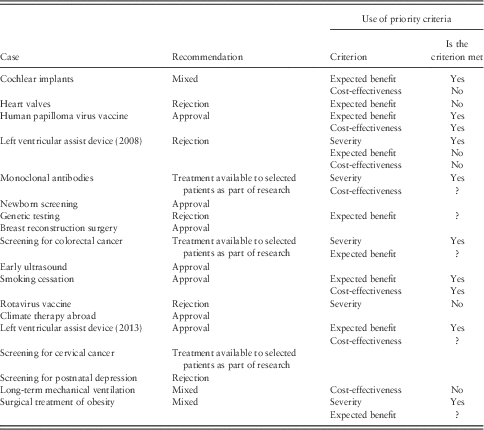
The Council had provided a justification for their recommendation in 15 of the 18 cases – the remaining three cases lacked a justification. The Council made reference to the official priority-setting criteria in their justification in 12 of these cases (the Council’s use of the criteria is summarised in Table 4). However, the Council generally only referred to one or two of the criteria, rather than using all of the criteria together. Furthermore, in some of the cases where the Council had made reference to a criterion in their justification, it was not clear whether they thought the criterion had been met. The expected benefit criterion was used the most, appearing in eight cases, while the cost-effectiveness criterion was used in seven cases. The severity criterion was used the least, cited in only five cases. We did not detect any pattern in the Council’s use of the criteria over time.
Summary of the Council’s use of the official priority-setting criteria

Note: ? indicates that it is unclear what the Council concluded regarding whether the criterion was met.
Insofar as the Council had referred to each of the three official priority-setting criteria, their recommendations were usually in accordance with the criteria. Two recommendations were justified on the grounds that two of the criteria had been met (Smoking cessation, Human papilloma virus vaccine). Conversely, several recommendations against the inclusion of a treatment or intervention were justified on the grounds that one or more of the criteria had either not been met (Cochlear implants, Rotavirus vaccine, Screening for postnatal depression), or that there was insufficient documentation thereof (Heart valves, Left ventricular assist device (2008), Genetic testing).
However, there were some noteworthy exceptions to this general pattern. In the first cluster of exceptions, the Council made recommendations that were arguably in conflict with their own judgement concerning one or more of the three criteria, with no clear explanation or justification offered for the departure from the criteria. In Early ultrasound, the Council’s preliminary decision indicated that there were no grounds for expecting early ultrasound to yield any medical benefits for either the mother or the foetus – it seems, then, that they took the view that the expected benefit criterion had not been met. Nevertheless, in their final decision, the Council made a recommendation in favour of the introduction of early ultrasound screening. The preliminary decision and the discussion indicate that the Council believed that other concerns beyond the official priority-setting criteria – in particular, early diagnosis of Down’s syndrome, as well as social inequalities in access to services – might be relevant for evaluating the introduction of early ultrasound. But this is not made explicit, nor is there any record of a discussion of whether such other concerns are sufficiently weighty to justify an exception to the official priority-setting criteria. In Climate therapy abroad, the Council recommended that the scheme should be continued. However, their discussion of the case indicates that there was great uncertainty concerning both effectiveness and cost-effectiveness. Yet, no explicit justification was provided for continuing the scheme in spite of such uncertainty, beyond an emphasis on the need for further research to assess the effects and the costs of this treatment.
In the second cluster of exceptions, the Council’s decision was mixed, allowing for exceptions to their general recommendation subject to individual assessment by health care professionals. However, they did not offer any reasons for why such exceptions should be allowed, even though the exceptions seemed to violate one or more of the official priority-setting criteria. In Long-term mechanical ventilation, the Council states explicitly that this intervention ‘does not meet the priority-setting criteria’. It was clear from the Council’s discussion that they considered the costs to be well above any reasonable cost-effectiveness threshold. (The discussion suggests that they also had severe doubts about whether the expected benefit criterion had been met, but it is unclear what position they took on this point in the end.) Similarly, in Cochlear implants, the high costs relative to the expected benefit was the stated reason for not granting a right to a second implant. In both cases, it is unclear on what grounds they recommended that the intervention should nevertheless be available to selected patients. The Surgical treatment of obesity case also bore some resemblance to these two cases, in that there seemed to be some incongruence between one part of the recommendation and the considerations they raise in relation to the expected benefit criterion. The Council recommended prioritising non-surgical interventions, apparently on the basis of uncertainty concerning the long-term effects and the high risks of side effects of surgery, but nevertheless they also recommended against restricting eligibility for such surgery. No further reasons were given to explain the basis for this latter part of their decision.
The Council sometimes made reference to other kinds of considerations in their final decision. These included: international guidelines; the lack of an alternative intervention or treatment; fear in the population; the importance of preventive interventions; reduce social inequalities in health; total budgetary implications; treatment already in use; public trust in the health care services; the WHO screening criteria. Often, where such other considerations had been emphasised, they were offered as further but secondary support for a recommendation based on one or more of the official priority-setting criteria, though there were some exceptions. In Breast reconstruction surgery, Left ventricular assist device and Monoclonal antibodies, the appeal to other considerations appear to have been made in order to support a recommendation where the recommendation’s compliance with the official priority-setting criteria was not clear-cut, though this was not made explicit. In Breast reconstruction surgery, the Council made a recommendation that, effectively, gave higher priority to this intervention than under the status quo.Footnote 7 However, the rationale for this decision was unclear. The Council noted that the costs are very high and that the evidence base for expected benefit and costs should be strengthened, but it is not clear from their discussion or final decision what conclusion they reached with respect to either expected benefit or cost-effectiveness. Although they referred to ‘international guidelines’ as an alternative justification, they did not explain why this particular consideration should be given weight in this instance. In the reconsideration of the Left ventricular assist device case in 2013, the Council concluded that the intervention should be offered to carefully selected patients, in light of somewhat better evidence of clinical effectiveness. The Council acknowledged that the costs of the intervention were high and that cost-effectiveness was low, but it also pointed out that eligibility for the treatment was likely to be limited to only 8–12 patients per year. Although this observation is not explicitly offered as a justificatory reason, it is possible to read the statement as a claim about low overall costs or budgetary implications, which may have been intended as a reason justifying ‘overriding’ the cost-effectiveness criterion. In Monoclonal antibodies, the Council gave a ‘conditional approval’ of the treatment, recommending that it be made available to patients within a clinical phase IV study. Their main concern was the high costs of these drugs, and this appears to have been the reason for their recommendation against the inclusion of these drugs in the standard treatment protocol. Two reasons are offered that, like in the Left ventricular assist device case, can be read as reasons that justify overriding the cost-effectiveness criterion: first, the drugs were already in use, and second, availability of the drug via a clinical phase IV study would not entail an increase in general health expenditures.
Discussion
The Council issued concrete recommendations in a fairly low number of cases. The tendency to issue advisory statements of a more general nature was also noted by the Kaupang report and the third national Priority Commission in their evaluations of the Council’s work (Norges Offentlige Utredning, 2014; Agenda Kaupang, 2015). Both reports emphasised the need for more specific and concrete advice. The Kaupang report suggested that the Council’s consensus-based approach might partly explain this feature of the Council’s recommendations, which seems plausible: the more specific and concrete the recommendation, the more scope for disagreement. In particular, this seems likely given the Council’s broad composition, with members representing different stakeholders in health care and a diverse and sometimes conflicting set of interests and perspectives. In this context, where it may be difficult to reach an agreement, a consensus-based approach may serve as a disincentive to issuing more concrete recommendations. Recommendations that in a sense deferred part of the decision-making to other parties can also be seen in this light: allowing some level of flexibility in the decision, as opposed to being absolute – e.g. by giving a mixed recommendation or allowing for individual exceptions – might also increase the likelihood of obtaining a consensus. Alternatively, a concern to preserve some degree of local autonomy may also have motivated less absolute decisions.
While the Council often appealed to the official priority-setting criteria to justify their recommendations, they did not do so in a systematic or consistent manner. First, in six out of 18 cases, the Council made no explicit reference to any of the official priority-setting criteria in their final decision. Second, the Council did not use all three criteria together, but referred to only one or two at a time, without explaining why they employed some of the criteria but not others. Importantly, the three criteria should have been used together, according to the recommendations of the second Priority Commission (Norges Offentlige Utredning, 1997) and the relevant legislation in effect at the time. In some of the cases, the failure to refer to one or more of the criteria seemed to have been ‘innocent’, in the sense that whether or not the omitted criterion had been met was considered self-evident or uncontroversial, and compliance with it thus implicitly assumed. In particular, this often seems to have been the case for the Severity criterion (e.g. Genetic testing, Heart valves) – we can reasonably expect to find more discussion of this criterion in cases where a condition’s level of severity was not clear-cut. In other cases, however, it was simply not clear why some of the criteria had not been cited, nor was it always possible to deduce from the Council’s deliberation what their stance was with regards to the criteria that were not mentioned in their final decision. Third, there were also several cases where recommendations and justifications were mixed in terms of their compliance with the criteria, without the Council giving explicit reasons for their departure from the criteria. There are reasons to be concerned about the lack of a systematic and principled approach to the use of the criteria.
We suggest that two sets of factors may help explain the unsystematic, and to some extent inconsistent use of the criteria in the Council’s decisions and justifications. First, the criteria themselves may not always provide adequate support for decision-making. Second, certain features of the Council may influence their decision-making process and its outcomes. We consider each in more detail below.
The official priority-setting criteria have been widely endorsed and have been attempted implemented in the health care services in various ways. At the same time, however, it has been pointed out that the criteria have been difficult to apply in practice (Norges Offentlige Utredning, 2014; Wisløff, Reference Wisløff2015). One important concern in that respect is the discretionary nature of the official priority-setting criteria, which arguably imposes some limitations on the level of decision support that they provide. Neither of the criteria has been formulated in very precise or concrete terms, and thus require significant discretionary judgement: ‘Not insignificant’, ‘expected to benefit’ and ‘reasonable ratio of costs to benefits’ are all statements with considerable interpretative space. In particular, the severity criterion allows for a wide range of possible interpretations (see Robberstad, Reference Robberstad2015). Thus, in some cases it may be difficult to reach an agreement on whether the criteria have been met; accordingly, an advisor or decision-maker might be hesitant to attribute much weight to this consideration in reaching a decision. Conversely, however, a criterion that is formulated in less precise terms may be marshalled ad-hoc to support a wide range of decisions. A further issue is how the criteria should be weighed against each other in cases where they conflict. To a large extent, this question was left open by the second Priority Commission – their discussion highlights important challenges but is not conclusive, and they allowed that different weights may be assigned to the criteria depending on the objective of the evaluation (Norges Offentlige Utredning, 1997).Footnote 8
To some extent, the Council’s deliberations reflect some level of difficulty in applying the criteria. First, in the Breast reconstruction surgery case, the question of how the severity criterion should be interpreted in relation to this group of patients came up in the discussion – more specifically, how much weight should be attributed to concerns about quality of life in the evaluation. Second, the Climate therapy abroad case featured a discussion of the application of the expected benefit criterion, and of whether the benefits of the intervention were sufficient to meet the criterion. It is not clear from the discussion what, if any, conclusions were reached in each case, and the Council made no reference to these criteria in the final decision. At the same time, however, potential difficulties in applying the criteria does not explain why, in some cases, the Council did not consider the criteria at all.
The second set of factors concerns certain features of the Council itself. One important consideration is the formal status of the Council. The Council’s role is primarily advisory, and the health authorities and other governing bodies are under no obligation to abide by the Council’s recommendations. Thus, it is somewhat unclear how one might characterise the status and implications of the Council’s final decisions. We suggest that this lack of formal decision power may be part of the explanation for the Council’s lack of a systematic and principled approach to arriving at, and justifying, their decisions. The need for accountability, through for example clear and detailed explanations of the rationale behind decisions, may seem less pressing when the decisions are ‘merely’ advisory, and the responsibility for making a decision lies elsewhere. A further concern is the composition of the Council and its internal dynamic. As we have already remarked upon, the members of the Council are selected to represent different stakeholders in health care, with diverse and sometimes conflicting sets of interests. On the one hand, this approach ensures that a range of perspectives will be represented and may be an effective means to promote debate, which is part of the Council’s mandate. But on the other, insofar as members are prone to act as advocates of their stakeholder group’s interests, conflicting interests will likely make reaching an agreement more difficult.Footnote 9 Furthermore, as Landwehr and Klinnert (Reference Landwehr and Klinnert2015) have suggested, different parties – e.g. health economists vs patient representatives – may represent different values, which in turn will likely affect how much weight they attribute to considerations such as cost-effectiveness.
It is beyond the scope of this paper to consider in further detail the extent to which different kinds of institutional properties and practices may promote or hinder good decision-making. Here, we merely wish to point to the possibility that such factors play a role in how an institution like the Council makes its decisions, and to suggest that this question merits further discussion and research.
Lastly, we offer a few observations regarding our finding that the Council referred to a wide range of considerations other than the official priority-setting criteria in support of their recommendations (see also Wang and Høymork (Reference Wang and Høymork2014) on this point). It is notable that the Council was not explicit about what role these other considerations played in their deliberation. Furthermore, they did not provide any details about their procedure for deciding when and why other considerations were relevant. Finally, no details were given about how these other considerations were weighed relative to the official priority-setting criteria in reaching a decision. Clearly, further discussion is needed about the appropriate procedure for identifying and incorporating other morally relevant concerns.
Conclusion
In this paper, we examined the Priority Council’s coverage decisions and the reasons they provided to justify these decisions, with a particular focus on the extent to which their justifications reflected the official priority-setting criteria. While for the most part, the criteria seemed to have played an important role in the Council’s decisions and justifications, it was also evident that they often did not apply the criteria in a systematic and principled manner.
We suggested that these findings may in part be explained by a combination of factors, including the discretionary nature of the three criteria, the Council’s lack of formal decision-making power, as well as the compositions of its members and their dynamic. In particular, the latter two point towards a more general lesson. The international academic debate on priority setting in health care tends to focus either on what criteria, principles or values should inform our decisions, or on defining fair decision-making procedures. Our study of the Norwegian National Council suggests that we ought to pay more attention to the appointed institutions that are tasked with making priority-setting decisions. Whether such institutions rely on substantive criteria or fair procedures, their role, design and structure may influence the decisions that are being made. The question of how priority-setting institutions should be designed in order to foster good decision-making deserves a more prominent place in the debate on the fair allocation of health care resources.
Acknowledgements
The authors would like to thank the Global Health Priorities research group and the audience at the project workshop organised by Bergen University College for helpful discussions of this work. We are especially grateful to Reidun Førde, Ole Frithjof Norheim, Kristin Voigt and two anonymous referees for this journal for their detailed comments on earlier versions of this paper. We would also like to thank Hege Wang for her assistance with our inquiries about the Council. This research was funded by the Research Council of Norway (project number 229141).