

1. Introduction
Globally, 85% of people identify as having a religious affiliation. Religious freedom is an important part of human rights. In addition, religious freedom can help alleviate poverty and reduce conflicts between ethnicities including war (Marshall, Reference Marshall2008; World Population Review, 2023). China has the largest population in the world and has 640,610,000 religious people according to a report from the World Population Review in 2023. However, evidence has been proffered that there is no freedom to have a religious affiliation in China using data and other Chinese religious descriptions (Piccone, Reference Piccone2018; Turkel et al., Reference Turkel, Cooper, Curry, Davie, Kleinbaum, Magid and Schneck2023). Officially, the Chinese government states “Citizens of the People's Republic of China shall enjoy freedom of religious belief” (NPCPPC, 2019).
Even though the Chinese government is tolerant of five official religions for non-Chinese Communist Party (CCP) individuals, members in CCP must adhere to ardent atheism as stipulated in the constitution of the Communist Party of China. Membership in the CCP brings large and stable material benefits for those who are able to join (Ji, Reference Ji2021; Nikolov et al., Reference Nikolov, Wang and Acker2020).Footnote 1 In general, CCP members maintain an elevated position in society, and higher probability of advantages when working in the Chinese government system, a stable source of income, better political status, and access to social networks, as well as subsidies and influence (Appleton et al., Reference Appleton, Knight, Song and Xia2009; Gao et al., Reference Gao, Kong and Kong2019; Xu et al., Reference Xu, Li, Liu and Gan2017; Yang et al., Reference Yang, Ma, Zhang and Hong2018; Yuen, Reference Yuen2013). The existence of these benefits to CCP members implies a large material cost to overt religious affiliation and practice.
This paper uses a difference-in-differences (DID) approach to study the extent to which the CCP's policies regarding religion may influence religious identification over an individual's life cycle.Footnote 2 To do so, we contrast changes in religious affiliation before and after retirement for CCP members in comparison to before and after retirement of non-CCP individuals. In theory, individuals who were in the CCP but religious may have chosen to hide their religious beliefs while working in order to not lose out on party benefits including a higher probability of getting a better job with higher direct salary and higher probability of getting better indirect benefits including better education and medical resources. If this is the case, then we would expect to observe some degree of increase in religious identification or practice among newly retired CCP members above that which happens naturally for people who are retired. To employ the DID analytical method and validate our theoretical hypotheses, we utilize the Chinese General Social Survey (CGSS), a cross-sectional dataset widely recognized as the most comprehensive and reliable source of information at present (Bian & Li, Reference Bian and Li2015). We find significant evidence of a discontinuous jump in religious membership or religious behavior after retirement. Religious identification is increasing in age among non-CCP individuals for their entire life but remains flat among CCP members before their retirement age then suddenly increases around and after retirement. In this paper, religiosity refers to the frequency of individuals' religious activities within a particular time frame. This paper classifies religiosity into five groups: (1) less than one time of religious activity per year, (2) more than one time of religious activity per year, (3) one time of religious activity per month, (4) one time of religious activity per week, and (5) more than one time of religious activity per week.
This paper makes multiple contributions to the literature on how the government affects individuals' religious behavior. This is the first paper to attempt to quantify how the Chinese government uses a strategy of economic incentives to influence religious belief or religious behavior. Even though many other papers have commented qualitatively on how the CCP controls religious beliefs, no paper systematically discusses how the Chinese government controls or influences them through economic benefits (Office of International Religious Freedom, 2020). The second contribution is that we show how CCP members with a government system job are influenced more through economic material benefits. The third contribution is a new identification method through the changes of religious belief in the CCP group before and after retirement because of religious belief regulations in the constitution of the Communist Party of China.
2. Background on religious belief
Previous research has focused on religion as a commercial commodity by using supply and demand principles (Finke & Iannaccone, Reference Finke and Iannaccone1993; Iannaccone, Reference Iannaccone1991; Iannaccone et al., Reference Iannaccone, Finke and Stark1997). Recently, other researchers have begun to focus on the role of economics in religion (Iyer, Reference Iyer2016). Research on the relationship between religious beliefs and secularization is also popular due to technical and economic developments (Bruce, Reference Bruce2011). They conjecture that religious belief is a public good and that econometric methods should be used for identification. Other researchers focused on religious trends such as Christianity in West Europe, East Europe, and America (Brenner, Reference Brenner2016; Finke & Stark, Reference Finke and Stark2005). In addition to researching how the Communist party affects religious beliefs, some papers have focused on religious belief changes between East Germany and West Germany before and after the collapse of the Soviet Union (Hardy et al., Reference Hardy, Skirbekk and Stonawski2020; Konrad, Reference Konrad, Willekens, Scheiwe and Nawrotzki2015). They find that the number of people stating religious belief in East Germany was much smaller than in West Germany after the collapse of the Soviet Union. The number of religious youths in East Germany was also significantly smaller than in West Germany. Even after the collapse of the Soviet Union these young people's religious belief did not increase. They concluded that the communist party could reduce people's preference for religious beliefs and that this effect persisted in East Germany. Does China, which is also a communist country, have the same issue? If it has the same issue, what channels are being used to influence people's religious belief? Our research can partially answer this question in an economic way.
The religious environment in China is different than western countries, especially after the CCP took control of China. Some researchers have focused on how economic market reform influenced Chinese religious affiliation (Xu et al., Reference Xu, Li, Liu and Gan2017). They find that professed religious belief can reduce corruption in China.
During the 1950s, when the CCP came into power in China, the CCP selected several cooperative religious leaders to build up some related institutional organizations, such as the Chinese Buddhist Association, the Chinese Islamist Association, the Chinese Taoist Association, and the Chinese Catholic Patriotic Committee. These were essentially efforts to better monitor and control religious activities (Unger, Reference Unger1996). The Cultural Revolution almost destroyed all religious culture and activities (FitzGerald, Reference FitzGerald1967). During the Cultural Revolution from 1966 to 1976, many traditional temples and religious venues were destroyed (Lopez, Reference Lopez1996). After the death of Chairman Mao in 1976, the Chinese government relaxed its restrictions on religious belief regulations through the “Open Gate” policy. Since 1982, the Chinese government officially defines only five legal religions in the country – which are Buddhism, Daoism, Islam, Protestantism, Catholicism, and other traditionally local religions, but no others (Madsen, Reference Madsen, Uhalley and Wu2015; Office of International Religious Freedom, 2020).Footnote 3 Methods were then used to directly or indirectly control and monitor religious activities.
The World Values Survey (2007) and Lai (Reference Lai2003) show religious affiliation in China has increased significantly in the past 30 years. According to the CGSS, the primary dataset used in this paper, people with religious beliefs in China has increased 120% between 2005 and 2015. However, the religious belief rate in China is still much lower than in other countries (Xu et al., Reference Xu, Li, Liu and Gan2017). This comparatively lower religiosity rate probably reflects, among other factors, the effects of long-term religious regulations (Hardy et al., Reference Hardy, Skirbekk and Stonawski2020).
In addition to data from World Values Survey and CGSS, the Chinese Congressional-Executive Commission in China's Annual Report of 2017 stated that the Chinese government regulates Chinese citizens' religious freedom. China Document No. 19 stipulates that only non-CCP individuals have religious freedom. CCP members are not allowed to join any religious group because of regulations in the constitution of the Communist Party of China. The constitution of the CCP stipulates that any member of CCP can only believe in Marxism–Leninism and Mao Zedong Thought (The Constitution of the Communist Party of China, 2017). These individuals should use these theories to guide their work and life. In addition to this requirement, the United Front Work Department (UFWD) is responsible for the management of religions and for checking CCP members' religious status, spirit, and loyalty (Bowe, Reference Bowe2018; De la Beaumelle, Reference De la Beaumelle2017). The UFWD is an agency of the CCP and deals with important individuals and organizations that do not belong to the Chinese government inside and outside of China (Bowe, Reference Bowe2018). A bureau in this department specializes in managing and drawing religions over to CCP ideology.
Examining the costs and benefits of CCP membership sheds light on religious beliefs in China. Two earlier editions of the “Regulations on Disciplinary Actions by the Communist Party of the People's Republic of China” (Chinese government, 2004, 2018) exist. In the 2004 version, only regulation 56 outlines punishment. In the 2018 version, regulations 61, 62, 64, 115, and 132 pertain to punishment for CCP members with religious beliefs. When their religious behaviors/affiliations are discovered, members could forfeit their CCP membership document and would be criticized by name in the mass media, damaging their reputation. They will also be removed from their places of employment. Before CCP members’ retirements, especially for CCP members in the Chinese government system, they have some ability in the government system or companies to access higher income and better material welfare. Also, before their retirement, CCP members' membership documents are kept by their companies or the government. They must also gather to study the Chinese president's thoughts and spirit and, in addition, sometimes they must observe each other's behavior, especially those not following CCP rules (Constitution of the Communist Party of China). However, after CCP members' retirement, their CCP membership documents are transferred to their residence area – residents committee. The residents committee does not report activities to the government and CCP and thus, individuals do not need to focus on conforming or competition for position or promotion, meaning no one will monitor and report their behavior. Thus, they can go to religious services in a much more relaxed environment.
These regulations illustrate an increasing tightening of restrictions on religious beliefs. Beyond official regulations, evidence also points to CCP's penalties against members with religious beliefs. Because the CCP partnered with religious groups when they were gaining control over China, they knew the power of religious beliefs. The CCP tried to use several methods to control, influence, and limit religious beliefs (Yang, Reference Yang2011).
The long-time regulations on religious affiliation in China worked to dampen religious identification. During the last 40 years, Chinese government policies were not very consistent. On the one hand, it pronounced religious freedom. On the other, it surveilled religious associations, officially defined the legal religions, and limited all CCP members' religious behaviors.
3. Data
The main source of data for this paper comes from the CGSS, a cross-sectional survey which was conducted in 2003, 2005, 2008, 2010, 2011, 2012, 2013, and 2015. It includes the stated religious affiliation of individuals as well as different measures of religiosity and demographic characteristics including age, gender, education, income, health, and expenditure. It is rare that religious identification, religious belief, and religiosity are collected in China. A key advantage of this dataset is that it is the current best religious dataset to research Chinese religious beliefs. For example, it has survey questions “Your religion belief is: (Choose one answer),” “How often do you go to the religious places?,” and “How much do you donate to this religious group?.”Footnote 4 However, because of a lack of adequate religious information in 2003, we could not use all of that information.
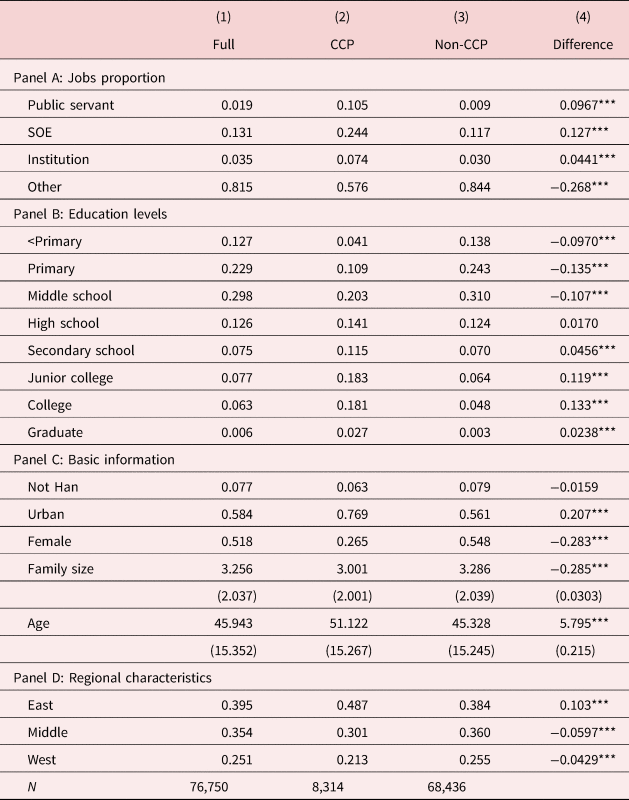
Table 1 summarizes the basic demographic information for all observations including CCP members and non-CCP members. CGSS includes a specific survey question that asks respondents whether they are CCP members or not. Based on the responses to this particular question, we classified CCP membership for all observations. In panel A, the percentage of CCP members who worked in the Chinese government system, column (2), is significantly higher than the percentage of non-CCP individuals who worked in the government system, column (3).Footnote 5 This implies that, as expected, CCP members are tied to the Chinese government system more than non-CCP individuals. CCP members have the advantage of getting better jobs in the Chinese government system and have better political status and social networks which can support more and better job opportunities (Nikolov et al., Reference Nikolov, Wang and Acker2020; Yuen, Reference Yuen2013). On average, government jobs suggest more material benefits, stable income, and anecdotally, a more esteemed reputation (He & Sun, Reference He and Sun2021; Hewlett & Rashid, Reference Hewlett and Rashid2011; Li, Reference Li2021; Nikolov et al., Reference Nikolov, Wang and Acker2020). This summary information is consistent with our expectations and other researchers' results.
Summary statistics for jobs, CCP status, demographic, and regions

Notes: Results are calculated by using CGSS in 2005, 2006, 2008, 2010, 2011, 2012, 2013, and 2015. Standard deviations in parentheses are included were informative. Total number of observations is 76,750 for the full sample, 68,436 for non-CCP members, and 8,314 for CCP members. CCP members and other entities are calculated separately for public employees who work in the government. SOE is “state-owned enterprise.” Institution is “government-owned organizations.” “<primary” infers education level is less than primary education. “Primary” is primary school education. “Middle school” and “High school” are similar to the educational system in the USA. “Secondary school” is technical school. “Junior college” is for 3-year college. “College” is a 4-year college. “Graduate” means graduate education, such as masters and PhD. “Not Han” means people are not of the Han ethnicity, or the other 55 ethnicities in China. Urban is urban living household. East, Middle, and West are living areas in China. The “Difference” column is the t-test for the difference between CCP and non-CCP members.
***p < 0.01, **p < 0.05, *p < 0.1.
Regarding education levels, panel B shows that the educational level of CCP members is significantly higher than that of non-CCP individuals. Education is an important element which affects citizens' religiosity, and is usually negatively correlated with religiosity (Nord, Reference Nord2014). Education also leads to more secularization in society (Liang & Dong, Reference Liang and Dong2019). Therefore, to understand more on how education affects religious beliefs in our paper, we draw on Fig. A1 in the Appendix which indicates that as education levels increase, the level of religiosity decreases in both CCP and non-CCP groups with the same magnitude. Therefore, educational influences are about the same for both treatment and control groups. To avoid educational bias in our regression analysis, we also include education as a covariate.
In China, there are 56 ethnicities with different and unique cultural and religious characteristics. Of these 56 ethnicities, Han was the major part which was 91.11% in 2021 (Ning, Reference Ning2021). To simplify ethnic influence on religious beliefs, we created a dummy indicator for being “Not Han.” “Not Han” equals 1 for the other 55 ethnicities. Panel C shows that CCP members are 6.3% vs. 7.9% among non-CCP members of being “Not Han.” It appeared that “Han” people were influenced by CCP's ideas much more than the other 55 ethnicities (Kaup, Reference Kaup2000). In addition to higher direct income, there are other indirect benefits for CCP members such as better residential areas with more education and medical resources. In China, urban areas have better social services such as higher quality education and better medical systems. Panel C shows that 76.9% of CCP members live in urban areas, which is much higher than that of non-CCP members.Footnote 6 Some researchers have stated that it is easier for women and older people have religious beliefs (Schwadel, Reference Schwadel2011; Trzebiatowska & Bruce, Reference Trzebiatowska and Bruce2012). Therefore, we also checked gender proportions and age in the CCP and non-CCP groups. Our results reveal that only 26.5% of the sample of CCP members are women, which is significantly lower than their proportion in the non-CCP group. In addition, CCP members are relatively older than non-CCP members, on average. According to Alicia Adsera's research, family size could also influence religious belief (Adsera, Reference Adsera2006). Family size is smaller among CCP members. Overall economic growth is another important element affecting people's religious behavior (McCleary & Barro, Reference McCleary and Barro2006). China developed very fast during the last 40 years with varying rates in the east, middle, and west of the country. To check this influence, we examine the distribution of CCP members and non-CCP members in different regions.Footnote 7 The result is that the distribution of CCP members and non-CCP members is similar in these three areas.
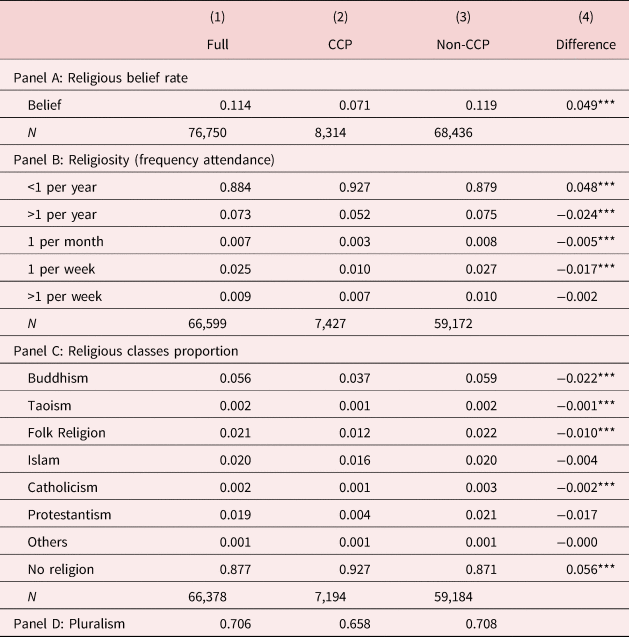
Religious information is summarized in Table 2. Based on the CGSS, we define the outcome variable, religious identification, in accordance with respondents' answers to the survey question on religious identification. The CGSS survey explicitly inquired, “Your religion belief is: (Choose one answer from the following).” The definition of the outcome variable, religious identification, in our main analysis is based on the responses to this question. The summary information of Table 2 is consistent with our expectations previously mentioned. Overall, 11.4% of individuals were classified into religious groups. Despite being forbidden, 7.1% of CCP members identified themselves as religious believers that is much smaller than the 11.9% religious' believers in the non-CCP group.
Summary statistics for religiosity and religious types

Notes: The results are calculated by using the CGSS sample in 2005, 2008, 2010, 2011, 2012, 2013, and 2015. This table is pooled religiosity and religious classes. “Belief” is the rate of religious believers in each group. “<1 per year” is the frequency of religious event participation less than one time per year including atheism. “>1 per year” is more than one time per year containing participation in one or several religious events per year. “Pluralism” is the religious pluralism index which is calculated by using one minus the Herfindahl index (sum of squares of religious adherence shares). “Folk Religion” means local Chinese religions, such as fortune-telling, Jingzu, Baoying, Mingyun, and Tian. “Others” includes Hindu, Orthodox, Judaism, and other Chinese local beliefs.
***p < 0.01, **p < 0.05, *p < 0.1.
In panel B of Table 2, we provide summarized information of religiosity; we classify religiosity into five groups according to the frequency of religious activities as mentioned previously. The percentage of less than one time per year in the CCP groups' religious activities is much higher than that of the non-CCP group. Conversely, the percentage of all other kinds of religious activities in the CCP group is much less than those in the non-CCP group.
The CGSS also provides information on different types of religious affiliations: Buddhism, Taoism, Folk Religion, Islam, Catholicism, Protestantism, and Others including Hindu, Orthodox, Judaism, and other Chinese local Gods.Footnote 8 We summarize all different types of religions, including the “no religion” group in panel C, Religious Classes Proportion, of Table 2. It indicates that Buddhism is the most popular religion in China with a belief rate of 5.6% overall. Buddhism was 3.7% in the CCP group and 5.9% in the non-CCP group. For other religions, the religious belief rate is also higher in the non-CCP group than the rate in the CCP group.
In general, religious diversity is another important aspect to measure when examining the religious environment in a country and how government influence may create societal differences (Bruce, Reference Bruce1999, Reference Bruce2011; Froese & Pfaff, Reference Froese and Pfaff2005; Henne, Reference Henne and Fox2020; Iannaccone et al., Reference Iannaccone, Finke and Stark1997; McCauley & Posner, Reference McCauley and Posner2019; Miller, Reference Miller2000; Neff, Reference Neff2006; Stepan, Reference Stepan2000). To examine religious diversity in China, we calculate a religious pluralism index by using one minus the Herfindahl index (sum of squares of religious adherence shares). The pluralism index estimates the possibility of two randomly selected religious believers belonging to different religions. It equals zero when all randomly selected religious believers are in the same religion. Conversely, the pluralism index would be one when every randomly selected pair is in different religions. In panel D of Table 2, the pluralism index is 0.706 for all individuals, 0.708 in the non-CCP group, and 0.658 in the CCP group, indicating a diverse religious environment in China. This religious diversity index is also consistent with our expectation given that the Chinese government does not control religious belief but rather religious behaviors. This index implies that Chinese individuals have some options on religious belief.
Tables A2-1 and A2-2 in the Appendix show summary information of religiosity, religious class proportion, and religious diversity of CCP and non-CCP individuals in separate years. They are consistent with the pooled summary information in Table 2.
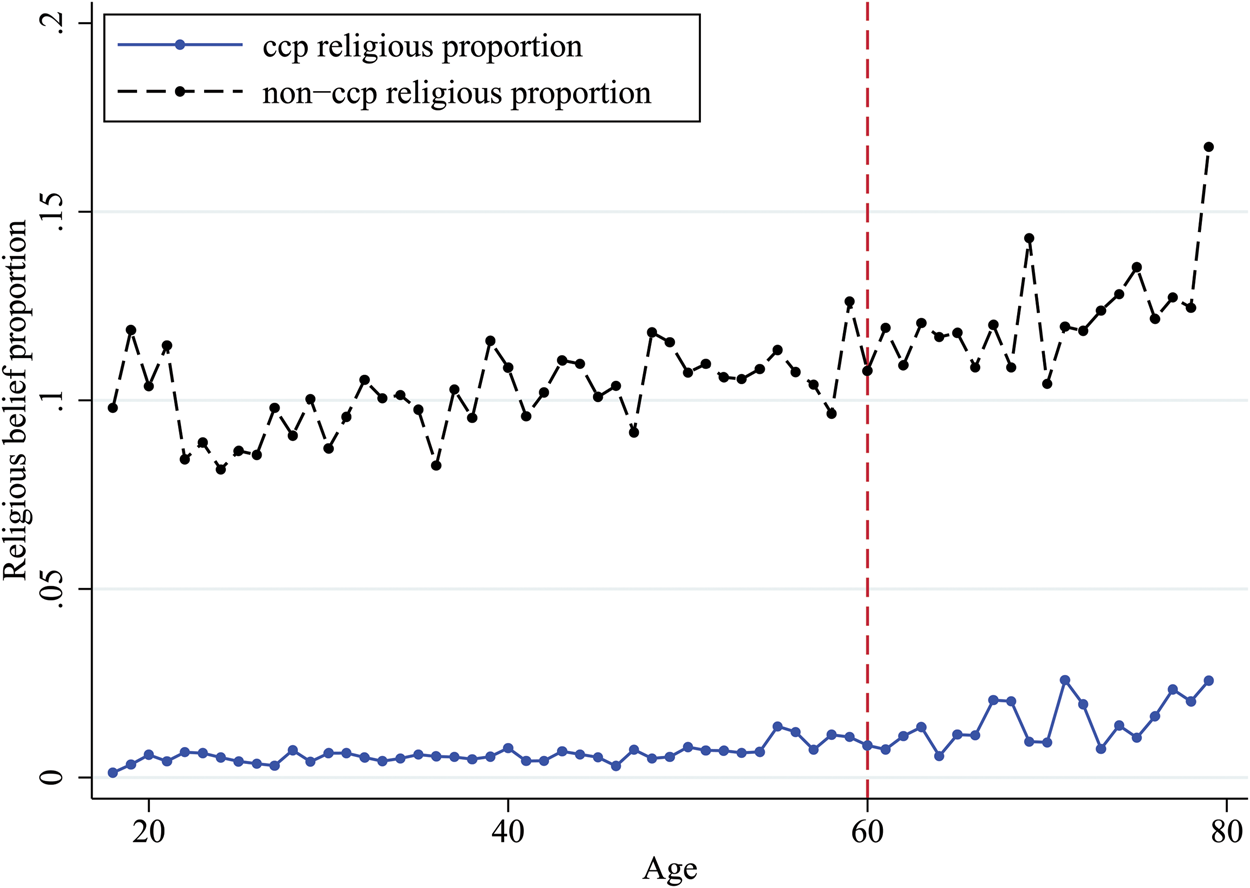
Age is another important element influencing people's religious activities. It may also impact our analysis on the retirement variable given that the official retirement age is 60 for men and 55 for women (Jeff & James, 1979). Some scholars also argue that elderly people or women have more time to participate the religious events, especially elderly people with health problems (Bruce, Reference Bruce2011; McCleary & Barro, Reference McCleary and Barro2006). To check the influence of age, we provide Fig. 1, illustrating the religious identification rate in the CCP and non-CCP groups along the dimension of age. The dashed line is the rate of religious believers in the non-CCP group, and the blue line is the rate of religious believers in the CCP group. It is shown that the rate of religious identification in the non-CCP group is significantly larger than that of the CCP group and the rate of religious identification gradually increased along all ages in the non-CCP group. Religious identification rates of CCP members did not change with age before age 60, the official retirement age, but it started increasing thereafter. This result is consistent with our expectation about religious identification jumping in the CCP group with no corresponding jump in the non-CCP group after retirement.
Religious belief trends along age in both CCP and non-CCP groups.
Notes: The CGSS surveyed individual religious belief information in 2005, 2008, 2010, 2011, 2012, 2013, and 2015. The Y axis is the religious belief rate. The X axis is individual age. The religious identification rate is different for CCP and non-CCP individuals and is calculated by using the number of religious believers in a specific age group divided by the number of individuals in that specific age group. The religious identification trend in non-CCP individuals is higher than the trend in the CCP group. The trend of the religious identification rate in the non-CCP group consistently and gradually increases without abrupt jumps after their retirement. However, the trend of religious identification rate for CCP members jumped after their retirement.
Source: CGSS website and authors' calculations.

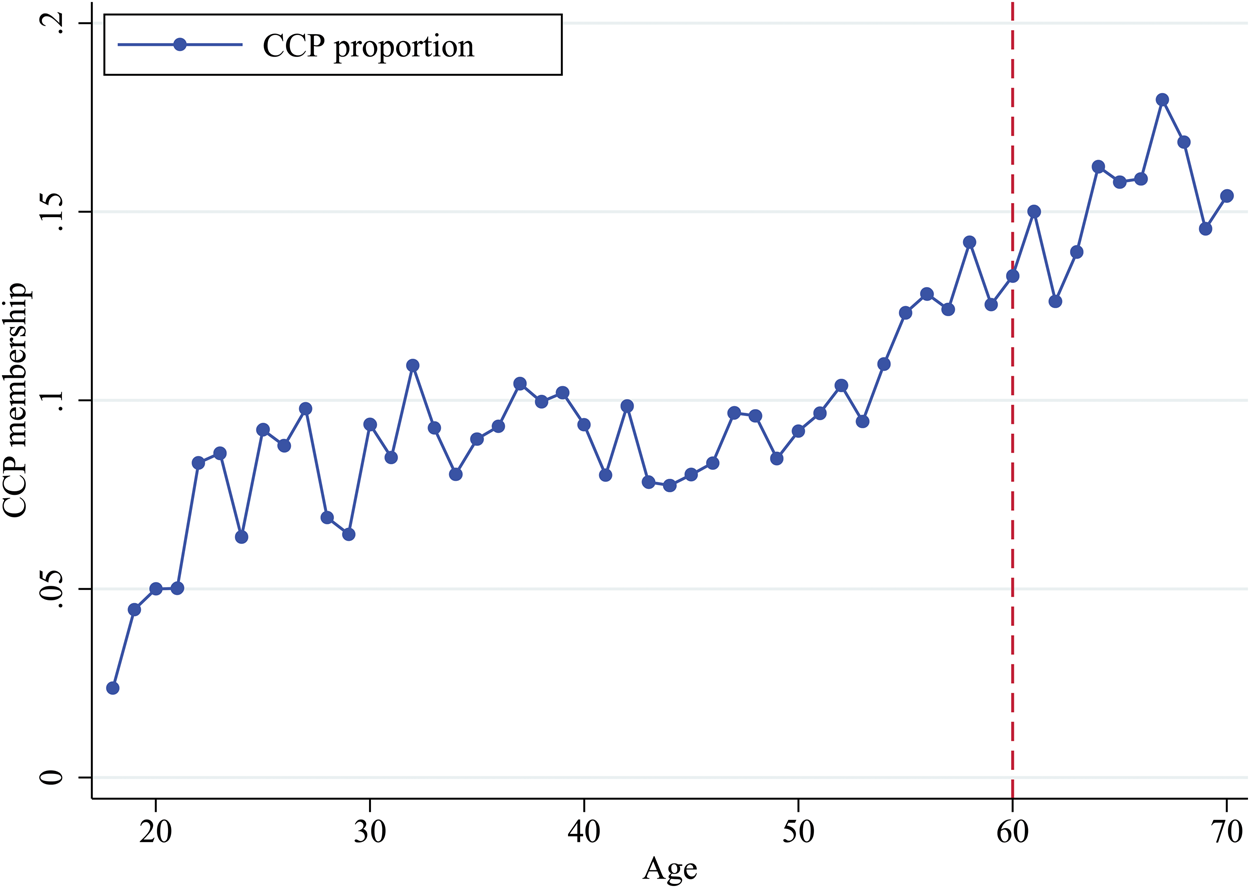
Figure 2 addresses concerns about whether CCP members give up their CCP membership to practice more freely their religion or to increase their religious activities after retirement. Figure 2 indicates that the rate of CCP membership is increasing with age. This implies that it is unlikely that CCP members would decrease their membership at the time of retirement since this would show as a decreased enrollment around retirement ages.
CCP membership trend along age.
Notes: The CGSS surveyed individual CCP member information in 2005, 2008, 2010, 2011, 2012, 2013, and 2015. The Y axis is the rate of CCP members in different age groups. The X axis is an individual age group. The rate of CCP members’ trend increased.
Source: CGSS website and authors' calculations.

To check the income and pensions of these two groups, we included information in Fig. A2, which shows that incomes and pensions of the CCP group are higher than that of the non-CCP group along all ages. This result is consistent with our research expectation given that CCP members have better political status and more political resources than non-CCP individuals, in general (Appleton et al., Reference Appleton, Knight, Song and Xia2009; Nikolov et al., Reference Nikolov, Wang and Acker2020).
4. Analysis
The main challenge in estimating the influence of material benefits on individual religious identification pre- and post-retirement is that any religious identification changes might be correlated with age, education levels, health, or other unobserved factors. We have checked age, income, and education in Figs. 1, A2, and A1, and we also included the observed variables, age, education levels, health, and other covariates in regressions to control for potential observable influences. To address potential unobserved endogeneity, we use a DID approach. This approach limits the impact of endogeneity, which would exist if these covariates had differential impacts on religiosity for CCP and non-CCP members.
The structure of our empirical analysis is as follows. The regulation on the religious beliefs of CCP members is very restrictive and by using economic benefits as the “penalty,” CCP members are expected to have more religious freedom after retirement, because retired CCP members are not impacted like regular CCP members (Lawrence & Martin, Reference Lawrence and Martin2013). Therefore, they do not need to worry about forgone economic benefits (or punishments). The results in Fig. A2 also highlight income information of CCP members. To uncover the impact of the Chinese government's religious affiliation regulation on CCP members, we compare individual religious identification across CCP members and non-CCP members, in groups that are not yet retired vs. those that are retired. We mainly use the linear probability model (LPM), logit, and probit models with many other robustness checks and placebo tests whose results are consistent with those of the main results. The main empirical specification is the following equation:

The left-hand side of the equation refers to the conditional expected probabilities of y i to be a general function of the index function. Also, y i is the religious identification dummy, y i = 1 indicates whether individuals have religious beliefs and is 0 otherwise. The right-hand side of the equation F represents the different functions, logit and probit. All of these functions estimate the probability of religious identification changes for CCP members and non-CCP members among those still in their working phase vs. those in their retired phase once we have considered the independent variables. The indicator i denotes individuals. The variable, CCP i, is a dummy variable, CCP i = 1 for CCP members and 0 for non-CCP individuals. The time shock dummy variable in this equation is the retirement condition which is from the CGSS survey question “Are you retired?,” thus, retirement i = 1 is for retired individuals and 0 otherwise. We have β 1 as the coefficient of the interaction term between CCP i and retirement i. We use X i to indicate all control variables comprising age, gender, health, family size, father's CCP membership, mother's CCP membership, spouse's CCP membership, all education level dummies (no education, primary school, middle school, high school, special secondary school, junior college, and college), and provinces fixed effects.Footnote 9 In addition, elements such as urbanization and cultural pluralism can affect religious affiliation or religious belief (Casanova, Reference Casanova, Beyer and Beaman2007; Gorski, Reference Gorski2000). Therefore, we include ethnicity (Han or not Han) and urban in X i.
5. Empirical results
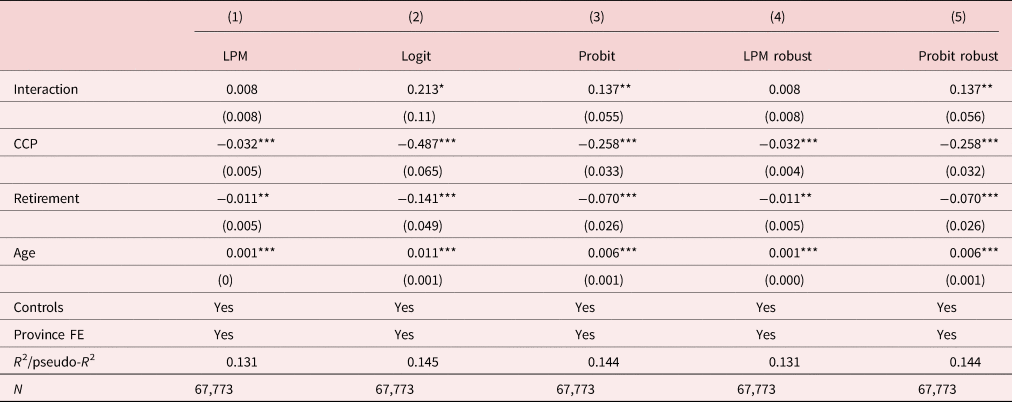
Column (1) of the LPM results in Table 3 indicates that the probability of a CCP member having religious identification is lower than that of non-CCP individuals as indicated by the coefficients of the CCP membership dummy variable. The coefficient of the interaction term, CCP × Retirement, is not significant. LPM can be a less appropriate estimation method when the outcome variable is very close to 0 or 1 which is the case in our regression. Therefore, to further check the results, we use logit and probit regressions which can potentially solve the LPM problem. The coefficients in columns (2) and (3) are average marginal effects in Table 3 and the coefficient of the interaction term is significant and large, inferring that religious affiliation probability did increase among CCP members after their retirement. The results of logit and probit models are consistent with our expected results. These significant results imply that the rate of CCP members' religious identification is significantly higher in groups that are retired compared to groups that are not yet, compared to non-CCP members. The significantly positive coefficient of retirement also indicates that material benefits did influence religious belief behavior. To check if we have a heteroskedasticity issue, we also performed robustness error analyses for LPM and probit. All results are given in columns (4) and (5). These two results are also significant which are very similar to columns (1) and (3). Due to the characteristics and assumptions of the logit model, we are less concerned with heteroskedasticity in the logit model.
Baseline regression results – LPM, logit, probit

Notes: This paper relies on data from the CGSS. The survey includes a specific question: “Your religion belief is: (Choose one answer from the following).” The outcome variable in this table is defined based on respondents' answers to the specified religious identification question. The CCP dummy variable is used to classify CCP members from the CGSS CCP membership identification survey question. The years include 2005, 2008, 2010, 2011, 2012, 2013, and 2015. All standard errors are in parentheses. Retirement is the “time shock” dummy variable to classify before and after retirement. The interaction term is “CCP × Retirement.” Controls include ethnicity, residency (living in urban or not), gender, family size, father's CCP membership, mother's CCP membership, spouse's CCP membership, education levels, health, and province fixed effects are included.
R 2 measures the model fitness for LPM with pseudo-R 2 for model fitness for logit and probit models.
*p < 0.1, **p < 0.05, ***p < 0.01.
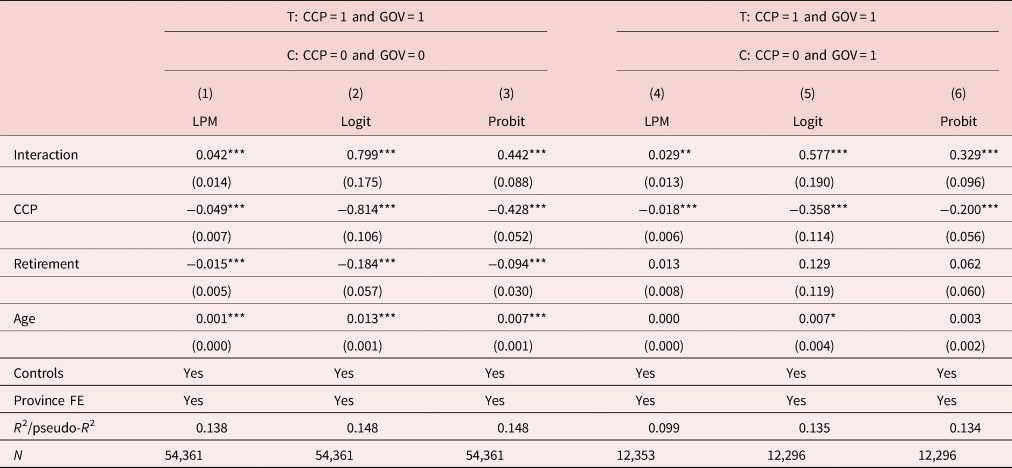
Even though incomes of CCP members are larger than incomes of non-CCP individuals, which is shown in Fig. A2, not every CCP member works in the government system, which we speculate is the main channel for better material benefits for CCP members. Thus, it is clearer to use CCP members working in the government as the treatment group to estimate how the Chinese government successfully uses economic benefits to affect individuals' religious affiliation. It is advantageous that the CGSS furnishes information regarding the careers or jobs of surveyed individuals through a specific survey question. This inquiry pertains to the job types of the surveyed individuals. Based on their job types, we can determine whether they are employed within the government system or not. For instance, occupations such as those in government-owned companies, public school teaching, and gubernatorial roles are considered jobs within the Chinese government system. Therefore, we classify CCP members with government jobs as the treatment group and classify non-CCP individuals without government jobs as control group in our LPM, logit, and probit regressions. In other words, we are using two subgroups from CCP members and non-CCP members to create another treatment and control group. For the retirement dummy, we continue to employ the identical retirement variable as presented in Table 3, which is also utilized in equation (1). The CGSS survey includes a specific question, “Are you retired?” According to the responses to this question, we define the retirement dummy variable. The utilization of these novel treatment group metrics within the same models as previously employed is illustrated in the left panel of Table 4. The results are similar to those of Table 3: coefficients on the interaction term are significantly positive as well. Because the new treatment and control groups are affiliated with material benefits more than the previous groups’ classifications, the coefficient of the interaction term in the LPM is also significantly positive. The results on the left-side panel of Table 4 further indicate that material benefits are the most important element preventing CCP members from expressing religious belief. Another interesting comparison is to check the religious identification between the CCP members and the non-CCP members in the government system. Because the religious belief limitation is only for CCP members, the non-CCP members should not be influenced. Simultaneously, CCP membership can help get more material benefits in the government system. Therefore, we classified the CCP members working in the Chinese government system as the treatment group and the non-CCP members working in Chinese government system as the control group. The results are on the right-side panel of Table 4 with the same controls as the left-side panel of Table 4. The interaction coefficient is significant at the 0.05 level in LPM analysis and at the 0.01 level in logit and probit analyses. This result implies that even in the government system CCP members choose to hide their religious identification before their retirement. These significant results also signify that the CCP membership is the key influential element for people's religious identification expression.
Subgroups robustness check

Notes: The CCP dummy variable is used to classify CCP members from the CGSS CCP membership identification survey question. Compared with the baseline results in Table 3, we are using the subgroups for treatment and control groups in this regression analysis. For the left panel from columns (1) to (3), the treatment group is CCP members working in the government. The control group is non-CCP members and those not working in the government. For the right panel from columns (4) to (6), the treatment group is CCP members working in the government. The control group is non-CCP members and those working in the government. We utilize the retirement condition survey question from CGSS to categorize the retirement dummy variable. Use of the career survey question from CGSS is used to determine whether an individual is working in the government system or not. All other components in the regressions are the same as in Table 3.
*p < 0.1, **p < 0.05, ***p < 0.01.
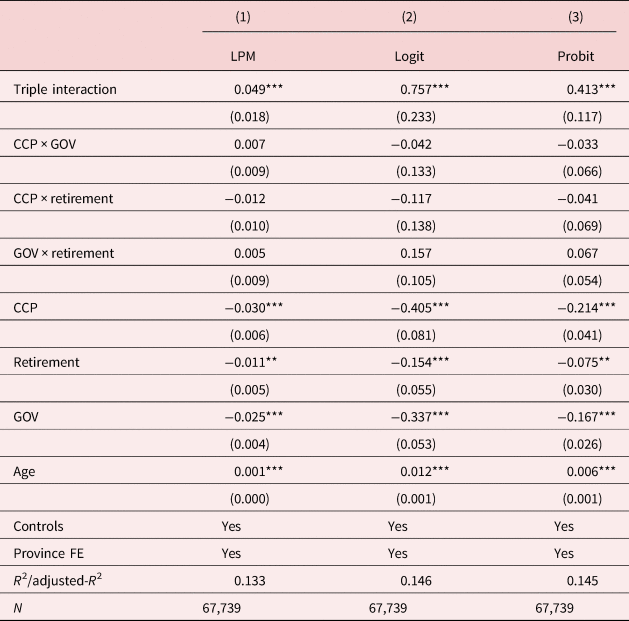
Because a government job is another important element and the main channel determining material benefits, it is reasonable to check how CCP, the retirement dummy variable, and government jobs together influence individual's religious affiliation. We employ identical methods such as those outlined in Table 3 for categorizing CCP members and non-CCP members, as well as for the retirement dummy variable. Additionally, we have generated a government dummy variable to distinguish between observations within the government working group and those outside it. Hence, we employ a triple DID approach in Table 5. Within this table, the triple interaction term, signifying the interplay among the CCP dummy variable, retirement dummy variable, and the government dummy variable, demonstrates statistical significance at the 0.01 level across LPM, logit, and probit models. This significant result indicates that CCP members working in the Chinese government system express their religious affiliation after their retirement.
Robustness check – triple DID: CCP, GOV, and retirement

Notes: The CCP dummy variable is used to classify CCP members from the CGSS CCP membership identification survey question. The CCP dummy variable defines CCP members or non-CCP members. The GOV dummy variable identifies if people are working in the government system or not. We utilize the retirement condition survey question from CGSS to categorize the retirement dummy variable. Use of the career survey question from CGSS is used to determine whether an individual is working in the government system or not. All other components in the regressions are the same as in Table 3.
*p < 0.1, **p < 0.05, ***p < 0.01.
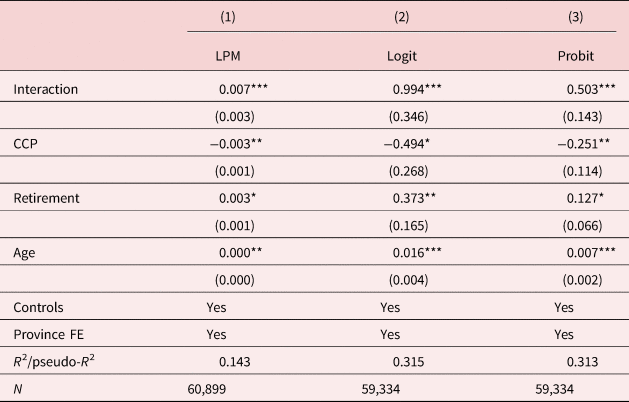
Even among religious believers, their religious affiliation intensity could be different, meaning some believers participate in religious activities or visit religious places more frequently than others. The advantage of the CGSS is that it provides religiosity information. Therefore, we use religiosity as the dependent variable to run the previous regressions again with results shown in Table 6. For the religiosity-dependent dummy variable, we classify religiosity with “>1 per week,” with an outcome of 1 and all other religiosity outcomes including, less than or equal to one time per week, the non-religious beliefs, non-religious identification as 0. All other regressors are the same as in Table 3. The coefficients of the interaction term in the LPM, logit, and probit models are all significantly positive at the 0.01 level. This result is consistent with all previous analytical results and also denotes that the frequency of CCP members' religious activities is higher in groups that are retired compared to those who are not yet, compared to non-CCP members.
Robustness check religiosity – religious activity frequency classification

Notes: We are using religious activity frequency to classify the religious affiliation binary dependent variable. Religious belief = 1 when religious activities are more than one time per week, otherwise 0. All other components in the regressions are the same as in Table 3.
*p < 0.1, **p < 0.05, ***p < 0.01.
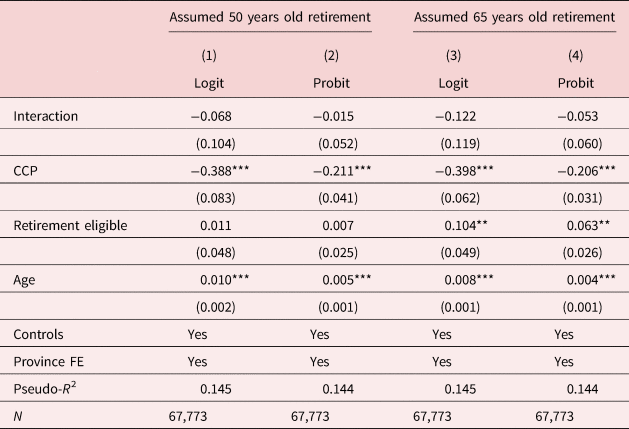
Another concern in our regression analysis is that other unobservable elements may affect the outcome of the two groups. For example, some people may not retire at the exact retirement age which is 55 for women and 60 for men in China. Some other factors could change a CCP member's religious affiliation before or after their retirement. Therefore, we use a falsification test to examine if there could be potential endogeneity issues. We set up age 50 as the retirement age with the results shown in columns (1) and (2) of Table 7 and then set up age 65 as the retirement age in the results shown in columns (3) and (4) of Table 7. The results are not significant in columns (1)–(4). These results suggest that religious affiliation is not simply increasing in age for CCP members but rather concentrated exactly at the moment of the retirement decision.
Falsification test – retirement age

Notes: Retirement eligible is equal to 1 if individuals are older than 50 in columns (1)–(3) and if individuals are older than 65 in columns (4)–(6). All other components in the regressions are the same as in Table 3.
*p < 0.1, **p < 0.05, ***p < 0.01.
One remaining concern is the identification for treatment and control groups before and after the retirement condition or retirement age, because the CGSS is cross-sectional, we have different individuals of different ages in different surveys over different years. Specifically, we do not observe the exact same individuals in the time leading up to and after their retirement. A concern of our empirical results is that since we do not observe the same individual over time, there could be differences in who reports being CCP member and being retired in different rounds which would be what we captured instead of a change in behavior around retirement. We already included various covariates to try to capture this, but here we run our main regression using our covariates as outcome variables to show that there are no difference in other covariates between CCP members and non-CCP members in the group that is retired and the group that is not.Footnote 10
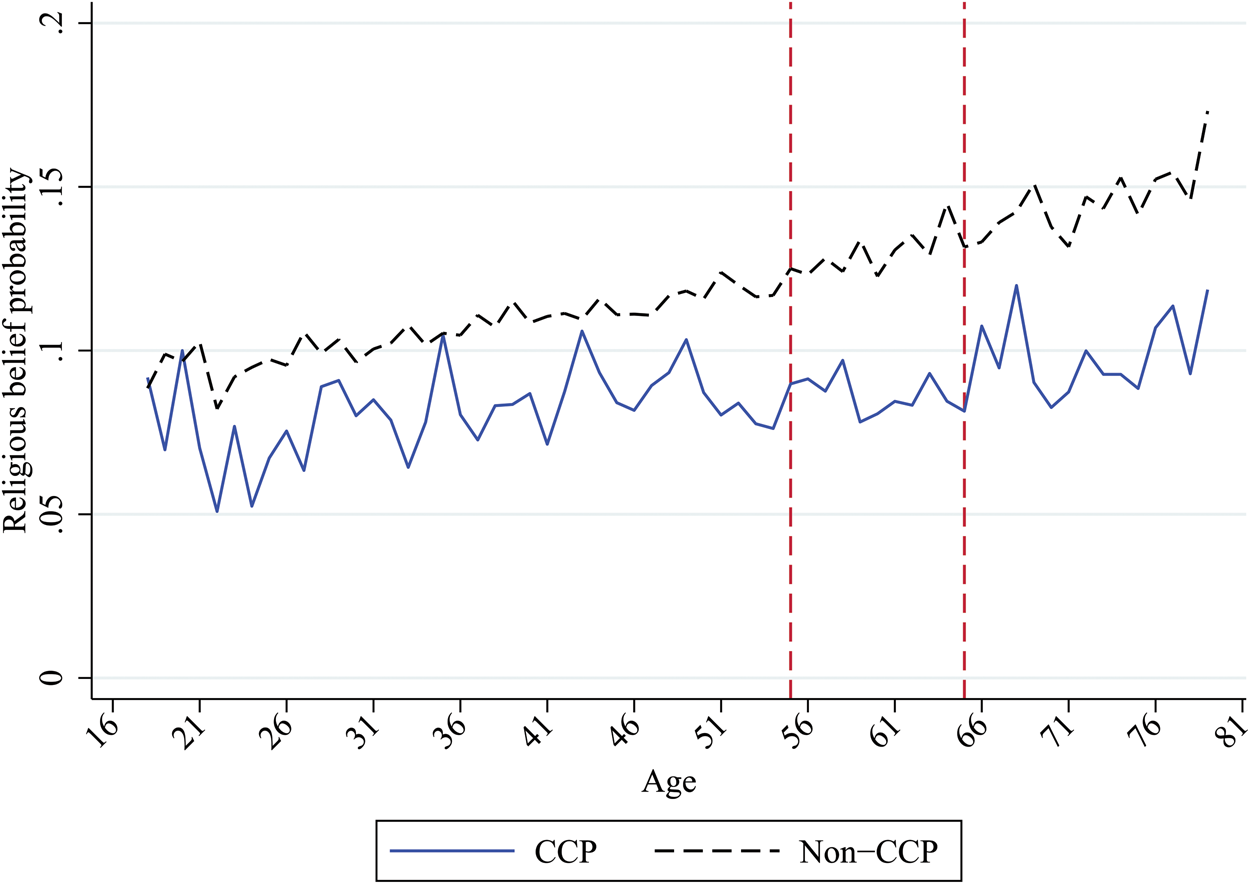
In Fig. 3, we checked the parallel trend of DID. Even though the Chinese official retirement age is 55 for women and 60 for men, our retirement dummy indicator is not from this age variable information, meaning the retirement dummy variable is an independent variable from surveyed individuals answer about retirement. Therefore, when parallel trend checking, the retirement “shock” should have a short age range, which is from 55 to 65 years old. In this graph, the probability of religious identification in the non-CCP group, the dash line, stays increasing smooth as age is increasing both preceding and following retirement age. On the other hand, the probability of religious identification in the CCP group suddenly jumps. The strong parallel trend evidence strengthens the findings.
Religious belief probability parallel trend.
Notes: Regression-adjusted means of religious belief rates by CCP membership in 2005, 2008, 2010, 2011, 2012, 2013, and 2015. Solid line means religious belief rates for CCP members; dashed line mean religious belief rates for non-CCP members. Means have been regression adjusted for gender, ethnicity, education levels, age, parents' CCP membership, spouse CCP membership, family size, health, and provinces fixed effects.
Source: Authors' calculations using CGSS.

6. Conclusion
This study demonstrates that state-promoted incentives in the Chinese context can influence religious affiliation and participation. Despite the globalization of China's economy and the reduction of regulations on religious behavior, implicit regulations persist for members of the CCP. While the legal framework in China grants religious freedom to its citizens, this paper addresses the empirical measurement of government policies using survey data. The analysis provides initial insights into the role of the Constitution of the Communist Party of China and economic benefits in shaping citizens' religious affiliations. Using a novel test based on retirement condition and communist party affiliation, we show that CCP members who are retired are more likely to declare a religious affiliation than those who are still working, compared to the same difference among non-CCP members. This is even more stark for CCP members with Chinese government jobs. Through more robust checks, the study demonstrates that the determining factor for CCP members revealing their religious beliefs is not age but rather their retirement status.
While CGSS is currently the most reliable dataset for understanding religious conditions in China, it does have some limitations, such as its cross-sectional nature. Despite utilizing summary tables and graphs to demonstrate the effectiveness of time series cross-sectional data for DID analysis, obtaining a panel dataset would strengthen and enhance the persuasiveness of our results. Additionally, the response rate to the question “How much did you donate to religion?” in CGSS is relatively low. In the future, we aim to acquire a panel dataset and gather more information related to religious beliefs for further investigation.
Supplementary material
The supplementary material for this article can be found at https://doi.org/10.1017/dem.2024.4.
Competing interests
None.