


1 Introduction
1.1 Quantity-manipulating morphology as a theoretical challenge
The moraic approach to phonological length (Hayes Reference Hayes1989) gives rise to a maximally simple account of quantity-manipulating morphology (QMM) – morphologically triggered gemination, vowel lengthening or coda epenthesis – as affixation of a mora (μ); e.g. Lombardi & McCarthy (Reference Lombardi and McCarthy1991), Samek-Lodovici (Reference Samek-Lodovici, Ackema and Schoorlemmer1994), Davis & Ueda (Reference Davis and Ueda2002, Reference Davis and Ueda2006), Grimes (Reference Grimes2002), Stonham (Reference Stonham2007) . Take as an example 1st person agreement marking in many varieties of Quechua, which is expressed by lengthening the final vowel of the base word (cf. the 2nd person singular forms, which illustrate segmental affixation).
-
(1)


Under a μ-affixation analysis, vowel lengthening does not have to be captured by a word-formation rule like the one in (2a), which uses the notation of Matthews (Reference Matthews1974) and Anderson (Reference Anderson1992) ; rather, the 1st person exponent can be simply represented as a suffix consisting of a bare (floating) mora (2b).Footnote 1
-
(2)

If affixation is seen as attaching an affix to a peripheral element of the relevant autosegmental tier, suffixing the mora (2b) to the base /kuti/ results in the input representation in (3). Since Quechua does not have geminates or moraic coda consonants, the only way to integrate the mora into the overall phonological structure without crossing of association lines is to associate it to the final vowel of /kuti/ (and the corresponding syllable). Thus lengthening follows from general constraints on the association of floating material.
-
(3)
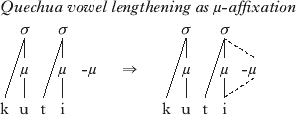
This analysis of morphological lengthening allows the reduction of a non-concatenative operation to simple affixation of an independently motivated primitive of phonological theory.
The affixation of moras also gives rise to a simple account of the phenomenon we call non-concatenative allomorphy: the same morphosyntactic category is expressed by different non-concatenative processes, depending on the phonological form of the base. Thus Davis & Ueda (Reference Davis and Ueda2002, Reference Davis and Ueda2006) show that intensive formation of adjectives in Shizuoka Japanese results either in vowel lengthening (/zonzai/ → /zoːnzai/ ‘impolite’), gemination (/katai/ → /katːai/ ‘hard’) or insertion of a default consonant (/hade/ → /hande/ ‘showy’). The choice between the different strategies is predictable from the prosodic shape of the base word. Since all these effects conspire in augmenting the base by one mora, this is exactly the type of effect expected under μ-affixation and highly differentiated phonological optimisation. In fact, the μ-affixation analysis of Shizuoka Japanese represents substantial progress in comparison to an account in terms of word-formation rules. It allows us to reduce the different processes to effects triggered by a single morpheme representation. Moreover, the μ-affixation analysis for non-concatenative allomorphy makes the – we believe correct – prediction that the different processes constituting non-concatenative allomorphy are always inherently phonologically related in a similar way to the three different allomorphs in Shizuoka Japanese intensive formation. Thus, for example, changes in the segmental features of vowels should not alternate with consonant gemination.
Under the μ-affixation approach, QMM is hence in all relevant respects a phonological process where straightforward morphological affixation leads to complex surface patterns by phonological association and optimisation. Thus it is a paradigm case for Generalised Non-linear Affixation, the research programme which aims to derive all productive cases of non-concatenative morphology from the concatenative affixation of phonologically defective material such as floating tones or empty foot nodes (Bermúdez-Otero Reference Bermúdez-Otero2012). See Bye & Svenonius (Reference Bye and Svenonius2012) for applications of Generalised Non-linear Affixation to reduplication, featural affixation, metathesis and root-and-pattern morphology, and Trommer (Reference Trommer2011) for detailed case studies in this framework for the complex subsegmental and suprasegmental morphology of Western Nilotic.
Apart from providing a principled approach to non-concatenative allomorphy, Generalised Non-linear Affixation obviates a further problem of existing rule-based approaches to non-concatenative morphology: the lack of a restrictive inventory of possible exponence operations – the classical literature on word-formation rules (e.g. Matthews Reference Matthews1974, Anderson Reference Anderson1992) simply invokes a free choice of rule formats adapted from early generative phonology rule formats, i.e. an arbitrary list of possible base modifications.Footnote 2 On the other hand, restricting exponence operations to concatenation is a substantial restriction, which, for example, correctly predicts that there should be no productive cases of morphological metathesis (Zimmermann & Trommer to appear). In a procedural approach, there is no reason why the list of possible operations should not also contain metathesis as well as concatenation, subtraction, featural modification, etc.
However, the strictly phonological approach to QMM encounters two major problems, moraic subtraction and moraic distinctiveness. In moraic subtraction, QMM processes that target μ-sized portions of phonological material are entirely or partially subtractive. In procedural terms, μ-sized subtraction could be captured by rules such as (4), in parallel to (2a).
-
(4)

If procedural rules are necessary to account for subtractive QMM, the restrictiveness argument for the concatenative approach to QMM is undermined, and the statement that additive QMM is amenable to a concatenative analysis reduces to a spurious generalisation. It is hence desirable to reduce subtractive QMM to the same simple affixation mechanism as additive QMM. The second problem, moraic distinctiveness, is the phenomenon that a language can have different μ-sized QMM processes with distinct phonological effects, which leads to the obvious paradox that affixation of phonologically identical affixes does not lead to identical outputs under the same ranking of phonological constraints.
In this article, we show that both problems for μ-affixation can be solved without additional theoretical constructs, by making full use of standard mechanisms of theoretical phonology and morphology: autosegmental representations and a general theory of possible affixation sites. First, we argue that subtraction is systematically related to the possible autosegmental configurations resulting from μ-affixation where a mora is not fully integrated. Second, we derive moraic distinctiveness by assigning different moraic affixes different underlying phonological positions. The unifying hypothesis we pursue is thus that QMM has no special morphological properties that set it apart from segmental affixation. Rather, it is the result of moraic affixation, which obeys exactly the same principles as standard segmental affixation. We call this Generalised Mora Affixation, since the μ-affixation analysis is extended to all observed cases of QMM, and standard mechanisms of affixation are generalised to moras.
The article is structured as follows: in §1.2 and §1.3, we discuss moraic subtraction and moraic distinctiveness in more detail, and sketch our solutions to these problems. In §2 we lay out the theoretical background for our analysis. We formalise our account of subtractive QMM in §3, where different patterns of subtractive QMM are reduced to μ-affixation. In §4, we show that our model also captures moraic distinctiveness and its interaction with subtraction. Finally, in §5, we give a short summary, and discuss further consequences of our approach.
1.2 The moraic subtraction problem
As observed by Kimper (Reference Kimper2009) and Alber & Arndt-Lappe (Reference Alber and Arndt-Lappe2012), subtractive morphology, like morphological lengthening, typically targets mora-sized portions of the morphological base which it removes.Footnote 3 An example of subtraction is perfective formation in Tohono O'odham in (5), which deletes stem-final consonants, and hence effectively shortens the morphological base by exactly one mora (i.e. by enough segmental material to fill a mora).
-
(5)

Under a moraic analysis, morphological vowel shortening is a similar subtractive morphological process, because it expresses a morphological category by removal of a mora (although not the corresponding segmental material). An example of morphological shortening is antipassive formation in Anywa (Reh Reference Reh1996).
-
(6)

Finally, the same problem emerges in vowel-length polarity (Anderson & Browne Reference Anderson and Browne1973, Wolf Reference Wolf2007, de Lacy Reference de Lacy2012), where short base vowels are lengthened and long base vowels are shortened (see §3.3 for detailed discussion).
Here, we argue that the moraic subtraction problem can be solved by making full use of the representational potential of autosegmental phonology. Since, under a μ-affixation analysis of QMM, morphology does not ensure association of the affix mora to specific phonological autosegmental nodes, there is no principled guarantee that a given language will fully integrate a floating affix mora into prosodic structure. Whereas Quechua attaches 1st person moras to both the syllabic and the segmental structure of the base, resulting in the configuration in (7a) and straightforward phonetic interpretation of the mora, the phonologies of other languages might be less cooperative, and either fail to ensure association to the syllabic level (7b) (a configuration involving what we call a drifting μ), the segmental level (7c) (a hanging μ) or both (7d) (a stray μ) (we use the symbol ‘•’ to denote a segmental root node).
-
(7)
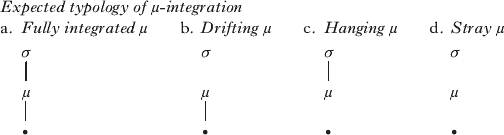
On standard assumptions with respect to the phonetic interpretation of autosegmental representations, the affix mora is not phonetically interpreted in (7b–d). However, our central claim is that only stray moras are phonologically truly inert, whereas unilaterally associated (drifting and hanging) moras can have indirect effects on phonological representations: they may trigger vowel shortening, as shown in (8a) for a hanging mora, or segmental subtraction, as shown in (8b) for a drifting mora. In both cases, the obligatory upward or downward association of the affix mora triggers dissociation in the prosody of the base, due to independently motivated phonological constraints such as a ban on quadrimoraic syllables, which in turn leads to non-realisation of underlying phonological material, as in (8a). Since drifting and hanging affix moras are not pronounced, this results in subtraction.
-
(8)

1.3 The moraic distinctiveness problem
Suppose that a language has a morphological category C1, which is expressed by gemination (e.g. the Classical Arabic Binyan II /katab/ → /katːab/) and a category C2, expressed by vowel lengthening (e.g. Binyan III /katab/ → /kaːtab/). This is a pattern which can be trivially captured by word-formation rules, simply by stating different rules for C1 and C2. For the μ-affixation approach, this leads to a potential problem: if V-lengthening and gemination are the result of μ-affixation, and association of affix moras is a purely phonological process, C1 and C2 become virtually indistinguishable, and either both should induce vowel-lengthening or both should induce gemination. This is the situation, where different mora-sized non-concatenative processes are morphologically distinctive in a given language, which we term moraic distinctiveness.
We derive moraic distinctiveness by assigning different moraic affixes different underlying phonological positions. As has been shown convincingly by Yu (Reference Yu2003) (cf. also Fitzpatrick Reference Fitzpatrick2004, Samuels Reference Samuels2010), segmental affixes may be prefixed or suffixed to specific peripheral or prominent segments of their morphological bases on an affix-specific (i.e. phonologically arbitrary) basis, resulting in different types of adfixation (prefixation or suffixation) and infixation. Our central assumption on affixation is that non-segmental affixes such as syllables, feet and floating segmental features behave in a perfectly parallel fashion, in line with the hypothesis in (9) (Zimmermann Reference Zimmermann2014, Zimmermann & Trommer to appear).
-
(9)

According to (9), μ-affixes may be prefixed or suffixed to the initial or final moras (or to prosodic head moras) of base words. In fact, intensive formation in Shizuoka Japanese consistently shows up after the first mora of the adjective (see the data in §1.1 above), thus constituting a textbook case of moraic infixation. Once moraic infixation is admitted as a possibility, it allows a simple account of moraic distinctiveness. Thus our analysis of contrastive gemination and vowel lengthening in Classical Arabic (see §4.1) is based on the simple assumption that gemination results from suffixation to the initial mora of the base (10a) and lengthening of the initial vowel from prefixation (10b). In (10a), a phonological preference for geminates over long vowels leads to association of the floating mora to the root-medial consonant, an option that would lead to crossing association lines for the configuration in (10b), where the affix mora is associated to the first root vowel.
-
(10)

2 Theoretical assumptions
2.1 Containment and the morphology–phonology interface
Our analysis is based on a version of Optimality Theory (OT) which is essentially the original implementation of Prince & Smolensky (Reference Prince and Smolensky1993), in that it adopts hierarchical autosegmental representations and the containment restriction on candidates (i.e. we eschew the substantial theoretical extension of OT in Correspondence Theory; cf. McCarthy & Prince Reference McCarthy and Prince1994, Reference McCarthy, Prince, Beckman, Dickey and Urbanczyk1995).Footnote 4 The two minimal departures from Classical OT which we will assume are the minimalist implementation of epenthesis by reference to morphological affiliation of phonological material, and the generalisation of the containment assumption to association lines.
Following van Oostendorp (Reference Oostendorp2006) and Revithiadou (Reference Revithiadou, Blaho, Bye and Krämer2007), we assume that morphological structure is minimally reflected in phonological representations: every morpheme has its own colour, which might be conceived as an index that is unique to a given morpheme. Thus the colour of a morpheme makes it possible to identify all phonological elements (segments, features, association lines, etc.) that are part of the underlying representation of this morpheme. Morphological colour is hence an explicit formalisation for the morphemic affiliation of elements, which is implicitly also assumed in correspondence-theoretic OT (cf. van Oostendorp Reference Oostendorp2006). Elements without any colour are epenthetic, since they are underlyingly not affiliated with any morpheme. Our notational conventions are illustrated in (11). Two underlying morphemes are shown, one consisting of the vowel /a/, associated to a μ, and the second only of the consonant /l/. The possible output given in (11) involves insertion of syllable nodes, an additional vowel (/i/) and a μ dominating it. The candidate hence violates various Dep constraints (for vowels, moras and syllables). In what follows, epenthetic association lines are dashed, and epenthetic nodes have a grey background.
-
(11)

Crucially, we assume that colouring is the only morphological information which phonological constraints have access to. Under this assumption, colouring is not an extension to standard OT, but actually a restriction on the pervasive practice in correspondence-theoretic OT of granting phonological constraints virtually unlimited access to morphological structure (e.g. to lexical categories in Smith Reference Smith, Kirchner, Pater and Wikeley2001, to morphological head–complement relations in Revithiadou Reference Revithiadou1999 and to arbitrary lexical classes in Pater Reference Pater2007).
On the containment assumption, phonological material can never be literally removed from phonological input representations in phonological computation (Prince & Smolensky Reference Prince and Smolensky1993, van Oostendorp Reference Oostendorp2008: 1365). (Non-)pronunciation of underlying material is implemented as phonetic (non-)interpretation of phonological material, following the axioms in (12).
-
(12)

‘Highest’ in (12a) refers to the familiar prosodic hierarchy … PrWd≻Ft≻σ≻μ≻•. Following standard assumptions in Prosodic Phonology (Nespor & Vogel Reference Nespor and Vogel1986) and the feature-geometric interpretation of autosegmental structure (cf. Clements & Hume Reference Clements, Hume and Goldsmith1995), we assume that all phonological representations are organised hierarchically. If two nodes n and m are associated, either n dominates m or m dominates n.
The containment assumption also implies that Gen cannot change or remove the colour (i.e. the morphological affiliation) of underlying material. The candidate-generating function Gen is thus restricted to the following changes on underlying forms.
-
(13)

(13a) implements the assumptions on containment and Gen in the earliest version of Optimality Theory (Prince & Smolensky Reference Prince and Smolensky1993), whereas (13b) replaces deletion of association lines by a less invasive operation: the marking of phonetic invisibility.Footnote 5 (14b) shows representative candidates generated by Gen for the input in (14a). Candidate (i) leaves the segmental content /i/ of the first morpheme unintegrated, and hence phonetically uninterpreted. Candidate (ii), on the other hand, integrates this vowel via an epenthetic association line into the overall prosodic structure. Candidate (iii) does the same, but marks the underlying association of the second vowel as phonetically uninterpreted: it hence remains unrealised.Footnote 6
-
(14)

In the following, we will often refer to surface representations as ‘phonetic representations’ (i.e. phonetically realised association lines and nodes), to underlying representations as ‘morphologically coloured’ and to epenthetic material as ‘colourless’, since these terms are equivalent in the ‘coloured containment’ system we assume.
2.2 Moraic linearisation
In this subsection, we develop the consequences of the Generalised Adfixation Hypothesis in (9) for μ-affixation. We adopt the general framework for affix linearisation developed for segmental affixation in Yu (Reference Yu2003), which is based on the assumption that affixation may target a specific member of a set of cross-linguistically possible anchor points (‘pivots’) by lexical (i.e. affix-specific) subcategorisation, and extend it to the linearisation of affix moras. The crucial assumption in Yu's theory is that the possible pivots form a fixed set comprising initial, final and prominent segments or syllables (see Fitzpatrick Reference Fitzpatrick2004 for further discussion on the inventory of anchor points).
Yu's morphological subcategorisation approach is in sharp contrast to phonological approaches to infixation which embrace the idea that infixes are basically prefixes and suffixes (i.e. target an absolutely peripheral position in output word forms), but exhibit divergent linearisation, due to phonological optimisation (Prince & Smolensky Reference Prince and Smolensky1993). There are two basic problems with phonological dislocation accounts. First, purely phonological approaches cannot predict which affixes actually infix. Thus, whereas /um/-infixation with C-initial bases in Ilokano can be understood as phonological optimisation to avoid a violation of the constraint NoCoda (Prince & Smolensky Reference Prince and Smolensky1993), Ilokano also has a prefix /ag/ which is phonotactically isomorphous to /um/, and does not infix (Yu Reference Yu2003: 83). Second, the phonological approach to infixation inherently predicts that infixation always optimises phonological representations. As Yu shows, there are a number of striking counterexamples to this claim, such as the nominalising infix /ni/ in Leti, which appears consistently after the first C of a C-initial base, even though this makes syllable structure worse, not better (e.g. Leti /kniaːti/, */nikaːti/).
Here we generalise pivot affixation and the exclusion of phonological affix dislocation to μ-affixes. Concretely, we assume that the initial and final moras and syllables of a base are the possible pivots to which an affix mora can suffix or prefix (for a more detailed discussion of this claim see Zimmermann & Trommer Reference Trommer2013). Thus 1st person lengthening in Quechua would amount to suffixing a mora to the final mora of a verb, whereas Shizuoka emphatic forms involve suffixation to the first mora of the base, i.e. moraic infixation.Footnote 7 Note that pivot affixation on the moraic tier presupposes a cyclic or stratal model of phonological evaluation which guarantees that bases have predictable mora and syllable structure at the point where affixes target pivots (Samko Reference Samko2011 and Trommer Reference Trommer2011 give specific proposals). See Zimmermann & Trommer (Reference Trommer2013) and Zimmermann (Reference Zimmermann2014) for detailed arguments that all cases of QMM discussed in the theoretical literature conform with the extension of the immobility assumption to moras.Footnote 8
The predictions of a pivot-affixation theory for μ-affixes are similar to the ones made within Prosodic Circumscription theory (McCarthy & Prince Reference McCarthy and Prince1990a, Lombardi & McCarthy Reference Lombardi and McCarthy1991). Prosodic Circumscription assumes that bases can be (recursively) delimited to certain prosodically defined portions, and that both parts (the ‘outparsed’ portion and the (extraprosodic) ‘remainder’) may then be targeted by morphological operations such as affixation. For example, in the analysis of medial gemination in Choctaw by Lombardi & McCarthy (Reference Lombardi and McCarthy1991), a μ-affix is prefixed to a base form that is created by making the first mora of the base extraprosodic. Circumscription can hence be used for a version of morphological pivot affixation where affixes prefix or suffix to a specific anchor point in their base. However, circumscription is much less restricted than pivot affixation, since the operation of outparsing can apply recursively, so that Prosodic Circumscription theory in principle predicts an infinite number of possible base positions to which affixation can apply.
2.3 Constraints
Under containment-based OT, constraints may in principle refer to material which is not overtly realised. Following Trommer (Reference Trommer2011, Reference Trommer2014, in press), we assume that this possibility is severely restricted by the assumption that all markedness constraints come in exactly two varieties (or ‘clones’, using a term introduced in Pater Reference Pater2007), one applying only to phonetically interpreted material of a candidate (the phonetic clone of the constraint), and one applying to all phonological material of a candidate (the general clone of the constraint). Thus the constraint *V 3μ (15a) implements the standard ban on phonetically trimoraic vowels (cf. Flack Reference Flack2007). The general clone in (15b) generalises this constraint to phonetically invisible structure in the computation of constraint violations. It hence evaluates all association lines linking moras to a vowel, whether they are phonetically visible or not. (Phonetic clones are indicated by underlining throughout.)
-
(15)

Just like corresponding phonetic constraints, generalised markedness constraints penalise phonologically marked surface structure, but in addition have a number of subtle side-effects, all of which correspond to well-documented phonological phenomena (see Trommer Reference Trommer2011, Reference Trommer2013 for details). First, they enforce overwriting by underlyingly floating material, as instantiated by the cases discussed here, where a base mora is deleted to ensure phonological integration of an affix mora (see §3 for details, and Trommer Reference Trommer2011 for cases from tonal morphology and featural affixation). Second, the generalisation of standard markedness constraints to phonetically unrealised material makes it possible to capture ‘grandfather’ effects in the sense of McCarthy (Reference McCarthy2003b: §2) (see Trommer in press for discussion). Third, in deletion contexts, they lead to counterbleeding opacity. For example, a counterbleeding pattern in Bedouin Hijazi Arabic whereby assimilation of velars to following front vowels is rendered opaque by deletion of high vowels in non-final open syllables (e.g. /ħaːkim-iːn/ → [ħaːkʲm-iːn] (*[ħaːkm-iːn]) ‘ruling-masc pl’; McCarthy Reference McCarthy2007) can be captured by a generalised version of a constraint requiring velar consonants (including phonetically unrealised ones) to share the coronal feature of a right-adjacent vowel.
It is important to note that ‘cloning’ limits the options of possible OT constraints in Containment Theory, since it restricts generalised markedness constraints to clones of constraints which are well motivated in their non-generalised version, disallowing constraints which make arbitrary reference to underlying material. Thus, on the assumptions of Containment Theory, cloning is actually a restriction of the inventory of possible constraints, not an extension. From a correspondence-theoretic perspective, containment-based cloning is a conceptually simpler alternative for approaches to opacity effects which allow markedness constraints to refer to input representations such as two-level markedness constraints (McCarthy Reference McCarthy, Lecarme, Lowenstamm and Shlonsky1996) and Diagonal Correspondence Theory (Ettlinger Reference Ettlinger2008).
The markedness constraints on prosodic structure and association that we will invoke in the following analyses in addition to (15) are given in (16). The constraint (16a) is the standard ban on trimoraic syllables (McCarthy Reference McCarthy, Downing, Hall and Raffelsiefen2005: 182) and (16b) the corresponding ban on syllables with four or more moras. Both constraints apply only to phonetically visible structure. On the other hand, (16c), penalising moras that dominate more than one segment and consonants dominated by more than two moras, applies to all phonological material.
-
(16)

(17) and (18) summarise the central constraints on autosegmental association which we assume. (17) captures the fundamental imperative of autosegmental association for moras: every mora must be associated to at least one • -node (17a) and to at least one σ-node (17b). The constraints are generalised, hence the association lines satisfying them can be either phonetic or phonetically invisible. The direction of arrows iconically indicates the directional implication encoded by these constraints.
-
(17)

The crucial faithfulness constraints for association lines are summarised in (18). The Max constraints demand that every underlying (hence morphological) association relation is phonetically realised, and the Dep constraints demand that no epenthetic (and hence colourless) association line is inserted between elements that are present underlyingly.
-
(18)

Moreover, we assume standard faithfulness constraints on the realisation of phonological nodes, such as (19).
-
(19)

As an illustration of these constraints, consider again augmentative QMM in Quechua. (20) is the tableau for the base /kuti/ (cf. (1)) followed by the μ-suffix (representing the 1st person morpheme). The undominated constraints σ←μ and μ→• ensure that the suffixed mora is completely integrated into its base, and exclude candidates (b) (where the affix mora does not dominate a segment), (c) (where the affix mora is not dominated by a syllable node) and (a) (where the affix mora lacks both these association relations). The winning candidate, (d), fully integrates the affix mora into its base by inserting association lines between a syllable and the affix mora, and between the affix mora and a segment, in violation of the lower-ranked constraints (18c) and (d), which penalise the insertion of epenthetic association lines. On the other hand, constraints (18a) and (b), which penalise the marking of underlying association lines as phonetically invisible, guarantee that the floating mora does not simply replace the underlyingly associated base mora in a Duke-of-York style (McCarthy Reference McCarthy, Féry and van de Vijver2003a ), as in candidate (e).
-
(20)

A final crucial constraint, given as (21), penalises crossing association lines between moras and segmental root nodes. In essence, it is a violable version of the classical autosegmental well-formedness condition ruling out crossing association lines (Goldsmith Reference Goldsmith1976), relativised to specific tiers (the μ-tier and the segmental root-node tier).
-
(21)

Summarising, the formal mechanisms we assume, although not uncontroversial, are in essence theoretically conservative. Reference to morphological affiliation appears in all versions of OT – typically in less restricted ways than in the colour and cloning model assumed here. Affix linearisation via subcategorisation is one of the major approaches for segmental and reduplicative infixes. The phonological representations that we adopt are those of classical autosegmental phonology, and although early mainstream Optimality Theory showed a tendency to abandon autosegmental representations for segmental phonology (e.g. Baković Reference Baković2000), the autosegmental paradigm has never lost its dominant role in the literature on tone and phonological length (see e.g. Yip Reference Yip2002, Morén Reference Morén1999). However, the adoption of autosegmental representations already inherently entails the potential for Containment Theory, since phonetically uninterpreted entities such as floating tones and moras may in principle be part of input and output representations, and hence have effects on phonological computation. In the following section, we show that a restricted use of this potential leads to a natural analysis of subtractive QMM.
3 Generalising μ-affixation to subtractive length alternations
In this section, we show that μ-affixation also captures morphological alternations which systematically downsize a base word by one mora, either by shortening a long vowel (§3.1) or by deleting a potentially moraic segment (§3.2). In §3.3, we extend the analysis to vowel-length polarity in Päri, where vowel shortening alternates with vowel lengthening.
3.1 Vowel shortening
In this subsection, we show that additive affixation of a mora may actually result in subtractive shortening, given standard assumptions on autosegmental representations.
3.1.1 Taubergrund German
We will begin our demonstration with a striking case of morphological vowel shortening in the plural forms of monosyllabic nouns of the Eastern Franconian (Upper German) dialect of German spoken in the Taubergrund area (Heilig Reference Heilig1898, Seiler Reference Seiler2008).Footnote 9
-
(22)

The key insight of Seiler (Reference Seiler2008) is that the alternation in (22) is actually not shortening, but lack of lengthening in the plural. The crucial observation is that prosodic words in Taubergrund obey a minimal word requirement of two moras. Since coda consonants are not moraic in the language, this requirement triggers vowel lengthening in monosyllabic bare roots, such as the singular nouns in (22), but not in polysyllabic nouns such as /rinə/ ‘bark’ (Heilig Reference Heilig1898: 120) or /bosaunə/ ‘trombone’. There are also contrasts like /fiːʃ/ ‘fish’ and /fiʃlə/ ‘fish-dim’ (Heilig Reference Heilig1898: 78), where derived polysyllabic forms with a short stem vowel alternate with a long vowel in the base noun. Similarly, the data in (23) show vowel lengthening in the (otherwise subminimal) singular, but not in the bisyllabic plural.Footnote 10 In fact, the only monosyllabic forms with a short vowel can be found in the plural forms of monosyllabic words like those in (22). They are obviously at odds with the otherwise general bimoraicity requirement.
-
(23)

Following Seiler's (Reference Seiler2008) insightful discussion of this pattern, we assume that shortening here is a case of catalexis, a formal counterpart to extrametricality, which is characterised as a situation where a ‘segmentally empty prosodic constituent, mora or syllable, is added at the edge of the domain, where it becomes accessible to prosodic rules’ (Kager Reference Kager, Hulst and de Weijer1995: 269). The main empirical argument for the existence of catalexis in metrical stress theory is that it allows us to eliminate degenerate feet: an apparently degenerate monomoraic foot (in a weight-sensitive language) can be taken to be a well-formed bimoraic foot with an additional catalectic mora under the syllable node (Kiparsky Reference Kiparsky1991). Thus moraic catalexis is formally an instantiation of the hanging-mora scenario in (7c).
Transplanting catalexis to μ-affixation, we take the plural allomorph underlying the contrast in (22) to be a floating μ-suffix, which ends up hanging, i.e. associated to a syllable node but not to a segmental root node.
-
(24)

What Seiler does not spell out in his analysis is the mechanism by which the final mora in (24) remains hanging. In our analysis this follows from the way in which faithfulness works. The tableau in (25) shows the derivation for the plural of /ris/.
-
(25)

We use WdMin as a cover term for the constraints PrWd→Ft (‘every PrWd node should phonetically dominate a Ft node’) and FtBin (‘every Ft node should phonetically dominate at least two moras’). It is ranked topmost, and thus ensures that all Prosodic Word nodes in Taubergrund dominate phonetically at least two moras. The constraints σ←μ (17b) and Dep(μ–•) (18c) are also undominated, and in turn dominate μ→• (17a). The floating affix mora must therefore be associated to the syllable node of the base to satisfy WdMin and σ←μ (eliminating (25a)), but cannot associate to the base vowel due to Dep(μ–•) (eliminating (b)). Catalexis, as in (c), is the only viable option. Crucially, the winning candidate is pronounced with a short vowel (because the affix mora is not associated to it), but counts as bimoraic, since μ is dominated by σ (recall that we assume a Ft and a PrWd node above σ).
In the singular, there is no μ-affix, so WdMin is satisfied by an epenthetic mora (26c). Associating the epenthetic mora to the base vowel does not violate Dep(μ–•), thus μ→• enforces full integration of the mora by eliminating the catalectic candidate, (b).Footnote 11 Note also that (26c) and (25b) above do not involve genuine line crossing. Line crossing would require pairs of associated elements on two tiers with reversed order (cf. the definition in (21) for the μ and σ tiers), whereas ‘crossing’ in (26c) and (25b) results from the interaction of three different tiers (μ, σ and •). What gives the impression of line crossing is the two-dimensional rendering of three-dimensional autosegmental graphs.
-
(26)

To fully appreciate the source of the asymmetry between the affix mora in the plural and the epenthetic mora in the singular, consider again the definition of Dep(μ–•) in (18c). The constraint only penalises an inserted (i.e. colourless) association line between a mora and a root node if both these nodes are morphologically coloured, and hence part of the underlying representation. This is in line with other faithfulness constraints against association-line epenthesis, and with similar constraints in correspondence-theoretic versions of OT (see especially NoSpread(μ); McCarthy Reference McCarthy1995: 53 and the discussion in Morén Reference Morén1999: 38). Whereas spreading of moras is controversial (it is excluded in the standard model of Hayes Reference Hayes1989, but licit in Broselow et al. Reference Broselow, Chen and Huffman1997), exempting epenthetic moras from Dep(μ–•) has the desirable effect that epenthetic moras are predictably fully integrated, because associating them comes ‘for free’. Moreover, it is striking that the asymmetry between underlying and epenthetic nodes has a crucial effect on non-concatenative morphology.
While Taubergrund German does not have an underlying phonological length contrast in monosyllabic roots, Richness of the Base (Prince & Smolensky Reference Prince and Smolensky1993) would lead us to expect that output nouns like /ris/ could also have a long vowel input (/riːs/, with /i/ associated to two moras). For an input like this, the singular would exhibit underlying length, and the plural would instantiate shortening – exactly the surface effect of (22). This follows from our analysis, which takes into account that Taubergrund does not have trimoraic syllables, implemented by the undominated constraint *σ 3μ (16a). As a consequence, straightforward association of the affix μ to the σ-node is blocked, and thus one of the underlying vowel moras has to be deleted, as shown in (27). In the singular corresponding to (27), the underlyingly long vowel simply persists.
-
(27)

Our analysis of Taubergrund German has a clearly paradoxical touch: addition of an affix mora leads to shortening instead of lengthening. It is important to see that this outcome is not the result of any substantial formal innovation, but follows from the options offered by the formalism of autosegmental phonology, namely the possibility that a mora can be unilaterally associated, together with a maximally local formulation of constraints on association such as σ←μ, which require association between two appropriate nodes.
The hanging-mora analysis is abstract in implying that learners of Taubergrund are forced to posit an underlying plural mora that has no augmentative effect on the surface. We believe that this is not implausible. There is evidence that in first-language acquisition learners acquire the general restrictions on the prosody and phonotactics of a language well before they learn to master alternations triggered by affixation and morphological context (cf. Albright & Hayes Reference Albright, Hayes, Goldsmith, Riggle and Yu2011). Learners of Taubergrund German will hence acquire the general word-minimality restriction of the language (high-ranked WdMin ) before they assign an analysis to nominal inflection, where the monomoraic plural forms are apparent exceptions to this generalisation. On the assumption that constraint re-ranking is not a viable option at this point, this predicts that learners must assume a hanging-mora representation for the apparently short vowels in the plural. Note also that the abstract nature of moras is already inherent in all standard formalisations of moraic theory, since the evidence for moraic (vs. non-moraic) coda consonants assumed in the literature does not come from a phonetic difference in consonant length (moraic coda consonants are not inherently longer than non-moraic consonants), but is only detectable from its effects on stress and on the timing of preceding vowels (Broselow et al. Reference Broselow, Chen and Huffman1997).
3.1.2 Anywa
Mutatis mutandis, the analysis for Taubergrund also extends
to morphological vowel shortening in languages with a consistent underlying
length contrast. A case in point is the Western Nilotic language Anywa,
which employs vowel length both to encode lexical contrast (e.g.
/gwɛl/ ‘money’ vs.
/gwɛːl/ ‘to ask for a dance’ and
/warɔ/ ‘shoe’ vs.
/waːrɔ/ ‘cotton’; Reh Reference Reh1996: 38), and for marking derivation
and inflection. Thus the antipassive form of a verb is marked by shortening
the stem vowel – stems in Anywa are consistently monosyllabic
(cf. Reh Reference Reh1996: 47) – if
it is underlyingly long (e.g. /ríːw/ →
/ríw/ ‘lay crosswise’; cf. (6a)) but has no effect if the stem
vowel is already short (e.g. /càm/ → /c m/
‘eat’; cf. (6b)). In contrast to Taubergrund German, Anywa seems to have moraic
coda consonants. If, under affixation of a vocalic suffix, a dorsal coda
consonant is deleted, compensatory lengthening of the preceding vowel can be
observed (/kāc/+/-
 /
(pl) → /káː-ɛ/
‘harvests’; Reh Reference Reh1996: 60). Our analysis for the Anywa antipassive is shown in (28), where shortening is achieved by
*σ
4μ
instead of
*σ
3μ, as
in Taubergrund. Max(•) ensures that maximal syllable
weight is maintained by vowel shortening (dissociating one of the vowel
moras), as in the winning candidate (e), not by deletion of the coda
consonant through delinking its μ (candidate (d)).
-
(28)

This ranking straightforwardly predicts that no phonetic effect results if the affix mora is added to a stem with an underlyingly short stem vowel. Two moras are present underlyingly, and the additional integration of the affix mora under the stem syllable does not violate *σ 4μ. Marking the underlying association to a μ as invisible is hence unnecessary (as in candidate (29b)), and candidate (c), with pure catalexis and without further effects on phonological structure, wins.
-
(29)

The defective integration of a μ-affix can hence result in shortening of a segment if the mora is associated to a syllable but not to a segment (the hanging-mora scenario in (7c)) and the syllable cannot be phonetically linked to too many moras. In the following subsection, we show that the converse type of defective μ-integration (the drifting-mora scenario in (7b)) may also result in subtractive QMM, but of a slightly different kind.
3.2 Segmental subtraction
3.2.1 Tohono O'odham
Tohono O'odham systematically deletes the final consonant from the imperfective base to form the perfective (30), partially repeated from (5) (Hill & Zepeda Reference Hill and Zepeda1992, Fitzgerald & Fountain Reference Fitzgerald and Fountain1995, Horwood Reference Horwood2001, Kosa Reference Kosa2006).
-
(30)

We capture perfective subtraction in Tohono O'odham by the affixation of a μ-suffix, as shown in (31), which is phonologically identical to the augmentative μ-affix of Quechua and the vowel-shortening μ-affixes of Taubergrund and Anywa.
-
(31)

Thus, as before, Tohono O'odham differs from Quechua not in the morphological representation of the moraic affix, but in the ranking of phonological constraints on μ-association. Crucially, we assume that constraints on faithfulness and association ensure that (31) associates to the final consonant of the base, but not to the final base syllable (or any other higher prosodic node), a configuration that triggers dissociation of the consonant from the syllable, as in (32). Since the base-final C in the output of (32) is not phonetically dominated by the overall prosody of the output, it is not pronounced, and hence effectively deleted.
-
(32)

This follows straightforwardly from the first axiom of phonetic realisation (12a), which states that only nodes that are dominated by the highest prosodic node of a candidate are phonetically pronounced. The dissociation of the underlying consonant mora is the effect of the constraint *•2⊙ in (33), which demands that phonological representations should have unique roots, and which is implicitly assumed in most work which integrates autosegmental phonology into a hierarchical prosodic organisation (e.g. Itô Reference Itô1988). Root is here intended in its graph-theoretic interpretation, as a node which is not dominated by any other nodes. This is the notion of ‘root’ that is used in the syntactic literature to refer to the highest node in a tree (cf. the related notions ‘root transformation’ and ‘root infinitive’) and which is also the basis of the notion ‘segmental root node’ (the node that is not dominated by any other node in segmental structure, i.e. the highest node in a feature geometry).Footnote 12
-
(33)

*•2⊙ rules out an output like that in (34), where a C is dominated by a PrWd node and a drifting μ, and neither the drifting μ nor the PrWd is dominated by any other prosodic node.Footnote 13
-
(34)

Tableau (35) shows how high ranking of *•2⊙, Dep(σ–μ) and μ→• derives coda subtraction for the Tohono O'odham example /máːk/ (imperf) → /máː/ (perf) ‘giving’ in (30). μ→• enforces association of the affix mora to the coda consonant (ruling out (a)) and Dep(σ–μ) blocks association to the base syllable (eliminating (b)). The two-root structure in (c) is excluded by *•2⊙. Thus the structure in (d), where the coda C is not pronounced, is optimal.Footnote 14
It is important to see why segmental subtraction in Tohono O'odham must be derived by drifting moras, not by hanging moras, although the prosodic effect on weight is partially the same as in Anywa vowel shortening. On the assumption that codas in Tohono O'odham are moraic, coda deletion could in principle be captured in a similar way to vowel shortening in Anywa, which systematically makes trimoraic syllables bimoraic. However a hanging-mora analysis for Tohono O'odham implies that the maximal syllable weight in the language is two moras – an assumption that leads to a paradox for stems such as /máːk/, with a long vowel and a coda.
-
(35)

There are a number of refinements which the analysis needs to account for the full range of Tohono O'odham data. First, in regular verbs, subtraction is restricted to base-final consonants; bases with final vowels fail to undergo deletion.Footnote 15
-
(36)

This follows if the faithfulness constraints against insertion of association lines between moras and segmental root nodes are sensitive to the distinction between consonants and vowels, with Dep(μ–V) ranked above and Dep(μ–C) below the constraints discussed so far.
-
(37)

Second, if after deletion of the final consonant the perfect stem ends in a sequence of a coronal consonant and a high vowel, the vowel of the final syllable is also deleted.
-
(38)

We are convinced by the argument of Fitzgerald & Fountain (Reference Fitzgerald and Fountain1995), Horwood (Reference Horwood2001) and Kosa (Reference Kosa2006) that this is due to an independent phonotactic restriction that blocks high vowels after coronal consonants in different independent environments in Tohono O'odham (Hale Reference Hale1965, Hill & Zepeda Reference Hill and Zepeda1992), ensured by (39) (Fitzgerald & Fountain Reference Fitzgerald and Fountain1995).
-
(39)

Undominated *Cor-High has the effect that μ-affixation leads to deletion not only of a base-final C, but also of a preceding high vowel (if this is in turn preceded by a coronal), since deletion of the peripheral C exposes the CV sequence to the effect of the phonotactic constraint in (39). Vowel deletion in Tohono O'odham might thus be called a collateral effect of μ-affixation, or collateral subtraction: μ-affixation leads to deletion of a base segment, creating a configuration with additional markedness violations, which in turn trigger further deletion of base segments.
3.2.2 Other instances of segment deletion
Tohono O'odham is representative of virtually all cases of subtractive morphology discussed in the literature, which crucially involve deletion of a peripheral (potentially) moraic segment, accompanied by collateral deletion of further segments (for a typological overview and analyses in terms of Generalised Non-linear Affixation see Zimmermann Reference Zimmermann2014). Consider for example Lardil, for which Prince & Smolensky (Reference Prince and Smolensky1993: 108, 110) argue that the major exponent of nominative case is subtraction of a word-final vowel.
-
(40)

Lardil is basically the mirror image of Tohono O'odham: it restricts morphological subtraction to vowels. This can simply be captured by a drifting-mora analysis: the nominative affix is a floating μ-suffix, and the ranking is identical to the one for Tohono O'odham, with the exception of Dep(μ–V) and Dep(μ–C) swapping positions. As in Tohono O'odham, morphological subtraction effects further collateral segment deletion: if the word would end in a non-apical consonant after subtraction, consonants are deleted iteratively up to the point that the word ends either in a vowel or an apical consonant (/jukarpa/ → /jukar/ ‘husband’ or /muŋkumuŋku/ → /muŋkumu/ ‘wooden axe’; Hale Reference Hale and Sebeok1973: 424–425). As shown by Prince & Smolensky (Reference Prince and Smolensky1993), this is due to a general phonotactic restriction against non-apical codas in Lardil.
All plausible cases of subtractive morphology seem structurally to be completely analogous to Tohono O'odham and Lardil. Deletion targets a final consonant (e.g. in Hessian noun plurals; cf. Golston & Wiese Reference Golston and Wiese1996) or vowel (e.g. Danish imperative formation (Anderson Reference Anderson1975), and imperative singular formation in Hidatsa (Harris Reference Harris1942)), potentially accompanied by further subtraction if required by phonotactics (e.g. Horwood Reference Horwood2001 on Lomongo). This is an expected result in our analysis if the typological preference for peripheral (non-infixal) affixation, and especially for suffixation, well established for segmental affixes, also extends to moraic affixation. Thus subtraction in Tohono O'odham cannot affect a non-final consonant, because this would necessarily involve line crossing, as in (41a), and similarly in Lardil /kentapal/ the nominative suffix mora cannot access the vowel of the last syllable (41b).Footnote 16
-
(41)

Both cases are blocked by the high-ranked constraint against line crossing introduced in (21). Since *×(μ–•) is not restricted to phonetically pronounced structure, it also derives the surprising fact that there is no subtraction of the final vowel in Lardil consonant-final stems which have undergone non-apical deletion: the nominative of /wuŋkunuŋ/ is /wuŋkunu/, not */wuŋkun/ or */wuŋku/, because the association of the word-final /ŋ/ to its coda mora still intervenes between the affix mora and the last base vowel. This line of reasoning for Lardil is in fact the essence of one of the major arguments which Prince & Smolensky (Reference Prince and Smolensky1993) offer in favour of a containment-based version of OT. On the other hand, subtraction of a non-peripheral segment should be possible if no moras intervene. Interestingly enough, one of the few cases where subtraction seems to target non-peripheral segments, imperative formation in Colloquial Hebrew (Bat-El Reference Bat-El2002), is also the only case of prefixal (left-peripheral) subtractive morphology we are aware of. One way to form the imperative in colloquial Hebrew is subtraction of the first vowel (e.g. /ti-kanes/ → /tkanes/ ‘to enter’; Bat-El 2002: 658).
This can be derived in parallel to final-V subtraction in Lardil (where μ–V association is licit, but μ–C association excluded), if the μ-affix in Colloquial Hebrew is interpreted as a prefix, as in (42). The μ can freely associate to the first vowel of the base, because there is no intervening μ. This association does not violate *×(μ–•) according to the definition in (21), because /t/ is not linked to a μ, but directly to the σ-node.
-
(42)

3.3 Vowel-length polarity
Descriptively, vowel-length polarity is the combination of lengthening (i.e. underlyingly short vowels become long) and shortening (i.e. underlyingly long vowels become short), and is another case of QMM that is prima facie not expected to derive from μ-affixation. Here we will show that it is a natural consequence of the approach developed so far, where the shortening component of polarity is again derived from hanging moras, and the lengthening component from fully integrated moras, resulting from one and the same affix mora. Typologically, morphological length polarity is a rare process, and most cases cited in the literature (Anderson & Browne Reference Anderson and Browne1973, Wolf Reference Wolf2007) are questionable, because they apply to arbitrary classes of lexemes (see de Lacy Reference de Lacy2012 for detailed discussion). The best-documented cases we are aware of again come from a number of Western Nilotic languages. Here we discuss Päri (Andersen Reference Andersen1989), which has roughly the same segmental and prosodic phonology as Anywa: a binary vowel-length contrast, maximally monosyllabic morphemes and the syllable template CVC (with very few exceptions, syllables end in single consonants). We will assume that coda consonants in Päri are non-moraic, and that syllables in Päri are maximally bimoraic, due to undominated *σ 3μ (16a), since we do not know of any process in the language requiring coda weight.Footnote 17
Crucially, Päri forms the frequentative of verbs by vowel-length polarity. Underlyingly short base vowels become long (43a), and underlyingly long vowels become short (43b).Footnote 18
-
(43)

Our analysis of polarity in Päri differs only in detail from our analysis for Anywa. First, Dep(μ–•) cannot be undominated, since floating affix moras must associate to (short) base vowels to induce lengthening. Second, we assume that Päri fully obeys *V3μ (15b), which penalises every vowel associated to more than two moras. It has the crucial effect that an affix mora in Päri cannot associate to an underlyingly long vowel. (44) shows the derivation of lengthening: the affix mora is added to a base with a short vowel. The markedness constraints *V3μ and *σ 3μ have no effect, since there is only one mora underlyingly present in the base. Hence the affix mora can be fully integrated, leading to lengthening of the base vowel (44c).
-
(44)

In (45), we show the competition for a bimoraic base. At this point, the maximality restrictions are crucial in ruling out candidates that phonetically integrate three moras under the base syllable (b, c) or the vowel with more than two moras (b, d). The winning candidate (e) integrates the affix mora partially as a hanging (catalectic) mora, and marks one of the underlying association lines between mora and vowel as phonetically invisible. Hence we have the shortening scenario familiar from Taubergrund and Anywa. Note that we assume that moraic consonants are excluded in Päri by an undominated markedness constraint, so the tableau does not include candidates that associate the affix mora to the final stem consonant.
-
(45)

This derivation of vowel-length polarity depends crucially on the dual nature of constraints made possible by Containment Theory: the frequentative μ-suffix is blocked from attaching to underlyingly long base vowels even if one of the base moras is discarded, because the constraint ensuring moraic binarity of vowels, *V3μ, refers to the complete phonological representation, containing morphological and phonetic material. This becomes clear from (45f), a candidate which minimally differs from the winner, (e), in additionally associating the affix mora to the stem vowel. Phonetically, this candidate instantiates a kind of Duke-of-York gambit (McCarthy Reference McCarthy, Féry and van de Vijver2003a ). Its phonetic structure is exactly the same as the representation of the (underlying and phonetic) unaffixed base (45a), but (f) fatally violates *V3μ, whereas (45a) does not. On the other hand, the interpretation of *σ 3μ must be restricted to phonetically visible material, because otherwise it could not trigger dissociation from the base mora node in the first place. Crucially, constraints restricted to phonetic material and constraints on full representations must interact in the same cycle of constraint evaluation, to make it possible to derive vowel-length polarity from general constraints on syllabic and segmental complexity.
This concludes our demonstration that μ-affixation and containment-based constraint cloning can in principle derive all major patterns of subtractive morphological length alternations, vowel subtraction (§3.1), segmental subtraction (§3.2) and length polarity (§3.3). In the following section, we will complement this result by arguing that moraic distinctiveness, whether in its additive or subtractive variety, also falls out from standard mechanisms of affixation.
At this point it is important to note that the relation between hanging moras and shortening (or polarity) on the one hand and drifting moras and segmental subtraction on the other is not biunique. Whereas we have shown above that subtraction of the Tohono type could not be achieved with hanging moras, vowel shortening as in Anywa could also be derived with a drifting mora that obligatorily associates to a vowel, forcing a base mora dominating a long vowel to dissociate in order to avoid violation of *V3μ. Moreover, the containment-based approach makes it possible to derive a scenario where hanging moras lead to consonant deletion of a slightly different type than in Tohono. Under the assumption that syllable codas maximally contain a single mora (whether they have one or more consonants), we expect consistent deletion of single and complex codas in a language where vowels and vowel length are protected by high-ranked faithfulness constraints, and faithfulness constraints for consonants are ranked low. We do not know of any such case, but think that it is in principle plausible. Thus hanging moras generally lead to effects where the ‘prey’ of subtractive morphology (the phonological part of the underlying base that is removed in the output) is a part of the base that is mora-sized in the input (i.e. a mora and potentially the segmental material it dominates), whereas drifting moras lead to deletion of base material that is mora-sized in the output.
On the assumption that constraints typically evaluate strictly local autosegmental configurations (i.e. maximally relations between two autosegmental nodes), we further expect that there are more potential triggers for hanging moras than for drifting moras: languages have quite heterogeneous and specific restrictions on which segments can be moraic under specific conditions (see e.g. Zec Reference Zec1995, Morén Reference Morén1999), but constraints that trigger drifting moras seem to be restricted to faithfulness constraints on association (especially Dep(σ–μ)) and maximality constraints on syllable weight (e.g. *σ3μ), potentially relativised to syllable prominence, since unstressed syllables typically do not license more than one mora.
4 Generalising μ-affixation to distinctive length alternations
In this section, we develop our solution to the moraic distinctiveness problem in more detail. Recall from our discussion in §1.3 that moraic distinctiveness describes a scenario where different non-concatenative morphemes with the same underlying phonological shape result in different outputs in the same language. Our central proposal is that affix moras with different effects are linearised in different positions in their bases. Different lexical linearisation requirements for different affix moras in a language are expected in an approach to linearisation where the affixation site of affixes is exhaustively determined by their morphological subcategorisation (Yu Reference Yu2003, Fitzpatrick Reference Fitzpatrick2004). In §2.2 we introduced our relevant background assumptions on mora linearisation. In §4.1 we apply it to the moraic distinctiveness problem in Arabic, and in §4.2 to a more complex case from Alabama, which involves three mutually distinctive QMM patterns, two subtractive and one additive.
4.1 Additive moraic distinctiveness in Classical Arabic
An example of moraic distinctiveness that we have introduced in §1.3 is found in the binyanim of Classical Arabic. While Binyan II geminates the first non-initial consonant, Binyan III lengthens the first vowel.
-
(46)

On the assumption that all binyanim are derived from fully vocalised Binyan I forms (Ussishkin Reference Ussishkin2005), both Binyan II and III could be captured by μ-affixation, as argued by Davis & Ueda (Reference Davis and Ueda2002, Reference Davis and Ueda2006). The crucial problem of non-concatenative distinctiveness which emerges is why the Binyan II mora attaches to the consonant and the Binyan III mora to the vowel. Guerssel & Lowenstamm (Reference Guerssel and Lowenstamm1990) and Lowenstamm (Reference Lowenstamm2003) were the first to notice that the two forms involve roughly the same type of prosodic augmentation, and differ minimally, in the location where affixal prosody shows up in the base. There are two standard solutions to the problem. Lowenstamm associates the lengthening prosody (which for him is not a mora, but a skeletal CV unit) by morphological stipulation, a move which has become canonical for analyses of templatic morphology in Government Phonology (e.g. Bendjaballah & Haiden Reference Bendjaballah and Haiden2003, Rucart Reference Rucart2006, Arbaoui Reference Arbaoui2010). Davis & Ueda suggest capturing the fact that the Binyan III mora associates to a vowel, not to a consonant (the default option for affixal moras according to their assumptions) by proposing ‘that the input mora indicating Form 3 would be subscripted as a vocalic mora’ (2002: 17). Both approaches are conceptually costly, since they add technical devices to phonological theory (phonological subscripting and morphological association) which are not motivated outside of non-concatenative morphology.
Under the morphological subcategorisation approach to affix placement, the account of moraic distinctiveness in Classical Arabic is maximally simple: Binyan III is realised as a mora prefixed to the first mora of its base, whereas Binyan II is an infix targeting the position immediately following the first base mora, as shown in (47) (we represent the leftmost mora of a base as ‘[μ’, and the rightmost as ‘μ]’).
-
(47)

The different associations of these affix moras then follows from the constraint ranking *×(μ–•)≫*Vː, which bars a prefix mora from attaching to a base-medial consonant (hence gemination), but gives preference to gemination to a μ-infix which is close enough to the medial consonant to associate to it without line crossing. This is illustrated in tableaux (48) and (49). The μ-infix of Binyan II attaches straightforwardly to the medial consonant (candidate (48c)), resulting in gemination, since association to the vowel, as in candidate (48b), violates *Vː.
-
(48)

On the other hand, the μ-prefix of Binyan III may only associate to the initial vowel (49b), because attachment to the medial C in candidate (49c) violates *×(μ–•) (we assume that initial geminates are not permitted in Classical Arabic).
-
(49)

In the next subsection, we show that the linearisation-based approach to moraic distinctiveness also extends to the moraic distinctiveness of subtractive QMM.
4.2 Subtractive moraic distinctiveness in Alabama
Alabama forms pluractionals of many verbs (i.e. forms which involve iterative or intensive semantics or a plural internal argument) by deletion of a final consonant (50a). This process is virtually identical to coda deletion in Tohono O'odham, apart from triggering compensatory lengthening. The special interest of Alabama for a purely phonological account of QMM comes from the fact that another class of verbs forms pluractionals using a slightly different strategy, where the entire final rhyme of the base is deleted, either a vowel and coda (50b.i) or a long vowel (50b.ii). This is thus an instance where verbs are lexically marked as taking one of two lexically listed allomorphs.Footnote 19
-
(50)

A final challenge which makes Alabama virtually the ideal battleground for theories of μ-affixation is the fact that the language also exhibits additive QMM, which in turn involves non-concatenative allomorphy in the formation of verbal imperfective stems: a consonant following an open antepenultimate syllable (if any) is geminated (51a); otherwise, if the antepenultimate syllable is closed or if the base form is bisyllabic (i.e. there is no antepenultimate syllable), the penultimate vowel is lengthened (51b).
-
(51)

We adopt the standard interpretation of these facts, i.e. the choice between different imperfective realisations is purely phonological, and there is only a single imperfective allomorph (Hardy & Montler Reference Hardy and Montler1988, Grimes Reference Grimes2002), whereas there are two morphologically different pluractional allomorphs, which select different inflectional classes of verbs that do not correspond to natural classes phonologically or semantically (Broadwell Reference Broadwell1993; cf. Horwood Reference Horwood2001 on Koasati). We assume further that all quantity-manipulating affixes in Alabama attach to stems inside the stem-classifying suffixes /-li/ and /-ka/ (Haas Reference Haas1946, Hardy & Montler Reference Hardy and Montler1988: n. 3).
We now show that all three morphological processes in Alabama (final C subtraction, final rhyme subtraction and augmentation) follow naturally from the concatenation of μ-affixes. That they generate dramatically different output effects is due to differences in their morphologically determined linear position with respect to their base. In particular, the affix mora triggering C-deletion is a suffix, whereas the mora instigating rhyme subtraction and the augmentative imperfective mora are infixes inserted at slightly different positions in the base verb.
4.2.1 Pluractional C-subtraction
Our analysis of coda subtraction in Alabama is virtually identical to the one we provided for Tohono O'odham in §3.2. In particular, it is also triggered by suffixation of a single mora to the final mora of its base verb.
-
(52)

The tableau in (53) shows the derivation for /salat-li/ in (50a). For convenience, we omit the classifying suffixes /-li/ and /-ka/, which attach outside all moraic affixes, in the following tableaux.Footnote 20 As in our analysis for Tohono O'odham in (35), the affix μ cannot be dominated by a syllable node, but must dominate a segment: a stray μ that results in segment deletion in winning candidate (c), since *•2⊙ is high-ranked, excluding candidate (b), where the final consonant is dominated by two highest roots.Footnote 21 Undominated *CC]σ captures the fact that Alabama has no complex codas (Hardy Reference Hardy, Hardy and Scancarelli2005: 84). This (and a few other constraints not shown in (53)) will only become relevant when we consider imperfective augmentation.
-
(53)

The only substantial difference from the Tohono O'odham data and the tableau in (35) is that Alabama exhibits compensatory lengthening after coda deletion (53c). We assume that this is due to the fact that in Alabama the constraint μ → • in (54), the phonetic clone of (17a) that requires phonetic association of a mora to a segment, is ranked above a constraint *μ2 • (‘assign a violation mark to every μ which is associated to more than one •-node’) and hence triggers reassociation of the coda μ.
-
(54)

4.2.2 Pluractional rhyme subtraction
We represent the second pluractional allomorph triggering rhyme subtraction as a moraic infix that prefixes to the final mora of its base.
-
(55)

In this position, the μ-suffix has two options to associate to a segment without line crossing: the following coda consonant and the preceding vowel. Association to the consonant, (56d), is dispreferred, because the latter is already associated to a μ, leading to violation of *C2μ (16c). Association to the vowel again triggers deletion, because the infix mora cannot associate to the syllable node, (c), and the vowel may not be dominated phonetically by its base μ and a drifting μ, by virtue of *•2⊙ (56b). Non-realisation of the vowel, as in (e) and (f), is hence required. This in turn triggers reassociation of the consonant preceding the deleted vowel to the preceding syllable node in order to avoid a further non-realised segment. This, however, cannot extend to the final consonant following the deleted vowel, (e), since this would result in a violation of *CC]σ. Rhyme deletion, as in (f), is thus optimal. At this point, it is crucial to recall from our discussion of morphological shortening in Taubergrund that Dep(μ–•) does not penalise all epenthetic association between moras and syllables, but only insertion of epenthetic association lines between morphologically coloured (underlying) σ and μ-nodes. Candidates (d) and (e) therefore do not violate Dep(μ–•) even though they integrate new moras into their syllable structure.Footnote 22 Note that compensatory lengthening in these contexts is impossible without crossing association lines.
-
(56)

If the μ-infix is added to a form ending in a final long vowel, non-realisation of this vowel results, as in tableau (57). As in (56), the floating μ associates to the last vowel of the base and *•2⊙ then enforces dissociation of both vowel moras in the winning candidate, (d).Footnote 23
-
(57)

4.2.3 Imperfective augmentation
While the linearity-based analysis of moraic distinctiveness straightforwardly accounts for the two distinct types of subtraction in the Alabama pluractional, it seems to lead to a paradox for imperfective gemination: subtraction results from the high ranking of Dep(σ–μ), but augmentation requires integration of the imperfective μ under a σ-node. The solution to this problem lies in an independent difference between pluractional and imperfective morphology: whereas the former is expressed exclusively by QMM, the imperfective also adds a high tone, which appears on the syllable that integrates the affix mora. Hence, following Grimes (Reference Grimes2002), we assume that the imperfective morpheme is a μ preassociated to a H tone, as in (58): the subcategorisation frame of the entry anchors the affix μ to the left of the final base σ, and is hence inserted before the leftmost μ associated morphologically to this σ.
-
(58)

The affixal H-tone is subject to two faithfulness constraints which conspire to ensure the realisation of the associated μ in the output, Max(H) (‘assign a violation mark to every H node that is not phonetically realised’), and Max(μ–H) (‘assign a violation mark to every underlying association line between a μ and a H that is phonetically invisible’). Max(H) guarantees that the affixal H itself is phonetically realised by integration in the overall structure, as in (59b, c), and, by virtue of Max(μ–H), this integration must take place via the morphologically associated μ, as in (c), since non-realisation of this underlying association relation is excluded.Footnote 24
-
(59)

We abbreviate the imperfective affix μ as  , and
{Max(H),
Max(μ–H)} as Faith(H).
The tableau in (60) shows the
derivation of gemination for bases with single intervocalic consonants.
Faith(H) excludes all candidates where is not fully integrated,
and *Vː, encoding the
markedness of phonetically long vowels, ensures that gemination (60d) is prefered to forming a long
vowel (60c)
(*Vː is ranked below
Max(μ–•) because Alabama has a
lexical vowel-length contrast).
-
(60)

The tableau in (61) shows the emergence of vowel lengthening for bases of the form CVC.CV.
-
(61)

Gemination (candidate (c)) is excluded because it would violate
*CC]σ, which is ranked above
*Vː. Deletion of the coda
consonant of the base, (b), is not an option, because it is blocked by
Max(•), hence the μ attaches to the
following vowel and lengthens it (d). Note also that the affix μ
cannot associate to the preceding vowel, giving lengthening, since this
would result in line crossing, violating
*×(μ–•). The same
result, lengthening of the following vowel, obtains for monosyllabic bases,
because they offer no other option to associate - without line crossing.
Taken together, Classical Arabic and Alabama show that distinctive affix linearisation can derive all three logically possible patterns of moraic distinctiveness: contrasts between two additive QMM patterns (Binyan II vs. Binyan III lengthening in Arabic), distinctness between different subtractive processes (the rhyme-deleting vs. the coda-deleting allomorph of the Alabama pluractional) and distinctness between additive and subtractive patterns (pluractional vs. imperfective in Alabama). Finally, the Alabama case also demonstrates succinctly that moraic distinctiveness may interact in crucial ways with non-moraic affix material (in this case tone). At this point, it is also important to note that the approach proposed here is crucially reductionist: it derives the possible QMM targets (such as final vowels and penultimate consonants of bases) from a straightforward generalisation of a theoretical approach to linearisation, independently motivated in the area of segmental infixation. Compared to approaches invoking procedural word-formation rules, it also substantially restricts the expected typological options. This obviously holds for the classical literature on word-formation rules (e.g. Anderson Reference Anderson1992), which does not impose any substantial restrictions on possible QMM targets, but to a smaller degree also for prosodic circumscription, which might be understood as a formal reformulation of WFRs in terms of prosodic phonology. As we showed in §2.2, Prosodic Circumscription theory allows a superset of the affixation targets available to the pivot affixation approach developed here. Thus Lombardi & McCarthy (Reference Lombardi and McCarthy1991) can derive all the QMM targets in Alabama (and closely related Choctaw), but also positions that are arbitrarily more deeply embedded in bases.
5 Conclusion
The insight that augmentative and subtractive morphology share much more than meets the eye – a templatic-prosodic backbone – was forcefully established in earlier autosegmental treatments of subtraction, especially in the analysis of subtraction by moraic dissociation in Martin (Reference Martin1988) and the Prosodic Circumscription approach of Lombardi & McCarthy (Reference Lombardi and McCarthy1991) (see also Kimper Reference Kimper2009 for a similar analysis), making substantial progress over the type of formally arbitrary word-formation rules advocated by Anderson (Reference Anderson1992). However, these approaches share a derivational residue: subtraction (or dissociation) itself is still a procedural morphological operation that is substantially different from affixation.
The innovation we have added to this body of work in this article is the claim that subtraction does not require a distinct rule type, but can be derived as a side-effect of μ-affixation, by making full use of the independently motivated representational inventory of autosegmental phonology and local constraints on association. As support for this result on the morphological side, we have shown that different quantity-manipulating operations in the same language can be differentiated by purely representational means, deriving different phonological effects of affix moras via their morphological linearisation requirements.
A further important consequence of the reductionist approach to QMM is that there is not necessarily a complete correlation between QMM and μ-affixation. For example, Saba Kirchner (Reference Saba Kirchner2010, Reference Saba Kirchner2013) shows that many cases of syllable-sized templatic reduplication are also best analysed as the effects of μ-affixation under different constraint rankings. Similarly, hanging (catalectic) moras have a shortening effect only if they lead to specific phonotactic problems under a given language-specific constraint ranking, and might have very different effects in other settings. Van Oostendorp (Reference Oostendorp2005) argues that the verbal 1st singular marker in some varieties of Dutch is a floating mora which leads neither to lengthening or shortening of base syllables, but to the formation of an additional syllable. The 1st singular of the base verb [ɣəμ]σ.[løμv]σ ‘believe’ (cf. the infinitive /ɣəløv-ən/) is thus [ɣəμ]σ.[løμ]σ[v μ]σ, where the final syllable is headed by a hanging mora. In this context, the only audible effect of the hanging mora is that it blocks the otherwise perfectly regular phonological process of coda-final devoicing, since the final obstruent of the 1st singular is phonologically a syllabic onset, although it is phonetically the word-final segment.
On the other hand, augmentative (or subtractive) QMM is not necessarily triggered by μ-affixation. There is a substantial body of literature which argues that beside moraic geminates there are also long consonants that are not moraic, but rather doubly linked (e.g. Muller Reference Muller2001, Topintzi Reference Topintzi2008). Morphological ‘gemination’ resulting in such consonants cannot be due to μ-affixation, but is rather assumed to follow from affixation of an empty segmental root node. Trommer (Reference Trommer2011) provides evidence that morphological gemination in many Western Nilotic languages is due to suffixation of empty root nodes which share segmental features with word-final consonants.
This systematic morphological ambiguity of phonological output – an output geminate might be generated by phonologically quite diverse input affixes, and a floating mora might have dramatically different surface realisations – is an expected consequence of the overall research programme we are pursuing here, Generalised Non-linear Affixation (Bermúdez-Otero Reference Bermúdez-Otero2012), which equates the triggers of non-concatenative processes with simple, but incomplete, autosegmental and prosodic representations. Thus we expect substantial further progress in the understanding of QMM and non-concatenative morphology in general, by the combination of in-depth studies on single languages and a systematic exploration of representational possibilities provided by standard phonological formalisms.


