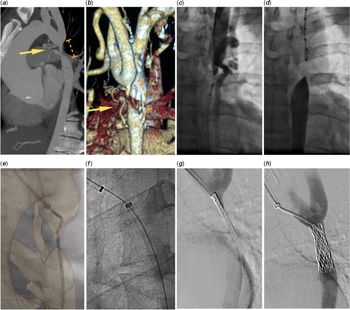
A 24-year-old male was presented with treatment-resistant arterial hypertension of 6 years’ duration. Initial workup revealed a blood pressure gradient between the upper and lower extremities, suggesting coarctation of the aorta. The subsequent CT scan demonstrated aortic atresia, with a 1.5 cm long atretic segment (Fig 1a and b, supplemental Video 1) and large collateral vessels (Fig 1b and c, arrow). The interventional procedure was performed in the hybrid OR with surgical dissection of the right brachial artery and placement of sheaths at the upstream and downstream ends of the atresia (Fig 1c and d, respectively) via the brachial and femoral arteries, respectively. Navigation of the atretic segment was optimised by CT-fluoroscopy-merge, allowing the atresia to be crossed with a stiff-wire (260 cm straight Amplatz Extra-stiff, Cook Medical, Indiana, United States of America, Fig 1e), and the establishment of a continuous wire loop (Fig 1f). Recanalisation of the atretic aorta was then performed by positioning a 39 mm long covered CP stent (NuMed Inc., Hopkinton, New York, United States of America) mounted on a 12 mm × 4 cm long Cordis Powerflex balloon (Cordis Corp., Miami Lakes, Florida, United States of America) within the atretic segment (Fig 1g and h) and subsequent inflation to nominal diameter. Post-procedural angiography showed a good result without complications (Fig 1g, supplemental Video 2). At first follow-up, the systemic blood pressure had decreased, allowing reduction of antihypertensive treatment. Further re-expansion of the stent has been planned after 6 months.
(a) CT scan of the aorta illustrating aortic atresia (yellow arrow). (b) 3D reconstruction of the CT scan illustrating atresia, a large siphon-like left subclavian artery and large collaterals (yellow arrow). (c) Fluoroscopy with pigtail catheter in distal end of atresia and contrast injection into the upstream end. (d) Fluoroscopy with pigtail catheter in proximal end of atresia and contrast injection into the downstream end. (e) Wire-crossing of the atretic segment and (f) establishment of a continuous femoral to brachial artery loop. (g) Stent positioning within the atretic segment. (h) Angiogram after stent implantation.

Our case illustrates that interventional recanalisation of even long-segment aortic atresia can safely be performed.
Supplementary material
To view supplementary material for this article, please visit https://doi.org/10.1017/S104795112000236X