Externalizing behavior (EB), that is, agitation, impulsivity, aggressiveness, and opposition, is a common form of childhood maladjustment whose expression and frequency may change substantially as children develop (Larsson, Dilshad, Lichtenstein, & Barker, Reference Larsson, Dilshad, Lichtenstein and Barker2011). In this context, researchers have been strongly encouraged to study EB from a developmental perspective. They have accumulated evidence that EB typically decreases from early childhood to adolescence (Leve, Kim, & Pears, Reference Leve, Kim and Pears2005). For example, during the preschool period, a decrease has been reported among children scoring above the 75th percentile on the Preschool Child Behavior Checklist (Achenbach & Rescorla, Reference Achenbach, Rescorla and Mariush2004) between age 2 and age 5 (Mesman, Bongers, & Koot, Reference Mesman, Bongers and Koot2001). The same was true for preschoolers referred by their parents for EB, whose behavioral problems decreased from 3 to 5 years of age (Meunier et al., Reference Meunier, Roskam, Stievenart, Van de Moortele, Browne and Kumar2011). EB was also seen to gradually decrease in the preschool period from age 2 to age 6 in a sample of boys from low-income families (Owens & Shaw, Reference Owens and Shaw2003). A decrease in EB between 2 and 9 years of age has been found (Miner & Clarke-Stewart, Reference Miner and Clarke-Stewart2008; Prinzie, Onghena, & Hellinckx, Reference Prinzie, Onghena and Hellinckx2005), and in another study EB was found to diminish from 4 to 12 years of age, with a slowdown in the rate of decrease around middle childhood (Wang, Christ, Mills-Koonce, Garrett-Peters, & Cox, Reference Wang, Christ, Mills-Koonce, Garrett-Peters and Cox2013). A significant decrease in EB between the ages of 4 and 15 has been confirmed in other studies as well (Goh Kok Yew & O'Kearney, Reference Goh Kok Yew and O'Kearney2015; Williams, et al., Reference Williams, Degnan, Perez-Edgar, Henderson, Rubin, Pine and Fox2009). However, in a five-wave study focusing on adolescence, an increase in participants’ EB was reported between the ages of 11.5 and 15 years (Galambos, Barker, & Almeida, Reference Galambos, Barker and Almeida2003). Finally, the developmental trajectory of EB from childhood to adulthood (from 5 years to 27 years) was recently studied (Petersen, Bates, Dodge, Lansford, & Pettit, Reference Petersen, Bates, Dodge, Lansford and Pettit2015). Other longitudinal research has focused on specific behaviors like aggression or delinquency (Broidy et al., Reference Broidy, Nagin, Tremblay, Bates, Brame, Dodge and Pettit2003; Huesmann, Dubow, & Boxer, Reference Huesmann, Dubow and Boxer2009). Overall these studies suggest that EB decreases from early childhood to adolescence, increases during adolescence, and decreases again from late adolescence to adulthood (Petersen et al., Reference Petersen, Bates, Dodge, Lansford and Pettit2015).
One major topic of research is still to identify early factors that predict the rate of change in EB over time (Miner & Clarke-Stewart, Reference Miner and Clarke-Stewart2008). Identifying early factors that are associated with increasing EB may make it easier to identify children at particular risk of persistent behavioral problems in adolescence. Moreover, the identification of factors from early childhood associated with the decrease of EB is essential for prevention and intervention. In the current study, we selected factors from theoretically sound models of EB etiology on which psychological treatment focuses and that can be directly addressed to reduce behavioral difficulties in children. Some of these are internal factors such as children's executive functioning (Barkley, Reference Barkley1997) or language abilities (Hoff, Reference Hoff2008), while factors such as parenting (Patterson, Reference Patterson1982; Snyder, Reid, & Patterson, Reference Snyder, Reid and Patterson2003) or attachment (Bowlby, Reference Bowlby1969; Cassidy, Reference Cassidy, Cassidy and Shaver2008) refer to the caregiving environment. These models lead to hypotheses that have been tested in numerous cross-sectional and prospective longitudinal studies. However, studies testing these hypotheses on EB developmental trajectories remain scarce, and longitudinal studies testing competing hypotheses gathered from these four theoretical frameworks (i.e., neuropsychology, language, parenting, and attachment) are nonexistent.
One relevant explanation for EB relies on a neuropsychological model stating that executive functions, in particular inhibition in childhood, are necessary to regulate behavior in social situations (Barkley, Reference Barkley1997). Several components of inhibition functions, in particular the capacity to interrupt an ongoing response, impulsivity management, inhibition of a predominant response, and inhibition of external distractors, have been seen as key ingredients in children's ability to adapt their behavior to caregivers’ demands and obey rules. Accordingly, associations between executive functioning and children's EB have been tested and found in correlational studies (for a metanalytic review, see Pauli-Pott & Becker, Reference Pauli-Pott and Becker2011; Schoemaker, Mulder, Deković, & Matthys, Reference Schoemaker, Mulder, Deković and Matthys2013), comparisons between children displaying deficits in executive functioning and a control group (e.g., Schoemaker, Bunte, Espy, Dekovic, & Matthys, Reference Schoemaker, Bunte, Espy, Dekovic and Matthys2014; Youngwirth, Harvey, Gates, Hashim, & Friedman-Weieneth, Reference Youngwirth, Harvey, Gates, Hashim and Friedman-Weieneth2007), prospective longitudinal research (e.g., Roskam, Meunier, Stievenart, & Noël, Reference Roskam, Meunier, Stievenart and Noël2013), and experimental studies (e.g., Volckaert & Noël, Reference Volckaert and Noël2015). With regard to the prediction of the EB slope, one study suggested an association between executive functioning and the trajectory of EB between 5 and 10 years of age (Zhou et al., Reference Zhou, Hofer, Eisenberg, Reiser, Spinrad and Fabes2007). In this study, attention focusing was rated in each wave of assessment by parents and teachers. Children on a high and stable attention slope had a high probability of being on a low and stable EB trajectory, while those on a low and stable attention slope had a high probability of being on a moderate and stable or on a low and rising EB trajectory.
Another relevant explanation for EB is language. Language is considered as a fundamental skill that relates to the cognitive, social, and emotional sides of children's development (Hoff, Reference Hoff2008). It has been postulated that communication failures affecting the understanding of the interlocutors’ communicative intentions or the expression of children's needs, desires, or feelings, may result in noncompliance and aggressiveness (Prizant et al., Reference Prizant, Audet, Burke, Hummel, Maher and Theadore1990; Stevenson, Reference Stevenson, Beitchman, Cohen, Konstantareas and Tannock1996; Van Schendel, Schelstraete, & Roskam, Reference Van Schendel, Schelstraete and Roskam2013). According to the social learning model (Bandura, Reference Bandura1977), children with such EB would in turn be isolated and lack opportunities to practice their communicative and social abilities. In addition, it has been suggested that the ability to internalize language in the form of private speech is very useful to regulate behavior (Petersen et al., Reference Petersen, Bates, D'Onofrio, Coyne, Lansford, Dodge and Van Hulle2013). Accordingly, associations between language deficits and children's EB have been identified in meta-analytic research (Yew & O'Kearney, Reference Yew and O'Kearney2013), and longitudinal studies (e.g., Lindsay, Dockrell, & Strand, Reference Lindsay, Dockrell and Strand2007; St. Clair, Pickles, Durkin, & Conti-Ramsden, Reference St. Clair, Pickles, Durkin and Conti-Ramsden2011). With regard to the prediction of EB slope, an association between language and the EB developmental trajectory was identified in a recent contribution in which children with early language difficulties displayed persistently higher levels of EB than children with typical language (Goh Kok Yew & O'Kearney, Reference Goh Kok Yew and O'Kearney2015). This association has also been supported in a study in which language ability in both middle childhood and early adolescence was predictive of the linear rate of change in EB from childhood to adulthood (Petersen et al., Reference Petersen, Bates, Dodge, Lansford and Pettit2015).
A third relevant explanation for EB is the social interactional learning model, which regards EB as related to coercive parenting (Dishion, French, & Patterson, Reference Dishion, French, Patterson, Cicchetti and Cohen1995; Patterson, Reference Patterson1982, Reference Patterson, Reid, Patterson and Snyder2002; Snyder et al., Reference Snyder, Reid and Patterson2003). In this model, EB has been thought to be more likely to emerge when parents use behaviors that reinforce children's problematic behavior. Coercion often leads to conflicts in which parents back down, leading to further negative reinforcement of aggressive and negative behaviors. The model assumes negative cycles of interaction, in which children's coercive behavior is met by parents’ coercive behavior, resulting in an escalation of negativity. Such an escalation of negativity and the parents’ failure to provide positive reinforcement for prosocial or compliant behaviors result in the maintenance of EB over time (Patterson, Reference Patterson1982, Reference Patterson, Reid, Patterson and Snyder2002). This model of bidirectional relations between negative aspects of parents’ controlling behaviors (e.g., ignoring, rejecting, or harsh discipline) and children's EB has received strong empirical support from previous correlational studies (Aunola & Nurmi, Reference Aunola and Nurmi2005; Bailey, Hill, Oesterle, & Hawkins, Reference Bailey, Hill, Oesterle and Hawkins2009; Barber, Olsen, & Shagle, Reference Barber, Olsen and Shagle1994), meta-analyses (e.g., Hoeve et al., Reference Hoeve, Dubas, Eichelsheim, van der Laan, Smeenk and Gerris2009), prospective longitudinal studies (e.g., Galambos et al., Reference Galambos, Barker and Almeida2003; Miner & Clarke-Stewart, Reference Miner and Clarke-Stewart2008; Wiggins, Mitchell, Hyde, & Monk, Reference Wiggins, Mitchell, Hyde and Monk2015), experimental studies (Loop & Roskam, Reference Loop and Roskam2016; Mouton & Roskam, Reference Mouton and Roskam2015), and randomized controlled trials (e.g., Lundahl, Risser, & Lovejoy, Reference Lundahl, Risser and Lovejoy2006; Maughan, Christiansen, Jenson, Olympia, & Clark, Reference Maughan, Christiansen, Jenson, Olympia and Clark2005; Mouton, Loop, Stievenart, & Roskam, Reference Mouton, Loop, Stievenart and Roskamin press). With regard to the prediction of EB slope, harsh parenting has been found to predict the rate of change in EB trajectory (Lansford et al., Reference Lansford, Malone, Stevens, Dodge, Bates and Pettit2006; Petersen et al., Reference Petersen, Bates, Dodge, Lansford and Pettit2015) while authoritarian parenting has been associated with a better decrease in EB (Williams et al., Reference Williams, Degnan, Perez-Edgar, Henderson, Rubin, Pine and Fox2009).
A last relevant explanation for EB is the model referring to the caregiving environment put forward by attachment theory. The nature of the parent–child relationship in the first years of life has been thought to be predictive of children's socioemotional development and behavioral adjustment. One of the most important theoretically driven hypotheses is the epigenetic view that the quality of children's relationship with their primary caregiver, and in particular their attachment security, lays the groundwork for subsequent socioemotional development (Bowlby, Reference Bowlby1969; Cassidy, Reference Cassidy, Cassidy and Shaver2008; Thompson, Reference Thompson, Damon and Lerner2006). As a corollary, EB has been viewed as the result of insecure or disorganized attachment (Greenberg, DeKlyen, Speltz, & Endriga, Reference Greenberg, DeKlyen, Speltz, Endriga, Atkinson and Zucker1997; Greenberg, Speltz, & DeKlyen, Reference Greenberg, Speltz and DeKlyen1993). Support for this model has been provided by meta-analytic research (Fearon, Bakermans-Kranenburg, van IJzendoorn, Lapsley, & Roisman, Reference Fearon, Bakermans-Kranenburg, van IJzendoorn, Lapsley and Roisman2010; Hoeve et al., Reference Hoeve, Stams, van der Put, Dubas, van der Laan and Gerris2012), and longitudinal prospective studies (Pauli-Pott, Haverkock, Pott, & Beckmann, Reference Pauli-Pott, Haverkock, Pott and Beckmann2007; Roskam, Meunier, & Stievenart, Reference Roskam, Meunier and Stievenart2011; Smeekens, Riksen-Walraven, & Van Bakel, Reference Smeekens, Riksen-Walraven and Van Bakel2009)
All of these models are interesting, because they provide suggestions for prevention and intervention. Unlike other factors associated with EB, such as personality (Prinzie et al., Reference Prinzie, Onghena and Hellinckx2005), gender (Miner & Clarke-Stewart, Reference Miner and Clarke-Stewart2008), or intelligence (Petersen et al., Reference Petersen, Bates, Dodge, Lansford and Pettit2015), inhibition, language, parenting, and attachment can be targeted and improved through interventions (Bakermans-Kranenburg, van IJzendoorn, & Juffer, Reference Bakermans-Kranenburg, van IJzendoorn and Juffer2003; Roskam, et al., Reference Roskam, Brassart, Houssa, Loop, Mouton, Volckaert and Schelstraete2016). The aim of the current research was to predict EB trajectory from inhibition, language, coercive parenting, and attachment security among clinically referred children from age 3 to age 14. By doing so, the current study addresses an important gap in the literature. It studies predictors of continuity and change in EB using theoretically sound models that have usually been treated separately in previous research. Successful predictions would promote prevention, increased specificity in targets for intervention, and the validation of theoretical models.
Method
Sample
This study was part of the Hard t(w)o Manage (H2M) research program carried out at the Psychological Sciences Research Institute of the University of Louvain in Belgium. Data were collected from an initial sample of 111 children (78.4% boys), drawn from the French-speaking area of Belgium, who had been referred for EB (arousal, opposition, agitation, aggressiveness, or noncompliance). The referral had to have been made by a physician and EB was the immediate and principal reason for the referral. Inclusion and exclusion criteria were added in order to select children whose behavioral problems were the core mental health problem. We therefore excluded children with overall developmental delay or intellectual disability. This applied to children born prematurely (before 37 weeks), and those with autism, dysphasia, or IQ below 80 tested in Wave 1 using two subtests of the third edition of the Wechsler Preschool and Primary Scale of Intelligence (i.e., the block design subtest, for reasoning IQ, and the information subtest, for verbal IQ; Wechsler, Reference Wechsler2004). These subtests have been found to correlate highly with the full-scale IQ (Anastasi & Urbina, Reference Anastasi and Urbina1997). In Wave 1, children's IQ scores were M = 95.39, SD = 14.14. In Wave 3, a full examination of IQ was carried out with the Wechsler Preschool and Primary Scale of Intelligence, which was highly correlated to brief assessment in Wave 1, r = .67, p < .001. It was M = 97.43, SD = 14.05. All of the children were attending normal school at the onset of the study. The H2M research program has been approved by the ethical committee of the Cliniques universitaires saint-Luc in Brussel. It also complies with the American Psychiatric Association ethical standards. The parents were informed about the longitudinal study and were assured that the data would remain confidential. The cohort was recruited when the children were between 3 and 5 years old. Data came from five waves of assessment: the first three occurred on a yearly basis during early childhood in 2006, 2007, and 2008, the fourth one was conducted during middle childhood in 2012, and the fifth one in adolescence in 2016. In Wave 1, the mean age of the children (78% boys) was 3.80 years (SD = 0.80). It was 4.77 (0.92) in Wave 2, 5.64 (0.86) in Wave 3, 10.23 (1.13) in Wave 4, and 14.11 (1.06) in Wave 5.
Parents’ educational level was taken as the number of years of education they had completed, counting from first grade onward. Some 25.7% of mothers had completed 12 years (corresponding to the end of compulsory secondary school in Belgium); 56% had completed 3 more years (corresponding to a first-level higher education degree); and 18.3% had a second-level higher education degree or higher. Among fathers, 38.5% had completed 12 years of education, 42.3% had achieved a first-level higher education degree, and 19.2% had a second-level higher education degree or higher. Family incomes are highly correlated to educational level in Belgium (Oakes & Rossi, Reference Oakes and Rossi2003). Due to the current economic context in the country, educational level was preferred as a stable indicator rather than family income, which is liable to fluctuate. The majority of parents in the sample were working (either full-time or part-time), with 14.7% of the mothers and 16.2% of the fathers being unemployed at the time of the onset of the study. Most of the parents lived in two-parent families (82.6%). Of the families who took part in the study, 26.4% had one child, 37.3% had two children, and 36.6% had three or more children.
With regard to treatment, 23% and 49.1% of the children were taking medication in Waves 3 and 5, respectively. In addition, 68% had experienced at least one form of treatment, either psychomotor, speech, psychology, or psychiatric treatment, for more than 1 month between Wave 1 and Wave 3. In Wave 5, parents reported that 73.6% of children had experienced at least one of these treatments between Wave 1 and Wave 5. Taken together, over the entire course of the study, 32.6% had no treatment and 46.7% experienced either medication or another form of treatment (i.e., psychomotor, speech, psychology, or psychiatric treatment), and 20.7% had experienced medication combined with another treatment.
Procedure
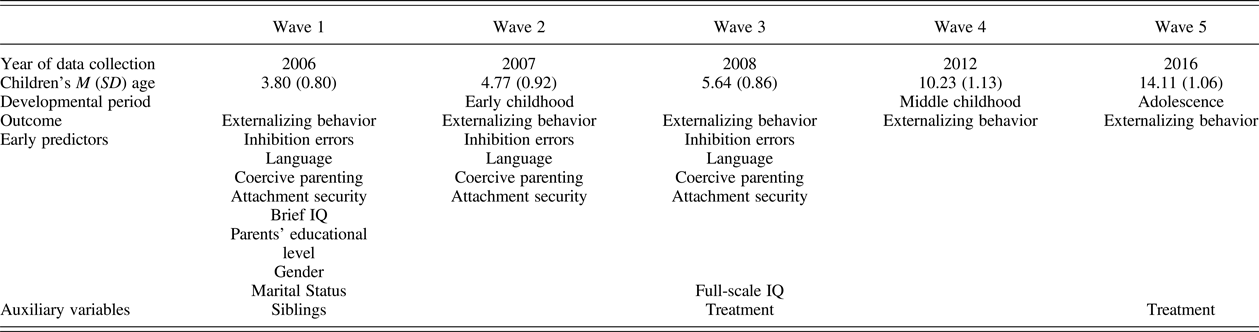
Doctoral students in psychological sciences were involved in the data collection, which was based on a multimethod approach. At each of the three first waves of assessment, the families were seen by one of the doctoral students at the Psychological Sciences Research Institute. Parents were asked to complete questionnaires assessing their coercive practices and their children's EB. If one of the two parents was absent, the questionnaire about coercive parenting was sent to him or her by regular mail. The parent was asked to return the completed questionnaires to the research team. While parents completed questionnaires at the Research Institute, children were examined in a quiet room. They completed an assessment tool designed to assess attachment representations, they were exposed to language and inhibition tasks, and their IQ was evaluated in Waves 1 and 3. In Waves 4 and 5, parents were invited to complete an online survey focusing on their children's EB. A forced format response was used to avoid missing data. In Waves 3 and 5, parents were also asked to report about treatment (i.e., medication and treatment types and duration) experienced by their children from the onset of the longitudinal study. A summary of the study design is presented in Table 1.
Study design summary

Measures
Behavior
Children's behavior was assessed with the externalizing scale of the Socio Affective Profile (PSA: LaFrenière, Dumas, Capuano, & Dubeau, Reference LaFrenière, Dumas, Capuano and Dubeau1992) in the three first waves of data collection and the Child Behavior Checklist (CBCL) in Waves 4 and 5 (Achenbach & Rescorla, Reference Achenbach, Rescorla and Mariush2004). The practice of changing developmentally appropriate measures over time has been reported in previous studies (Brame, Nagin, & Tremblay, Reference Brame, Nagin and Tremblay2001; Petersen et al., Reference Petersen, Bates, Dodge, Lansford and Pettit2015). It has been argued that the use of the same measure is not necessary in developmental studies (Owens & Shaw, Reference Owens and Shaw2003) provided the measures used are comparable both conceptually and empirically. This is the case for the externalizing scales of the PSA and the CBCL since they reflect the same construct, they are reliable, and their convergent validity is high, with r over .60 (LaFrenière et al., Reference LaFrenière, Dumas, Capuano and Dubeau1992).With regard to the PSA, the 20 items of the EB scale scored from 0 (never) to 5 (always) were used in the current study. EB encompasses aggressiveness, irritability, and noncompliance. Examples of items are “Gets angry when interrupted,” “Irritable, gets mad easily,” and “Defiant when reprimanded.” The scoring of the PSA is such that a higher score on the scales corresponds to a higher level of behavioral adjustment, or in other words, to a lower level of EB. For the sake of the readability of the results, we recoded the PSA scores so that higher scores indicated more EB. In Waves 4 and 5, the externalizing subscale of the CBCL, with the possible scores 0 (not true), 1 (sometimes or somewhat true), or 2 (often or very true), was used. The EB scale encompasses the rule-breaking and aggressive behavior syndrome scales. Examples of items are “argues a lot,” “can't sit still, restless, or hyperactive,” or “disobedient at home.”
To ensure comparability between the PSA and CBCL measures, proportion of maximum (POM) scoring was applied (Little, Reference Little2013). This consists of dividing individuals’ scores in each wave by the maximum score. Given the widely different distributions of the two measures, we used the observed maximum score rather than the total possible maximum score as the denominator (Velasquez, Reference Velasquez2010). For example, the CBCL externalizing scale consists of 35 items with an observed maximum score of 37 in Wave 4. Participants’ scores were summed across items and divided by 37, and finally multiplied by 100 for interpretability so that all POM scores had the same range (0–100). The same procedure has been successfully applied in previous studies (Petersen et al., Reference Petersen, Bates, Dodge, Lansford and Pettit2015; Velasquez, Reference Velasquez2010).
Inhibition
Children's inhibition was assessed with six tasks that were completed by children at the onset of the study. In the first five tasks, there was a control condition in which no inhibition was involved and a test condition that required the inhibition of a dominant response. In the Three Blobs task (based on Balamore & Wozniack, Reference Balamore and Wozniack1984), the child had to tap with a hammer on three colored spots in succession: first the one on the left, then the one in the middle, and then the one on the right (10 times in a row). In the test condition, the child was asked to tap each spot one at a time but in an unusual direction: left, right, and then middle. In Luria's Hand Game (see Diamond & Taylor, Reference Diamond and Taylor1996) the child had to mimic the examiner's action in the test condition (taps once or twice on the table) but do the opposite of the examiner's action in the test condition. In the Card Sorting Test (based on Brooks, Hanauer, Padowska, & Rosman, Reference Brooks, Hanauer, Padowska and Rosman2003), the child had to place rabbit cards on the rabbit model card and truck cards on the truck model card in the control condition, and the opposite in the test condition. In both conditions, the first eight cards varied only with respect to shape (rabbit or truck), but the last eight cards also varied with respect to color (blue or yellow). In Cat, Dog and Fish (inspired by the Day–Night Task; Gerstadt, Hong, & Diamond, Reference Gerstadt, Hong and Diamond1994), the child was shown series of drawings of cats, dogs, and fishes and had to name each drawing as fast as he/she could in the control condition. In the test condition, the child was required to say “cat” when he/she saw a dog, “dog” when he/she saw a cat, and “fish” when he/she saw a fish. In the Monsters Stroop Task (developed by S. Censabella and M.P. Noël, unpublished), rows of drawings of monsters of different colors were presented to the child who had to name the color of each monster (control condition). In the Test 1 condition, each monster was placed on a different colored background square and the child had to name the color of the monster, without being distracted by the color of the background. In the Test 2 condition, the instructions were the same except that if the monster was upside down, the child had to name the color of the background. Finally, we used the Statue Test (Kemp, Kirk, & Korkman, Reference Kemp, Kirk and Korkman2001), in which the child was asked to maintain a body position with eyes closed without talking during a 75-s period and to inhibit the impulse to respond to sound distractors. A principal component factorial analysis was conducted on the six tasks’ error scores. Both the sample size and the moderate correlations between the six tasks (ranging from r = .20 to r = .61) were considered to be sufficient to perform principal component analyses (Floyd & Widaman, Reference Floyd and Widaman1995). A single factor, “inhibition,” was produced in each of the three first waves that explained 40.07%, 40.85%, and 43.63% of the variance with factorial loadings ranging from .43 to .73, from .48 to .71, and from .51 to .73 in Wave 1, 2, and 3, respectively. The factorial scores were used for the analyses. They were computed so that a higher error score indicated lower inhibition capacities.
Language
The evaluation of children's language abilities included articulation and phonology, lexicon in comprehension and production, and morphosyntax in comprehension and production. Articulation and phonology, and lexicon in comprehension and production, were evaluated with the Nouvelles Epreuves pour l'Examen du Langage (Chevrie-Muller & Plaza, Reference Chevrie-Muller and Plaza2001). In the evaluation of articulation and phonology, children were asked to name different pictures. The task consisted of three lists evaluating different types of target words. For each list, a score was given for naming and for repetition, repetition being used to evaluate the stability of errors. Lexical skills in comprehension and production were assessed using the vocabulary subtests of the Nouvelles Epreuves pour l'Examen du Langage. To assess comprehension, children had to point (on a sheet of paper) to the word pronounced by the examiner. To assess production, children had to name a set of single pictures. French tests were used to assess morphosyntactic skills incomprehension (Evaluation du Langage Oral; Khomsi, Reference Khomsi2001) and production (Test de Closure Grammaticale; Deltour, Reference Deltour1992). In the Evaluation du Language Oral, the child was shown four pictures and had to point to the one that corresponded to a sentence spoken by the examiner. In the Test de Closure Grammaticale, the child was given sheets that each contained two pictures. The examiner began a sentence describing the first picture and the child had to finish the sentence with reference to the second picture (e.g., “Here the boy is seated, and there he is … running”). Both the sample size and the moderate correlations between the tasks (ranging from r = .20 to r = .97) were considered to be sufficient to perform principal component analyses (Floyd & Widaman, Reference Floyd and Widaman1995). A single factor, “language,” was produced in each of the three first waves which explained 64.16%, 64.52%, and 58.35% of the variance with factorial loadings ranging from .41 to .94, from .55 to .94, and from .40 to .93 in Wave 1, 2, and 3, respectively. The factorial scores were used for the analyses. They were computed so that a higher error score indicated greater language capacities.
Coercive parenting
Mothers’ and fathers’ coercive parenting was assessed with the parenting negative control scale of the preschool and primary school form of the Evaluation des pratiques éducatives parentales, designed for parents of 2- to 7-year-old children (Meunier & Roskam, Reference Meunier and Roskam2009). The controlling dimension of parenting includes six items for discipline, five items for harsh punishment, and five items for ignoring and includes items such as “When my child is impolite or behaves badly, I punish him/her,” “I slap my child when he/she has done something wrong,” and “When my child does something that is not allowed, I only talk to him/her again when he/she behaves better.” A 5-point Likert-type scale is provided for each item, ranging from never to always. This instrument was validated on 565 French-speaking mothers and fathers of normally developing children and shows good psychometric properties (Meunier & Roskam, Reference Meunier and Roskam2009). Confirmatory factor analyses from the validation study showed that two second-order factors covering the supportive and controlling dimensions of parenting emerged from the initial factor solution. The fit measures in the validation study demonstrated an acceptable fit to the data, with comparative fit index = 0.94, root mean residual = 0.03, and root mean square error of approximation = 0.05 (Hu & Bentler, Reference Hu and Bentler1999; Meunier & Roskam, Reference Meunier and Roskam2009).
Attachment
Children's attachment security was measured with the French version of the Attachment Story Completion Task (Bretherton, Reference Bretherton1990). The administration of the task was video-recorded. The stories involved handling materials, and covered themes such as naughtiness, fear, separation from and reunion with parents, and the loss of a dog. The narratives were coded by the clinician research assistants using a Q-set procedure (Miljkovitch, Pierrehumbert, Karmaniola, & Halfon, Reference Miljkovitch, Pierrehumbert, Karmaniola and Halfon2003). This resulted in continuous correlation scores (–1 to +1), which were obtained by comparing the children's individual Q-sort description with the criterion sort provided by experts for a prototypical secure child using Main and Cassidy's pattern. Twenty percent of the first wave of video-recorded tasks were coded separately by two independent coders. The agreement between the two coders of attachment patterns was computed with intraclass correlations. It was high and significant for the secure score with α = 0.80, p < .01.
Results
Analysis of missingness
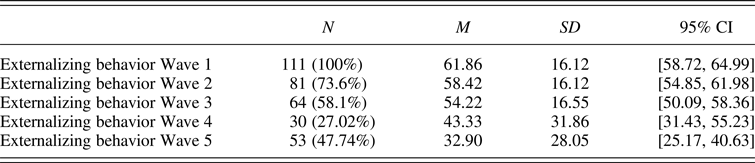
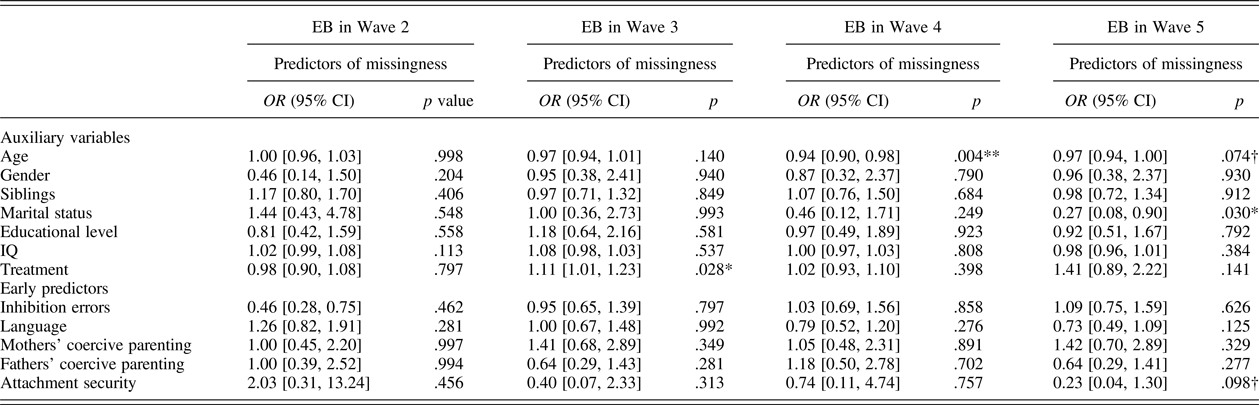
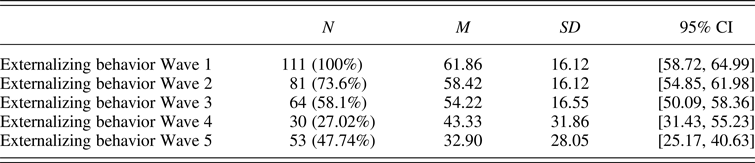
As in most longitudinal studies, attrition occurred due to participant dropout, item nonresponse, inability to locate participants, or strong opposition of children to completing tasks. The number of valid cases in each wave of assessment is presented in Table 2. We examined the missing values in each wave through logistic regression. Predictors of missingness (i.e., child's age in Wave 1, gender, number of siblings, marital status, parents’ educational level, child IQ, treatment, inhibition, language, coercive parenting, and attachment) were entered in logistic regressions with the binary dropout in each wave as the dependent variable. We found no differential attrition among subgroups within the study. We only found 3 significant associations over 48 tested ones: between treatment and attrition in Wave 3, between age and attrition in Wave 4, and between marital status and attrition in Wave 5. The results are displayed in Table 3.
Number of valid cases and descriptive statistics of externalizing behavior (proportion of maximum scores) in each wave
Predictors of missingness in externalizing behavior in each of the five waves of assessment
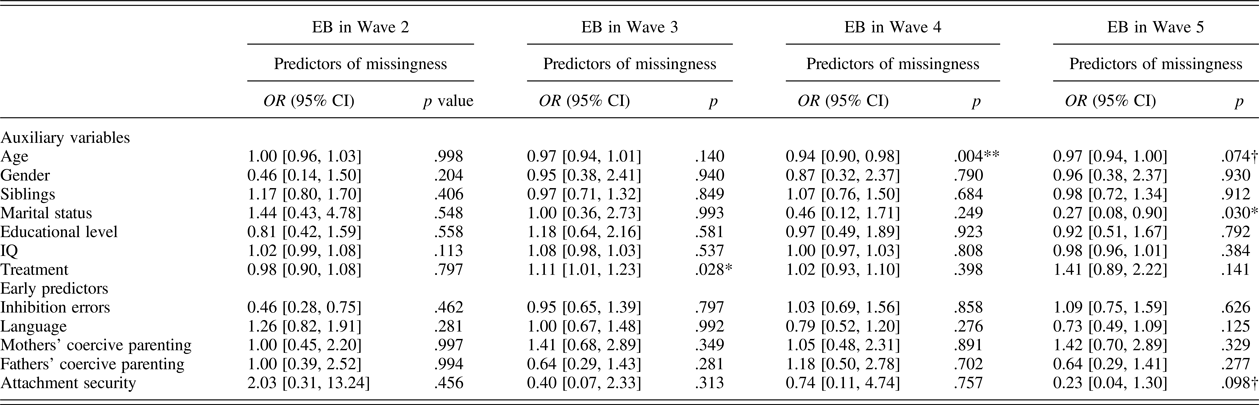
Note: EB, externalizing behavior. †p < .10; *p < .05; **p < .01; ***p < .001.
Preliminary analyses
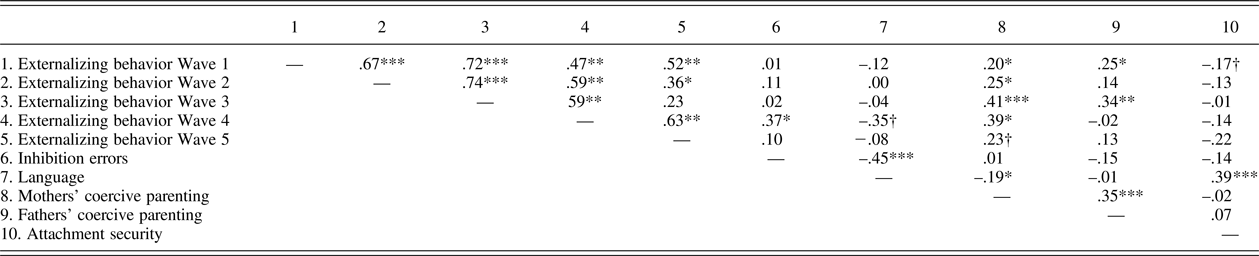
We tested the normality assumption of the distribution of EB POM scores in Waves 1 to 5. Joint kurtosis and skewness tests for normality showed that scores were not normally distributed in Wave 3, adjχ2 = 7.78, p = .02, Wave 4, adjχ2 = 8.28, p = .01, and Wave 5, adjχ2 = 6.07, p = .04. A log transformation was applied in the five waves in order to keep comparable scaling. Transformations ensured normality for the five variables. We also tested whether the relation between EB and time (waves) was linear, quadratic, or cubic. Estimates showed that the data were best represented by a linear relation, F (1, 314) = 152,63, p < .001. We then examined the stability of EB over the five waves of assessment. Correlations are displayed in Table 4.They suggest a moderate to high stability of EB.
Correlations among externalizing behavior over the five waves of assessment and early predictors

Note: †p < .10; *p < .05; **p < .01; *** p < .001.
Association between early predictors and EB trajectory
The main analyses were those intended to examine the association between early predictors, (i.e., inhibition errors, language, coercive parenting, and attachment security) and the development of children's EB. With regard to the early predictors, an average score was computed for each predictor that had been measured at multiple time points within the early childhood period of development. Across the three first waves of data collection, correlation coefficients between inhibition errors ranged from .60 to .64. For language, they ranged from .85 to .93. For coercive parenting, they ranged from .62 to .69 and from .56 to .66 for mothers and fathers, respectively. For attachment security, they ranged from .40 to .51. This was done to limit the number of predictors in the model and to consolidate measures through the correction of measurement errors. This procedure also ensured a complete data set for the 111 participants, as all of the predictors were measured at least once for each participant during the early childhood period of development. The variables that were computed must be understood as the children's average level of inhibition errors, language, coercive parenting, and attachment security in early childhood. The number of valid cases for each variable in each wave of assessment is presented in Table 5. We also examined the relations among the early predictors in order to avoid multicollinearity. Correlations are presented in Table 4. No multicollinearity was suspected, and the bivariate associations were in the expected direction, supporting the validity of the measures. For example, inhibition errors were found to correlate negatively with language, and language was found to correlate negatively with mother's coercive parenting.
Number of valid cases and descriptive statistics of early predictors

We then tested the bivariate associations between the four early predictors and EB in each of the five waves. Coefficients displayed in Table 4 reveal recurring associations between mothers’ coercive parenting and EB, while fathers’ parenting was related to EB only in Waves 1 and 3. Attachment security tended to be related to EB in Wave 1. Inhibition errors were positively associated with EB in Wave 4, and language tended to be negatively associated with EB in Wave 4.
The main analysis was conducted using a multilevel modeling (MLM) framework with HLM 7 software (Raudenbush, Bryk, & Congdon, Reference Raudenbush, Bryk and Congdon2012). MLM capitalizes on the multilevel structure of the data, providing information about the variability of individuals over time (Level 1, repeated measures) as well as between individuals (Level 2, early predictors). MLM estimates are based on all the available data at Level 1, but without imputing data (McCartney, Burchinal, & Bub, Reference McCartney, Burchinal and Bub2006). HLM uses maximum likelihood estimation, which does not require the assumption of missingness completely at random (Little, Reference Little1988). This method was chosen because it allowed the inclusion of children who did not participate at each measurement point in the study sample. We tested a model to predict the developmental trajectory of children's EB, that is, the unconditional growth model in which time is the only predictor. The time component used in this model was the wave (i.e., the five assessment points). Out of a maximum of 555 pieces of data on EB (i.e., 111 children over 5 waves of data collection), 339 were actually collected (61.08%). Because the estimation of the longitudinal model (Level 1 in MLM) is computed over available data with the same equation: Externalizing_Behavior_0ij = β0j + β1j*(WAVEij) + rij), 61.08% of complete data may be considered adequate for the use of full information maximum likelihood. The conditional model tested the effect of early predictors (i.e., mean level of inhibition errors, language, coercive parenting, and attachment security) on EB slope. Predictors at Level 2 were included as fixed effects in the model after being mean-centered.
Results of the unconditional model
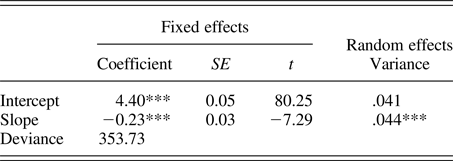
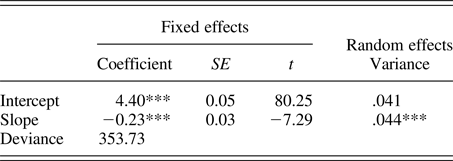
The results of the unconditional model testing the developmental trajectory of children's EB are presented in Table 6. They indicate that the intercept was significantly different from zero, which is not very informative here. The slope was also significantly different from zero, meaning that in line with previous results, there was evidence of a decreasing trajectory in EB over time, as reported by parents. In particular, the negative slope value showed that children's EB decreased by 0.23 units in each wave of assessment. The results from the random section indicated significant individual variability around the slope but not around the intercept. Therefore, it was appropriate to examine the predictors of children's EB slopes in the conditional model.
Results of the unconditional model
Note: ***p < .001.
Results of the conditional model
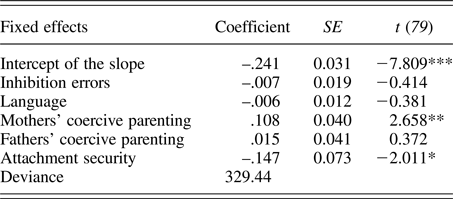
The results of the conditional model are presented in Table 7. EB slope was predicted by two early predictors: attachment security and mothers’ coercive parenting. For 1 SD above the average level of attachment security, a decrease of 0.14 units in the rate of change of EB was evident over a wave. For 1 SD above the average level of mother's coercive parenting, an increase of 0.11 units in the rate of change of EB was evident over a wave. The random part of the model suggested that a significant part of the variance in the slope was not explained by the model with a variance component of 0.03, p < .001. Finally, we tested the conditional model in which the nonsignificant parameters were deleted. Parameter estimates of attachment and parenting displayed only a very small change.
Results of the conditional model

Note: *p < .05; ** p < .01; ***p < .001.
Discussion
The aim of the current research was to disentangle theoretically sound models of EB etiology by testing their relation with EB trajectory from age 3 to age 14. Four theoretically grounded explanations were under consideration: one of these was based on neuropsychological theories stating that executive functioning, and especially inhibition, is responsible for greater behavioral regulation; two others came from the social learning model, stressing language as a fundamental skill for behavioral outcomes and the role of coercive parenting in the etiology of EB; and the last came from attachment theory, positing that attachment security lays the groundwork for subsequent socioemotional development. Bivariate correlations between the early predictors and EB in the five waves of assessment revealed associations between inhibition, language, and EB in the school-age period, while systematic associations across waves were found for coercive parenting, especially with mothers. Attachment showed little association with EB, but a tendency toward this association emerged in early childhood, in Wave 1. Based on the correlations, the role of coercive parenting in the etiology of EB received the strongest support. However, in addition to bivariate time-to-time associations between two variables regardless of the effect of any others, two of the four models received support from the results of the multilevel longitudinal approach. The rate of change in EB over time was predicted by mothers’ coercive parenting as well as by attachment security. Conversely, neither inhibition nor language was seen to predict EB slope.
These results have strong implications for research into EB etiology. In contrast with previous studies, the present study gathered hypotheses from several theoretical backgrounds that are usually considered separately from each other. By doing so, it put these models into competition with one another. As a conclusion, the results of the conditional model suggest that of the four models, the one pointing to the central role of coercive parenting in the social learning model and the one coming from attachment theory are the most convincing. One important question now is why parenting factors, in particular mothers’ coercive parenting and attachment, might be stronger predictors of the EB trajectory over and above language or inhibition. The two models that received the strongest support refer to the caregiving environment, while the two others concern children's internal factors. It may be that etiological models of children's behavioral development that are mainly based on individual features do not account for the core assumption that any human development happens in a specific developmental setting. Etiological models that try to explain children's development in a multilevel longitudinal approach, taking into account the quality of interactions with the primary caregivers, may be more convincing than those that promote individual characteristics only.
The results suggest that further studies are needed to replicate the current findings. They should consider theoretical models from various backgrounds rather than studying them in isolation and that give preference to factors whose etiological role in EB is fully understood. This is highly important for providing strong guidelines for both prevention and intervention, as testing a factor such as the role of language apart from other theoretical etiological factors may lead to its role in the EB trajectory being overestimated. The same may be true for the role of executive functioning, which has mostly been considered in neuropsychological studies that encompassed no other etiological risk.
If the results of the current research can be replicated, they may have some implications for clinical practice. The implications of longitudinal studies are very useful for intervention purposes, as they give indications for recognizing young children who are at particular risk of increasing EB from early childhood to adolescence. In this respect, our results suggest that early factors that significantly predict increasing EB over time (i.e., high coerciveness in mothers’ parenting and low attachment security) may be used to identify children who may benefit from early intervention. Concretely, standardized parenting and attachment ratings may be systematically associated with behavioral assessment in early childhood. This is very useful for practitioners who work with clinically referred children for whom caregivers seek help. It provides them with several hypotheses with regard to the etiology of children's behavioral problems and several therapeutic solutions for those problems (Roskam et al., Reference Roskam, Brassart, Houssa, Loop, Mouton, Volckaert and Schelstraete2016). In particular, our results offer some support for ecological intervention taking into account both the child and the caregiving environment, as opposed to individual intervention settings focusing on the child exclusively. They suggest that interventions improving parents’ responsiveness and childrearing behaviors are of great interest and may be favored for both prevention and clinical issues in children's externalizing problems.
However, this way of considering results from longitudinal studies may be risky if it is applied to universal prevention policy. Young children in the community may be identified as being at risk because of coercive parenting or attachment insecurity, for example, and such a labeling effect may give them a negative reputation that adversely affects their subsequent relationships with both caregivers and peers (White, Jones, & Sherman, Reference White, Jones and Sherman1998).Footnote 1 Universal prevention should rather be considered in terms of protective mechanisms. Universal prevention should be thought of more as giving a chance to every child to grow up and behave than as tracking at-risk children. In this respect and based on the current results, close attention should be paid by caregivers in every developmental setting (family, daycare center, school, etc.) to the importance of a sense of security in affective bonds as well as to parenting support.
Strengths and limitations
The present study has several strengths. First, it was conducted among children whose clinical referral was primarily based on EB. Second, it studied the EB trajectory from early childhood to adolescence with five waves of assessment. Third, factors estimated in early childhood were measured with a multimethod strategy of assessment encompassing parent reports, standardized tasks, and child interviews. Fourth, factors were theoretically grounded. Fifth, four theoretical models of EB etiology were considered in a single study for the first time.
The present study also has several limitations. First, the assessment of EB as well as coercive parenting was limited to parental reports. Measurement from multiple sources would be useful to correct for informant bias. Second, the computation of POM scores across different measures limits our ability to draw conclusions regarding EB trajectories. The proportion scores may be different across the two scales used in the study. However, the measures reflect the changing nature of EB from childhood to adolescence. For example, “defiant when is reprimanded” is very suitable for young children, but would be less so for adolescents, and “argues a lot” is more appropriate to older than to younger children. The trajectory that was estimated in the current study is meaningful and replicates those found in previous research, and this gives us some assurance with regard to the use of POM scores. Third, the results are only generalizable to a specific clinical population. Differences in developmental pathways between normally developing children and those considered in the current sample may be explained by other mechanisms. Fourth, in a clinically referred sample, it would have been very useful to control for the effect of treatment experienced by children on EB trajectory; we were not able to do this as information about both types and duration of treatment(s) was reported by parents with no way of verifying its validity. In addition, types of treatment were seen to be very heterogeneous and treatments varied greatly in duration. Most of the children had experienced a mix of several treatments, for example, psychomotor with speech therapy and medication, at different moments in childhood and adolescence. Most of them had taken different drugs with varying doses between age 3 and age 14. It was therefore hard to reflect such diversity. The content of the treatments was also not standardized. It is impossible to know what had been experienced by each child in speech, psychomotor, or psychological treatment, for example. Alongside the fact that testing treatment effect was not the objective of the current study, the inaccuracy of the variable was the main reason why, apart from testing treatment effect in missingness, we did not consider this variable in the longitudinal model. Fourth, an important limitation of the current study is the sample size and missingness. Replication of the findings is needed. Fifth, the interactional nature of the current study prevents us from drawing any conclusion about causal mechanisms. Experimental studies focusing on EB etiology are still needed to confirm the role played by parenting and attachment security as well as by inhibition and language. Evidence has recently been put forward for language abilities (Brassart & Schelstraete, Reference Brassart and Schelstraete2015), parenting (Loop & Roskam, Reference Loop and Roskam2016; Mouton & Roskam, Reference Mouton and Roskam2015), and inhibition (Volckaert & Noël, Reference Volckaert and Noël2015). The manipulation of parenting has been found to predict positive outcomes 9 years later (Forgatch, Patterson, Degarmo, & Beldavs, Reference Forgatch, Patterson, Degarmo and Beldavs2009). Sixth, using average scores of predictor variables prevented us from studying the developmental pathways of these predictors and their association with EB trajectory. For example, the possibility cannot be ruled out that EB trajectory may be better explained by developmental change in inhibition or language than by the mean inhibition or language. This methodological choice was made to limit the variables in the model, mostly because of the small sample size. Seventh and finally, while the current study has the merit of testing four competing models of EB etiology, it does not consider their potential interrelated effects on EB. Future studies should test the interactive contribution of the factors under consideration. It can be conjectured that child factors such as language or inhibition interact with parenting or attachment to predict change in EB over time.
Conclusion and future prospects
In sum, the present study tested the developmental trajectory of EB from age 3 to age 14 among clinically referred children. This showed a significant decrease over time, which was explained by factors measured in early childhood. These derived from theoretical models of EB etiology and involved mechanisms relating to executive functioning, language, coercive parenting, and attachment security. The rate of change from age 3 to age 14 was related to the mean level of mothers’ coercive parenting and attachment security in early childhood but not related to the mean level of inhibition errors and language. However, a significant part of the variance in the model still remains to be explained. Future investigation is needed to go further in testing etiological hypotheses from other domains such as genetics or social information-processing mechanisms (Crick & Dodge, Reference Crick and Dodge1994), and interactions among factors.