Introduction
Dormancy cycling in seeds with non-deep physiological dormancy (i.e. dormancy caused by low growth potential of the embryo; Baskin and Baskin, Reference Baskin and Baskin2004) has been shown to occur in seeds of numerous species (Baskin and Baskin, Reference Baskin and Baskin1985, Reference Baskin and Baskin1998). There are claims that seeds with physical dormancy (i.e. dormancy caused by a water-impermeable seed or fruit coat; Baskin and Baskin, Reference Baskin and Baskin2004) can cycle between dormancy and non-dormancy (Rolston, Reference Rolston1978; Norsworthy and Oliveira, Reference Norsworthy and Oliveira2007). However, this does not seem to be possible since dormancy break of physically dormant seeds occurs through formation of mechanical breaks in a special morpho-anatomical area in the seed or fruit coat, the water gap (Baskin et al., Reference Baskin, Baskin and Li2000; Baskin, Reference Baskin2003; Jayasuriya et al., Reference Jayasuriya, Baskin, Geneve and Baskin2007a).
Sensitivity cycling to dormancy break of physically dormant seeds has been shown to occur in Fabaceae [Trifolium subterraneum (Taylor, Reference Taylor1981, Reference Taylor2005), Ornithopus compressus (Taylor and Revell, Reference Taylor and Revell1999) and other papilionoid legumes (Van Assche et al., Reference Van Assche, Debucquoy and Rommens2003)] and in Convolvulaceae [Ipomoea lacunosa (Jayasuriya et al., Reference Jayasuriya, Baskin and Baskin2008a), Cuscuta australis (Jayasuriya et al., Reference Jayasuriya, Baskin, Geneve, Baskin and Chien2008b), Jacquemontia ovalifolia (Jayasuriya et al., Reference Jayasuriya, Baskin and Baskin2008c) and Ipomoea hederacea (Jayasuriya et al., Reference Jayasuriya, Baskin, Geneve and Baskin2009b)]. In sensitivity cycling, seeds cycle between insensitive and sensitive states. Sensitivity cycling allows the seeds to germinate in favourable conditions for seedling establishment and prevents germination when conditions are unfavourable.
Sensitivity cycling of physically dormant seeds is driven either by temperature only or by the interaction of temperature and soil moisture (Jayasuriya et al., Reference Jayasuriya, Baskin and Baskin2009a). I. hederacea is a good example of sensitivity cycling driven solely by temperature. Sensitivity of I. hederacea seeds is induced by storing them wet or dry at high temperatures ( ≥ 15°C) and reduced by storing them wet or dry at low temperatures ( ≤ 5°C) (Jayasuriya et al., Reference Jayasuriya, Baskin, Geneve and Baskin2009b). I. lacunosa is a good example of sensitivity cycling driven by the interaction of temperature and soil moisture. Sensitivity of I. lacunosa seeds can be induced by storing them wet at moderate temperatures (30/15°C), and sensitivity is reduced by storing them dry at high temperatures ( ≥ 25°C) or dry or wet at low temperatures ( ≤ 5°C) (Jayasuriya et al., Reference Jayasuriya, Baskin and Baskin2008a). Dormancy in sensitive seeds of I. lacunosa can be broken by incubating them at 35°C at ≥ 90% relative humidity (RH) for ≥ 2 h (Jayasuriya et al., Reference Jayasuriya, Baskin and Baskin2008a), whereas sensitive seeds of I. hederacea require dry storage at high temperatures for >1 month to release them from dormancy (Jayasuriya et al., Reference Jayasuriya, Baskin, Geneve and Baskin2009b).
The seeds of both I. lacunosa and I. hederacea have physical dormancy (Jayasuriya et al., Reference Jayasuriya, Baskin and Baskin2008c). Therefore, dramatic changes in moisture content of these water-impermeable seeds cannot be expected. However, Jayasuriya et al. (Reference Jayasuriya, Baskin, Geneve and Baskin2009c) demonstrated that moisture content (MC) of sensitive seeds of I. lacunosa is about 2% higher than that of insensitive seeds; there are no available MC data on seeds of I. hederacea. Further, no study has been conducted to assess the effect of this MC difference on seed vigour of insensitive versus sensitive seeds.
Loss of seed vigour is a good indication of deterioration of a seed lot, and it can be observed long before there is a reduction in seed germination (McDonald, Reference McDonald1999). Seedling growth and evaluation tests, stress tests and biochemical tests are used to determine vigour of seeds (TeKrony, Reference TeKrony1989). Rate of seedling root and shoot growth and dry weight are commonly used in seedling growth evaluation tests, whereas conductivity is the commonly used biochemical test and accelerated ageing the commonly used stress test (TeKrony et al., Reference TeKrony, Egli and White1987; TeKrony, Reference TeKrony1989; McDonald, Reference McDonald1999). In most cases, an index that incorporates all three of these measures is used to determine the quality of seeds (TeKrony et al., Reference TeKrony, Egli and White1987; TeKrony, Reference TeKrony1989). However, seed vigour has been studied mostly in economically important crop varieties (TeKrony and Egli, Reference TeKrony and Egli1991). The primary aim of this study was to determine the effect of sensitivity cycling on seed vigour in I. lacunosa and I. hederacea using five vigour tests: accelerated ageing, conductivity, root and shoot growth of the seedling and increment of the dry mass of the seedling.
Materials and methods
Seed material
Ipomoea lacunosa L. and Ipomoea hederacea Jacq. var. hederacea (hereafter I. hederacea) are summer annual vines native to eastern USA (Gleason and Cronquist, Reference Gleason and Cronquist1991). They are common noxious weeds in agricultural crops, especially in cotton, soybeans (Anonymous, Reference Anonymous1995, Reference Anonymous2001), corn and rice (Anonymous, Reference Anonymous2000). Seeds of both taxa have physical dormancy (Jayasuriya et al., Reference Jayasuriya, Baskin and Baskin2008c). Two collections each of I. lacunosa and I. hederacea seeds were made in soybean and corn fields at Spindletop Experimental Farm, University of Kentucky, Lexington, Kentucky, on 6 October 2006 (2006C1) and 3 November 2006 (2006C2). Experiments were carried out immediately after seeds were collected.
Seed treatments
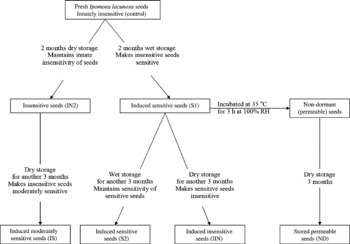
Seeds were stored under different conditions for various periods of time to create different combinations of sensitivity and dormancy. Then, all seeds were made permeable (see later for method), except those that had already been made permeable by the storage treatment, and subjected to a range of vigour tests. I. lacunosa seed samples were stored at ambient laboratory temperatures as follows to manipulate and maintain the desired state of sensitivity:
(1) Fresh seeds without any treatment (innately insensitive);
(2) 2 months on wet sand (insensitive → sensitive);
(3) 2 months on dry sand (maintain innate insensitivity);
(4) 5 months on wet sand (insensitive → sensitive);
(5) 5 months on dry sand (insensitive → moderately sensitive);
(6) 2 months on wet sand+3 months on dry sand (insensitive → sensitive → insensitive); and
(7) 2 months on wet sand → break dormancy by incubating at 35°C for 3 h at 100% RH → stored for 3 months on dry sand (only for 2006C1) (insensitive → sensitive → non-dormant).
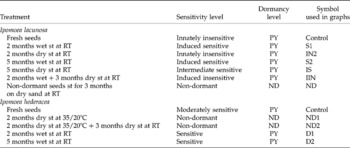
Pretreatments performed on I. lacunosa seeds are explained in the flow diagram in Fig. 1 and in Table 1.
Flow diagram for the different pretreatments used for Ipomoea lacunosa seeds.

Different pretreatments used for I. lacunosa and I. hederacea seeds

st, stored; RT, ambient laboratory temperature; PY, physically dormant; ND, non-dormant.
I. hederacea seed samples were stored wet for 2 or 5 months at 35/20°C to maintain dormancy. Another sample was stored dry at 35/20°C for 2 months to break dormancy, and then they were stored dry at room temperature (22–24°C) for another 3 months. Prestorage treatments performed on I. hederacea are shown in Table 1. I. lacunosa seeds were made permeable by dipping them in boiling water for 4 s prior to vigour tests, whereas dormant I. hederacea seeds were manually scarified. Although dipping I. lacunosa seeds in boiling water made them permeable within a short period of time, there was no quick treatment to make I. hederacea seeds permeable, other than manual scarification. The boiling water treatment rather than high RH treatment was used to make I. lacunosa seeds permeable, because insensitive seeds did not respond to the high RH treatment.
Moisture content of seeds
The effect of the vigour tests, especially the accelerated ageing (AA) test, depends on seed moisture content (MC). Thus, MC of a sample of permeable I. lacunosa and of I. hederacea seeds was determined using the oven-dry method (ISTA, 2008) after each storage treatment, prior to each vigour test. Four replicates each of 15 fresh, 5 months wet stored, 2 months wet+3 months dry stored and 3 months dry stored permeable 2006C1 and 2006C2 seeds of I. lacunosa; and of fresh, 5 months dry stored and 5 months wet stored 2006C1 and 2006C2 seeds of I. hederacea were weighed to the nearest 0.0001 g and oven dried to constant weight at 105°C. MC (fresh mass basis) of each seed lot was calculated after each storage treatment. If initial MC was less than 13%, it was raised to 13% by keeping the seeds at 75% RH (maintained using saturated NaCl solution) at ambient laboratory temperature in a closed container for 24 h. Moisture content was raised to 13% because this is the moisture content of fresh seeds of I. lacunosa at maturity (Jayasuriya et al., Reference Jayasuriya, Baskin, Geneve and Baskin2007b), and seed vigour change is insignificant at low seed moisture conditions (Jayasuriya et al., unpublished data). Furthermore, a previous study showed that seeds of I. lacunosa stored at 75% RH would equilibrate to a moisture content of 13% in 24 h (Jayasuriya et al., unpublished data).
Accelerated ageing test
Four replicates each containing approximately 2 g of 2006C1 and of 2006C2 I. lacunosa and I. hederacea seeds from all pretreatments (Fig. 1, Table 1) were weighed to the nearest 0.0001 g. Seeds were placed on wire-mesh trays, which were then placed in accelerated ageing containers containing 40 ml of de-ionized water and aged in a water-jacketed incubator at 45°C for 5 d. Temperature was monitored using a NIST (National Institute of Standards and Technology, USA) thermometer. After 5 d seed samples were retrieved from the incubator, and 25 seeds of each replicate were sown separately for germination on paper towels and incubated at 30/20°C (12 h/12 h) in light/dark (12 h/12 h) for 5 d. Normal and abnormal seedlings and dead seeds were counted after 2 d and 5 d of incubation as described by ISTA (2008).
Conductivity
Four replicates containing 2 g of seeds from each pretreatment of I. lacunosa and of I. hederacea (Fig. 1, Table 1) seeds were immersed in 75 ml of deionized water. Conductivity of the solution was measured soon after immersion and after 6 and 8 h, using a digital conductivity meter. After 8 h, seeds that were still dormant (water impermeable) were separated from the water permeable imbibed seeds, and their mass was determined to the nearest 0.0001 g using a digital balance. Mass of water-impermeable seeds was subtracted from original mass, and thus conductivity (dS m− 1 g− 1) was based on mass of water-permeable seeds only.
Growth of plumule and radicle
Four replicates of 25 seeds from each pretreatment (Fig. 1, Table 1) of I. lacunosa and I. hederacea were sown on moist (distilled water) paper towels and incubated at 30/20°C in the light/dark regime. Lengths of radicles and plumules were measured separately to the nearest 1 mm on days 2 and 5 of incubation. Dry mass of seedlings was determined after drying in an oven at 105°C.
Imbibition of sensitive and of insensitive seeds made non-dormant
Fifteen sensitive and insensitive I. lacunosa seeds each were made non-dormant by dipping them in boiling water for 4 s. These seeds were surface-blotted, weighed individually to the nearest 0.0001 g and placed on moist (distilled water) filter paper at ambient laboratory temperature. Seeds were retrieved at 1-h intervals for 6 h, surface-blotted, reweighed and returned to the filter paper. Imbibition tests were done using the same method described above for 15 manually scarified (individually with a scalpel at chalazal end) sensitive and intermediate-sensitive I. hederacea seeds each.
Experimental design and analysis of data
The seven seed pretreatments for I. lacunosa and the five for I. hederacea were considered to be separate treatments and were treated as such in statistical analysis of the data. These treatments were used as a factor in the experimental design, and seed lot was used as another factor. A completely randomized design was used in every experiment. Two-factor ANOVA was performed using the general linear model (GLM) procedure in the SAS system (SAS Institute Inc., Cary, North Carolina, USA) to analyse the data. The ‘2 months wet+3 months dry stored at RT’ treatment done for the I. lacunosa 2006C2 seed lot was excluded from this analysis. Duncan's and Dunnett's mean separation procedures were used to determine differences between treatments. One-way ANOVA was performed on the I. lacunosa 2006C2 seed lot to determine the effect of the ‘2 months wet+3 months dry stored at RT’ treatment. Data were arc-sine transformed before analysis.
Results
Moisture content of seeds
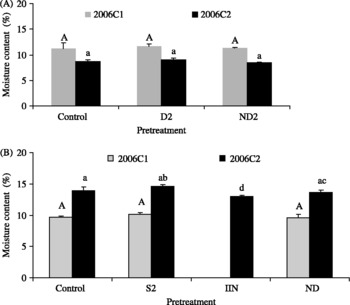
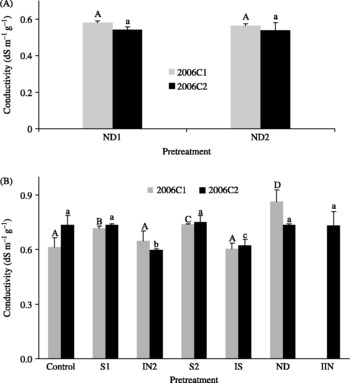
There were no significant differences in MC of fresh (control, dormant-insensitive), 5 months wet stored (at RT) (sensitive, D2) and 3 months dry stored (at RT) non-dormant (made permeable by 2 months dry storage, ND2). MC of I. hederacea 2006C1 seeds was higher than that of 2006C2 seeds (Fig. 2A). Moisture content of I. lacunosa 2006C1 seeds was lower than that of 2006C2 seeds of this species (Fig. 2B, two-way ANOVA, P < 0.001). I. lacunosa 2006C2 seeds stored 5 months wet (sensitive, S2) had a higher MC (14.6%) than innately insensitive [control (13.9%)] and 2 months wet+3 months dry stored [IIN (12.9%)] (one-way ANOVA, P = 0.0128) of the same collection. The difference between MC of sensitive (S2) and insensitive seeds of 2006C1 was not statistically significant. I. lacunosa 2006C2 seeds stored 2 months wet+3 months dry (induced insensitive, IIN) had the lowest MC.
Moisture content (fresh mass basis) of I. hederacea (A) and of I. lacunosa (B) seeds. Bars are+1 SE. Different upper-case letters show significant differences between seed pretreatments in the 2006C1 collection, and different lower-case letters show significant differences between seed pretreatments in the 2006C2 collection. Interaction between seed lot and seed pretreatment is not statistically significant. See Table 1 for definitions of abbreviations. Figure shows the raw data, but statistics were done on arc-sine transformed data. The experiment was not performed on IIN treatment of the I. lacunosa 2006C1 seed collection. All of this information also applies to Figs 3–6.

Accelerated ageing test
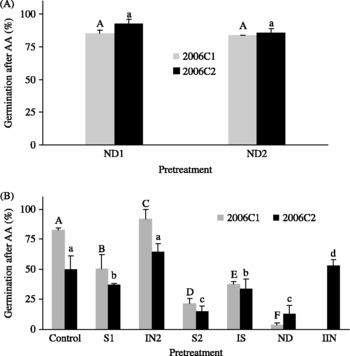
Germination after accelerated ageing showed that vigour of I. hederacea did not change even after 5 months of wet or dry storage. Germination after accelerated ageing of 2 months dry stored (ND1) I. hederacea 2006C1 and 2006C2 seeds (Fig. 3A) was not significantly different from that of 2 (at 35/20°C)+3 (at RT) months dry stored seeds (non-dormant seeds stored for an additional 3 months dry at RT, ND2).
Germination at 30/20°C following accelerated ageing of I. hederacea 2006C1 and 2006C2 (A) and of I. lacunosa 2006C1 and 2006C2 (B) seeds.

Germination of the two seed lots of I. lacunosa after AA showed that wet storage reduced the vigour more rapidly than dry storage. Germination of seeds stored wet for 2 (induced sensitive, S1) and 5 (induced sensitive, S2) months was much lower (50 and 21%, respectively) than that of freshly collected seeds (control) (82%) and that of seeds stored dry for 2 months at RT (insensitive, IN2, 92%). Germination of 5 months wet stored seeds (sensitive seeds, S2; 21%) was lower than that of 5 months dry stored seeds (moderately sensitive, IS; 37%) (Fig. 3B) after the AA test. Further, germination of the 2006C2 seed lot after AA showed that reduction of vigour was slowed or regained when wet stored seeds were stored dry for another 3 months. Three months dry storage after 2 months wet storage (induced insensitive, IIN) of 2006C2 seeds increased germinability (53%) in the AA experiment compared to 2 months wet stored seeds (induced sensitive, S1) (37%). However, 3 months dry storage of non-dormant seeds resulted in the lowest vigour.
Conductivity
Conductivity experiments showed that vigour of I. hederacea seeds was not reduced even after 5 months wet or dry storage. Conductivity of 2 months dry stored (ND1) I. hederacea 2006C1 and 2006C2 seeds did not differ significantly from 2 (at 35/20°C to make seeds permeable)+3 (at RT) months (ND2) dry stored I. hederacea 2006C1 and 2006C2 non-dormant seeds (Fig. 4A).
Conductivity of leachates of I. hederacea 2006C1 and 2006C2 (A) and of I. lacunosa 2006C1 and 2006C2 (B) seeds at laboratory temperature (22–24°C).

Results of the conductivity test for the two seed lots of I. lacunosa were contradictory. Conductivity of I. lacunosa 2006C1 seeds (Fig. 4B) stored dry for 2 (IN2) or 5 (IS) months did not differ significantly from that of fresh (control) seeds. However, conductivity of 2006C2 seeds (Fig. 4B) was significantly lower for 2 (0.60 dS m− 1 g− 1) and 5 (0.62 dS m− 1 g− 1) months dry stored seeds than for fresh (control, 0.74 dS m− 1 g− 1) seeds. Further, conductivity of 2 (S1) and 5 (S2) months wet stored (0.72 and 0.74 dS m− 1 g− 1, respectively) seeds did not differ from that of the control. Likewise, 3 months dry stored permeable (ND) seeds and 5 months wet stored (S2) 2006C2 seeds did not differ significantly from 2 months wet stored+3 months dry stored (IIN, 0.73 dS m− 1 g− 1) seeds.
Growth of shoot and radicle
Plumule length of seedlings
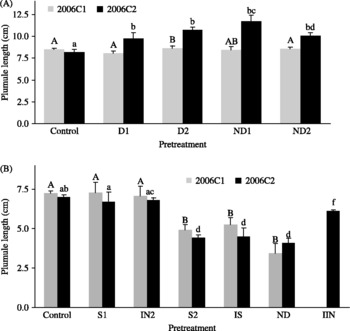
Shoot length of control seedlings of I. hederacea 2006C1 was very similar to that of seedlings following wet [2 months (D1), 5 months (D2)] or dry [2 months (ND1), 5 months (ND2)] storage (Fig. 5A). However, following wet and dry storage, shoot length was greater for I. hederacea 2006C2 seedlings compared to the control. Results of the seedling growth experiment show that wet or dry storage reduced seed vigour; however, 3 months dry storage after 2 months wet storage slowed the rate of vigour loss. Seedling shoot length in I. lacunosa 2006C2 (Fig. 5B) seeds was reduced by 5 months of wet and by 5 months of dry storage, whereas in the 2006C1 seed lot vigour was reduced during the wet storage only. There was no significant difference in shoot length of seedlings produced from seeds stored dry and wet for 2 or 5 months. However, when permeable seeds were stored dry (2 months wet storage+dipping in boiling water+3 months dry storage, ND) seedling shoot length was less (4.1 cm) than that of those produced from dormant seeds stored wet for 2 months (S1, 6.6 cm) (Fig. 4B). When sensitive seeds (made sensitive by 2 months wet storage of 2006C2) (Fig. 4B) were stored dry for 3 months (2 months wet+ 3 months dry storage, induced insensitive, IIN), seedling shoot length was greater than that of 5 months wet stored (sensitive, S2) or 5 months dry stored (moderately sensitive, IS) seeds.
Plumule length of I. hederacea 2006C1 and 2006C2 (A) and of I. lacunosa 2006C1 and 2006C2 (B) seedlings after 5 days of incubation at 30/20°C.

Root length of seedlings
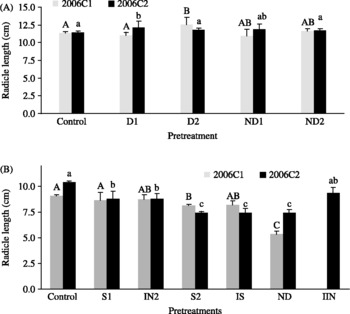
There were only minor significant differences in root length between dry and wet stored 2006C1 and 2006C2 seeds of I. hederacea (Fig. 6A).
Radicle length of I. hederacea 2006C1 and 2006C2 (A) and of I. lacunosa 2006C1 and 2006C2 (B) seedlings after 5 days of incubation at 30/20°C.

Based on seedling root length growth, both dry and wet storage reduced the vigour of I. lacunosa seeds. However, vigour loss was regained or slowed in seeds dry stored for 3 months after they were wet stored for 2 months. Seedling root length of both 5 months wet and 5 months dry stored (moderately sensitive) I. lacunosa 2006C1 and 2006C2 seeds (Fig. 6B) was significantly lower than that of the control (9.0 cm and 10.4 cm, respectively). Storage of permeable (2 months wet stored+dipping in boiling water+3 months dry stored, ND) 2006C1 and 2006C2 seeds reduced root length of seedlings dramatically (5.3 cm and 7.4 cm, respectively) compared to control, and the difference between wet [(2 months (S1) and 5 months (S2))] and dry storage [2 months (IN2) and 5 months (IS)] of dormant seeds was significant (Fig. 5B). Root length of seedlings from dry stored sensitive 2006C2 seeds (2 months wet stored+3 months dry stored, IIN) was not significantly different (9.4 cm) from that of seedlings from control seeds (10.4 cm).
Dry mass
Neither wet nor dry storage of I. hederacea 2006C1 and 2006C2 seeds reduced dry mass of seedlings significantly (data not shown). Although wet and dry storage of I. lacunosa 2006C1 and 2006C2 seeds did reduce dry mass of seedlings (data not shown), the difference was not significant due to large standard errors.
Imbibition of sensitive and of insensitive seeds made nondormant
Sensitive and insensitive seeds of both species took up water at about the same rate after they were made permeable. I. lacunosa sensitive (S1) and insensitive (IN2) seeds increased 112 ± 12% (fresh mass basis) and 105 ± 19%, respectively, in mass, whereas I. hederacea sensitive (D2) and intermediate sensitive (D1) seeds increased 172 ± 23% and 181 ± 18%, respectively.
Discussion
Five methods of seed vigour assessment were used in this study: accelerated ageing, conductivity of seed leachates, plumule and radical growth of seedlings and dry mass increment of seedlings. Except for the conductivity test and the dry mass test, all of the seed vigour measurements followed a similar trend for both collections of both species.
I. hederacea seeds had higher vigour than those of I. lacunosa. Vigour of I. hederacea seeds did not change even when they were made permeable and then stored dry (ND1 and ND2). In contrast, permeable seeds of I. lacunosa lost vigour rapidly when they were stored dry. Gomes et al. (Reference Gomes, Chandler and Vaughan1978) studied change in vigour of seeds of I. lacunosa and of I. hederacea during storage. However, they did not break physical dormancy before the vigour tests were done; thus, their results are confounded with dormancy.
All of the vigour tests suggest that when permeable [2 months wet storage+dipping in boiling water+2 months dry storage (ND)] seeds of I. lacunosa are stored dry, they lose vigour dramatically. All of the vigour tests, except conductivity, showed that the sensitive seeds of I. lacunosa stored wet (induced sensitive, S2) or insensitive seeds stored dry (2 months+3 months dry storage, IN2) lost vigour at a slower rate than permeable seeds (ND). However, when 2 months wet stored seeds (sensitive, S1) were stored dry for more than 3 months (IIN), rate of vigour loss was reduced significantly. Likewise, insensitive seeds (control or IN2) had consistently higher vigour than sensitive seeds or non-dormant seeds. Therefore, vigour tests showed that I. lacunosa seeds can maintain high vigour when they are in the insensitive stage.
In the conductivity test, lowest conductivity or highest vigour was observed for 2 months (IN2) and 5 months (IS) dry stored seeds for both I. lacunosa seed collections, whereas in other vigour tests 2 months wet+3 months dry stored (IIN) seeds had the highest vigour. Since these seeds are in different stages of dormancy, the sensitivity of the seed coat to water movement may be different. Therefore, we speculate that there is always a resistance to leaching. In which case, some seeds remained completely dormant (impermeable), while others began to imbibe water early or late during the soaking period. Thus, we suggest that not all the seeds used in this experiment leached for the same time or at the same rate. We tried to reduce this error by removing the weight of dormant seeds from final conductivity calculations. However, the different trend in the conductivity results compared to that of the other vigour tests may be due to these variable levels of permeable versus impermeable seeds during the soaking period. Although the same trend as seen in other vigour tests was observed in the increment of dry mass test, it was not supported statistically due to high variation between samples.
In I. lacunosa, initial vigour of the two seeds lots was different. The 2006C2 collection had high initial vigour as indicated by all vigour tests except conductivity. The conductivity results may have been affected in the same way as discussed above. Due to these initial differences, the 2006C2 collection always had a lower rate of deterioration during storage as expected (TeKrony and Egli, Reference TeKrony and Egli1991). Initial vigour of the two seed lots of I. hederacea did not differ. It seems that seeds of this species are capable of maintaining a high quality throughout the growing season.
Although I. lacunosa seeds are impermeable to water, a difference in moisture content was observed between sensitive and insensitive seeds. Sensitive seeds of I. lacunosa had the highest moisture content in all treatments used in our experiments. Although the difference between moisture content of sensitive and insensitive seeds was less than 0.5%, sensitive seeds had the capability to absorb moisture at both 35 and 25°C and thus to increase their MC by as much 2% (1.8 ± 0.6%, based on 25 individual seeds; Jayasuriya et al., Reference Jayasuriya, Baskin, Geneve and Baskin2009c). There were no differences in moisture content between impermeable and permeable seeds of I. hederacea. Formation of slits in the bulges (i.e. dormancy break) of I. hederacea seeds occurs in response to water loss from the seeds (Jayasuriya et al., Reference Jayasuriya, Baskin, Geneve and Baskin2009b), whereas in I. lacunosa formation of the slits occurs in response to water absorption (Jayasuriya et al., Reference Jayasuriya, Baskin, Geneve and Baskin2009c). Although there was a small increase in mass when sensitive seeds of I. hederacea were immersed in water, water does not enter into the seed; it gets into the hilar pad only (Jayasuriya et al., Reference Jayasuriya, Baskin, Geneve and Baskin2009b). In sensitive seeds of I. lacunosa, a small amount of water (about 2%) enters into the seed through the hilar fissure (Jayasuriya et al., Reference Jayasuriya, Baskin, Geneve and Baskin2009c). Therefore, moisture content is higher in sensitive I. lacunosa seeds than it is in insensitive seeds of this species and in sensitive and permeable (stored dry) I. hederacea seeds.
In most models predicting seed deterioration, moisture content has to be >20% to obtain a high rate of deterioration in most species (Copeland and McDonald, Reference Copeland and McDonald2001). When moisture content exceeds the 20% limit, seeds of most species enter the glass state from the porous glass state. In the glass state, seed moisture content is high enough to drive several enzymatic reactions at a slow rate. The Maillard reaction is an important cause of seed deterioration. In sensitive (11–16% theoretical maximum, not the observed) seeds of I. lacunosa, moisture content is only 2% (theoretical maximum) higher than that in insensitive seeds (9–14%) of this species and in dormant sensitive and non-dormant I. hederacea seeds. Although there may be some chemical compositional differences between I. lacunosa and I. hederacea that can affect the rate of deterioration, we suggest that there is no difference between sensitive and insensitive seeds of I. lacunosa. The vigour of Vigna radiata seeds starts to decrease at a rapid rate when they are stored at 20% moisture content (dry mass basis; = 16% wet mass basis) (Murthy et al., Reference Murthy, Kumar and Sun2003). This shows that seeds of some species are more sensitive to moisture content than others. We suggest that I. lacunosa may be such a species. Perhaps there are mechanisms involved in loss of vigour in I. lacunosa sensitive seeds in addition to those observed in this study.
These results show that sensitive and permeable seeds of I. lacunosa lose vigour at a faster rate than insensitive seeds of this species. Further, plumule and radicle lengths of induced insensitive (2006C2) seeds were greater than those of sensitive seeds, suggesting that seed vigour increased after sensitive seeds became insensitive. Copeland and McDonald (Reference Copeland and McDonald2001) stated that seeds cannot regain vigour after it is reduced. However, seed performance can be improved up to its maximum potential by using different seed treatments. Thus, we suggest that the observed increment of plumule and radicle length in induced insensitive seeds is due to improvement of seed performance up to its maximum level during dry storage. Although vigour cannot be regained during cycling of sensitivity, maintaining seeds in the insensitive state allows them to retain their high vigour.
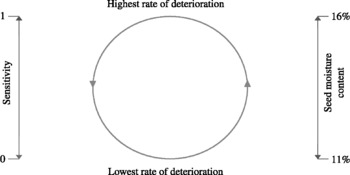
The relationship between sensitivity level, moisture content and vigour loss (deterioration rate) is shown in Fig. 7. It shows that deterioration rate is lowest when both seed MC and seed sensitivity to dormancy release are lowest, and that when seed sensitivity is low seed MC is also low. In summary, I. hederacea seeds have higher vigour than those of I. lacunosa, and I. hederacea seeds lose vigour at a slower rate than those of I. lacunosa. Sensitive seeds of I. lacunosa lose vigour more rapidly than insensitive seeds. Although both sensitive and insensitive seeds of I. lacunosa are water impermeable, sensitive seeds can absorb small amounts of water, whereas insensitive seeds cannot. Therefore, sensitive seeds of I. lacunosa have a slightly higher moisture content than insensitive seeds. When sensitive seeds revert to the insensitive stage, rate of vigour loss is reduced considerably (Fig. 7). This reduction is even much lower than that of the moderately sensitive seeds stored in dry conditions. Therefore, maintaining the insensitive stage until the appearance of favourable conditions for germination and reverting back to the insensitive stage with the onset of unfavourable conditions is an advantage to a species such as I. lacunosa that produces a physically dormant seed with relatively low initial vigour.
Conceptual model of change in rate of I. lacunosa seed deterioration (vigour loss rate) as influenced by moisture content and level of sensitivity.

A high proportion of I. lacunosa seeds is maintained in the insensitive state for long periods, and these are the seeds that make up the permanent soil seed-bank (Jayasuriya et al., Reference Jayasuriya, Baskin and Baskin2008a; Jayasuriya, unpublished data). Therefore, we suggest that sensitivity cycling is important in maintaining the vigour of I. lacunosa seeds in addition to allowing them to germinate at the appropriate time for subsequent seedling development. Maintenance of seed vigour is important in establishment, within a short period of time, of a healthy plant that can tolerate harsh environmental conditions. Furthermore, it is of utmost importance in species such as I. lacunosa that can form a long-lived seed-bank (Toole and Brown, Reference Toole and Brown1946; Egley and Chandler, Reference Egley and Chandler1983).
Acknowledgements
We thank Mrs Marcella Rucker, Department of Plant and Soil Sciences, University of Kentucky, for helping with the vigour experiments.