Introduction
Volumetric-modulated arc radiotherapy (VMAT) is a high-end novel radiotherapy technique that delivers modulated radiation beams with simultaneous adjustment of dose rate, gantry speed and multi-leaf collimator (MLC). Reference Bedford1,Reference Otto2 The superiority of VMAT over fixed gantry intensity-modulated radiotherapy (IMRT) in terms of dose conformity, OAR sparing and treatment time in various cancer sites, including the prostate, has been established in many studies. Reference Bedford1,Reference Cozzi, Dinshaw and Shrivastava3–Reference Yoo, Wu, Lee and Yin8 RapidArc® (Varian Medical Systems, Palo Alto, CA) is a novel technique for delivering a highly focused VMAT that was approved for clinical use in 2008· Reference Otto2 In this era of precision radiation oncology, VMAT is routinely used to treat various sites, including prostate carcinoma.
Although VMAT increases dose uniformity in the target volume, few limitations of this technology have also been reported. The MLC leaves of the Varian Trilogy linear accelerator moves on a carriage with a maximum leaf span of 15 cm. Therefore, MLC in Varian linear accelerators inherits a mechanical limitation when the field size is typically more than 15 cm along the transverse direction, resulting in relatively unsatisfactory dose distribution in the planning target volume (PTV) region.
Vieillot et al. first reported that the RapidArc field size should be restricted to 15 cm in the x-direction. However, they did not conduct additional experiments to confirm the findings. Reference Vieillot, Azria and Lemanski9 Later, Huang et al. stated that if the field size is set to 15 cm, the fields can be modulated from both sides of the MLC. This leads to a higher degree of freedom for the modulation to achieve better optimisation. If the field size is larger than 15 cm in the X-jaw direction, some regions within the field can be reached by one side of the MLC, which restricts adequate modulation. Therefore, the X-jaw should be limited to 15 cm or less to obtain superior target dose coverage and OAR sparing. Reference Huang, Fang and Huang10
Zhang et al. investigated two VMAT techniques: open and limited X-jaw for patients with nasopharyngeal carcinoma. The usual field size along the X-jaw was more than 15 cm. Reference Zhang, Lu and Chen11 . In the open X-jaw technique, the jaw width was set to adequately cover the target volume. The fields created were typically extended to more than 15 cm of MLC limitation, which resulted in reduced modulation. The advantage of the limited X-jaw technique is that the jaw width is limited to 15 cm, resulting in improved modulation, target dose distribution and OAR sparing. The disadvantage of this technique is that some regions of the PTV remain outside the field. They concluded that the limited-jaw strategy resulted in similar or slightly superior target coverage. However, the OARs were also spared more effectively with more MUs (monitor units) and equivalent treatment times. Reference Zhang, Lu and Chen11
Keil et al. used the split X-jaw planning technique to further improve endometrial cancer planning. In the split X-jaw method, the open field was divided into two separate fields overlapping each side. Thus, the four treatment arcs covered the target PTV. Because each field was restricted to 15 cm in the X-jaw direction, it provided more modulation opportunities. The split technique resulted in better target dose coverage, more plan conformity and better OAR sparing than the limited and open techniques. Reference Keil, Carda, Reihart, Seidel, Lenards and Hunzeker12
Prostate cancer is the second most common malignancy in men worldwide, with approximately 1·4 million cases diagnosed in 2020· Reference Sung, Ferlay and Siegel13 In the past decades, external beam radiotherapy (EBRT) has been widely used as a primary management modality for prostate cancer. Various aspects of EBRT for prostate cancer have evolved, and VMAT is now the most commonly used technique worldwide for its management. When the PTV comprises primary and regional nodal areas, the field size along the X-jaw direction becomes more than 15 cm. The present study is the first of its kind to investigate the benefits of the split X-jaw VMAT planning technique in prostate cancer radiotherapy.
Methods
Patient selection and simulation
The computed tomography (CT) data sets of 15 patients with pathologically confirmed prostate carcinoma who received treatment at our institute were included. The patients were consecutively selected based on the criteria where an X-jaw width of 18 cm or more was required to adequately cover the PTV. The simulation was performed in the supine position using VacLok immobilisation with arms over the chest. Three reference points with fiducials were created for setup reproducibility, and the centre was tattooed. The CT simulation was performed using a Philips Brilliance Big bore CT (Phillips Medical Systems Nederland B.V. Veenpluis, The Netherlands) machine with intravenous contrast and 3 mm slice spacing. All patients were simulated following a similar institutional bladder and bowel protocol.
Radiotherapy planning: techniques and objectives
CT images were transferred to the Eclipse V 15·6 treatment planning system (Varian Medical Systems, Inc. Palo Alto, CA, USA) for contouring and planning. A single radiation oncologist performed the target delineation, and the clinical target volume (CTV) of the prostate was performed according to the ESTRO-ACROP consensus guideline. Reference Salembier, Villeirs and De Bari14 Another two radiation oncologists subsequently reviewed the contours. The CTV of the draining nodal areas was also contoured. A uniform three-dimensional 7 mm margin was applied to the CTV to obtain the final PTV. The prescription dose was 4500 cGy in 25 fractions to the PTV, covering the primary and nodal areas for all treatment plans. The boost PTV was not taken into consideration.
Three separate treatment plans were generated for each patient: open, limited and split X-jaw planning techniques.
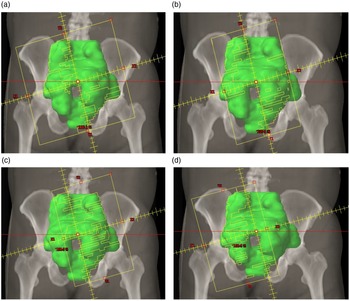
Two coplanar arcs (clockwise from 181° to 179° and counter-clockwise from 179° to 181°) were used for the open and limited field techniques. The collimator angles were 15° and 345° to reduce the tongue-and-groove effect contribution to the dose. The X-jaw was expanded to cover the entire PTV using the Eclipse Arc Geometry Tool in the open technique (Figure 1a). In the limited X-jaw method, the same isocenter was used to restrict the X-jaw width to a symmetric 15 cm (X1 = + 7·5, X2 = −7·5) (Figure 1b).
(a) In the open technique, the X-jaw was expanded to encompass the entire target volume using Eclipse Arc Geometry Tool; (b) the limited X-jaw method utilised the same isocentre with restriction of the total X-jaw expansion to a symmetric 15 cm (X1 = +7·5, X2 = −7·5); (C, D) the split method was created by using the Eclipse Arc Geometry Tool to expand the X-jaws to cover the entire PTV and duplicating resulting in 4 arcs. X-jaw for arcs was then adjusted so that the maximum X-jaw opening was 15 cm for both the arcs.

In the split X-jaw technique, treatment fields consist of four arcs, two in the clockwise (CW, 181° to 179°) and two in the counter-clockwise (CCW, from 179° to 181°) direction. First, two coplanar arcs (CW and CCW) were generated using the arc geometry tool of the Eclipse TPS. The entire PTV was covered with an X-jaw opening, keeping collimator angles at 15o and 345o. Second, both the arcs were duplicated and renamed as 1·0 and 1·1 for CW arcs and 2·0 and 2·1 for CCW arcs, respectively. The X-jaw for CW arcs was then adjusted by reducing x2 and x1 of arc 1·0 and 1·1, respectively, so that the maximum X-jaw opening remains at 15 cm for both arcs (Figure 1c and 1d).
Similarly, the same procedure was followed for CCW arcs. Although four arcs were used, the open fields were divided into two halves, each limited to 15 cm. This covered the entire PTV, as in the open field, but provided the opportunity for more plan modulation due to the X-jaw restriction.
For all the plans, dose calculation and optimisation were performed using the Eclipse TPS using a 6 MV photon beam for a Varian Trilogy linear accelerator equipped with a Millennium 120 MLC (MLC 120). Equivalent optimisation objectives were maintained to reduce the dosimetric variability for plan comparison. The width of the central 20 cm MLC projected at isocenter was 5 mm, whereas the width of the outer 20 cm leaf was 10 mm with a leaf transmission factor of 0·0145 for 6 MV photons. The maximum dose rate was 600 MU/min, and the dose calculation was carried out using an anisotropic analytical algorithm and 2·5 mm grid spacing.
PTV planning objectives were set as follows: at least 97% of the PTV volume was covered by 97% of the prescription dose, and less than 1% of the PTV volume received 107% of the prescribed dose.
The dose–volume histogram (DVH) parameters evaluated for OARs were as follows: percentage of bowel bag and rectum receiving a dose of 40 Gy (V40), percentage of the urinary bladder that received 45 Gy (V45) and percentage of the femoral heads that received 35 Gy (V35). The planning objectives for the above OARs were set as follows: V40 (bowel bag) < 30%, V40 (rectum) < 60%, urinary bladder V45 < 35% and femoral heads V35 < 15%. The base plan was first created using these objectives with the open method, as it had the minimum opportunity for modulation. The same optimisation parameters were used for the limited and spit X-jaw plans without modifications.
Plan evaluation and comparison
The cumulative DVH calculated for each plan was used for the quantitative evaluation. For the PTV, the dose received by 98% (D98%) and the dose received by 2% (D2%) were kept as measures for minimum and maximum doses and reported. V97 is the target volume, defined as a percentage (%) covered by 97% of the prescription dose.
The plans were primarily evaluated for target coverage and plan conformity using the conformity index (CI). The CI was calculated by taking the ratio of the volume of the target enclosed by 95% of the reference isodose lines (TV95%) to the total PTV (VPTV). Reference Shaw, Kline and Gillin15,Reference Atiq, Atiq, Iqbal, Shamsi, Andleeb and Buzdar16 A CI value of 1·0 indicates the ideal level of plan conformity.
 $${\rm CI} = {{{T{V_{95\% }}}} \over {{{V_{PTV}}}}}$$
The homogeneity index (HI) is an objective tool to determine the dose uniformity in the target volume. This was calculated using the following formula: Reference Hodapp17
 $$\rm HI = {{{\left( {{{\rm{D}}_{2{\rm{\% }}}} - {\rm{\;}}{{\rm{D}}_{98{\rm{\% }}}}} \right)}} \over {{{{\rm{D}}_{50{\rm{\% }}}}}}}$$
Statistical analysis
The data were tested for normality, and we observed that normality assumptions were meet. A t-test was used to compare the parameters among the different techniques. Statistical calculations were performed using Microsoft Office Excel 2019 and GraphPad Prism version 8·3·1. The results were reported as mean ± standard deviation. Statistical significance was set at P < 0·05.
Results
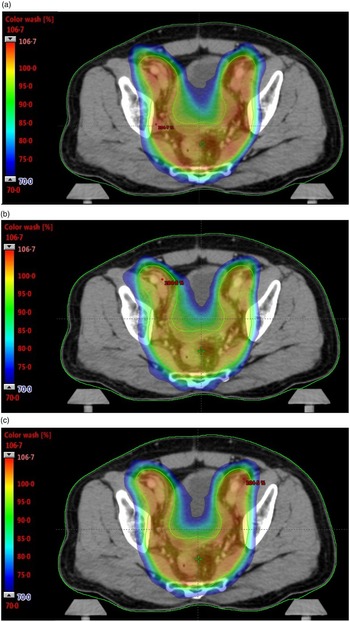
Fifteen patients were included in the present study, and 45 plans were generated. Figure 2 depicts the isodose distribution and comparison among the three different treatment techniques for one patient.
Visual images of an isodose wash obtained using the open technique (a), the limited technique (b) and the split technique (c).

Target coverage, conformity and homogeneity
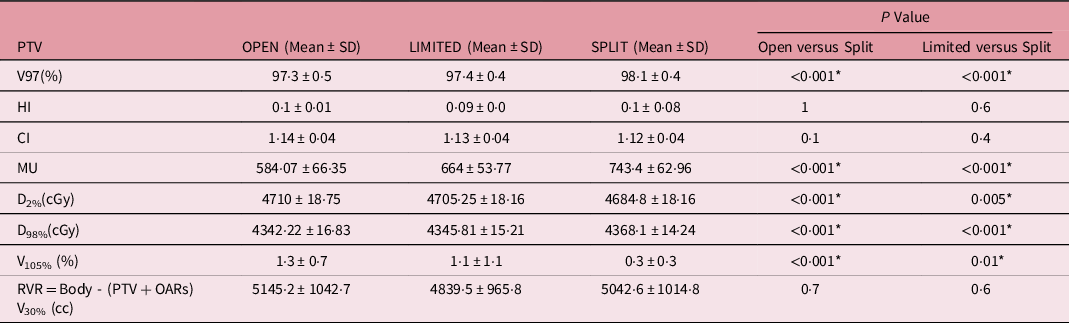
All three planning methods could achieve the target dose objective that at least 97% of the PTV volume should be covered by 97% of the prescribed dose. Dosimetric comparisons of target coverage are shown in Table 1. The target coverage of PTV (V97%) of the three treatment modalities was 97·3 ± 0·5, 97·4 ± 0·4 and 98·1 ± 0·4 for open, limited and split techniques, respectively. The split X-jaw technique resulted in statistically significant superior PTV coverage when compared with open (P < 0·0001) and limited techniques (P < 0·001). D2% (cGy), which is the measure of the maximum dose, was lowest for the PTV in the split technique (4684·8 ± 18·16) and highest for the open procedure (4710 ± 18·75).
Comparison of target coverage for different techniques

Notes: *Statistically significant.
Abbreviations: SD: standard deviation, HI: homogeneity index, CI: conformity index, MU: monitor unit, RVR: remaining volume at risk.
D2%(cGy) was significantly reduced with the split technique when compared with the other two techniques (P < 0·05).
In all the techniques, 107% of the prescribed dose was restricted to less than 1% of the volume. When compared with the value of V105%, the split method was found to be statistically superior to the open (P < 0·001) and limited techniques (P = 0·005). All the methods showed equivalent plan conformity with a similar range and comparable HI (p > 0·05).
OAR sparing and MU
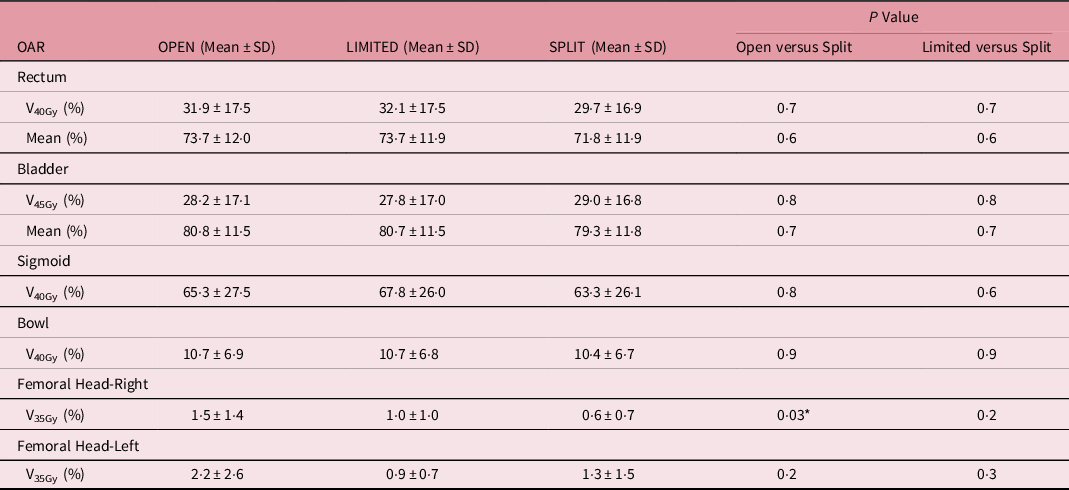
In OAR sparing, all the techniques achieved the plan objectives, as stated earlier. Table 2 shows the dose–volume parameters of the OARs with different planning techniques. In most OARs, the split approach delivered a lower dose, although statistical significance could not be achieved. The split method showed significantly better sparing when compared with the open technique only in the case of dose to the right femoral head (p = 0·03).
Comparison of OAR sparing for different techniques

*Statistically significant.
Abbreviations: OAR: organ at risk.
The value of mean MUs reflects the modulation of the plans. As the ability of modulation in a plan increases, the MUs also increase. Reference Teoh, Clark, Wood, Whitaker and Nisbet18 In this study, the average MU of the plans was the highest with the split technique (743·4 ± 62·96), intermediate in the limited (664 ± 53·77) and lowest with the open technique (584·07 ± 66·35). The difference in the MUs between the plans was statistically significant (p < 0·05).
Discussion
This retrospective dosimetric study was carried out to determine whether the split X-jaw planning technique for the Varian Trilogy linear accelerator improves the plan quality for PTVs in which the required field size is larger than 15 cm in the X-jaw direction. As already stated, the maximum MLC leaf span in the Varian Trilogy linear accelerator in the X-jaw direction is 15 cm; therefore, there is a relatively unsatisfactory dose distribution in the PTV region in the traditional open and limited-jaw technique. Keil et al. first reported the use of the split X-jaw planning technique in patients with endometrial cancer. They concluded that the split X-jaw method could be used with Varian linear accelerators to achieve superior VMAT plans. Reference Keil, Carda, Reihart, Seidel, Lenards and Hunzeker12 Our study aimed to investigate the advantage of the split X-jaw technique in VMAT planning for prostate cancer.
Although all the planning techniques could achieve adequate PTV coverage, split X-jaw planning achieved the maximum target dose with a statistically significant difference compared to the open and limited techniques (p < 0·001). This is because, in the split technique, each open field is divided into two arcs with field sizes restricted to 15 cm; therefore, the entire PTV remains within the fields during the entire course of treatment delivery, resulting in superior dose distribution. In the limited X-jaw technique used by Zhang et al., the X-jaw was restricted to 15 cm. Hence, a portion of the PTV remains partially uncovered, resulting in relatively poor dose distribution. Reference Zhang, Lu and Chen11 In the open technique, although the entire PTV is covered with the jaw, modulation is compromised as MLCs suffer from mechanical limitations. In our study, the indices of maximum dose, such as D2% and V105%, were the lowest with the split technique. The difference was statistically significant compared with the open and limited approaches (P < 0·05).
Regarding OAR sparing, all the techniques in this study achieved the target objectives. The split strategy delivered a relatively lower dose to many OARs, as shown in Table 2, but the difference did not reach statistical significance. The dose to the right femoral head was significantly lower in the split technique than in the open technique (p = 0·03). The study by Keil et al. achieved statistically better OAR sparing in most structures.
A critical aspect of the split X-jaw planning technique is that it has four treatment arcs compared to two in open and limited methods. Because of the increased arcs, the plans in the split approach usually have more MUs, resulting in increased treatment time. Similar results were achieved in this study, where the average MUs were maximum with the split technique. The increase in MUs leads to low-dose spillage to the surrounding normal tissue, subsequently increasing the risk of secondary malignancies. Reference Teoh, Clark, Wood, Whitaker and Nisbet18 Therefore, it can be considered as a potential disadvantage of the split technique. However, in our study, the mean V30% (cc) of the remaining volume at risk (RVR) (Body-(PTV + OARs)) in the split technique (5042·6 ± 1014·8) was still less than that of the open technique (5145·2 ± 1042·7) (p = 0·8). Although the V30% (cc) of the RVR of the split technique was higher than that of the limited technique, the difference was not statistically significant (p = 0·6). Therefore, there is no additional concern regarding secondary malignancy with the split planning method despite more treatment arcs and MUs.
Conclusion
In the Varian Trilogy linear accelerator, the maximum leaf span of the MLC was 15 cm. Therefore, the VMAT plans of PTVs requiring an X-jaw width of more than 15 cm with the traditional open X-jaw technique resulted in relatively poor target coverage. For improvement, Zheng et al. described the limited X-jaw technique, where the X-jaw was limited to a symmetrical 15 cm width. Reference Zhang, Lu and Chen11 This resulted in partially uncovered areas in the PTV, leading to suboptimal modulation. Both these techniques had a scope of improvement, and Keil et al. used the split X-jaw planning technique. It divides each open field into two arcs and restricts the field sizes to 15 cm, resulting in benefits over open and limited planning techniques. Reference Keil, Carda, Reihart, Seidel, Lenards and Hunzeker12
In the current study, we observed a superior dose distribution to the target volume using the split technique. Although not statistically significant, OAR sparing was superior to the split method. Increased MUs are a concern with the split technique. However, comparable low-dose spillage removes the additional concerns of second malignancies. Therefore, it can be concluded that the split X-jaw planning is superior to the traditional open X-jaw and limited X-jaw techniques for VMAT planning in Varian Trilogy machines for PTVs requiring X-jaw widths of more than 15 cm.
The present study has few limitations, including the small sample size. Although our study showed statistically significant superiority of the split technique over open and limited in terms of target coverage, it failed to show a considerable difference in OAR sparing. However, based on the results of Zheng et al., Keil et al. and the present study, it can be recommended that the split X-jaw techniques of VMAT planning can be optimal for sites where the field sizes are usually larger than 15 cm in the x-direction. Moreover, a comparative study between limited X-jaw and split X-jaw planning methods in a larger sample size is warranted to determine the optimal one.
Acknowledgements
Author contribution
All authors contributed to the conception or design of the work, the acquisition, analysis or interpretation of the data. All authors were involved in drafting and commenting on the paper and have approved the final version.
Financial support
This research did not receive any specific grant from funding agencies in the public, commercial or not-for-profit sectors.
Conflicts of interest
The authors declare that they have no known competing financial interests or personal relationships that could have appeared to influence the work reported in this paper.
Ethical standards
Institutional Ethics Committee approved the study; BBCI Medical Ethics Committee (Registration No: ECR/1040/Inst/AS/2018).