INTRODUCTION
Post-mastectomy radiation therapy (PMRT) significantly reduces locoregional recurrence (LRR) rates and improves overall survival in patients with high-risk breast cancer.Reference Horst, Haffty and Harris 1 – Reference Ma, Li and Xie 3 The dose regimen for PMRT is usually 50 Gy to the chest wall (CW) followed by additional 10–16 Gy to the surgical chest wall scar, especially for patients with close or positive mastectomy margins and large (i.e., ≥5 cm) tumours.Reference Jagsi 2 , Reference Rong, Yadav and Welsh 4 The most common treatment planning technique is opposed tangential megavoltage photon fields for the CW and an en face electron field for the scar boost.Reference Jagsi 2 While various treatment planning options such as electron beam only, combined photon-electron beams, proton therapy, intensity modulated radiation therapy or volumetric modulated radiation therapy have been used for CW irradiation,Reference Gez, Ashaf and Bar-Deroma 5 – Reference MacDonald, Jimenez and Paetzold 10 the electron beam therapy is still the most common and preferred technique for scar boost irradiation because of the simplicity of treatment and the easy setups,Reference Vijayaprabhu, Gunaseelan and Vivekanandan 11 despite the availability of simultaneous integrated boost or high-dose rate treatments.Reference Rong, Yadav and Welsh 4 , Reference Vijayaprabhu, Gunaseelan and Vivekanandan 11
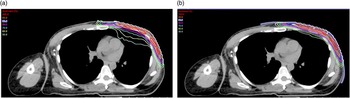
However, one of the disadvantages of this en face electron field treatment technique is the radiation dose delivered to the underlying normal lungs, which can result in acute radiation induced toxicity such as radiation pneumonitis (RP).Reference Perkins, McNeese and Antolak 7 , Reference Goldman, Anderson and Wennberg 12 , Reference Chung, Yoon and Kim 13 Hence, minimising dose to underlying normal lungs is critical to avoiding acute lung toxicity in breast cancer patients undergoing PMRT. The risk of RP is strongly associated with the irradiated lung volume and the V20 (relative lung volume receiving more than 20 Gy).Reference Chung, Yoon and Kim 13 , Reference Mehta 14 Mehta showed an increase in the incidence of RP with increasing V20 with radiotherapy alone, and a sharper increase in risk of RP with the addition of chemotherapy to radiotherapy in non-small-cell lung cancer.Reference Mehta 14 However, minimising the irradiated lung volume is very challenging in breast cancer patients, especially in patients with a thin chest wall, which usually results in unfavourable outcome (i.e., V20>30%). Therefore, in high-risk breast cancer patients undergoing PMRT, additional radiation to the underlying lungs during scar boost treatment is unavoidable even using the lowest electron energy (Figure 1a).
Dose distributions of 6 MeV electron beam for scar boost treatment of a thin chest wall (a) without a bolus and (b) with a 5 mm bolus at 100 cm source-to-surface distance for 20×20 cm2 field size. The chest wall is about 1·6 cm thick.

A common technique employed to reduce lung dose during the scar boost treatment is to use a bolus with the lowest available electron energy (Figure 1b). Although the use of a bolus reduces the dose to the underlying lungs with the added benefit of uniform dose distributions across uneven skin surfaces, it can also significantly increase the dose to the skin.Reference Rong, Yadav and Welsh 4 , Reference Perkins, McNeese and Antolak 7 , Reference Ordonez-Sanz, Bowles and Hirst 15 Hence, the use of a bolus can exacerbate the acute skin erythema after chest wall irradiation, potentially also increasing late telangiectasia and thus compromising the cosmetic outcome following mastectomy. Moreover, irregular skin surfaces created after mastectomy can cause an air gap between bolus and skin which can lead to the overestimation of the radiation dose during electron scar boost irradiation.Reference Khan, Doppke and Hogstrom 16
Hence, another technique employed to reduce radiation dose to the lungs is to use lower electron energies. However, in most clinical settings, the lowest electron energy is usually 6 MeV and lower energies below 6 MeV are not selected for commissioning because they are rarely ever used for treatment. In order to address this dilemma, one approach is to degrade the electron energy beam, similar to an energy degrader in total skin electron therapy (TSET), thus allowing the use of lower energy electrons without commissioning them. In TSET, a 1 cm degrader generally made of acrylic (density of about 1·18 g/cm3) is placed about 20 cm in front of a patient to reduce radiation dose to visceral organs and to improve dose uniformity.Reference Karzmark, Anderson and Fessenden 17 To our knowledge, there has been no prior study to utilise this technique for PMRT. For this technique, various energy degraders such as solid water slabs or Lucite can be used to reduce lung dose during scar boost irradiation. Of those, solid water slabs are water-equivalent, readily available and unlike a commercial bolus, various thicknesses from 1 to several mm can be easily achieved. Therefore, in our study, we evaluated water-equivalent slabs as an alternative option to reduce lung dose for post-mastectomy scar boost treatment in breast cancer patients with a thin chest wall. Clinical physics data were obtained for various thicknesses of water-equivalent slabs to degrade 6 MeV electron energy beam. In addition, scatter dose to the contralateral breast was measured on a human-like phantom with patient setups of scar boost treatment.
METHODS
Percent depth doses with solid water slabs
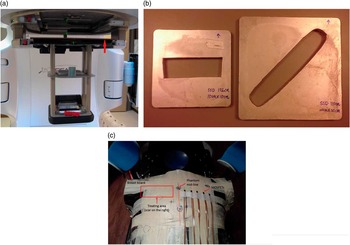
The percent depth dose (PDD) profiles of 6 MeV electron beam were measured at 100 cm source-to-surface distance (SSD) for 10×10, 15×15, 20×20 and 25×25 cm2 electron cones using a water tank (IBA Dosimetry, Schwarzenbruck, Germany) and ion chambers (CC13; IBA Dosimetry) on the TrueBeamTM (Varian Medical System Inc., Palo Alto, CA, USA) during annual quality assurances (QAs). Then the depth dose profile measurements were repeated with 1–10 mm (by 1 mm increments) solid water slabs (30×30 cm2, Virtual WaterTM; CNMC Company Inc., Nashville, TN, USA) placed on top of the same electron cones in the same setups (Figure 2a). All beam data were collected and analysed using OmniPro-Accept software (IBA Dosimetry).
(a) A solid water slab (red arrow) placed on top of a 10×10 cm2 electron cone to degrade 6 MeV electron energy, (b) electron cutouts of short and long scar patients and (c) phantom setups using setup parameters of a right breast patient with a short scar for scatter dose measurements. Abbreviation: SSD, source-to-surface distance.

Attenuation factors in solid water slabs
Outputs of 6 MeV electron beam were measured in solid water phantoms (30×30×7 cm3, Virtual WaterTM) using an ion chamber (farmer chamber, sensitive volume of 0·6 cm3, PTW, Freiburg, Germany) under standard calibration conditions (10×10 cm2, 100 cm of SSD, 1·3 cm of d max) on the TrueBeamTM. Outputs of 6 MeV electron beam with 1–10 mm solid water slabs placed on top of a 10×10 cm2 electron cone were measured in the same setups. The ratios of outputs with 1–10 mm slabs (by 1 mm increments) to those without the slabs were calculated as attenuation factors. Then monitor unit (MU) calculations were performed using the following equation: MU={prescribed dose (cGy)×100%} ÷ {dose rate under standard calibration conditions (cGy/MU)×PDD (%)×cutout factor×extended SSD factor×attenuation factor}.
Scatter dose to contralateral breast from solid water slabs
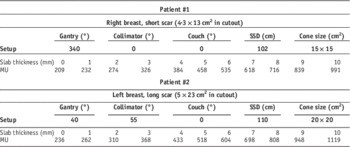
Scatter dose to the contralateral breast was measured on the Rando® phantom (The Phantom Laboratory, Greenwich, NY, USA) using the same setups as in two scar boost patients treated with 10 Gy (2 Gy per fraction). The two patients were selectively picked such that one patient had a short scar (≤15×15 cm2 electron cone size) and the other patient had a long scar (≥20×20 cm2 electron cone size) (Figure 2b) and the patient setup parameters as well as immobilisation were maintained the same for scatter dose measurements on the phantom (Figure 2c) (Table 1). Metal oxide semiconductor field effect transistor (MOSFET) detectors (MobileMOSFET system, TN-RD-70-W; Best Medical Canada, ON, Canada) were placed at every 2 cm from the Rando phantom mid-line up to 10 cm (two detectors per each location) roughly along the centre of breast on the phantom surface (Figure 2c) and MUs calculated using the attenuation factors were delivered for one fraction (Table 1). For each location, average values of two detector readings were taken. Before the measurements, MOSFETs were calibrated under standard calibration conditions for 6 MeV electron energy. Figure 2c shows phantom setups using setup parameters of a right breast patient with a short scar.
Treatment setup parameters and MUs (for 200 cGy) for two scar boost patients

Abbreviations: SSD, source-to-surface distance; MU, monitor unit.
RESULTS
PDDs with solid water slabs
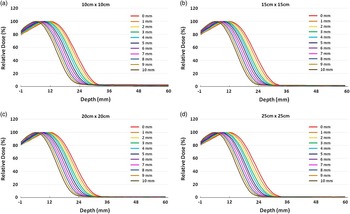
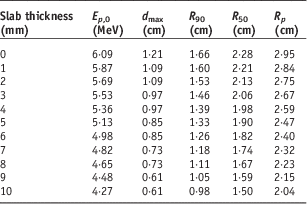
The PDDs of 6 MeV electron beam without slabs and with 1–10 mm slabs for 10×10 cm2 field size are displayed in Figure 3a. With increasing the thickness of the slabs, E p,0 decreases and useful parameters such as d max, R 90, R 50 and R p are shifted towards water surface as shown in Table 2. The mentioned parameters are defined as follows: E p,0 is the most probable energy on the water surface and d max is the depth of dose maximum. R 90 and R 50 are the depths of the 90 and 50% on the electron percentage depth doses beyond d max, respectively. R p is the practical range defined as the depth at which the tangent plotted through the steepest section of the electron depth dose curve intersects with the extrapolation line of the background due to bremsstrahlung.Reference Khan, Doppke and Hogstrom 16 Similarly, the PDDs for 15×15, 20×20 and 25×25 cm2 field sizes without and with the slabs are shown in Figure 3b, 3c and 3d, respectively. Field size dependence on E p,0, d max, R 90, R 50 and R p was minimal.
Percent depth dose profiles of 6 MeV electron beam with 0–10 mm sold water slabs by 1 mm increments at 100 cm source-to-surface distance for (a) 10×10 cm2, (b) 15×15 cm2, (c) 20×20 cm2 and (d) 25×25 cm2 field sizes.

Useful parameters for 6 MeV and its degraded electron energies for 10×10 cm2 field size

At 6 MeV without the solid water slabs, the entire chest wall at about 1·6 cm in depth is well covered with the 90% isodose line calculated using the Monte Carlo algorithm (Figure 1a) and it corresponds to clinical physics data (R 90=1·66 cm) shown in Table 2. In this case, low dose spillage into the deep ipsilateral lung is observed. When a 5 mm bolus (Superflab bolus; Radiation Products Design Inc., Albertville, MN, USA) is used, R 90 covers the chest wall up to about 1·3 cm in depth from skin and irradiated lung volume is considerably reduced (Figure 1b). With a 5 mm slab, similar results (R 90=1·33 cm) would be expected as shown in the physics data obtained in this study (Table 2).
From the PDD data shown in Figure 3, with a 5 mm slab, surface dose is increased by about 3% from 80 (no slab) to 83% (5 mm slab) of the dose at d max for 10×10 and 15×15 cm2 cone sizes while with a 5 mm bolus, skin dose would be increased by about 10% from 80 (no bolus) to 90% (5 mm bolus) of the dose at d max. Similarly, with a 5 mm slab, surface dose is increased by about 1·5% from 81·5 (no slab) to 83% (5 mm slab) of the dose at d max for 20×20 and 25×25 cm2 cone sizes while with a 5 mm bolus, skin dose would be increased by about 9% from 81·5 (no bolus) to 90·5% (5 mm bolus) of the dose at d max.
Attenuation factors in solid water slabs
Attenuation factors of 6 MeV electron beam for various thicknesses (1–10 mm) of solid water slabs normalised to without slabs are tabulated in Table 3. The attenuation factors do not have a linear relationship to slab thickness, but about 50 and 75% of the beams are attenuated by 4·5 and 9 mm slabs, respectively. The attenuation factors were used for MU calculations (Table 1). For example, MU is 458 [={200 cGy×100%} ÷ {1 cGy/MU×100%×0·958 (cutout factor×extended SSD factor)×0·456 (attenuation factor)}] for the right breast patient with a 5 mm slab (Table 1). As a result of attenuation in the slabs, MUs and treatment time are increased with increasing the thickness of the slabs. The use of a 5 mm slab would increast treatment time by about 2·2 times compared with when no slab used (Table 1).
Attenuation factors in solid water slabs normalised to without slabs for 6 MeV electron energy

Scatter dose to contralateral breast from solid water slabs
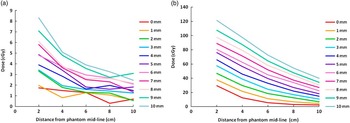
As expected, measured scatter dose to the contralateral breast on the Rando phantom decreases with distance from the phantom mid-line and increases with solid water slab thickness (Figure 4). The short scar patient received scatter dose of 1·76 cGy (0·88%) at 2 cm from the phantom mid-line and 0·69 cGy (0·35%) at 10 cm without the slabs, and 8·32 cGy (4·16%) at 2 cm and 2·46 cGy (1·23%) at 10 cm with a 10 mm slab roughly along the centre of the contralateral breast per 200 cGy of delivered dose to the ipsilateral breast (Figure 4a). Scatter doses between 6 and 10 cm fluctuate due to the very low dose (<2% of the delivered dose to the ipsilateral breast). On the other hand, the long scar patient received quite significant scatter dose of 29·5 cGy (14·75%) at 2 cm from the phantom mid-line and 2·3 cGy (1·15%) at 10 cm without slabs, and 121·5 cGy (60·75%) at 2 cm and 40 cGy (20·00%) at 10 cm with a 10 mm slab per 200 cGy of delivered dose to the ipsilateral breast (Figure 4b).
The scatter dose to the contralateral breast on Randon phantom surface per 200 cGy of delivered dose to the ipsilateral breast as a function of distance from phantom mid-line and thickness of solid water slabs using (a) short scar and (b) long scar patient setups.

DISCUSSION
In our study, we evaluated the capability of solid water slabs in degrading 6 MeV electron energy and consequently, minimising the dose to the lungs during scar boost irradiation. Commercially available solid water slabs have water-equivalent density (1·04 g/cm3) and physical properties such as scatter and attenuation. In order to estimate the thickness of solid water slabs required to reduce the dose to the lungs, clinical data such as PDDs should be obtained. This approach is more practical and less costly than commissioning 4 MeV or lower electron energy beams. It can be performed in a big water tank during annual QAs of a linear accelerator as in this study or it can be simply done using a small two-dimensional water tank that is readily manageable. As commissioning is performed for each linear accelerator, clinical data for solid water slabs should be collected for each treatment machine and used as a look-up table. In addition, the data provided in this study are slab location specific. Therefore, clinical data should be obtained for a specific location and the same location should be maintained during treatment. Also clinical data should be material specific to be used due to its own density. For most scar boost patients, field sizes smaller than 10×10 cm2 are hardly used due to the size of mastectomy scar and thus, PDD data for field sizes smaller than 10×10 cm2 were not acquired in this study.
Dosimetric comparison between bolus and solid water slabs from the PDD data shows that the solid water slabs provide similar dosimetric effects to a bolus for the same thickness but do not boost skin dose to the ipsilateral breast as much as a bolus. Patients who have acute skin erythema after CW irradiation could benefit from the current study. In those instances where our treatment technique may result in a lower dose than the desired dose to the skin (i.e., the mastectomy scar and subcutaneous tissues at high risk of LLR), a bolus can still be used to address this therapeutic concern. The comparison made in this study was for 100 cm SSD. For extended SSD setups, a minimal change in depth dose would be expectedReference Khan, Doppke and Hogstrom 16 and thus, PDD data acquired at the standard SSD are still applicable. Since the results are estimates and comparison from PDDs, more accurate measurements should be made with the slabs in a phantom using a plane-parallel chamber to determine skin dose of the ipsilateral breast.
When solid water slabs are used, attenuation in the slabs must be measured and taken into account in MU calculation to deliver the correct prescribed dose to the mastectomy scar. Instead of separate measurements as that had to be made in this study, the attenuation factors can be measured along with other factors such as cutout factors, inverse square factors, and cone factors. Table 1 shows the MUs calculated using attenuation factors for two different scar boost patient setups (Table 3). Although increased MUs and consequently, prolonged treatment time is a disadvantage of using the slabs, about 1 min (518 MUs ÷ (500 MUs/min)) of treatment time is fairly short when a 5 mm slab is used (Table 1).
The increased MUs and treatment time led to increased scatter dose to the contralateral breast as shown in Figure 4. This is one disadvantage and consequence of utilising the slabs. For the patient with the long scar, field edge of scar boost is very close to the contralateral breast and the breast receives significant scatter dose even without the slabs and the scatter dose increases by a factor of 4 with a 10 mm slab (about 0·3 Gy/fx at 2 cm from the Rando phantom mid-line without slabs; about 1·2 Gy/fx at 2 cm with a 10 mm slab) (Figure 4b). The significant scatter dose even without slabs could be attributed to the gantry angle of 40° and scatter from electron cone close to detectors. Similar results (the increase in scatter dose by a factor of 4 with a 10 mm slab) are observed for the short scar patient but this patient receives much smaller scatter dose (about 0·02 Gy/fx at 2 cm from the Rando phantom mid-line without slabs; about 0·08 Gy/fx at 2 cm with a 10 mm slab) because the field edge is farther to the contralateral breast (Figure 4a). Usually it is challenging to measure very low dose (<10 cGy in this study) even using detectors with high sensitivity and accuracy. Thus, in this study, inconsistent readings are observed for low scatter dose (Figure 4a). In spite of increased scatter dose, considering the mastectomy scar boost treatment is usually given a boost dose of 10 Gy and a total dose of 60 Gy, ~4 Gy to the contralateral breast for a 5 mm slab (Figure 4b) may not be so clinically significant. In addition, a shield can be used over the contralateral breast during treatment if this scatter dose needs to be reduced, especially in young patients in whom the development of secondary cancers is of clinical concern. The two patients presented in our study are only examples of scar boost setups, and the scatter dose will depend on each individual patient’s setup parameters such as gantry angle, SSD and electron cone size. Additional studies are warranted to further evaluate the scatter dose as a function of gantry angle or SSD for the same cutout.
In many cases, patients treated with electrons are clinically setup, and the data generated here will be a good example as a ‘look-up’ table to determine the thickness of water-equivalent materials necessary to degrade an electron energy beam and consequently, in reducing the underlying dose to the lungs. However, there are some drawbacks of this study. Even though the solid water slabs seem to have similar dosimetric effects to a bolus for the same thickness as indicated in the results section, determining the adequate slab thickness from PDD data would be challenging because dose distributions and irradiated lung volume for the degraded energies were not generated in the present study including the V20 for lungs among the degraded energies, 6 and 6 MeV with a bolus. Before this proposed technique is clinically implemented, therefore, future studies will need to be conducted as follows. Physics data measured in our study will need to be entered into a treatment planning system. Then dose distributions, the reduction in the irradiated lung volume and the hot spots that may occur in shallow regions (<d max) will need to be evaluated for each thickness of the solid water slab in the various treatment plans. Also, the effect of using the slabs on the electron spectrum, angular distribution and the skin dose will need to be further investigated.
CONCLUSIONS
This study shows the feasibility of using water-equivalent slabs as a substitute for a bolus to reduce the dose to the lung and simultaneously not significantly increase the skin dose for breast cancer patients with a thin chest wall undergoing post-mastectomy electron scar boost treatment. However, this treatment approach can potentially increase the scatter dose to the contralateral breast, which can be reduced by using shielding.
Acknowledgements
The authors are grateful to Dr Tania De La Fuente Herman in the University of Oklahoma Health Science Center for reviewing the manuscript.
Financial support
This research received no specific grant from any funding agency, commercial or not-for-profit sectors.
Conflicts of Interest
None.
Ethical Standards
None.