INTRODUCTION
The exploration of the deep waters of the outer shelf and upper slope in southern Brazil started in the late 1990s with the redirection of the trawler fleet to this area. Expanding the fisheries to unexploited deep grounds has been considered one alternative to the required effort reduction on the main continental shelf resources, such as the sciaenid fish and the red-shrimp (Perez & Pezzuto, Reference Perez and Pezzuto2006). The recent development of deep-water fisheries off Brazil was strongly influenced by a foreign vessel-chartering programme implemented by the Brazilian government in 1998. From 2000 onwards, large vessels using various fishing gears occupied what were virtually unexplored areas of the continental slope and established unprecedented fishing regimes on shellfish and finfish species, including deep-sea crabs (Chaceon notialis and C. ramosae), the Argentine shortfin squid (Illex argentinus), the monkfish (Lophius gastrophysus), the Argentine hake (Merluccius hubbsi) and others (Perez et al., Reference Perez, Wahrlich, Pezzuto, Schwingel, Lopes and Rodrigues-Ribeiro2003; Dallagnolo et al., Reference Dallagnolo, Perez, Pezzuto and Wahrlich2009).
Among the other fish caught as by-catch in the trawl fishery were several fish of particular interest (e.g. ateleopodiform fish). This group is composed of a single family Ateleopodidae (McEachran & Fechhelm, Reference McEachran and Fechhelm1998). Ateleopodids are elongate (to 2 m) and tapering, with a relatively large, broad head, reduced pelvic fins and a long anal fin that is continuous with the reduced caudal fin. They are known as tadpole fish or jellynose fish, because of their very soft and gelatinous snout (Moore, Reference Moore and Carpenter2002). These curious characteristics make them distinctive with a moderately long snout that overhangs the mouth and a convex dorsal profile (McEachran & Fechhelm, Reference McEachran and Fechhelm1998).
Ateleopodids are widely distributed in the temperate and tropical waters of the Atlantic, Indian and Pacific waters inhabiting a wide depth-range from about 30 m on the continental shelf to the deep sea down to 700–800 m (Moore, Reference Moore and Carpenter2002; Amoaka, Reference Amoaka and Richards2006). This family consists of 4 genera, Ateleopus Temminck and Schlegel, 1847, Guentherus Osório, 1917, Ijimaia Sauter, 1905 and Parateleopus Smith & Radcliffe, Reference Smith and Radcliffe1912 with a total of about 12 species (Nelson, Reference Nelson2006).
Blache et al. (Reference Blache, Cadenat and Stauch1970) and Smith (Reference Smith, Smith and Heemstra1995) have reported the occurrence of two species of ljimaia, two species of Ateleopus and one species of Guentherus (= Melanogloea) in the Atlantic Ocean (Amoaka, Reference Amoaka and Richards2006) with no reports of the genus Parateleopus (Jordan, Reference Jordan1919). Of these, the genera Guentherus and Parateleopus are easily distinguished from the other genera. Guentherus differs by having 3 free rays followed by 6–9 normal rays with membrane between them in the pelvic fins whereas the pelvic fins of other genera are reduced to a single long filament or 1 relatively developed ray plus 0 to 3 rudimentary rays (Howell-Rivero, Reference Howell-Rivero1935; Paxton, Reference Paxton, Whitehead, Bauchot, Hureau, Nielsen and Tortonese1986; Smith, Reference Smith, Smith and Heemstra1986). Parateleopus has only 3 fin-rays in dorsal fin (Smith & Radcliffe, Reference Smith, Smith and Heemstra1912). Ateleopus is separable from ljimaia by length of the pelvic fin, which in Ateleopus pelvic fins are equal to or extending beyond half of pectoral fin length while in Ijimaia pelvic fins are short never extending to origin of pectoral fins (Amaoka, 2006). The two species of Ijimaia that occur in the Atlantic Ocean (I. loppei and I. antillarum) are easily distinguished by the relative length of the eye, number of rays in the caudal fin and the relative depth of the body (McEachran & Fechhelm, Reference McEachran and Fechhelm1998).
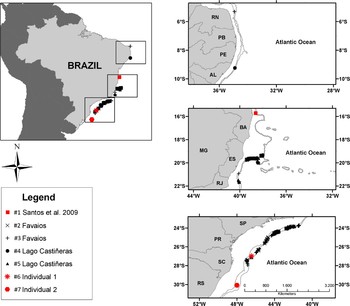
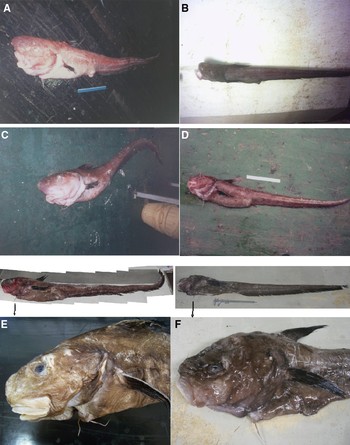
In Brazilian waters, an ateleopodid fish was first documented in slope waters of the central region of the country, Bahia State (BA) (Figure 1) during the voyage of ‘Thalassa’ being identified as Ijimaia loppei (Costa et al., Reference Costa, Braga, Melo, Nunan, Martins, Olavo, Costa, Olavo and Martins2007) and subsequently described (Santos et al., Reference Santos, Senna and Nunan2009) (Table 1, column 1). By the end of 2009, another ateleopodid was captured in a long-line research cruise of the TAMAR project (Carvalho-Filho, personal communication) in the same area. From the north-eastern to south-eastern sectors of the Brazilian coast (–5.377 to –30.087; Figure 1) four ateleopodids were photographed during four different fishing trips by two foreign trawlers (Table 1, columns 2 to 5; Figure 2A, D). And recently, two additional ateleopodids were landed in Navegantes, Santa Catarina State (SC), southern Brazil (Figure 1; Table 1, columns 6 and 7). Both individuals landed in southern Brazil were identified and compared with the previous descriptions to improve our knowledge of the diversity and distribution of these fish in Brazilian waters.
The location of two Ijimaia antillarum landed in southern Brazil (individuals 1 and 2), Ijimaia loppei captured in the central part of the country (Santos et al., Reference Santos, Senna and Nunan2009) and the entire range of four fishing trips in which the other ateleopodids were photographed.

Four specimens captured during four fishing trips of two foreign trawlers that have operated off the Brazilian coast. (A) First photographed specimen; (B) second; (C) third and (D) fourth ateleopodid captured during the deep-sea shrimp fishery; (E) and (F) are respectively individual 1 and individual 2.

Geographical position of the samples of jellynose fish used in the present work. Sample 1, the ateleopodid described in Santos et al. (Reference Santos, Senna and Nunan2009); samples 2, 3, 4 and 5, the ateleopodids captured by the foreign vessels; samples 6 and 7, the ateleopodids landed in Navegantes, Santa Catarina (SC), southern Brazil.

MATERIALS AND METHODS
The first ateleopodid landed in southern Brazil came from a Brazilian trawler that operated between 25 August and 14 September 2008 in the south-west part of Barra do Itajaí between 400 and 430 m depth (Anonymous, Reference Anonymous2008; Table 1 column 6; Figures 1 & 2E), and the second ateleopodid landed was caught by a Brazilian gillnetter near Tramandaí at around 400 m depth (Table 1 column 7; Figures 1 & 2F), between 23 September and 2 October 2009.
The individuals landed in Navegantes were brought to the Biological Oceanography Laboratory of Universidade do Vale do Itajaí (UNIVALI) for further identification. The specimens were both identified using the Howell-Rivero (Reference Howell-Rivero1935) identification key and compared with other specimens of I. loppei (Amaoka, Reference Amoaka and Richards2006; Santos et al., Reference Santos, Senna and Nunan2009) and I. antillarum descriptions (Fahay, Reference Fahay1983; Amaoka, 2006) (Table 2). Two radiographs were taken to check the internal structures of caudal and pelvic fins against those described in Howell-Rivero (Reference Howell-Rivero1935). Those radiographs were made using a Tunk RX10 set at 60 Kv and 10 Ma. The exposure time was 0.5 seconds and the slides were developed in a dark room using the time/temperature method. For description purposes, individuals landed by the trawler and the gillnetter will be treated as individual 1 and individual 2, respectively. Both individual 1 and individual 2 are located in the Laboratory of Biological Oceanography.
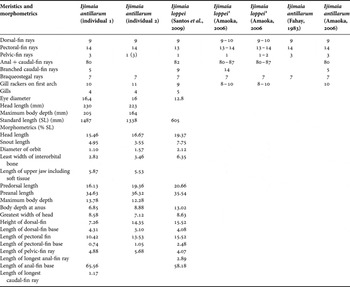
Meristic and morphometric data of the jellynose fish captured in southern Brazil and the comparison of three Ijimaia loppei (Amaoka, Reference Amoaka and Richards2006; Santos et al., Reference Santos, Senna and Nunan2009) and two Ijimaia antillarum (Fahay, Reference Fahay1983; Amaoka, 2006).

KEY FOR THE WESTERN ATLANTIC SPECIES IN THE GENUS IJIMAIA PROPOSED BY MCEACHRAN & FECHHELM (Reference McEachran and Fechhelm1998) AND ADAPTED FROM HOWELL-RIVERO (Reference Howell-Rivero1935)
1a. Caudal fin rays 14; eye diameter 9.4% to 12.1% of head length; body depth 14.1% to 15% of total length …………………………… . Ijimaia loppei.
1b. Caudal fin rays 5; eye diameter 6.9% of head length; body depth about 11% of total length……… …………………………….……… Ijimaia antillarum.
RESULTS
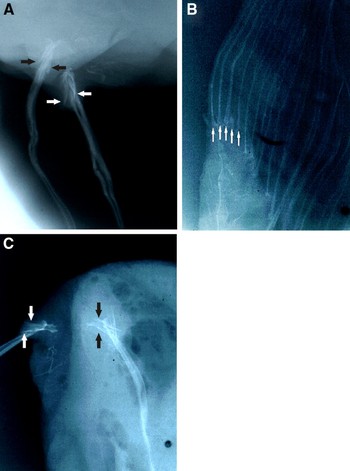
The two individuals brought to the laboratory both possess 9 dorsal-fin rays and a single free pelvic-fin ray that only reaches the margin of the pectoral fin, which characterizes them as members of the genus Ijimaia (Figure 2E, F). The body of each individual analysed in the laboratory is elongate, tapering, and posteriorly compressed, with a large, robust head, relatively small eyes (eye diameter of both individuals = 7.1% of head length), a short trunk and a long tail ending in a caudal fin. The radiograph of the caudal fin from individual 1 showed five rays connected to the last vertebra (Figure 3; Table 1). Caudal fin of individual 2 was damaged and could not be radiographed. Head surface is rugose and snout has a convex dorsal profile and overhangs mouth. Mouth is horizontal. Gill rakers on first arch varied between 10 and 11. Branchiostegal rays number 7. Head length varied between 15.4 and 16.7% of standard length (SL) and body depth at anus varied between 6.8 and 8.8% of SL. Snout length varied between 3.5 and 4.9% of SL. Dorsal fin originates behind origin of pectoral fin, which has 14 rays. The radiographs of pelvic fin showed that individual 1 and individual 2 have two additional undeveloped rays buried in integument behind the larger free ray (Figure 3). Anal fin has 75 rays. Lateral line consists of separate pores and runs the length of body. Colour is light brown and mottled with dark brown over most of the body. Pelvic fin is white.
(A) and (C) show the radiographs of the two additional undeveloped rays buried in integument of pelvic fin of individual 1 and individual 2, respectively. The rays are indicated by the arrows; (B) shows the radiograph of the caudal fin of individual 1. The arrows are pointing to the 5 rays.

DISCUSSION
In the genus Ijimaia characteristics such as eye diameter, number of rays of caudal fin and the depth of the body are the most usual measurements for the species identification (McEachran & Fechhelm, Reference McEachran and Fechhelm1998). The eye diameter in relation to head length and the number of rays of the caudal fin (individual 1) have clearly distinguished it as consistent with the description of I. antillarum (Howell-Rivero, Reference Howell-Rivero1935; Fahay, Reference Fahay1983; Amaoka, 2006). The relative height in the region of anus of I. antillarum captured in southern Brazil differed somewhat from the description of McEachran & Fechhelm (Reference McEachran and Fechhelm1998), but it differed greatly from I. loppei studied by Santos et al. (Reference Santos, Senna and Nunan2009), showing that the latter is relatively taller than I. antillarum. Another characteristic is that the lateral line consisted of separated pores instead of being covered by scales as in I. loppei. The radiographs confirmed two undeveloped rays buried in integument of both individuals of I. antillarum, as described by McEachran & Fechhelm (Reference McEachran and Fechhelm1998). However, biogeographical studies are still needed for this family in Brazilian waters because the specimen data were frequently based on the entire fishing trip for the specimens photographed by fishery observers. In this sense, this work represents an attempt to evaluate the species diversity in Brazilian waters and could be attached to the species identifications guides for on-board observers, which will be useful for the identification of the deep-fisheries by-catch.
ACKNOWLEDGEMENTS
The authors are indebted to the captains and crew of the national fleet and all on-board observers, who provided biological samples and fishery data of the fish captured in the commercial operations off Brazilian waters. We also thank Roberto Wahrlich who negotiated with the fishing company to bring the second fish to the laboratory, Martin C. Dias for invaluable help with the map, Professor Ariel Mezadri who assisted us with the radiographs, which was decisive in this work, and two anonymous referees for their valuable critiques on the manuscript.