Recent research on reading in English provides mounting evidence for the role of morphology in a variety of literacy skills. Morphology refers to the aspect of language that deals with “word-formation processes, including inflections, derivations, and compounds” (Nagy, Carlisle, & Goodwin, Reference Nagy, Carlisle and Goodwin2014, p. 4). Morphology provides meaningful cues for the reader and the speller, because it allows learners to analyze unknown words into their constituent morphemes and synthesize the morphemes into complex words. Whereas some morphological processing operates automatically without conscious awareness (e.g., Deacon, Parrila, & Kirby, Reference Deacon, Parrila, Kirby, Reid, Fawcett, Manis and Siegel2008), the conscious metalinguistic sensitivity to morphological structure and the ability to manipulate morphemes have been referred to as morphological awareness (MA; Carlisle, Reference Carlisle and Feldman1995).
The role of MA in word reading and reading comprehension has been well established in English monolinguals, above and beyond the effects of phonological awareness, vocabulary, and verbal and nonverbal intelligence (Carlisle, Reference Carlisle and Feldman1995; Kieffer, & Lesaux, Reference Kieffer and Lesaux2012; Kirby et al., Reference Kirby, Deacon, Bowers, Izenberg, Wade-Woolley and Parrila2012; Nagy, Beringer, & Abbott, Reference Nagy, Berninger and Abbott2006). MA has been linked to a variety of literacy skills, including reading accuracy, reading fluency, reading comprehension (Roman, Kirby, Parrila, Wade-Woolley, & Deacon, Reference Roman, Kirby, Parrila, Wade-Woolley and Deacon2009), spelling (Carlisle, Reference Carlisle1987; Deacon, Kirby, & Casselman-Bell, Reference Deacon, Kirby and Casselman-Bell2009; Nunes & Bryant, Reference Nunes and Bryant2006; Nunes, Bryant, & Olsson, Reference Nunes, Bryant and Olsson2003), and vocabulary (Bowers & Kirby, Reference Bowers and Kirby2010; Carlisle & Fleming, Reference Carlisle and Fleming2003; Nagy & Anderson, Reference Nagy and Anderson1984). Meta-analyses show that morphological instruction leads to significant gains in vocabulary and reading (Bowers, Kirby, & Deacon, Reference Bowers, Kirby and Deacon2010; Goodwin & Ahn, Reference Goodwin and Ahn2013). Morphological problem solving has been linked to children's ability to decipher previously untaught complex words (Anglin, Reference Anglin1993; Bowers & Kirby, Reference Bowers and Kirby2010; Carlisle, Reference Carlisle, Wagner, Muse and Tannenbaum2007; Carlisle & Fleming, Reference Carlisle and Fleming2003; Wysocki & Jenkins, Reference Wysocki and Jenkins1987). All of these findings underscore the role of morphology in literacy outcomes.
In contrast, MA and reading by Arabic-speaking children is underresearched (Abu-Rabia, Reference Abu-Rabia2007, Abu-Rabia & Shalhoub-Awwad, Reference Abu-Rabia and Shalhoub-Awwad2004; Saiegh-Haddad, Reference Saiegh-Haddad2013; Saiegh-Haddad & Geva, Reference Saiegh-Haddad and Geva2008; Shalhoub-Awwad & Leiken, Reference Shalhoub-Awwad and Leikin2016; Taha & Saiegh-Haddad, Reference Taha and Saiegh-Haddad2016, Reference Taha and Saiegh-Haddad2017). The available studies on processes of reading Arabic have included relatively small samples (sometimes not from a monolingual Arabic population), used a limited number of morphological tasks, or dealt exclusively with adults in priming experiments. The paucity of research on MA in Arabic reading is conspicuous, particularly because morphology is a salient feature of the Arabic lexical structure. The majority of Arabic words are at least bimorphemic because surface forms are derived by applying two abstract morphemic units (roots and word patterns; Eviatar & Ibrahim, Reference Eviatar, Ibrahim, Leikin, Schwartz and Tobin2012). Furthermore, Arabic morphology and orthography have a number of features that distinguish them from more commonly studied languages and orthographies such as English. For example, as Boudelaa (Reference Boudelaa2015) said, “The historically predominant analysis of Arabic morphology is stated in root-and pattern terms, where surface word forms are constructed by interleaving bound morphemes one within the other” (p. 2). After describing the nature of morphological processing and morphological awareness, and reviewing evidence (in English) on the dimensionality of morphological awareness, we will return to a more detailed analysis of Arabic language, orthography, and morphology.
MORPHOLOGICAL PROCESSING AND MORPHOLOGICAL AWARENESS
It is important to note that there is a difference between MA and morphological processing. The classical example of the “Wug test” devised by Berko (Reference Berko1958) has provided evidence that children as young as 4 years old have and can use knowledge about English morphological rules. Children's overgeneralization of the –ed suffix to irregular past tenses such *goed or *buyed is another example of their unconscious knowledge of their morphology system (Nagy et al., Reference Nagy, Carlisle and Goodwin2014; Owens, Reference Owens2001). These are examples of tacit morphological processing. At the more explicit level, MA requires conscious working out of the morphological processes needed, that is, awareness. There seems to be a fine line between MA and morphological processing, and sometimes it is not easy to differentiate between implicit and explicit MA tasks. For example, selecting which of two sentences has correct morphology could be done by judging which sounds better, without any direct or explicit application of morphological knowledge. Other tasks, for instance, constructing a word that has particular morphological characteristics, require more explicit morphological knowledge (Deacon et al., Reference Deacon, Parrila, Kirby, Reid, Fawcett, Manis and Siegel2008). Bowers et al. (Reference Bowers, Kirby and Deacon2010) and Nagy et al. (Reference Nagy, Carlisle and Goodwin2014) have pointed out that this is a complex issue because existing measures of MA draw on both implicit and explicit processes. Deacon et al. (Reference Deacon, Parrila, Kirby, Reid, Fawcett, Manis and Siegel2008) argued that morphological tasks vary with respect to modality, content, and process, and proposed a taxonomy to delineate the types of MA tasks. For example, a morphology task may use oral or written stimuli and oral or written responses. The content of a morphology task could include inflectional or derivational morphology. Furthermore, morphology tasks may ask participants to produce a response or judge the correctness of a particular response. Other factors contributing to this complexity include developmental issues; for example, younger children who are still in the process of reading acquisition may perform differently than older children who read more fluently and have gained more vocabulary. Another factor could be individual differences between children depending on the type of education they receive and their abilities, including intellectual abilities. Task demands vary also and may tap other factor such as memory or syntax. Finally, differences across languages/orthographies and the way the type of morphology (linear vs. nonlinear or root based vs. stem based) would play a role in the processes needed to process words.
THE DIMENSIONALITY OF MORPHOLOGICAL AWARENESS
While numerous studies have examined the role of MA in the development of reading in English and other alphabetic orthographies, only a few studies have investigated the dimensionality of MA in English-speaking children (Muse, Reference Muse2005) or adults (Tighe & Schatschneider, Reference Tighe and Schatschneider2015). Although a wide range of MA measures has been used across studies (Apel, Diehm, & Apel, Reference Apel, Diehm and Apel2013), only few studies (Muse, Reference Muse2005; Spencer et al., Reference Spencer, Muse, Wagner, Foorman, Petscher, Schatschneider and Bishop2015; Tighe & Schatschneider, Reference Tighe and Schatschneider2015) have examined the number of dimensions underlying multiple MA measures. Muse (Reference Muse2005) administered nine MA measures to a sample of fourth graders and found that MA emerged as a single latent construct, having considered a number of possible distinctions underlying the morphological structure: oral–written, implicit–explicit, multiple-choice versus production, inflection versus derivational, different levels of word complexity, and whether contextual clues were included or excluded. Tighe and Schatschneider (Reference Tighe and Schatschneider2015) gave seven measures of MA and two vocabulary measures to a group of adult students, finding that MA divided into two dimensions, one for real words and one for pseudowords, each separate from vocabulary. Furthermore, Spencer et al. (Reference Spencer, Muse, Wagner, Foorman, Petscher, Schatschneider and Bishop2015) reported on the unidimensionality of morphological awareness in two studies using a number of different morphological awareness tasks and an expanded set of vocabulary measures examining the breadth and depth of vocabulary knowledge. They emphasized that morphological awareness is an integral part of vocabulary knowledge and may even be considered a facet of an individual's depth of vocabulary knowledge. Spencer et al. (Reference Spencer, Muse, Wagner, Foorman, Petscher, Schatschneider and Bishop2015) supported a unidimensional model that encompassed morphological awareness and vocabulary knowledge.
The variety of MA measures used in the literature spans many differences in task requirements, as described in the above studies and in the taxonomy proposed by Deacon et al. (Reference Deacon, Parrila, Kirby, Reid, Fawcett, Manis and Siegel2008). Although there are linguistic differences between Arabic and English, it is important to note that the current study is partially framed in terms of the English literature on morphological awareness only because that is the greatest amount of literature available. Hence, the multidimensionality of MA as a construct needs to be explored further, and in languages other than English. No study has investigated the construct of MA and examined its relationship to reading among native Arabic-speaking children using multiple measures with distinct task requirements.
ARABIC LANGUAGE AND ORTHOGRAPHY
Arabic is a Semitic language. Its orthography has 28 letters that are primarily consonantal, is written from right to left, and uses superscripted diacritics to mark its three short vowels (Saiegh-Haddad & Henkin-Roitfarb, Reference Saiegh-Haddad, Henkin-Roitfarb, Saiegh-Haddad and Joshi2014). When Arabic orthography employs the diacritics, it is considered to be a shallow (i.e., transparent) orthography. However, when Arabic words and texts appear without superscripted vowels (diacritics), it is considered to be a deep (i.e., opaque) orthography. Abu-Rabia (Reference Abu-Rabia2001) demonstrated that vowelized words and text were read more accurately than nonvowelized words and text by skilled Arabic readers. However, Shalhoub-Awwad and Leikin (Reference Shalhoub-Awwad and Leikin2016) showed that morphological knowledge conveyed by the consistency in the word patterns compensated for the missing vowels. In explaining how readers of Semitic languages such as Arabic and Hebrew read when short vowels are omitted, Hansen (Reference Hansen, Saiegh-Haddad and Joshi2014) argued “The fact that short vowels are normally omitted in Semitic writing makes decoding more reliant on other kinds of information than phonology. . . . , decoding is predominantly orthographic, and the vast number of homographs makes the reader heavily dependent on context in the quest for the meaning of words” (p. 71).
A description of the Arabic language would be incomplete without a mention of diglossia. The term diglossia describes two linguistically related varieties of a language: the standard and the spoken (Ferguson, Reference Ferguson1959). Literary or Standard Arabic is used in writing and in formal communication, whereas spoken Arabic, a linguistically related form usually referred to as colloquial Arabic, is used in daily conversation. Although each country in the Arab world has its own distinguishing dialects, they all share the same standard language, which is the only form that appears in conventional writing. All literate Arab persons are taught this standard form in formal schooling and are expected to read and write using this written standard form regardless of their spoken dialects (Tibi & McLeod, Reference Tibi, McLeod, Saiegh-Haddad and Joshi2014).
The difference between the standard form and the dialect has been referred as “linguistic distance” by Saiegh-Haddad (Reference Saiegh-Haddad2003), and the differences exist at the phonological, morphological, syntactic, and lexical levels. In a series of studies, Saiegh-Haddad (Reference Saiegh-Haddad2003, Reference Saiegh-Haddad2004, Reference Saiegh-Haddad2005) tested the impact of the phonological distance on phonological awareness and word decoding, and showed that the difficulty children have with Standard Arabic phonemes appears to be related to the quality of phonological representations in long-term memory. In a recent study, Saiegh-Haddad and Schiff (Reference Saiegh-Haddad and Schiff2016) showed that this affects reading in both vowelized and unvowelized Arabic across the school grades (Grades 2–10). If we acknowledge that “reading is jointly defined by a language and by the writing system that encodes the language” (Perfetti, Reference Perfetti2003, p. 4), then Arabic reading acquisition in the context of diglossia deserves to be investigated further. In spite of considerable overlap between spoken Arabic and Standard Arabic, diglossia is evident in all aspects of the language: phonology, morphology, syntax, and vocabulary. For example, morphology in spoken Arabic has fewer inflections than Standard Arabic (for a review, see Saiegh-Haddad & Henkin-Roitfarb, Reference Saiegh-Haddad, Henkin-Roitfarb, Saiegh-Haddad and Joshi2014).
ARABIC MORPHOLOGY
The cross-linguistic differences between Arabic and more commonly studied languages like English extend to its morphology. Arabic morphology is in sharp contrast with Indo-European morphology in its linguistic structure and functions (Boudelaa, Reference Boudelaa, Saiegh-Haddad and Joshi2014; Boudelaa, Pulvermüller, Hauk, Shtyrov, & Marslen-Wilson, Reference Boudelaa, Pulvermüller, Hauk, Shtyrov and Marslen-Wilson2010; Frost, Reference Frost2012; Saiegh-Haddad, Reference Saiegh-Haddad2013; Saiegh-Haddad & Henkin-Roitfarb, Reference Saiegh-Haddad, Henkin-Roitfarb, Saiegh-Haddad and Joshi2014). Two main systems make up Arabic morphology: inflectional and derivational. Inflectional morphology provides information about the grammatical functions of a word such as gender, number (singular, dual, and plural), person, case, mood, and tense (see Saiegh-Haddad & Henkin-Roitfarb, Reference Saiegh-Haddad, Henkin-Roitfarb, Saiegh-Haddad and Joshi2014). In this inflectional system, prefixes, suffixes, or both are added to real words in a linear fashion /kitaab/ “one book” /kitaabaan/ “two books.” In Arabic derivational morphology, words are formed by combining two bound morphemes (root and word pattern). The root is only consonantal and carries the general meaning of the lexeme, whereas the word pattern is mainly vocalic and provides phonological and morphosyntactic information (Holes, Reference Holes2004). Derivations are formed by interleaving the consonants of the root with different word patterns. The different word patterns are classified into nominal word patterns and verbal words patterns that represent different grammatical categories such as agentive, passive adjective, passive verb, and active participle (for more examples, see Saiegh-Haddad & Henkin-Roitfarb, Reference Saiegh-Haddad, Henkin-Roitfarb, Saiegh-Haddad and Joshi2014). To illustrate, the root /k t b/ with its general semantic field “anything related to writing” when affixed on different word patterns (with each dash representing the position of a root consonant), such as (-a-a-a), (-a:-i-), (-u-i-a), or (ma- - a-), yields the following distinct but semantically related words with different syntactic functions: /kataba/ meaning “to write,” /ka:tib/ (“writer”), /kutiba/ (“was written”), and /maktab/ (“office” or “desk”). The root's three consonants /k t b/ remain in the same order in all of the derivatives. Preserving the sequence of these consonants has a morphological function (lexical access) and provides the general semantic field, in this case “anything related to writing.” Conversely, changing the order of the consonants changes the semantic field. For example, the word /kabata/ yields a different word meaning, “to suppress.” In some cases, such a change may yield a pseudoword (e.g., *takaba).
In contrast, when the same word pattern combines with different roots, the result is different words with similar syntactic functions, but completely different meanings. For example, the pattern (-a-a-a) has the grammatical function of the verb “to do.” When affixed to different roots such as /d r s/, /k t b/, or /r s m/, the result is /darasa/, /kataba/, or /rasama/, meaning “to study,” “to write,” and “to draw,” respectively. It has been reported that there are 5,336 roots and 2,324 word patterns in Standard Arabic (Boudelaa & Marslen-Wilson, Reference Boudelaa and Marslen-Wilson2010). The root-word pattern structure causes almost all Arabic words (with the exception of few function words) to be at least bimorphemic. Some roots are highly productive allowing for many words to be derived from them.
In addition to the inflectional and derivational systems of Arabic morphology, there is another group of morphemes referred to as clitics, which Saiegh-Haddad and Henkin-Roitfarb (Reference Saiegh-Haddad, Henkin-Roitfarb, Saiegh-Haddad and Joshi2014) described as “grammatically independent, but phonologically dependent on another word or phrase. . . . Clitics may attach to the word . . . and can co-occur within the same word, resulting in one-word phrases and clauses” (p. 14). For example, the one-word clause /bimadrasatihi/ “in his school” includes the prefix /bi/ “in,” /madrasat/ “school,” and “hi/ referring to the suffix that means “his.”
The complexity of Arabic morphology being both linear and nonlinear requires the Arabic reader to process its morphology by means of composition and decomposition processes to attain comprehension (Boudelaa, Reference Boudelaa, Saiegh-Haddad and Joshi2014; Boudelaa et al., Reference Boudelaa, Pulvermüller, Hauk, Shtyrov and Marslen-Wilson2010). In the composition process, the Arabic learner applies different patterns to the root in order to derive different words. In the decomposition process, the learner extracts the root from the polymorphemic word to derive the meaning. Both processes are important and natural for the advanced learner. Frost, Kugler, Deutsch, and Forster (Reference Frost, Kugler, Deutsch and Forster2005) found that morphological priming was far more robust than orthographic priming in Hebrew and Arabic. Boudelaa (Reference Boudelaa2015) provided evidence from two cross-modal priming experiments that Arabic learners rely mainly on the root in accessing meaning. He found that the consonants that belong to the root were more effective primes than the vowels of the word patterns. Boudelaa concluded that the roots and word patterns in Arabic have distinct representational and processing properties. Similarly, Ussishkin, Dawson, Wedel, and Schluter (Reference Ussishkin, Dawson, Wedel and Schluter2015) found that the consonantal root facilitated priming in spoken-word recognition in Maltese, another Semitic language.
The predominance of the root-word pattern morphological structure in Arabic words has been shown to play a key role in reading accuracy and comprehension among normal and dyslexic Arabic readers across different age groups (Abu-Rabia, Reference Abu-Rabia2007; Abu-Rabia, Share, & Mansour, Reference Abu-Rabia, Share and Mansour2003; Abu-Rabia & Taha, Reference Abu-Rabia and Taha2004) and in spelling (Saiegh-Haddad, Reference Saiegh-Haddad2013). Abu-Rabia (Reference Abu-Rabia2007) compared typically developing and dyslexic Palestinian students in Grades 3, 6, 9, and 12 and found that, within groups and across grade levels, performance on an orthographic morphology task was a robust, and often the sole, predictor of word recognition accuracy and reading comprehension in vowelized texts. In a previous study, Abu-Rabia et al. (Reference Abu-Rabia, Share and Mansour2003) compared reading-disabled and normal readers of the same chronological age (9.5–10.5 years), and younger normal readers (7.5–8.5 years) at the same reading level as the reading disabled children. They found that the reading-disabled children performed poorly on the morphological measures, and their overall performance was significantly poorer than that of the other groups. After phonological awareness, morphology was the strongest predictor. Saiegh-Haddad (Reference Saiegh-Haddad2013) found that Grade 1 Arabic-speaking students made use of morphology while doing a spelling task. For example, spelling accuracy with the letter <t> increased when the <t> was part of the root as opposed to part of the word pattern (e.g., present tense prefix).
THE CURRENT STUDY
Considering the relative lack of research on Arabic MA and reading, especially among children, the importance of morphology in the Arabic lexical structure, and the specific linguistic nature of Arabic (e.g., differences between spoken and Standard Arabic, and differences between the root and word patterns), we set out to investigate the dimensionality of Arabic MA and its role in reading Arabic with native Arabic-speaking Grade 3 children. Examining morphological awareness in Arabic may reveal new insight because of its varied types of morphology (linear and nonlinear), and because its words are formed mostly through derivational processes. Furthermore, the diglossic situation of Arabic makes it different from other languages investigated so far. It is also important to note that the available studies on Arabic processes of reading have included a relatively small sample (sometimes not from an Arabic population), examined older students only, used a limited number of morphological tasks, or dealt with adults only in priming experiments. None of the Arabic studies has examined the performance of typical Arabic-speaking children living in an Arabic country on a wide range of measures capturing all domains of morphology in addition to reading measures. More important, none of the available studies on Arabic morphology has attempted to examine the underlying nature of morphological knowledge in Arabic. Our reasons for studying Arabic are, first, to extend the MA literature, and second, to capitalize on key features of Arabic concerning morphology and its potential relationship to reading. The mounting evidence on the strong relationship between morphological awareness and reading motivated us to explore this relationship in Arabic, particularly because Arabic combines linear and nonlinear morphology and plays a central role in forming its words. Therefore, the present study investigates the following research questions:
-
1. What dimensions underlie morphological awareness in Arabic?
-
2. Does morphological awareness predict the reading ability of Arabic-speaking children, and if so, how well?
To answer the first question, we developed 10 MA tasks in Arabic covering a wide range of dimensions (Deacon et al., Reference Deacon, Parrila, Kirby, Reid, Fawcett, Manis and Siegel2008), and examined their dimensionality through exploratory factor analysis. An exploratory analysis was conducted because there were many plausible alternative structures and little guidance was provided by prior research regarding constructs and construct validity. We used Deacon et al.’s taxonomy to construct a set of 10 MA tests that varied in several dimensions. In designing the tasks, we took into consideration the morphological structure of Arabic (e.g., root vs. word pattern), and inflectional versus derivational processes. We included a variety of different consonantal roots and different word patterns covering a wide range of grammatical functions and different inflectional and derivational processes in each measure. Because Arabic is diglossic in nature, it was possible to assess children on an oral task in their own dialect. Including an oral task may shed light on the nature of dimensionality in Arabic MA. For example, are there two dimensions, dialect versus standard? The same applies to including both written and oral tasks in the sense that oral versus written dimensions could emerge. To answer the second research question, we developed two reading tests (words and pseudowords), and due to the central function of morphology in forming Arabic words, we investigated the relationship between MA and reading (predictive validity).
METHOD
Participants
Participants were 102 Arabic-speaking children (51 girls; mean age = 104 months, SD = 5.7 months) recruited from three public schools in the Emirate of Abu Dhabi in the United Arab Emirates (UAE). All children in Grade 3 in the participating schools were invited to participate. Only the children with parental consent and child assent were tested; the participation rate was 60%. All children were assessed informally for any signs of developmental impairment by the first author. All children with any sign of hearing or cognitive impairment were excluded from participation in this study. All participants were native Arabic-speaking Emirati children with both parents being native speakers of Arabic, and were tested at the end of Grade 3. All children were learning Standard Arabic as a core subject in their curriculum. In addition, the children were studying English, mathematics, and science in English. Although these children had started studying English in Grade 1, their knowledge of English was at best rudimentary. Possible reasons for this are that their exposure to English is limited to the class periods, many of the teachers who teach these subjects are not native English speakers, and lack of access to peers who are native or near native English speakers (only Emirati children attend government schools in UAE). The only mode of communication in the children's homes is also Arabic. Therefore, considering the factors proposed by Paradis, Genesee, and Crago (Reference Paradis, Genesee and Crago2011; i.e., the majority language, ethnolinguistic community, and time of exposure), we see the sample as primarily Arabic speaking.
Procedure
Children completed a series of tasks administered individually by the first author (who is a native speaker of Arabic) in a quiet room in their school. Task administration for each child was broken up into two sessions, 30 min each. The first session included the word reading test and the six oral MA tests. The second session included the pseudoword reading test and the four written MA tests. In the written tests, children were instructed to carefully read the sentences presented in print and were given a pencil to use for writing or circling the correct choice. All tests were preceded by practice items (four for MA tests and three for reading measures) to ensure that children understood the task; during the practice items, corrective feedback was given if needed. All instructions were given in the Emirati dialect, though the content of most tests was in Standard Arabic. All assessments and contacts with the children were exclusively in Arabic.
Measures
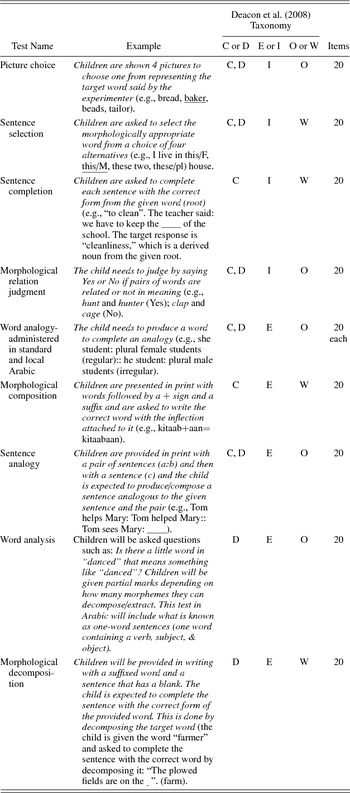
We developed 10 MA tasks covering the dimensions addressed in the Deacon et al. (Reference Deacon, Parrila, Kirby, Reid, Fawcett, Manis and Siegel2008) taxonomy and other relevant factors (see Table 1). Four of the tasks were presented in vowelized print and required the participants to read and write or circle the correct answer. The other 6 MA tasks were presented orally and required the child to either provide an oral answer or to say Yes or No. Nine out of the 10 MA tests were in Standard Arabic, whereas the 1 MA test was in the local Emirati dialect. The termination rule for each MA task was 4 consecutive errors, for word reading 10 consecutive errors, and for pseudoword reading 4 consecutive errors. To address as many types of morphological process as possible, we included items within each test that varied in the degrees of transparency/opacity of phonology, orthography, and semantics. Furthermore, all measures involved both inflections and derivations, though these were not included as separate scales. We also included both linear and nonlinear morphology items. We explicitly included two variations of the word analogy task, one in Standard Arabic and one in the local dialect to examine the diglossia issue. In all multiple-choice tasks, the position of correct answers was varied randomly. All tasks are listed in Table 1, with examples and descriptions in terms of the Deacon et al. (Reference Deacon, Parrila, Kirby, Reid, Fawcett, Manis and Siegel2008) taxonomy.
Morphological awareness tasks, examples, and description in terms of Deacon et al. (Reference Deacon, Parrila, Kirby, Reid, Fawcett, Manis and Siegel2008) taxonomy, and number of items

Note: C, Composition; D, decomposition; E, explicit; I, implicit; O, oral; W, written; F, feminine; M, masculine; pl, plural.
Written tasks
WORD SELECTION
This task was based on Singson, Mahony, and Mann (Reference Singson, Mahony and Mann2000) and Tyler and Nagy (Reference Tyler and Nagy1989, Reference Tyler and Nagy1990). Participants were presented with 20 written vowelized incomplete sentences and asked to complete each sentence by circling the appropriate word from four alternatives. The four word choices for each item contained the target word plus distractors that were morphologically related, orthographically similar, or phonologically similar to the target, but incorrect. A typical item was “In the summer, the weather is usually ________.” The four choices were Ha:r, Hur, Hari:r, Hararah, meaning hot, free, silk, and heat. The participant's score was the number of items correct.
SENTENCE COMPLETION
In this task (based on Carlisle, Reference Carlisle2000) the participants were presented with 20 written sentences each preceded by a clue word, and they were asked to write the correct form of the word to complete each sentence. Half of the target words required application of inflectional morphology, the other half derivational morphology. An example of this task was “/kitaab/ (book): I have two __________.” The correct answer would be /kitaabaan/ (two books). The participant's score was the number of items correct.
MORPHOLOGICAL DECOMPOSITION
In this task based on Carlisle (Reference Carlisle2000), the participants were shown 20 incomplete sentences, each preceded by a clue word, and asked to complete each sentence in writing with a word related to the clue word. Half of the items required inflectional morphology processes, and the other half derivational morphology processes. The correct responses varied in the type of morphological operations required (e.g., verb to noun; noun to verb; plural to singular; dual to singular; adjective to noun; and so on). An example of this task was “/ʔmTarat/ (rained): The rain /maTar/ falls in the winter season.” The score was the number of items answered correctly.
MORPHOLOGICAL COMPOSITION
This measure (based on Carlisle, Reference Carlisle1988) had two parts. In the first 13 items, participants were presented with written words plus prefixes and/or suffixes, and asked to write them as complete words (all of these were to be composed in a linear fashion). For example, children were shown “t + ʔistaqbala + hum,” for which the correct response is “tastaqbiluhum” (she received them). Another example that required more change at the phonological and orthographic levels was “/j/ + / ʕa:da/” (correct answer “/yaʕu:du/|” (to return). The other 7 items on this test targeted the broken plural (irregular inflection). Broken plural in Arabic, unlike regular plural, follow different nonlinear process of morphological derivation (see Saiegh-Haddad, Levin, Hende, & Ziv Reference Saiegh-Haddad, Levin, Hende and Ziv2011). The 7 broken plural items were administered by presenting children with a picture of one object (e.g., rabbit) /ʔarnab/, then a picture of five rabbits, and asking the child to say the name of the plural form which is /ʔara:nib/. The rationale for this was the nonlinear quality represented in the broken plural. Participants’ scores were the number of correct responses.
Oral tasks
MORPHOLOGICAL RELATION JUDGMENT
In this task based on Carlisle and Nomanbhoy (Reference Carlisle and Nomanbhoy1993) and Derwing (Reference Derwing1976), the participants were presented orally with 20 pairs of words and asked if the two words in each pair were morphologically related (shared the same meaning). Half of the items were morphologically related pairs and half were phonologically related foils. For example, “/mi”za:n/ and /zama:n/” (scale, time) were not related, whereas “/muTa:laʕa/ and /Ta:laʕa/” (reading, read) were related. The participant's score was the number of items correct.
STANDARD WORD ANALOGY
In this task (based on Kirby et al., Reference Kirby, Deacon, Bowers, Izenberg, Wade-Woolley and Parrila2012; Nunes, Bryant, & Bindman, Reference Nunes, Bryant, Bindman, Perfetti, Rieben and Fayol1997), children were asked to supply words that completed morphological analogies. They were told a pair of words that had a morphological relationship, and then asked to apply that same relationship to a third word. For example, if the tester said /kataba (he wrote): katabu:/ (they wrote), and then /laʕiba/ (he played), the child was supposed to say /laʕibu:/ (they played). To reduce the likelihood of participants responding according to phonological cues and replicating a phonological pattern (see Kirby et al., Reference Kirby, Deacon, Bowers, Izenberg, Wade-Woolley and Parrila2012, for a discussion of this issue), some items included irregular formation processes or a phonological shift. There were 20 items, half of which required linear operations while the remainder were nonlinear, and the participant's score was the number of items correct.
LOCAL WORD ANALOGY
This test followed the same format as Standard word analogy except that this test included different words and all items were presented in the spoken Emirati dialect. The two tests were constructed to be as equivalent as possible in terms of linear and nonlinear operations and other morphological processes. The participants were required to respond orally in the local dialect to complete each analogy. For example, if the tester said /finja:n/ (cup):/fana:ji:n/ (cups) :: /rajja:l/ (man), the correct answer would be /rajaji:l/ (men). Some items required more phonological shifts than others. There were 20 items (a balanced number of linear and nonlinear operations), and the participant's score was the number of items correct.
SENTENCE ANALOGY
In this task based on Nunes et al. (Reference Nunes, Bryant, Bindman, Perfetti, Rieben and Fayol1997), the participants were presented orally with two sentences in Standard Arabic in which the first sentence had been transformed into the second one by a morphological change. They were then asked to apply the same transformation to a third sentence. To reduce the likelihood of participants responding according to phonological cues, some items included irregular formation processes or a phonological shift. For example, /ha:ð:hi d
 ari:da/ (this is a newspaper) :/ha:ði hi d
ara:ʔid/ these are newspapers:: /ha:ða qalam/ (this is a pencil), the correct answer would be “/ha:ð:hi ʔaqla:m/ these are pencils.” The transformation in this example requires irregular plural formation in which there is a phonological change between the first plural /d
ara:ʔid/ and the second plural /ʔaqla:m/. The participant's score was the number of correct answers. There were 20 items.
WORD ANALYSIS
This 20-item task (based on Carlisle & Fleming Reference Carlisle and Fleming2003; Rubin, Reference Rubin1988) asked the participants to generate as many smaller words as possible from given complex words. Participants were asked cue questions, such as “Is there a smaller word in the given word that means something like the given word?” For example, the word /mudarrisu:n/ (teachers) contains /mudarris/(teacher), /darrasa/(to teach), /darasa/(to study), and /dars/(lesson). Each of these words is derived by means of a different word pattern calling for different vocalic/phonological form. Children were given corrective feedback on practice items, to ensure that they understood they needed to strip the word into its smallest constituting word or root in some cases. Responses were scored zero when the child was not able to provide any smaller and related word from the given multimorphemic words, 1 point when the child provided a smaller word that was not the smallest possible word, and 2 points when the child was able to provide the smallest word or root from the target word. There were 20 items, so the maximum score for this test was 40.
PICTURE CHOICE
In this task based on Casalis and Louis-Alexandre (Reference Casalis and Louis-Alexander2000), the participants were shown 20 sets of four pictures, and asked to choose the picture that correctly represented the target word spoken by the experimenter. In designing this task, the four pictures selected for each individual item included ones which (a) corresponded to the target word; (b) represented a word morphologically related to the target word, but was semantically wrong; (c) was phonologically and semantically similar to the target word, but was incorrect morphologically; and (d) was phonologically and orthographically similar to the target but was incorrect semantically and morphologically. The pictured words assessed children's knowledge of a variety of inflectional and derivational morphemes. For example, when the target spoken word was “/tuffa:Hataan/ (two apples), the child was shown pictures of (a) /tuffa:Hataan/ (two apples); (b) /mawzata:n/ (two bananas); (c) /tuffa:Ha/ (one apple); and (d) /mufta:H/ (key). The participant's score was the number of correct answers.
Reading measures
Two reading tests were constructed, one with real words and one with pseudowords. The real words were selected based on the frequency count from two sources each representing a different corpus. One source was the lexical database of Modern Standard Arabic known as Aralex (Boudelaa & Marslen-Wilson, Reference Boudelaa and Marslen-Wilson2010). Aralex consists of 40 million word tokens primarily drawn from Arabic newspapers available online, and includes information about orthographic forms, vowelized stems, unvowelized stems, roots, and word patterns. Aralex also provides statistical information about words and morphemes. The second source was a corpus of 147,527 word tokens compiled from Arabic textbooks used in primary schools (Grades 1–6) from two different Arab countries (Libya and UAE) by Belkhouche, Harmain, Al Najjar, Taha, and Tibi (Reference Belkhouche, Harmain, Al Najjar, Taha and Tibi2010). Words chosen for the reading test ranged in frequency from most frequent as in the preposition /fi:/ (in) with a frequency of 32,189 in Aralex (and 4,100 in the textbook corpus) to the lowest frequency of .13 in Aralex (and 1 in textbook corpus) as in the one-word phrase /lijabi:ʕha:/ (to sell it).
All real words were vowelized, and represented different parts of speech, with nouns comprising the largest percentage, followed by verbs, adjectives, and particles. Words varied in number of syllables, ranging from monosyllabic to five-syllable words. There were 80 words in the word reading measure. Each word was vowelized and appeared in 26-point Times New Roman font. Words were arranged in order of decreasing frequency. Participants were instructed to read each word out loud with its complete vowelization. The score for the reading measures was 1 point for each word read accurately. The termination rule was 10 consecutive errors.
The pseudoword reading test was developed based on the Arabic structure of words. For example, the pseudowords included phonemes (consonants and vowels) and syllabic structures that are similar to real words. Pseudowords varied in number of syllables, and in orthographic, morphological, and phonological structure. The set of pseudowords included all Arabic letters and captured a variety of different word patterns. The test consisted of 20 vowelized pseudowords, arranged in order of expected difficulty as judged by two Arabic language inspectors and the first author. Children were asked to read all pseudowords with their vowelizations. One point was given to every pseudoword word read accurately. The termination rule was four consecutive errors. The first author scored both word reading and pseudoword reading tests. Each test began with the more frequent word patterns, and with the words that are most frequent or (in the case of the pseudowords) were judged to be easiest (by the first author and two Arabic language experts).
RESULTS
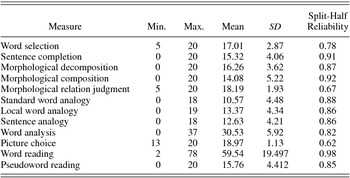
Descriptive statistics and split-half reliability estimates for all variables are displayed in Table 2. The word reading, pseudoword reading, and 9 out of 10 MA test distributions showed negative skewness. The exception to the skewness among the 10 MA tests was the Standard word analogy. All skewness problems were solved by square root, logarithmic, or inverse transformations, except for the sentence completion test, which after a logarithmic transformation required further winsorizing (following the guidelines of Tabachnick & Fidell, Reference Tabachnick and Fidell2007).
Summary of descriptive statistics on all tasks (untransformed data; N = 102)

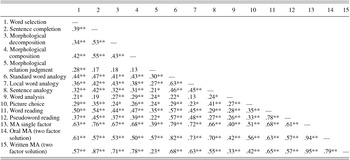
Correlations between measures are reported in Table 3. Correlations between MA tests ranged from .12 to .63 and most were significant; the exception was morphological relation judgment (an oral test) that was not strongly correlated with some of the other measures, namely the three measures that required students to read and write. The two MA tests that varied in the language variety (Standard and local word analogy) were significantly correlated (r = .63, p < .01). The two reading measures were correlated significantly (r = .78, p < .01). All of the MA tests correlated significantly with both reading tests (range = .22–.60, p < .05).
Correlations between transformed variables

Note: MA, Morphological awareness.
*p < .05. **p < .01.
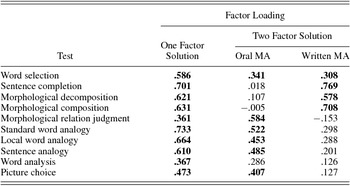
The dimensionality of the 10 MA tasks was examined using principal axis factor analysis with direct oblimin rotation when appropriate. The first eigenvalue was substantial (4.06), much larger than the second (1.06) and subsequent eigenvalues. Although the scree plot clearly showed one factor, we decided to explore one- and two-factor solutions because the second eigenvalue was greater than 1.0.
Both the one- and two-factor solutions are shown in Table 4. The single factor has substantial loadings for all tests, although the loadings of morphological relation judgment and word analysis were lower than the others. This factor, termed MA, accounted for 40.1% of the variance. In the two-factor solution, all oral MA tests loaded on the first factor (hence, we labeled it oral MA); however, the loading for word analysis was not high. All tests requiring reading or writing loaded on the second factor, which we labeled written MA. Only one test (word selection) had split loadings; this test required students to read a sentence and make a choice of three options by placing a circle around it, rather than writing a word. The two-factor solution accounted for 51.3% of the variance. Regression factor scores were generated from the one-factor and the two-factor solutions. Correlations between the factor scores and all of the other variables can be seen in Table 3. Each factor score correlated significantly with each MA test, and with both reading variables.
Summary of principal axis factor analysis (N = 102)

Note: Direct oblimin rotation used in two-factor solution. Loadings > .300 are in bold.
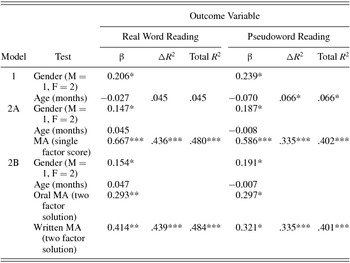
Finally, hierarchical regression analyses were conducted to investigate the extent to which the MA factors predicted reading after controlling for age and gender. Two regression analyses were conducted from each factor solution, one for real words and one for pseudowords (see Table 5). In each model, gender and age were entered in the first step and the MA factor score(s) in the second step. Gender and age accounted for about 4% to 7% of the variance in the outcomes, mostly due to gender (higher performance by girls). For real-word reading, the single MA factor accounted for a further 44% of the variance (Model 2A in Table 5). When the two MA factors of the two-factor solution were used, the amount of variance accounted for stayed essentially the same (Model 2B in Table 5); the beta coefficients indicate that written MA (β = 0.41) was more powerful than oral MA (β = 0.29), though each was significant (p < .01). For pseudoword reading, both the single and the dual MA factors contributed an additional 33% of the variance (Models 2A and 2B in Table 5); in the analysis with two factors, written MA (β = 0.32) was only slightly more powerful than oral MA (β = 0.30), but again each was significant (p < .05).
Summary of hierarchical regression analyses predicting real word reading and pseudoword reading

Note: M, Male; F, female; MA, morphological awareness.
*p < .05. **p < .01. ***p < .001.
DISCUSSION
The goals of the current study were to explore the dimensionality of MA and establish its relationship with reading in Arabic. The results indicated that MA is predominantly one dimensional, though when forced, this factor splits into oral and written MA factors. It should be noted that the two-factor solution is not clean in that one oral measure (word analysis) did not load highly on the oral factor and another measure (word selection) loaded on both factors. Whether seen as one factor or two, these results support the construct validity of MA in Arabic. Whether used as a single predictor or as two, MA accounted for a substantial and equivalent amount of variance in reading, establishing its predictive validity in Arabic.
Dimensionality
In recent years many researchers have used many different measures of MA. Deacon et al. (Reference Deacon, Parrila, Kirby, Reid, Fawcett, Manis and Siegel2008) pointed out that these measures can be classified in terms of modality, content, and process. Although there is some work in English exploring how many dimensions underlie such measures (Muse, Reference Muse2005; Spencer et al., Reference Spencer, Muse, Wagner, Foorman, Petscher, Schatschneider and Bishop2015; Tighe & Schatschneider, Reference Tighe and Schatschneider2015), this is the first study to do so in Arabic. The measures administered in the current study covered a wide variety of MA task features: spoken dialect/Standard Arabic, inflectional/derivational, implicit/explicit, word/sentence level, composition/decomposition, oral/written, and judgment/constructed response (see Table 1). In contrast to previous studies, this set of measures provides a broad coverage of the MA domain in Arabic. The characteristics of Arabic (diglossia, phonological transparency, and linear and nonlinear morphological structure) made many possible dimensions feasible.
Our results demonstrate either a single MA dimension representing all 10 measures or two dimensions representing the oral and written tests separately. The single factor suggests that MA knowledge in Arabic is essentially one dimensional, in spite of the diversity of measures used and the complexity of the processes involved in Arabic. This conclusion is helpful for researchers and practitioners alike because it implies that relatively few measures could be used to assess the MA construct. However, we also investigated the two-factor solution as an alternative model, which resulted in distinct oral and written factors. Almost all MA tasks that were administered orally and required an oral response loaded on the oral MA factor, the exception being that word analysis did not load highly. Conversely, all of the tasks that were presented in writing and required a written response loaded on the written MA factor, except for word selection, which had loadings on both factors. Psychometrically, the one-factor solution is cleaner and has a simpler structure.
The two-factor structure does not challenge the underlying cognitive nature of MA, and may be attributed to the developmental stage of the Grade 3 participants in this study. Although many of the children had acquired the basic foundational skills of reading and writing, some children were still in the process of learning to read, spell, and write. This may have been influenced by the differences between written and spoken Arabic, so that oral knowledge could not be used as a reliable support when dealing with print, and by differences in reading instruction. Hence, some children with adequate oral MA knowledge may have performed poorly on written tasks, giving rise to the second factor. We would expect the oral–written separation to disappear with increased age and reading ability. Oral measures may be more appropriate for younger children, but given the consistent orthographic representations of morphemes in Arabic, written measures should be introduced as soon as instruction makes it possible. Once reading competence is well established, the single MA factor should emerge: this should be tested in longitudinal studies.
MA and reading
The second aim of the current study was to investigate the predictive validity of MA in Arabic by examining its relationship with reading. Previous research in English and other languages has found substantial relationships between reading and MA (Carlisle, Reference Carlisle and Feldman1995; Kirby et al., Reference Kirby, Deacon, Bowers, Izenberg, Wade-Woolley and Parrila2012; Mahony, Singson, & Mann, Reference Mahony, Singson and Mann2000; Nagy et al. Reference Nagy, Berninger and Abbott2006). We found that both the one-factor MA and the two-factor MA (oral and written) predicted a substantial proportion of real-word and pseudoword reading, thus supporting the predictive validity of MA. With regard to real words, our findings are consistent with those of Abu-Rabia (Reference Abu-Rabia2007), who found that MA predicted real-word reading accuracy in normal and dyslexic Arabic readers in Grades 3, 6, 9, and 12.
As for pseudoword reading, our finding is consistent with that of Deacon and Kirby (Reference Deacon and Kirby2004), who found that MA made a significant contribution to pseudoword reading, after controlling measures of prior reading ability, verbal and nonverbal intelligence, and phonological awareness. Deacon and Kirby were initially surprised that pseudoword reading would be predicted, because pseudowords should not be meaningful and thus should not have morphological structures. However, some of the pseudowords on the test they used appeared to have morphological structures (e.g., gaked). Kirby et al. (Reference Kirby, Deacon, Bowers, Izenberg, Wade-Woolley and Parrila2012) argued that morphology could be used to rule out certain pronunciations by identifying either the presence or the absence of morphological boundaries. In the present study, the result was less surprising because the pseudowords had been constructed in a way similar to real-word structures in Arabic. Furthermore, pseudoword reading was highly correlated with real-word reading (r = .78, p < .01), so the prediction could be due to this degree of covariance. Future research could explore this relationship further by including pseudoword measures with different degrees of (pseudo) morphological structure and observing the relationship with MA.
Limitations, future directions, and implications
Several limitations of this study should be mentioned, each of which should be addressed in future studies. First, although a wide range of measures was employed, other measures of MA need to be studied; these could include priming and response time measures. Word and pseudoword reading accuracy were addressed here, but word-reading fluency, spelling, and reading comprehension need to be examined. Including other measures varying in other features may affect the factor structure that emerges; for example, if we had included separate inflection and derivation measures (rather than embedding both in each test as we did), those tests could have defined separate factors. Second, the study took place within one Arabic country; given the diversity of spoken Arabic, other national settings and educational systems need to be studied. Third, to fully assess the effect of MA on reading, further control variables need to be included in the predictive models, such as intelligence, executive functions, vocabulary, phonological awareness, and orthographic knowledge. Furthermore, only experimental studies, in which MA was taught, could establish a causal relation. Fourth, future studies should investigate the developmental course of the MA factors.
More generally, it would be important to investigate the sources of morphological awareness before it is taught deliberately in school (if it is taught). Two obvious candidates are the home language environment and genetic factors. Hart and Risley (Reference Hart and Risley1995), for example, observed large individual differences in vocabulary development related to amount of language exposure. Morphological awareness is intertwined with vocabulary (Spencer et al., Reference Spencer, Muse, Wagner, Foorman, Petscher, Schatschneider and Bishop2015), so it will be important to determine their developmental relationships. Samuelsson et al. (Reference Samuelsson, Byrne, Quain, Wadsworth, Corley, DeFries and Olson2005) found that vocabulary and morphology demonstrated stronger shared-environment influences and weaker genetic influences than other language skills, including general verbal ability and phonological awareness. Results such as those of the present study show that largely untaught morphological awareness predicts reading ability, and other studies (e.g., Bowers et al., Reference Bowers, Kirby and Deacon2010; Goodwin & Ahn, Reference Goodwin and Ahn2013) show that morphological awareness can be taught with positive effects on reading. It remains to be clarified to what extent the preschool factors (home environment and genetics) interact with deliberate instruction, but Lyster, Lerväg, and Hulme (Reference Lyster, Lerväg and Hulme2016) have shown that preschool morphological instruction leads to long-term gains in reading.
The present results provide a framework for researchers interested in pursuing studies in the morphological processes of the Arabic language on Arabic-speaking children in Arabic countries. Given the relatively strong relationship between MA and word reading, measures of MA should be included in predictive studies so that a more complete picture of linguistic strengths and weaknesses can be obtained. By including other predictors, the unique effects of MA will be shown. Building on the current findings will help us also deepen our understanding of morphology's effects and help us refine the tools further for different age groups.
For educators, two applications arise. First, assessment of morphological awareness should be included in any language or early reading assessment. Teachers and speech-language pathologists need to give this area more attention in their assessments (American Speech-Language–Hearing Association, 2010; Gabig & Zaretsky, Reference Gabig and Zaretsky2013). We are not aware of any formal evidence about the assessment of morphological awareness by teachers and speech-language pathologists in Arabic, but our discussions with these professionals suggest that little is currently being done. Second, another application would be in instruction. The strong association between MA and reading suggests that it may be a useful target for instruction; this would be supported by instructional studies in other languages (for reviews, see Bowers et al., Reference Bowers, Kirby and Deacon2010; Carlisle, Reference Carlisle2010; and Goodwin & Ahn, Reference Goodwin and Ahn2013). Instruction programs explicitly targeting MA in Arabic are sorely needed. Considering the important role morphology has in Arabic word construction and the present results, it seems very likely that enhanced morphological knowledge would exert a powerful positive influence on literacy achievement in Arabic. One impediment for both researchers and educators is the lack of standardized measures of reading and reading-related processes in Arabic, even though all Arab countries share the same standard form of the language. The development of such tools should be seen as a priority for policymakers in the Arab world.
This study offers a basis for further research on the morphological and other cognitive processes involved in Arabic reading of Arabic-speaking subjects residing in an Arabic country. The construct and predictive validity demonstrated in the current study should spark more research in the field of Arabic reading and morphological processing. This research is needed to improve the literacy skills of many children in many countries. The distinctive features of the Arabic language and orthography also offer opportunities to researchers to broaden their understanding of language and literacy in a global context.
ACKNOWLEDGMENTS
The authors thank the Abu Dhabi Education Council for allowing access to the schools to conduct this study. We also thank the children who participated in the study and their parents.