Introduction
Many older people need help and care as they age. In the Nordic countries despite their highly developed social-care services, family care in general and practical intergenerational care have remained a strong source of support, and this help is often provided by adult children (Kröger Reference Kröger and Szebehely2005; Ogg and Renaut Reference Ogg and Renaut2006). In Finland and elsewhere, the reduction of public welfare services and benefits in recent decades has led to the promotion of home-based care and family care. At the same time, people are expected to work more and to a greater age (Glendinning and Kemp Reference Glendinning and Kemp2006). Middle-aged people are faced with decisions about striking a balance between parental care giving and/or sustaining working careers (Yeandle and Buckner Reference Yeandle and Buckner2007). In addition to these societal trends, the relationships between older parents and adult children are situated within individual and familial biographies and family cultures. Family ties and the sense of filial obligation are constructed and negotiated across the lifecourse and can produce tensions in later life relationships, which often include unilateral or mutual caring between generations (Chambers et al. Reference Chambers, Allan, Phillipson and Ray2009: 27–36; Finch and Mason Reference Finch and Mason1990, Reference Finch and Mason1993; Lashewicz and Keating Reference Lashewicz and Keating2009).
Care researchers who have focused on the ethics of care emphasise the relational nature of care (e.g. Williams Reference Williams2001). It is said that there are at least two participants, the provider of care and the receiver of care, but even when studying parental care, many researchers have focused on the relationship between an elderly parent and his/her adult child and neglected the wider family context, i.e. the carer's siblings and the other children of the parent needing help (Hequembourg and Brallier Reference Hequembourg and Brallier2005; Matthews Reference Matthews2002).
The aim of this article is to discuss Finnish working carers' perceptions of their sibling relations and the sharing of responsibilities for parental care-giving. The main focus is on the rationales that 20 interviewees provided regarding the participation or non-participation of their siblings in the parent's care. The study reported here is part of a larger research project on Finnish working carers. As compared to Anglo-America, in the Nordic countries there has been noticeably less research on the division of care responsibilities among siblings. In addition, there is a lack of research on Nordic working carers (Kröger Reference Kröger and Szebehely2005; Leinonen Reference Leinonen2009). In Finland, most (84.5%) employed workers have full-time jobs (Statistics Finland 2010), but the growing expectation that the middle-aged people will take responsibility for the everyday care of their parents has stimulated increased interest in flexible working hours and part-time jobs. The assumption in this study is that employment status and working hours are major factors in adult children's views about the equitable division of care responsibilities. The research literature makes clear, however, that employment status and work duties are only one influence on the division of care responsibilities among siblings (e.g. Connidis and Kemp Reference Connidis and Kemp2008).
The article begins with a discussion of parental care in ageing societies. It briefly reviews the latest literature on family care, focusing specific attention on studies on filial care-giving and sibling relations. Following the clarification of the research questions, the data and method are outlined. After the presentation of the empirical findings the article goes on to discuss their interconnectedness with the previous research.
Parental care-giving in ageing societies
It is generally agreed that the ‘adult worker model’ (that women as well as men are expected to be in paid employment) and altering family structures (divorces, diminishing number of siblings) are having a direct effect on the supply of parental care. Researchers from many countries (e.g. Glendinning and Kemp Reference Glendinning and Kemp2006; Pfau-Effinger and Geissler Reference Pfau-Effinger and Geissler2005) have reported that despite the expansion of social-care services, family care has remained the main source of help for older people, and is becoming increasingly important as states and municipalities reduce public welfare services and benefits. The general trend is towards the ‘marketisation’ and ‘privatisation’ of care responsibilities. Some Swedish researchers (Johansson, Sundström and Hassing Reference Johansson, Sundström and Hassing2003; Szebehely and Trydegård Reference Szebehely and Trydegård2007) have talked about the ‘reverse substitution’ and ‘informalisation’ of care. These concepts refer to the process whereby families have been forced to take over social-care tasks that were financed and organised by the state during the era of the expanding welfare state.
With particular reference to Finland during and after the 1990s, societal and economical changes led to a growing research literature on the division of responsibilities between the formal and informal sectors and carers (seeKröger Reference Kröger and Szebehely2005). The well-documented changes that have stemmed from both economic development and the ageing of the population include the rising pressure to decrease public expenditures, which has resulted in the retrenchment of hospital and residential care and the promotion of home care. Public home-help services are increasingly targeted and many older people with less extensive welfare needs are forced to rely on paid services or family carers (Voutilainen et al. Reference Voutilainen, Kauppinen, Heinola, Finne-Soveri, Sinervo, Kattainen, Topo, Andersson, Heikkilä and Lahti2007).
The changes in public social-care services and the availability of formal help have clearly influenced adult children's capabilities, willingness and ability to provide intensive care for their parents. Finch and Mason (Reference Finch and Mason1990) indicated that while most British adult children have a sense of filial obligation, how these obligations operate in practice – that is, what children should do and are expected to do – is a matter of individual and mutual negotiation. Stuifbergen, van Delden and Dykstra (Reference Stuifbergen, van Delden and Dykstra2008) emphasised in their Dutch study that a good parent–child relationship is a stronger motivator than the sense of filial obligation when it comes to caring for one's parents. As governments attempt to keep down the cost of public expenditure by promoting family care, the question raised is, what is the actual significance of the negotiations and relationships between family members? Taking on the role of a family carer can be both a personal choice and/or a structural necessity.
Previous studies on parental care-giving (Connidis and Kemp Reference Connidis and Kemp2008; Hequembourg and Brallier Reference Hequembourg and Brallier2005; Matthews Reference Matthews2002; Willyard et al. Reference Willyard, Miller, Shoemaker and Addison2008) show that often one sibling provides more care than the others, and that this can produce tensions and distress among them. Siblings who provide more help may become resentful or angry, and siblings who are less active carers may feel guilty. The distress can be diminished by creating actual or psychological equity or both (seeIngersoll-Dayton et al. Reference Ingersoll-Dayton, Neal, Ha and Hammer2003). The former, actual equity, means that a sibling attempts to change the behaviour of his or her siblings by asking them to help their parents more. The latter, psychological equity, may be achieved when the sibling providing the most care constructs explanations and ‘legitimate excuses’ (Finch and Mason Reference Finch and Mason1993: 97) for their siblings' non-participation as well as rationales for their own more intensive contribution. Consequently, the unequal division of caring tasks is then perceived as more equitable and fair. Some of the factors which are often used to assess the level of input among siblings are life histories and the relationships between each sibling and parent, gender, employment status, geographical proximity, other family responsibilities, personality, individual skills, health status, socioeconomic status and senior status (e.g. Connidis and Kemp Reference Connidis and Kemp2008; Ingersoll-Dayton et al. Reference Ingersoll-Dayton, Neal, Ha and Hammer2003; Matthews Reference Matthews2002).
Under the circumstances described above, one of the siblings can be called the primary carer and the others are supporters or occasional carers. Matthews (Reference Matthews2002: 140–3) presented a typology that clarifies different care-giving roles in parental care. ‘Routine care’ means regular assistance that is incorporated into the adult child's habitual activities. By ‘backup care’, Matthews referred to assistance with routine activities by another, less participating sibling. ‘Circumscribed care’ relates to participation that is predictable but bounded. ‘Sporadic care’ depicts care provided to parents irregularly. Finally, there is ‘dissociation from responsibility for parent care’. Matthews's typology clearly illustrates the diversity of care-giving roles among siblings and provides a useful template for this examination of the participation patterns of Finnish carers and their siblings. By participation pattern, this study refers to different participation types in parental care-giving. Taking the findings from previous studies into account, the following research questions were formulated:
1. How do the interviewees perceive the equality or inequality of the division of care responsibilities among siblings? Are they satisfied with the existing arrangement or would they like to make changes to it?
2. How do those interviewees who do not wish to change the unequal division of family care view the participation patterns among siblings, and how do they rationalise the participation and non-participation of their siblings?
Design and methods
The data
The present study uses data from qualitative interviews conducted as part of the WoCaWo (Working Carers – Caring Workers) research project on Finnish working carers. People who provided regular care to older close kin (parent, grandparent, spouse or other relative) and had experience with combining gainful employment and family care were the target group. Recruitment to the study was through newspaper and magazine announcements and with the help of a number of major employers who circulated invitations to participate to their mailing lists or in their weekly bulletins. The entire data set has 76 interviews, and the data used in this article were drawn from a subsample of 20 interviews (18 women, two men) conducted in early 2009 by the author. All of the interviewees had at least one sibling and helped one or both parents.
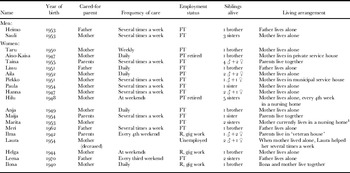
The face-to-face interviews took place at the interviewees' homes or workplaces, or at the University of Jyväskylä. Each interview lasted approximately 90 minutes. Assurances were made of the participants' anonymity and the confidentiality of their replies, and informed consent was obtained. The interviews were organised around several broad themes that included questions related to caring, working, social life and personal interests. The interviewees were also asked to tell the researcher about their siblings and the type of help they provided for their parents, as well as to describe their own views about the division of care responsibilities. The respondents performed a wide range of care activities. The amount and type of formal help also varied significantly: some parents received daily municipal or private home-help services while others had barely any. The sample characteristics are presented in Table 1.
Sample characteristics

Notes: The names are pseudonyms. Employment status abbreviations: FT: full-time; PT: part-time; R: retired. 1. When she lived at home and in a care home, Marita helped her several times a week.
Source: WoCaWo (Working Carers – Caring Workers) data, 2009.
Analysis
All the interviews were audio-recorded and transcribed with the permission of the respondents. The transcriptions (circa 15 pages of single-spaced text) were checked against the audio version of the interview for accuracy. For this article, qualitative content analysis (see e.g. Marvasti Reference Marvasti2003: 88–92) was carried out. The coding was facilitated by the ATLAS.ti software. Prior to analysing the data in greater detail, ‘sibling talk’ was identified and separated from the other text. For the purposes of the analysis, sibling talk is that related to the participation or non-participation of siblings in caring, including that about one's own care-giving in the context of sibling relations. The ‘sibling talk’ was analysed in stages.
First, the interviewees' views on the equality or inequality of the division of caring tasks and their possible desire for changes in the arrangement were examined. This categorisation was based on the interviewees' subjective expressions. Second, the talk of those interviewees who saw the sharing of caring tasks as unequal and who did not wish to alter the current division of care responsibilities was examined by pinpointing different participation types; that is, participation patterns. The aim of the next stage of the analysis was to examine, in depth and detail, the content of these participation patterns. The analysis included tracing various explanations and justifications, i.e. the rationales related to a sibling's participation or non-participation. These rationales were categorised and compared, the objective being to pinpoint the rationales particular to specific participation patterns.
Views about the equity of the division of care responsibilities among siblings
Of the 20 interviewees, almost all identified themselves as primary carers for their parent(s) and said that they were responsible for more care tasks than their siblings. Strikingly, 19 interviewees viewed the sharing of care responsibilities as unequal, but most were clear that they did not want to change the division. Before delving further into the situations of these carers, it should be noted that a small number of the carers did say that they wanted more help from their siblings, including four women (Marita, Hanna, Aila and Paula) whose strategies for coping with the inequality can be called striving for ‘actual equity’ (Ingersoll-Dayton et al. Reference Ingersoll-Dayton, Neal, Ha and Hammer2003). In contrast to these women's desire for change, 13 women and two men expressed no clear intention of attempting to force their siblings to increase their participation in the parent's care. After a more detailed reading of these interviews, three participation patterns were identified: ‘absence’, ‘backup’ and ‘togetherness’.
First, five of the interviewees (Meri, Anja, Heimo, Helga, Ilona) described the participation of their siblings as non-existent or minimal. This type of participation is called ‘absence’. The interviewees said they were almost solely responsible for the care of their parent(s). They described their siblings as ‘guests of honour’, visitors or people who made short or occasional phone calls. In Matthew's (2002: 140–3) terms, they had dissociated from responsibility for parental care. Second, in four cases (Lissu, Pirkko, Taru, Aino-Kaisa), the siblings participated but only in specific ways. This type of participation is called ‘backup’. The interviewees said that although they did receive some help from their siblings, it was often sporadic or circumscribed (Matthews Reference Matthews2002: 140–3). They described themselves as the ‘co-ordinators’ and organisers of everyday care. Most said that their siblings only helped when asked to do so. The third group (Hilu, Sauli, Ilma, Maija) reported that they had the greatest responsibility for the care of their parent(s) but stressed that the task was shared with their sibling(s). Consequently, this type of participation is called ‘togetherness’. Most of the interviewees described themselves as the ‘mental leaders’ among siblings that had close relationships with each other. Within this group, the sharing of caring tasks was described as quite clear and agreed through negotiation and joint decision making. Two other women (Taina and Laura) described different patterns of participation from different siblings. Laura's care companionship with her sister could be called ‘togetherness’, but she received only occasional, if any, support from her brothers. Taina shared much of the responsibility for caring for her parents with her younger sister, while her other siblings participated less.
Rationales related to participation and non-participation among siblings
It is appropriate to examine the participation patterns more closely. We begin with the 15 interviewees that expressed no desire to change the behaviour of their siblings; that is, to renegotiate the actual division of care responsibilities. They all offered explanations and justifications for the unequal division of care tasks and responsibilities among siblings. They presented not only legitimate excuses (Finch and Mason Reference Finch and Mason1993: 97) for their siblings' non-participation or minor contributions, but also gave various reasons for their own high level of participation and for the type and quality of their siblings' help. Referring to the study by Ingersoll-Dayton et al. (Reference Ingersoll-Dayton, Neal, Ha and Hammer2003), their expressions could be interpreted as strategies to forge ‘psychological equity’.
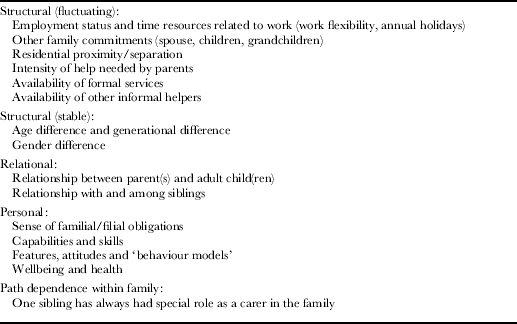
When analysing the interviewees' statements, various explanations and justifications were pinpointed. These ‘rationales’ are categorised in Table 2 and discussed in the next section in relation to the various participation patterns. The first group of rationales comprised statements that referred to ‘structural but fluctuating’ factors (which were subject to both rapid and slow changes). For example, a person's work hours could change abrubtly, a sister could become a grandparent, or there could be unexpected cuts in formal social-care services. Unlike fluctuating factors, ‘structural and stable’ rationales refer to factors based on permanent human qualities. In this study, ‘relational’ rationales are those statements in which the interviewees speak about family relationships. ‘Personal’ rationales are statements related to the individual characteristics and the attributes of family members. Finally, there were statements about the siblings' life-long roles or positions in the family. These were grouped under the title of ‘path dependence within the family’.
Rationales for lack of equality in parental care-giving among siblings
Source: WoCaWo (Working Carers – Caring Workers) data, 2009.
Participation patterns and rationales
The absence pattern
The interviewees who indicated that their brothers did not participate in parental care presented various interconnected rationales, and predictably had diverse life situations. For example, Anja and Ilona stressed the significant age difference and generational difference between themselves and a younger brother or between a parent and child. When Ilona was asked about her personal care situation and how she felt about it, she said:
Well, you know, how should I put it? It is my concern because even though I have a brother, we have a really big age difference. He had a totally different upbringing. He is 15 years younger. He doesn't think about old age because it is so far in the future for him. He never comes to visit mother, or very rarely. For example, when I told him that I was going away and asked him to come, he didn't. He is so far removed from this, but for me this is a debt of honour. I am a post-war child and I have lived through those difficult times myself. … They [the brother and his family] are living in such a different phase of life. Old age is far away. They don't understand it. Well, they come sometimes. They come on our mother's birthday, when I have prepared a meal and invite them. Then they come and bring girlfriends and boyfriends and grandchildren. But you can't get a feel for the reality of our mother's life by visiting for a couple of hours.
Ilona claimed that her younger brother and his even younger wife did not understand the life situation of their ageing mother because it was so different from their own. Ilona, on the other hand, was approaching her 70th birthday and her own advanced old age. But, in addition to the age difference, Ilona also stressed the generational difference between her and her brother. Ilona was a child during the 1940s. After the quoted extract, she spoke about the shortage of daily consumer goods and the lively, everyday, neighbourly help in post-war Finland. She suggested that her own generation has been taught to help other people and older kin, while the younger generation, which her brother represents, has more individualistic values.
Consequently, these structural and stable rationales, the age difference and generational difference, are behind the different features, attitudes and behaviour models represented by Ilona and her brother. For Ilona, caring is a debt of honour to her mother for her work. Ilona depicted her brother's behaviour in the family as selfish: she sets the table and her brother is a guest of honour. All in all, Ilona described herself as a dutiful person, and in her opinion people should, but actually do not, have ‘moral and social responsibility towards their disadvantaged fellow-people’ in the community. She had strong views about filial obligations, as reflected in her comment that, ‘I think as a general rule, children should care about their parents’.
Interestingly, a younger woman, Meri (born in 1962), had quite different views about filial obligations. She too identified helping as characteristic of her own situation and withdrawing from help as characteristic of her brother's situation, but Meri's talk was instilled with relational rationales. When asked about the personal meaning of helping, Meri responded:
Well, how should I put it? I have a brother who doesn't live here at the moment, but sometimes, when I think about helping our father – I mean he is still the father of both of us – he [brother] is not interested and he won't help, and he wonders why I am helping. Of course, there are bad memories from our childhood. But, I still think that somehow I have an obligation to do these things. Sometimes when I think about old times myself, I think I won't help anymore … but it's not that simple. When I think about my relationship with my father, it's not so much a father–daughter relationship. I am really just a carer, I take responsibility for these things.
During the interview, Meri spoke of the family situation during her childhood. Her father had been a problem-drinker; her parents divorced a long time ago, and there were many years when Meri and her father barely had any contact. Meri's brother and father still have no contact. Meri rationalised the non-participation of her brother by referring to the bad relationship between father and brother. Meri indicated that her brother is not interested in their father's wellbeing and that he does not understand her willingness to help him – after years of drinking and living an unhealthy lifestyle, he became ill, called suddenly and asked his daughter to look after him and his finances.
Meri claimed not to be bitter about her brother's non-participation, and, unlike Ilona, indicated that helping kin is a matter of individual choice. She said, ‘I don't think about that so much, I just think, well, every person makes his/her own choices’, but Meri had reflected on her own relationship with her father. In the extract above, she indicated that her own attitudes toward parental care were ambivalent because of her memories from a bad childhood. She confided that sometimes she would like ‘to dump’ her father, but that something made her continue to help him. Interestingly, Meri stated that it was not a sense of filial obligation that made her continue to care for her father; she saw helping as an individual feature of her personality. Later in her interview, Meri said that she would help any person who needed help, even though she had no relative with whom to share the caring tasks. She stated that a private home-help was her partner and the most important source of help in looking after her father.
All in all, it was striking where the participation pattern was one of absence, relational rationales were visible and noticeable. Meri, Heimo, Anja and Helga all stressed that the relationship between the siblings or between the parent and their sibling was troublesome, and that this explained why they were the main carers and had minimal help from their brothers. The other striking finding was that work-related rationales were hardly used to explain the pattern of ‘absence’. If siblings were not participating in parental care because of bad relationships, either between the parent and the adult child or among the siblings, work duties and employment status had little significance as rationales. It may be that emotional rationales obscure more practical and structural explanations.
The backup pattern
The interviewees' and their siblings' work hours and other structural and fluctuating rationales were relevant, however, in the situations categorised as ‘backup’. When the interviewer (AL) asked Lissu about her motives for continuing to care for her father, the following exchange ensued:
Lissu: Well, they are my parents. It is my obligation to take care of them. And my brother, he lives in Southern Finland, but he has a family. My husband and I don't have children …
AL: You spoke about your brother. Does he help sometimes?
Lissu: When he can. He is a taxi-driver. He drives schoolchildren in the winter time. He can come when he is not working. My nephew comes too sometimes, but he is also busy and has his own life.
AL: Do you think they could help you more?
Lissu: Well, I think, if I asked, I would get more help. But I won't, not necessarily, no. I know they are all working, and it's difficult to organise your time, but they have always come when we have needed help, like when we have taken trips. We were visiting my husband's brother in Australia for three weeks. My nephew came for two days, and my brother came for two days too. There is not so much to do; somebody just has to take care of the practical things.
There are multiple rationales in Lissu's expressions. In the first response, Lissu stressed her own filial obligation. Following Lissu's suggestion after her mother fell ill with Alzheimer's disease, her parents moved from Northern Finland to very close to Lissu's apartment. By the time of the interview, her mother had died and her father needed more and more help with daily tasks. Lissu presented very practical and mostly structural explanations for her brother's limited participation in their father's care. First she emphasised the distance between her brother and her and the father's home city, or the residential separation. She also cited her brother's commitment to his own nuclear family. Unlike her brother, Lissu had no children of her own and so had more time for the older generation. After she was asked to elaborate on her brother's contributions, she emphasised his working hours and work commitments. Nonetheless, her brother's help appeared to be significant to Lissu. He took a more active role when Lissu had her annual vacation and was away from home. She also indicated that their father does not yet require extensive help. Thus, this interviewee appears to be happy with receiving occasional help from her brother and other relatives.
Work hours and employment status were also evident in the ‘sibling talk’ of Pirkko, Aino-Kaisa and Taru. Like Lissu, they said that their siblings came to help when they, each one the primary carer, went on holiday. Pirkko explained that her mother spent her summers at Pirkko's sister's home: ‘She [mother] clearly cheers up there because there is somebody with her 24 hours a day. I can't do that because I work. But my sister is retired, she has time’. In this statement, their mother's wellbeing was also mentioned – staying with Pirkko's sister provided a refreshing summer holiday for their mother. Interestingly, Taru also highlighted her mother's wellbeing when she talked about her brother's participation. However, in this situation her brother's presence was described as detrimental to their mother: ‘Mother said that now that he [brother] is retired she will start to ask him to help her. But it won't work because his personality is so different from ours. For example, when they went shopping, my brother would hurry my mother and not let her choose things for herself’. Although Taru expressed some willingness to ask her brother to support their mother more, she stated that his impatient behaviour would not be ‘nice’ for their mother.
Altogether, structural and fluctuating rationales were prevalent in all of these ‘backup’ cases. All of the interviewees cited residential separation as a factor in the sharing of caring tasks. The siblings who live nearest to the parent(s) in need of care managed their everyday affairs. Each interviewee, however, mentioned many different and interconnected rationales. Interestingly, in some cases a sibling's backup role and the more significant input of the interviewee can be understood in the context of path dependence within the family. This was the case when the interviewees described life-long histories as carers or mentors in the family. For example, Aino-Kaisa recounted that when she was young she had looked after her family for long periods when her mother was in a tuberculosis sanatorium. She remained extremely close to her parents even after she was married. Aino-Kaisa reflected on her personality:
Sometimes I think maybe I just can't relax and do nothing. For example, even if my brother says that he'll look after things and I don't have to worry, I still call my mother every night and make sure that my brother has been there. And I have to admit that it's exhausting for me too; it's draining because I just can't relax.
Earlier in her interview, Aino-Kaisa stated that she managed her mother's everyday care and social-care and health-care needs, including ensuring that she took her medicine every day. She also said that she and her brother consulted each other about their mother's wellbeing, and that her brother and his wife helped look after their mother: they did her shopping every Saturday and cared for her in emergency situations when Aino-Kaisa was unavailable or at work. However, Aino-Kaisa also talked about feeling tired and indicated that organising all aspects of mother's daily care was more demanding than her brother's contribution. Aino-Kaisa also revealed that she monitored her mother's care even when her brother had promised to look after the mother and Kaisa was abroad. In this case, both the son's backup role and the daughter's more extensive care responsibilities were rooted in their individual biographies, the family history, and Aino-Kaisa's personality. Giving up her role as their mother's main carer and ‘care co-ordinator’ was difficult for her.
To summarise, compared to the absence participation pattern, those who described a backup pattern offered practical rationales for their participation in the care of their parent(s). The relationships between siblings were described as good or at least polite but not necessarily very close, but the sibling relationships were not very visible in the interviewees' rationales for the division of care responsibilities.
The togetherness pattern
By contrast, in the togetherness participation pattern, the primary carers emphasised close ties among the siblings. All the siblings were said to have close relationships with each other and strong commitments to parental care-giving. Interestingly, in some cases the close relationships among siblings and mutual understanding about the sharing of care responsibilities was described as being rooted in complicated relationships with the parents. For example, Maija stated that her mother, who received a carer's allowance because she cared for her spouse, was extremely reluctant to accept external and formal home help. At the time of the interview, Maija took care of her parents' everyday needs, although she believed that her father really should be cared for in an institution. She visited her parents several times a week and did many things from washing their clothes to chopping firewood. When Maija was asked to speak about her sister's participation, she replied:
Yes, she does participate. She does cleaning: she cleans the kitchen cupboards and bathroom etc. … I do the cooking and everyday mopping etc. … this works very well between us … and it has brought us, my sister and me, closer together. We call it rallying together [rallying round]. Somehow this has brought us closer. We agree about everything. We don't argue about anything. … It is like a dance between us, this arrangement.
I then asked Maija, a little rhetorically, ‘you've succeeded in sharing the caring tasks? Her response was, ‘Yes, although it is not really equal. But I don't really think that's important.’ Maija's talk was lively and she compared the sharing of tasks to a ‘rallying round’ of caring, adding that she and her sister work together as if ‘dancing’ together. Helping their parents had brought the sisters closer together. Doing things together seemed to be more important than doing things equally. These types of thoughts and ‘we’ talk were also prevalent in the remarks of Sauli, Ilma and Hilu. It therefore appears that a warm relationship obscures an unequal division of parental care. Some of this group of interviewees, however, also rationalised their own role as mental leaders among their siblings by referring to their personal capabilities and skills. For example, Sauli described himself as brave and his sisters as timid when he talked about the actual physical personal care of his mother: ‘May be it's weakness, or lack of know-how … (but) I think it's healthy to get involved in such situations’.
Interestingly, as opposed to those backup situations in which primary carers were also the main co-ordinators of the formal help, these interviewees emphasised that they also negotiated with their siblings about their parents' formal social- and health-care services. Ilma stated: ‘We have a “ring around” on the phone before we make any decisions. All of us are informed, and we are all part of the negotiations’. The interviewees that described togetherness rationalised the less significant contributions of their sibling(s) using various structural and fluctuating rationales, e.g. residential separation and commitments to their own spouse or grandchildren. Maija pointed out that her sister had four grandchildren to look after: ‘Her own children need help and time too’. Hilu, who had five sisters, said cheerfully: ‘You have to understand if a husband doesn't understand and is angry about his wife's absence on the weekends. Then the rest of us just take more responsibility, but we always make sure that we all know what mother's condition is.’
Again, work hours and employment status were prominent rationales for and explanations of this participation pattern, but in contrast to the backup cases, the interviewees who described togetherness emphasised their own work situation as a rationale for greater input as opposed to using their work responsibilities and those of their sibling(s) as a rationale for less input. Sauli and Maija were self-employed and thus able to organise their working day according to their parents' needs. Ilma had recently retired and was thus able to work remotely from the rural municipality where her parents lived. Hilu, too, had recently decreased her working hours. She gave an extended account of her sisters' and her own working hours in her rationale:
Then there are farmers, who are always very busy in the fall. There are two of us who can help more. My sister lives in Southern Finland and I live here, much closer [to the parents] than she. And she has a really demanding job. She works evenings and weekends. We are all different and we all have different life situations. It's not a question of being willing to help or not willing to help. … You have to take into account that despite their willingness to help, people have different life and work situations. For me, this was a really good time to retire part-time. And I didn't have any other reason to retire than this situation.
For Hilu, the decision to retire part-time was hers alone. As a part-time retiree she had time to care for their mother, in contrast to her sisters, who had ‘demanding’ work hours or ‘busy’ jobs. As regards the sibling talk of Finnish carers, the findings in this study have much in common with American and British research findings. In addition to the summary of the most striking rationales pinpointed, the discussion below highlights these similarities and stresses the interconnectedness of the concepts emerging from the data especially in relation to the concepts of ‘lifecourse’, ‘linked lives’ and ‘gender’.
Discussion and conclusions
When analysing the rationales – related to the unequal division of parental care responsibilities – of the Finnish interviewees, work-related rationales and rationales surrounding commitments to their nuclear family and grandchildren were the most common, as appears to be the case in other Western countries (e.g. Finch and Mason Reference Finch and Mason1993; Matthews Reference Matthews2002). Like many of their British and American counterparts, the interviewees in this study indicated that their siblings should indeed be committed to their work and earning a living for their own nuclear family. They all expressed the belief that caring for one's own children and even grandchildren should be everybody's first priority, and after that comes parental care. These structural and fluctuating rationales were common in the accounts of the backup pattern of siblings' participation.
The finding that people in different welfare regimes share these practical rationales indicates that parental care-giving has similar features worldwide, and also indicates that the human lifecourse has standard features. Individual time is constrained by shared assumptions and expectations about the duties of adults. The concept of human lifecourse is defined as ‘a sequence of socially defined events and roles that the individual enacts over time’ (Giele and Elder Reference Giele and Elder1998: 22). Although the notion of the lifecourse (and its conceptual use) has become more flexible in relation to life transitions, it still appears to be assumed that the primary task of Western adults is to participate in paid work and take care of the nuclear family. Nevertheless, it is interesting that by transferring responsibility to family members, current social policy strengthens the growing tendency for parental care-giving to be a standard component of the adult lifecourse. Yet care-giving responsibilities affect adult children in various ways and, as illustrated in the interviewees' quotations, are moulded by path dependence within the family. Individual families have idiosyncratic histories of emotional ties among the members and of their giving and receiving of care (seeFinch Reference Finch1989: 201–29).
Overall, the rationales in the backup participation pattern were quite practical in contrast to those of the absence and togetherness patterns, in which intergenerational relationships and relationships between siblings were discussed extensively. In this study, these issues were conceptualised as relational rationales. They stress the relational nature of human lifecourse (Settersten Reference Settersten2003): the lives of the family carers were linked with the lives of other actors involved in a care relationship. The interviewees stressed that either the relationship between adult children and parent(s) or the relationships among the siblings influenced the division of care duties.
Some respondents even expressed a degree of hate or anger towards their parents that they associated with negative childhood memories. Some said these were the cause of difficult relationships between the interviewees' parent(s) and their other siblings, and these were cited when explaining a sibling's absence in parental care-giving. In contrast, a close relationship with the sibling(s) and sharing the care were recognised as valuable for managing the intergenerational ambivalence that the children faced when they helped their parents (cf. Luescher and Pillemer Reference Luescher and Pillemer1998). More explicitly, despite experiencing feelings of alienation towards their parent(s), many of the interviewees continued to offer help because they felt a moral obligation, and this sense of familial obligation was also used to rationalise the level of participation in parental care-giving among siblings. In this study, such an explication was categorised as a personal rationale.
Although the Finnish interviewees' rationales relating to the pattern of sibling sharing in care tasks were very similar to those of British and American research participants, there were some interesting differences. Specifically, previous research has highlighted the tendency for the division of caring tasks to be gendered. Not only do daughters use predominantly more time for parental care than sons do, they also tend to be the main co-ordinators of care (Connidis and Kemp Reference Connidis and Kemp2008; Hequembourg and Brallier Reference Hequembourg and Brallier2005). Gender differences could explicitly be used as a reason for men's minor contributions when people assess their siblings' behaviour (Matthews Reference Matthews2002: 91–5).
This study does not challenge the established finding that brothers most often have a backup role or are absent in parental care-giving. For example, in all of the eight respondent families with one daughter and one son, the daughters described themselves as the main carers and their brothers were either absent or provided periodical or occasional help. However, only a few of the Finnish informants used gender differences as a rationale for sharing caring responsibilities: only when they were asked to compare the participation of sisters and brothers. The female interviewees made excuses for their brothers' non-participation, but they were seldom explicitly related to gender differences. Instead of this stable and structural rationale they employed fluctuating and structural rationales. Non-gender-related rationales (commitments to work and one's own nuclear family, residential proximity/separation, relationships between family members) were presented as more important in forming the pattern of sibling participation. The muteness about gender differences may well reflect respect for the Nordic model of the equality of both sexes. The emphasis on non-gender-related rationales could be interpreted as legitimating the interviewees' silence about gendered caring responsibilities.
To conclude, at a time of the ‘informalisation of care’ and the spread of the ‘adult worker’ norm, it is important that social-care and health-care services take the primary carer's siblings into account, although not only as ‘resources’. There are many reasons why a primary carer may not receive help from his/her sibling(s). The availability of this help must not be taken for granted, even when the relationship between siblings is close and unproblematic. On the other hand, care-givers who do not receive help from their siblings are sometimes able to supplement sibling support with help from other family members. Demographically, the number of adult children who have no siblings will increase. More specifically, the total fertility rate has decreased in Finland. At the moment, women give birth to approximately 1.7 children throughout their reproductive years. After the Second World War, this figure was 3.4, and in late 1960s it was 2.1 (Statistics Finland 2009). How in the future only children will manage the everyday care of their parents is a crucial question. Special attention should be paid to those carers who are lone carers in the sense that their networks are limited.
Acknowledgements
The WoCaWo research project is funded by a grant (124450) of the Academy of Finland. The writing of this paper was supported also by the author's postdoctoral research project grant (131870) from the Academy of Finland. I am grateful to the international and national members of the WoCaWo research team and anonymous reviewers for support and comments on earlier versions of this paper. My warmest thanks for encouragement and advice to the co-ordinator of the WoCaWo project, Dr Teppo Kröger. Special thanks to Professor Sue Yeandle for her helpful comments and support during the Autumn of 2009.